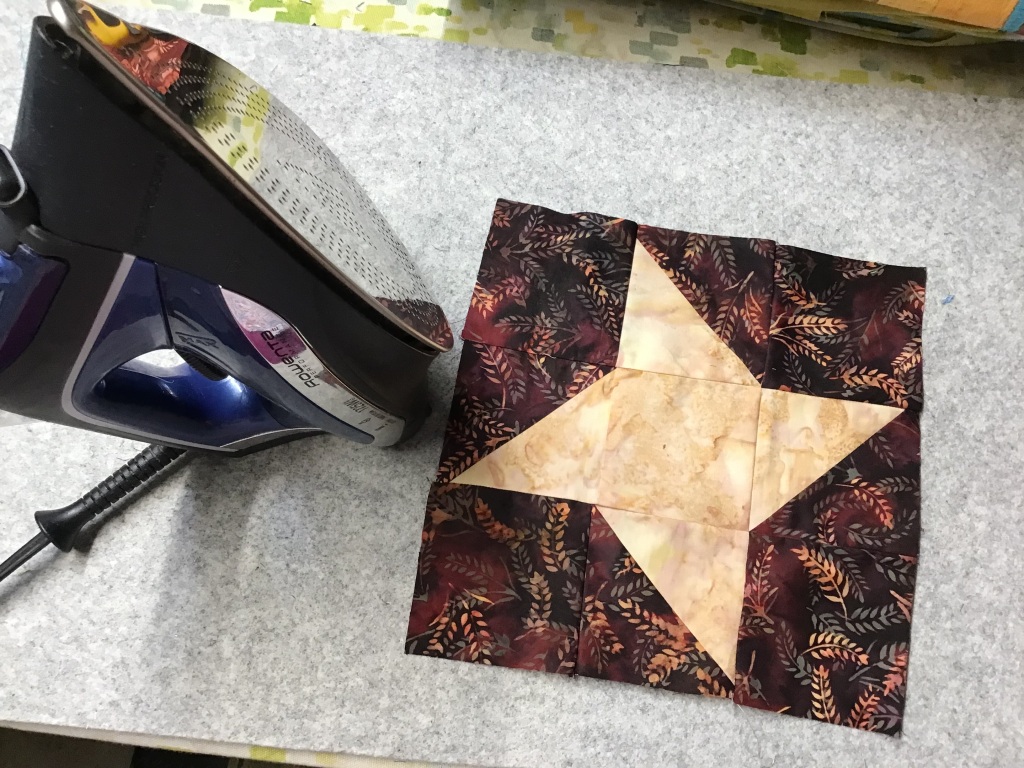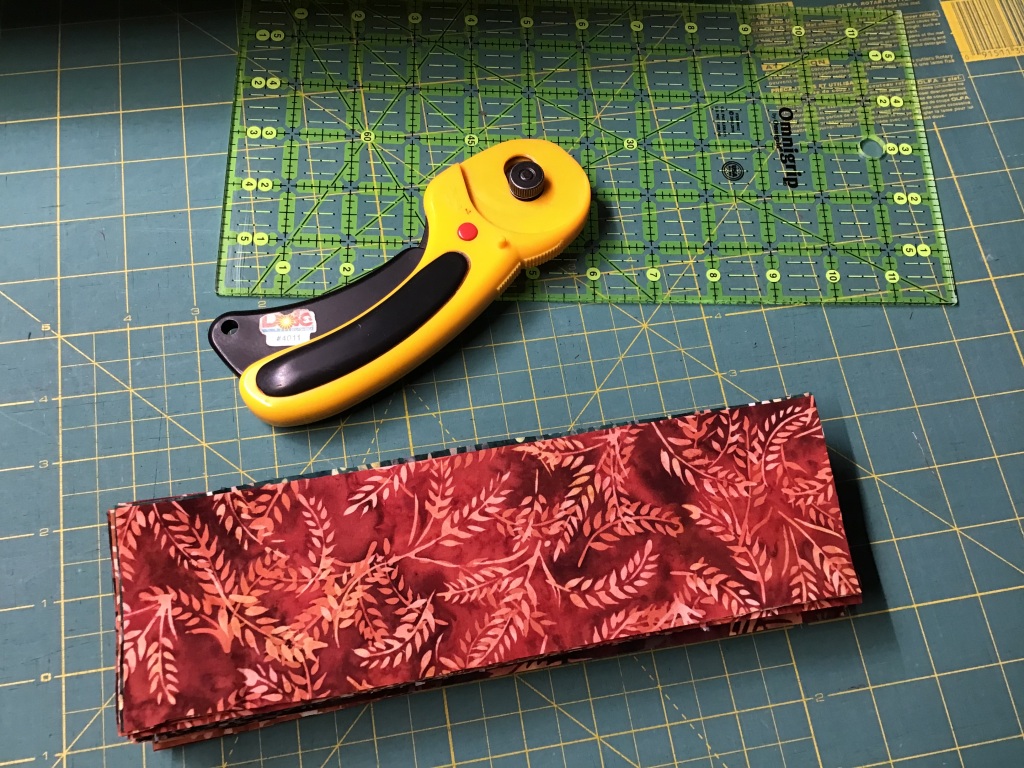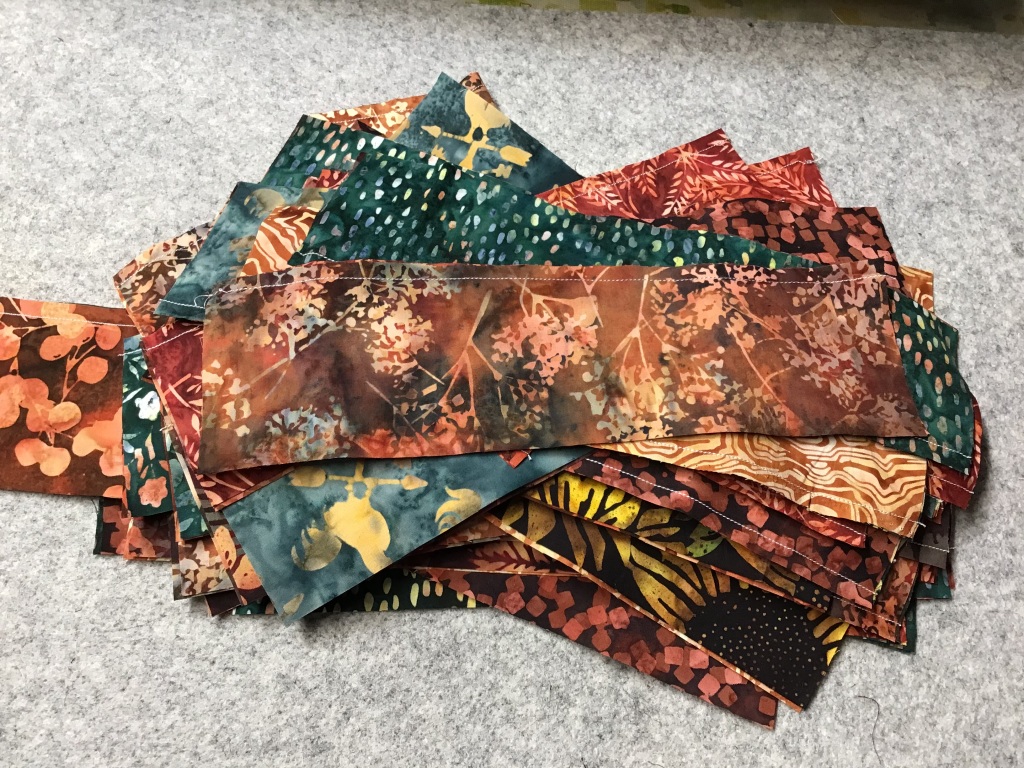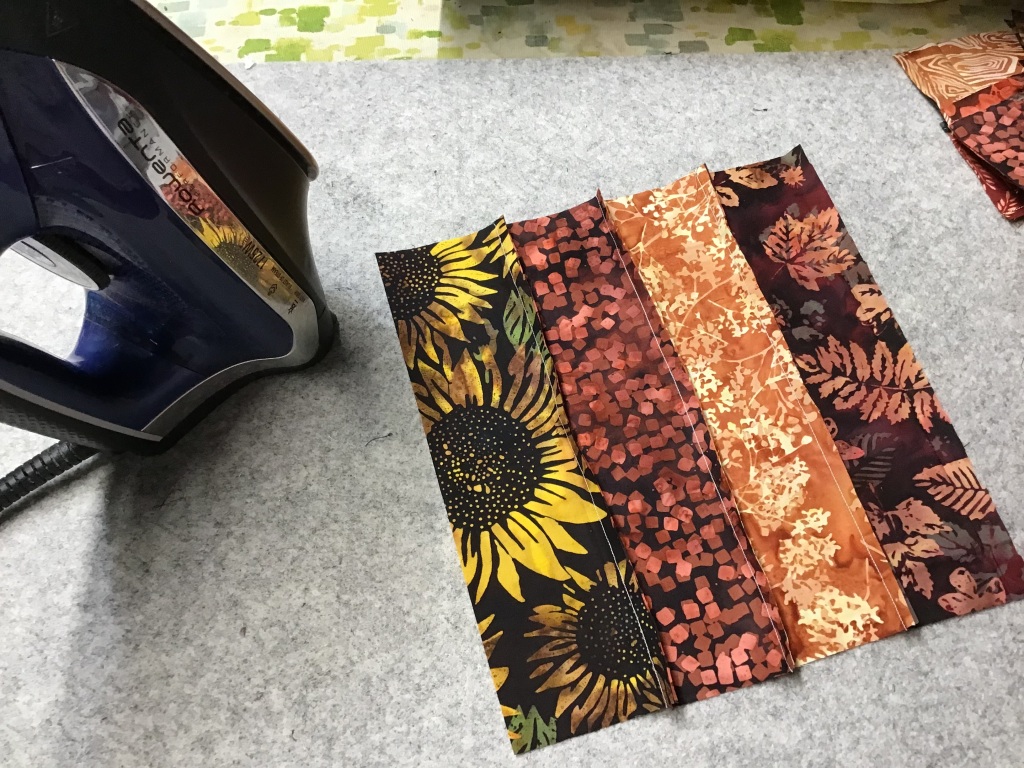
Quilting Partners · Rose Cards · Tutorials · villa rosa designs

NEW Villa Rosa Designs Rose Card Patterns for September, New Website Content, and VRD Ebb Tide Quilt Tutorial

Happy Thursday to you!

Welcome to September! Now that fall and back-to-school is in full swing, we all need to turn our thoughts to MORE QUILTING! In order to help you get sewing again, today’s post is brimming over with quilty goodness.

First up is our brand new collection of September Rose Card patterns.

YAY! By now most of you know that I just love the Thursday after the first Friday of the month because that’s New Pattern Day here on the blog. So, here they are — Candies, Icing, Elsie May, Delphinium, and Jolie.

Every month the VRD designers never fail to create a new collection of wonderful quilt patterns. I am sew blessed to be part of this VRD family. Just looking at the new patterns every month, I get inspired and can’t wait to spend some quality time with my sewing machine.

You can get all 5 patterns HERE.

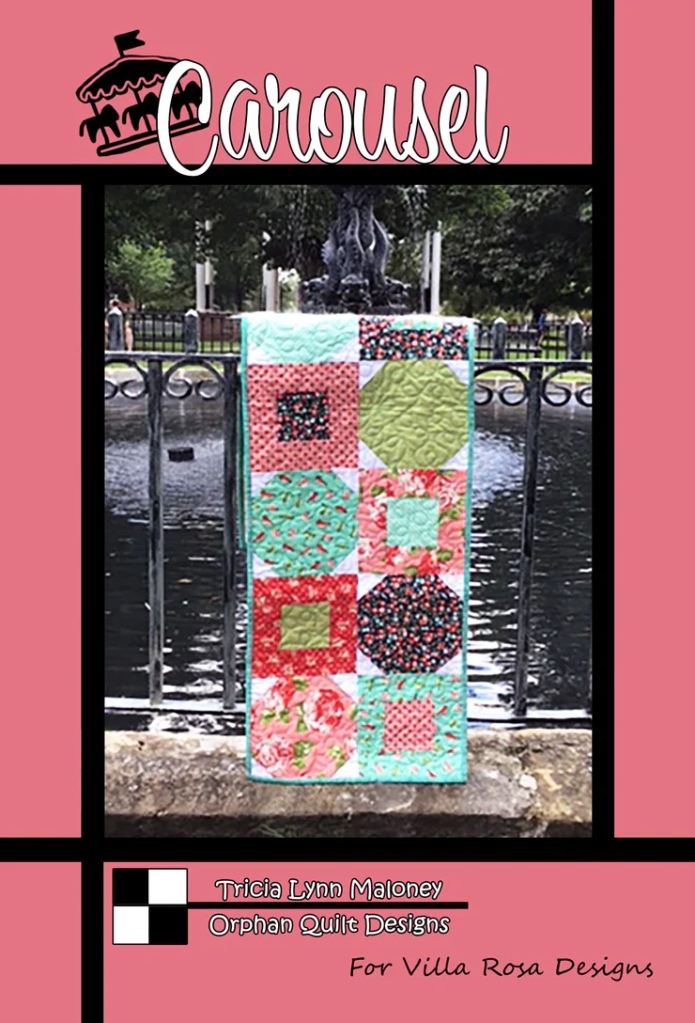
But wait……..there’s more! Here is my new September table runner, Carousel.

Get Carousel HERE

I’m not sure if you can really see the background fountain in the cover photo, above, but I took this photo at Diamond Park, a lovely tree-lined park in the heart of my hometown. The land for the Park was gifted to the city in 1795 (Meadville was founded in 1788) by the city founder, David Mead. This gorgeous fountain was then gifted and constructed in the park in 1863 by the Shippen family. It still stands and functions today, after being renovated a couple times through the years.

Image from Meadville Calendar,
https://www.facebook.com/MeadvilleClub

Here’s a photo of the fountain with the park in the background. I didn’t even think to take any photos of the fountain itself when I was taking photos of Carousel. Silly me! Sorry for that. It truly is a beautiful fountain — and well over 150 years old.

As much as I’d like to keep talking history (another of my favorite things), we’d better keep moving or we’re never going to get to today’s tutorial. LOL!

Just this week, a new feature was added to the VRD website — a printable list of all the FAT QUARTER patterns in our VRD Rose Card catalog!

People and fabric companies have been asking for such a list for a while now. The fat quarter patterns on the list are thoughtfully organized by the number of fat quarters needed for each pattern — how ingenius! This awesome list will be updated monthly to include all new fat quarter patterns going forward, so the list will always be current and up-to-date. WOW!

You can find the printable list at the bottom of the website under Patterns (see the screenshot below). In fact, there is LOTS of stuff at the bottom of the website. If you’ve never scrolled down that far, you should. You might just be missing something good down there, like a directory of the tutorials on the blog, for example. Or maybe something important like Corrections.

Here’s a screenshot of the bottom of the VRD website, showing the things
you will find down there.

You can find the printable Fat Quarter Quilt List HERE.

Now on to our tutorial!

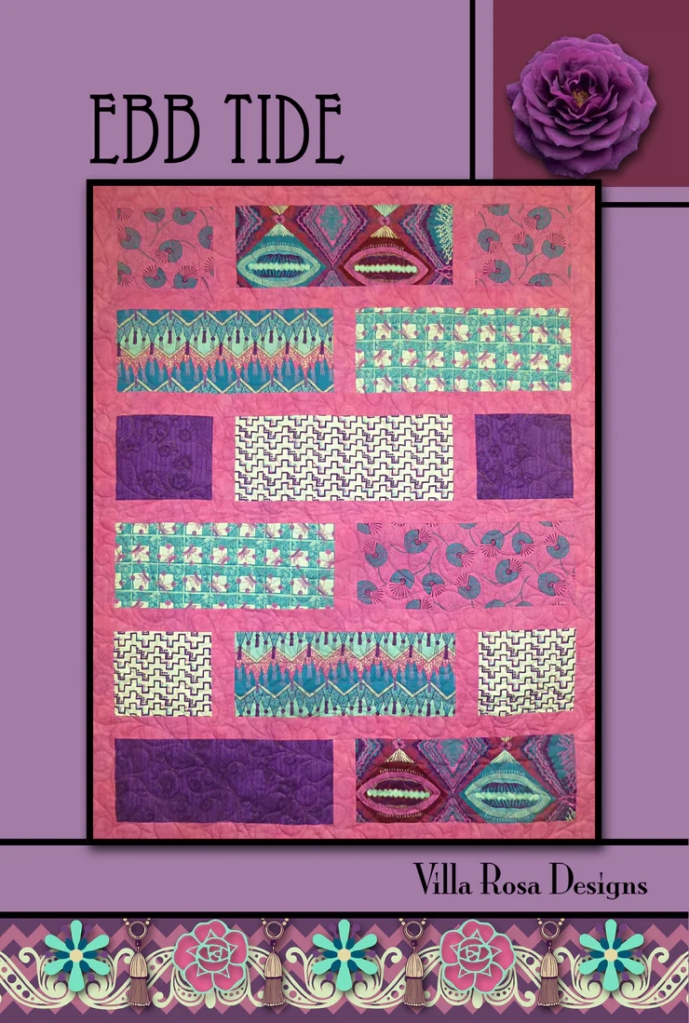
Keeping with our recent Fall fabric theme, I have another great VRD quilt tutorial for you today. You will want to add Ebb Tide to your collection of VRD Rose Cards if you don’t have it yet. So far, it’s the fastest and easiest VRD pattern I have made. It also looks great in any fabric, and can even handle large prints with ease. Ebb Tide will definitely become one of your go-to Rose Card patterns, if it hasn’t already.
Get Ebb Tide HERE

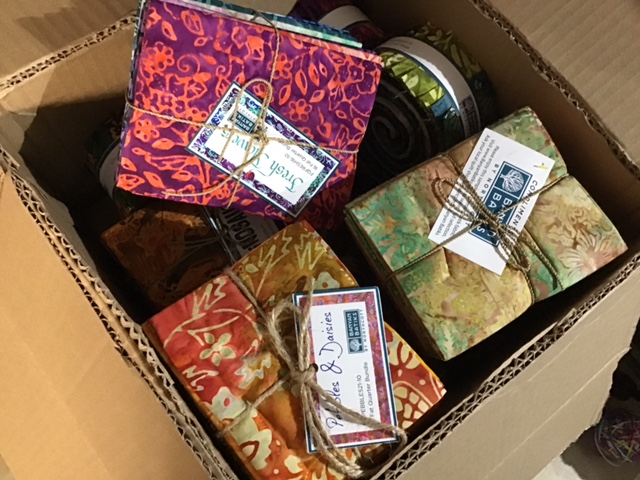
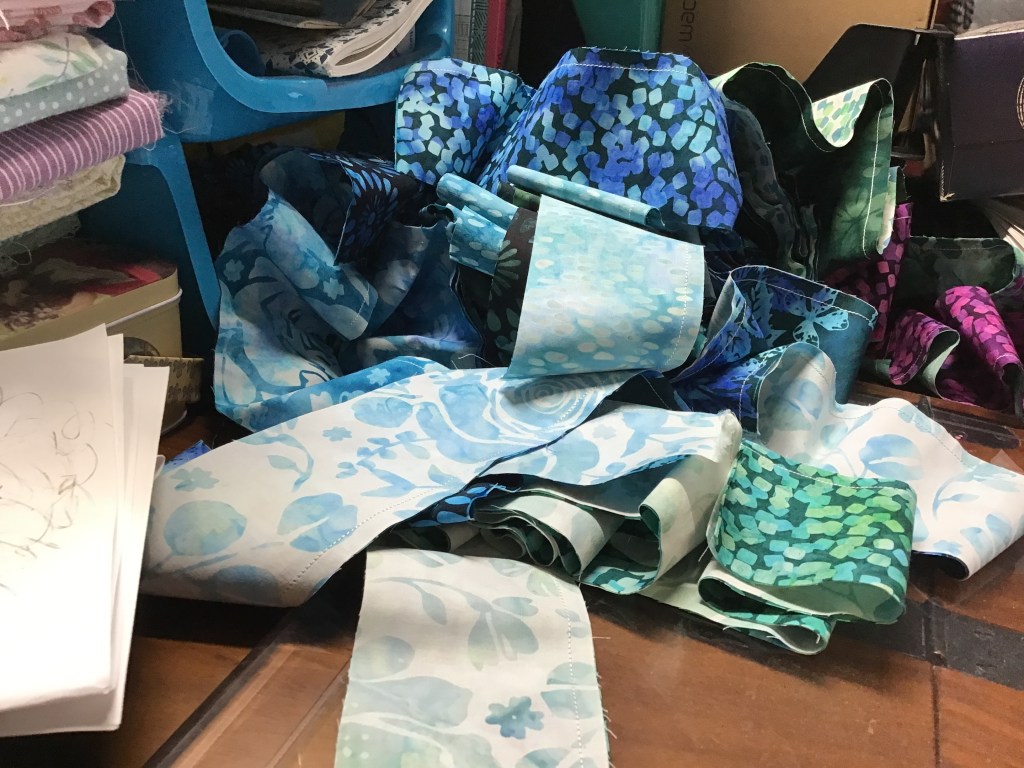
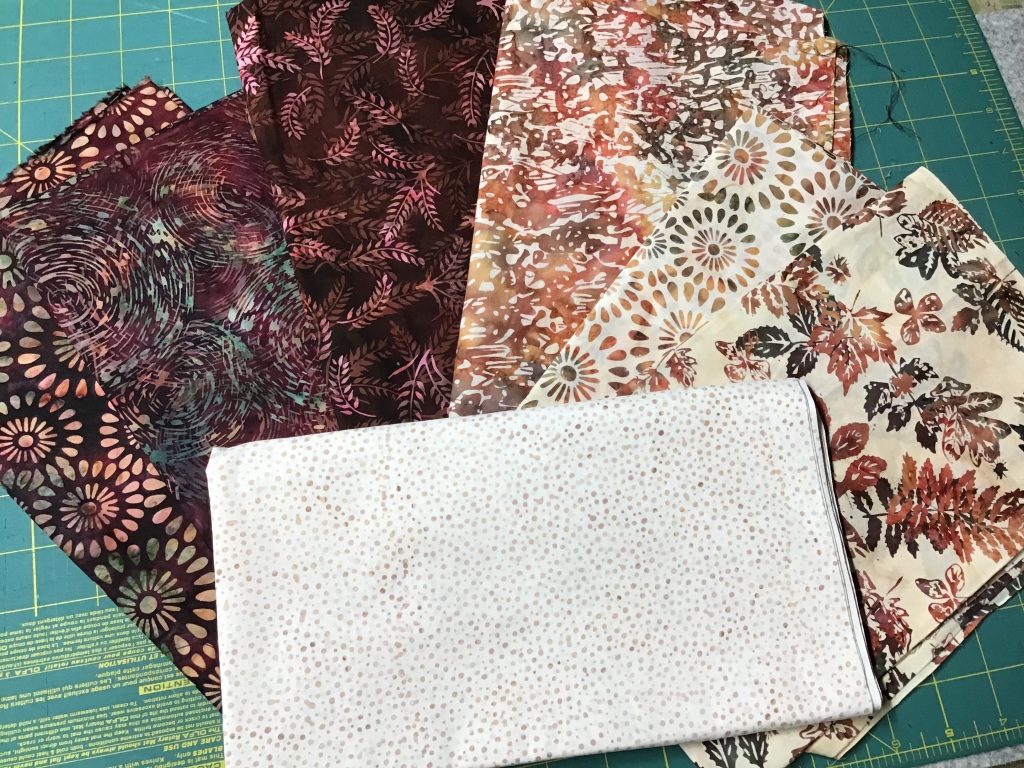
Today I’m working with Hoffman batiks again — more yummy luscious fall fabrics. Aren’t they beautiful??? This collection is appropriately called Shades of Autumn. Ask for it at your favorite quilt shop or retailer.

I want to point out a couple things about the fabrics I am using for Ebb Tide. It takes 6 fabrics plus a background. I chose 3 light fabrics and 3 dark fabrics. I liked the idea of a color-balanced quilt. Some other options might be to choose 6 medium or dark fabrics with a light background or 6 light fabrics with a medium or dark background. The fun thing about this quilt is that it really does go together lightening-fast and you’ll probably want to make more than, which will then give you more opportunities to play with different fabric options.

Let’s make Ebb Tide!

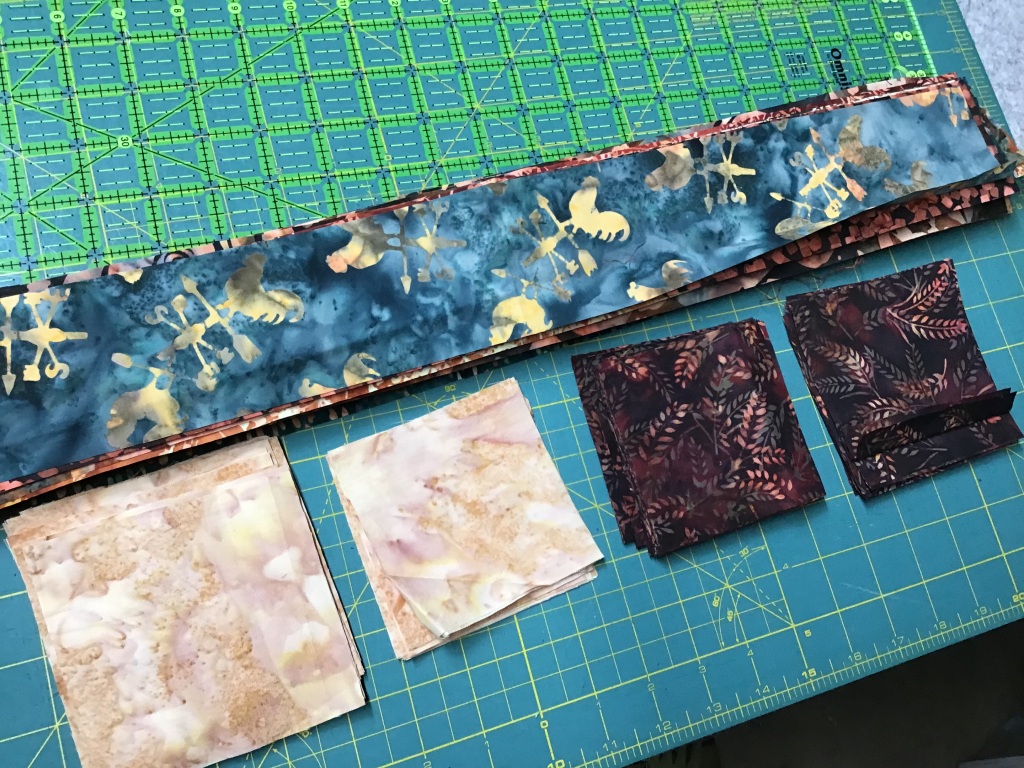
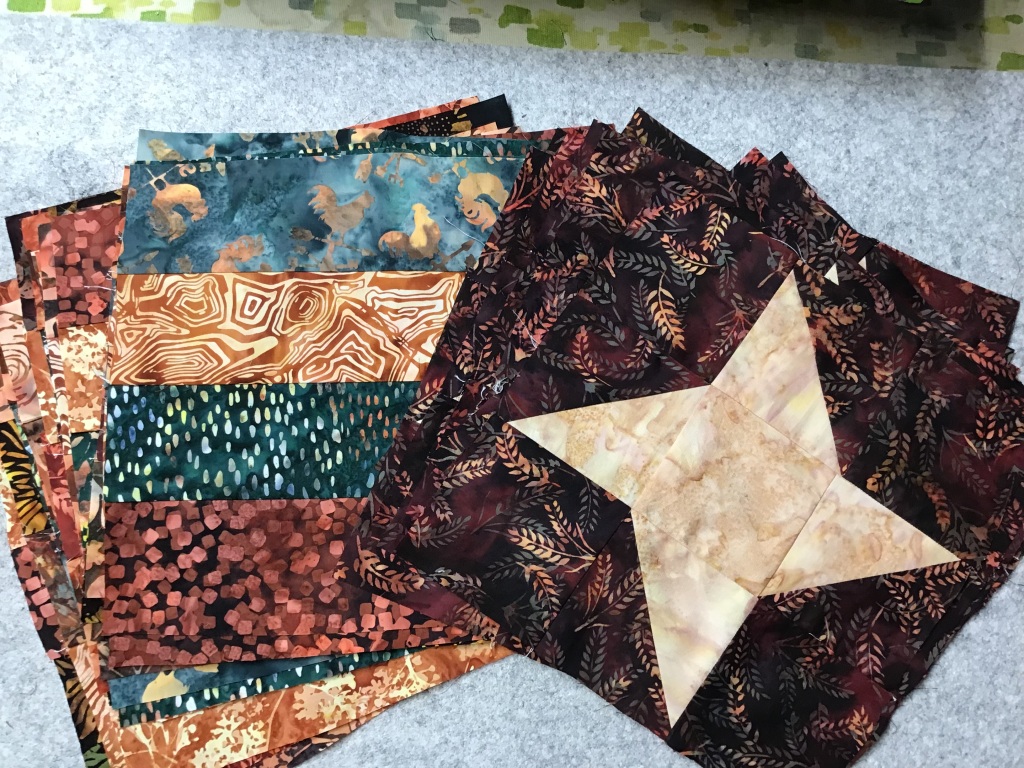
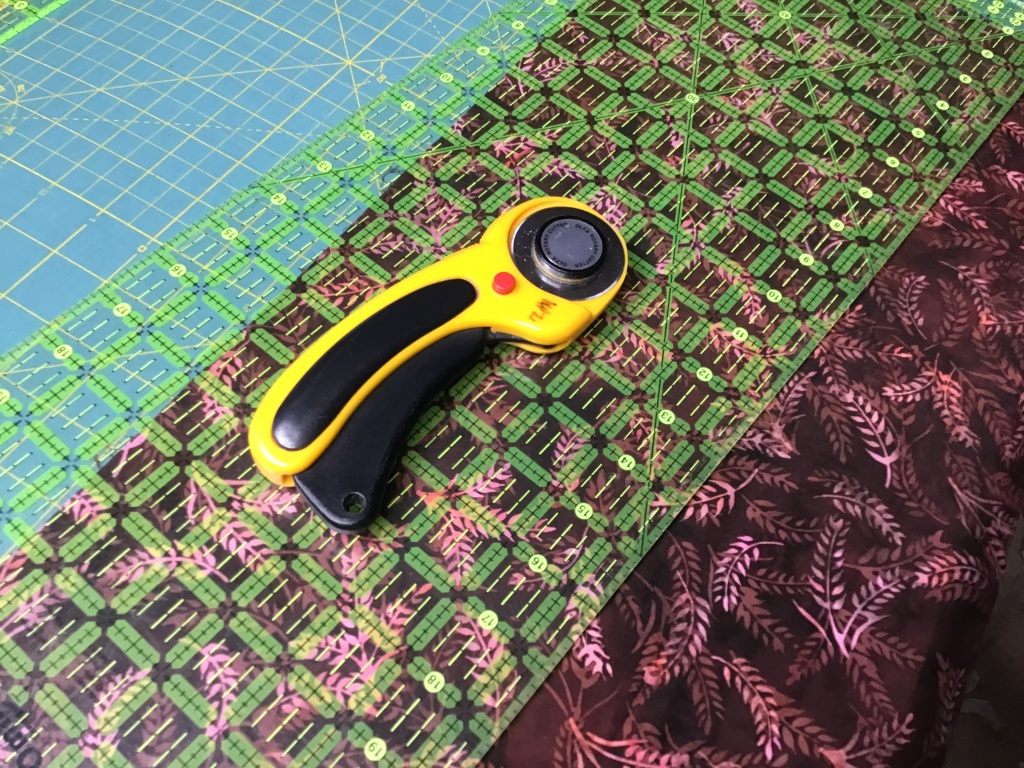
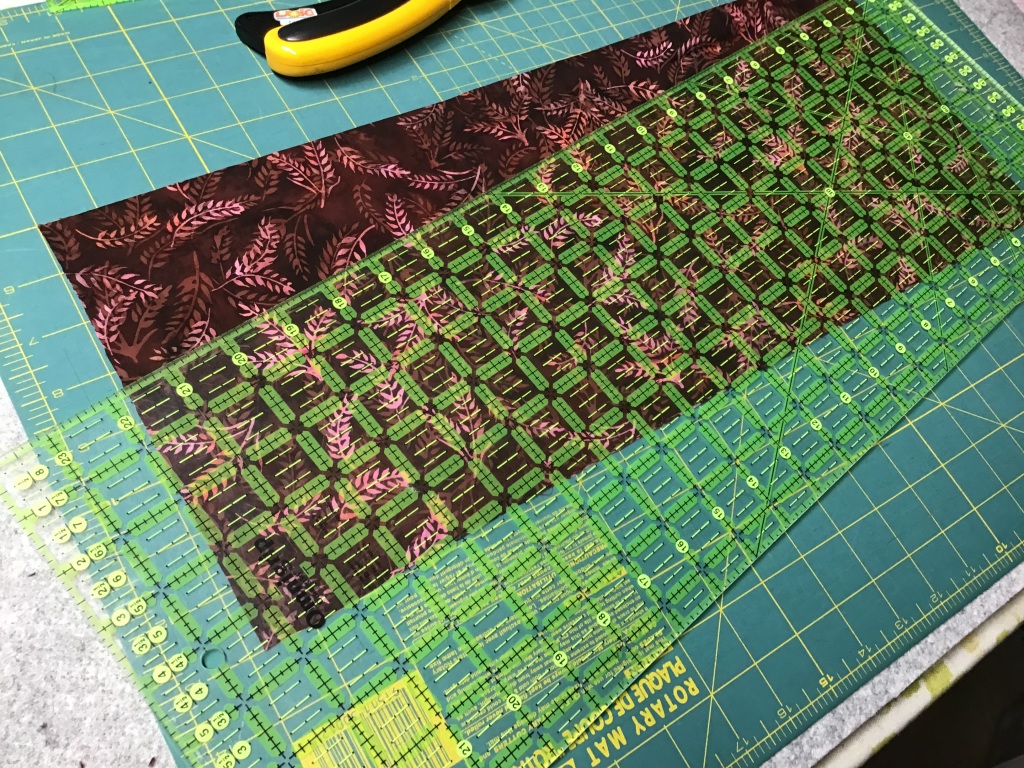
1. After you’ve gathered up your fabrics, it’s time to cut your pieces out. This doesn’t take very long, but keep in mind the pieces you cut out of the fat quarters will be large and you might need a bigger ruler. I used my 8 1/2″ x 24″ ruler to cut the rectangles out. This really helped to keep my cutting more accurate as I didn’t need to joggle multiple rulers around to get the wider strips. I also layered and cut three fabrics at a time, but don’t feel you have to layer your fabrics for cutting if you’re not comfortable doing that. Cutting one layer at time works just as well.

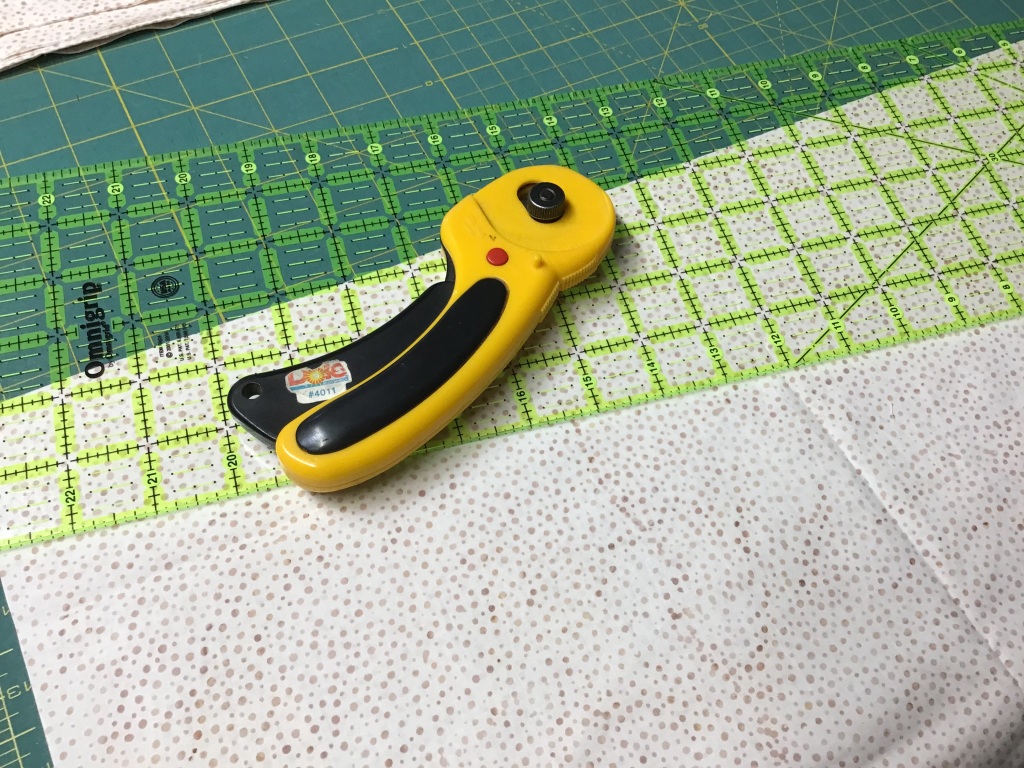
Don’t have an 8 1/2″ x 24″ ruler? You can find it HERE. You can find the my absolute favorite rotary cutter, the Olfa ergonomic cutter, HERE.

2. Now that my fat quarters are cut out, it’s time to cut the background pieces. For this part, I switched to a 2 1/2″ x 18″ ruler, which makes cutting my 2 1/2″ strips and rectangles a breeze. Don’t have a 2 1/2″ ruler? You can find it HERE.

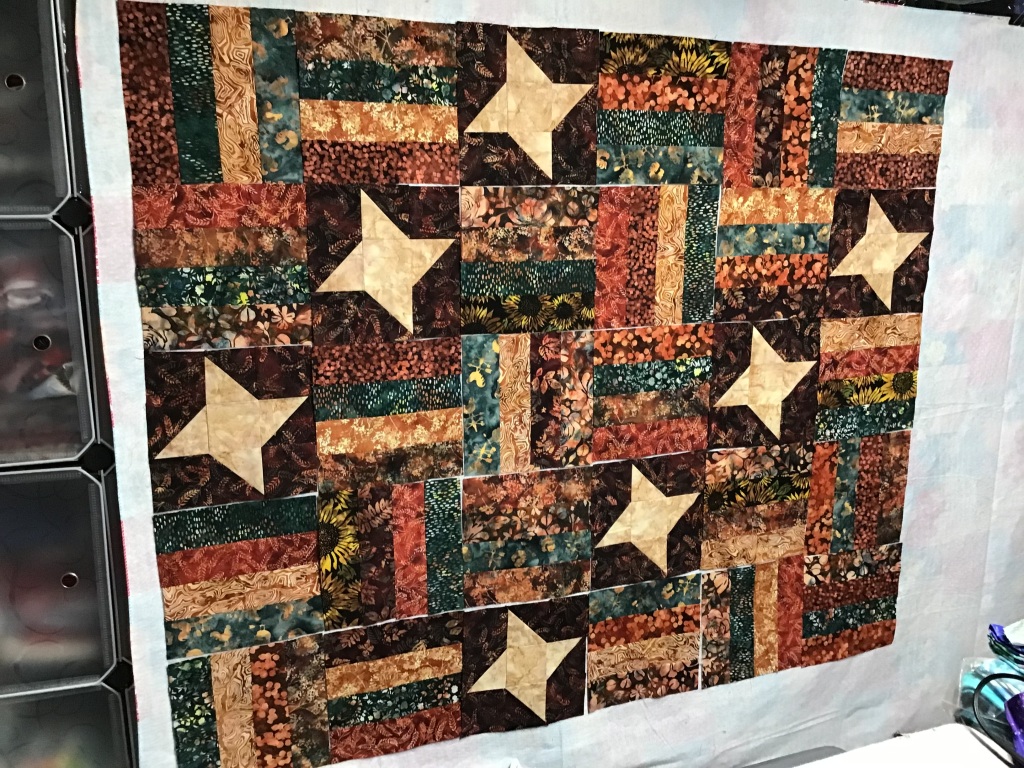
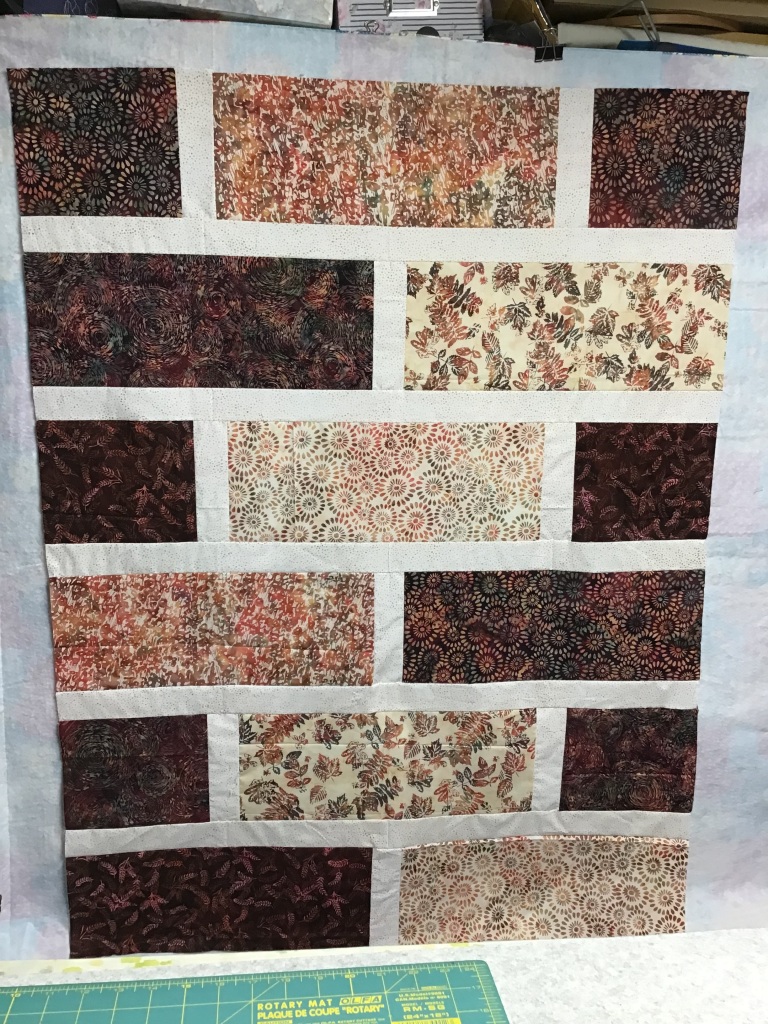
3. I’m going to use my new handy-dandy design wall to lay the quilt out so I can arrange the fabrics before I sew everything together. The beauty of Ebb Tide is that because you aren’t piecing the quilt blocks, you can get right to laying out and arranging the entire quilt. Sew simple!

PSST! In case you didn’t know — my fancy-smancy design wall is actually a flannel-backed large rectangular table cloth clipped to the top of my fabric storage cubes doors with large binder clips. Here’s a great traditional plaid flannel backed table cloth that comes in multiple colors and sizes. What a HUGE improvement this has been for putting quilts together — so much easier than laying blocks out on the floor or on a bed to shuffle things around.

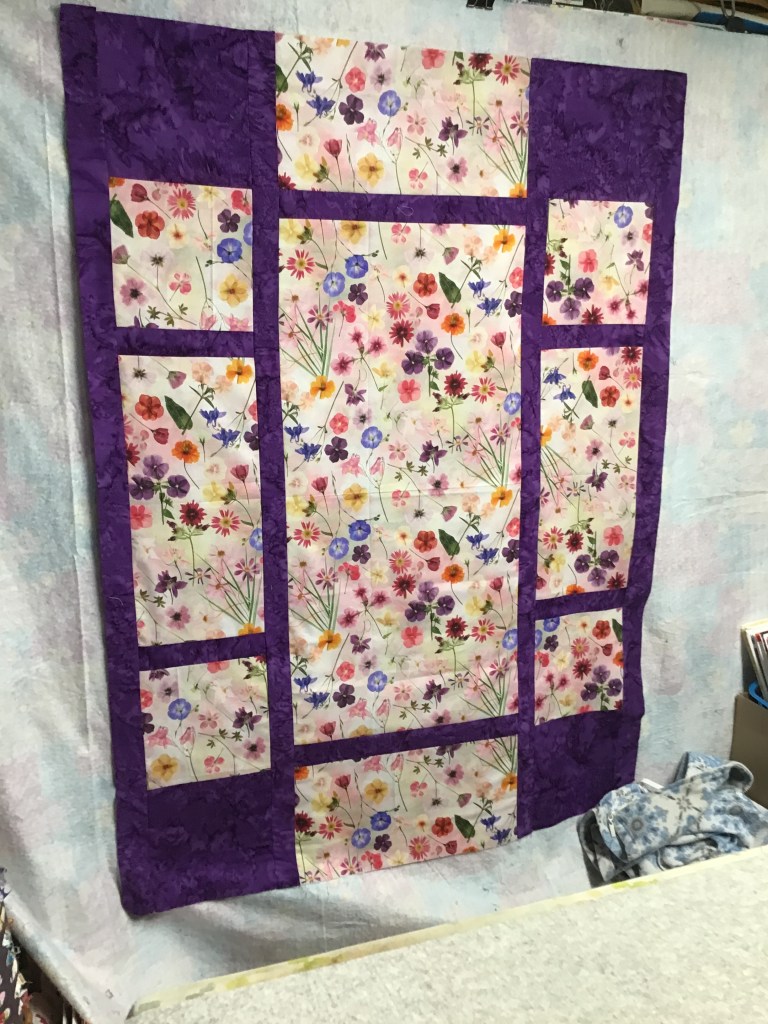
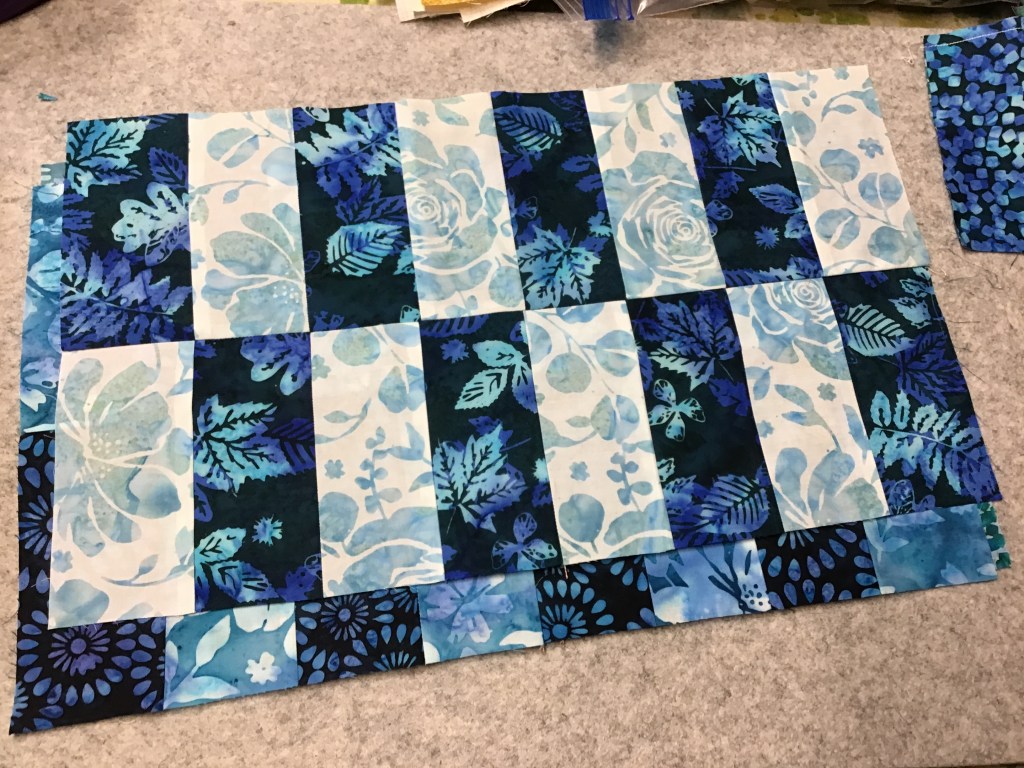
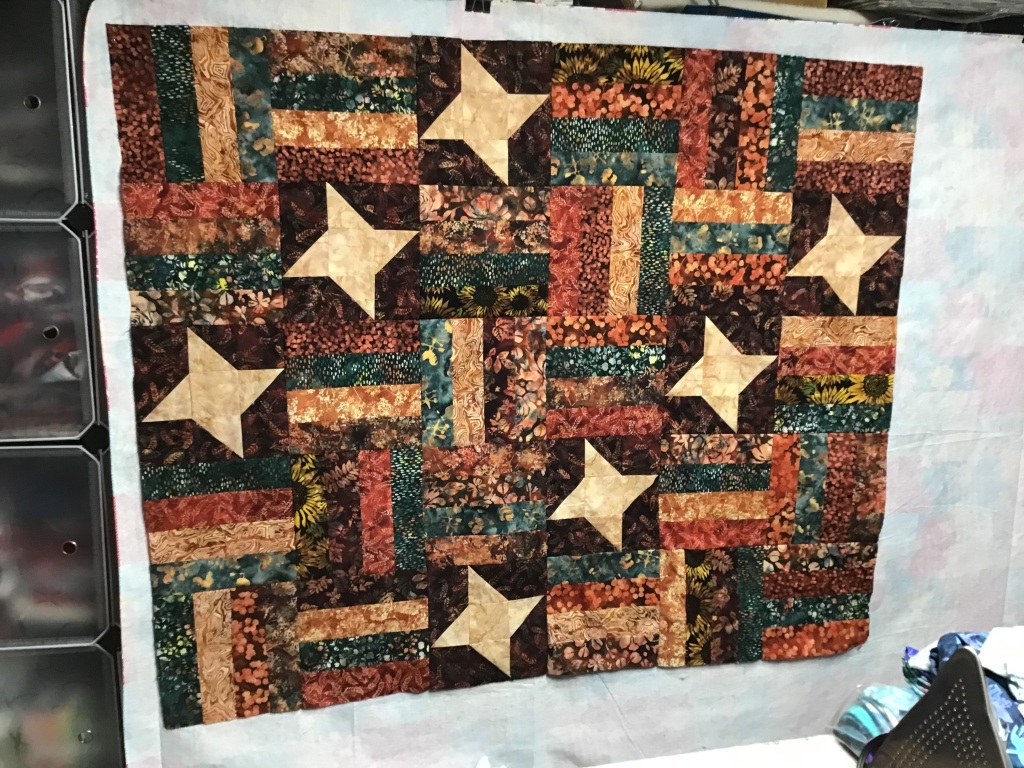
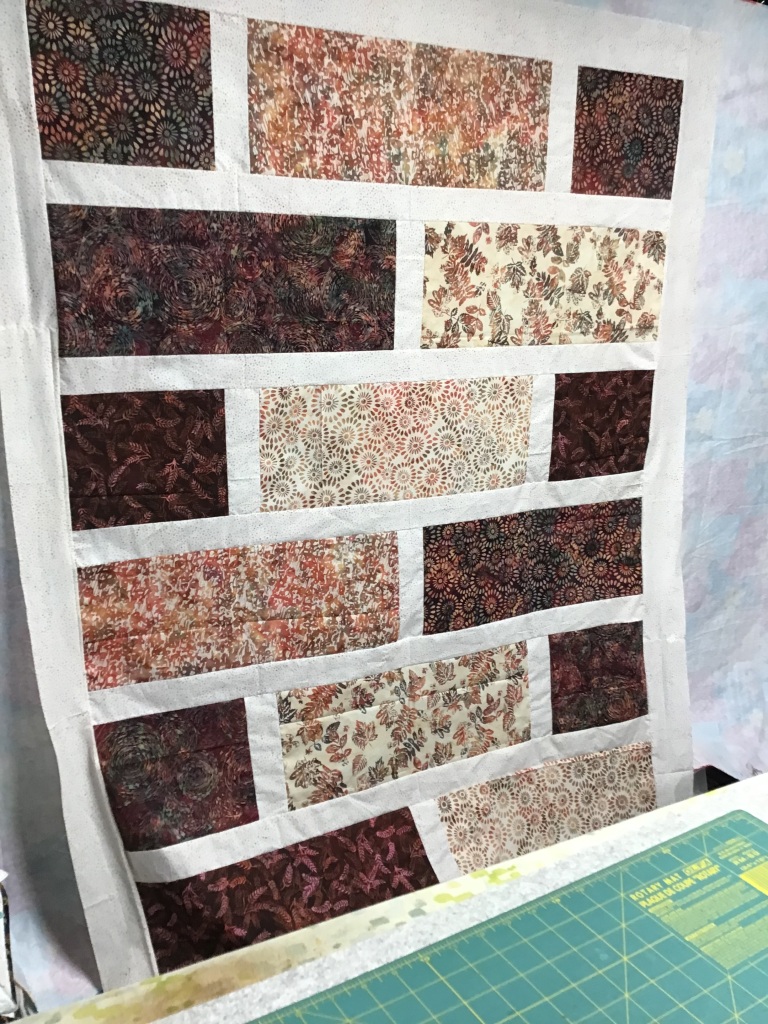
Here is my final layout for the Ebb Tide, not including the horizontal background strips in between each block row. What do you think of this layout? I really like how your eye travels down the quilt, following the light fabrics path, kind of like stepping stones.

4. Now that I’m happy with my layout, it’s time to sew the horizontal rows together. I just gathered one row at a time and took it right to my sewing machine (which is close to my flannel design wall). I sewed the large rectangles and the sashing strips together one row at a time, then I put the rows back on the flannel wall, so I didn’t get things mixed up as I worked.

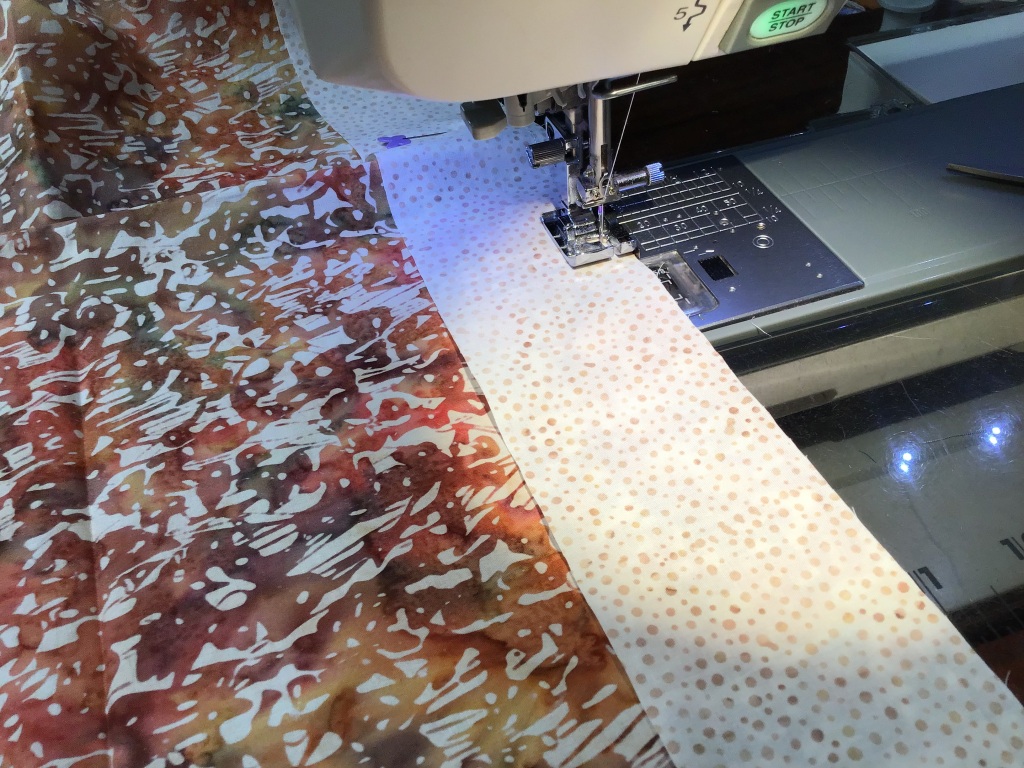
5. Now I’m ready to sew the long sashing strips in between the pieced rows. One last look to make sure I have the rows in the right order, and back to the sewing machine. I sewed the rows and sashing strips into sections and then sewed the sections together, that way I didn’t have to struggle with the growing quilt top with each row I added.

6. One more step and Ebb Tide will be done (or at least the quilt top will be done). Did you know that a quilt top is called a flimsy in quilt lingo? Isn’t that fun??? Sorry, I’m easily distracted — did someone say squirrel??? Tehehehe……..

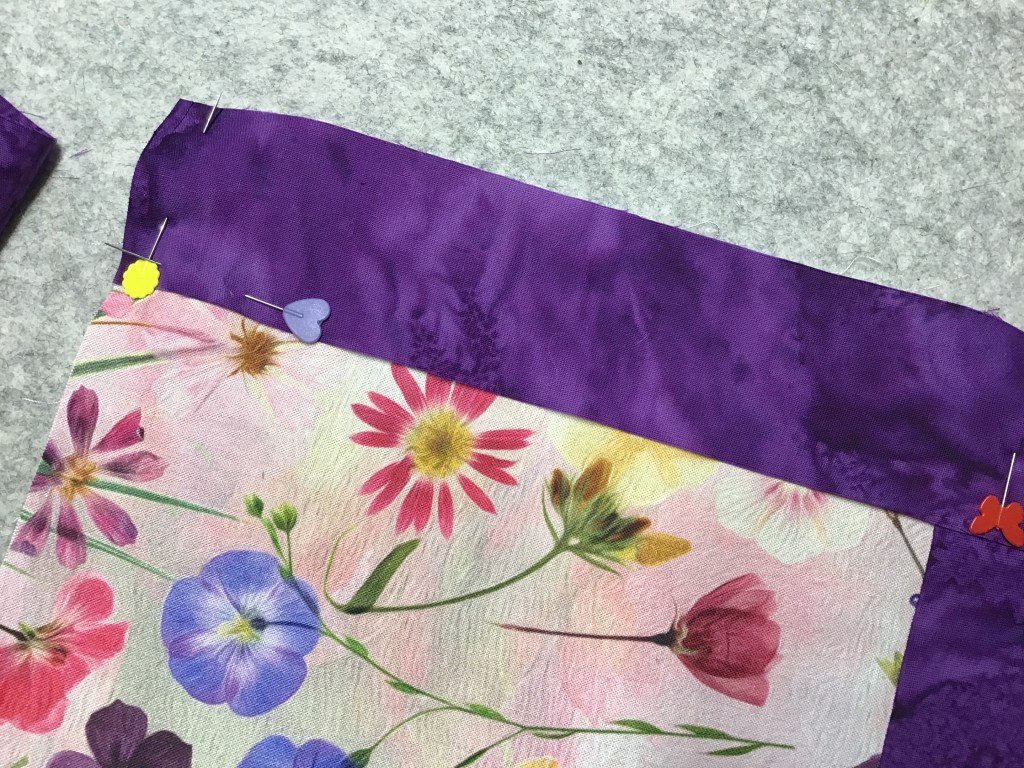
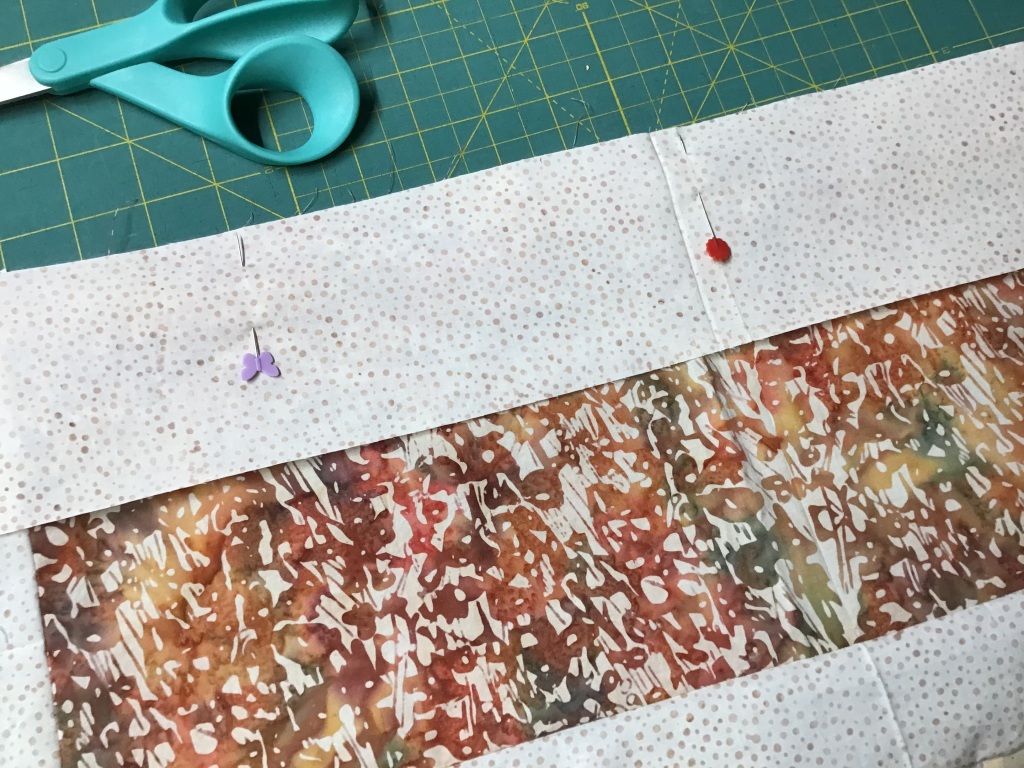
Now that the quilt center is finished, let’s sew the top and bottom borders on. But before we do that, I need to cut my border strips to the right size. I like to lay my border strips across the center of the quilt, trimming the strips to the width of the quilt center. I use the center because the edges can sometimes stretch out. By cutting my strips to the center width, I can bring those stretchy edges back to square. I know this sounds weird, but trust me, it works.

Next I pin my borders to the quilt top. I start by matching the center of the border to the center of the side I’m sewing the border to ( I fold them in half to find the centers, making a crease at the true center). Then I match and pin the outside edges. After the edges, I straighten and smooth the quilt and border, adding more pins between the center and outside edges to keep everything in place while I sew. Finally, it’s time to sew them together, knowing that my borders will be flat and not waving all over the place.

7. The side borders are the last thing to sew to the quilt. They will need to be pieced so the border strips are long enough. For this quilt, I used a straight seam to sew the strips together, but sometimes I use a diagonal seam (I do this when fabrics are busy in order to hide my seam a little better).

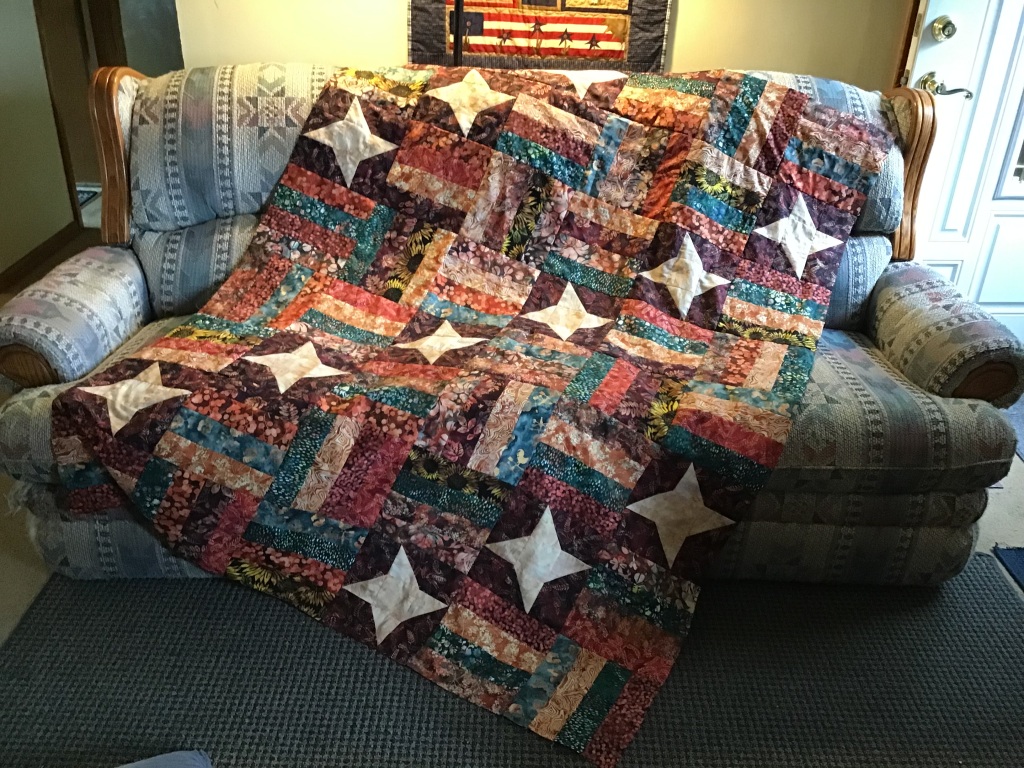
Yay! Ebb Tide is done. Eventually, I will back it with cozy fleece, machine quilt, bind, and label it. Hopefully sometime in the next 100 years. Ha!

By the way, I wanted to let you know that it took me about 2 hours to make the Ebb Tide flimsy — that included cutting the fabrics, laying it out, and doing the photography for this tutorial. I wonder how long will it take you to make it?

Here’s a “beauty” shot of my Ebb Tide flimsy — I really wanted to get a pretty picture with my Black-Eyed Susans. Sadly, the breeze wouldn’t cooperate with me, so the bottom of the flimsy kept blowing under the porch. Oh well…….

Thanks for sticking with me through the entire blog post, I know it was a long one, but I hope you enjoyed all of the quilty inspiration.

Take care and get quilting!

Until next week —

Always,

Tricia

Rose Cards · Tutorials · villa rosa designs

VRD Alassio Quilt Tutorial

Happy Thursday to you!

Yep, I am still in my fall quilt-making zone. Which is not a big surprise really because for the last couple weeks, here in NW PA, we’ve been having very fall-like weather. Today is quite cool with a high temperature only in the 60s and it feels really really chilly. Usually, August is in the 80s and even 90s occasionally. You know the “dog days” of summer? So the 60s is kind of a shock to the system. Our nights have even dipped down into the 40s a couple times. Just chalk it up to the ever-changing world of weird weather, I guess.

So in honor of our early autumn weather in August, I am going to show you how to make anther great Villa Rosa Designs Rose Card pattern, Alassio. Do you really have to use a fall-themed fabric collection like I am doing? Nope, not at all. This pattern will work beautifully with any fabric collection!

Get Alassio HERE

I made my Alassio quilt sample with the Hoffman All Things Spice batik collection and coordinating 1895 Watercolors batiks. Isn’t it sew yummy? I just want to crawl into those fabrics with a good book, a cup of cider, and a donut………

On that note, let’s make Alassio together!

  1. First, we need to cut out our background squares.

2. Next up is cutting the pieces for our framed blocks from our fat quarters. I like to stack my fabrics and cut 3 or 4 at a time. Do likewise if you want, but it’s perfectly fine to cut them one at a time, too.

3. Moving right along, let’s mix and match our fabrics so each square will have a different fabric frame around it. And after that’s done, we’ll sew matching shorter strips to opposite sides of the squares.

4. Now we need to press our blocks so far before we add the long strips on the other sides of the center squares. I don’t normally do a lot of pressing when I’m making blocks but I do think pressing these blocks as you go results in crisper seams and better blocks.

5. Okay, now we’re ready to sew the long strips on the opposite sides of the center squares. Make sure the long strips match the strips you’ve already sewn onto the squares.

The again, who says your strips have to match — just sayin’…….

6. Head over to your iron again and press those blocks one more time — now our blocks done. That was fast, wasn’t it?

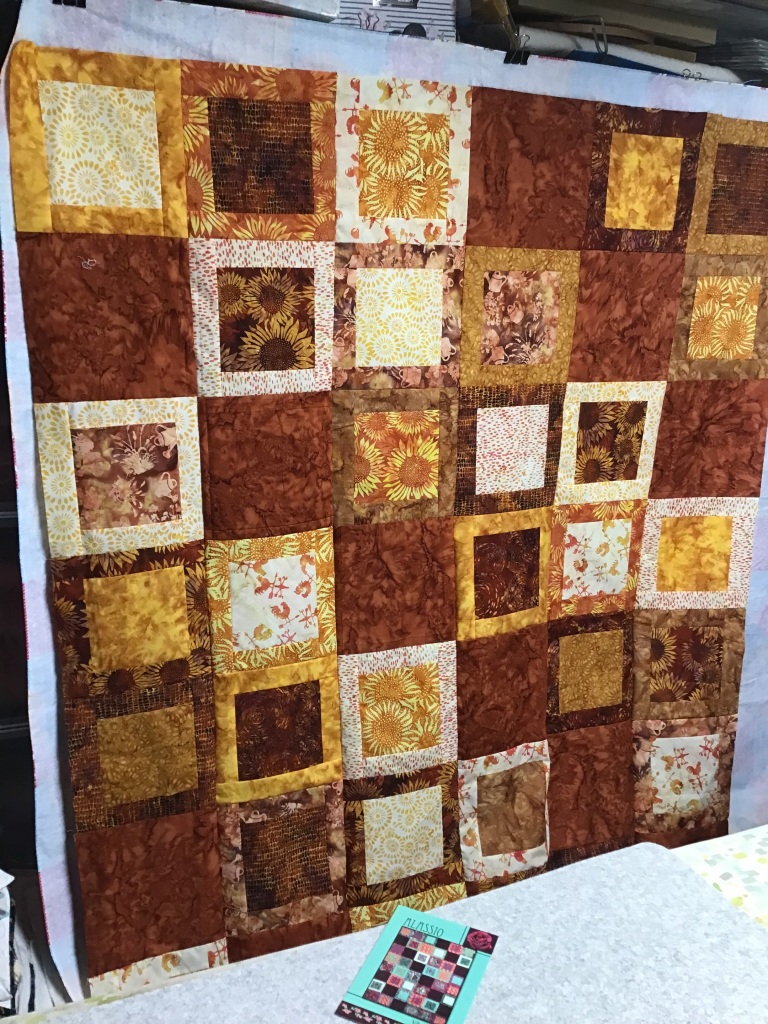
7. I just clipped my flannel-backed tablecloth up on my fabric storage cubes, which is my new design wall. I have to hang it sideways because it’s too long to hang up and down. And because this quilt is so big, I’m going to need to lay it out sideways, too. Fingers crossed that the tablecloth is long enough (or wide enough because it’s hung sideways) to lay out all the blocks.

How do you lay out your blocks before sewing them together? When I first started quilting, I used to lay my blocks out a cement floor. Yikes! Then for a really long time, I laid them out on a queen sized bed, which accommodated most of the quilts I made and saved some stress on my knees and my back. Now I have my very own portable design wall, otherwise known as a flannel-backed tablecloth. And it works great!

So, while we’re laying out the blocks according to the quilt diagram on the back of the pattern, go ahead and move the blocks around so fabrics and colors are well-distributed throughout the entire quilt.

Then once we’re satisfied with our layouts (yay — all the blocks fit on the flannel tablecloth!), it’s time to sew them into rows. Then we will sew the rows together. Quilt top done! Easy piezy!

I am so pleased with how my Alassio top turned out! I can’t wait to get it layered with pretty autumn-themed fleece, machine quilted, bound, and labeled so I can start enjoying it right away!

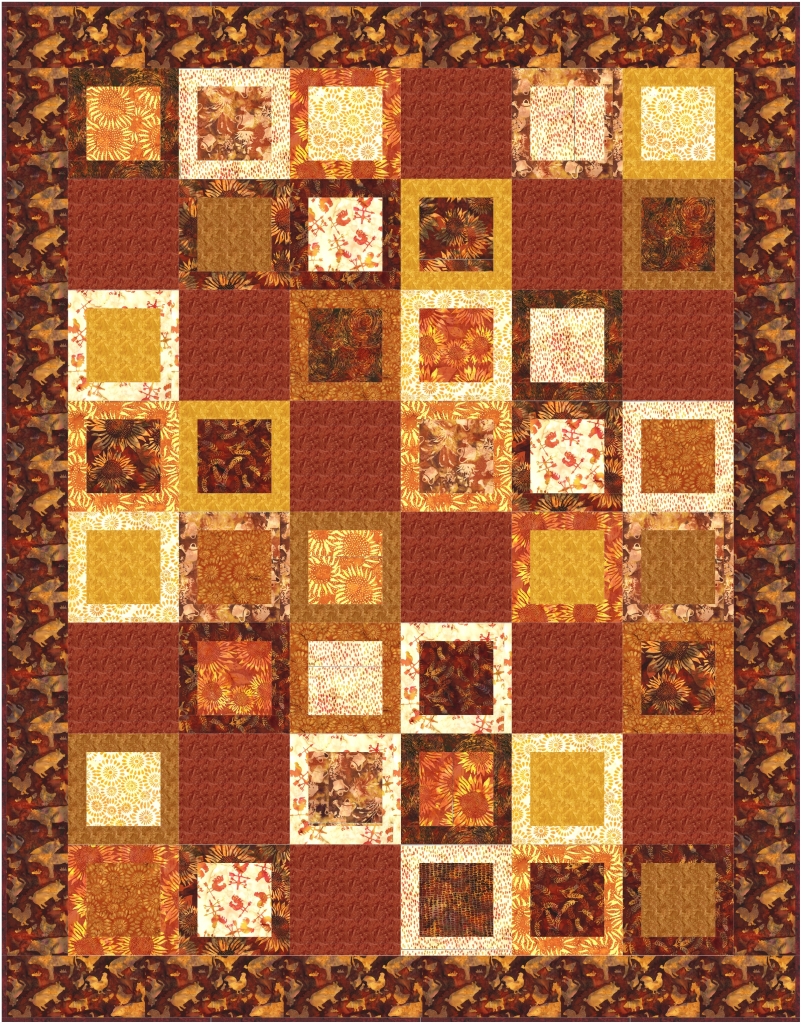
Alassio finishes faster because it doesn’t have a border, but if you want to make the quilt larger, you could add a border. It would look kind of like this:

This version of Alassio features a 4 1/2″ finished border. With this border, Alassio would finish at 64″ x 82″, which fits a twin bed or makes a nice big comfy throw.

To make Alassio with the border, you need 1 1/4 yds for the border (cut 8 strips that are 5″ x WOF) and a total of 5/8 yard (cut 8 strips that are 21/2″ x WOF) for binding.

Isn’t this a great quilt? Bet you can’t make just one!

I’d love to see your Alassio quilts! You can share them on our Villa Rosa Designs Facebook group page.

Until next week —

Always,

Tricia

Panel Quilts · Quilting Partners · Rose Cards · Tutorials · villa rosa designs

VRD October Sky Panel Quilt Tutorial

Hello Quilty Friends!

Happy Thursday to you!

Today is a kind of blah day — raining off and on, overcast, and grey — not what I’d call a typical summer day at all. It’s been looking more fall-like here in NW PA. In fact, I was looking at one of the maple trees in the back yard yesterday and I actually saw the leaves starting to change on ends of several branches. As much I hate to see summer going, I do love autumn. What’s your favorite season?

As I’ve mentioned before, I get fall fabrics on my brain this time of year! Then I can’t wait to start making fall quilts. What better day than a dreary one to share an awesome FALL tutorial with you? And you can’t get more fall than October Sky!

Get October Sky HERE

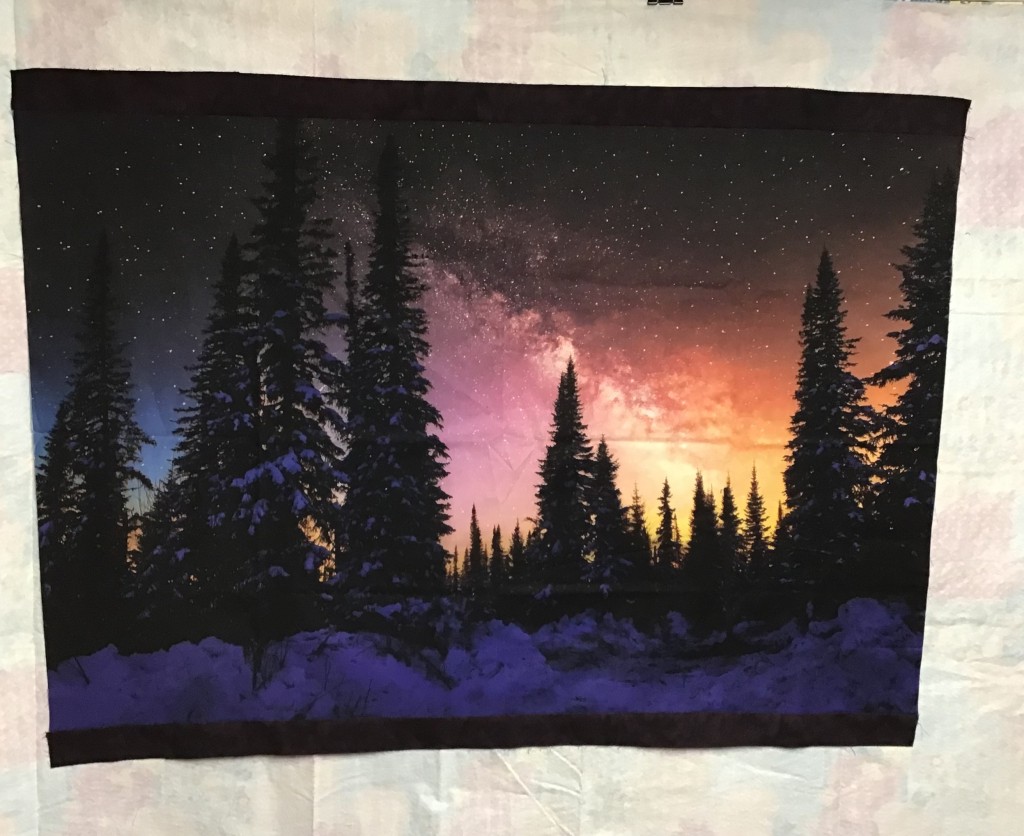
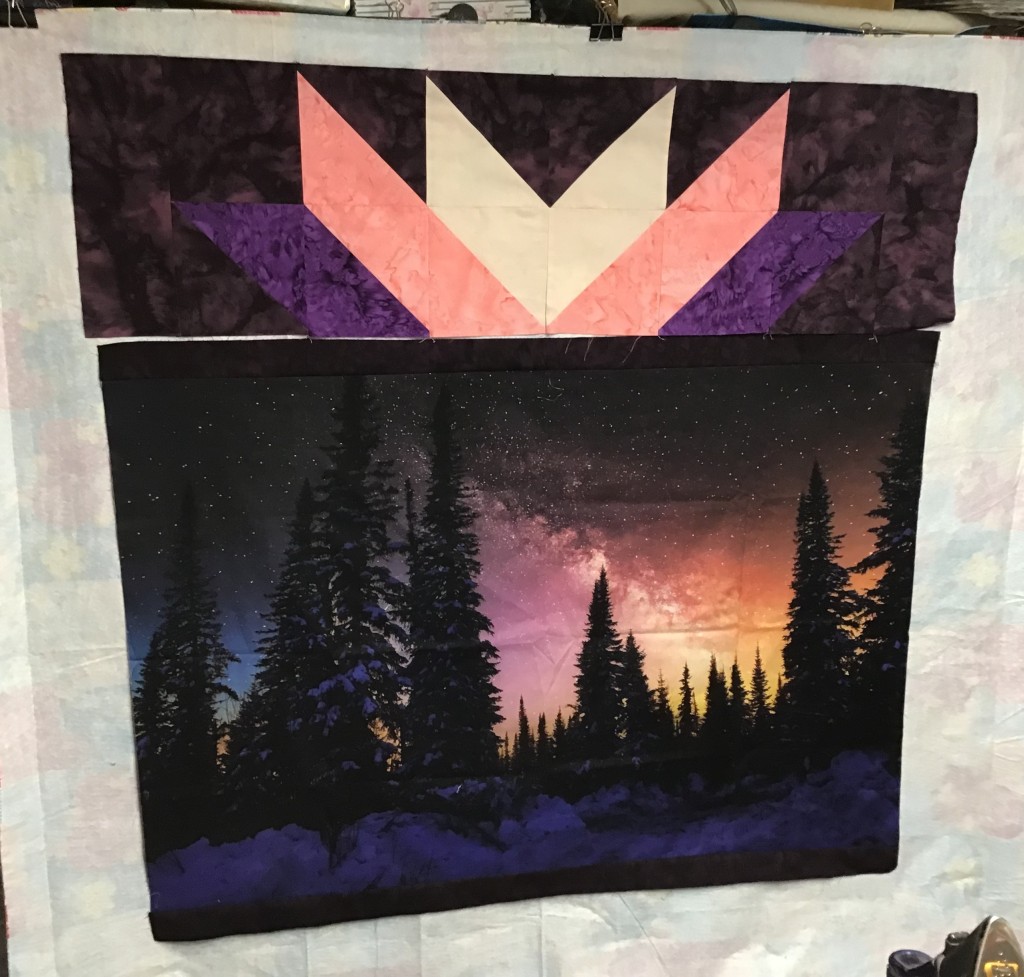
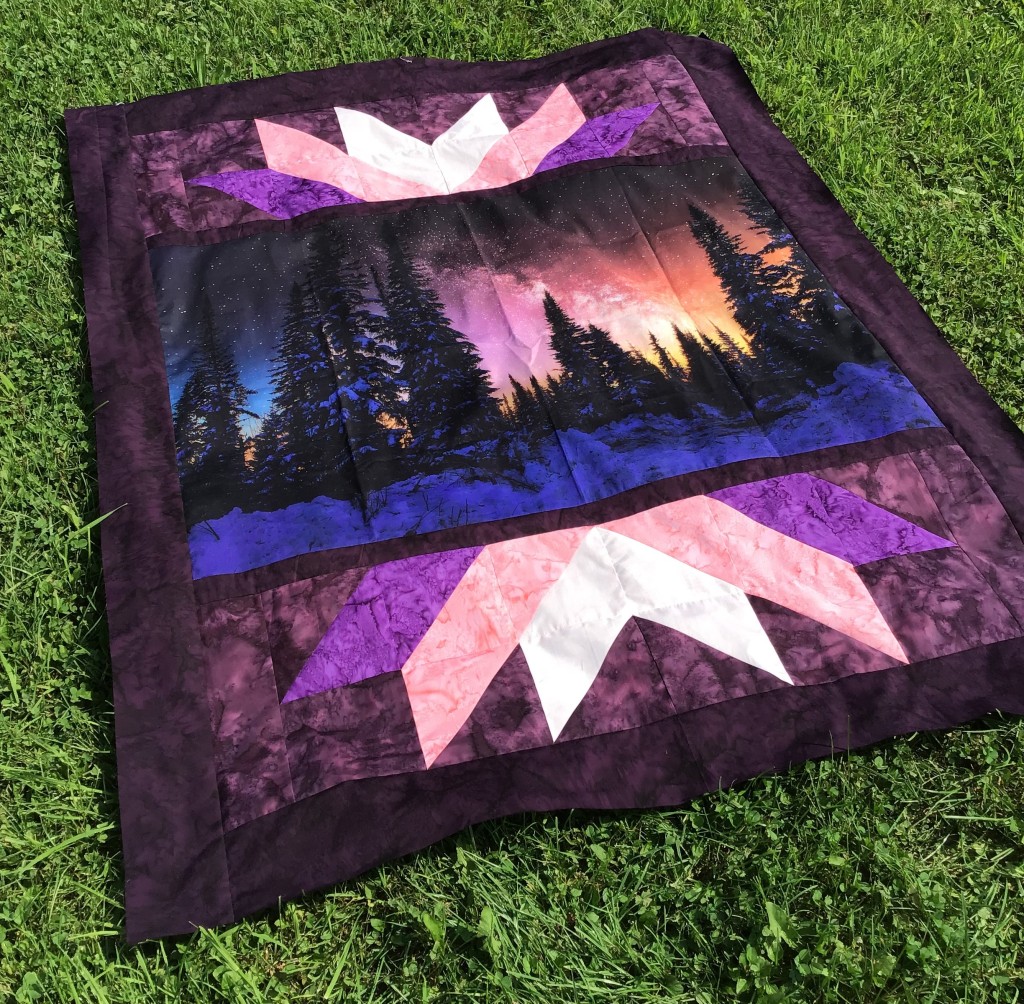
Don’t let the name of the pattern fool you — you can use any kind of horizontal panel — any one your little hear desires. I’m not using actual fall fabrics for this quilt, but to me, it still feels like a fall quilt. I think it’s the jewel-tone colors. Take a look at these yummy fabrics from Hoffman California Fabrics, one of our quilting partners. The digital panel is called Nightshade and the fabrics are coordinating 1895 Watercolors batiks. Simply scrumptious!

Let’s get started!

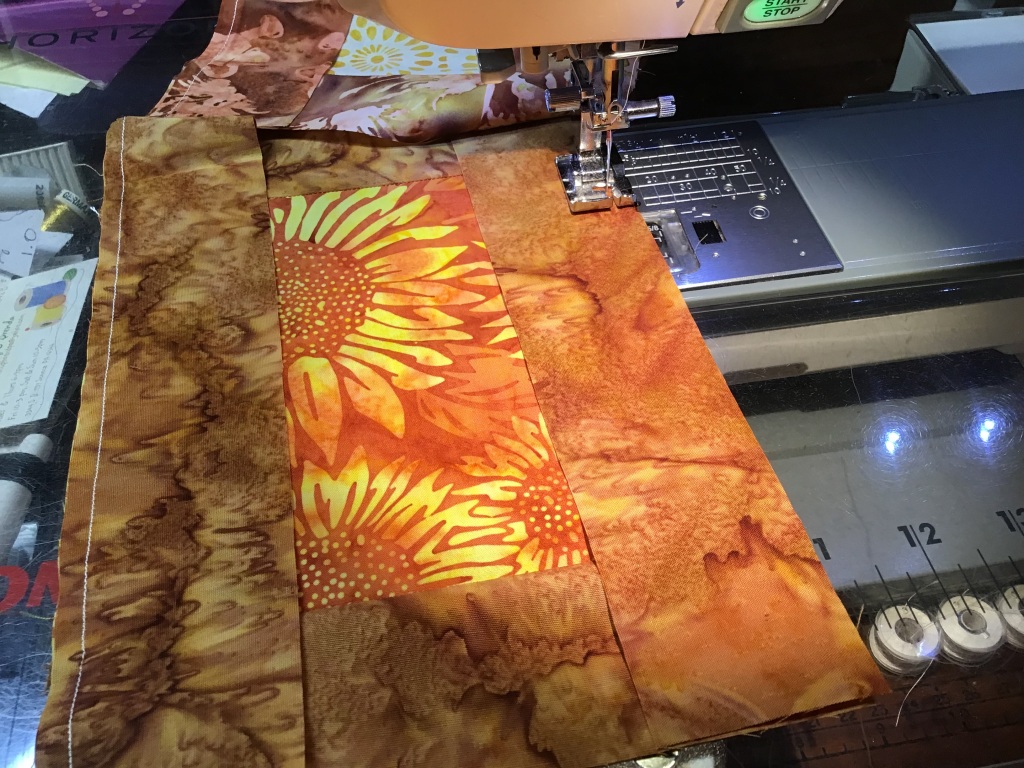
1. Trim the selvages off your panel. Horizontal panels can vary slightly so it doesn’t hurt to do a quick measurement of your panel, then you’ll know how it compares to the pattern. You don’t really need these numbers right now, but if your panel is not as wide as the pattern, you will need to make a small adjustment a bit later in the construction process.

2. Cut your border strips for the top and bottom of the panel and sew them on.

3. Now we are going to cut out the squares for the pieced sections at the top and bottom of the panel. I just love these 1895 Watercolors batiks — they go with everything. The dark plum in front is my background.

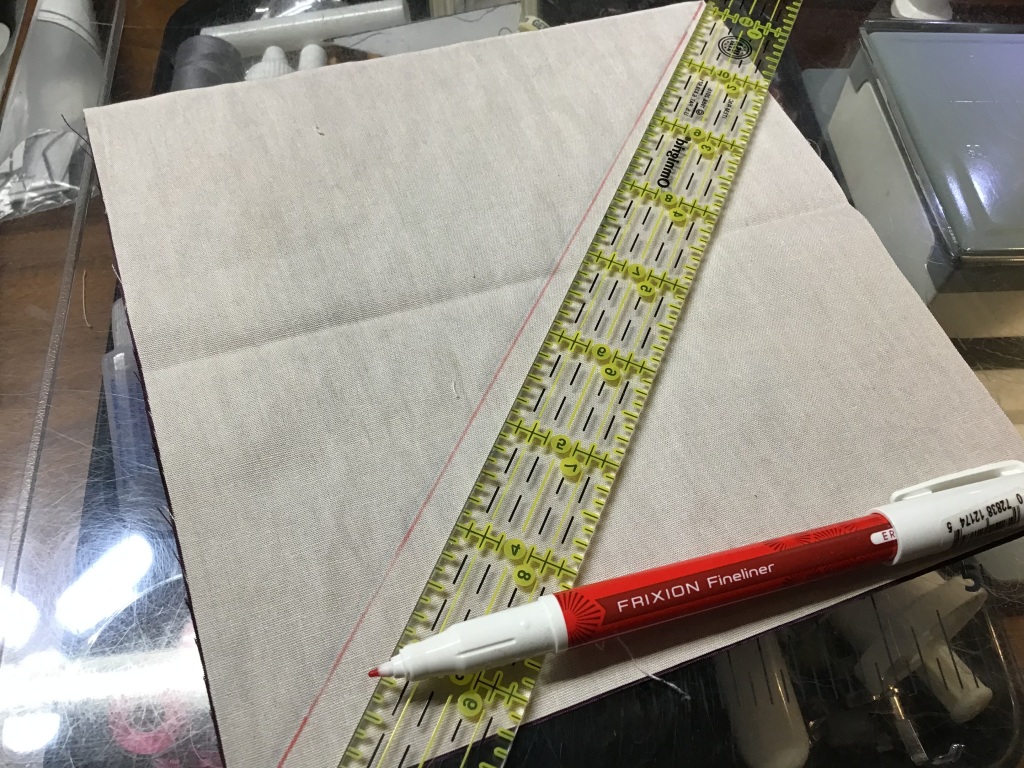
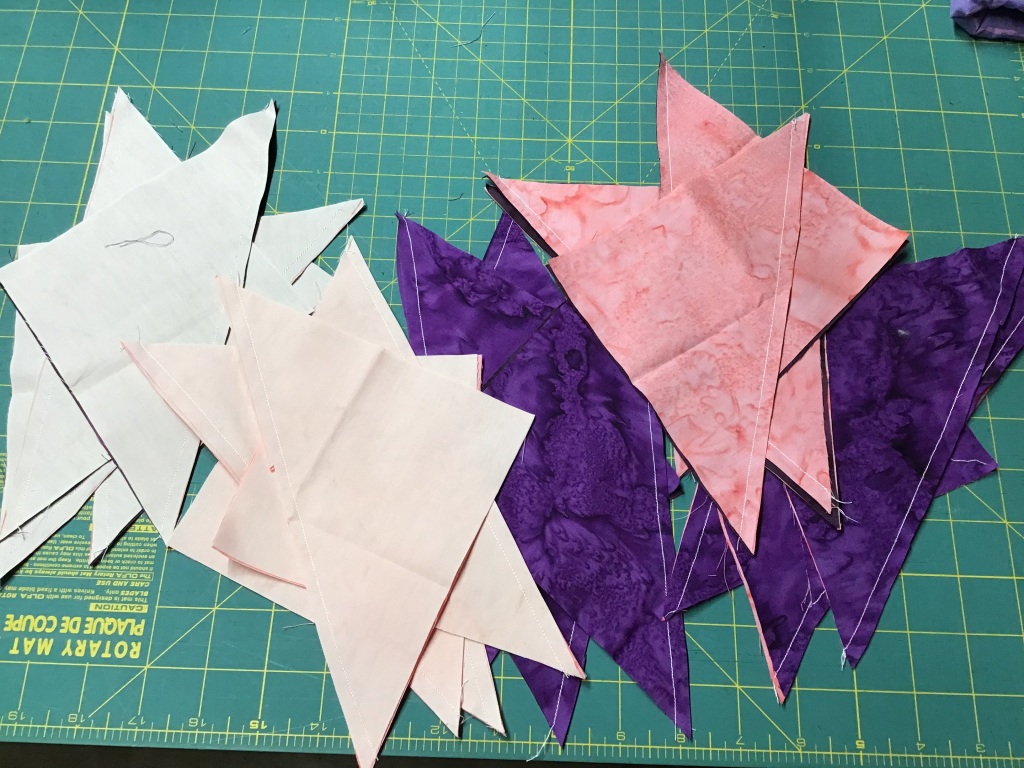
4. Time to make some Half Square Triangles, or HSTs. Layer 2 squares right sides together, drawn a diagonal line from corner to opposite corner. Sew 1/4″ away from both sides of the drawn line. Cut apart on the drawn line and press open.

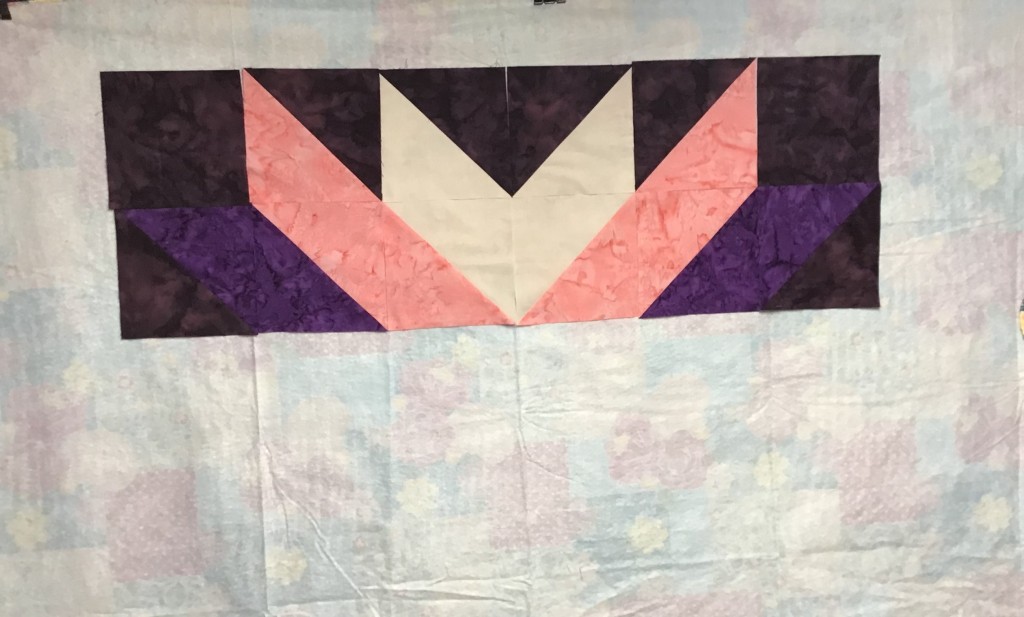
5. Having a flannel board — or in my case, the back of a flannel tablecloth clipped to my wall cube unit — to arrange the HSTs makes getting the arrangement right the first time much easier to accomplish.

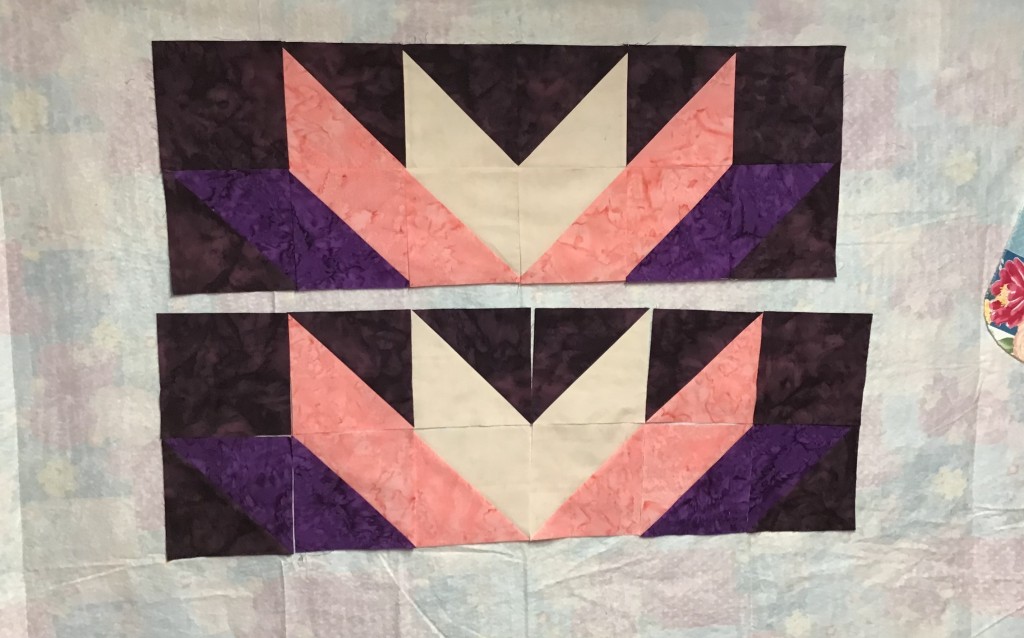
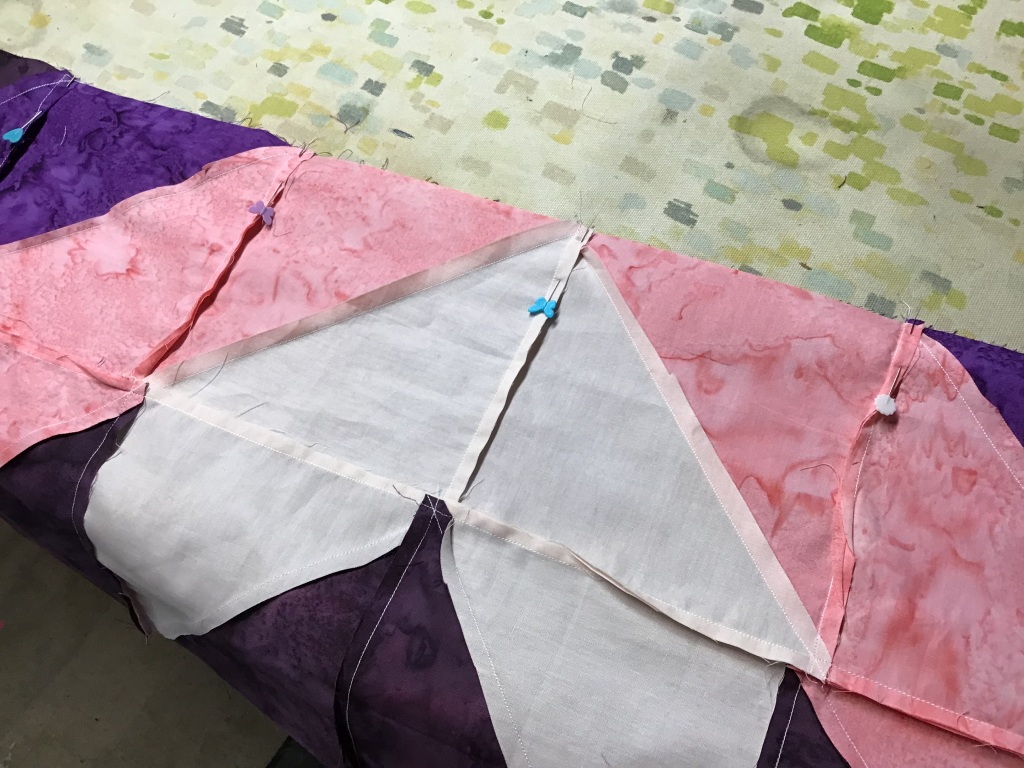
6. Sew the HSTs together. Make 2 identical pieced sections. You will be flipping one upside down to sew t the bottom of the panel. It makes an interesting design even without the panel in the middle though, doesn’t it?

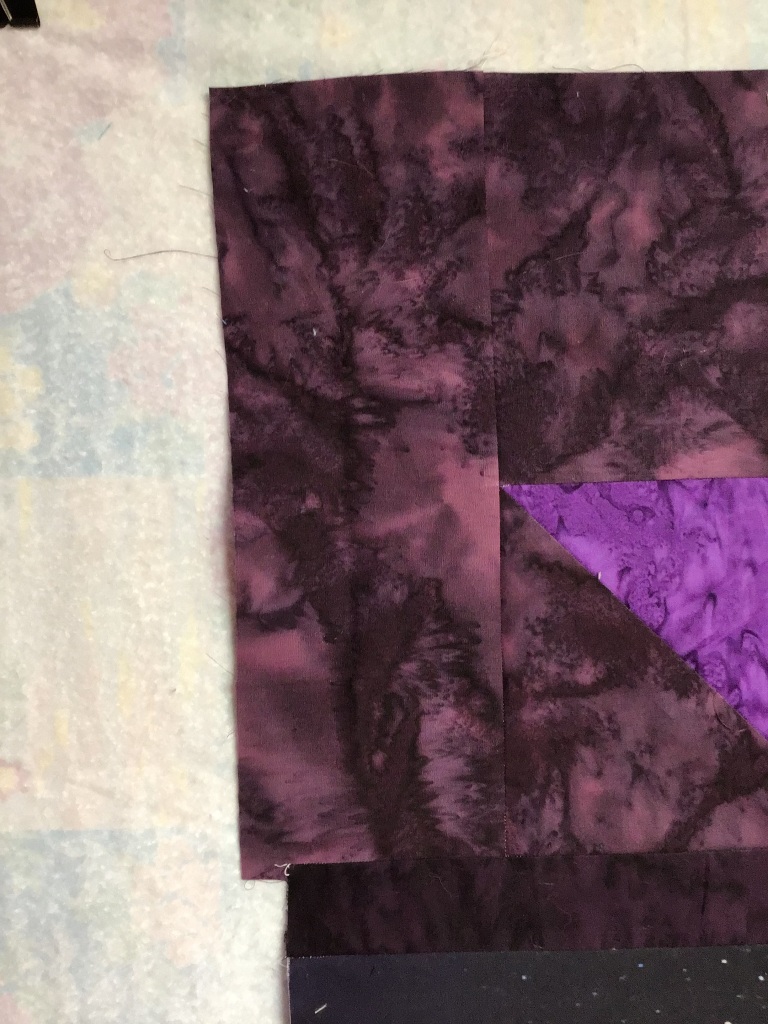
7. Refer back to your panel measurements. If your panel is not as wide as the panel measurement in the pattern, you may need to add a little extra width to the side background rectangles. To be on the safe side, I added an extra 1″ or so to the side rectangles just to make sure my pieced sections would be wide enough because my panel wasn’t quite the same size as the one listed in the pattern.

It’s okay if the side rectangles make the pieced sections a little wider than the panel — you can trim and square things up in a later step.

8. The most important part of this step is to find the centers of both the pieced sections and the panel. Then match those centers up before sewing because nobody wants off-center sunbursts! LOL!

Once you’re happy with your placement (I used pins to keep everything lined up just right), sew the pieced sections onto the panel. Lookin’ good!

9. Now it’s time to trim and square up the sides of the pieced sections. Ahhh! Much better!

10. Time to add top and bottom borders. I actually increased the width of my borders a couple inches to make the quilt just a little bit bigger as a throw. Do the same if you’d like. Just keep in mind, you might need more fabric if you increase the width of your borders.

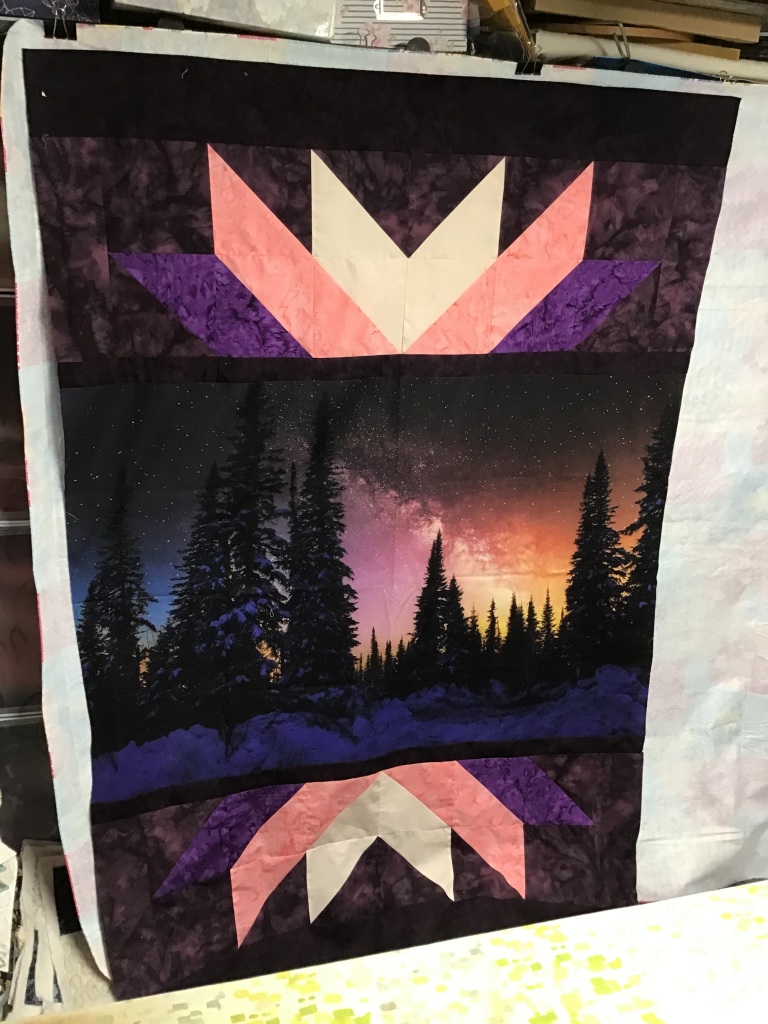
11. Ready to add those side borders now? You will need to piece those side borders to make them long enough. VOILA! The top is done!

Since I couldn’t get the breeze to cooperate with me, I took another photo of the October Sky out flat. Gorgeous, isn’t it? The colors are so rich and yummy.

12. The next steps will be layering, quilting, binding, and labeling the quilt. And then….another VRD quilt DONE!

I hope you enjoyed this tutorial! I’d love to see your October Sky quilts — you can post them on our Facebook page HERE or drop me an email if you’d like. And there will be more fun VRD tutorials coming, so stay tuned!

Well, that’s it for me. See you next week!

Always,

Tricia

Rose Cards · Tutorials · villa rosa designs

NEW VRD Rose Cards for August and a VRD Rose Card Tutorial for Steppin’ Up

Happy Thursday to you!

Boy, do I have some fun things to share with you this week! Like NEW PATTERNS, for one. And a NEW TUTORIAL for this month’s table runner pattern, Steppin’ Up. So buckle up and get ready for some VRD fun!

First up is our New August Villa Rosa Designs Rose Card patterns! Check ’em out!

What a great variety of patterns, don’t you think? You can order all five Rose Cards HERE for the super low price of $8.95.

Here’s my latest table runner Rose Card pattern — Steppin’ Up. Isn’t it fun?

You can get the Steppin’ Up Rose Card HERE.

Keep reading for a tutorial for Steppin’ Up as the blocks are a tad tricky.

Don’t forget that we also offer digital patterns for most of our Rose Cards patterns. This is great if you’re a techie quilter or if you live outside the USA. You can find individual digital patterns HERE, unfortunately there aren’t any of the card sets as digital bundles.

There are even some great kits still available for the NEW August Rose Cards —

Marsala

Circus Time

Sorry, but kits for Steppin’ Up, Mira Costa, and Pots and Pans are already out of stock at the moment, so make sure you check back later.

All right! Let’s get to our Steppin’ Up tutorial.

Since I’ve been wanting to do something with an autumn theme (Yes, Gaynel, you were right!), I grabbed some great prints out of my stash. I think you’ll really like how Steppin’ Up looks with a seasonal twist. I’m now thinking Christmas might be fun, too….

Step 1: Time to gather up your fabrics for Steppin’ Up. For the cover runner, I chose fun brights with black and white, but for this version I chose a brown tonal and a cream dot to go with my fall fabrics. The most important thing in selecting fabric for this runner is to have high contrast between the light and the dark.

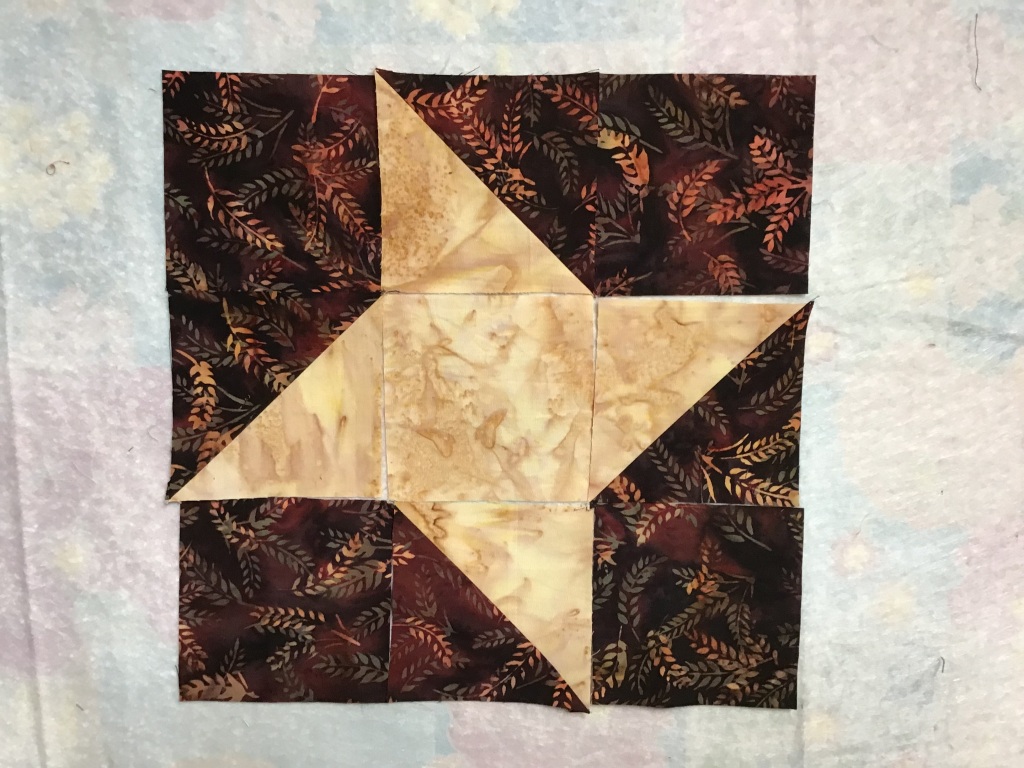
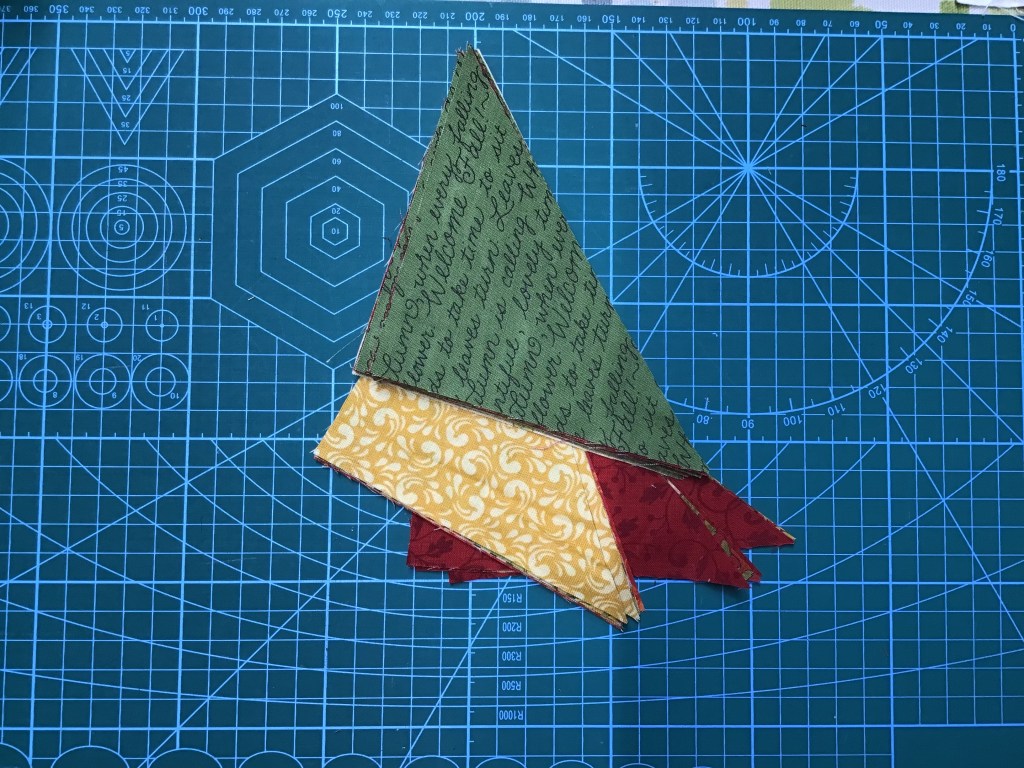
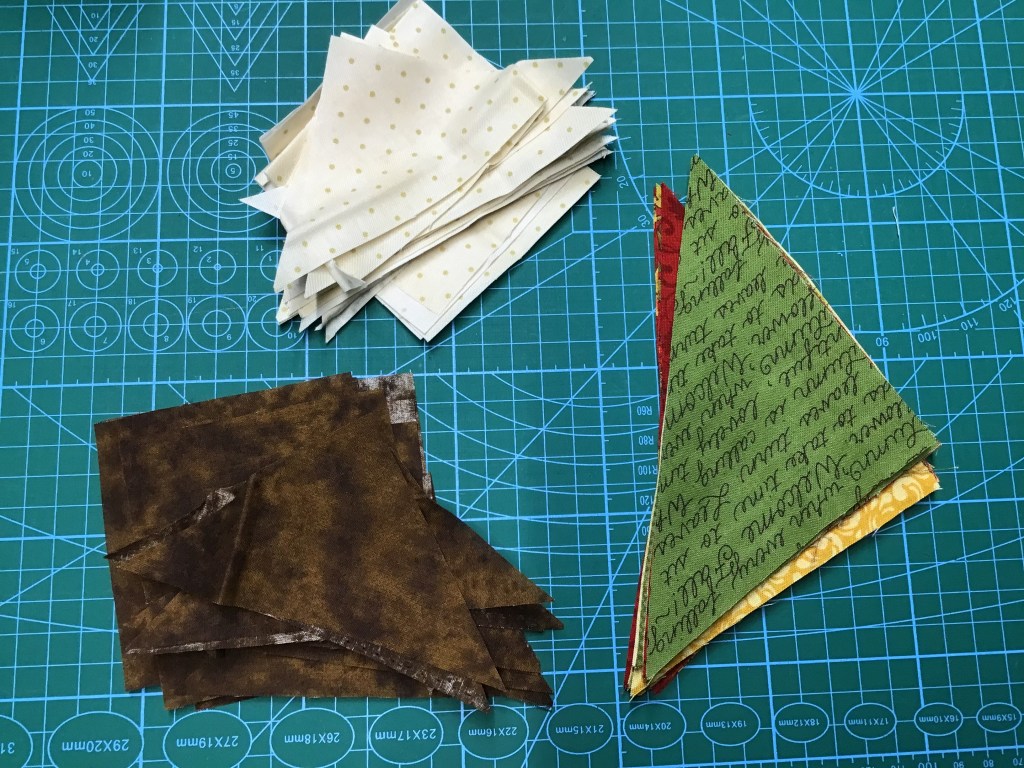
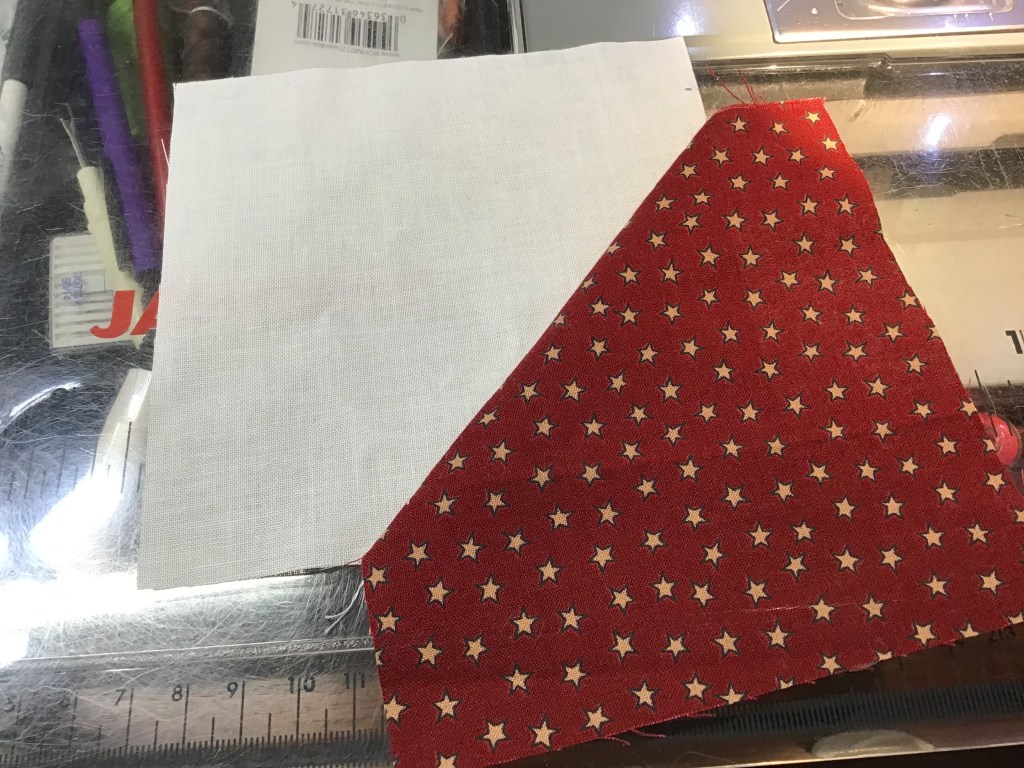
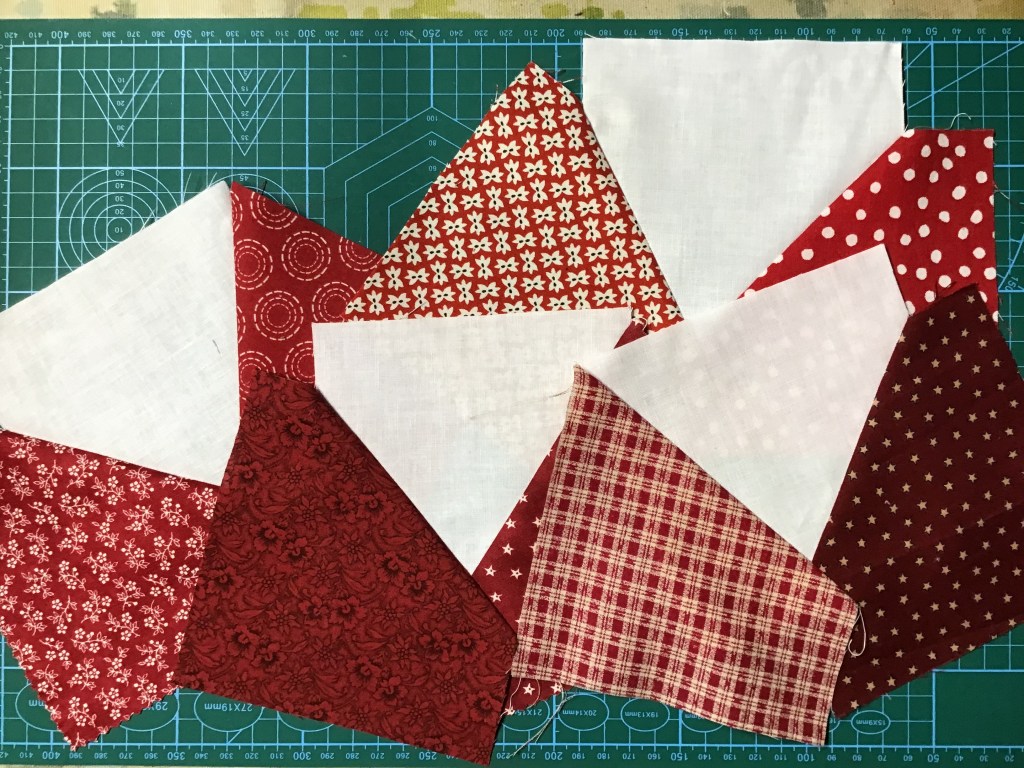
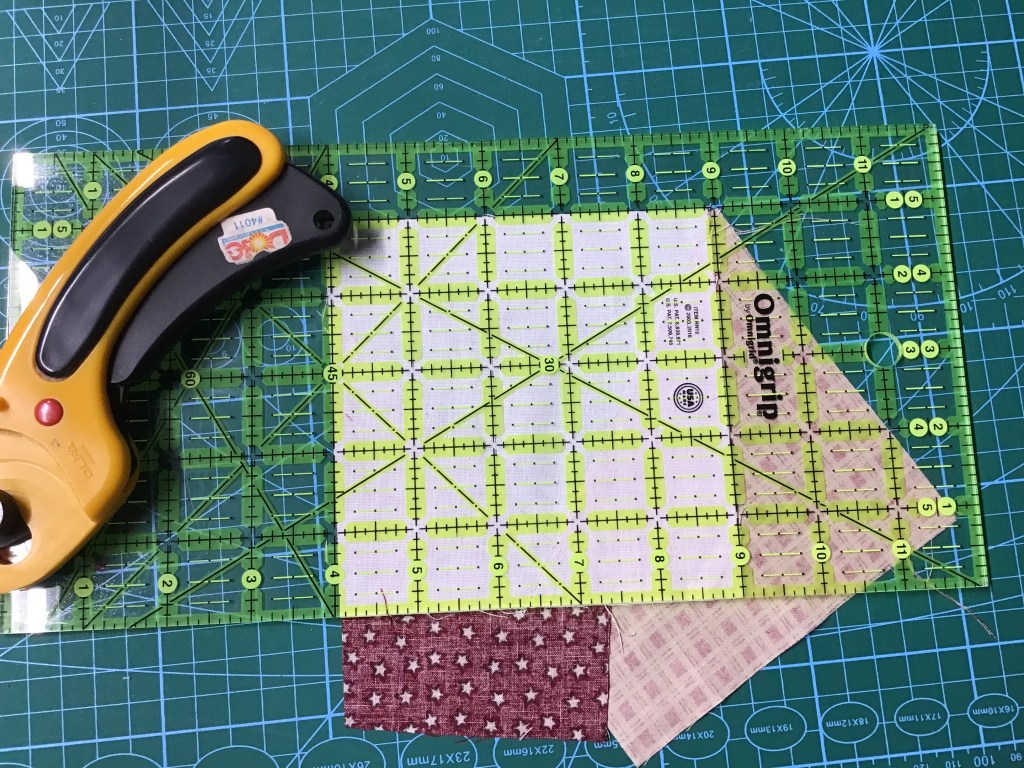
Step 2: Go ahead and trim your print squares and then cut your print squares into triangles. Cut on one diagonal to make 2 triangles out of each square.

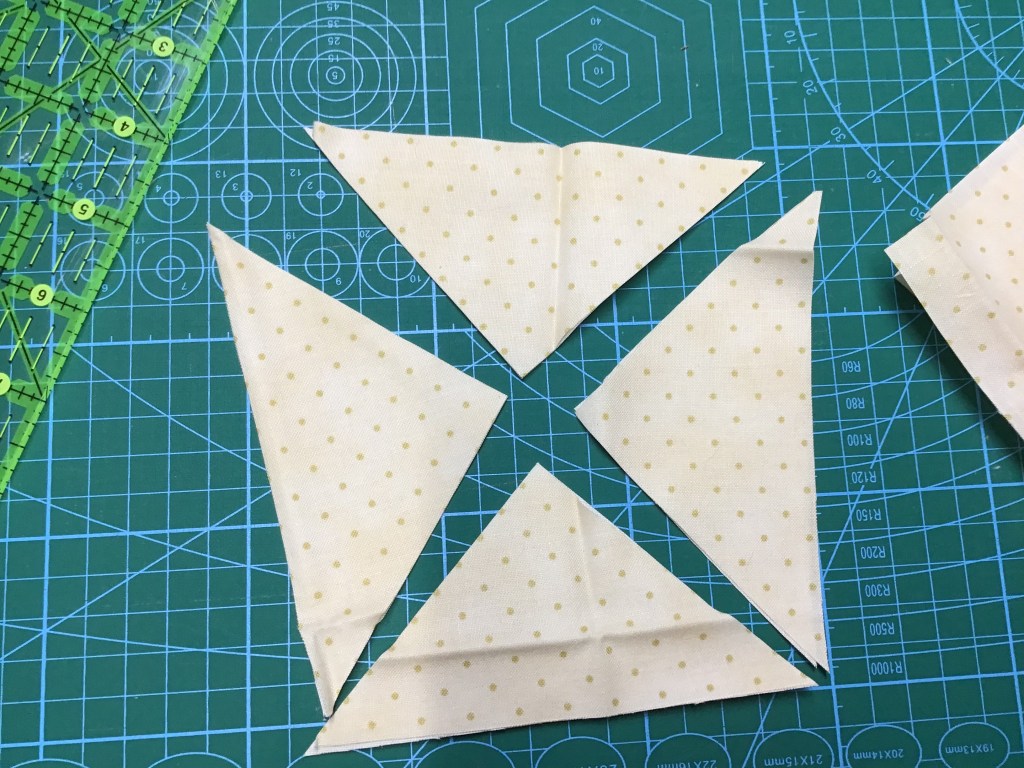
Step 3: Now it’s time to cut our light fabric into squares and then cut the larger squares on both diagonals to make 4 smaller triangles out of each larger square.

Oops! I just looked over at the pattern beside me and I see I did the dark first and then the light in the directions and when I did the tutorial steps, I did the light first followed by the dark. Mea culpa! I hope switching the order of the light and dark won’t confuse anyone….

Step 4: Next we’re going to cut the dark fabric into 2 different sized squares and cut each larger square on both diagonals so we get 4 smaller triangles from each square.

Step 5: Yay you! All your fabrics are cut for the blocks. I don’t usually cut my border strips until after I’ve pieced the center. That way, I can measure my quilt just in case my measurements might be a tad different than the designer who wrote the pattern.

BLOCK 1

Step 6: Let’s make Block 1. I’m going to break this into smaller steps so it’s a bit easier to follow.

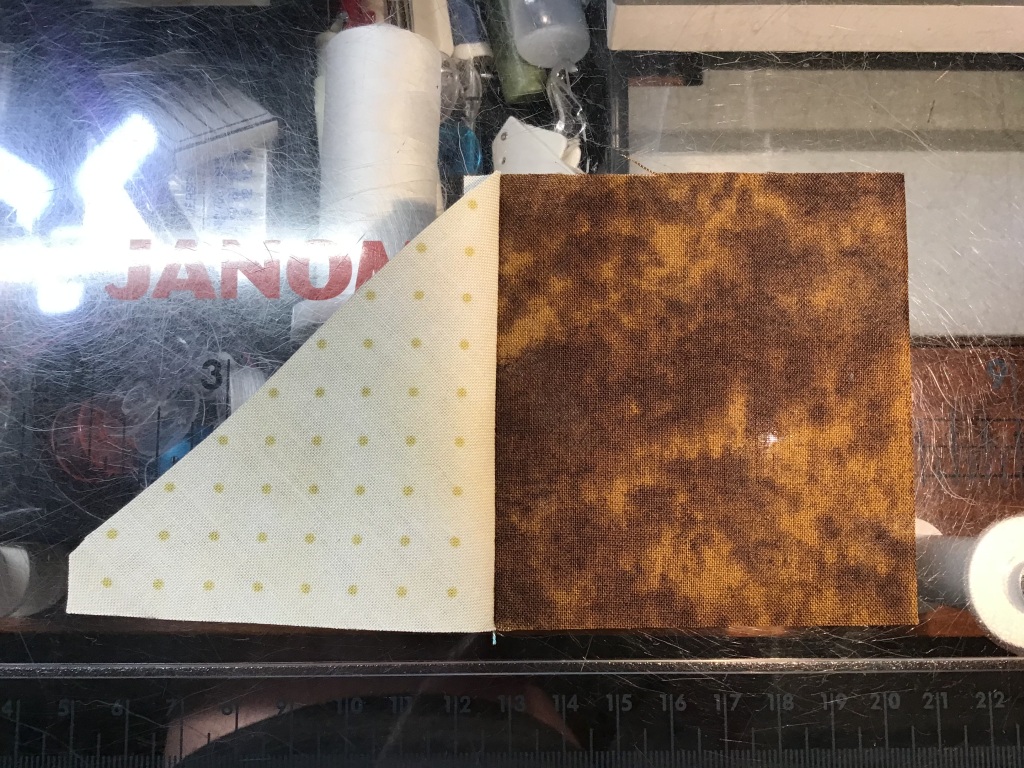
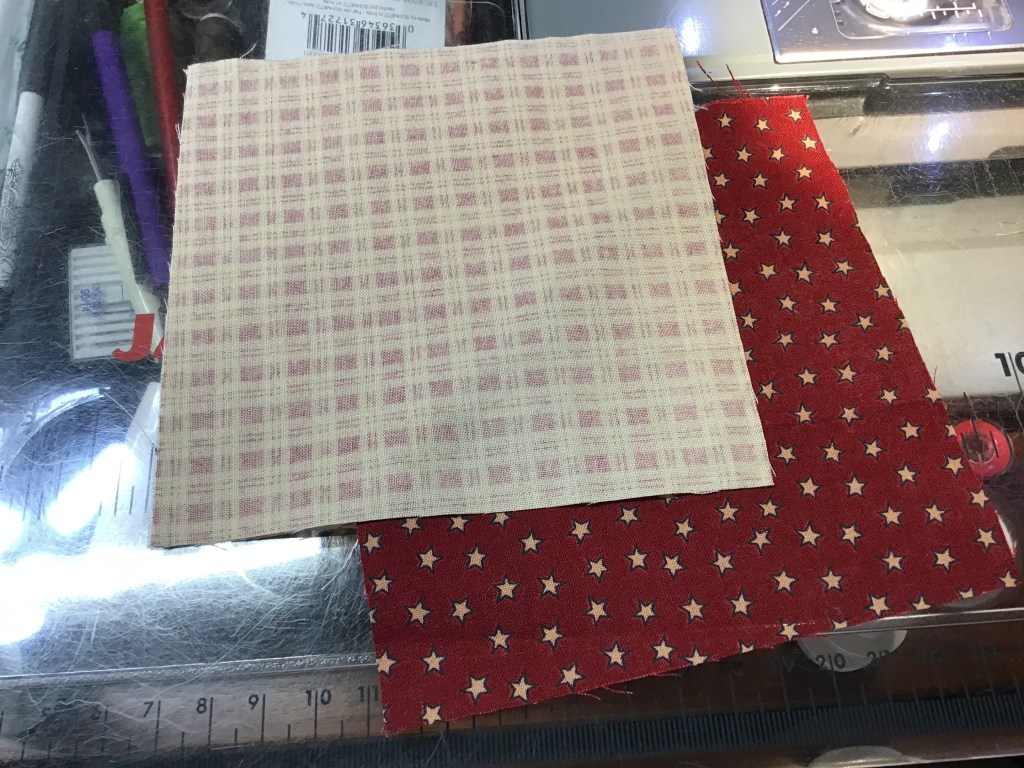
Image A. See how my light triangle is sitting up against my dark square with the slanted side (the hypotenuse) facing towards the top left? Once your pieces look like this, then carefully flip the brown square over on top of the triangle with the right sides together.

Image B and C. Go ahead and sew along that straight side using your 1/4″ seam. Open up the unit and press (I usually just finger press as I’m assembling a block).

Image D and E. Now we’re going to sew a light triangle to the right side of the dark square. Once your pieces look like this, then go ahead and carefully flip the triangle over on top of the brown square, with the right sides together. Go ahead and sew using your 1/4″ seam.

Image F. Open the unit and press. Repeat for the rest of your dark squares and light triangles.

Step 7: Here’s my favorite part of assembling these rectangular blocks — sewing the print triangles on! This really makes the blocks a lot more fun.

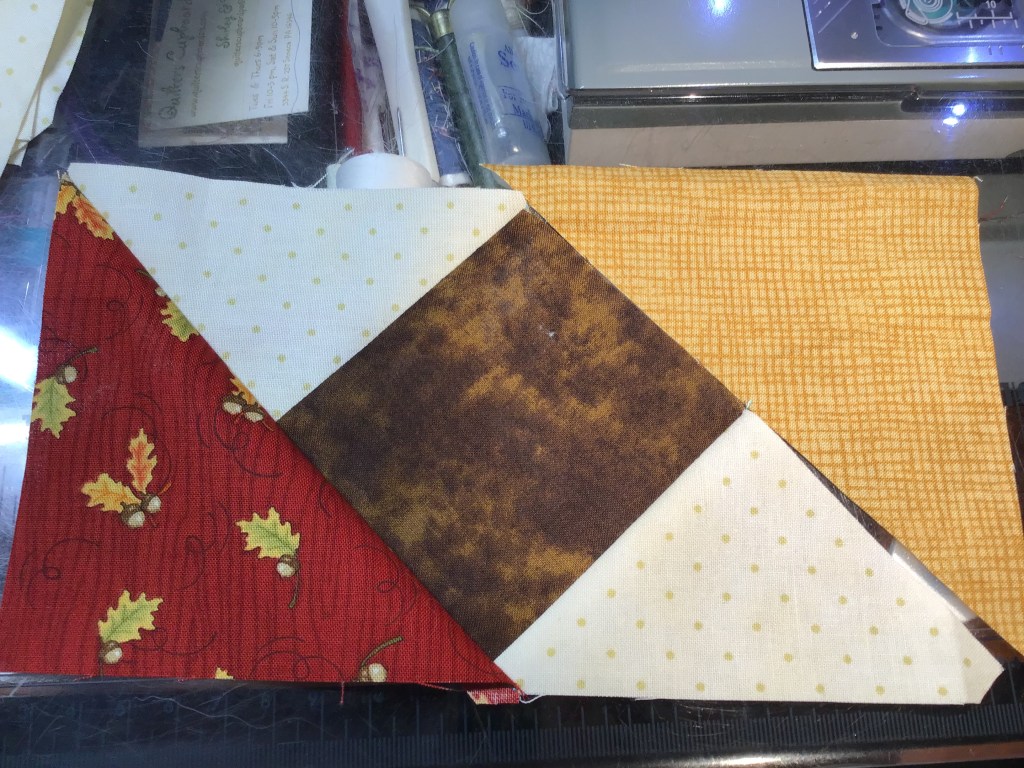
Image A and B. Turn your Block 1 unit on its side like you see in the photo. Choose a print triangle and place it on the left as shown. Carefully flip the unit over on top of the triangle, lining up the bottom straight edge (you should have about a 1/4″ triangle overhang at the top). Sew using your 1/4″ seam. Open and press.

Image C and D. Go ahead and repeat for the right side.

Image E. Here is a completed Block 1.

BLOCK 2

Step 8. Are you ready to make Block 2? This time we are using light squares and dark triangles. The placement of the triangles is different than in Block 1.

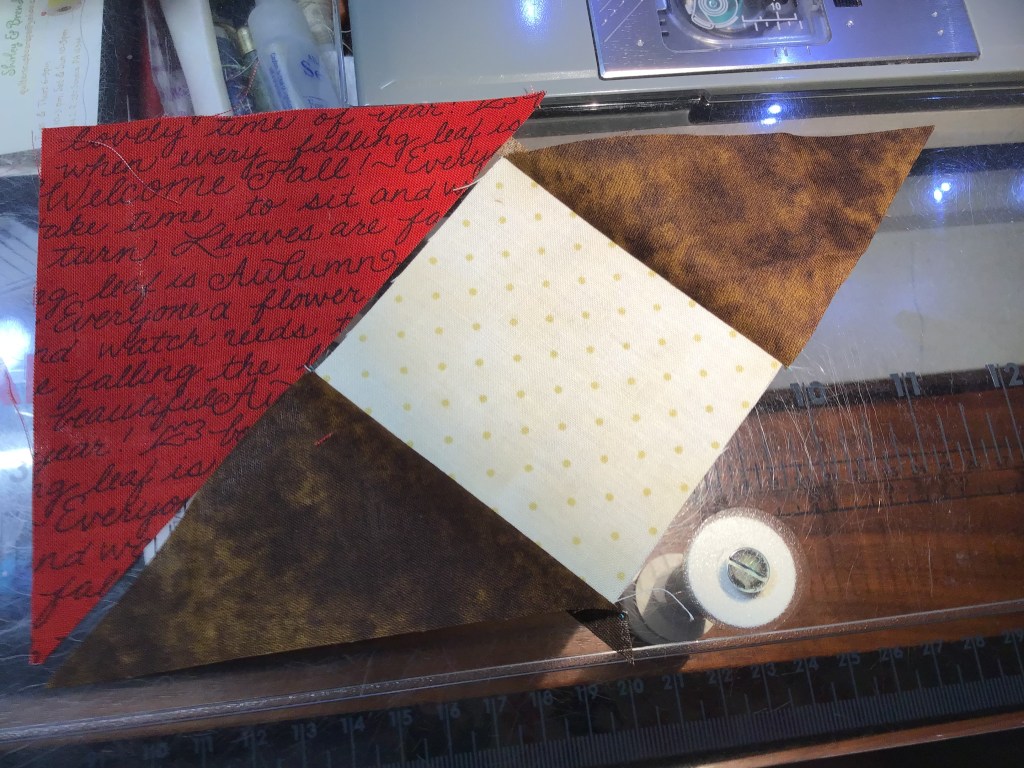
Image A and B. Notice how the dark triangle is laid out for Block 2 with the slanted side pointing to the bottom left. Once your pieces look like this, go ahead and flip your light square over on top of your dark triangle, with right sides together. Sew using your 1/4″ seam. Open the unit and press.

Image C. Lay a dark triangle on the right side of the light square as shown. Then flip the dark triangle over on top of the light square, with right sides together. Sew using your 1/4″ seam.

Image D. Oops! Take a look at the bottom unit in the photo — I sewed the right dark triangle on wrong. Oh dear….time to unsew and try it again.

Image E. Got it right the second time. Open the unit and press. Repeat for the rest of your light squares and dark triangles.

Step 9: Now let’s get Block 2 finished! Grab the rest of your print triangles.

Image A and B. Turn the Block 2 unit on its side and place a print triangle on the left. Flip the unit over on top of the print triangle, right sides together, and lining up the edge. Sew using your 1/4″ seam. Open and press.

Image C. Repeat for the right side. Open and press.

Image D. YAY! Block 2 is now done.

Step 10: Yay! You made it through the hardest part of putting this runner together. Now it’s time to alternate Blocks 1 and 2, arranging them until you are satisfied. Once you like what you see, sew your blocks together. (A few of my blocks were AWOL when I snapped this photo, but I found them in a couple minutes — they didn’t get very far.)

Step 11: Measure your quilt through the center horizontally and cut 2 border strips to this length, piecing your strips together as needed. Then sew the borders on the long sides of the runner. (My errant blocks were added to the end before I sewed on the long borders.)

Step 12: Now measure your runner through the center vertically and cut 2 border strips to this measurement. Sew the borders to the short sides of the runner.

Step 13: Layer, quilt, and bind your table runner. Don’t forget your label.

Step 14: Enjoy!

Interested in more VRD tutorials? You can check out our tutorials to date on the blog HERE.

Until next week —

Always,

Tricia

Rose Cards · Tips and Tricks · Tutorials · villa rosa designs

July’s NEW Rose Card Patterns and VRD Crazy Stars Table Runner Tutorial

Hello Quilty Friends!

Happy Thursday to you!

BIG NEWS today! With last Friday’s release of our brand new July 2023 Rose Card patterns, we now have over 600 patterns in our catalog!!!

Put on your party hats! Cue the confetti! Blow that party horn!

WAY TO GO, VILLA ROSA DESIGNS!!!

LET’S CELEBRATE!!!

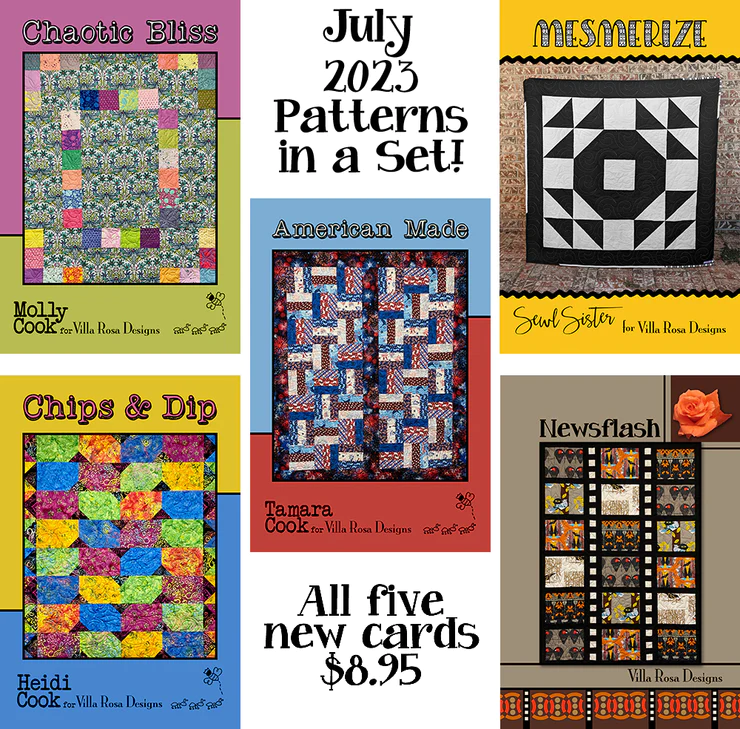
Here are July’s Brand New AWESOME AMAZING SPECTACULAR FANTASTIC Rose Card Patterns:

You can get all 5 regular patterns, above, for the special low price of $8.95 HERE.

BUT WAIT! THERE’S MORE!!!

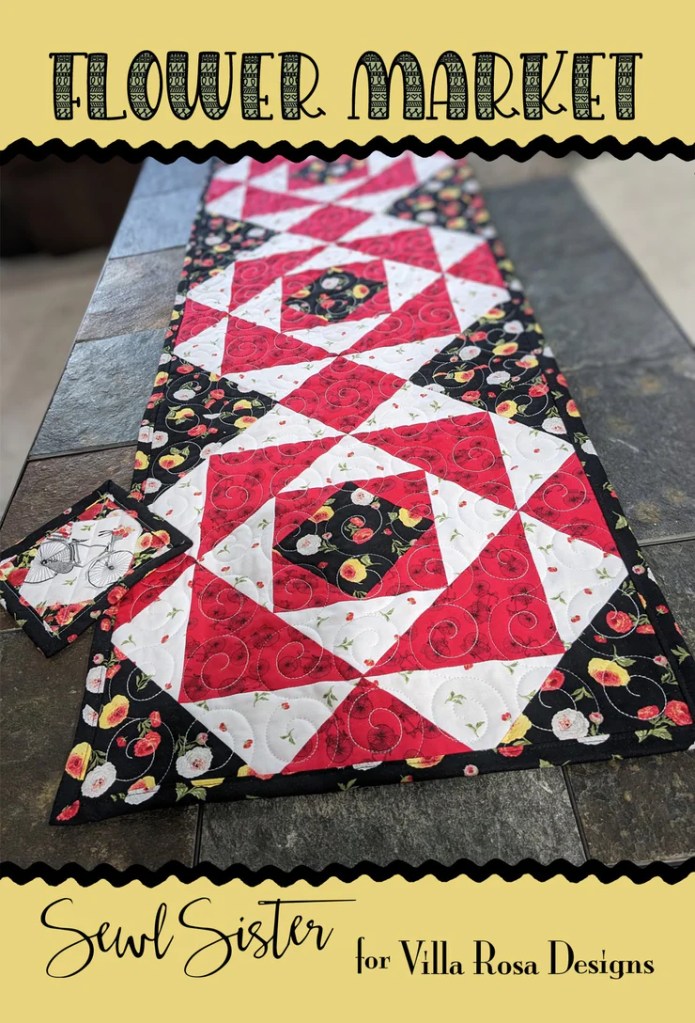
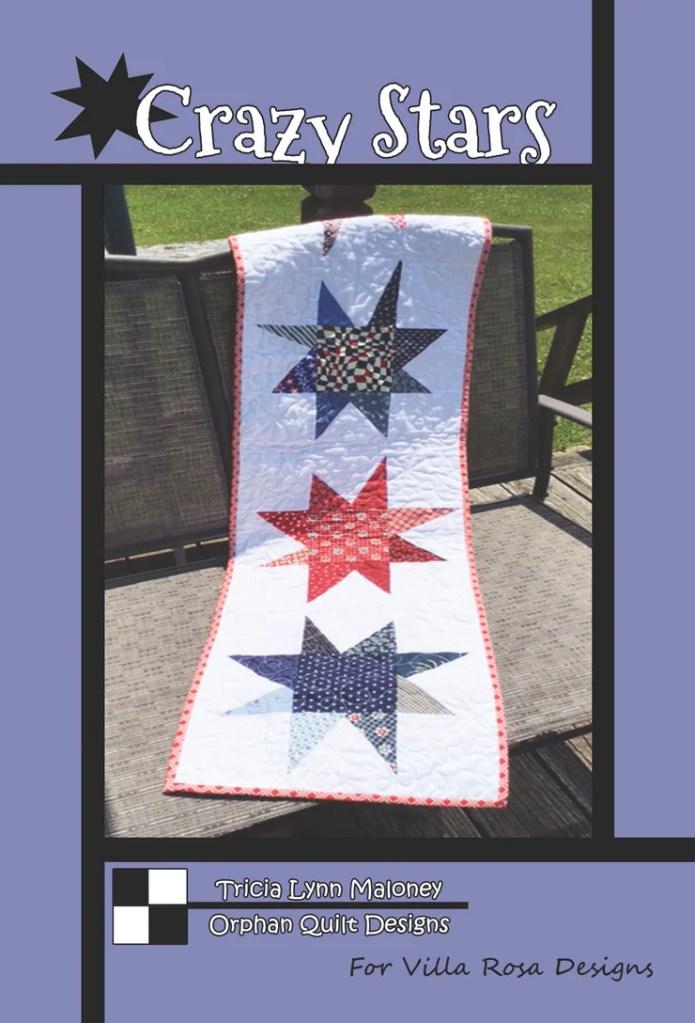
This month, we have TWO NEW Table Runners! Wahoo!!!

You can get Flower Market HERE and you can get Crazy Stars HERE.

Hey! Did you know you can get each month’s new Rose Card patterns delivered right to your mailbox???

You can go HERE to sign up to get the 5 regular patterns each month

Or,

You can go HERE to sign up to get the 5 regular patterns plus table runners each month.

And, don’t forget shipping for Rose Card patterns is always free.

VRD Crazy Stars Table Runner Tutorial

I thought it might be helpful to everyone if I did a tutorial of my new table runner, Crazy Stars. It was hard to figure out how to illustrate the pattern so it made sense. And, because I don’t trust my humble illustrations, I am going to show you step by step how to make the stars in Crazy Stars.

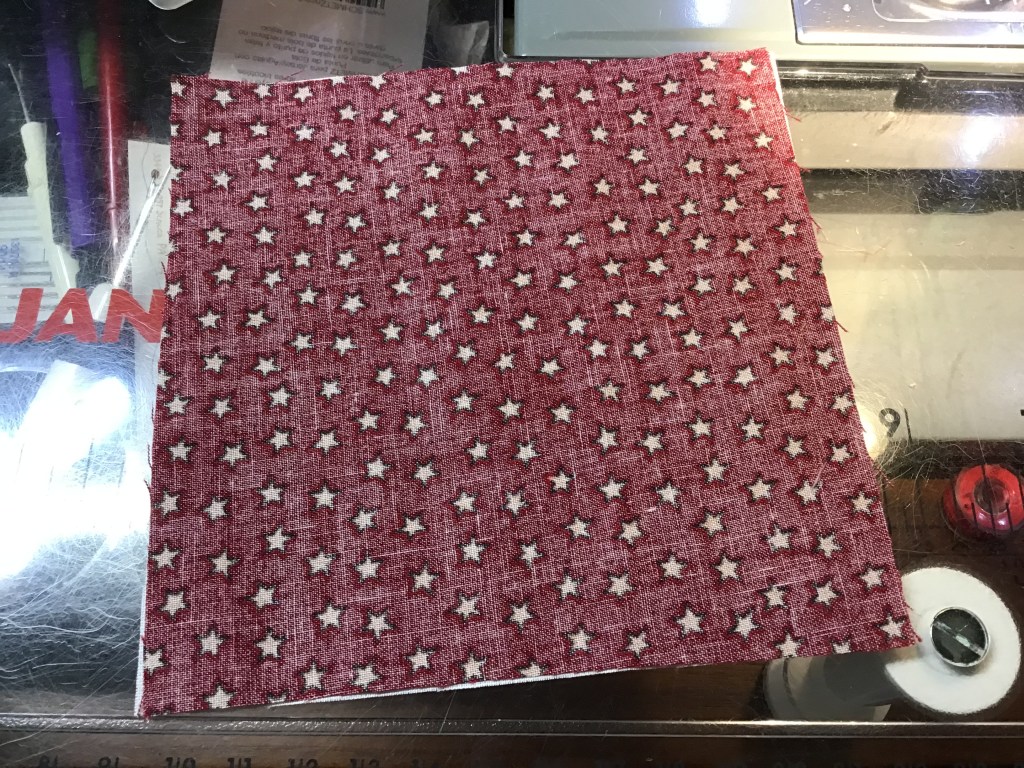
Step 1 The first thing you need to do is divide your charm squares into 4 stacks — one stack for each star. If you find that the colors end up a bit uneven, you can always add a few squares from your stash or even cut them from fat quarters or yardage.

Step 2 Layer a print charm square right sides together on top of a background square.

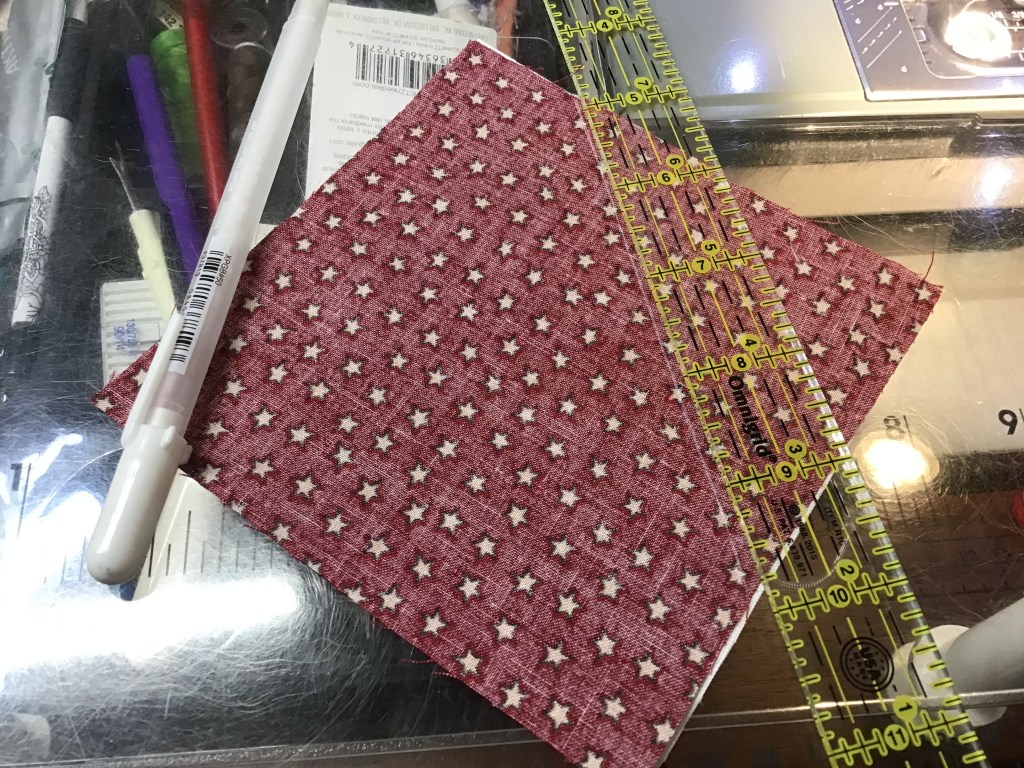
Step 3 Now the fun begins! Next use a ruler and draw a line from the bottom edge to the right edge. Place the ends of your diagonal line anywhere you’d like on those edges. Sew on the drawn line. Then open the unit and press towards the print square.

Step 4 Layer another print charm square right sides together on top of the background square. You will need to carefully line up the left and top edges. Please note you will see the right side of your first Star point square, just ignore it for now.

Step 5 Draw a diagonal line from the left edge to the bottom edge, while ignoring the print square on sticking out on the other side. Then open the unit and press. You will have a weird looking unit somewhat like the one in my photo, but your Star points might look different than mine because we probably started and stopped in different places along the edges.

Step 6 Repeat steps 2-5 to make 4 Star point units for one Crazy Star block.

Step 7 Turn a Star point unit over so that it is right sides down and the back of the unit is facing up. Do you see your background square kind of in the middle of the 2 print squares? Use the background square as your template and cut away the excess Star point print fabrics beyond the background square. Turn the unit right sides up again and you now have a perfect Crazy Star point unit. Trim the other 3 Star point units as well.

Step 8 You can reduce the bulk in each unit if desired. Fold back a star point until you see your stitching. Cut away the excess background and Star point fabrics 1/4″ away from the seam. I used my cutter and a ruler over the seam to protect it while I cut that 1/4″ seam allowance. Open the unit again and do the same thing for the second Star point. Repeat for the other Star point units.

Step 9 Now you have a fun and funky set of Star points to make into one Crazy Star block.

Step 10 Now it’s time to sew your Crazy Star block together like a Nine Patch. You will need 4 Star point units, 4 background squares for the corners, and a center print square.

Step 11 Repeat steps 2-10 to make a total of 4 Crazy Star blocks for the table runner.

Step 12 Then sew your Crazy Star blocks together into a row. You can twist and turn your blocks to see which star arrangement you like the best. Then layer your quilt, quilt it, and bind the edges. Don’t forget your label!

Well, that’s it for me. I hope this tutorial will make it a lot easier for you to put together your own Crazy Star Table Runners. Crazy Star blocks can be a lot of fun to make, so I hope you will give them a try.

Until next week —

Sew. Laugh. Repeat.

Always,

Tricia

Guest Bloggers · Rose Cards · Tips and Tricks · Tutorials · villa rosa designs

VRD Gallant Rose Card Quilt Tutorial

Hello Quilty Friends!

Happy Thursday to you!

PSST!

Hey, it’s me, Molly! I’m stealing the blog from Tricia this week!

I hope everyone had a fun (and safe) 4th of July!

You know, every year around this time, with patriotic things everywhere, I start thinking about Quilts of Valor. I know, making QOV quilts is something you can do any time of year, but when those brand new red/white/blue fabric collections start rolling in, it’s kinda like a screaming billboard to make a patriotic quilt.

So as we are unpacking the red, white, and blue collections here in the shop (want to see what the VRD shop in CA looks like? Go HERE), Gallant was calling my name (yelling?) to make it from one of these awesome new patriotic collections.

Get Gallant HERE.

Gallant was designed by our very own Tricia to meet the criteria for a Quilt of Valor quilt. The quilt on the cover of the Gallant Rose Card was presented to her cousin, Lisa, in 2022 at a family reunion QOV presentation.

You can read the blog post about the QOV presentation HERE.

Tricia’s cousin Lisa being presented with her Quilt of Valor.

So let’s get started! You will be amazed at how many different ways you can arrange the Gallant blocks — you can make this quilt over and over and you’ll never get bored.

VRD Gallant Quilt Tutorial

Making the Blocks

Gallant calls for red and blue fat quarters along with a background and an accent fabric for the top and bottom border to help make the size perfect for a Quilt of Valor (check out QOV quilt requirements HERE). Sounds easy enough, right?

After a lot of deliberation, I decided to use fabrics from the Liberty collection by Robert Kaufman and “Blossom on White Uncle Sam” fabric by Riley Blake for the background. Isn’t that a perfect background name for our quilt? LOL!

It didn’t take long to cut all the pieces for the blocks. And while I was cutting, I organized my pieces by color and size to make it easier to sew.

After you have all your pieces cut out, it’s time to get sewing!

Get ready, because these blocks almost sew themselves! Hah!

Lay out your A B C D cut pieces to make each block easier to sew. You can stack up all the A’s, B’s, C’s, and D’s like I did below — this will make things go even faster.

Now sew the four pieced strips together into one unit –ABCD. Then add the last red strip to the side of D. Make 36 blocks. Like I said before, they go together really fast!

Laying Out the Blocks

Now on to the most fun part of making Gallant!

Seriously, there are so many layouts for these blocks that it was hard picking the one I liked best. (The first photo on the top left is the layout Tricia chose for her Gallant quilt.)

Here is the layout I went with:

Finish Your Quilt

Sew your blocks together in your chosen layout. Warning! Shuffling the blocks around can be very addictive. LOL!

Finally, add the borders to the top and the bottom of the quilt.

Quilt and bind.

And don’t forget your label.

DONE!

Now find someone to gift your Gallant quilt to!

A Quilt Challenge for You

Did you like the fabrics I chose for my Gallant quilt? If so, I’m going to challenge you to make a Gallant quilt to gift to your favorite veteran or to your local Quilts of Valor organization!

We have Gallant quilt kits HERE at the shop, featuring the same fabrics as my quilt. So grab your Gallant kit and make your own quilt.

How many different layouts can you create with your blocks???

By the way, we always LOVE seeing what you do with our VRD patterns and kits, so if you are on our VRD Facebook page, please post a picture of your Gallant quilt!

If you’re not hanging out with us on Facebook, you should be! LOL!

That’s all for now.

Until next week —

Sew. Laugh. Give. Repeat.

Later,

Molly

Quilt Block Basics · Rose Cards · Tips and Tricks · Tutorials · villa rosa designs

Quilt Block Basics — The Hardworking Rail Fence Unit

Hello Quilty Friends!

Happy Thursday!

We’re getting close to the end of this series on the Basics of Quilt Blocks — just one more post next week and we’ll be moving on to other topics. I originally called it a mini series and expected it to be maybe 3 posts, but I am having so much fun with it, that it ended up turning into a much longer series. Personally, I love any idea that inspires me to play with my EQ8 software and to go through our VRD Rose Card Pattern Catalog and look at all the patterns with fresh eyes. I hope you’ve gotten a lot out of this series too.

If you’ve missed any posts in this series or if you just want to visit it again down the road, I added the series to the right side of the blog for you, right beneath the 2022 Basic Quilting Skills Series.

What’s our Quilt Block Basics unit for today??? RAIL FENCES!

Quilt Block Basics — Rail Fence

Rail Fences — YAY!

Whether you like 2, 3, 4, 5, or more logs, Rail Fence units and blocks are workhorses in the field of making quilt blocks (workhorse and field….get it???). Sigh…… I know, I know. I’ll stop here before I go overboard with the farm puns and cliches. I’m sure you’ve heard them all before anyway.

Sew, what’s a Rail Fence? You newbies might ask.

For the purpose of this series, we’re going to focus on 2 and 3 Rail Fence units with equal sized logs and finished squares. Keep in mind, though, that Rail Fence blocks can contain more than 2 or 3 logs, logs do not necessarily have to be the same width, and finished blocks do not have to be square.

Rail Fence units can stand alone as individual blocks or can be successfully combined with other basic block units to make even more quilt blocks. Rail Fence is the strong, silent type that fades into the background allowing others to be the stars of the show, but without Rail Fence, something would definitely be missing.

Rail Fences can be created with other methods when making quilt blocks. Sometimes a Rail Fence is actually a secondary design or a happy accident.

If you are getting the impression that I really like Rail Fences, then you are correct. One of the very first quilts I ever made from a pattern in the book, The Weekend Quilt by Leslie Linsley. That was the book that made me want to make quilts!

My quilt was a Rail Fence double-sized quilt will 4 shades of blue. I was sew proud of my piecing! It was the first time I’d sewn strip sets together and then cut them into blocks. At the time I didn’t know how to machine quilt yet, so I sensibly tied my quilt with white crochet thread and I used it for years on my bed.

Let’s take a look at some quilt blocks featuring Rail Fence units.

These 9 blocks are really just the tip of the iceberg when it comes to blocks with Rail Fence units.

How to Make a Rail Fence Unit

To make a traditional 2 log Rail Fence unit, first you need to know the finished size of your unit. So, let’s say our unit will be 6″ finished. To figure out what dimensions to cut our pieces, we will divide our finished size by 2 (6 divided by 2 = 3). But we need to cut our logs the same width of our finished unit, so we will need 2 logs 3″ x 6″ — BUT WAIT! — we need to add our seam allowances before cutting. That means we need to cut 2 logs 31/2″ x 6 1/2″. Then simply sew the 2 logs together along one long edge. Voila!

This image has an empty alt attribute; its file name is 2-log.jpg

To make a 3 log Rail Fence, instead of dividing the finished size by 2, we will divide it by 3 (6 divided by 3 = 2 and we need to add our seam allowances, too). So, we will need to cut our logs 2 1/2″ x 6 1/2″. Decide in which order to sew your logs (whether you decide to use 2 or 3 fabrics in your unit) and sew the 3 logs together along the long edges.

This image has an empty alt attribute; its file name is 3-log.jpg

A Few Simple Rail Fence Quilt Ideas for You

Here are two simple Rail Fence quilt designs using 2 different color combinations. But just imagine what you could create if you used multiple blocks, added more colors, etc. WOW!

Time to take a look at my curated collection of Rail Fence VRD Rose Card Patterns!

Features a skinny center log.

Get Ascot HERE

Uses a 5 log Rail Fence block.

Get Basket Case HERE

4 log Rail Fence blocks.

Get Beatrice HERE

Get Bits and Pieces HERE

Get Bride’s Dream HERE

Get Bunny Hop HERE

Both 2 and 3 log Rail Fence blocks!

Get Busy Bee HERE

5 log Row Fence blocks.

Get Chutes & Ladders HERE

Rail Fence blocks turned on their sides.

Get Cobblestones HERE

Get Dapper HERE

Slightly elongated 3 log units.

Get Firecracker HERE

Get First Night HERE

Unique configuration and controlled colors make such an interesting design.

Get French Braids HERE

Get Fruit Salad HERE

See how the Rail Fence units recede?

Get Gridwork HERE

Get Infinite HERE

Get Inglenook HERE

Get Jubilee HERE

4 log Rail Fence blocks.

Get Limelight HERE

Get Melinda Jo HERE

Get Native HERE

Get Panama City HERE

Get Playdate HERE

Get Polka HERE

Very clever color placement!

Get Positive Sign HERE

Love Melissa’s scrappy traditional Rail Fence design!

Get Rail Fence HERE

Thin center log.

Get Ripple Runner HERE

Fat center log.

Get Royal Sunset HERE

Another fat center log.

Get Saratoga HERE

Get Scallywag HERE

Get Shadow Dancer HERE

Stack up those Rail Fence blocks!

Get Snow Ruby HERE

One of my favorite Rail Fence variations!

Get Social Climber HERE

Get Specks of Color HERE

Get Spin Cycle HERE

Skinny center logs.

Get Split Charms HERE

Get Standing on the Corner HERE

Get Sugar & Spice HERE

Get Tumblebug HERE

Get Vienna HERE

Get Village Glade HERE

Fat center logs.

Get Waterside HERE

Get Winter Garden HERE

Stack ’em up!

Get Zelda HERE

That’s another wrap! Time to sign off and get back to making quilts………in my dreams, anyway. LOL!

Until next Thursday —

Sew. Laugh. Repeat.

Always,

Tricia @VRD

Quilt Block Basics · Rose Cards · Tips and Tricks · Tutorials · villa rosa designs

Quilt Block Basics — Square in a Square and NEW VRD Rose Cards for May 2023

Hello Quilty Friends!

Happy Thursday!

Before I forget I want to wish all you Moms, Grandmas, Aunties, Cousins, Step Moms, Pet Moms, Dads, Caregivers, Teachers and ANYONE who has touched the life of a child a very special Mother’s Day.

Thank you for everything you do everyday. Although you might not get a thank you or an acknowledgement, those little everyday things mean more than you will ever know.

Quilt Block Basics — Square in a Square

This week we are going to talk about the Square in a Square unit.

You may also know this unit as the Diamond in the Square quilt block.

Often, you will see this unit combined with other quilt block units to create really cool quilt blocks. The unit usually has an unpieced square in the center, but sometimes you will see that center square filled in with a pieced unit or block, which makes Square in a Square not only a unit, but also a frame.

Why am I telling you all this? Just food for thought if and/or when you are designing your own quilt blocks!

Let’s take a look at some Square in a Square blocks.

I find the Square in a Square unit to be a very good tool in my designer’s quilt toolbox because it can really add a lot of POW to a quilt block. Wouldn’t you agree?

Let’s take a couple minutes and play with this unit. Only a couple minutes, mind you, or I might get lost in Electric Quilt 8 all day. Seriously, I’m not kidding….

Here is our single unit again:

Here are 4 units together in a 4 Patch block:

And here are 9 units together in a 9 Patch block:

You can see how complex looking the 9 Patch version (our Kansas Star block from above) is, just by repeating the Square in a Square unit. And I added another color just for fun, which can add a whole other dimension. Do you see the star in the middle?

Let’s play with our color placement now. Same block, 3 different ways!

Now let’s go crazy and add a few other Quilt Block units that we’ve already explored — HSTs, Hourglass, and Flying Geese.

MUST. STOP. NOW. Or else I’m going to forget all about writing the rest of this blog post and keep playing in my EQ8 for the rest of the day. LOL!

How to Make a Square in a Square Unit

This unit is a breeze to make.

My favorite method uses a large square and 4 smaller squares, so I don’t have to worry about working with fiddly triangles and stretchy bias edges.

But, how do you know what size squares to cut???

Math…….math…..math, of course! There is a nifty little formula to figure out the sizes of squares needed. You can also find cutting charts too, but what’s the fun in that???

  1. You need to know your finished size. So let’s say I want a finished size of 6″ for my unit.
  2. Next you need to add 1/2″ to your finished size and that is the size of your large center square. So, if I want a finished block of 6″, then I need a 6 1/2″ square for the center.
  3. For the 4 small squares, you will need to divide the size of the finished unit in half (6″ divided by 2 = 3″) and add 1/2″ (3″ + 1/2″ = 3 1/2″). So for a 6″ finished block, I need to cut 4 squares 3 1/2″. Easy Piezy! (Maybe you’re wondering why I add the 1/2″? The 1/2″ is what you add to a finished size to account for your seam allowances. We add 1/4″ for each side which equals 1/2″ in total needed for seam allowances.)

Okay, what about an 8″ finished unit or block? I would need to cut 1 large square 8 1/2″ and 4 small squares 4 1/2″.

What about a 2 1/2″ finished unit? Then I would cut the large center square 3″ and the 4 small squares 1 3/4″.

Cool, huh???? Quilt Math never fails to amaze and amuse me (wink, wink).

So, let’s make the block now:

  1. Layer a small square right sides together in one corner of a large square. Draw a diagonal line from corner to corner. Sew on the line. Repeat for the opposite corner. Cut 1/4″ away from each sewn line. Press open.
  2. Repeat with the other 2 opposite corners.

I do want to take a moment to point out that you can get a Square in a Square look by using different units like HSTs, Flying Geese, and more. Just something to think about….

But wait! There’s more….

If you aren’t completely sold on my method, you have other options —

There is a cool Creative Grids ruler, you can find it HERE.

It’s Sew Emma has even created Square in a Square foundation papers in both THREE INCH and FOUR INCH sizes.

Next let’s check out my Square in a Square curated list of patterns!

Square in a Square VRD Rose Card Patterns

This clever quilt actually uses Hourglass units to achieve a Square in a Square.

Find Downtown HERE

Like Downtown, Duffy uses a different unit (Flying Goose) to create the look of a Square in a Square block.

Get Duffy HERE

Hidden Gems uses HSTs to achieve the look of Square in a Square blocks.

Get Hidden Gems HERE

Again, this one uses HSTs to get the Square in a Square look.

Get Indigo Bay HERE

Point of View uses 4 Square in a Square units in each block.

Get Point of View HERE

Raspberry Cream uses HSTs, too!

Get Raspberry Cream HERE

Sky Diamonds uses HSTs with a quick Flippy Corner to make a really unique Square in a Square variation.

Get Sky Diamonds HERE

A Square in a Square variation with pieced corners.

Get Square Box HERE

I am including Twisted in my list because you get the affect of Square in a Square blocks with the Pinwheels, although it actually uses Y Block units.

Get Twisted HERE

I’m including this one because you get the Square in a Square affect on point — it uses HSTs and careful color placement.

Get Underground HERE

The large center Square in a Square unit is made with HSTs.

Get Whiplash HERE

Winchester uses HSTs to get the center Square in a Square unit.

Get Winchester HERE

A fun list of patterns, isn’t it? Don’t forget that when you order Rose Card patterns on the Villa Rosa website, it’s always free shipping for patterns. Always.

New Villa Rosa Designs Rose Card Patterns for May 2023

Moving on, do you know what day it is????

It’s the first Thursday after the first Friday of the month, which means NEW PATTERNS! YAY!!!

Here are the 5 regular patterns for May. Aren’t they great? Some nice variety in patterns and interesting options, wouldn’t you say?

Bubbles by Sugar Pine Quilts uses a fun bright collection of fat quarters and a background fabric.

31 is a new vertical panel quilt with a fun border. Join me in wishing VRD designer Molly Cook a Happy 31st Birthday this month.

Tiramisu is a very cool quilt featuring either 12 or 20 fat quarters. You get to decide which size of quilt you want with this one.

Happy Thoughts is my latest throw quilt pattern and it uses a focal or theme fabric and coordinating 5″ charm squares.

Tres Leches looks as yummy as its name! This quilt uses yardage.

You can get all 5 patterns HERE for the special price of $8.95. Yep, and the shipping is free.

And here’s my new Table Runner Rose Card Pattern for May called Fly Away.

When I was designing and then later making this runner, I kept thinking about the movie, Fly Away Home, so in homage to that great movie, I named my runner Fly Away. By the way, you can find the movie HERE.

Well, I guess that does it for me this week.

Please spend time with the ones you love this week end for Mother’s Day. Wouldn’t a quilt be a nice gift to show your loved one how much you care??? Just sayin’…………..

Until next Thursday —

Sew. Laugh. Repeat.

Always,

Tricia @VRD

Quilt Block Basics · Rose Cards · Tutorials · villa rosa designs

Quilt Block Basics — Quarter Square Triangles (QSTs)

Hello Quilty Friends!

Happy Thursday to you!

I hope you’re ready to dive right back into our Quilt Block Basics mini series! This week, we’re going to talk about Quarter Square Triangles (QSTs). So, what exactly is a QST?

A QST is made up of 4 triangles sewn together into a square. Those are Isoceles triangles for you math people out there. LOL!

You might have heard of this as an Hour Glass unit. Barbara Brackman, quilt historian extraordinaire, and Electric Quilt call it Four X. What other names have you heard this unit called?

I guess in a way, you could even consider it to be a type of a Four Patch, but calling it a QST helps to differentiate it from the classic Four Patch, below, which is made up of 4 squares.

Let’s look at some quilt blocks with QSTs! Some are old favorites and some may be new to you.

How to Make a Quarter Square Triangle

  1. Layer 2 squares the same size, right sides together.
  2. Draw a diagonal line from one corner to the opposite corner.
  3. Sew 1/4″ away from both sides of the line.
  4. Cut on the drawn line and open each unit to make 2 HSTs. (What????? HSTs???? Wait — we’re not done yet!)
  5. Layer the HSTs right sides together so that the light triangle is on top of the dark triangle and vice versa.
  6. Draw a diagonal line from corner to opposite corner, perpendicular to the already-sewn seam.
  7. Sew 1/4″ away from both sides of the line.
  8. Cut on the drawn line and open each unit to make 2 Quarter Square Triangles!

You may have noticed that I didn’t include any measurements for cutting the squares. Well, that was intentional. Just like HSTs, there is a magic math formula to figure out the size of squares you need to cut based on what your desired finished size will be (no charts to lose!).

YAY MATH!

And the magic number for QSTs is…..drum roll please………1 1/4.

Yep, that’s it. Add an extra 1 1/4″ to your finished size and your QSTs to get the right size.

So…………

If you want 4″ finished QSTs — then cut your squares 5 1/4″.

Want 8″ finished QSTs? Then cut your squares 9 1/4″.

What about 1″ finished QSTs? Cut the squares 2 1/4″.

That’s it, folks. Isn’t quilt math delightful?

Seriously, I would have loved geometry way back when if my high school geometry teacher had taught me quilt math instead of writing proofs to prove a square was “squarular”. Sigh…….yes, I know — that’s not really a word, but in my humble opinion, it should be……..triangles are triangular and rectangles are rectangular so why aren’t squares squarular????

Okay, enough of that! Don’t get me started on the vagaries of the English language. LOL!

Instead, let’s look at some great Villa Rosa Designs Rose Card patterns that feature QSTs.

QST VRD Rose Card Patterns

Get Baby Cakes HERE

Get Diamond Daze HERE

Get Downtown HERE

Get Kristin HERE

Get Tropicana HERE

This is a super short list compared to the HST list I curated a couple weeks ago, isn’t it? You can find the HST VRD list HERE if you missed it.

Well, that’s it for me for this week. Go forth make QSTs! Lots and lots of QSTs!

Until next Thursday —

Sew. Laugh. Repeat.

Always,

Tricia @VRD

Just Quilty Stuff · Quilt Block Basics · Quilt Play · Rose Cards · Tips and Tricks · Tutorials · villa rosa designs

Quilt Block Basics — Half Square Triangles (HSTs)

Hello Quilty Friends!

Happy Thursday to you!

Before I dive right into HSTs, I want to show off my completed Helix quilt top. Yes, I finished it! I really like the finished top, although I wish my points had turned out better. What do you think?

I didn’t have enough background left to add side strips, but that was okay, it will be fine as long as I’m careful when I sew the binding on because I don’t want to cut off the triangle points.

Quilt Block Basics

Lately I’ve been feeling very creative — maybe the change in the weather? I’ve been churning out new quilt designs on my EQ8 (Electric Quilt) software and I will never have enough time to make them all, I’m afraid. While I was working on all these new designs, I started thinking about the smaller units that make up quilt blocks and I thought — AHA!!! That’s a great topic for the blog!

So, welcome to a new VRQ mini-series, all about the smaller units that make up our favorite quilt blocks.

The first unit I want to talk about is the Half Square Triangle.

Half Square Triangles (HSTs)

Half Square Triangles or HSTs are one of the most common building blocks for a pieced quilt block. Sometimes you see HSTs called Triangle Squares or Half Square Triangle squares or blocks. I like to keep things simple when I write instructions and I consistently use Half Square Triangles or HSTs.

You can find HSTs in simple blocks such as:

Or in more complex blocks like:

One of my most favorite things is playing around with the parts of my blocks to create new block designs when I’m designing. I like to change colors, switch lights and darks, and change the orientation of the units within a block in order to create something new and different. EQ8 makes this sew easy to do.

To show you what I mean, let’s play with the Mosaic # 17 block, which is all HSTs and gives us lots of room to play!

Let’s change the orientation of the HSTs:

Now let’s add another color in the mix:

Let’s try change the orientation, too:

Okay, okay, I’d better stop here or I’m going to lose my writing focus and create another stack of quilt designs I will never have time to make! LOL!

I think you can see how much fun it is to play with HSTs. Imagine what happens when you add other building block units with the HSTs………but that is a post for another day.

Half Square Triangle Assembly

There are many different ways to make HSTs — just check on YouTube, Pinterest, or your favorite quilting magazine.

I am going to show you my favorite method here — this is the method I use in my quilt instructions.

  1. Layer 2 squares together, right sides together (RST).
  2. Draw a diagonal line from 1 corner to the opposite corner.
  3. Sew 1/4″ away from both sides of the drawn line.
  4. Cut the HSTs apart on the drawn line. Open to make 2 HSTs.

I bet you noticed I didn’t use any dimensions for my fabric squares. That was intentional. As I’ve said many times, quilting is all about math (check out my ode to quilting and math HERE).

HSTs are no different! You can use this construction method to make any size HST. You just have to know a teeny tiny magical math secret!

To figure out how big to cut your squares, you need to add 7/8″ to your finished dimensions! Really, that’s all you need to remember. You don’t need to refer to a cutting chart, you just need to remember 7/8″. (Please note that 7/8″ may not work for all HST methods.)

Here are some examples:

I want my HST’s to finish at 3″, so I need to cut my squares 3 7/8″.

5″ finished? Cut 5 7/8″ squares.

12″ finished HSTs……….cut 12 7/8″ squares.

Easy peasy! YAY MATH! Thank you, Mrs. Hank (my high school math teacher)!

HST VRD Rose Card Patterns

We have a wonderful collection of HST pattern sin our VRD catalog. It’s a L O N G list, so hang in there until the end of the post.

Here’s my curated HST list:

Get the April Showers pattern HERE

Get the Baby Zip Ties pattern HERE

Get the Bat Dance pattern HERE

Get the Be Unique pattern HERE

Get the Beatrice pattern HERE

Get the Blizzard pattern HERE

Get the Carnival Glass pattern HERE

Get the Chop pattern HERE

Get the Columbia pattern HERE

Get the Crossed Paths pattern HERE

Get the Diamonds pattern HERE

Get the Domino Five pattern HERE

Get the Drayton Hall pattern HERE

Get the Elementary pattern HERE

Get the Estrella pattern HERE

Get the Fa La La pattern HERE

Get the Falling pattern HERE

Get the Fernanda pattern HERE

Get the Friendship Hearts pattern HERE

Get the Giggles pattern HERE

Get the Hanover pattern HERE

Get the Hidden Gems pattern HERE

Get the Hole in One pattern HERE

Get the Illumination pattern HERE

Get the Indigo Bay pattern HERE

Get the Jardena pattern HERE

Get the Malaysia pattern HERE

Get the Maple Grove pattern HERE

Get the Mountains pattern HERE

Get the Movie Star pattern HERE

Get the Nana’s Aprons pattern HERE

Get the Notches pattern HERE

Get the October Sky pattern HERE

Get the Optic pattern HERE

Get the Orange Waves pattern HERE

Get the Painted Moon pattern HERE

Get the Party Girl pattern HERE

Get the Party Girl Remix pattern HERE

Get the Peppermint & Holly pattern HERE

Get the Pinwheel Picnic pattern HERE

Get the Pride pattern HERE

Get the Rainbow Road pattern HERE

Get the Raspberry Cream pattern HERE

Get the Rebound pattern HERE

Get the Remember Me pattern HERE

Get the Salt ‘n’ Pepper pattern HERE

Get the Salute pattern HERE

Get the Serengeti pattern HERE

Get the Silver Star pattern HERE

Get the Sisterhood pattern HERE

Get the Smidge pattern HERE

Get the Smudge pattern HERE

Get the Snow Goose pattern HERE

Get the Solar Flare pattern HERE

Get the Spaceman pattern HERE

Get the Spiritualized pattern HERE

Get the Square Box pattern HERE

Get the Star Rail pattern HERE

Get the Starfire pattern HERE

Get the Stars N Stripes pattern HERE

Get the Sunny Day pattern HERE

Get the Tower Bridge pattern HERE

Get the Twinkle pattern HERE

Get the Underground pattern HERE

Get the Waverly pattern HERE

Get the Whiplash pattern HERE

Get the Whirlpool pattern HERE

Get the Wild Rover pattern HERE

Get the Winchester pattern HERE

Get the Winter Sun pattern HERE

Get the X Ray pattern HERE

Get the Zig Zag pattern HERE

Get the Zip Tease pattern HERE

Get the Zipper pattern HERE

I hope you enjoyed this VERY extensive list of HST Rose Card patterns. Thanks for suffering through the whole list (wink, wink).

As I was gathering them from the VRD catalog, I was struck with the enormous amount of creativity and innovation shown by our VRD designers.

Kudos to all of the VRD designers! You rock!

Well, that’s it for me for this week.

Take care until next Thursday —

Sew. Laugh. Repeat.

Always,

Tricia @VRD