2025 Free Motion Quilting (FMQ) Series

Beginner Free Motion Quilting (FMQ) Lesson 7 – Quilting Borders with 3 Simple Designs

Happy Thursday to you!

I am so happy that spring has pretty much sprung here in NW PA, at least for right now, anyway! Last week the weather was simply gorgeous and after a day of cold temps, we’ve bounced back into spring. Today will be in the 70’s! For me, I know that spring is finally here when I fall asleep listening to the peepers. The robins, red- winged blackbirds, and grackles are back, too. When do you know it’s spring in your neck of the woods?

This week we are wrapping up our Beginner Free Motion Quilting (FMQ) series with some ideas for quilting borders. I’ll let you in on a little secret of mine – when I’m rushed for time, I use an allover design for the entire quilt, but when I have some extra time or if a quilt just needs it, I use a different design in the border. Let’s jump right in, there’s a lot to cover today.

If you missed any FMQ lessons, you can find them here:

Lesson 1: All the Background Information

Lesson 2: Let’s Doodle!

Lesson 3: Practice, Practice, Practice

Lesson 4: The Write Way to Doodle!

Lesson 5: Going Beyond Loops Part 1

Lesson 6: Gong Beyond Loops Part 2

I’m going to share with you 3 of my favorite go-to border designs along with variations of each to spark your creativity and to help you expand your FMQ toolbox of designs.

The hardest part of quilting borders, in my humble opinion, is making the transition around the corners. Usually, I add some kind of element in the corners to connect my border designs, but sometimes a design lends itself to bending around the corner without needing an element. Below, I’m going to show you both styles.

Zig Zags

Zig Zags are a SUPER border option when you’re just getting started with FMQ. It is a base design you can add to as your skills grow.

Here’s a good example of the basic Zig Zag design. You can see in the corner, I did an inverted triangle, which fills the space nicely and is a nice transition. The Zig Zag design is a very flexible design that can be sized to the width of the border strips – make it narrow for inner borders or wide for outer borders. You can even use it for sashings!

Above is the Zig Zag design doodled on my white board with my trusty dry erase marker. Easy piezy. Really.

If you’re not a fan of the inverted corner triangle, try some of your own ideas in the corners. Doodle, doodle, doodle.

Then when it’s easy for you to draw, it’s time to make a fresh practice square and practice quilting the Zig Zag design until you feel comfortable with it. Finally, take a deep breath and quilt it on a small project.

It might not be perfect, but that’s okay. Pat yourself on the back. It takes courage to do something new. I want you to remember there is no such thing as perfect. A finished quilt is a lot more satisfying than trying to find perfection and never finishing that project. YOU CAN DO IT!

Now let’s look at some variations of the Zig Zag border design. The following designs were created by quilting the border once and then going back and adding a second layer of quilting. The red line is the first quilting line and the blue line is the second quilting line in my doodles below.

PSST! One of the biggest secrets to quilting borders is that you don’t have to create the design in only one pass. Breaking a design into multiple passes can make a real jaw-dropping finished border design and you’ll be the only one who knows how simple it is, so don’t tell anyone, okay?!?

Double Zig Zag
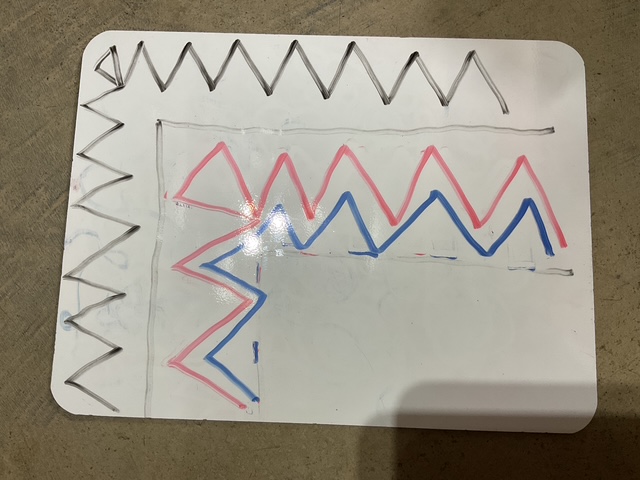
Double Zig Zag is simply quilting the basic Zig Zag design and then echoing another line either above or below the original Zig Zag. Depending on what you put in the corners, you might have to make a different transition than the one I used.

Mirror Image Diamonds
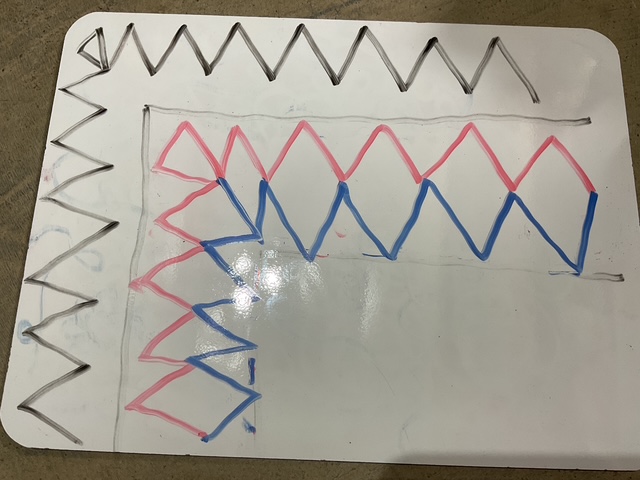
In this variation, I quilted the basic Zig Zag design and then with my second pass, I quilted the mirror image to make Diamonds. Again, depending on your corner element, you might have to come up with your own transition.

Argyle

Here I overlapped 2 lines of Zig Zags, off-setting the second Zig Zag about a half a Zig Zag so that the points are opposite of each other.

Trees

I LOVE this design! So many ways to use it. The first pass is the basic Zig Zag design – just make sure to leave enough space at the inside edges of the border so you have room for your second quilting pass with the trunks. I drew over my corner inverted triangle on the second pass and made it into an outward-facing tree. SEW cute!

I’m going to stop making Zig Zag variations right now or else I’ll never get to show you the 2 other designs! Have fun creating your own variations. I warm you though, it can be addictive. LOL!

Hillside

I’m calling our 2nd border design Hillside. It’s a lot like Zig Zag, but with curves instead of points. This design can also be used as an allover design and it lends itself to lots of variations. Yay!
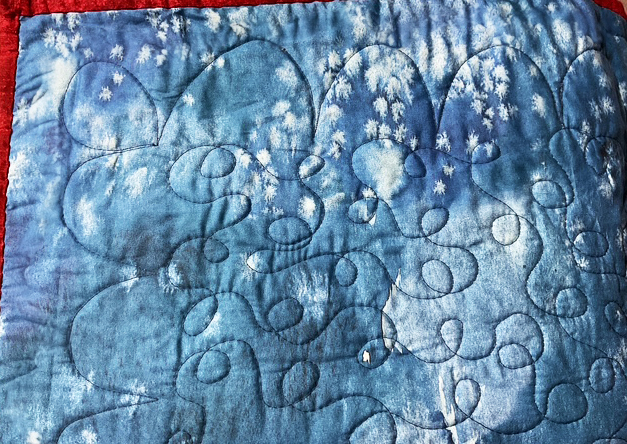
I’m sorry if the example above might be a little hard to see because of the blue backing fabric, but I think you can still make out the Hillside design.

You’ll notice I quilted a teardrop shape in the corner, but you can place any element you want in your corners, or omit corner elements entirely. Be creative, make this design your own.

Here’s my Hillside doodle on my white board. Fun, huh? I really like using this design because curves can be very forgiving.

On the following Hillside variations, please note that the red line is my first quilting pass and the blue line is my second pass.

Grab your white board and doodle along with me!

Hillside Fans
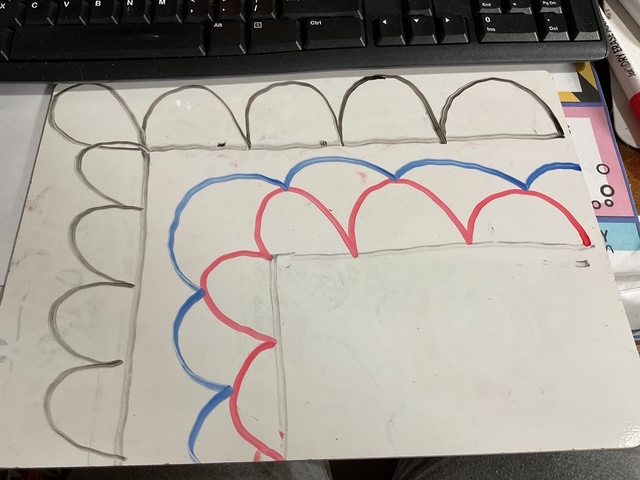
This version is a very simplified Baptist Fan. Like the Zig Zag design, you can size this design for any width of border. If it’s a really wide border, you can quilt multiple passes of the Hillside design to fill the space. In this version, I moved over half a Hillside to offset the second row. I also opted to skip the corner element and simply quilted a big Hillside arc in the corner. Snazzy!

Hillside Echo

Here is Hillside with an echo. This design has a great vibe, is easy to do, and looks very nice on a quilt. Again, I omitted the corner teardrop and just made 2 passes of Hillside.

Rainbows
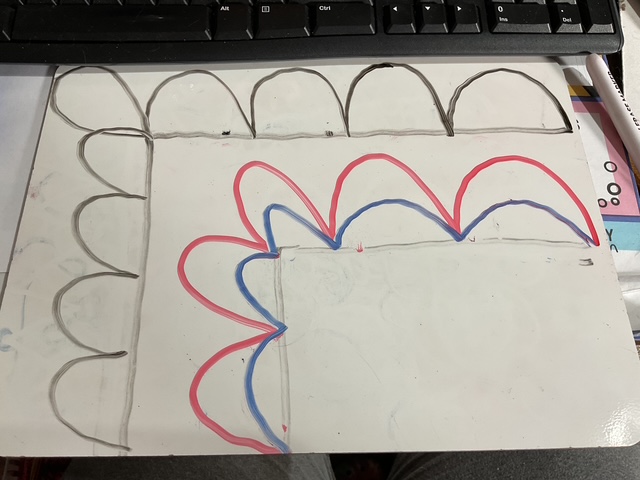
Isn’t this a really fun and quirky Hillside variation? It looks great on kids’ quilts but could also look elegant on a formal table runner, too. Again, I did not draw a corner teardrop, instead I just let the Hillside Echo strut its stuff. This design is also made with 2 passes; however, you can add as many Rainbow passes as you want and have space for – the more the merrier!

Hillside Zig Zag
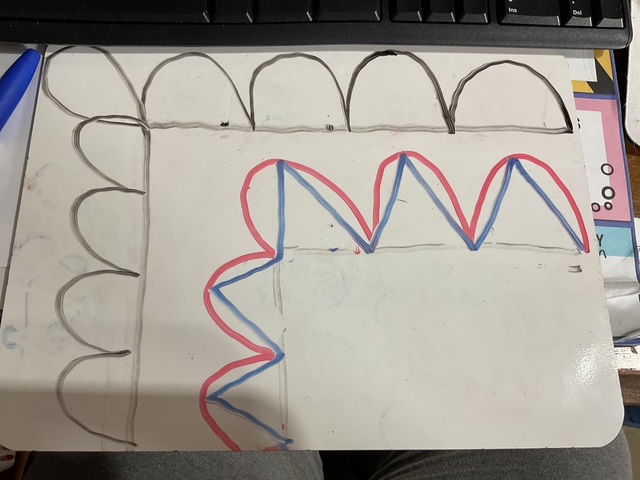
Another big secret of FMQ is combining different designs together to make more interesting and more complex-looking designs. It just takes some practice, some time, and a sprinkle of patience. I drew the Hillside design first and then added the Zig Zag inside the Hillside as my second pass.

These are just a few beginner-friendly variations of Hillside. I bet when you’re doodling, you’ll come up with some more. Just don’t forget to actually try quilting on your practice square and once you feel comfortable, quilt a real small project! WOW!

Loops

I’m sorry, but I couldn’t find a quilted example of a border Loops design, so we’ll have to use my doodles as our reference.

This design is a lot like our basic Loop allover design from earlier in the series , but it is straight instead of meandering and the loops all point in one direction.

In the Loops design, above, I drew alternating big and little loops, which is sometimes called E’s and L’s.

Most of the time, though, I make my loops roughly the same size instead of alternating big and small. Grab your white board and try this one out. When you’re ready, try it on your practice square. I bet you’ll get comfortable with this design quickly, so don’t forget to move on to quilting an actual small quilt project.

Now let’s play with a couple Loops variations. Like the previous designs, the red line is my first pass and the blue line is my second pass.

Lace Edge 1
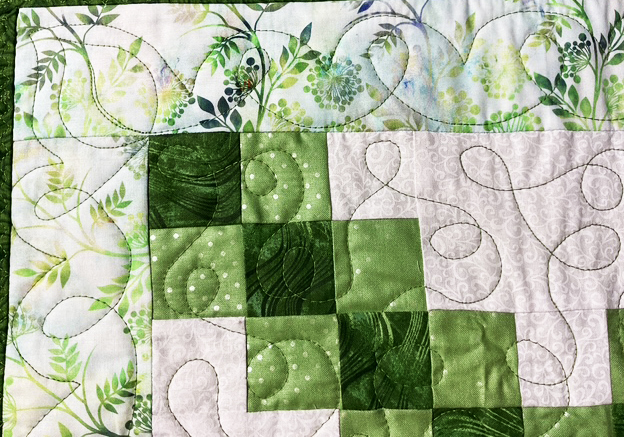
This quilt example, above, is a corner of my recent Erin table runner. I added a simple leaf in the corners because of the foliage border fabric. Want to see more of the quilt? You can find the Erin pattern HERE.
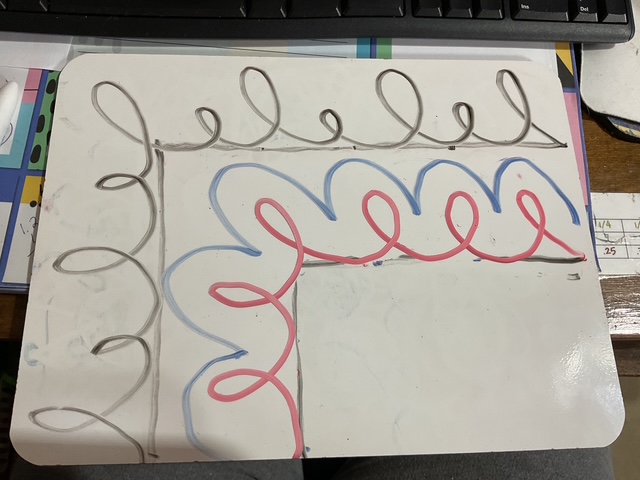
In this Lace Edge doodle, I did Loops (all roughly the same size) for the first pass and then I quilted Hillside as the second pass. This is absolutely one of my favorite designs – hands down! I use it often, quilting different elements in the corners or no elements at all.

Lace Edge 2

In this Lace Edge variation, I quilted 2 rows of Loops, but I flipped the second one over so it was facing the first pass of Loops and I moved over a half space. This design can look stunning on quilts. And complicated, too. SHHH! Never tell anyone how easy it really is. LOL!

Once you’ve quilted your quilt, it’s time to add binding to finish the edge. And don’t forget your label.

Check out these posts from our 2022 Beginner Quilting series:

Squaring Up Your Quilt

Binding 101

Label Your Quilt

Well, that’s a wrap! I hope you found our Beginner FMQ series to be helpful. Leave a comment if you did and what you liked the best about the series.

And as always, I’d love to see your free motion quilted quilts! Please share them on our VRD Facebook page.

Have a great week with some sunshine, some FMQ, and a sprinkle of Irish luck (wink, wink!).

Until next week –

Always,

Tricia @ VRD

2025 Free Motion Quilting (FMQ) Series

Beginner Free Motion Quilting (FMQ) Lesson 6 – Going Beyond Loops Part 2

Happy Thursday to you!

I hope you have all been practicing your Loops and your Loop variations from last week’s Lesson 5. This week we are going to continue Going Beyond Loops with 3 more Loop variations.

If you missed any of our Beginner Free Motion Quilting (FMQ) Lessons so far, you can find them all below:

Lesson 1: All the Background Information

Lesson 2: Let’s Doodle!

Lesson 3: Practice, Practice, Practice

Lesson 4: The Write Way to Doodle!

Lesson 5: Going Beyond Loops Part 1

I have also added a section over on the right side of the blog entitled 2025 Beginner Free Motion Quilting Series where you will be able to easily find all of the lessons in the future so you don’t have to sift through posts to find them.

If you’ve been having fun playing around with the Loop variations from last week, good for you! I hope you came away with the knowledge that you can add any kind of motif to the basic Loop design to change it up. Stars? Check! Hearts? Check Check! Elephants? Sure, why not. You just need to practice drawing an elephant motif without lifting your dry erase marker on your handy dandy white board. Practice until you are happy with your motif. Then practice drawing your Loops and motif together on your white board. Again, practice until it feels natural and you are not lifting up your dry erase marker (this is super important!). Then make a fresh practice square, take a deep breath, and just do it! This is my basic method for creating endless Loop variations. I’ve done hot air balloons and palm trees, to name a few. You can too, it only takes practice. And courage. You. CAN. Do. It.

Are you ready? Strap on your helmet and put on your your seat belt cause here we go!

#4 Double Loops

I think you’ll love these Double Loops – they are quick and fun and look great on most any project except maybe Civil War reproductions.

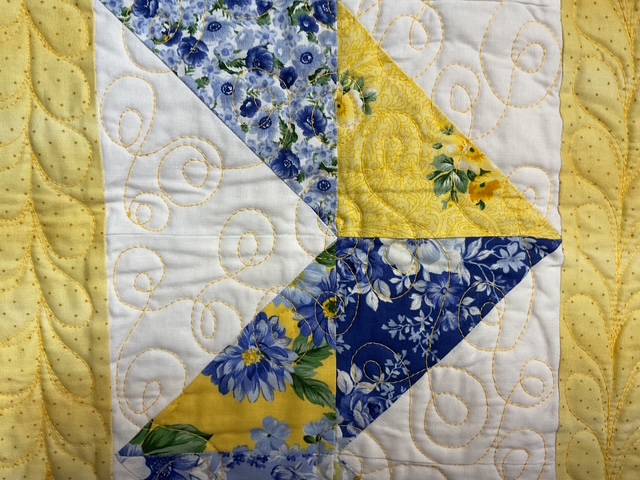
Check out my Double Loop example below. This is a close up of the quilting on my cover quilt for my Sunny Day VRD Rose Card pattern. Yes, I quilted a simple Feather design in the borders. LOL!

So, let’s grab our white boards and give Double Loops a try. Go ahead and draw a loop, then loop around the loop. Easy and very fun.

Now let’s practice connecting our Double Loops together.

Go ahead and practice this a bit until it feels comfortable.

It’s time to try this design on a practice square on your sewing machine. Below, you can see how I make Double Loops. It takes a little practice, but because you’ve already been working on the basic Loops design, adding a second loop around your first loop won’t take as long to master. So, get to it and quilt some Double Loops!

Wasn’t that a fun design? Just imagine all the quilts you can finish using this quirky and cool FMQ design? And don’t forget that you can change it up and make it entirely your own designs.

#5 Leaves

Leaves are a super element to have in your FMQ toolbox because leaves are all around us from the fabrics to the quilt blocks to the trees right outside the window. Can’t you picture how leaves will look quilted on your autumn quilts?

You can create leaves in just about any shape or style you can imagine. For this lesson, I’m going to show you a simple leaf or two. Feel free to use your imagination to come up with your own leaf shapes, too.

Here is a simple heart-shaped leaf for you to practice.

Once you get the leaf shape down, now it’s time to add it to your basic Loop design.

Go ahead and practice the Leaf variation until you can do it smoothly. Then it’s time to try it on your practice square with your sewing machine.

Here’s a quick video clip of me quilting the Leaf and Loop variation.

Practice. Practice. Practice.

#6 Flowers

Our last variation is adding flowers to our basic Loop design. Like leaves, you can create any flower shape you want or you can even mix different flower shapes together with you loops to create an entire quilted flower garden. For today, we are going to focus on Daisies.

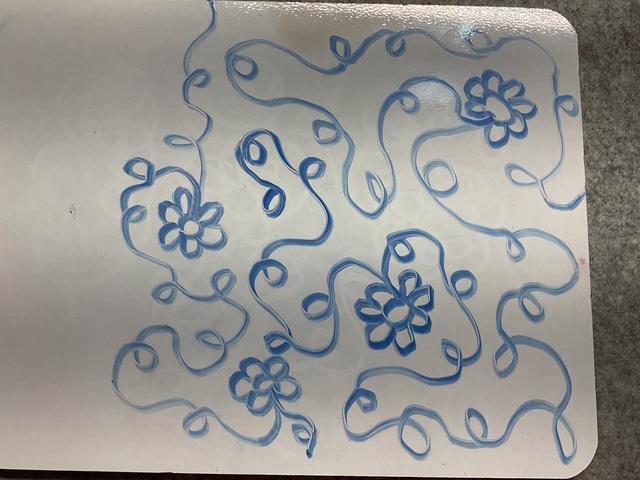
Daisies are simple to make. A circle followed by a ring of petals. Add an echo around the daisy if you want as this will make your flowers stand out.

Now it’s your turn to doodle and draw some flowers on your white board. What’s your favorite flower? Can you draw it without lifting your dry erase marker?

Next we’re going to add our Daisy to our basic Loop design. Go ahead and practice this variation on your white board.

Okay, time to quilt the Daisy and Loop variation on your practice square with your sewing machine. You can do it. Of course you can.

Below is a short video of me quilting Daisies and Loops.

I hope you are having fun with all of the designs and variations we’ve been exploring. Keep practicing as often as you can, but don’t wait too long before you quilt a small project for real. A snack mat, place mats, table runner or other small project is the perfect sized project on which to hone your skills. So hop to it and get quilting the FMQ way.

I hope you’ll stop back in 2 weeks as we wrap up our Beginner FMQ series with our final lesson – Quilting Borders with Simple Designs. Next week we’ll be showing our March patterns and a fun quilt tutorial for St. Patrick’s Day.

Until then –

Always,

Tricia @ VRD

2025 Free Motion Quilting (FMQ) Series · Quilt As Desired · Tips and Tricks · Tutorials · villa rosa designs

Beginner Free Motion Quilting (FMQ) Lesson 5: Going Beyond Loops Part 1

Happy Thursday to you!

I am thrilled to tell you that we’ve had a little bit warmer temperatures for a couple days in row here in NW PA. I’m talking above 32 degrees! Actually it’s been in the 40’s, which feels so balmy compared to last week’s temperatures in the single digits and teens. Whew! But I don’t think winter is over yet for us, though, as the beginning of March is looking cold again. Spring can’t get here soon enough!

PSST! While we’re waiting for Spring to arrive, it is a great time to work on our Free Motion Quilting (FMQ) skills, don’t you think? So far we’ve talked about tools, equipment, and resources; doodling, making loops, and using cursive writing as a quilting design.

This week for Lesson 5, we are venturing beyond the Loopy design.

If you missed any of the earlier lessons, you can find them below:

Lesson 1: All the Background Information

Lesson 2: Let’s Doodle!

Lesson 3: Practice, Practice, Practice

Lesson 4: The Write Way to Doodle!

Let’s get started!

You might be wondering what exactly I mean by “going beyond loops”. Talk a deep breath — there is no need to panic. I promise we are not jumping right into Feathers. Relax, Feathers are ahead of you sometime in the future, but today is not the day. Instead, we are going to add some fun elements to our quilting to change up our basic Loopy FMQ design.

#1 Snowflakes with Loops

This design is absolutely one of my favorites, hands down! It is quite flexible and looks great on a lot of different quilts. Depending on the theme of the quilt, it can look like a snowflake, a star, fireworks, a starburst, or even a cool funky flower. Wow! That’s a lot of options for a single element, isn’t it?

Here is an example of the Snowflake and Loop design on a Christmas/winter place mat I created years and years ago for a magazine pattern.

Please note this place mat design was featured in Quilter’s World magazine some years ago and is a copyrighted design.

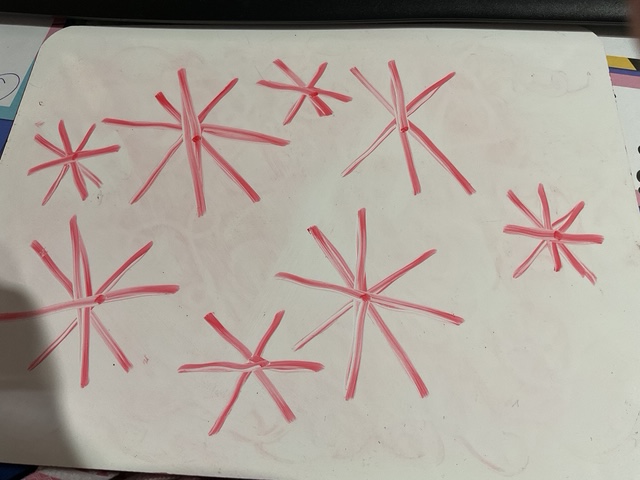
Grab your dry erase markers and let’s practice drawing Snowflakes or whatever you would like to call them on our white boards. You can decide how many spokes/rays you want your Snowflakes to have. You can even vary the number in your design to add more interest.

Next let’s add Loops to the Snowflakes and practice drawing our new Loopy variation design. Ready, set, go!Do you see how I surrounded each of the Snowflakes with my Loops? I like to use the Snowflakes as an accent, not the primary design. The primary design, of course, is the Loops. Additionally, I like to give my Loops lots of space to breathe.

Go ahead and practice drawing this design a couple times. Experiment with the Snowflakes (do you want 6 or 8 or more spokes/rays?).

Next, we’re going to FMQ this design on a practice square on our sewing machines. Are you ready? Take a deep breath and just do it.

To get you started, here’s a little video I made for you, showing how I create my Snowflake and Loop variation.

Here is a little example of quilting the Snowflake and Loop design.

Now it’s your turn to practice this design. Enjoy playing with it! Just imagine all the different kinds of quilts you can use it on!

#2 Kindergarten Star with Loops

Do you remember when you first learned how to make a five-pointed star? Probably around kindergarten, I should think. Can you remember how to make it now?

Here’s a little tutorial to jog your memory. Keep in mind that I am left-handed so you might draw your star differently than I do. Remember, you do you.

Kindergarten stars aren’t too much different from the Snowflake element above. And once you get comfortable making a five point star again (believe me, it will take some practice for some of you to remaster this shape), the design will flow more easily. Go ahead and draw some Five Pointed Stars on your white board. Make as many as you can fit onto the board. Make them all different sizes, too.

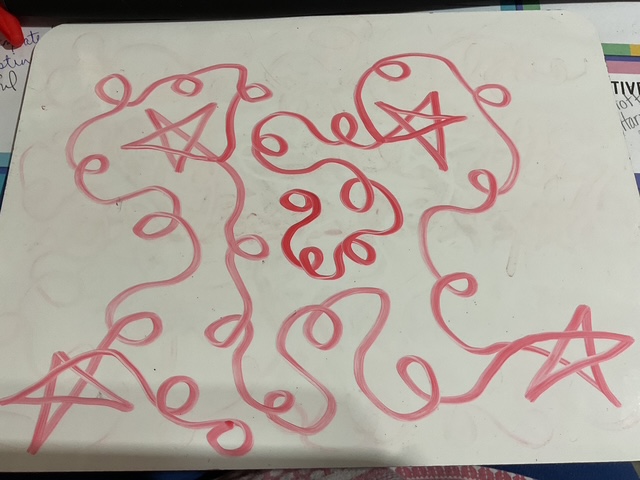
Now let’s practice drawing Kindergarten Stars combined with our FMQ Loop design. Feel free to do this several times until it feels more natural to you.

I bet by now (that is if you’ve been practicing) you are probably finding alternating the direction of the loops to be easier than when you first started several weeks ago. Go you!

Keep practicing on your white board until you can draw the five point stars without thinking about each line. Then I want you to practice making those stars upside down and sideways or else your design will come out very linear with stars lined up going the same direction.

This design looks amazing on patriotic quilts and on children’s quilts, too. What other kinds of quilts would look great with Kindergarten Stars and Loops?

Next up, we’re going to try quilting this design with our machines. Before we do, though, here’s a quick little video showing how I FMQ Kindergarten Stars and Loops.

Let’s make five point Kindergarten Stars!

Okay, now it’s your time to practice quilting Kindergarten Stars paired with Loops! This is fun, isn’t it?

#3 Hearts and Loops

Hearts will be our last design for today. So, how are you at making hearts? I have discovered that I can rarely make both sides of a heart exactly the same, so in my quilting (drawing and cutting, too), I intentionally make the sides of my hearts different. It lends a quirky funky look to my Hearts and Loops design, and that works just fine for me. LOL!

I have found that there are 2 basic ways to quilt hearts. Maybe you’ll come up with a different one and if you do, I hope you with share.

Anyway, the first way starts at the top center point and curves down and stops briefly at the bottom point before swooping back up and around to the center point once again. Remember, I’m a lefty so I usually move counterclockwise. Do what is comfortable for you.

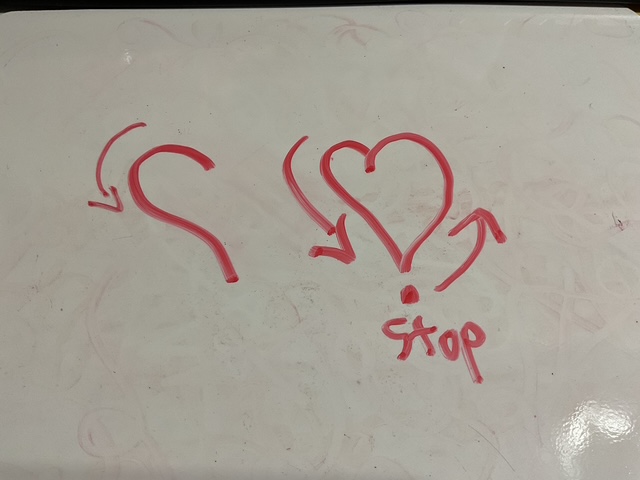
The second way is one continuous line which might make it easier for you to FMQ hearts. It starts at the bottom point then curves up and around to the center point where you pause briefly before doing the second top bump and then swooping back down to the bottom point. This heart reminds me more of a heart shaped balloon – you’ll see this more when I quilt it.

So go ahead and practice your stars on your white board. Which style do you like better?

Now that I’ve mentioned both styles, I’m going to show and use the second style Heart design. I find that it can flow better with the loops than the first Heart style.

Now it’s your turn to practice drawing the Heart and Loop design on your white board. Repeat as many times as you want, experimenting with your Hearts.

Notice how I crossed the bottoms of the hearts in the design.

Let’s head back to our sewing machines and try FMQ Hearts and Loops. Here’s a quick video of how I do FMQ my Hearts and Loops.

Check out this cute little Hearts and Loops design!

Well, that’s it for me today. I hope you keep practicing your Loops and adding these fun elements to change up your designs. Next week I’ll have a few more Loop design variations to share with you. So stay tuned!

Take care!

Until then –

Always,

Tricia @ VRD