Hello Quilty Friends!
Happy Thursday to you!
I hope you have all been practicing your Loops and your Loop variations from last week’s Lesson 5. This week we are going to continue Going Beyond Loops with 3 more Loop variations.
If you missed any of our Beginner Free Motion Quilting (FMQ) Lessons so far, you can find them all below:
Lesson 1: All the Background Information
Lesson 3: Practice, Practice, Practice
Lesson 4: The Write Way to Doodle!
Lesson 5: Going Beyond Loops Part 1
I have also added a section over on the right side of the blog entitled 2025 Beginner Free Motion Quilting Series where you will be able to easily find all of the lessons in the future so you don’t have to sift through posts to find them.
Going Beyond Loops Part 2
If you’ve been having fun playing around with the Loop variations from last week, good for you! I hope you came away with the knowledge that you can add any kind of motif to the basic Loop design to change it up. Stars? Check! Hearts? Check Check! Elephants? Sure, why not. You just need to practice drawing an elephant motif without lifting your dry erase marker on your handy dandy white board. Practice until you are happy with your motif. Then practice drawing your Loops and motif together on your white board. Again, practice until it feels natural and you are not lifting up your dry erase marker (this is super important!). Then make a fresh practice square, take a deep breath, and just do it! This is my basic method for creating endless Loop variations. I’ve done hot air balloons and palm trees, to name a few. You can too, it only takes practice. And courage. You. CAN. Do. It.
Are you ready? Strap on your helmet and put on your your seat belt cause here we go!
#4 Double Loops
I think you’ll love these Double Loops – they are quick and fun and look great on most any project except maybe Civil War reproductions.
Check out my Double Loop example below. This is a close up of the quilting on my cover quilt for my Sunny Day VRD Rose Card pattern. Yes, I quilted a simple Feather design in the borders. LOL!
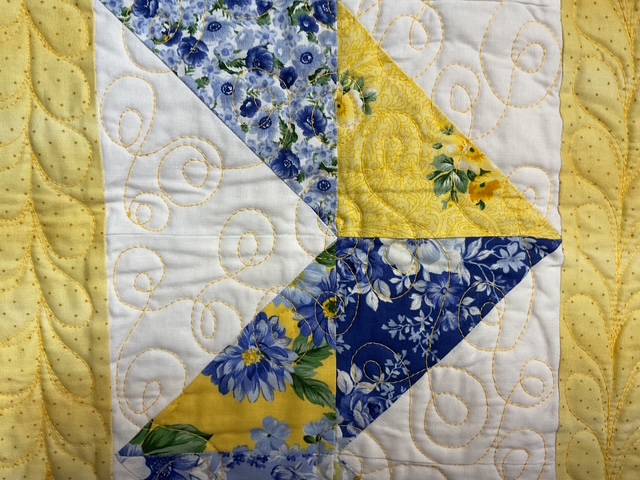
So, let’s grab our white boards and give Double Loops a try. Go ahead and draw a loop, then loop around the loop. Easy and very fun.

Now let’s practice connecting our Double Loops together.

Go ahead and practice this a bit until it feels comfortable.
It’s time to try this design on a practice square on your sewing machine. Below, you can see how I make Double Loops. It takes a little practice, but because you’ve already been working on the basic Loops design, adding a second loop around your first loop won’t take as long to master. So, get to it and quilt some Double Loops!
Wasn’t that a fun design? Just imagine all the quilts you can finish using this quirky and cool FMQ design? And don’t forget that you can change it up and make it entirely your own designs.
#5 Leaves
Leaves are a super element to have in your FMQ toolbox because leaves are all around us from the fabrics to the quilt blocks to the trees right outside the window. Can’t you picture how leaves will look quilted on your autumn quilts?
You can create leaves in just about any shape or style you can imagine. For this lesson, I’m going to show you a simple leaf or two. Feel free to use your imagination to come up with your own leaf shapes, too.
Here is a simple heart-shaped leaf for you to practice.

Once you get the leaf shape down, now it’s time to add it to your basic Loop design.

Go ahead and practice the Leaf variation until you can do it smoothly. Then it’s time to try it on your practice square with your sewing machine.
Here’s a quick video clip of me quilting the Leaf and Loop variation.
Practice. Practice. Practice.
#6 Flowers
Our last variation is adding flowers to our basic Loop design. Like leaves, you can create any flower shape you want or you can even mix different flower shapes together with you loops to create an entire quilted flower garden. For today, we are going to focus on Daisies.
Daisies are simple to make. A circle followed by a ring of petals. Add an echo around the daisy if you want as this will make your flowers stand out.

Now it’s your turn to doodle and draw some flowers on your white board. What’s your favorite flower? Can you draw it without lifting your dry erase marker?
Next we’re going to add our Daisy to our basic Loop design. Go ahead and practice this variation on your white board.
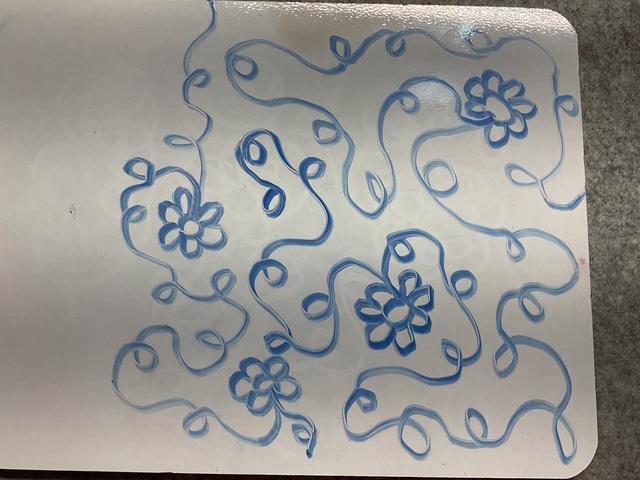
Okay, time to quilt the Daisy and Loop variation on your practice square with your sewing machine. You can do it. Of course you can.
Below is a short video of me quilting Daisies and Loops.
I hope you are having fun with all of the designs and variations we’ve been exploring. Keep practicing as often as you can, but don’t wait too long before you quilt a small project for real. A snack mat, place mats, table runner or other small project is the perfect sized project on which to hone your skills. So hop to it and get quilting the FMQ way.
I hope you’ll stop back in 2 weeks as we wrap up our Beginner FMQ series with our final lesson – Quilting Borders with Simple Designs. Next week we’ll be showing our March patterns and a fun quilt tutorial for St. Patrick’s Day.
Until then –
Sew. Laugh. FMQ. Repeat.
Always,
Tricia @ VRD
 Villa Rosa Quilts