Rose Cards · Tutorials · villa rosa designs

VRD Falling Quilt Tutorial

Happy Thursday to you!

Happy Fall!

A picturesque autumn scene featuring a cluster of bright orange pumpkins and a white pumpkin surrounded by hay bales and vibrant fall foliage.

Hard to believe it really is Fall now, but I know it’s here whether we’re ready or not. And I’m personally more than ready. We had such a hot and dry summer here in NW PA, so I’m eager for cooler weather.

Fall is definitely my very favorite season with its warm days and cool nights. All the gorgeous colors. The smells of the season. And the sounds. I truly love it all!

Another thing I love about Fall is that I start to feel more energized to get back to my many to-do lists. Summer definitely doesn’t inspire that in me. So now, it’s time to make plans to get things done. What is Fall to you?

I hope you’ve been enjoying our Jump into Fall quilt tutorials. Today’s project is beyond perfect for the season and I know you’re going to be excited to make this one.

Falling is truly a perfect project for this time of year, especially with all of the yummy fall fabrics at your local quilt shop and favorite online retailers. Falling is a pattern by Catherine, of Running Doe Quilts, who is one of our many talented VRD designers as well as a new VRD partner.

The quilt finishes at a generous 54″ x 72″ and goes together quickly with its oversized blocks and no borders (although you could easily add a border to make it bed-sized if you wanted to).

A colorful quilt featuring large, stylized leaf patterns in various shades, displayed outdoors against a backdrop of trees.

Get your digital pattern HERE or your print pattern HERE
Catherine even has kits available for the Falling quilt below – get yours HERE before they’re gone. Tell her Tricia sent you!

Quilt designed with colorful leaf patterns in orange, yellow, red, and blue fabrics, displayed outdoors against a rustic background.

Okay, time to get going on today’s tutorial.

Of course, our first thing to do is gather up our fabrics. Today I’m using a lovely collection from Hoffman Fabrics called Sweet Breeze. It’s a great choice today as we end summer and slide into fall. Sadly, this is an older fabric collection and probably isn’t available anymore, but happily Jason Yenter has a gorgeous fall collection called Falling Leaves, you can find it HERE – I think his wonderful fabrics would make great Leaves.

Here are our Sweet Breeze fabrics for today’s tutorial in lovely greens, a few browns, with a wee touch of orange.

Assorted fabric pieces in green, brown, and cream colors, featuring leaf patterns and textures, arranged neatly with a 'Falling' quilt pattern brochure on top.

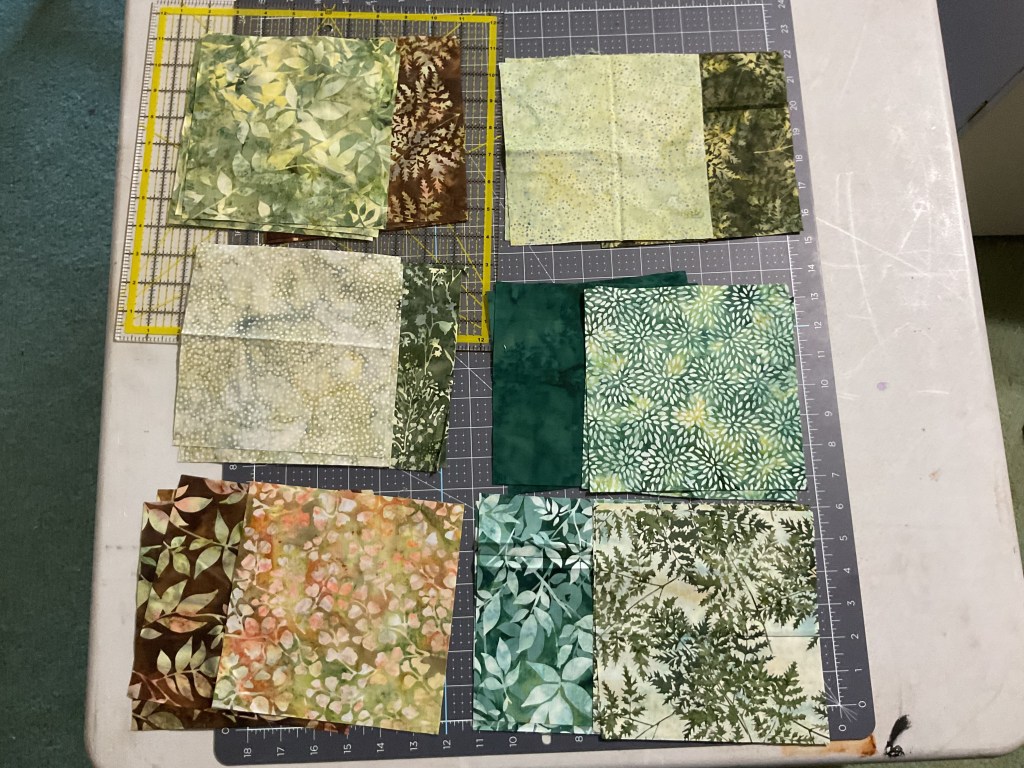
Let’s go ahead and cut out all the pieces we’ll need for Falling – the background, the Leaf fabrics, and the stems.

All right! All of our pieces are cut and ready to go.

A variety of fabric squares in green and beige tones on a cutting mat, with a brown strip of fabric positioned in the center.

Next we need to pair up our Leaf fabrics as each of the 12 blocks in the quilt uses 2 fabrics. I really love Catherine’s take on the traditional Maple Leaf quilt block, don’t you? She split it down the center so her leaves are two-toned. And the blocks are very big, which adds to the graphic appeal of this quilt.

The pattern suggests making 2 of each Leaf fabric combination, but you can mix and match your fabrics to your heart’s desire if you want, of course. I’m going to stick to the original plan today.

A variety of fabric squares in shades of green and brown, arranged on a cutting mat, ready for a quilting project.

Now we’re ready to sew. We haves lots of Half Square Triangle (HST) units to make for the quilt. I’m going to make 2 matching Leaf blocks before moving on. I don’t want to get all mixed up!

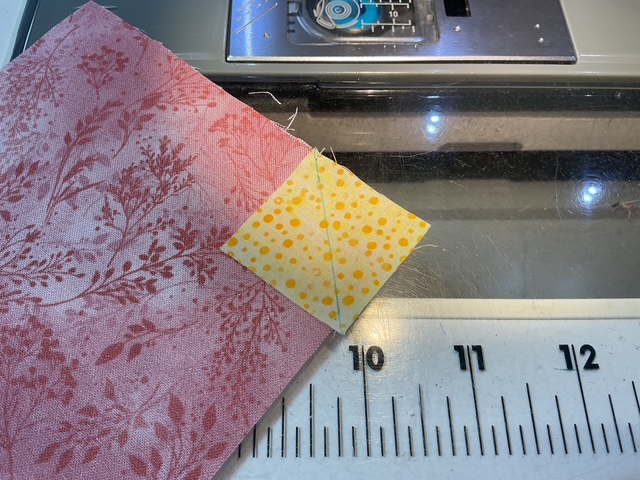
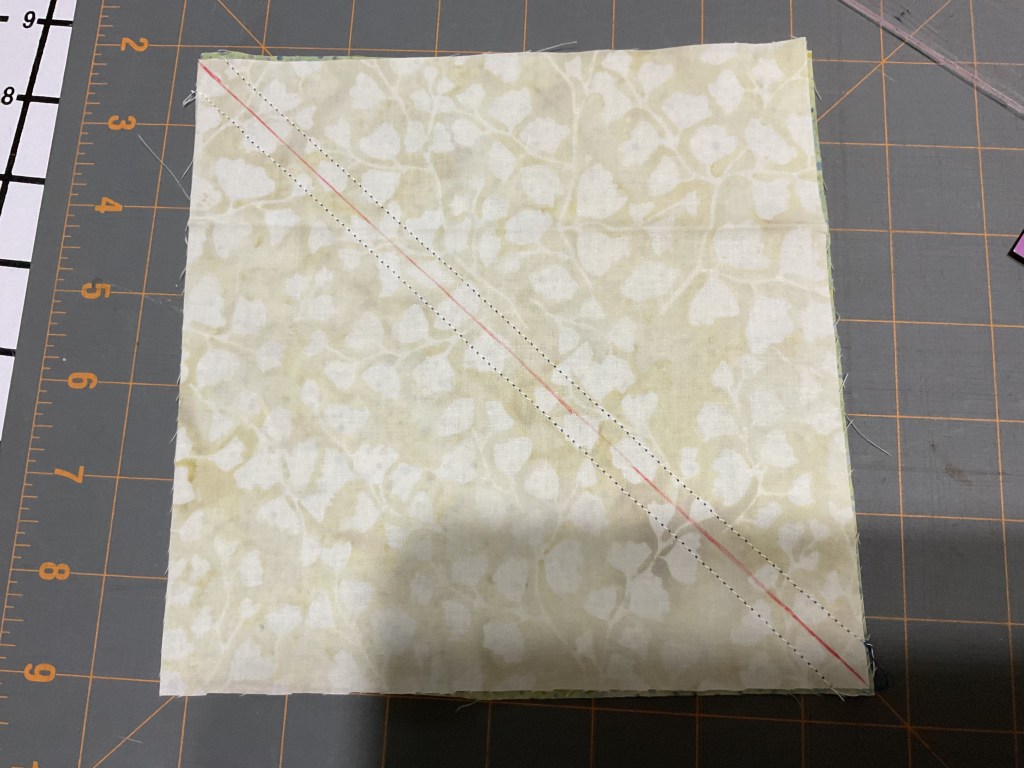
To make HSTs, the first thing you need to do is layer your squares right sides together (RST) and draw a diagonal line – I like to use FriXion erasable pens for marking my fabrics.

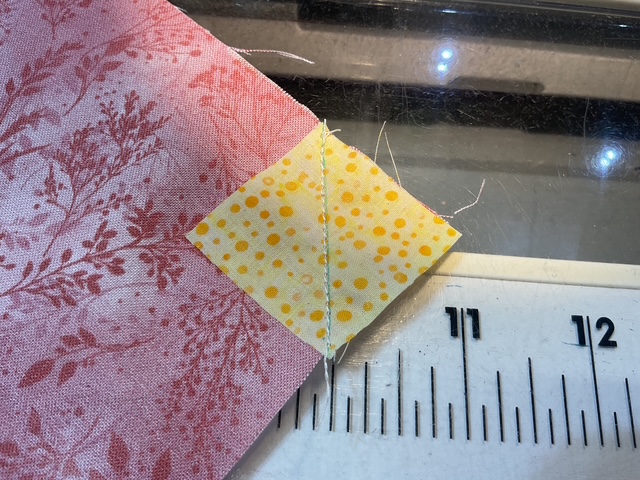
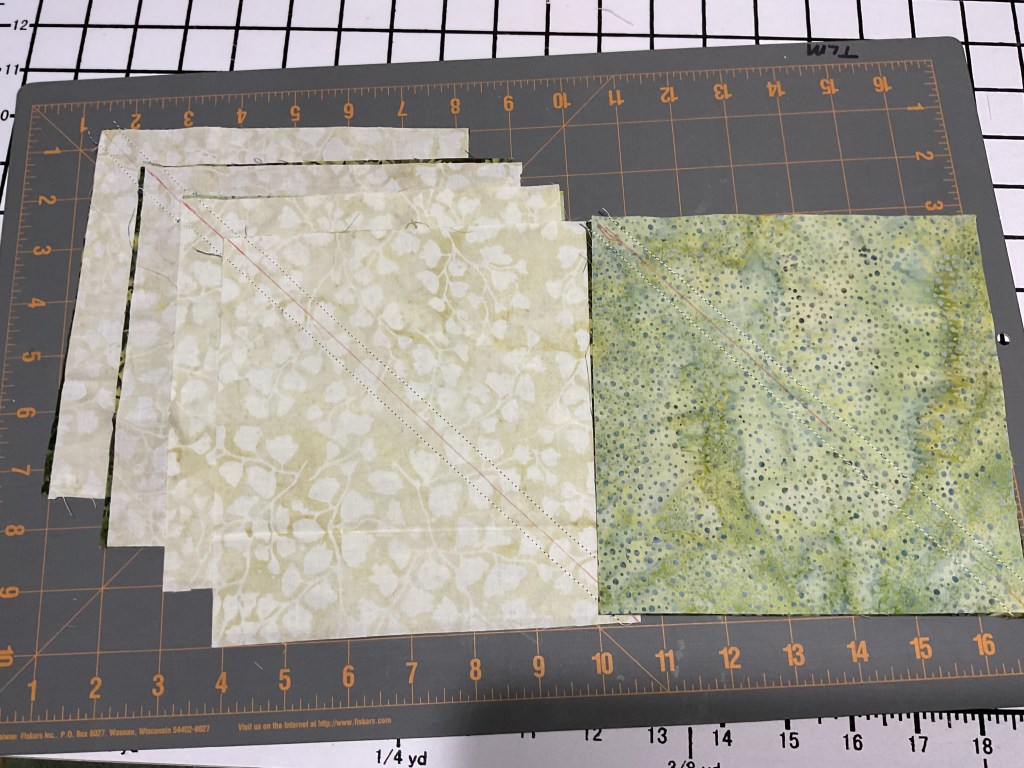
Then we’re going to sew 1/4″ away from both sides of our drawn line.

I went ahead and sewed all of the HSTs for my first 2 blocks at one time. Do likewise if you wish.

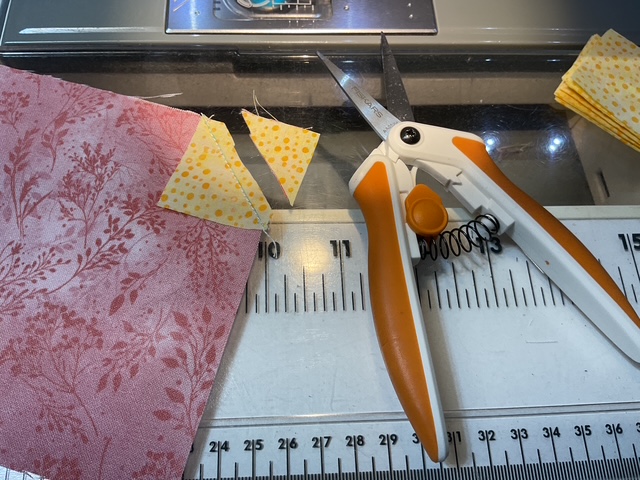
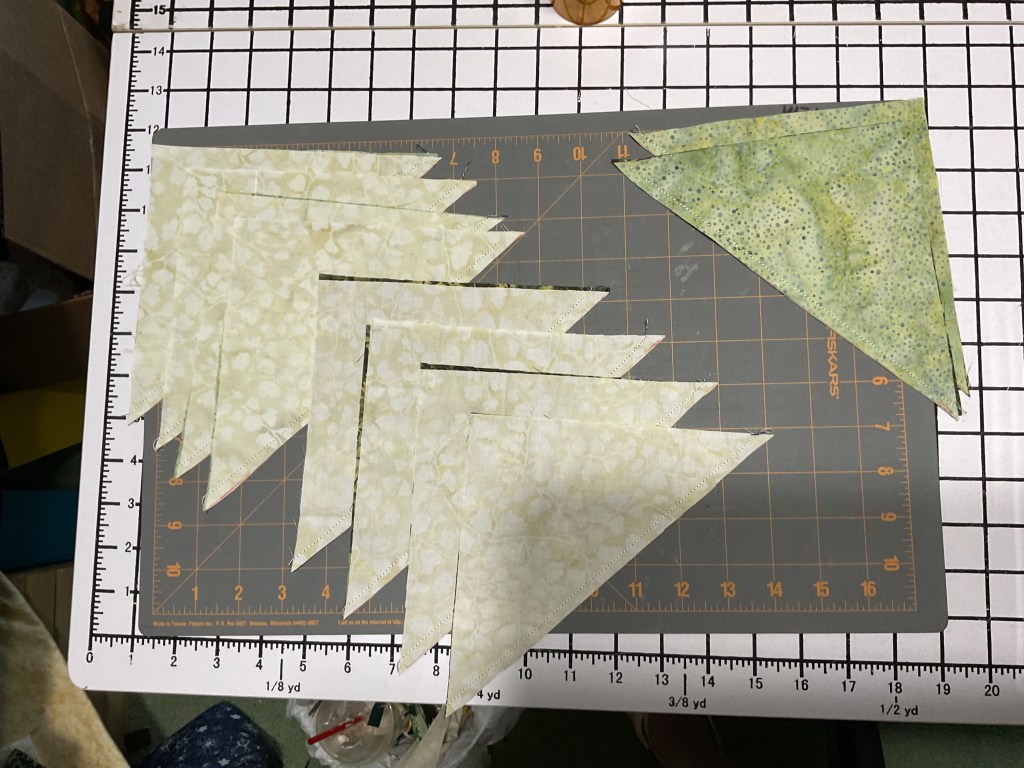
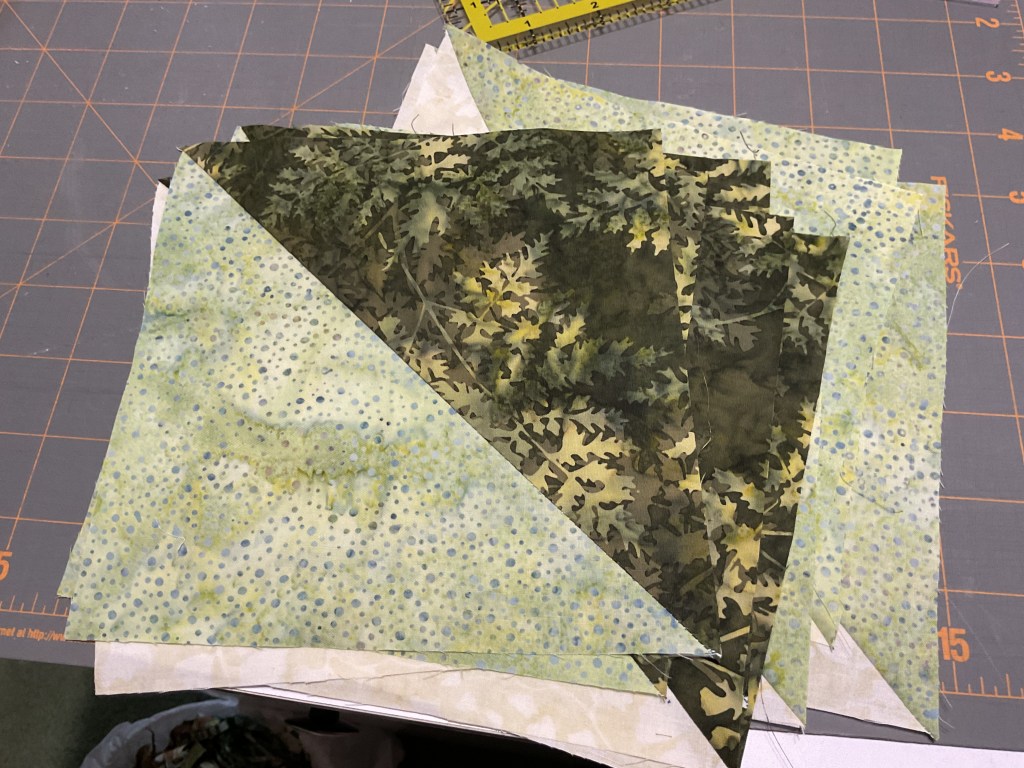
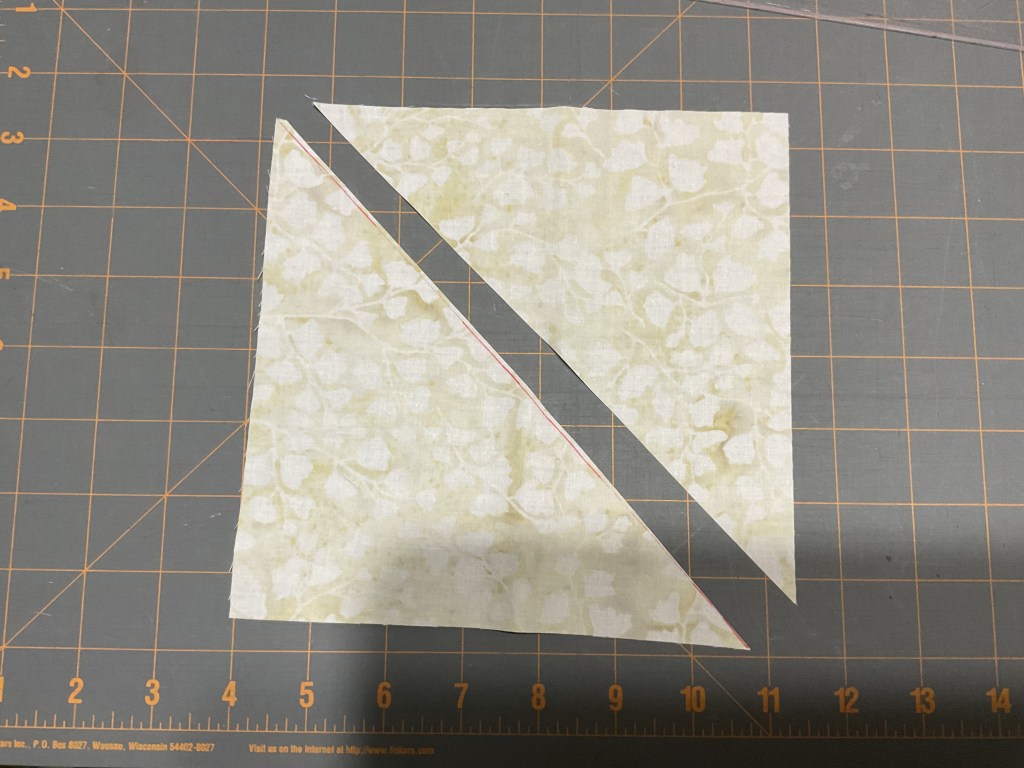
Next we need to cut on the diagonal lines which will give us 2 HSTs.

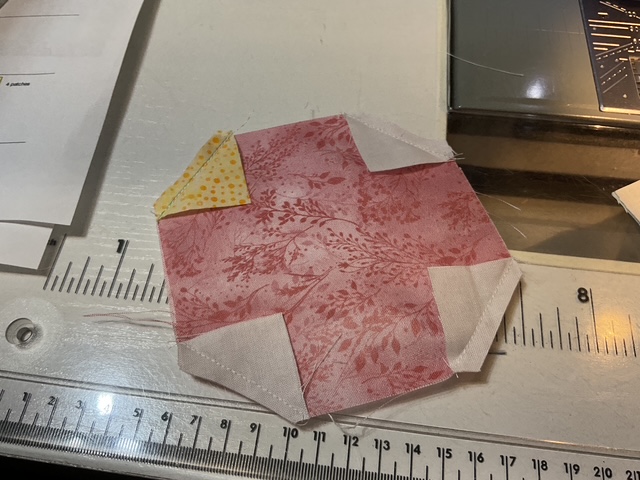
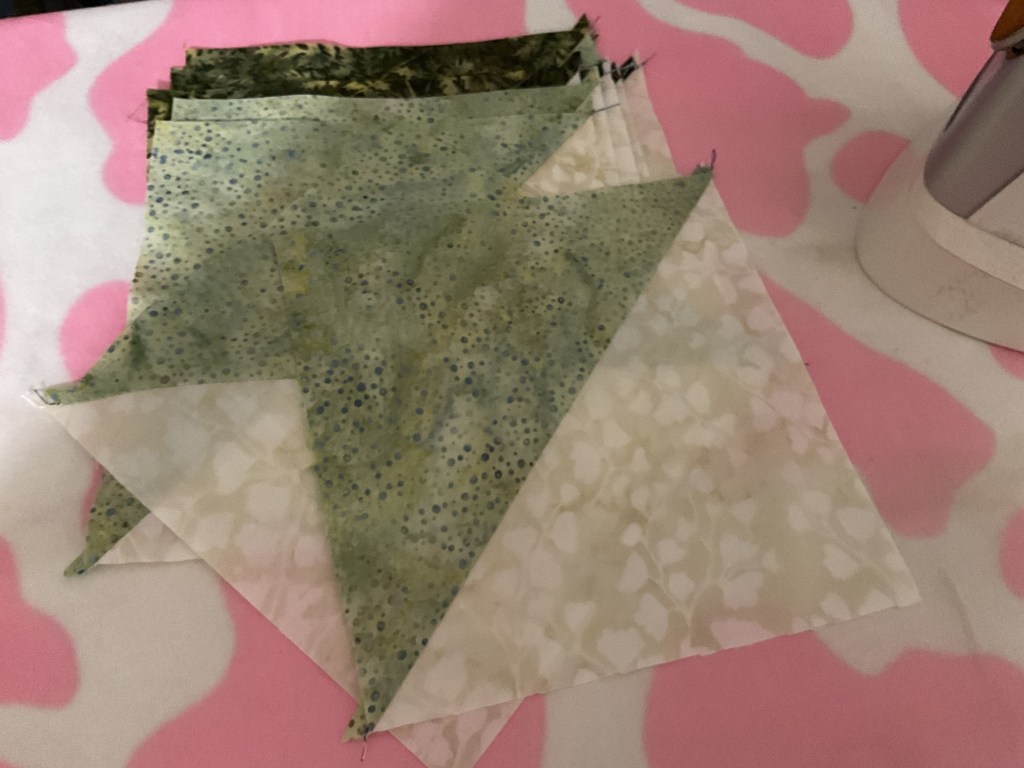
All right, let’s head over to the ironing board to press these HSTs open. Don’t forget to cut off the little dog ears on the corners so your piecing will be more accurate.

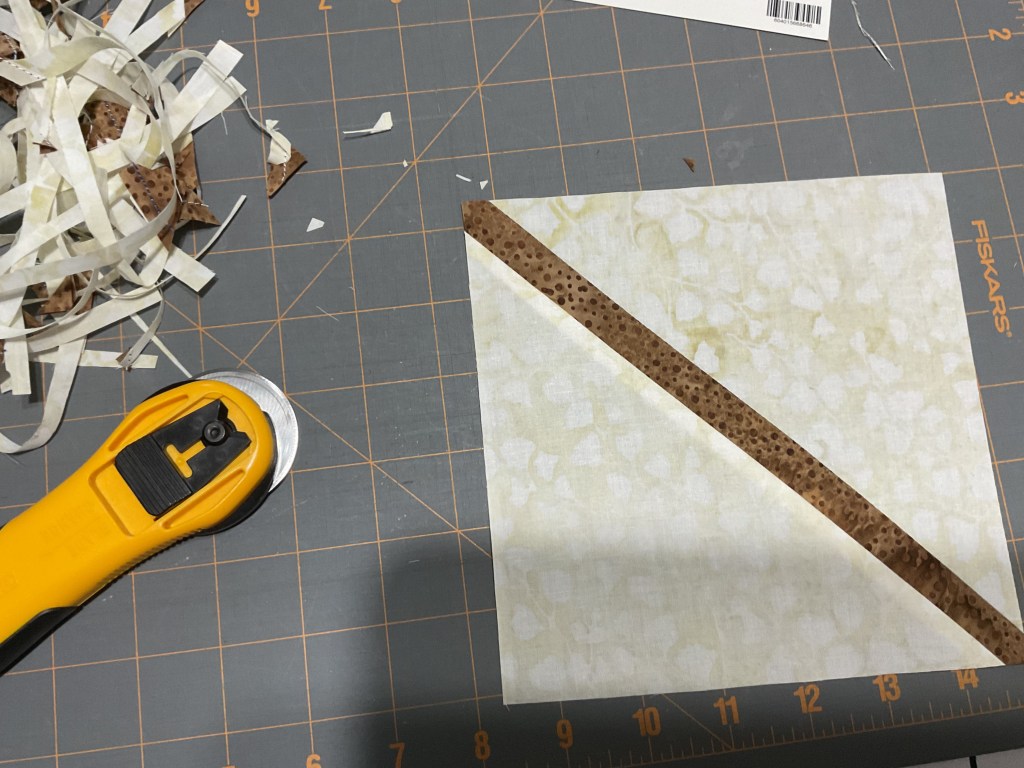
Let’s make the stems next. Cut your background square in half diagonally to make 2 triangles. Then we’re going to center and sew a stem rectangle between those 2 background triangles. I pressed my seams towards the stem so they wouldn’t show through my background fabric. We need to make 2 of these – 1 for each of our matching Leaf blocks.

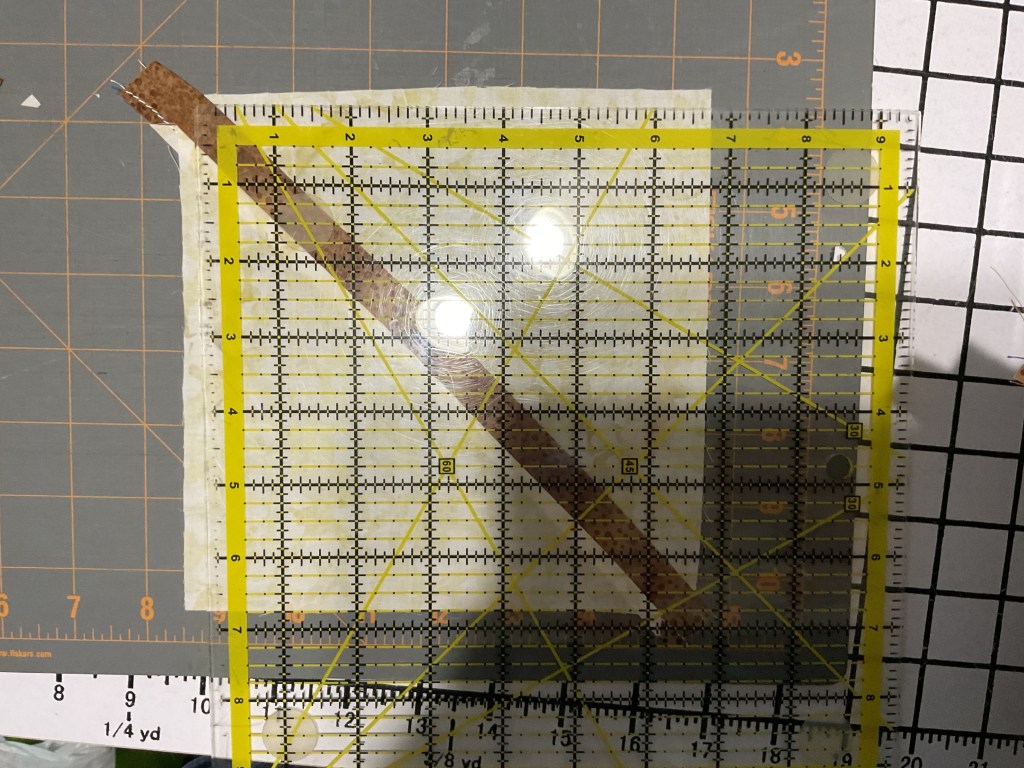
Before out stem units are finished, though, we need to trim them to the right size. Take your time when you do this step because you don’t want to miscut and make wonky stems.

Okay, now we’re ready to layout a block and sew it together. Once I’m happy with how the first block turned out, I’m going to make the second matching block. One Leaf pair done, 5 more pairs to go. Repeat the steps above to make 12 total Leaf blocks.

Woohoo! Here are my 12 Leaf blocks.

A pile of quilt blocks featuring various shades of green fabrics arranged in a leaf design, with a neutral background and some visible stitching.

Now it’s time to arrange the blocks on my design wall. If you want your quilt to have the same movement as the Falling quilt on the cover of the pattern, you will need to flip and flop your blocks like Catherine’s. I only switched 1 or 2 blocks before I liked the arrangement. As you, know sometimes I spend more time arranging the blocks than actually making the quilt. But not today, yay!

You will want to take care while sewing your blocks together because sometimes you are sewing a point to a point. Careful pinning will help keep your points under control and will result in a cleaner and more accurately stitched quilt.

A colorful quilt featuring oversized leaf blocks in various shades of green, brown, and floral patterns arranged on a design wall.

Next we are going to sew the blocks into rows and then sew the rows together to make the quilt top. Oops, this quilt is longer than my flannel wall, so I can’t show you the entire top yet. I told you it was a good sized quilt!

A quilt featuring a pattern of green and brown leaves arranged with a cream-colored background, showcasing various fabric textures and colors.

I just had to take my Falling flimsy outside to snap a photo in natural light so I could show you the entire top. Absolutely LOVE it! Can’t wait to finish it.

A quilt featuring large, stylized leaf patterns in various shades of green, brown, and orange, displayed outdoors on a clothesline with a grassy background.

To complete your quilt, layer it with batting and backing fabric (or fleece like I plan to). Quilt it. Bind it. And don’t forget your label!

Have you made a Falling quilt already? Or if you plan to make one this Fall, please share a photo on our VRD Facebook group – we’d all love to see them!

Well, that’s it for me – I’m heading back to my sewing machine to get some more sewing in.

Take care and I’ll see you right here next week.

Always,

Tricia @ VRD

Quilting Partners · Rose Cards · Tips and Tricks · Tutorials · villa rosa designs

VRD Busy Bee Quilt Tutorial and Hoffman’s New Fall 2025 Project Catalog

Happy Thursday to you!

Yep, it really is Thursday today. Bet I surprised a lot of you on Monday with our special VRD Announcement about upcoming changes (good ones, I promise you!). If you missed Monday’s VRD announcement, you can find it HERE.

Before I dive into this week’s inspirational quilt tutorial, I wanted to take a minute and share Hoffman’s Fall 2025 Project Catalog with you. I’m sure you’ve noticed I use a lot of Hoffman collections for our blog tutorials by now. We work closely with our friends over at Hoffman to inspire you by pairing new Hoffman fabrics and our easy breezy VRD Rose Card patterns.

Please enjoy the catalog and don’t forget to visit your local quilt shops to request these new upcoming Hoffman fabric collections and, of course, Villa Rosa Designs Rose Card patterns.

Lots of wonderful inspiration in this catalog, isn’t there? Which one(s) did you fall in love with and are adding to your “gotta make” list???

Now let’s make a quilt!

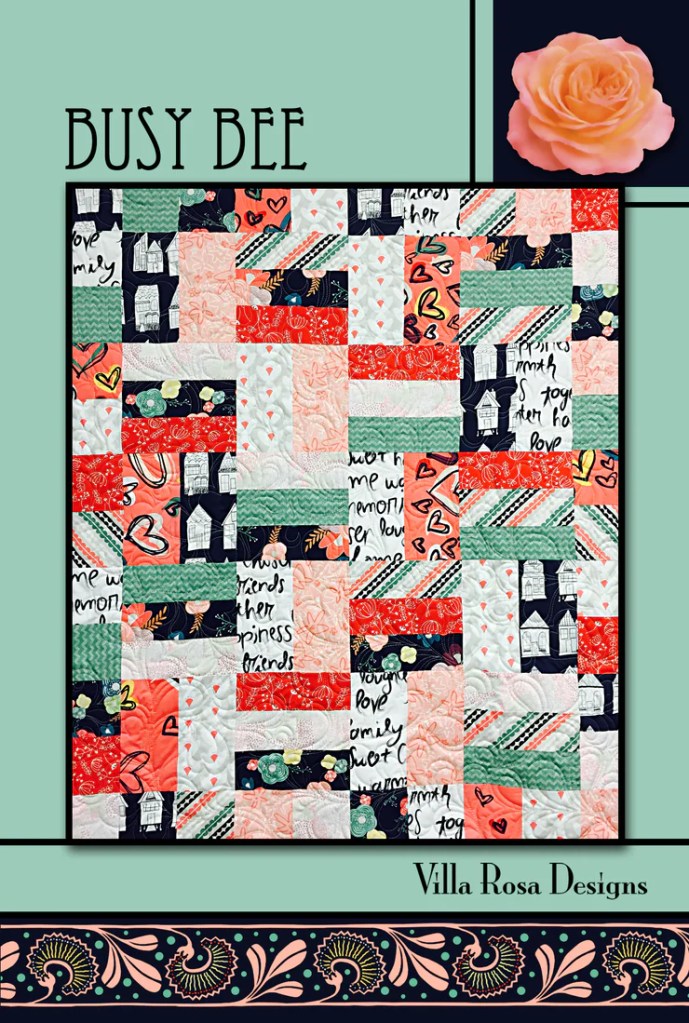
Are you ready for a super fun tutorial today? Busy Bee is an oldie, but a really great goodie! I know you’re gonna love it!

Colorful quilt design featuring various fabric patterns in shades of red, green, and navy, with a title 'BUSY BEE' and branding 'Villa Rosa Designs'.

Get your digital pattern HERE or your print pattern HERE
First things first, let me show you the fabric I’m using today for Busy Bee. You’ll notice right away that these fabrics don’t exactly have an autumn vibe going on, but I couldn’t resist these gorgeous fabrics when I was looking through my stack of quilt kits to choose my next victim….er, tutorial project. LOL!

Seriously, though, aren’t these fabrics divine??? This older Hoffman collection is called Blush Garden. It’s possible you still might find some bolts at your local quilt shop or at your favorite online shop, but somehow I doubt it as it’s just so yummy. Sorry……

Busy Bee is a fat quarter (FQ) pattern which means you only need FQs for the quilt top. No background, no borders. Busy Bee is stunningly simple and goes together like greased lightning!

A collection of colorful fabrics arranged on a sewing table, featuring various floral and abstract patterns, along with a pattern booklet titled 'Busy Bee.'
Psst! You might notice that my Busy Bee pattern looks different from the cover front above. Yep, my pattern is an older cover front. Sometimes we freshen up covers as fabric styles and trends change over the years.

Before we can get to the sewing, we have to cut our fabrics. You need to divide your FQs into 2 equal stacks.

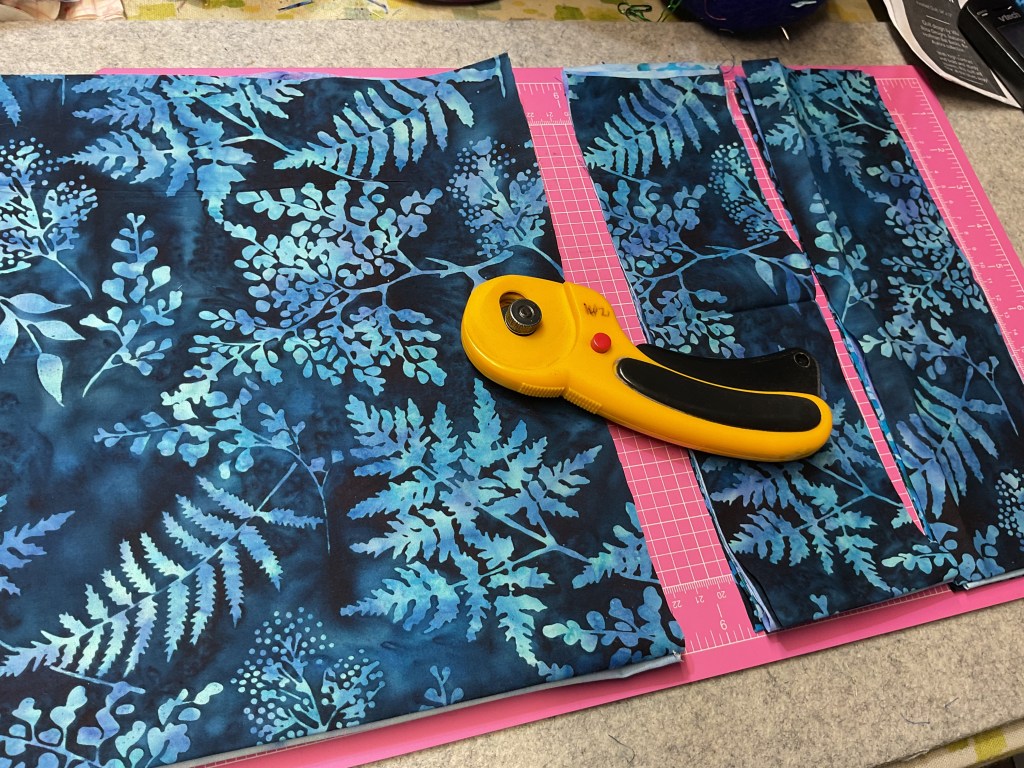
With the first stack, we’re going to cut our FQs into strips and then into fat rectangles and squares.

Moving on to the second FQ stack, we’re gong to cut skinny rectangles and squares.

Here are all our pieces ready to sew. And that’s it for cutting for the whole quilt top. I just love patterns like this, don’t you?

A collection of quilting fabric pieces in shades of pink and floral patterns, accompanied by a Busy Bee quilt pattern booklet on a green cutting mat.

Time to sew!

We’re going to sew 2 assorted fat rectangles together to make Block 1. I divided them equally into 2 piles and set them to the left of my machine so I could just grab the 2 top rectangles and feed them through the machine to chain piece them. If I didn’t like the combination or had 2 of the same on top, I just grabbed another one off one of the piles. Sew simple.

Do you chain piece your pieces together? Chain piecing is when you keep feeding/sewing pieces together through your sewing machine without cutting the thread in between the units. It saves both time and thread.

Now for Block 2 – we’re going to sew 3 assorted skinny rectangles together to make a Triple Rail Fence block. Again, I divided my strips equally into 3 piles and put them to the left of my machine. First I sewed 2 rectangles together from 2 of the 3 piles, leaving the last pile for last. Then I added a 3rd rectangle to all the pairs, making sure each Rail Fence block had 3 different fabrics.

Time to head over to the ironing board to press all of my blocks flat.

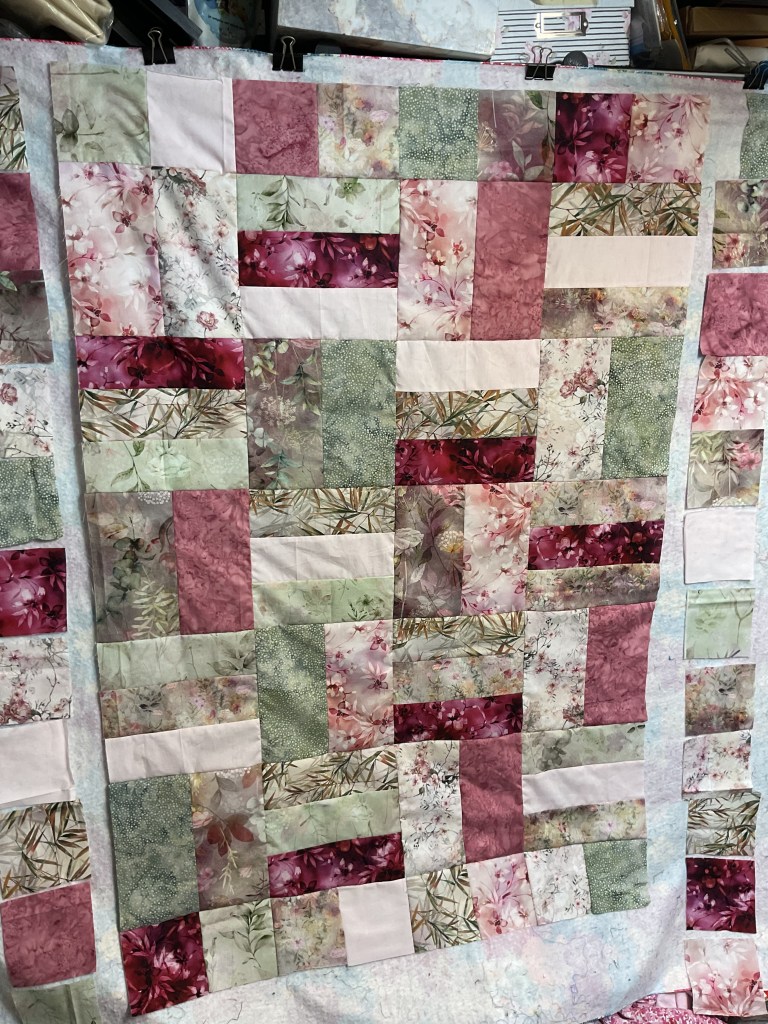
All righty, all the blocks are sewn and pressed, so now we’re going to put them up on the design wall so we can play switcheroo until we’re happy with the block arrangement.

The layout is an easy one for because we’re just going to alternate the blocks.

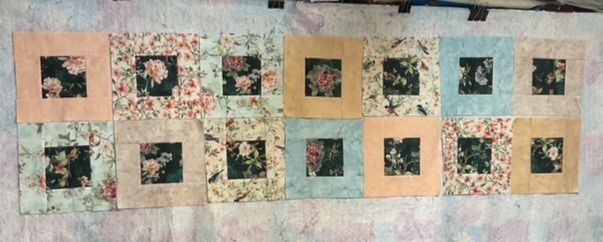
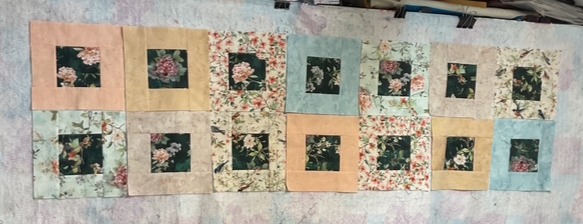
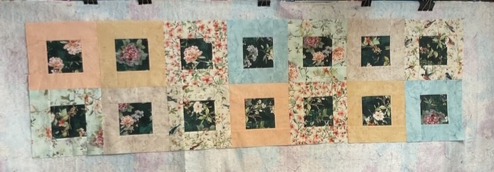
Take a look at some of my swaps. See how the dark reds are accumulating at the lower right corner of the photo at the left. In the middle photo, I swapped some blocks around and it’s starting to look a bit better, but we’re not quite there yet. And then the photo at the right looks the best of all. Often, arranging the blocks takes longer than sewing the whole top together, especially if you’re making a Villa Rosa pattern!

Now that I’m happy with how the blocks look, we’re going to add a border of squares all the way around the blocks. Huh! Bet you were wondering what we were going to do with all those squares (besides add them to our 5″ square stash).

A colorful quilt top made of various fabric pieces in shades of pink, green, and white, arranged in a patchwork design.

Guess what?!? Now it’s time to swap the squares around until the quilt looks just right (are you feeling a little bit like Goldilocks, ??? LOL!).

Take a look at some of my swap outs below. You might wonder why I went ahead and laid out my border of squares before I sewed the blocks together for the quilt center. I was afraid to sew the blocks together in case I would need to tweak them again once I laid out the border squares.

A quilt top layout featuring various floral and patterned fabric pieces in shades of green, pink, and mauve, arranged in a patchwork design.

Okay, I’m happy with the blocks and outer squares layout, so I’m going to sew my blocks into rows and then sew the rows together.

The center of the quilt is now sewn together. OH NO! Somehow I flipped a block at the bottom right corner of the quilt center! Sheesh! How’d I manage to do that?!?

A partially completed quilt top featuring a variety of floral and patterned fabrics in shades of pink, green, and white, arranged in a block design on a light background.

Oh well, don’t panic! We can fix this. We have 2 options – either leave it alone and continue or else take a break to rip out the corner of the quilt and sew the blocks back together. Can you guess which option I chose?

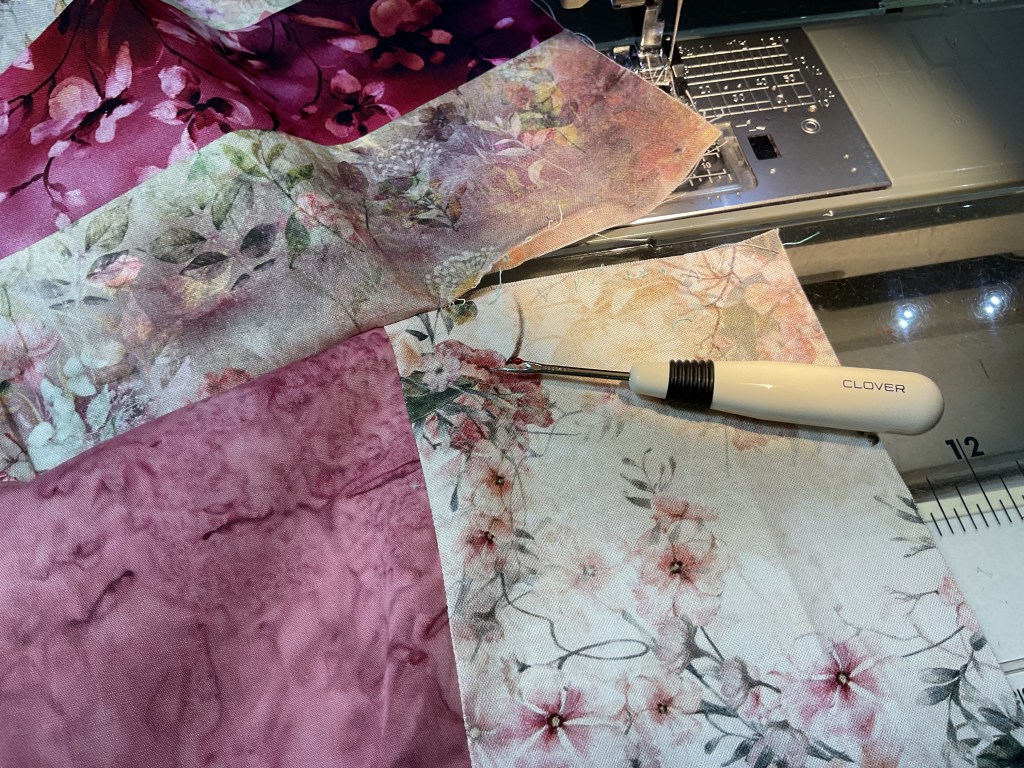
Yup, time to grab my pal (and my enemy – I guess that makes him my frenemy, doesn’t it?), Jack the seam ripper. Do you have a favorite seam ripper? Mine is by Clover. In my humble opinion, it’s simply the best seam ripper ever. Don’t have this one? You can find it HERE. Let me know what you think.

A Clover seam ripper, displayed in packaging, designed for easily cutting threads.

Anyway, time to rip!

Ugh! Look at all the threads bits! Ripping out stitches is definitely NOT my favorite thing to do, but it’s necessary sometimes. And besides, Jack really enjoys himself when we do.

Close-up of several fabric pieces in shades of pink, with threads visible on one piece.

Now I can resew the block into the quilt. This time, I’m making sure it’s turned the right way.

Okay, disaster averted, thank goodness. I’m still not a fan of the mauve rectangle touching the dark red one, but unless I want to do a ton more ripping and resewing, I’ve decided I can live with it. What do you think? Should I have ripped out the other block, too?

Quilt top featuring an assortment of floral and patterned fabrics in shades of pink, green, and cream, laid out in a patchwork design.

Moving on……..time to sew my squares into rows and then I’ll sew them to the quilt center. Fingers crossed I don’t get any of them mixed up. I’m going to sew the top and bottom squares together first and then I’ll sew them to the top and bottom of the quilt center.

Next I’m going to sew the side border squares together and then I’ll sew them to the sides of the quilt center.

And here is the completed Busy Bee quilt top (or flimsy). Isn’t it really beautiful? LOVE LOVE LOVE these fabrics!

A completed quilt top featuring a patchwork design made of floral and textured fabric squares in shades of pink, green, and white, displayed against a light background.

Let’s take it outside in natural light to see the fabrics sparkle (instead of my dark sewing dungeon). Love it sew much! Can’t wait to finish this one.

A vibrant quilt displayed outdoors on a clothesline, featuring a patchwork design in shades of pink, green, and white.

Of course, after you get the flimsy finished, it’s time to layer it with batting and backing and quilt it. Then bind it and add a label. Hopefully soon.

Well, that’s it for me this week. Try to get a bit of sewing in this week.

See you next week!

Always,

Tricia @ VRD
Rose Cards · Tips and Tricks · Tutorials

NEW VRD Rose Card Patterns for September and VRD Cinnamon Stix Quilt Tutorial

Happy Thursday to you!

I hope you are enjoying this collection of VRD quilt tutorials to inspire you to leap back into quilting this fall. May these tutorials nudge you into making a quilt for someone special or maybe just for yourself.

We’ve got lots to do today, so let’s get moving.

First up, it’s the Thursday after the first Friday of the month, and you know what that means – NEW PATTERNS! Talk about fall inspiration!!!

Here’s the new collection of 5 VRD Rose Cards for September. Aren’t they super???

A collage of quilt pattern cards for September 2025, featuring designs titled Awestruck, Edwina, Pumpkin Parade, Besties, and Viroqua, each with vibrant colors and unique patterns.

Get the set of 5 print patterns HERE

(Patterns are also available individually both as print and digital versions)

Awestruck by Molly uses 5″ squares and finishes at 44″ x 60″. There are kits still available HERE featuring Tula’s True Colors collection while they last. Totally loving the name!

Melissa wows us with her Pumpkin Parade throw quilt. It uses yardage (or your stash!) and finishes at 45″ x 56″. We still have a few kits left HERE featuring Riley Blake Seasonal fabrics, so grab one before they’re gone.

Pat is back this month with her latest Tim Holtz Palette quilt pattern, Edwina, featuring the Indigo Palette. Edwina finishes at 45″ x 60″ and is fat quarter friendly. Kits are still available, but going fast, so get yours HERE.

Besties is my new throw-sized quilt pattern this month. It’s fat quarter friendly and finishes at 48″ x 64″. We have kits featuring Anna Maria’s Iconic collection (see below) still available HERE.

Colorful patchwork quilt featuring various floral patterns and vibrant colors arranged in a grid layout.

Besties in the Iconic Collection

Viroqua is Rachelle’s latest smashing mod pattern. It finishes at 42″ x 48″ and uses half yards and yardage (stash friendly!). There are kits still available HERE featuring Windham’s Sketchbook 21 collection (see below).

A patchwork quilt top featuring various fabric patterns arranged in a geometric design with triangles and squares, showcasing a mix of colors and textures.

Viroqua in the Sketchbook 21 collection (please disregard the 2 mistakes where we turned the HSTs the wrong way – it’s getting fixed as we speak)

Last, but certainly not least is this month’s new table runner, Beachcomber. I’m sorry I missed the deadline boat last month with this fun runner, but I think it’s not too late to have just a wee bit more summer before it’s officially autumn on September 22nd.

You can really use just about any fabric collection or your stash for this fun and clever runner. Beachcomber finishes at 18″ x 54″ and uses yardage. Autumn? Halloween? Thanksgiving? Christmas? And the list goes on. Have you ever thought about making a 2 sided runner with 2 different seasons….here’s your chance!

A digital mockup of the Beachcomber quilt pattern designed by Tricia Lynn Maloney, featuring a colorful quilt laid out on a sandy beach with ocean waves in the background.

Get your digital Beachcomber pattern HERE or your print pattern HERE.

Now we’ve covered all of the new September patterns, which one will you make first?

OH! One last little thing about the new patterns – Melissa’s new Pumpkin Parade throw quilt is a fabulous companion to our best-selling Pumpkin Hollow table runner.

A quilted table runner featuring orange pumpkins on a white background with a checked pattern, accompanied by autumn leaves, titled 'Pumpkin Hollow' designed by Tricia Lynn Maloney for Villa Rosa Designs.

Get your Pumpkin Hollow digital pattern HERE or print pattern HERE.

All right, moving on, let’s dive into this week’s quilt tutorial – Cinnamon Stix.

Cinnamon Stix is a great pattern for a favorite fabric collection. You can use a stripe or even a seasonal/novelty fabric in the long strips, so it’s really versatile. Then simply add your coordinating fabrics for the Stix, a sashing, and border. Cinnamon Stix is fat quarter friendly and finishes at a nice 46″ x 63″.

A vibrant quilt titled 'Cinnamon Stix' featuring horizontal stripes of various fabrics in warm autumn colors and patterns, framed by a green border.

Get your Cinnamon Stix digital pattern HERE or your print pattern HERE.

I promised you a few weeks ago that I was going to have another quilt featuring Hoffman’s Rodeo Dreams digital collection – well, here it is! Today we’re using the border stripe in the collection along with fun coordinates, including a few batiks.

A variety of fabric swatches in red, blue, and neutral tones arranged on a sewing table, featuring a western-themed border print with cowboys and horses, alongside a quilting pattern titled 'Cinnamon Stix'.

First up, we’re going to cut out the Stix for the 3 pieced Stix rows.

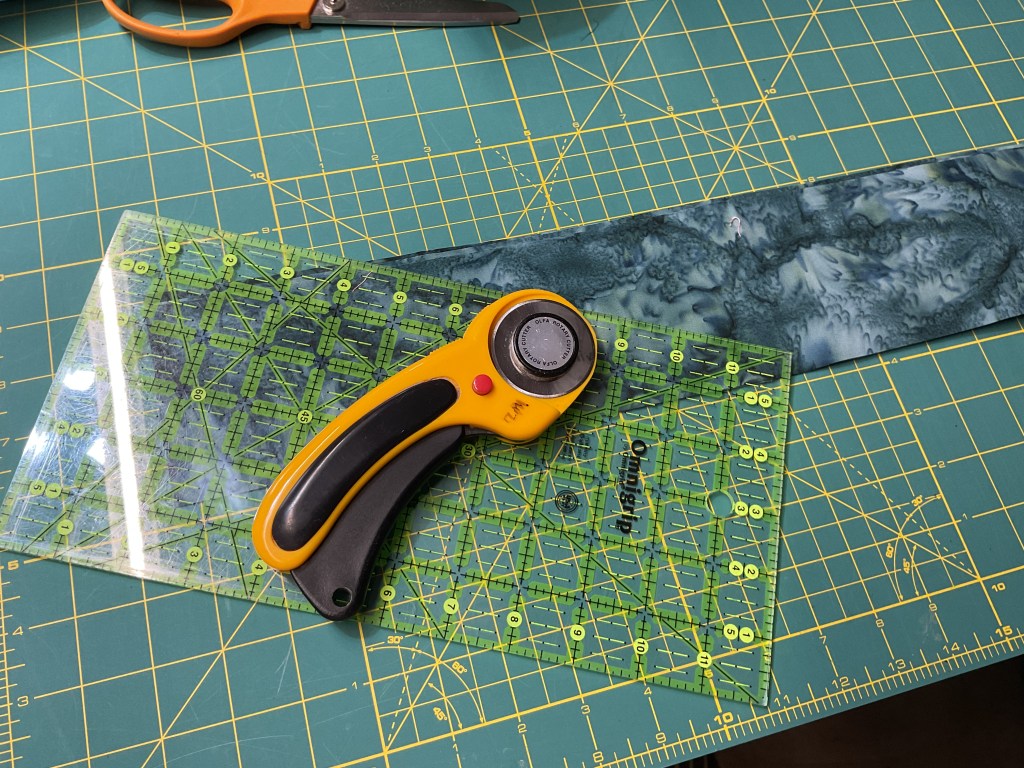
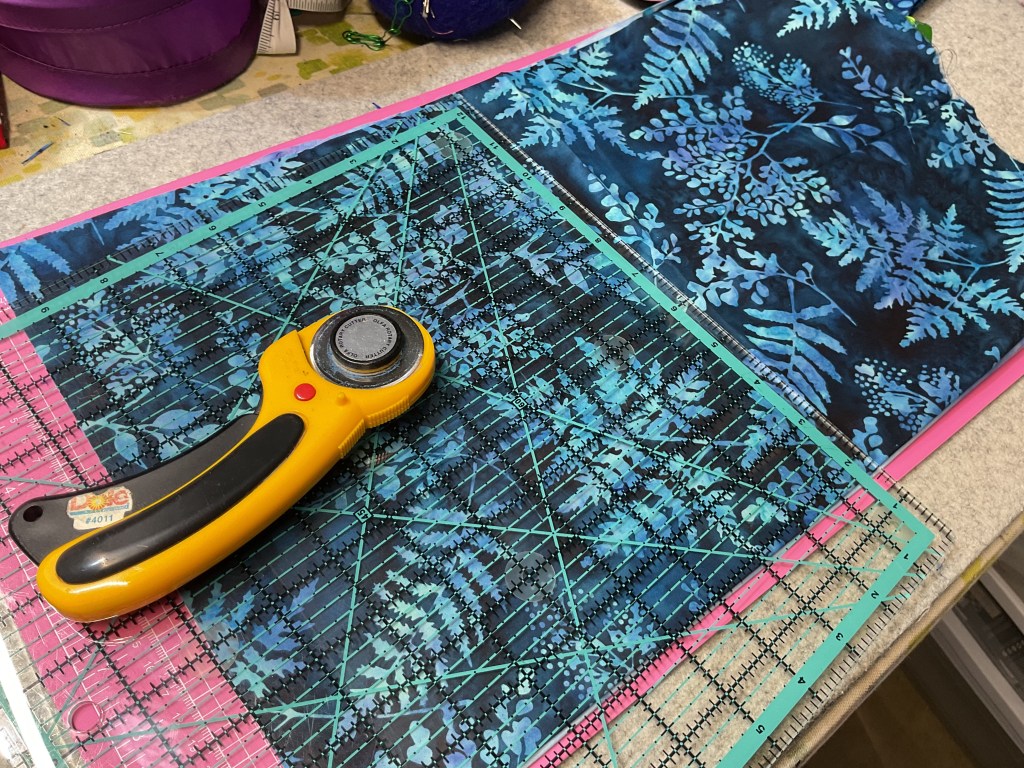
A rotary cutter and acrylic ruler on a cutting mat with the 'Cinnamon Stix' quilt pattern card by Heidi Cook.

Once we’ve gotten all of the Stix cut, we’re going to slap them up on the design wall so we can arrange and rearrange them until we’re happy with the fabric placement.

Heads up – because the Stix are cut different widths, each row might look a bit different, depending on how you arrange your Stix.

Fabric squares arranged on a design wall in a patchwork pattern, featuring red, white, and blue colors.

Now we’re happy with how the Stix rows look, so it’s time to sew them together. I like to sew them into pairs, then sew the pairs into quads, and so on until all the pieces are stitched together into a row. Then repeat for the next 2 rows.

Close-up of a sewing machine stitching layers of fabric together, featuring a mixture of light beige and patterned blue fabric.

Okay, all the Stix are sewn together into 3 rows. Lookin’ good!

Three rows of colorful quilt fabric blocks arranged on a design wall, featuring blue, red, and cream tones.

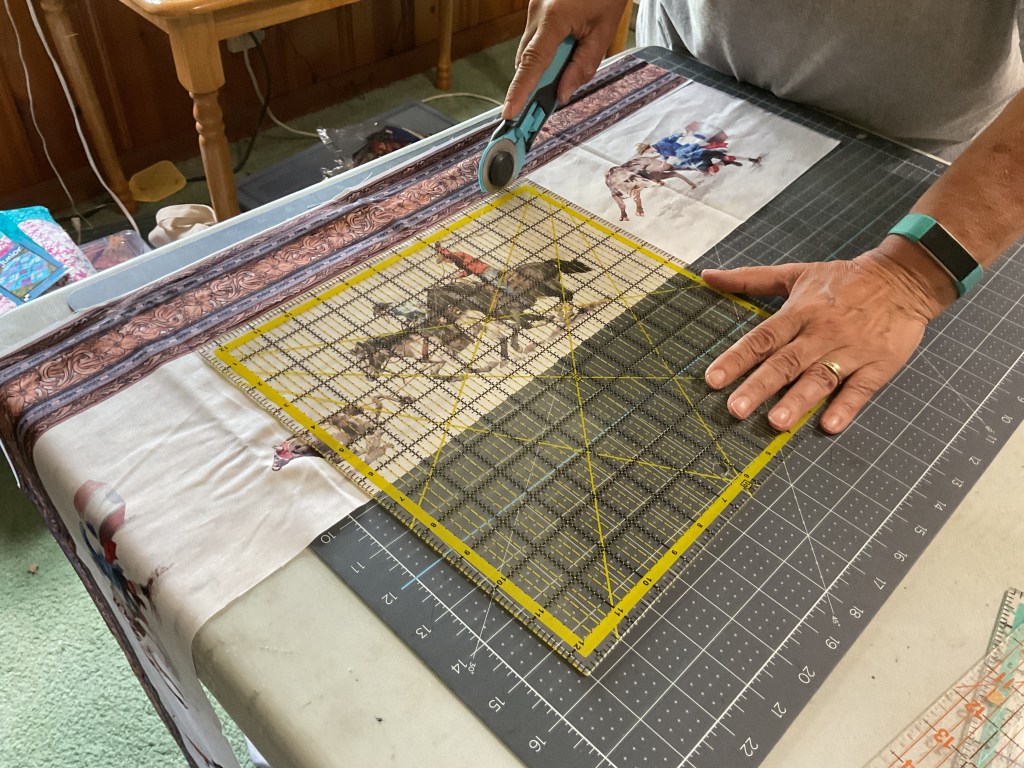
Next let’s work on prepping and cutting the Rodeo border stripe fabric. My pal (and cousin), Robin, is helping me out with this tutorial today – we’re working on it in her sewing room.

A person cutting fabric on a cutting mat with a rotary cutter, featuring printed rodeo scenes and decorative fabric borders.
Hey Robin!

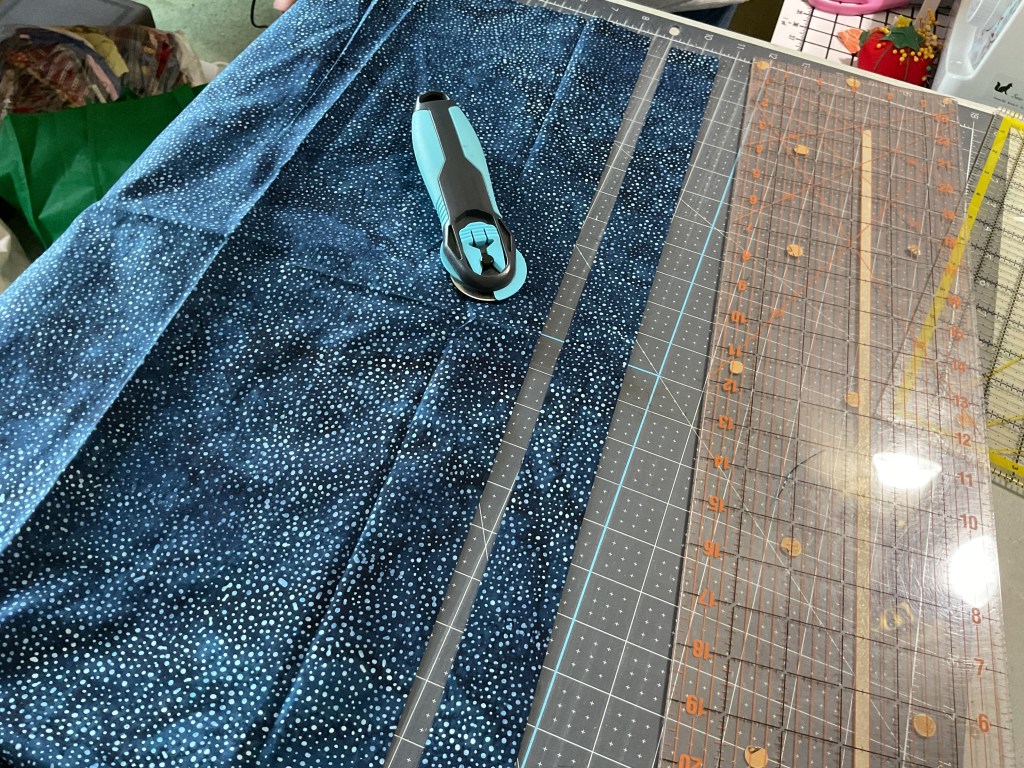
Once the stripe is cut, we’re going to work on cutting the narrow sashing, which is this gorgeous blue 885 Dot batik. LOVE IT!

A rotary cutter is placed on a cutting mat with strips of navy blue fabric featuring white dot patterns, alongside a clear acrylic ruler for measuring.

Let’s sew the sashing to both sides of our pieced Stix rows.

A sewing machine stitching together several pieces of fabric, including a patterned pink fabric and solid blue fabric, arranged on a sewing table.

Now we’re going to lay out the sashed Stix rows with the stripe. My tip is to find the center of the sashed Stix row and the center of the border stripe. Then match and pin the centers together and pin outward towards the ends to keep the quilt nice and square. We’re ready to sew the rows together. And then we need to add sashing all the way around as our first border.

Yay! The center of the quilt is finished. Easy peasy!

A quilt featuring western-themed fabric panels depicting riders on horses and dogs, arranged in alternating striped sections of blue, red, and patterned fabric, displayed against a light-grey backdrop.

Okay, time to cut the final border, which is a wonderful red bandana print from the Rodeo Dreams collection. Then we’re going to sew it to the quilt. Yay!

A person cutting red bandana fabric with a rotary cutter on a cutting mat using a ruler for measurements.

And here it is – the finished Cinnamon Stix quilt top in Rodeo Dreams. Isn’t it really fun???

A colorful quilt featuring cowboy and rodeo-themed fabric, arranged in vertical stripes with red borders, displayed against a light backdrop.

Here it is outside for a straight-on shot. It was really breezy so we ended up taking the photo in front of one of Robin’s hubby’s farm toys so it blocked the wind, instead of in front of the old barn (our first choice). Thank you Mary Lee and Robin for holding the quilt and fighting the wind for me. Perfect!

Two people holding a finished quilt featuring horse and cowboy patterns against a construction vehicle background.

I bet you’re already thinking about border stripes in your stash (or something new at your local quilt shop) to use in this fun and fast VRD pattern. We’d love to see your Cinnamon Stix quilts on our VRD Facebook page.

Now that the top (or flimsy) is done, it’s time to layer it with batting and backing, quilt it, bind it, and lastly add a label. Eventually…..

Stay tuned next week for another great VRD tutorial.

Until then –

Always,

Tricia @ VRD
Rose Cards · Tips and Tricks · Tutorials · villa rosa designs

VRD Midnight Pathway Quilt Tutorial, High British Tea, and a Quilt Exhibit/Museum Tour

Happy Thursday to you!

I hope you enjoyed last week’s tutorial, Morning Tea, with Molly. It was wonderful that she could stop by the blog and visit with you. Things have been super busy over there at the VRD shop in Grass Valley, CA, so she just hasn’t had a lot of extra time to hang out with us on the blog. What a great quilt she made, too, huh? Blue and white Australian fabrics – wow! If you missed last week’s Morning Tea tutorial, you can find it HERE.

Last Friday, I was delighted to attend a High British Tea and Quilt Program/Tour at the Gibson House Manor Museum in Jamestown, PA. I was invited by my sister’s aunt-in-law (is this even a word???), Anita, to attend as her guest. Anita is not only a quilter, she also volunteers at the Museum.

The Gibson House Manor has had a very interesting history, indeed. It was built by a local doctor, William Gibson in the 1850’s. It is also known as the Mark Twain house because Mark Twain actually stayed there after the Civil War. He liked the house so much, he even included it in one of his stories! But even more interesting, it was a vital stop on the underground railroad with hidden secret rooms and so much more! You can visit the website HERE for more information.

Here’s the museum – isn’t it gorgeous???

The exterior of the Gibson House Manor Museum, featuring a red brick facade, large windows, and surrounding greenery.

Lucky me – not only was the new quilt exhibit debuting, the curator was giving a tour of the quilts, AND it was the monthly High British Tea day. What fun!

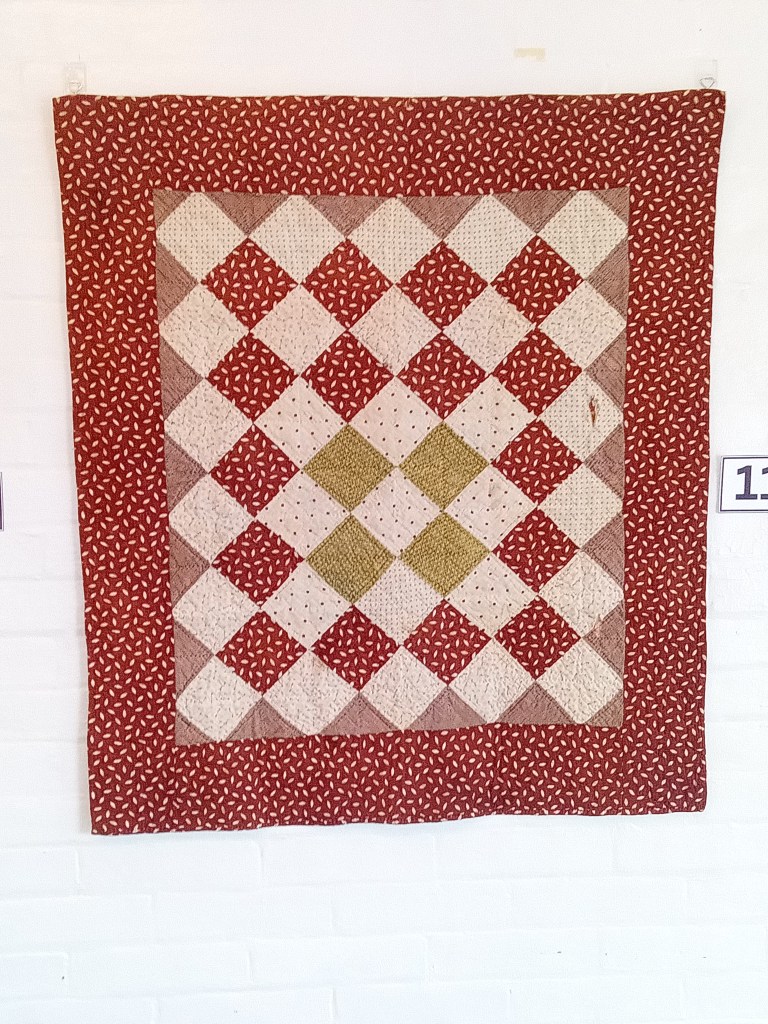
Here’s a few photos of the exhibit, showing some of the quilts on display.

You can see this lovely exhibit (and the museum!) until October. It’s called Quilted Layers: Piecing Together History and it is curated by Jill Mezaros. You can make reservations on the website to see the exhibit. While you’re there, you might want to take the Underground Railroad tour and maybe have High British Tea, which is usually the last Friday of the month. Yum!

Now let’s get started on this week’s quilt tutorial to help you restart your quilting this fall.

Midnight Pathway is another great VRD pattern by our own Molly Cook. It finishes at a big 52″ x 72″ and makes a good-sized throw quilt. Want it bigger? Simply add a border.

To me, this pattern has a more masculine feel to it. It’s very straightforward without any extras. I think you’re going to like it!

A quilt titled 'Midnight Pathway' with dark blue and gray fabrics arranged in alternating horizontal strips, featuring intricate quilting patterns.

Don’t have this pattern yet? Then get your digital pattern HERE or your print pattern HERE.

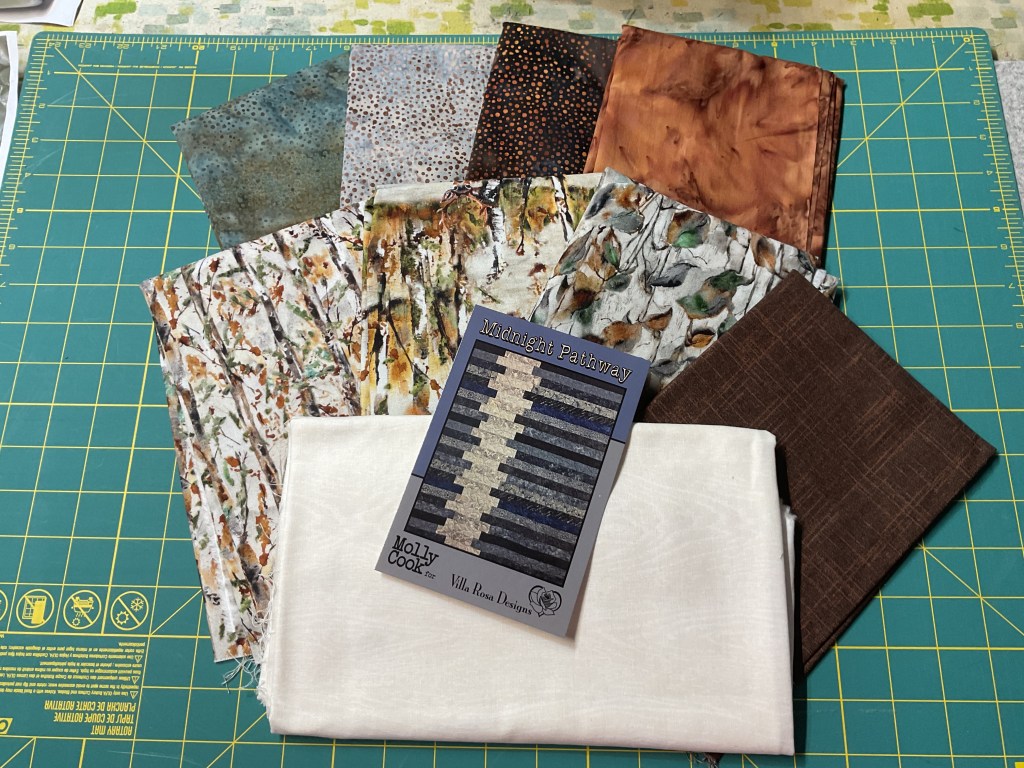
Today we’re using a rich earthy fabric collection. This collection is called Into the Woods and is a Hoffman Fabrics digital fabric collection with companion batiks.

A collection of quilting fabrics laid out on a green cutting mat alongside a pattern card for the 'Midnight Pathway' quilt. The fabrics include various colors and patterns, while the card is clearly labeled with the quilt design details.

Sadly, this collection is an older one, so you might not be able to find it anymore. This time of year, though, you’re bound to find something with a fabulous autumn woodsy feel that would work equally well like the Jason Yenter collection Falling Leaves or maybe Deb Tucker’s Forest Flora collection.

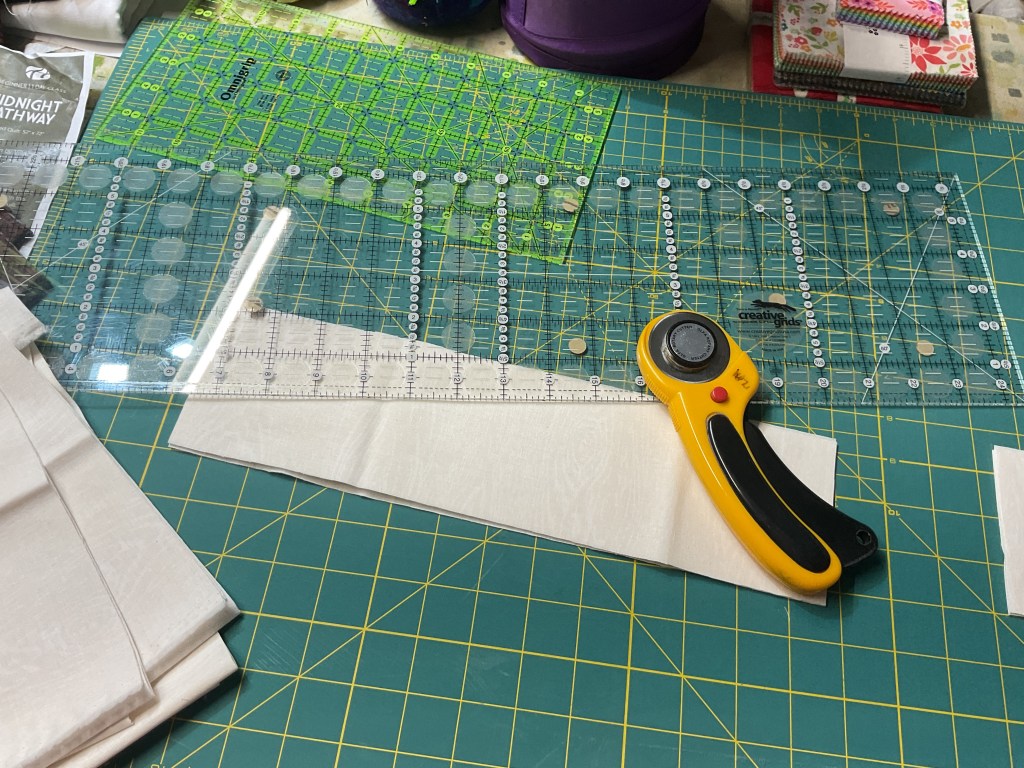
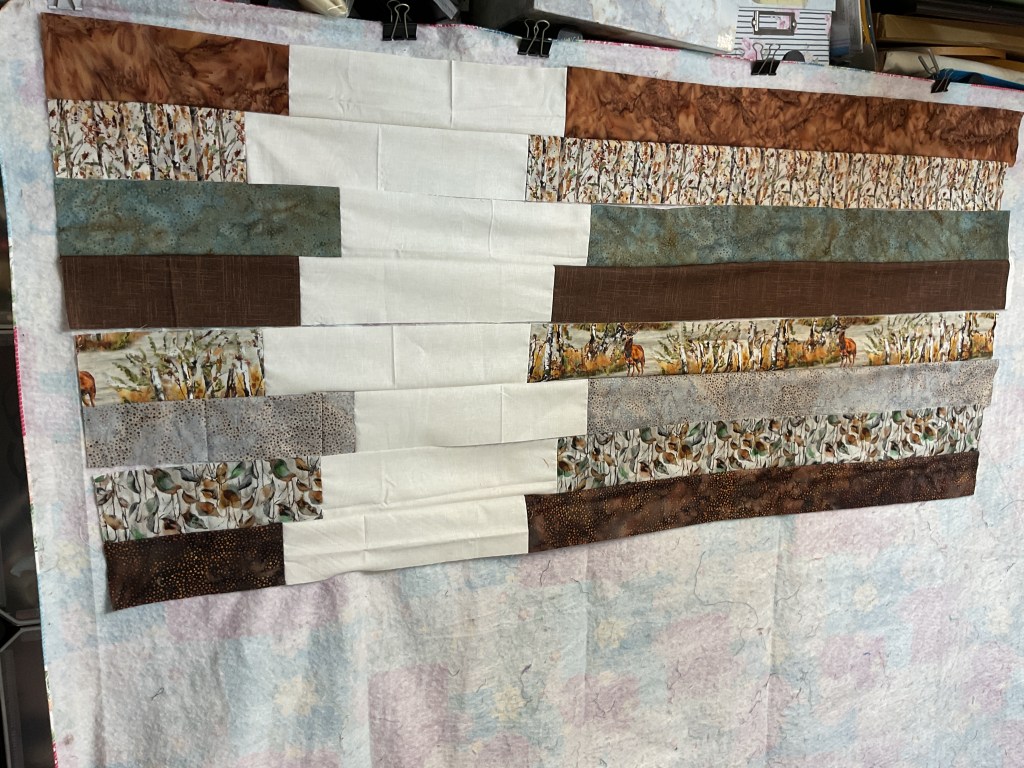
The first thing we’re going to do is to cut a lot of strips from our prints.

Then we’re going to cut more strips from our contrast fabric.

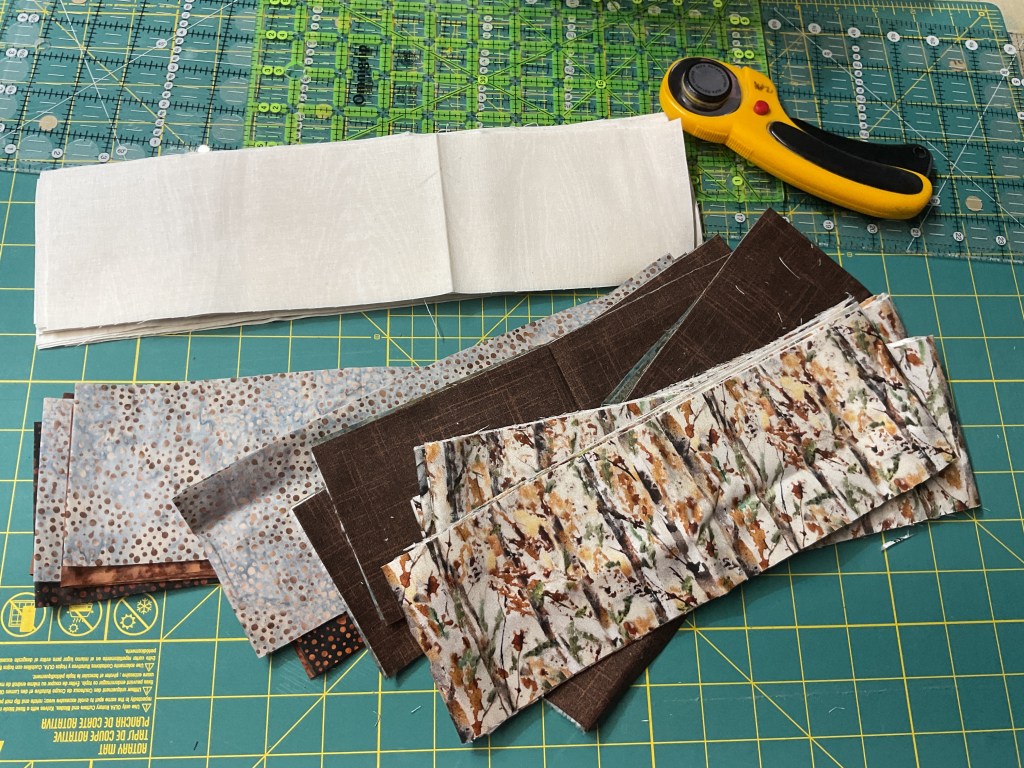
Once we’ve got all of our strips cut, we’re going to cut our strips into different sized pieces. It’s important to keep all the pieces from one strip together. I folded the smaller pieces inside the longer pieces so I wouldn’t lose them.

A collection of fabric strips in various patterns and colors, including light cream, earthy browns, and floral designs, arranged on a cutting mat alongside a rotary cutter and a ruler.

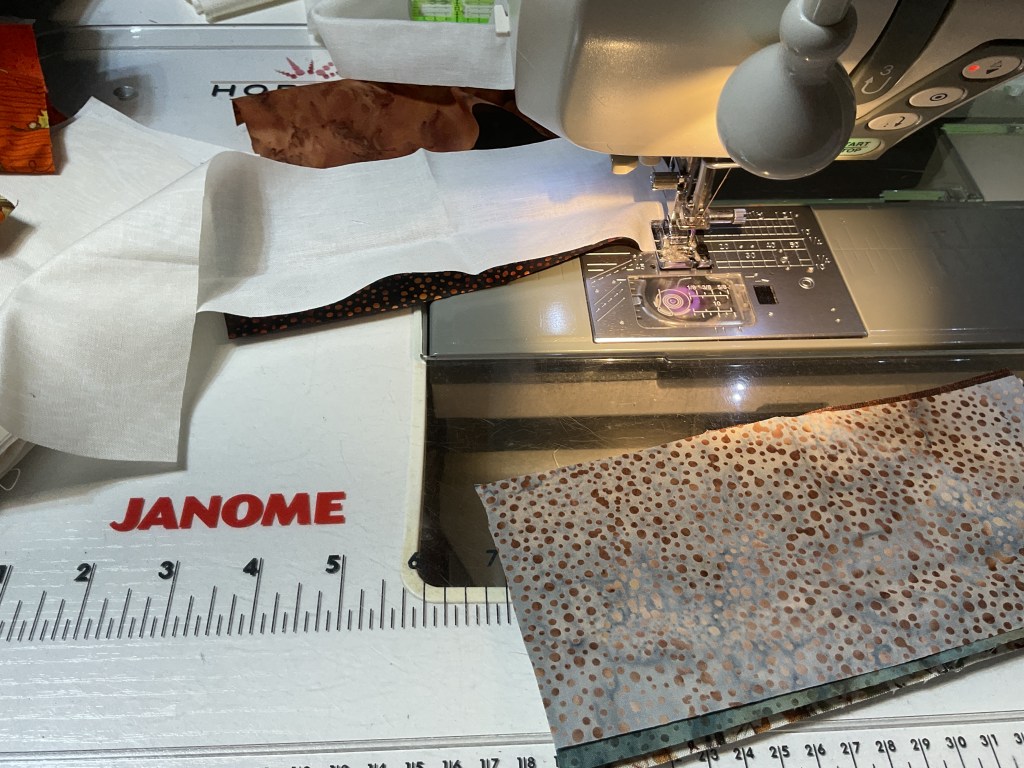
We’re heading to the sewing machine next so we can add contrast rectangles between the small and larger pieces of the strips. You could mix and match your pieces for a really scrappy look (or even shop out of your stash and scrap bins), but I’m sticking with the pattern and going to keep each original strip together.

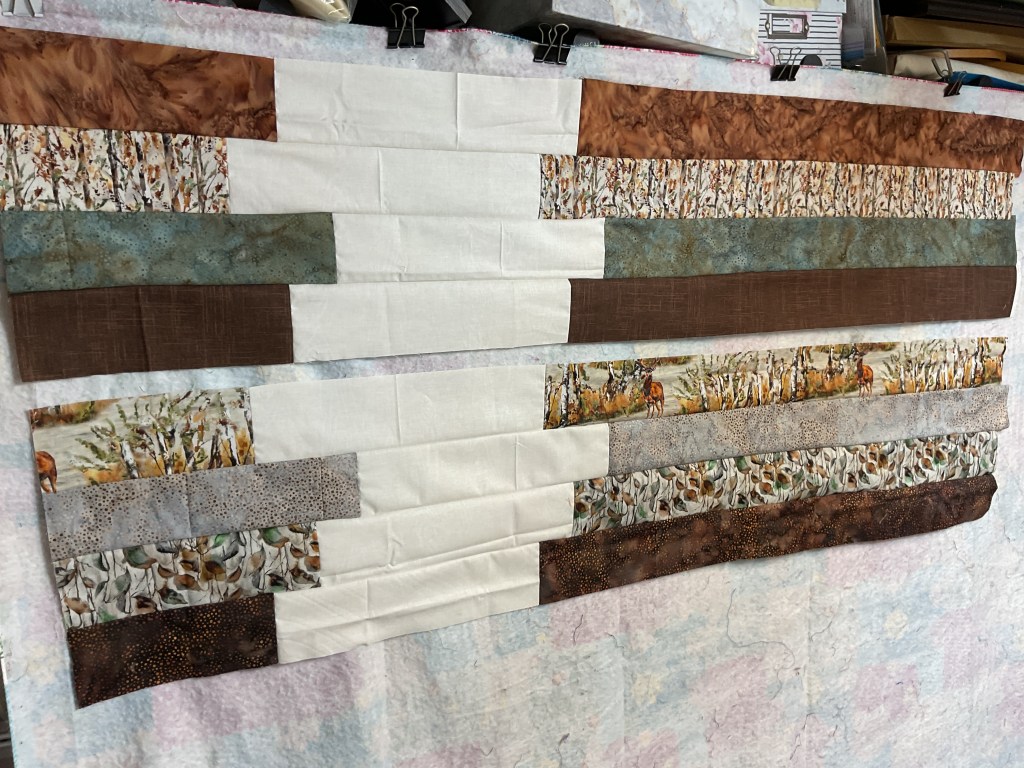
As there are three different pieced strips, I’m going to sew the strips together in 3 sections, then I’ll sew all the sections together.

I’m going to pin all the same pieced strips together to stay organized as I work on each group.

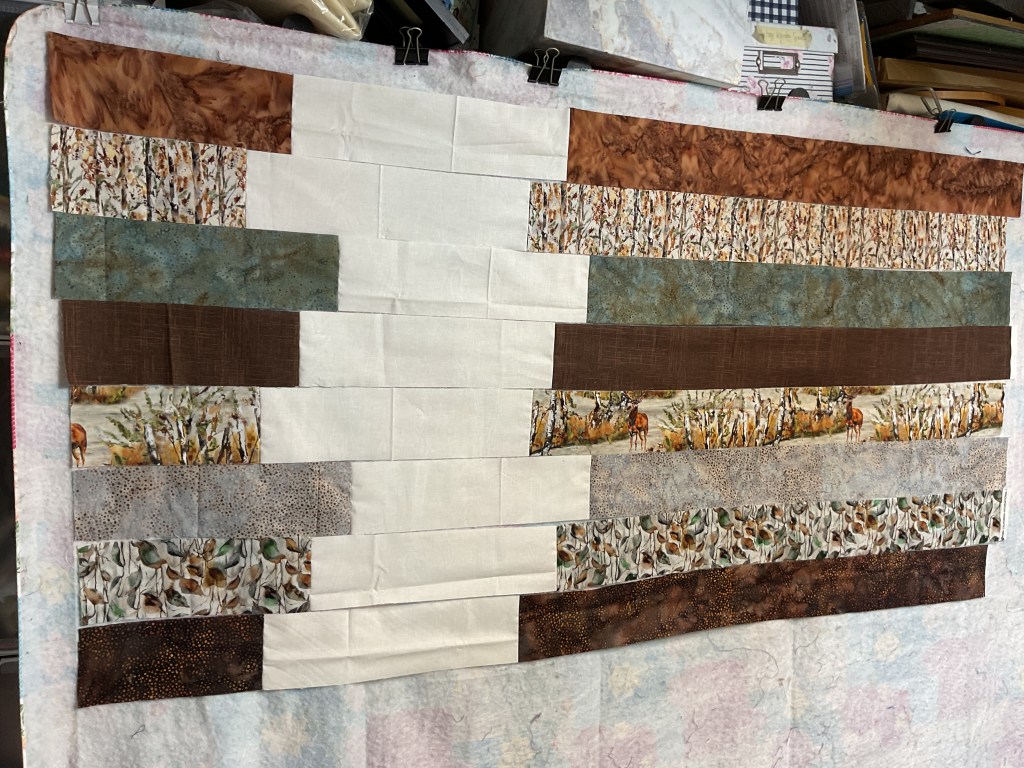
Now that all my strips are pieced, the fun can begin! Time to arrange the strips on my flannel board. Because I have my strips already divided into 3 groups, I’m also going to work on sewing the pieced strips together into 3 sections.

You can really have some creative license with this design because you can arrange the strips any way you want! There are so many ways you can put these strips together, so make sure you play a little bit before you commit.

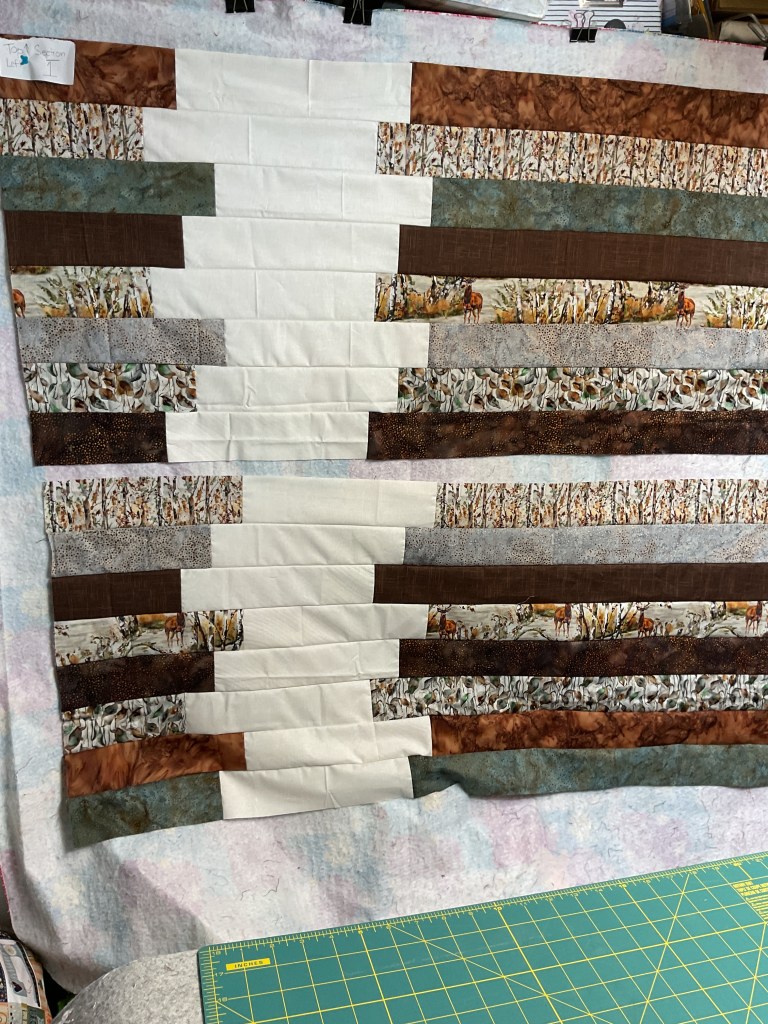
Okay, I’m happy with my first section, so I’m going to sew the pieced strips together – first into pairs, then into quads, then finally sewing the quads together into one section. This helps me to keep from mixing up the strips as I sew.

I added this piece of paper to the top left corner so I wouldn’t flip things all around as I went.

A close-up image of quilt fabric pieces showing a label that reads 'Top Section 1' with an arrow pointing up, indicating the arrangement. The fabric features earthy tones and patterns resembling autumn foliage.

Great! Time to move onto the second group of pieced strips. I’m going to continue using the same technique as I did with the first section (twosies and foursies) after I’ve decided how I want this section arranged.

Now onto the last section. Because the quilt top is getting so long, I’m pretty much standing on my head to arrange the last pieced strips. LOL! I can barely show you the entire quilt top now – my pressing counter is in the way and I’m running out of flannel board.

So I’m going to take the top outside for a photo so you can see the whole thing. And here it is! I really like how warm and cozy it looks and how any guy or gal would love it!

A patchwork quilt with alternating strips of earthy brown fabrics and light-colored fabric, laid out on green grass.

Now all I have to do is layer it with batting and backing (or fleece as I plan to do), quilt it, bind it, and put on a label. Ho hum…..I’ll be adding it to my mountain of projects that need finished, I’m afraid. Seriously, I have no idea how many flimsies (quilt tops) and layered quilts I have on my pile – so, what’s one more???

Fingers crossed I’ll get some time this winter to work on them. Of course, the more tutorials I do, the more flimsies I add to my teetering pile. What a delightful conundrum.

Bet you don’t have any WIPs or UFOs (works-in-progress or unfinished objects) in your sewing space, do you???

See you next week for another great tutorial and NEW September patterns!

Until then –

Always,

Tricia @ VRD
Rose Cards · Tutorials · villa rosa designs

VRD Morning Tea Quilt Tutorial

Happy Thursday to you!

PSST!

Hey, it’s me, Molly!

Long time no see! I’m stealing the blog from Tricia this week – it’s been a while since I snuck in here and did a tutorial. Sorry it’s been so long, but things have been awfully busy at the VRD shop and I’ve been working hard to create new patterns for you, too.

I heard Tricia’s doing a bunch of tutorials to help everybody get back into quilting this fall, so I thought I’d add one to the mix – Morning Tea. Yup, another Tea quilt. LOL!

Anyway, let’s get back to today’s tutorial, Morning Tea.

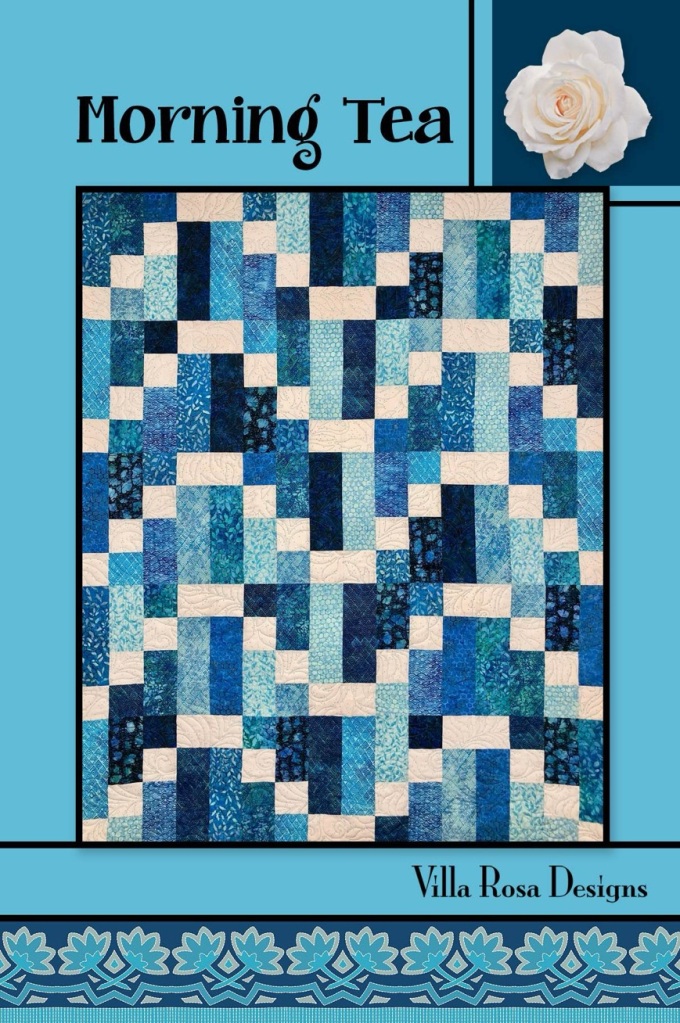
Here’s Morning Tea, designed by our very own VRD Rose Queen, Pat. It’s a fat quarter (18″ x 21″) friendly pattern plus you need to add a background fabric. And of course, it’s fast and fun!

A quilt design titled 'Morning Tea' featuring various shades of blue fabrics arranged in a patchwork pattern, with a light background and floral design at the top corner.

If you don’t have the pattern yet, you can get your print copy HERE or digital copy HERE

I wanted to play around with some of our Aboriginal fabrics in the VRD shop again and decided on this range of blues. Fun, huh? The squiggly light fabric towards the bottom of the photo is my background and the one in front if it is my binding.

A collection of Aboriginal fabrics in various colors and patterns, laid out on a green surface. The fabrics feature intricate designs, including circles and wavy lines, suitable for quilting projects.

Lucky you! We even have some kits left, and you can get yours HERE. Your kit comes with the fat quarters (FQs), background fabric, binding, and the pattern. I do have to say some of the fabrics have been discontinued but we did add some great replacements and they work perfectly too.

Let’s rock this quilt!

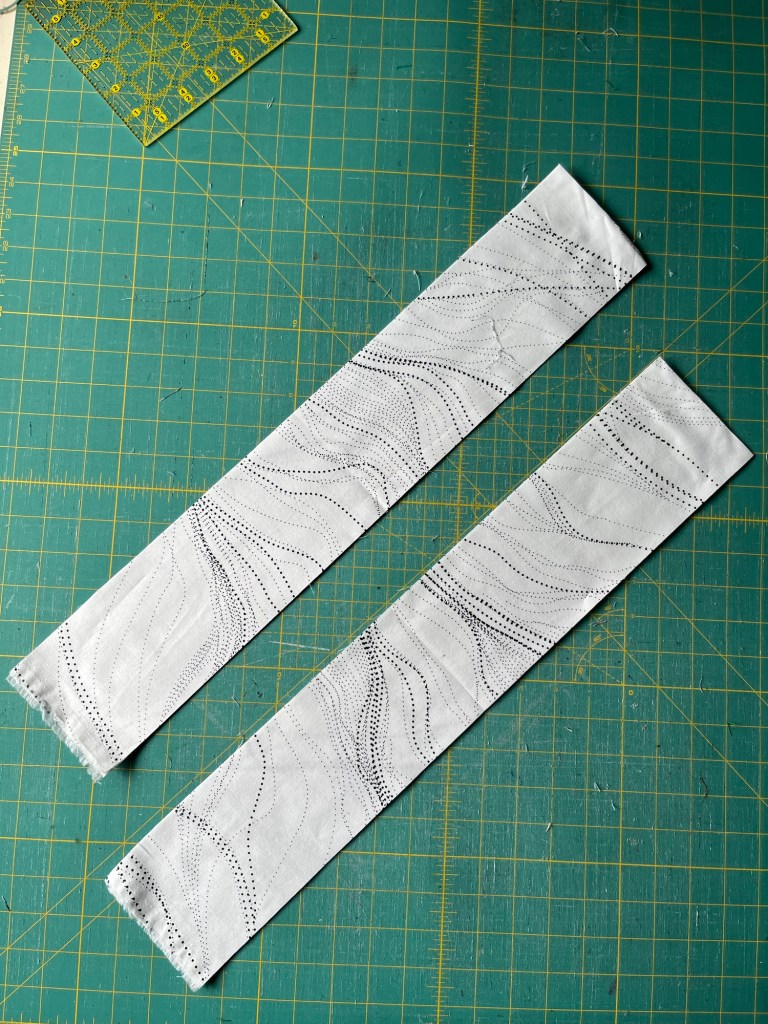
  1. First step is to divide your fat quarters into 2 piles. From the first group, we’re going to cut them into 2 different widths.
Two pieces of fabric with distinct Aboriginal designs, positioned on a green cutting mat with grid lines; one piece is wider and rectangular, and the other is a narrower strip.

2. From the remaining smaller group of FQs, you’ll cut the strips all the same width.

Two strips of fabric featuring a blue Aboriginal design, laid on a green cutting mat.

3. The background strips are all cut the same size by the width of the fabric, then we’re going to cut the long strips in half so our strips are the same length as our fat quarter strips. Genius!

Two strips of fabric with a squiggly pattern on a cutting mat, showcasing a quilting project.

4. Sew a background strip to each of the largest FQ strips. Next cut each of those strip sets into segments. I’m going to name these Unit A so we can keep everything straight as we go along.

5. Sew the remaining background strips between the small and the medium FQ strips. Subcut them into segments. These strip sets, I’m naming Unit B.

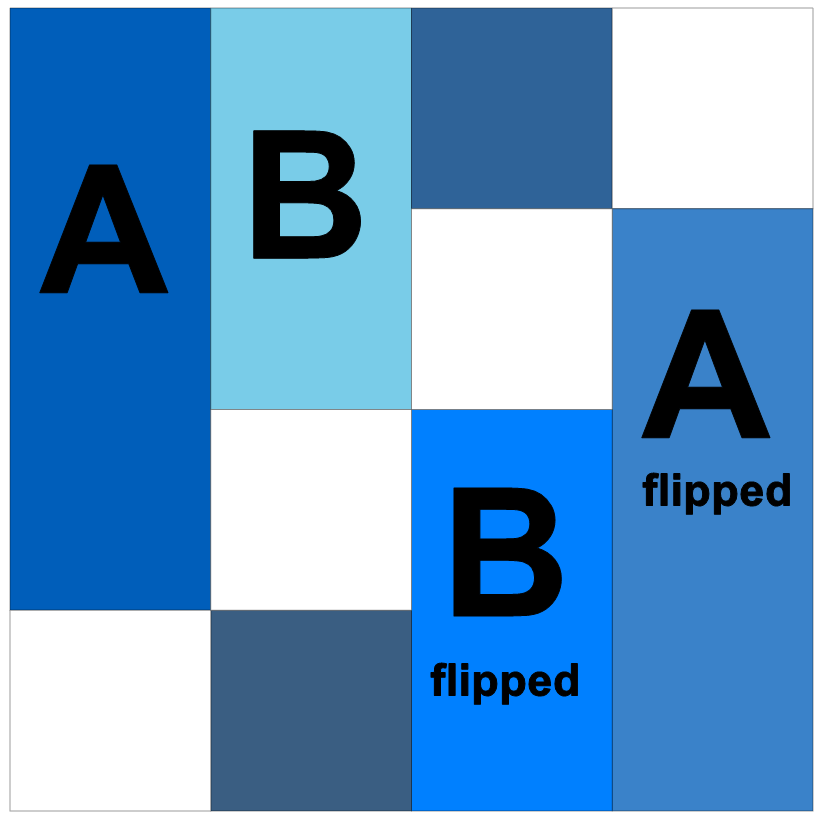
6. Are you following along? Because now we are going to sew our A and B units into blocks. Taking 2 of unit A and 2 of unit B, sew together with As on the outside and Bs in the middle. You’ll need to flip the last 2 units.

A quilt block layout featuring the letters A and B in various blue shades, with some blocks flipped.
Close-up view of a quilt featuring vibrant Aboriginal fabric patterns in shades of blue, black, and white, with intricate designs and stitching.

7. You will now make a reversed block with 2 more of each A & B units, turning the last 2 units as shown.

A visual representation of a quilt block layout, featuring blue and white squares, labeled with letters 'A' and 'B' indicating different fabric units.
Close-up of a quilt featuring a variety of blue Aboriginal fabric patterns arranged in a patchwork design.

8. You should now have the same number of each block. Time to play! You can lay your quilt out just like the pattern or you can play around with the layout and create some fun variations.

Here’s the original layout.

And here’s some cool variations to try out.

I bet you can even come up with your own block arrangement, so have fun!

9. When you’ve decided how you want to arrange your blocks, it’s time to sew the blocks into rows and then sew the rows together into the quilt top.

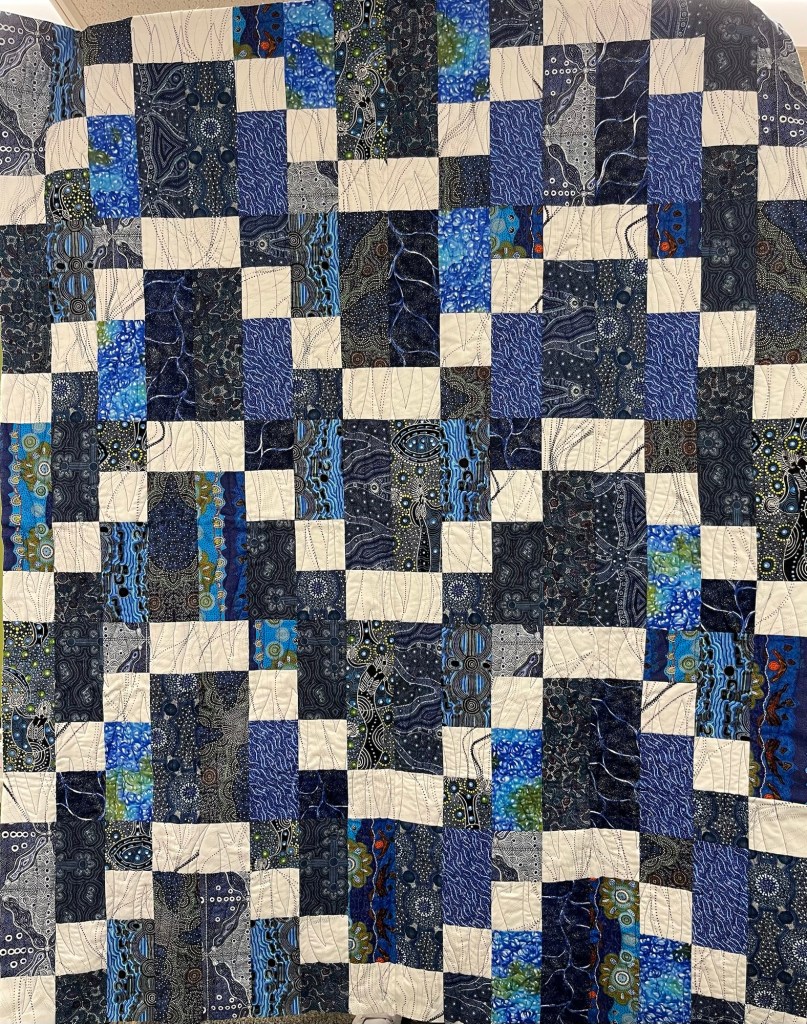
For my Morning Tea quilt, I’m going to stick with the original layout. Totally loving how it turned out!

A quilt featuring a patchwork design with various shades of blue, turquoise, and white, arranged in a square pattern.

10. Next up – layer, quilt, bind, and label your quilt.

Don’t forget to post your quilts on our VRD Facebook page or tag us on Instagram, #villarosadesigns. We love seeing your creations!

Thanks for stopping by and sewing with me!

Next week, Tricia will be back with another great tutorial for you.

That’s it for me.

Until next time —

Later,

Molly

Quilting Partners · Rose Cards · Tips and Tricks · Tutorials · villa rosa designs

VRD Tea With Mara Quilt Tutorial

Happy Thursday to you!

After our super fun Let’s Design a Quilt series (if you missed it, please check out the right side bar on the blog to find all of the links for the series) wrapped up last week, I promised a new group of tutorials to jump-start your autumn quilting.

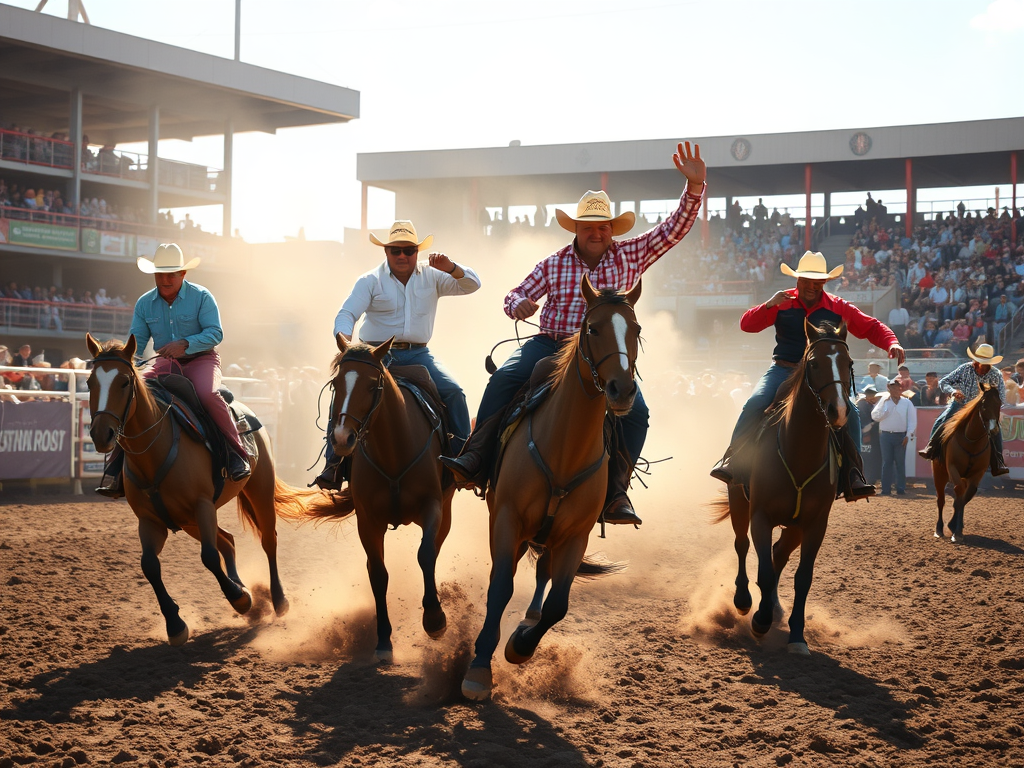
You know how this time of the year is filled with local fairs and such right before the kiddos go back to school? Well, this week we’re off to the rodeo! Yippee!

Four cowboys riding horses during a rodeo, raising their hands in excitement, with dust kicking up in the background and an audience visible in the stands.

Have you ever been to a rodeo? I have a vague memory of going when I was a kid. My Grandma (my Dad’s mom) was always crazy about horses and always had at least a couple on the farm (my Grandpa always had his cows). I spent a lot of time on the farm as a kid as my grandparents’ farm was just down the road from our house. I have lots of good memories on the farm from when I was a kid. Baby animals were probably my favorite. Of course, running through the fields at midnight in the summer chasing down stray cows or horses was always fun, too. Good times.

Let’s slap our cowgirl (or cowboy) hats on our heads, put on our boots, and get started!

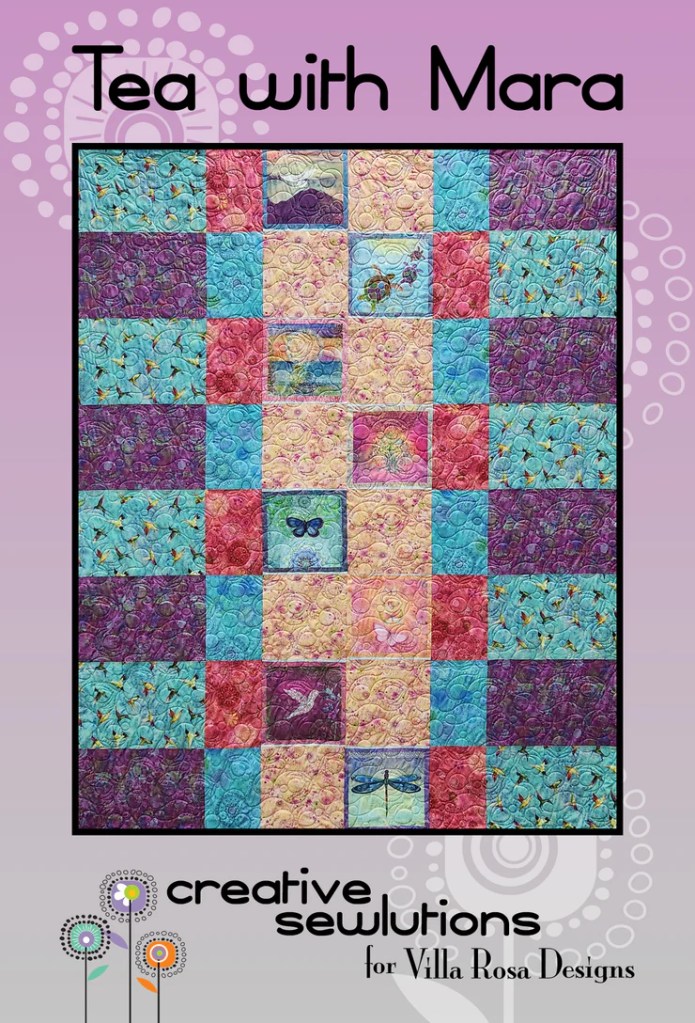
Tea With Mara is designed by Deanne of Creative Sewlutions, one of our talented VRD designers. This quilt finishes at a generous 58″ x 72″ and it can handle those large prints we are so loathe to chop up. Use printed panel squares……or not down the center. Sew many options……..sew little time!

A colorful quilt titled 'Tea with Mara' featuring a patchwork design with floral and butterfly patterns, highlighting various shades of pink, blue, and purple.

Get your digital pattern HERE or your print pattern HERE

PSST! Don’t forget, patterns always ship free, so grab a few more while you’re perusing the VRD patterns at the online shop.

For today’s tutorial, I’m using fabric from our friends over at Hoffman. It’s a digital-printed collection called Rodeo Dreams. When I saw this collection, I loved it! Maybe because it brought back fun memories from my childhood? So I’m letting you know right now that you’ll be seeing a couple more tutorials featuring Rodeo Dreams.

Just a quick word of caution when using digitally-printed fabrics – start with a brand new needle because if your needle is dull, you run the risk of damaging the fabric and we certainly don’t want to do that.

A selection of quilting fabrics, including blue and red bandana prints, a brown print, and a fabric featuring cowboys on horseback, alongside a digital pattern for the "Tea With Mara" quilt tutorial.

The first fabric I’m going to cut is the running yardage of the rodeo vignettes. I’m very glad I have a ruler the same size as the required block size in the pattern so I can fussy cut the squares easily and accurately.

A cutting mat featuring a quilting ruler over fabric with a rodeo scene, alongside a tutorial card for the 'Tea with Mara' quilt pattern.

Having the right sized ruler makes it a lot easier to fussy cut these vignettes than trying to cut strips and then cutting the strips into squares. This type of fabric makes strips and squares kind of tricky because the vignettes aren’t all the same size nor do they line up in a perfect grid.

Love quilting rulers! Boy, they do make quilting so much easier, faster, and more accurate.

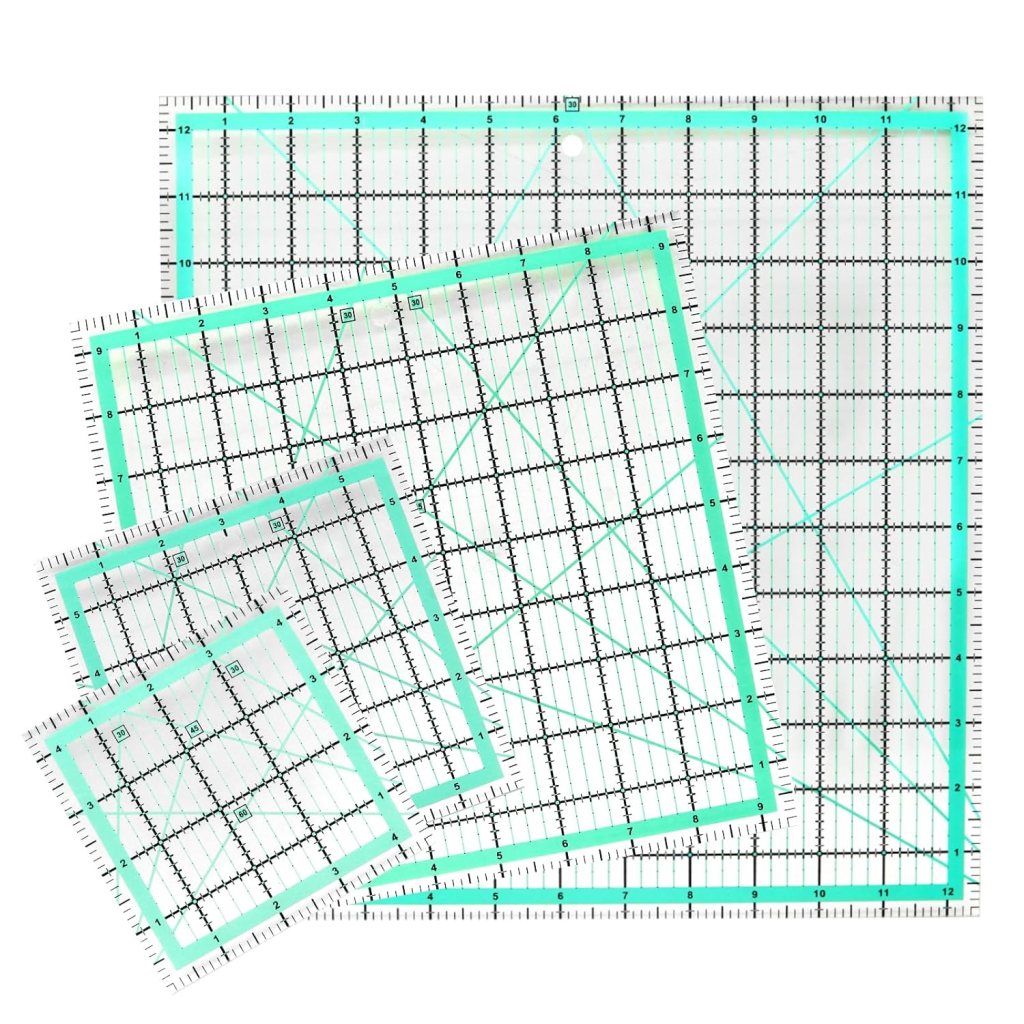
Mostly, I rely on my 6×24 and 6×12 rulers for cutting, but it’s always a great idea to have a collection of square rulers in the most common sizes, which are not only good for fussy cutting, but also for squaring up blocks.

A set of clear quilting rulers in various sizes, featuring measurement grids and markings, placed on a white background.
This basic ruler set includes rulers in common sizes

The only problem with fussy cutting is that your fabric will look like Swiss cheese when you get all done! LOL! Check mine out below. I can still fussy cut more pieces out of the fabric, but there is definitely more waste doing it this way than cutting strips into squares. Just something to think about if you’ve never fussy cut before.

A layout of quilting fabric featuring rodeo scenes, displayed on a flannel wall alongside various quilt blocks.

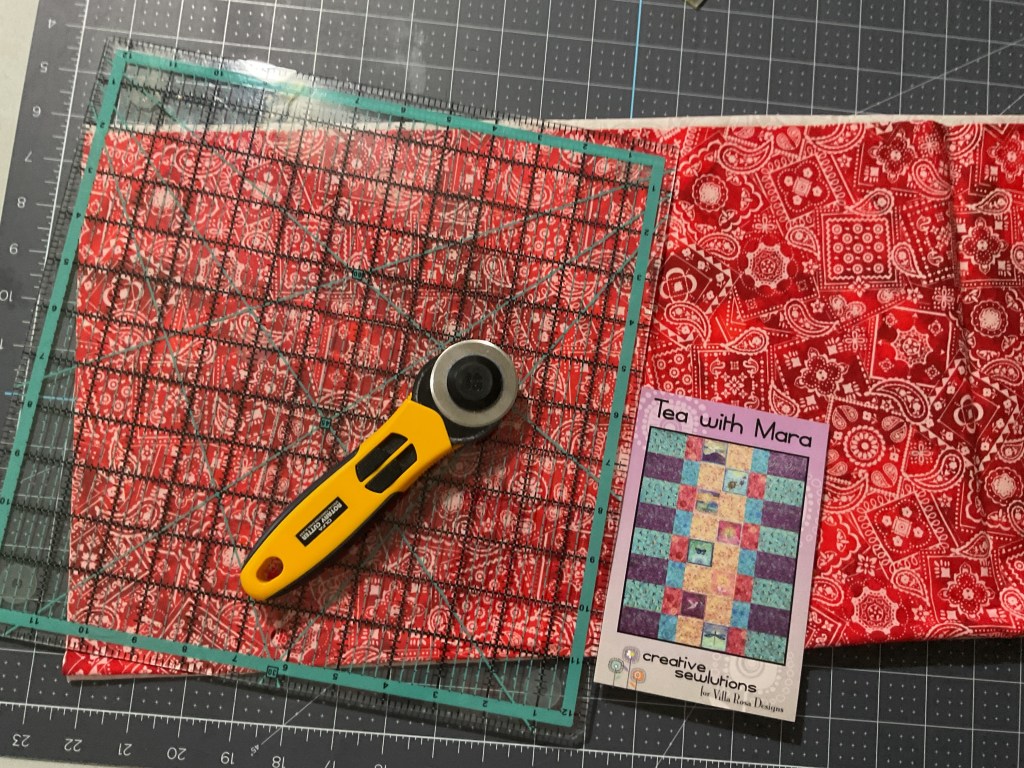
Now I’m finished making Swiss cheese, it’s time to cut the rest of my fabrics. Loving this red bandana print – it looks like the real thing (digitally printed, of course)!

A rotary cutter and quilting ruler positioned on a cutting mat, with a vibrant red bandana print fabric and a quilt pattern titled 'Tea with Mara' by Creative Sewlutions.

Here are all my fabrics cut and ready to sew.

A collection of quilting fabrics including a red bandana print, a blue bandana print, a brown fabric, and a fabric featuring a cowboy chasing a calf, with a quilt pattern titled 'Tea with Mara' visible.

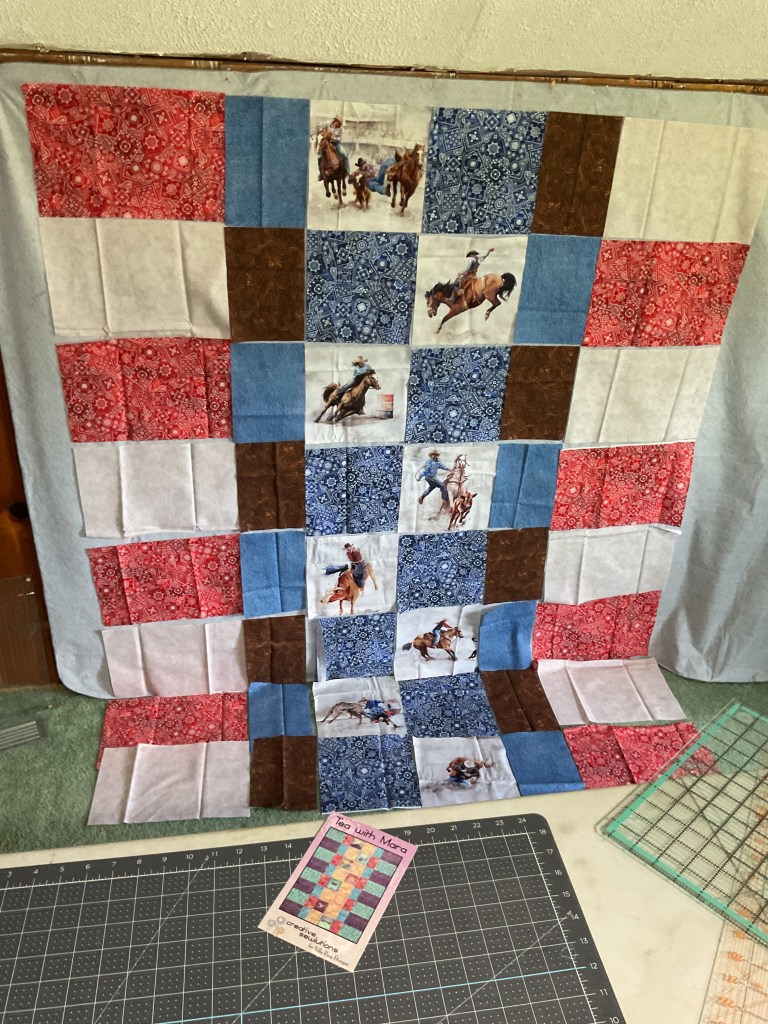
But before I start sewing, I’m going to lay out all of the pieces on my flannel wall. I want to make sure I like the placement of the rodeo vignettes before I commit to their positions permanently.

Quilt blocks arranged on a flannel wall, featuring red, blue, and brown fabrics with a rodeo theme and floral patterns.

I really like the nice big pieces in this quilt, even if I have to layer pieces on the floor because the quilt is going to be longer than my flannel wall. It’s going together surprisingly fast, though.

Of course, you don’t have to fussy cut your fabrics like I did – you could use any fabric you wanted for the center squares. Or you could even scrap this quilt up and use some of your stash. Such a versatile pattern – I could totally picture this quilt in a great collection of fall or harvest fabrics! Hmmmmmmmm….

You could even add a 6″ finished border, which would make the quilt a big 70″ x 84″!

Now I’ve got all my pieces up on the flannel wall. I switched a couple of the rodeo vignettes around, but other than that, I think it’s ready to sew. I like how it looks.

A colorful quilt layout featuring horse and rodeo-themed fabric squares, with red, blue, white, and brown patterned blocks arranged in a grid pattern on a design wall. A cutting mat and quilting ruler are visible in the foreground, along with a pattern card labeled 'Tea With Mara.'

Yippee-ki-yi-yay! Let’s sew this little dogie together! I really like how the fabrics alternate in placement from side to side – it definitely helps to keep your eyes moving around the quilt. The red and blue bandana fabrics really make this quilt in addition to the rodeo vignette squares. LOVE IT!

A quilt with alternating squares of red, white, blue, and brown fabric, featuring images of rodeo scenes.

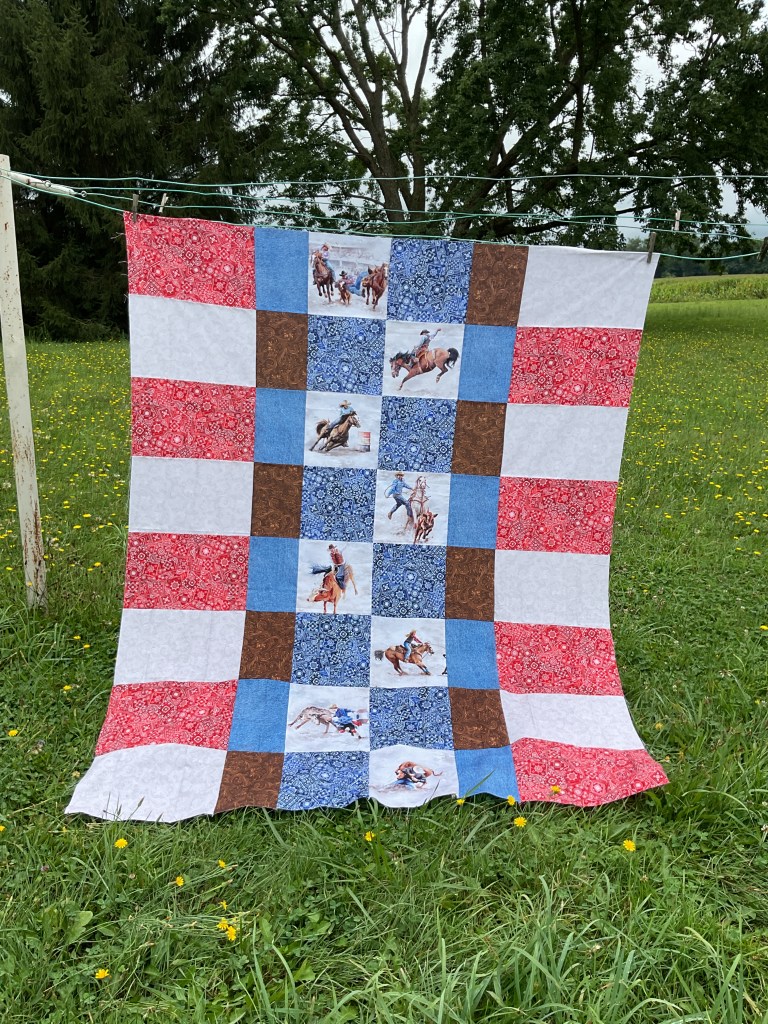
And here it is outside on the clothesline. All I need is a horse or 2 grazing in the backyard, right? I’ll be binding this quilt with the dark blue batik you see in the fabric and pattern photo way up at the beginning of this tutorial. I think it will frame the quilt nicely.

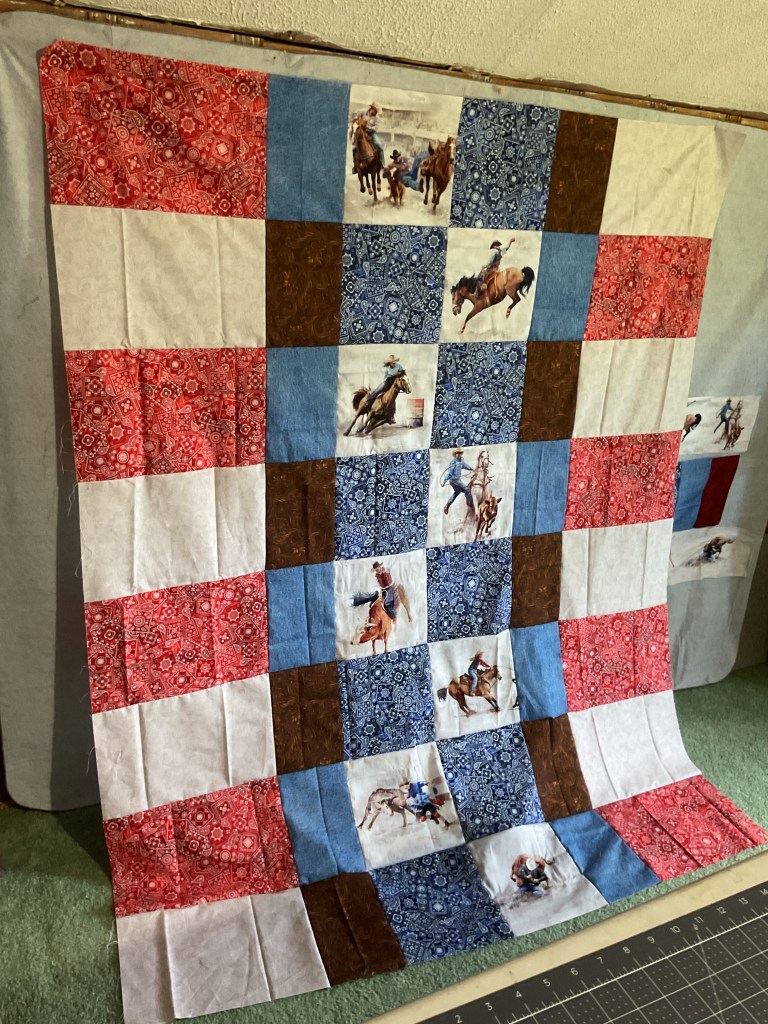
A colorful quilt with red, blue, brown, and white squares, featuring rodeo-themed prints, hanging on a clothesline in a grassy field.

Now to get this quilt top layered, quilted, bound, and labeled…….some day, anyway. Right now I’m going to add it to my teetering pile of flimsies and UFOs. I’m hoping to make a good-sized dent in that pile this fall and winter. It’s just been way too hot this summer to machine quilt and do binding.

Here’s to autumn with its warm days and cool nights. And the brilliant colors of the season…. I can’t wait!

See you next week for another great tutorial!

Until then –

Always,

Tricia @ VRD
Quilting Partners · Rose Cards · Tips and Tricks · Tutorials · villa rosa designs

VRD Augustina Quilt Tutorial – Perfect Summer Project

Happy Thursday to you!

WHEW! If you’re like me, you are having a heatwave right now. 90’s every day. It even hit 100 on the thermometer on Monday! YIKES! I’m sooooo not ready for these temps. It’s like we went straight from 50’s to 90’s in a couple weeks.

90’s are definitely not normal for this time of year here in northwestern Pennsylvania. AND we have high humidity to go with the heat which makes me want to just melt into a puddle on the ground every time I have to step outside. I literally had to scramble on Sunday to get the window AC units in, but we’re all good now. I just don’t want to go outside anymore.

A woman in a floral dress appears distressed while crawling on a sunlit street, with water droplets visually distorting around her, creating an impression of melting.
I’m melting into a puddle………!!!!

Luckily my dungeon studio is still cool enough (sadly, it is not air conditioned) to work in comfortably. I have several fans on to keep the air moving, but when the heat finally infiltrates my space, it’ll get quite uncomfortable. That usually isn’t until August and September, though, but we’ll see what summer brings this year. Northwestern Pennsylvania is an interesting place to live – record amounts of snow and cold in the winter, a wet and cold spring, then – POOF! – record high temps in June. Only the strong survive……..

I finally got a little quality time with my sewing machine this week so I decided to put together a new tutorial for you. Augustina is a such great project for summer!

Of course Augustina is fast and fun – it’s a VRD pattern, but it’s also not so big that you feel like you’re wrestling an alligator while your body is dripping with sweat. I promise you, this quilt really is quick – I made the top in a couple hours and that included both cutting and photographing my step-outs for the tutorial. It’s a very satisfying afternoon project.

Augustina is a great sized quilt for a small throw or a juvenile quilt. And this is a pattern you are going to turn to over and over again for a beautiful quilt with little effort, yet it looks like a million bucks (sorry, it’s late and I couldn’t think of another phrase to use). So don’t forget to get your own Augustina pattern if you don’t have it yet.

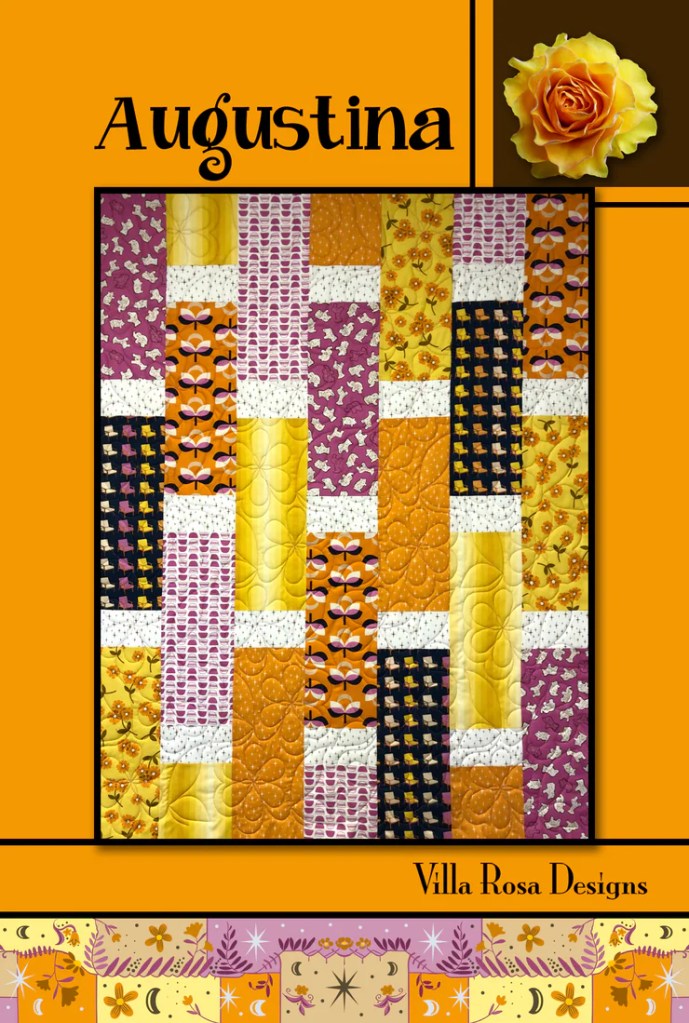
A vibrant quilt pattern titled 'Augustina' featuring colorful fabric blocks in shades of purple, yellow, and orange, with floral and geometric designs. The quilt is displayed on a warm orange background, showcasing its cheerful and lively aesthetic.

Get your digital pattern HERE or your print pattern HERE

Let’s get started!

The first thing we need to do, of course, is round up our fabrics. Augustina is a fat quarter project, so you can march right over to your stash and find some coordinating fat quarters or you can use this project as an excuse to visit your local quilt shop to buy new fabric. Yeah, I know, we quilters really don’t need an excuse, but it is handy to have one anyway, isn’t it?

For this tutorial, I am using Flower Shoppe fabrics from our quilty friends over at Hoffman Fabrics. The flower fabrics are all amazing Hoffman digital prints – have you seen these in person yet? The colors are so bright and clear – I feel like I could pick these flowers right off the fabric. We’ve paired a few Hoffman batiks to balance out the gorgeous flower prints.

Please remember when using digital prints, that they do not react exactly the same as regular quilting cottons. Always start with a new needle in your machine so you are not pulling threads when sewing as well as a new rotary cutting blade so you are cutting cleanly through the fabric instead of sawing at it, which can damage the fibers.

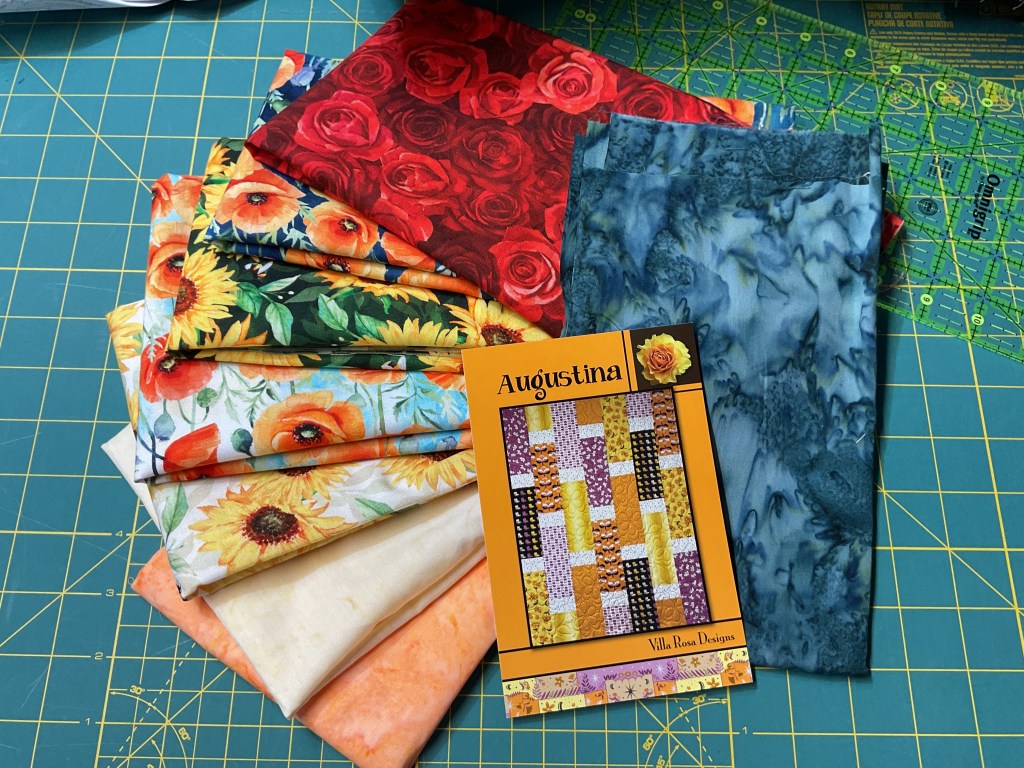
A collection of fabric pieces featuring floral patterns, including sunflowers and roses, stacked with an Augustina quilt pattern booklet on a cutting mat.

Next up…..cutting.

SHHHHH! The secret of this quilt is that the pieces are big. Big pieces mean you don’t have to spend loads of time cutting little squares, rectangles, or triangles. Big pieces are a huge time saver! Big pieces also mean you can use bigger prints (when you use big prints in small pieces, the design gets all chopped up and you tend to lose what you loved about the print to begin with). Yay! Let’s GO BIG!

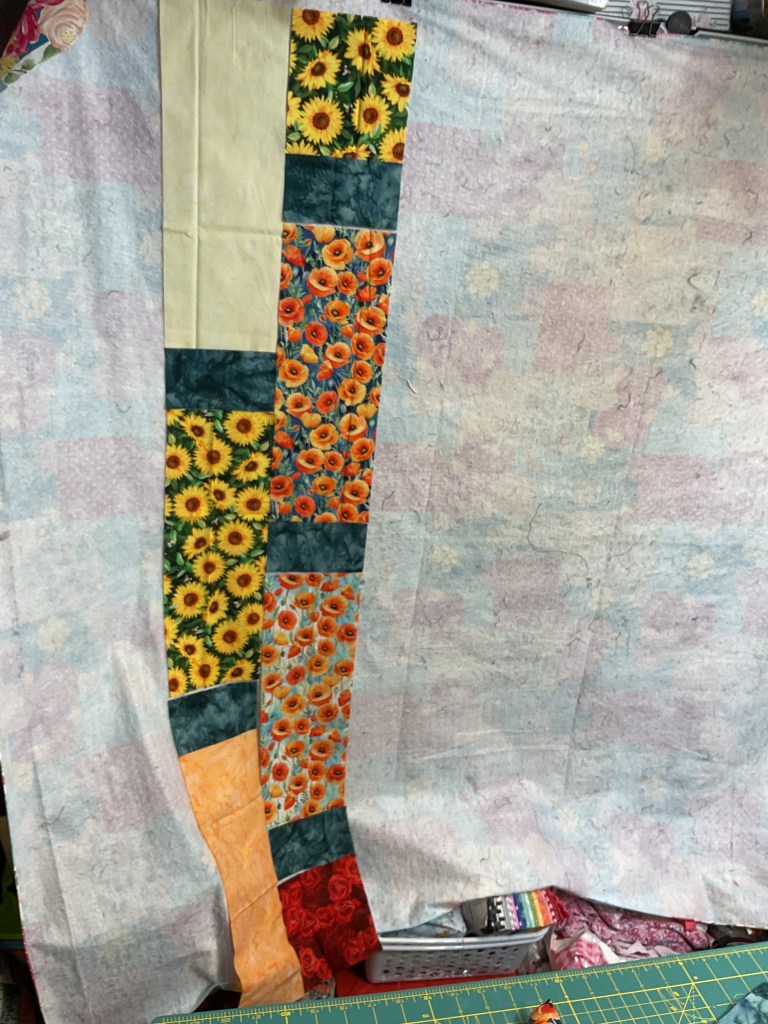
In the photos, below, we’re cutting our accent fabric into strips and then into rectangles.

Below, we’re cutting our FQs into strips and then into 2 different sized rectangles.

VIOLA! Cutting done. Easy peasy. Here’s all the pieces we need to make Augustina.

A selection of colorful quilting fabrics featuring vibrant floral patterns, including poppies and roses, arranged on a green cutting mat with a ruler and rotary cutter nearby.

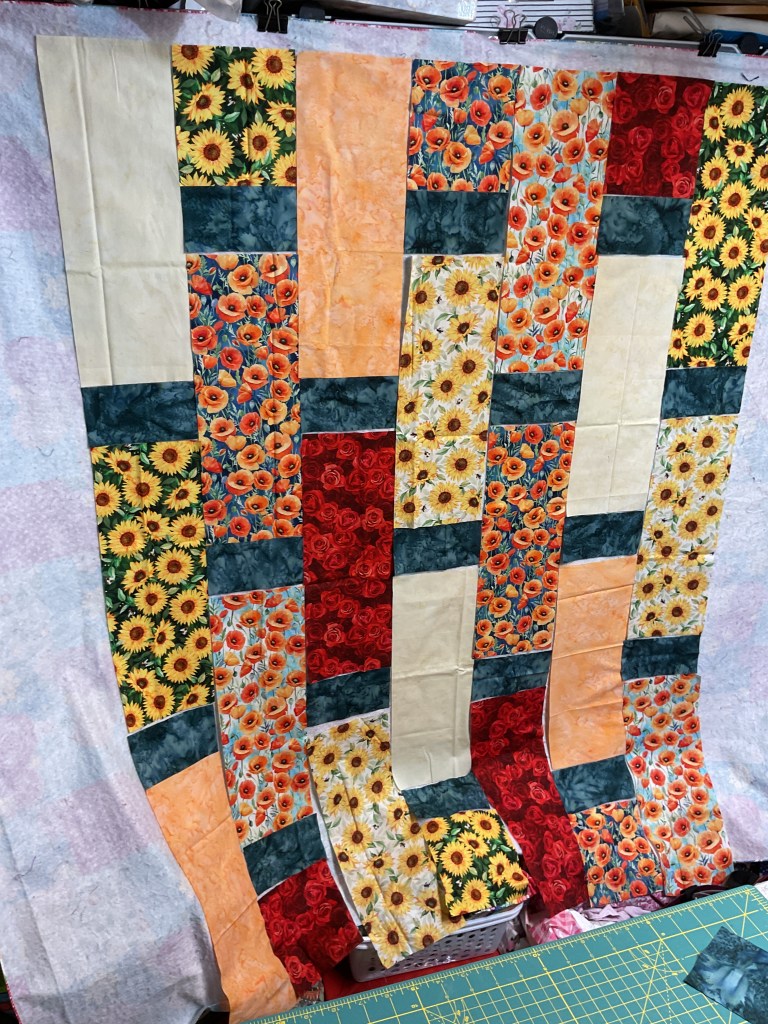
Before we can sew Augustina together, we have to lay out our fabrics. I’m going to put them up on my handy dandy flannel board which consists of a flannel-backed table cloth clamped to the tops of my fabric storage unit doors. As I’ve mentioned before, this idea came from my pal, Mary Lee. Kudos to you, Mary Lee! It’s a great option if you don’t have a spare wall to put up a more permanent quilt wall solution. I can simply take it down when I need access to my yardage stash. I’ve actually had this tablecloth for years now, so it’s even an economical option.

Hmmm……I think I need to move some fabrics around.

After several switcharoos, I think I’m happy with the layout now.

Let’s sew!

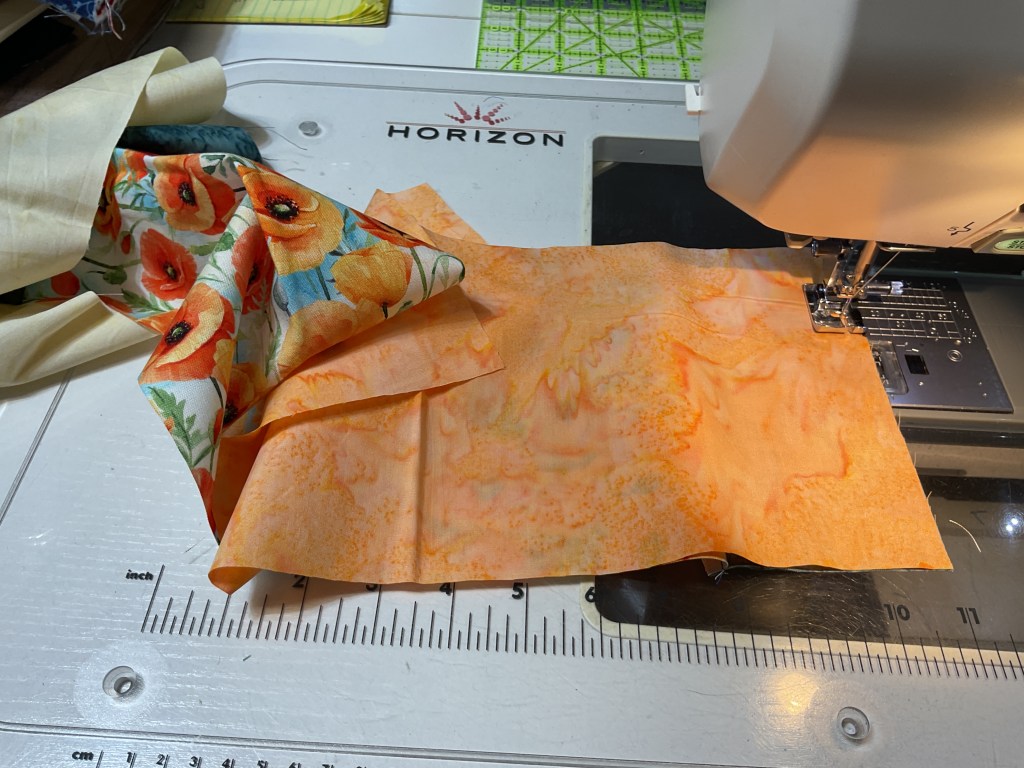
This quilt is sewn together in vertical rows. I took my time, only taking one vertical row off of my board at a time. I worked from the top down to sew the pieces together. It doesn’t matter whether you sew your strips top down or bottom up, just be consistent with all of your rows or else you might get your fabrics out of kilter.

Okay, all the fabrics are now sewn into vertical rows.

Vertical strips of colorful floral and solid fabrics are laid out for a quilt project, with a cutting mat visible below.

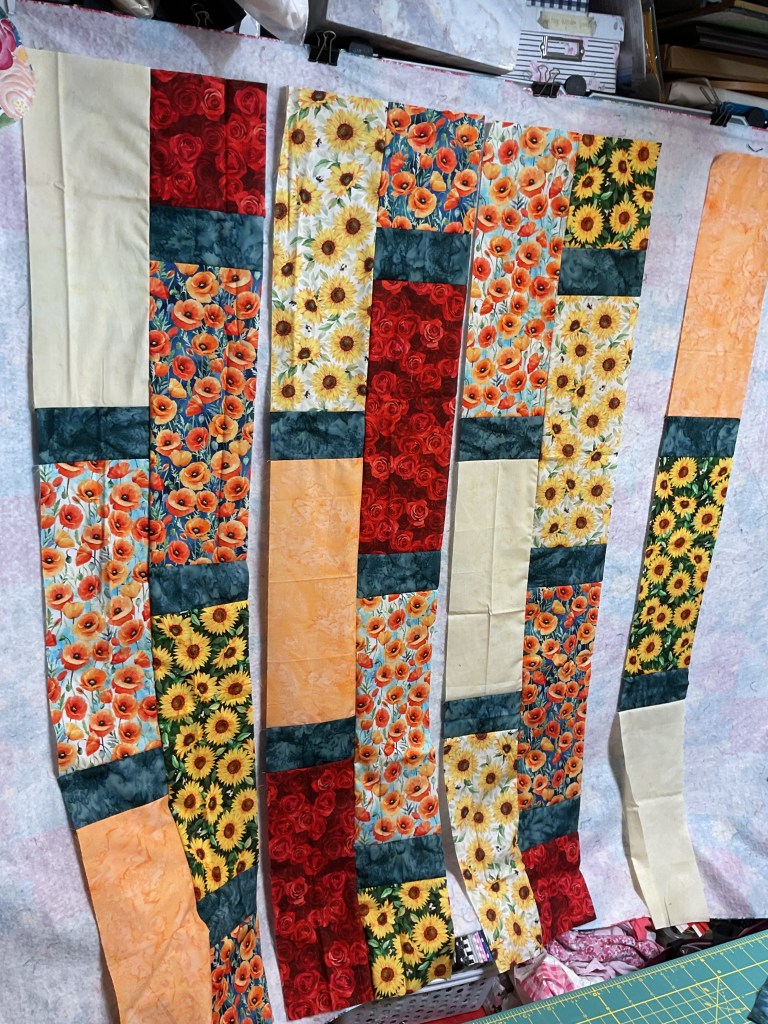
Now I’m going to sew the vertical rows together into pairs. As this quilt has an odd number of rows, the last row will have to hang out all by itself for a while.

Vertical strips of colorful floral fabrics arranged on a flannel board in preparation for quilting.

Next, I’m going to sew the first 2 pairs together into a foursome. Then I’ll sew the third pair and the last row together into a trio.

Two vertical quilt sections showcasing a colorful patchwork of floral and solid fabrics on a cutting mat.

One last seam to sew the 2 sections together and the Augustina top will be finished. Fast as can be! There isn’t a lot of matching seams, but you do want to make sure your accent pieces are relatively even-looking across the quilt.

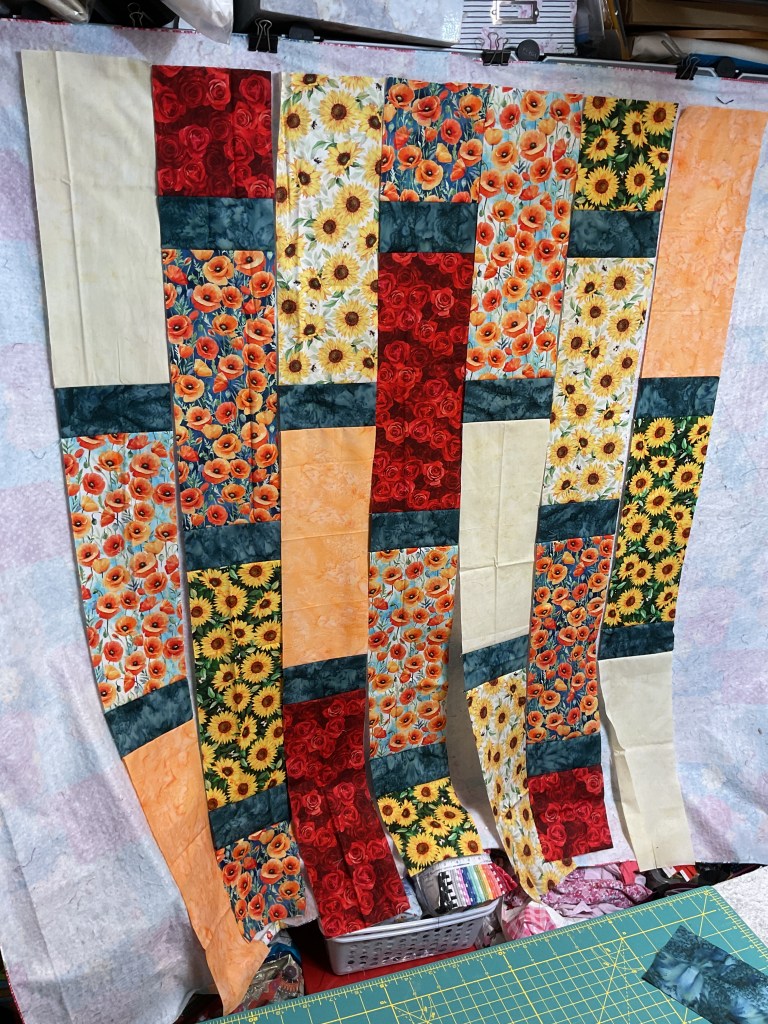
And here it is! Our completed Augustina quilt top.

Colorful quilt top featuring floral and solid fabric blocks arranged in a vertical pattern.

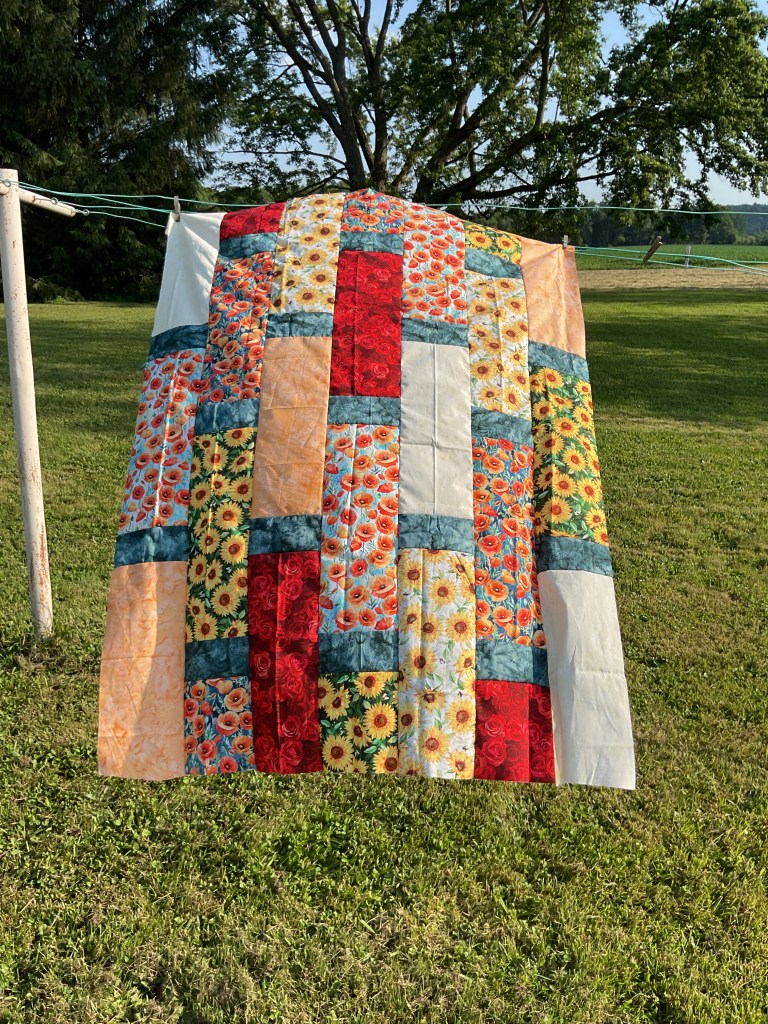
Although it was hot, I decided to take Augustina outside for a glamour photo. Sigh…….it was a little breezy out and I couldn’t get a photo with it hanging nicely for you. Bummer. But I do love how it looks surrounded by all the green – the flowers look like they are about to burst right off the quilt! That’s digital fabric for you – the number of colors that can be printed on fabric is phenomenal and creates stunning designs.

A colorful quilt featuring floral patterns and various fabrics, hanging on a clothesline outdoors with green grass and trees in the background.

And that’s it! Finito! Next I need to layer, quilt, and bind it…….someday, anyway.

If you’re looking for another great summer quilt pattern, check out the Jubilee tutorial from a few weeks ago. It’s also a super go-to project.

That’s it for me today, gotta go have me some summer……..in the air conditioning. LOL!

See you next week, same time same place —

Always,

Tricia @ VRD
Rose Cards · Tutorials · villa rosa designs

VRD Jubilee Quilt Tutorial

Happy Thursday to you!

Warm temps are here……..finally! Maybe a bit too much too fast, but I’ll take it! The sun is shining, the sky is blue, it’s actually warm in the upper 80s, but there’s a nice breeze to make the heat tolerable. Believe it or not, I’m sitting here in shorts and a t shirt as I write this blog post. Last week, I was wearing a fleece jacket and long pants. Oh, the difference a week can make. I hope you are having some nice weather wherever you are, too.

I thought we’d kick off the gorgeous weather here in my little corner of the world with a fun quilt tutorial.

Let’s make Jubilee today. It’s a super fast and fun fat quarter quilt and it’s a great option when you need a quilt in a hurry. Looks great in just about any fabric. Perfect for summer quilting. Make it in the afternoon and still have time for dinner and s’mores around the campfire in the evening.

A vibrant quilt titled 'Jubilee' featuring an assortment of patterned batik fabrics in earthy tones of brown, turquoise, and black, designed by Villa Rosa Designs.

Get your digital Jubilee pattern HERE or your print Jubilee pattern HERE

The first thing we need is fabric! YAY FABRIC!

Today I’m using batiks from the Sweet Shoppe collection by our friends at Hoffman Fabrics. Aren’t these fabrics yummy? I can’t wait to see how the quilt turns out!

A collection of colorful batik fabrics arranged around a Jubilee quilt pattern, showcasing vibrant colors and intricate designs.

Of course, we need to do some cutting before we can sew. Let’s get to it.

In the left photo, below, you can see how many layers I’m cutting at once. I find batiks to be great for layering for cutting as the fabric is finer. When I’m cutting thick or slippery fabrics, I only cut one layer at a time.

Let’s get the rest of the fabrics cut. For Jubilee, we only need 2 different shapes, which is one thing that makes this quilt go together so quickly. Wow! That was fast!

Time to start sewing the strips together so we can make strips sets and then we’ll cut the strip sets down into the block size we need.

I like to set all my strips to the left of my machine while I sew. Then I select strips randomly to sew together, making sure I don’t grab 2 of the same strip. We want these strip sets to be as scrappy as possible.

Once I’ve sewed 2 strips together for the required sets, I then go back and add the third strip to all of the sets. I find it more efficient to complete each step for all the pieces at once before moving onto the next step.

Sewing colorful fabric strips together at a sewing machine for a quilt project, with scissors nearby.

Once our strip sets are sewn together, it’s a good idea to press them before we begin cutting out the blocks.

Do you struggle with which way to press your seams on the back of your blocks? Me too. More often than not I end up flipping the seams in the other directions when I go to assemble blocks. Oy vey!

The good news with Jubilee is that it doesn’t matter which way you press your seams because the blocks do not line up and the seam do not cross – another reason why Jubilee is quick as a wink.

Next we need to cut our strippy blocks from our strip sets. I’m layering 3 strip sets on top of each other for cutting. To do this, I line then up on the left edge (or the right edge if you cut from that side), but I stagger them a bit top to bottom so the seams are not sitting right on top of each other because stacked seams make a big lump. It’s not a good idea to attempt to cut through lumpy seams or you might accidentally miscut something.

Awesome applesauce! All of the blocks are pressed, cut, and ready to go. Time to head to my flannel wall to lay them out.

A collection of colorful batik fabric pieces organized on a work surface, showcasing various floral and abstract patterns.

I’m going to put the blocks up, alternating the squares with the pieced blocks. I’m just going to slap the blocks up randomly and then I’ll shuffle them around to distribute both colors and fabrics until I find a layout that pleases me. When you are putting blocks together, what is your process?

Below are 3 photos showing shuffled blocks. Sometimes this step takes longer than actually making the whole quilt top (eye roll here).

Here is my final layout.

A colorful quilt layout featuring various batik fabrics arranged in a vibrant pattern, showcasing different shapes and sizes of fabric pieces on a design wall.

Because the blocks don’t line up horizontally, we’re going to sew the blocks into columns and then sew the columns together.

And done! Here is the finished quilt top. Isn’t it pretty? I love that the blocks are large so one can enjoy the beauty of the batik fabrics. It turns into a nice throw at 45″ x 60″, but it would be easy to make the quilt larger by adding a border or additional blocks.

A colorful quilt made with batik fabrics, hanging on a clothesline outdoors against a backdrop of green grass and trees.

Now I just have to layer, quilt, and bind it.

Looking for info on finishing your quilts? Check out these posts in our Basic Quilting Skills blog series:

Batting, Backing, and Preparing Your Quilt for Quilting

Quilt As Desired

Squaring Up Your Quilt

Binding 101

Label Your Quilt

Now I’m off to my sewing machine to work on more quilts. Hope you are too!

See you next week, same time same place —

Always,

Tricia @ VRD
Quilting Partners · Rose Cards · Tutorials · villa rosa designs

VRD Stepped Quilt Tutorial

Happy Thursday to you!

I’ve got a fun and happy quilt tutorial for you today – Stepped by Running Doe Quilts for Villa Rosa Designs.

But before we get into the tutorial – I have an AMAZING announcement for you!

Drum roll, please!

Cue the confetti! Or how about a balloon drop from the ceiling this time?

Our Rose Queen and owner, Pat Fryer, has done it again!

She has a new batik fabric collection with Riley Blake Designs coming this October!

It’s called Kalinda.

WOOHOO!

Here’s a sneak peak –

Kalinda is simply perfect for all your autumn projects! You can download the collection PDF with all the fabrics and skus below.

Guess what????? There will be another collectible pattern storage tin for the Kalinda collection, too! I can’t wait! I love love love my tin from Pat’s first collection, Bedazzled. I can’t wait to collect them all as she designs new collections in the future!

Mark your calendars for October – when Kalinda makes its debut. Don’t forget to ask your local quilt shop to order the collection if they haven’t already.

Now I’ve spilled the beans about Pat’s new collection, it’s time to jump into our tutorial.

Stepped is a fun modern Rose Card pattern designed by Running Doe Quilts for Villa Rosa Designs. It is a large quilt, finishing at 66″ x 78″ and is fat quarter friendly – yay!

Get your digital pattern HERE or your print pattern HERE

For this tutorial I chose a wonderful warm and sunny collection from our friends, Hoffman Fabrics, called Sunset Hour. I chose the bright blue as the frame and binding for a wonderful pop of color against the warm sunset tones.

As usual, the first thing I’m going to do is cut the pieces for the blocks. Since this quilt doesn’t have a border (which is common for modern quilts, by the way), we don’t have to worry about that.

I’m wondering – do you cut your borders when you cut the fabric for the blocks or do you wait until after the center of the quilt is assembled? For me, I usually cut the border strips when I cut the block fabrics, but I don’t piece and cut the borders to size until after I finish the blocks.

Oops, let me get back to the cutting. LOL!

Here are all the pieces I need to make the whole quilt top. Isn’t that blue striking?

Now we’re ready to rock and roll at the sewing machine! The Stepped block goes together really quick (of course, it’s a VRD Rose Card pattern!). I like to put the large rectangle to my left and the blue frame strip to my right so I can grab a rectangle, place a frame strip on top, and zip it through the sewing machine. Then I repeat this same step for all the blocks, using chain piecing (meaning I’m not cutting the thread between blocks as I sew).

Working with batiks is lots of fun – you don’t usually have to worry about right or wrong sides because they are dyed the whole way through.

I could just flip the frame strip over, give it a finger press, and add the 2nd frame strip on, but I want my blocks to be nice and crisp, so I’m going to head to my ironing board to press the blocks before adding the 2nd frame strip.

Now I’m ready to sew the 2nd frame strip on the side of each block. Easy piezy – just the way I like ’em!

Then it’s back to the iron to press the blocks one more time. I warn you – there are a lot of blocks! Seriously!

Next I’m heading to my flannel board, which is actually behind my pressing station, to lay out my blocks. SHHH! My flannel board is really a flannel backed tablecloth hung in front of my fabric storage wall. To hang it, I clip the tablecloth to the tops of my storage doors with big binder clips. That way, I can take it down whenever I need access to the fabric cubbies (these particular cubbies hold my yardage and fat quarters by color).

Now the fun begins. As I lay out the blocks, I’m moving them around to spread the colors and fabrics out over the whole quilt. Laying out your blocks is an important step in making a quilt because you don’t want all the same fabrics or colors clumped together in the same area by accident.

Yikes! I’m actually running out of flannel board for this quilt because it’s big, so I think I need to sew this section together before I can add the final 4 rows. Off to the sewing machine I go…..

All right, here’s the section sewn together. Sorry, just noticed in this photo, I have it turned upside down from the previous photos. Mea culpa.

Finally, I can lay out the final 4 rows and add them to the quilt top. Ugh, you can’t see the bottom section I just added because my ironing station is in the way. Did I mention this is a BIG quilt???

I know! Let’s go outside so I can show you the completed quilt top!

I LOVE the warm and sunny colors of the sunset and the blue plays nicely. I reminds me of photos of the sun setting over the ocean. I say photos as I’ve yet to actually see an ocean. Someday…….

OH! Rats!

Take a look at the bottom of the quilt, I ended up with too much light colored fabrics bunched together. This happened because I couldn’t lay out the entire quilt on my flannel board all at once before I stitched the blocks together. ARGH!

Looks like I will be doing some un-sewing with my trusty seam ripper sidekick, Jack. Then I can relocate some of those light blocks from the bottom towards the center. Sigh……definitely a project for another day. Sorry about that.

Have you ever made the Stepped quilt? If so, I’d love to see your quilts on our VRD Facebook group.

Well, that’s it for me. Have a great week! Find some time to do a little sewing this week. Or maybe some un-sewing……

Until next time –

Always,

Tricia @ VRD
Rose Cards · Tutorials · villa rosa designs

VRD Brickwork Quilt Tutorial
Happy Thursday to you!

Although it’s really March 26th as I write this post, it sure feels more like April Fool’s Day here in NW PA! Mother Nature is laughing loudly at us because this morning we woke up to a layer of snow on the ground. Of course, it’s already beginning to melt away as the temperature increases a bit, but it was certainly a deja vu moment. Just another crazy weather day….

So, I definitely think it’s a fitting day to do a new tutorial for you featuring a beautiful blue and lavender batik collection.

Brickwork is a super fun fast fat quarter quilt designed by our VRD designer, Molly Cook. Don’t know Molly? Check out an interview with Molly HERE.
Get your digital pattern HERE or your print pattern HERE

We do have a few different Brickwork kits available (sorry, not the fabrics used in this tutorial, though) – you can find the kits HERE

For this tutorial, we’re using yummy batik fabrics from the Hoffman collection Dragonflies at Dusk. I just love these gorgeous blues and lavenders – perfect for a snowy day like today.

Who am I kidding??? I just love the saturated colors, smooth hand, and interesting designs of batiks regardless of the weather outside. LOL!

Let’s get started with our cutting. If you feel comfortable layering a couple fat quarters with the right side facing up, the cutting goes super fast. But if you are only comfortable cutting one layer at a time, that works great too. You do you.

Next you need to pair up 2 matching smaller rectangles with a different larger rectangle. Sew the larger rectangle between the 2 matching smaller rectangles. This is a great block on which to practice your chain piecing skills.

Once you have all of the blocks pieced, head to the ironing board and press everything. It doesn’t matter how you choose to press these ones, just be consistent.

After pressing the blocks (sorry, for some reason I didn’t snap a photo of this step), we’re heading to the design wall (ie: a flannel-backed tablecloth – LOL!) to arrange our blocks.

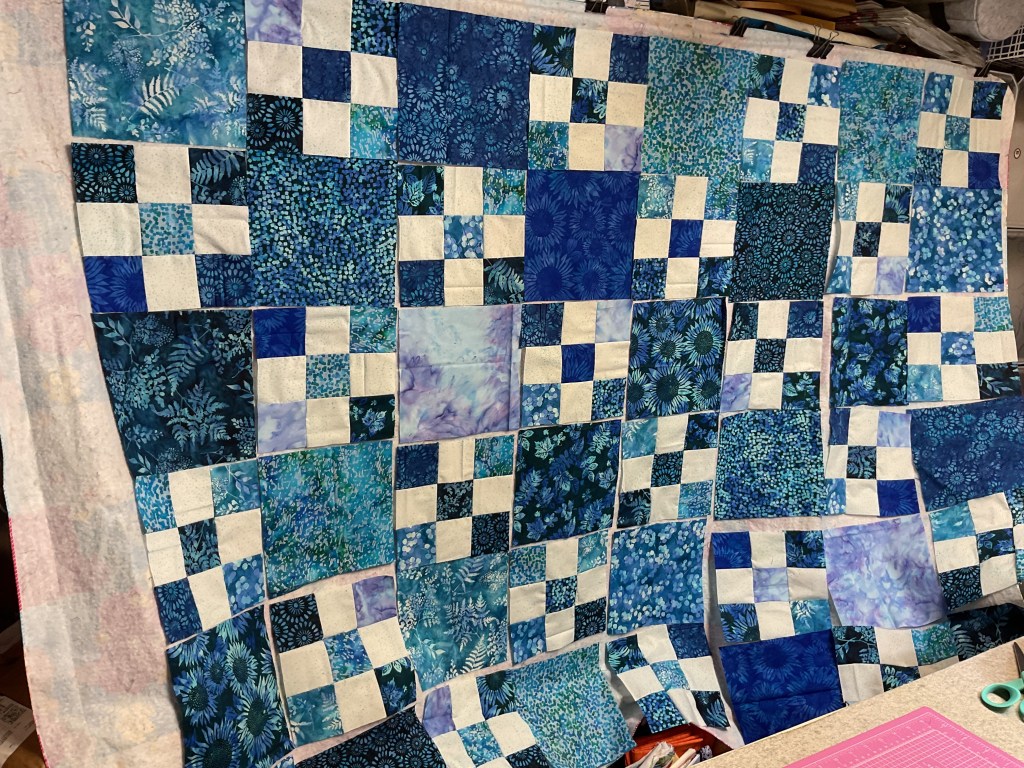
Okay, now the real work begins – rearranging the blocks so we have a nice balance of colors and lights/darks. The funny thing is that sometimes this process takes longer than actually making the blocks added to the actual time spent sewing the blocks. Just take your time and keep arranging until you are happy with what you see.

This quilt did give us some challenges, though, because the fabrics looked either light or dark and we didn’t have a lot of medium values to balance things out.

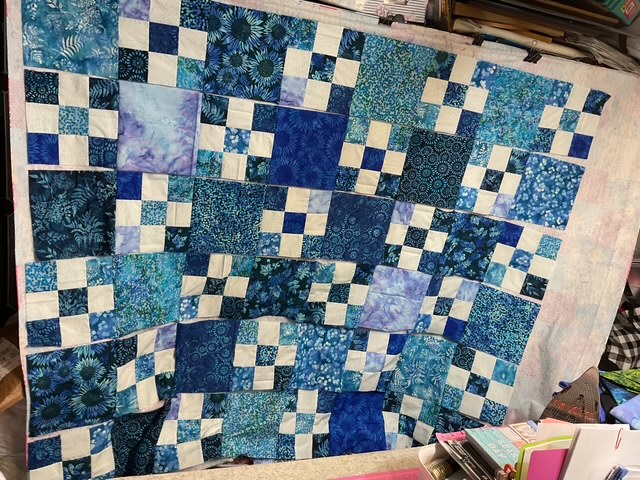
Here are some photos showing subtle changes in block placement while we try to achieve a better balance of colors. Bear with us while we keep changing blocks around….

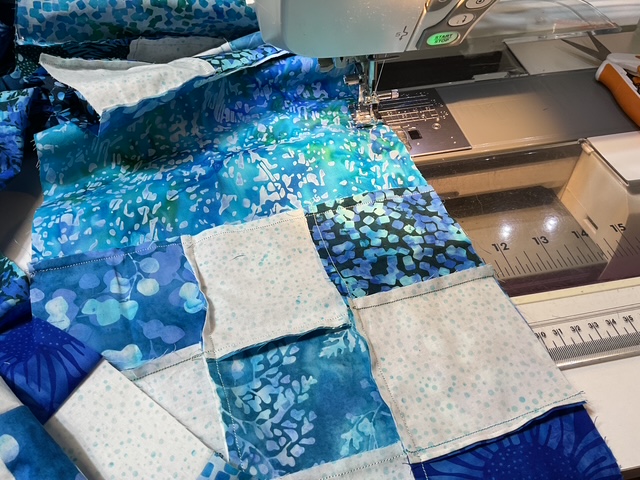
Finally! We found a pleasing block arrangement and then it was time to sew the blocks together into rows and then sew the rows together.

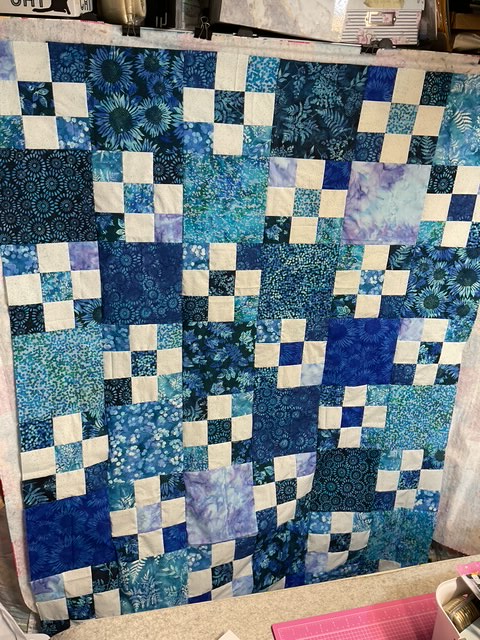
Here is the finished Brickwork quilt top! Now to layer it with batting and backing, quilt it, bind it, and label it. Not sure how to do all of that? You can check out our 2022 Basic Quilting Skills Series over on the right side of the blog for useful tutorials on

Batting, Backing, and Preparing a Quilt for Quilting

Quilt As Desired

Squaring Up Your Quilt

Binding 101

Label Your Quilt

Of course, if you’re interested in learning more about Free Motion Quilting (FMQ), we just wrapped up a 7 part series about Beginner FMQ, which is also located over on the right side of the blog.

I want to thank my pal, Robin, for helping me with this tutorial – thanks, Robin!

Have fun making your very own Brickwork and I look forward to seeing your quilts on our VRD Facebook Page.

Well, that’s it for me. Take care and find a little time to quilt this week.

Until next time –

Always,

Tricia @ VRD