Tutorials · villa rosa designs

VRD Angel Face Quilt Tutorial

Happy Thursday to you!

It’s summer time and the living is easy! After last week’s unusual heatwave here in NW PA, this week has been delightfully pleasant! I’ve enjoyed some quality time on the back porch hanging out with my pup, Bailly, and watching our local eagles. Breakfast on the porch? Yup! Lunch on the porch? Double yup!

As I’ve shown in photos before, the little valley where I live, tucked into the foothills of the Allegheny Mountains, truly is a little slice of paradise.

I hope you are able to slow down your pace a smidge in order to enjoy nature, too.

I’ve also been getting in some much-needed sewing as well. WHEW! I am so relieved that crazy has settled down a little bit for me in recent weeks! You’ll see some of my industriousness when the new July Rose Card patterns are revealed!

In the meantime, let’s get going on this week’s summer tutorial — Angel Face.

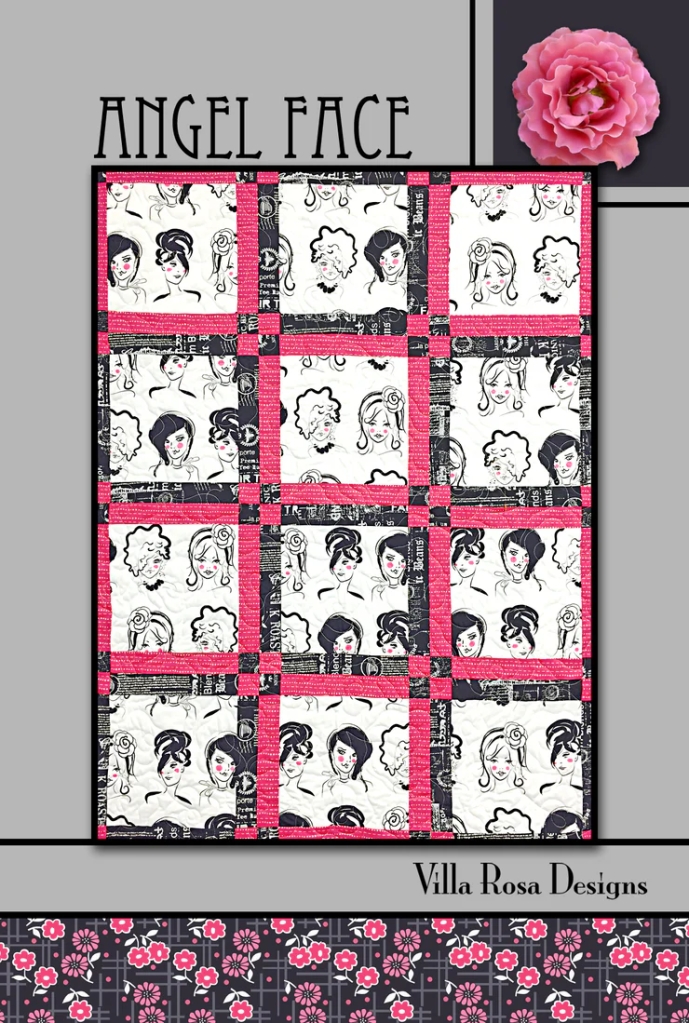
I’ve been a big fan of Villa Rosa Designs Rose Cards since my first Quilt Market in 2010 when I first met the amazing Pat Fryer, but Angel Face was one of the very first VRD patterns I’d seen in one of my local quilt shops way back when as they used it as the pattern for their beginner quilting series. Funny how little memory nuggets resurface, isn’t it???

You can find the Angel Face Print Pattern HERE or the Digital Pattern HERE.

Sew, let’s get this tutorial part started!!

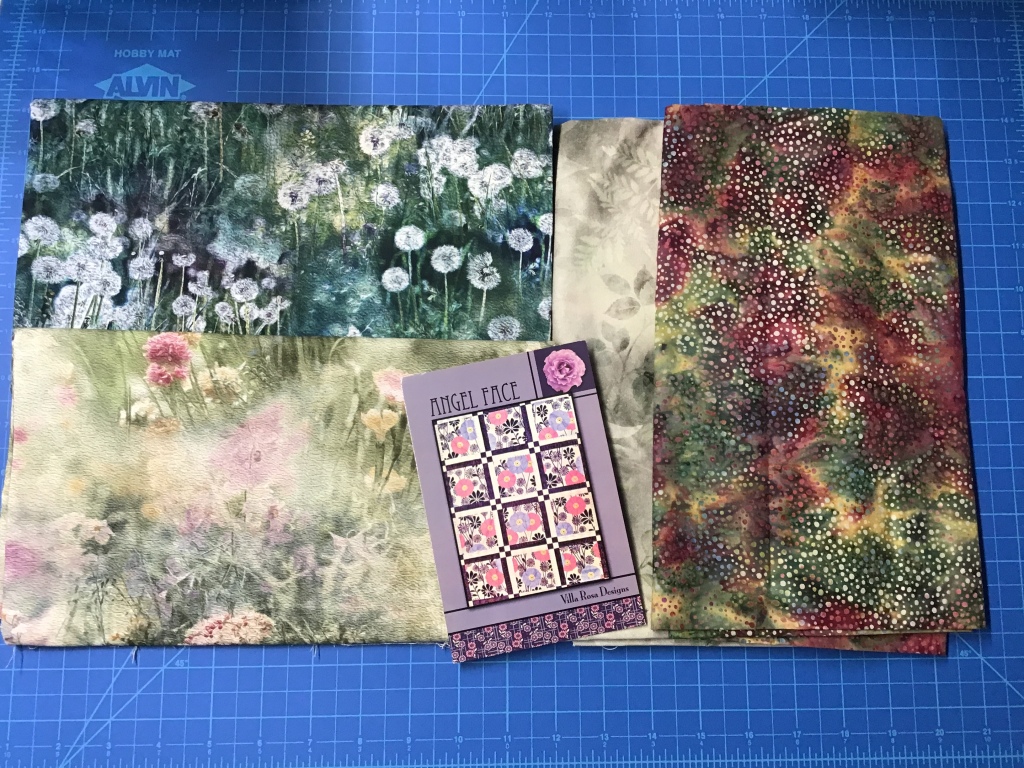
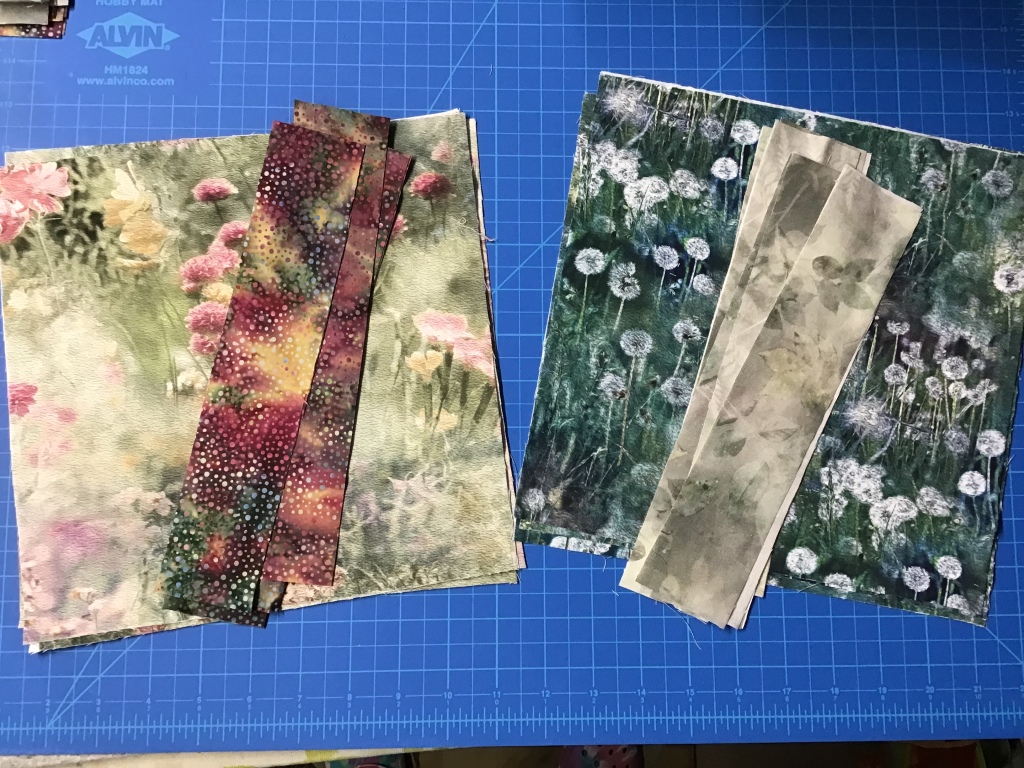
Today I’m using fabric from the Dandelion Wishes digital collection and an 885 Dot Batik companion from our quilting pal, Hoffman. Love, love, love these fabrics — the colors are so so soft and gentle. There are 2 colorways — green and pink — and I used a little of both for this fun beginner quilt project.

Heads up! I did make a slight change to the pattern instructions. The pattern calls for a single main print, but I went with and alternated the 2 prints you see on the left side of the photo because I just couldn’t decide between them. Big surprise, there, huh?

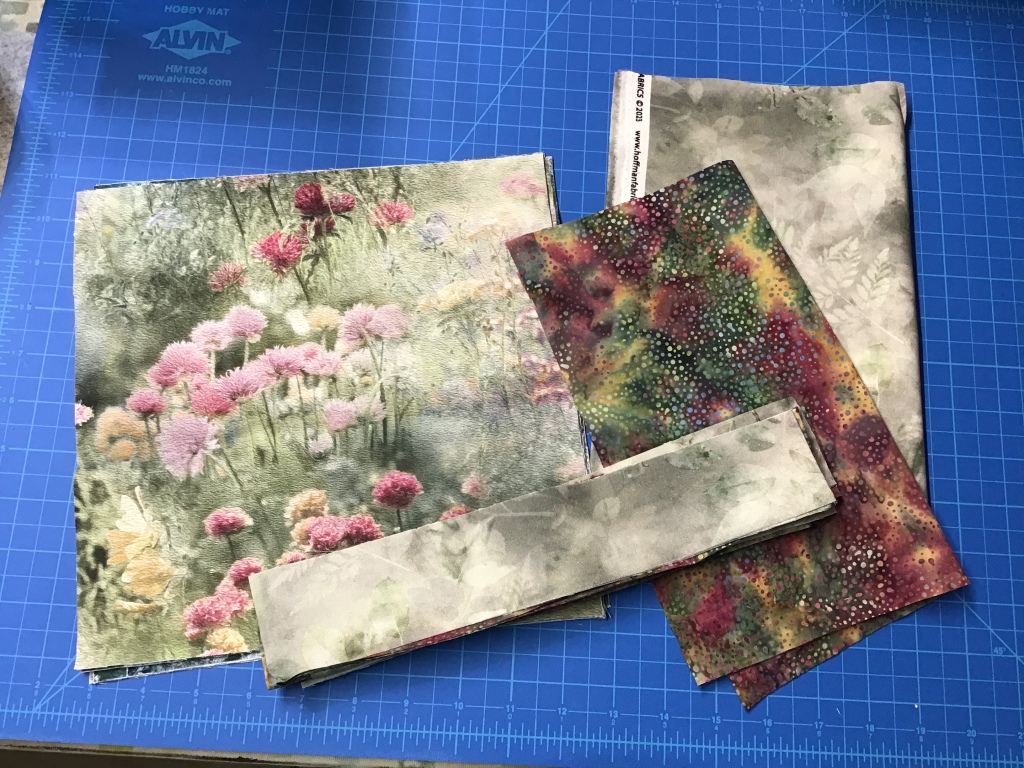
First up is cutting out all the pieces, which doesn’t take because we’re going to do some strip sets, so no little pieces. Easy Piezy!

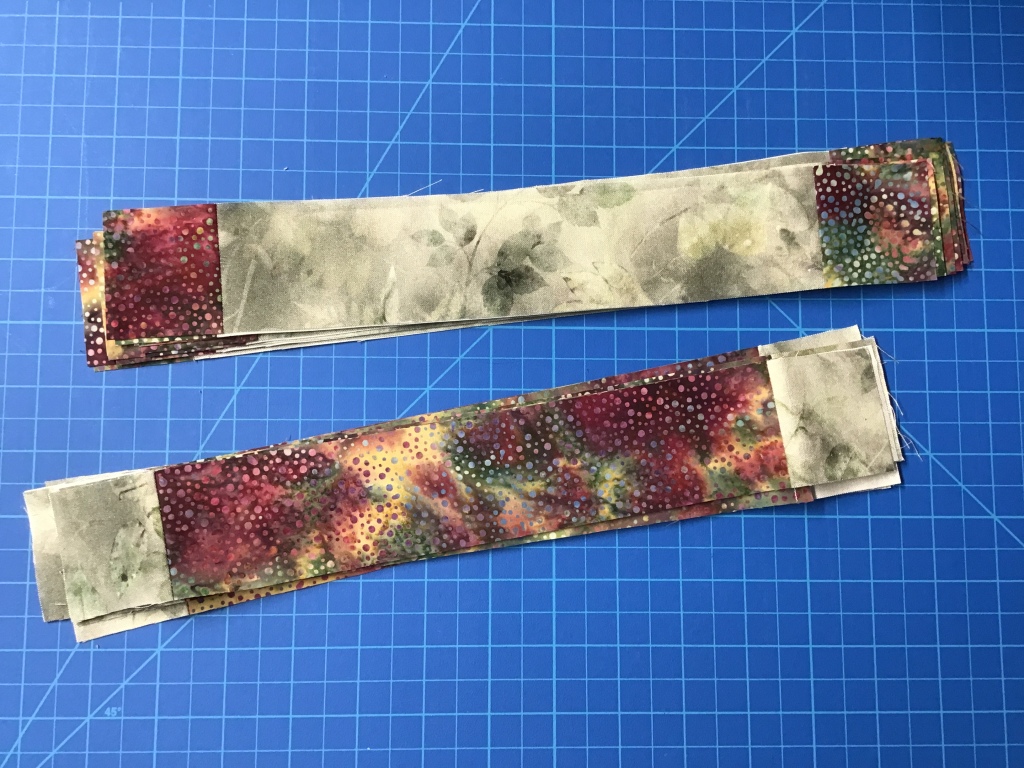
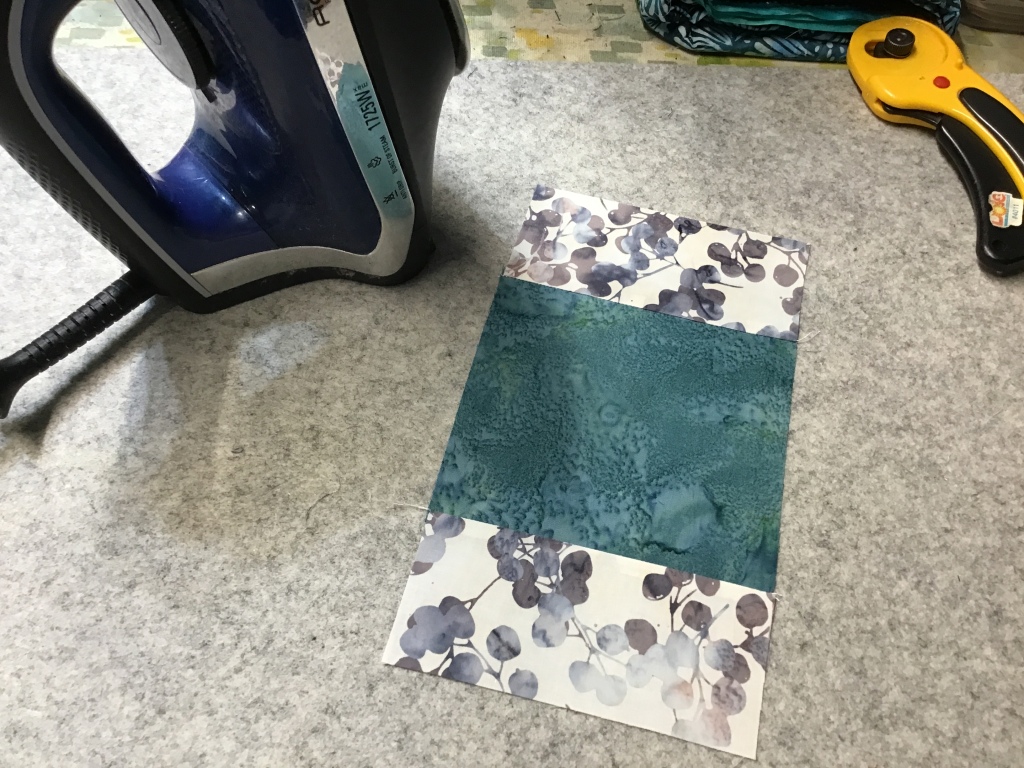
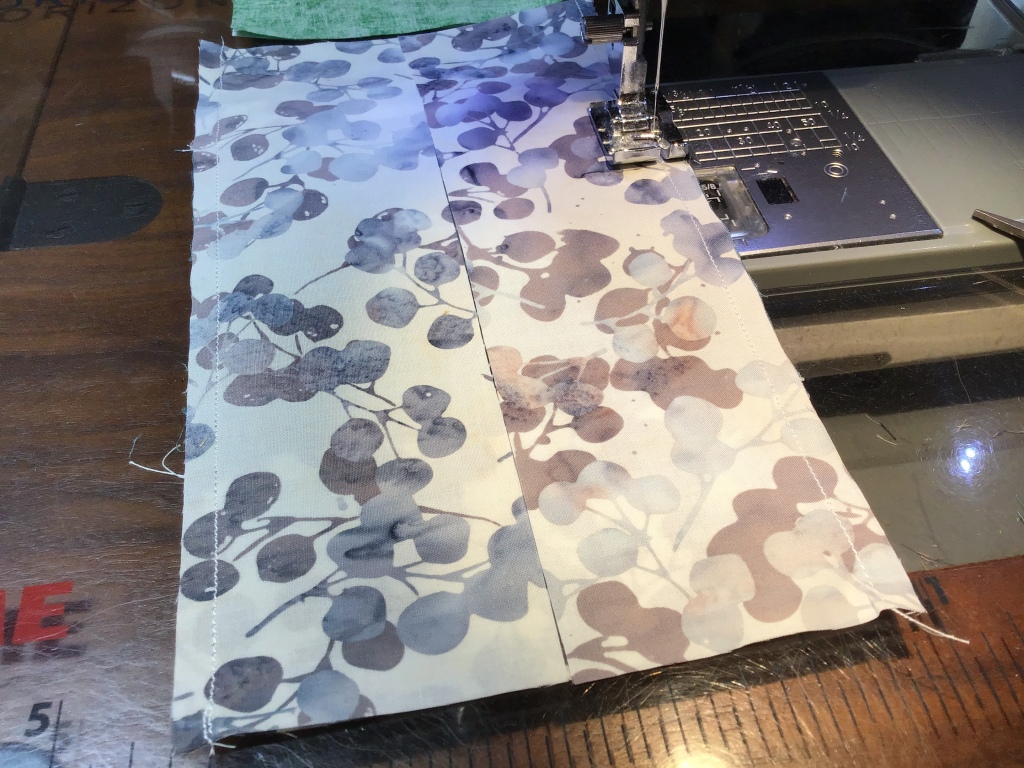
Let’s sew a couple strip sets together. Press the seams towards the narrow strips. Then we need to subcut our strip sets into units. Bet you can do this with both eyes closed, right?

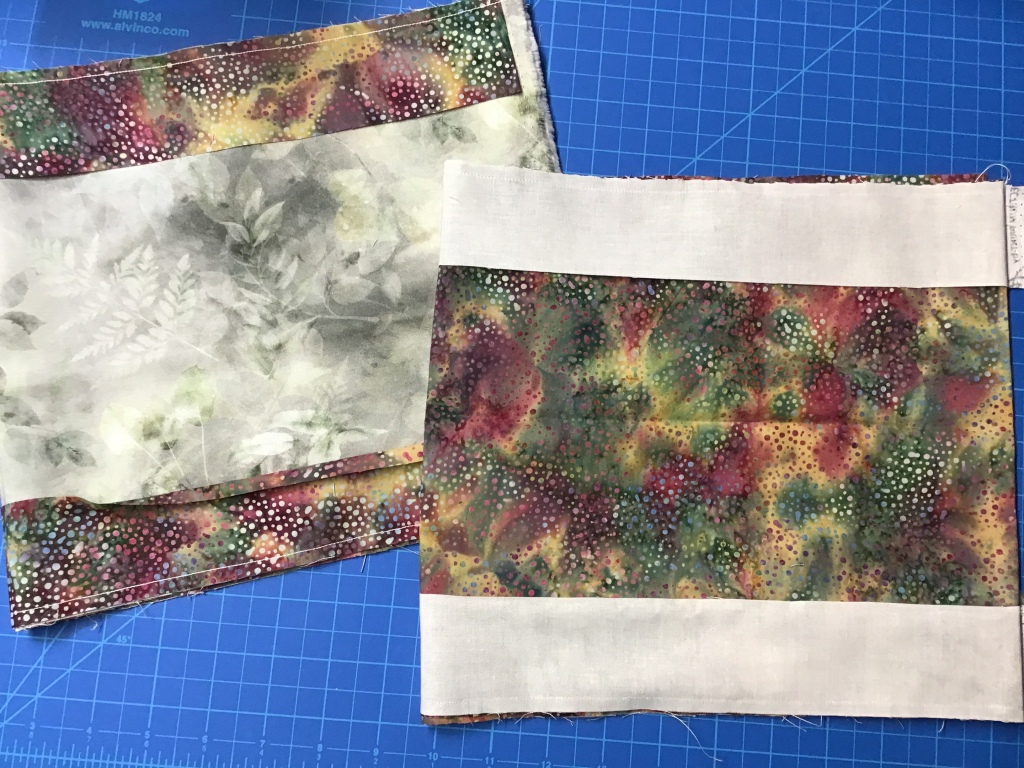
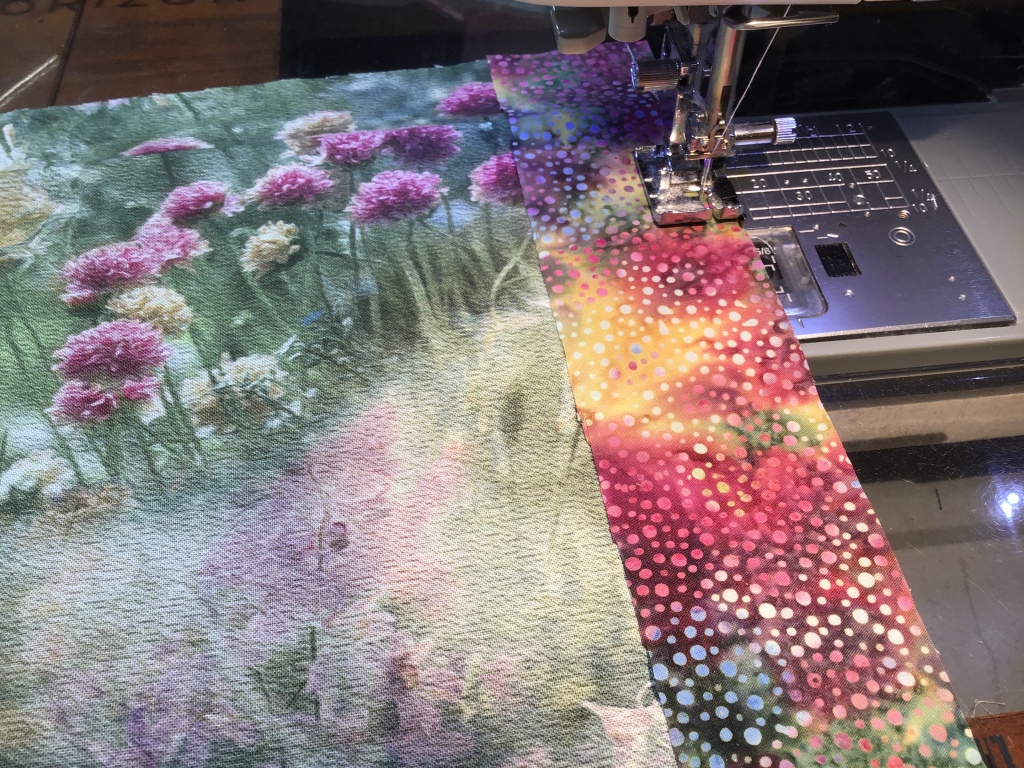
Our next step is to sew the unpieced strips to opposite sides of our main print (or prints) squares.

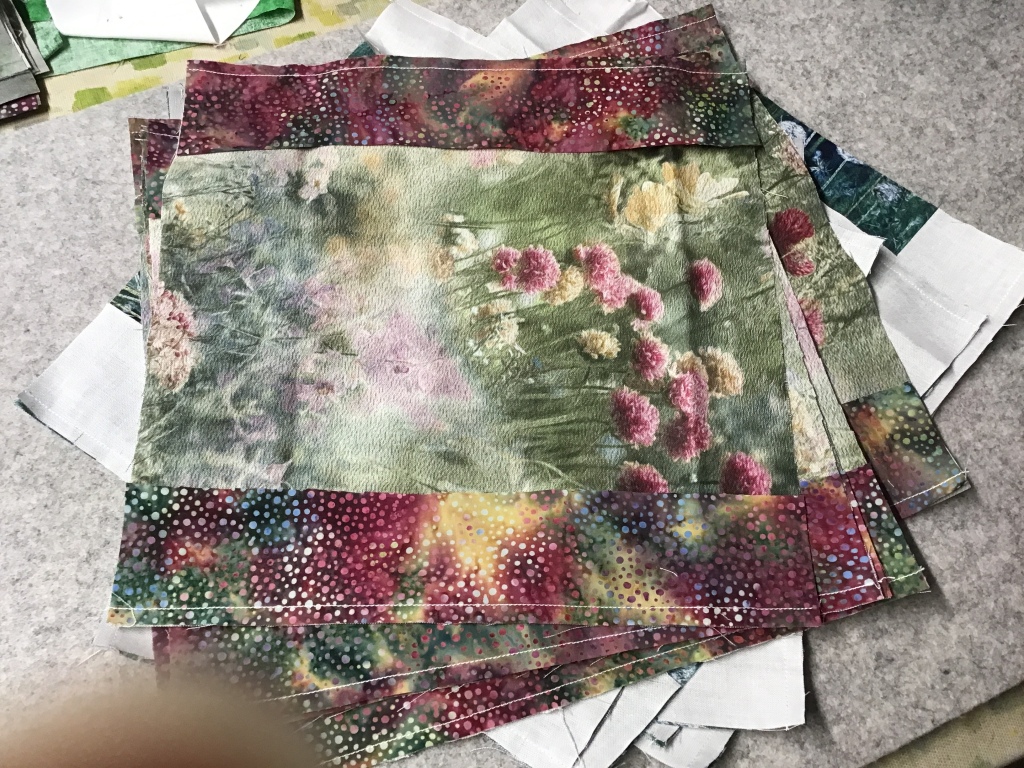
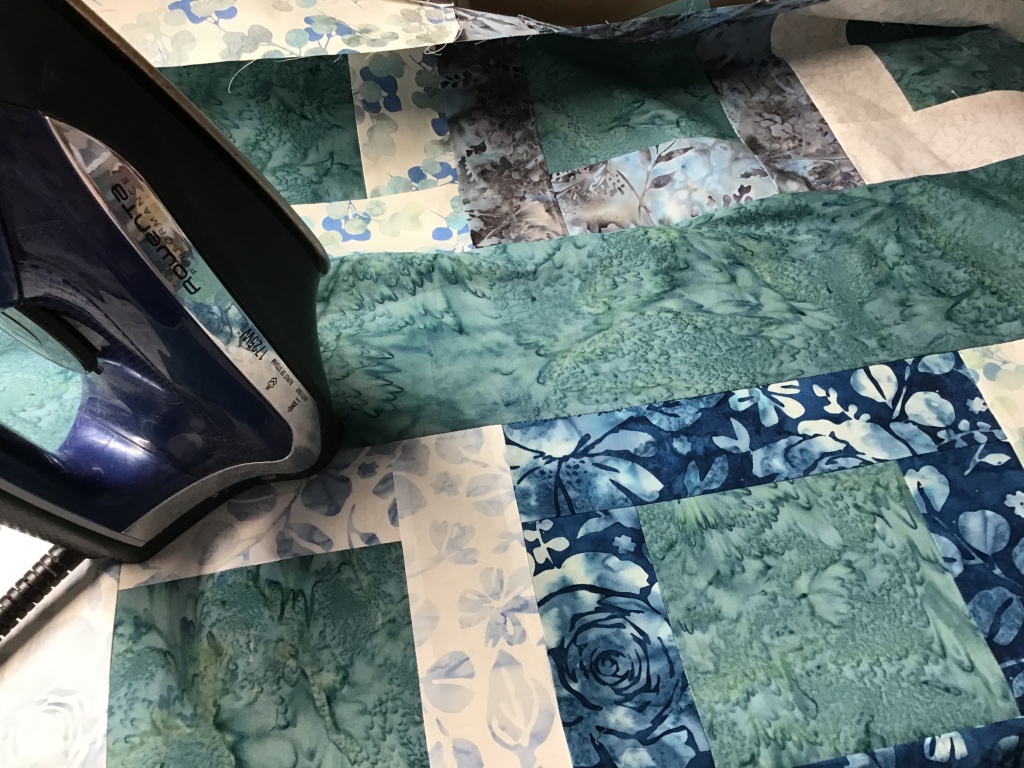
Now that our strips are sewn to our squares, let’s give them a nice press. Press your seams towards the center square.

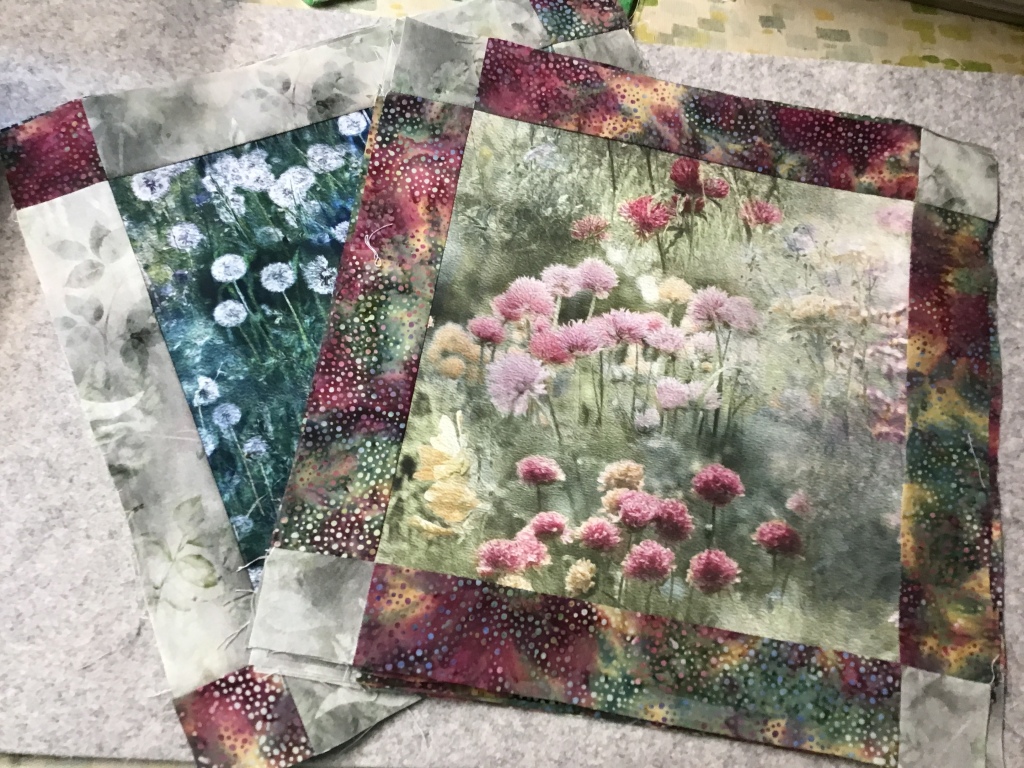
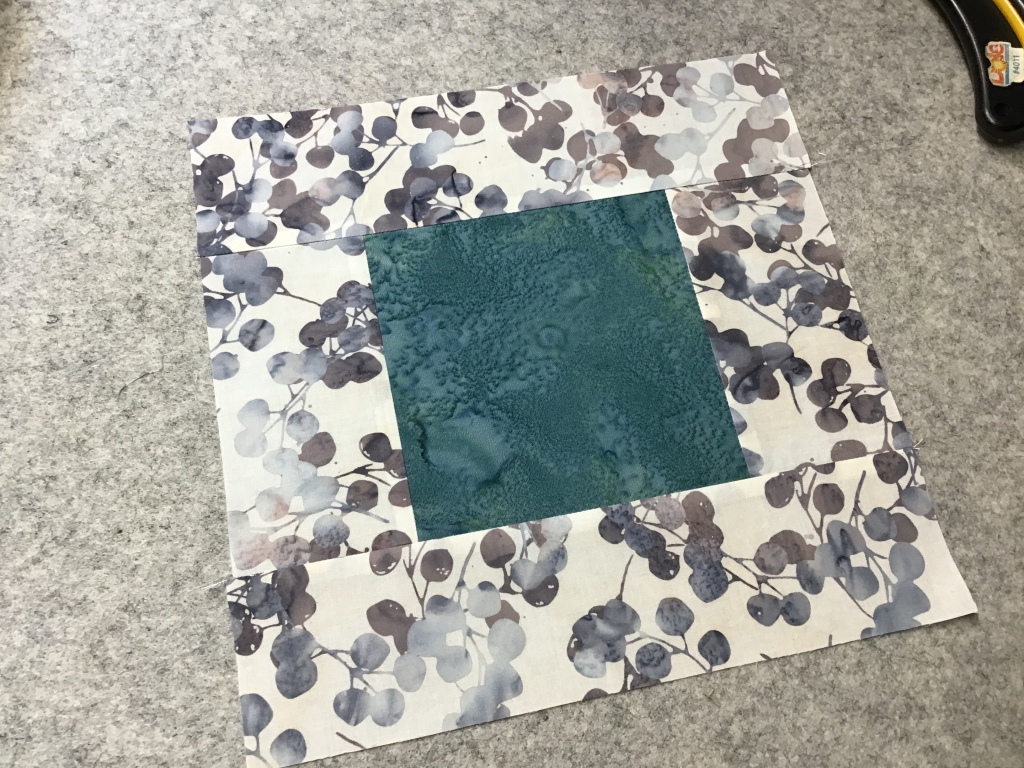
Remember those pieced units we cut from our strip sets? It’s time to sew them to the other 2 sides of the squares. There is a teeny bit of matching seams on the ends, but if you pressed the way I suggested above, the seams will nestle together nicely. Pin if you need to and just take your time.

Good to go! Time to give them a little press.

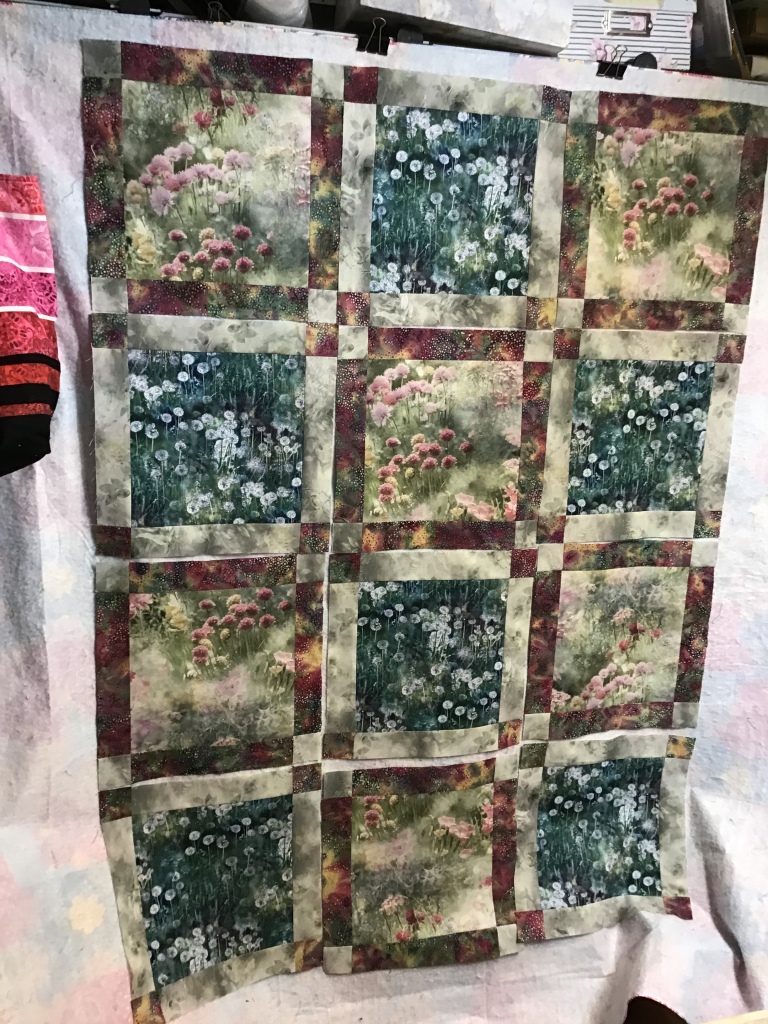
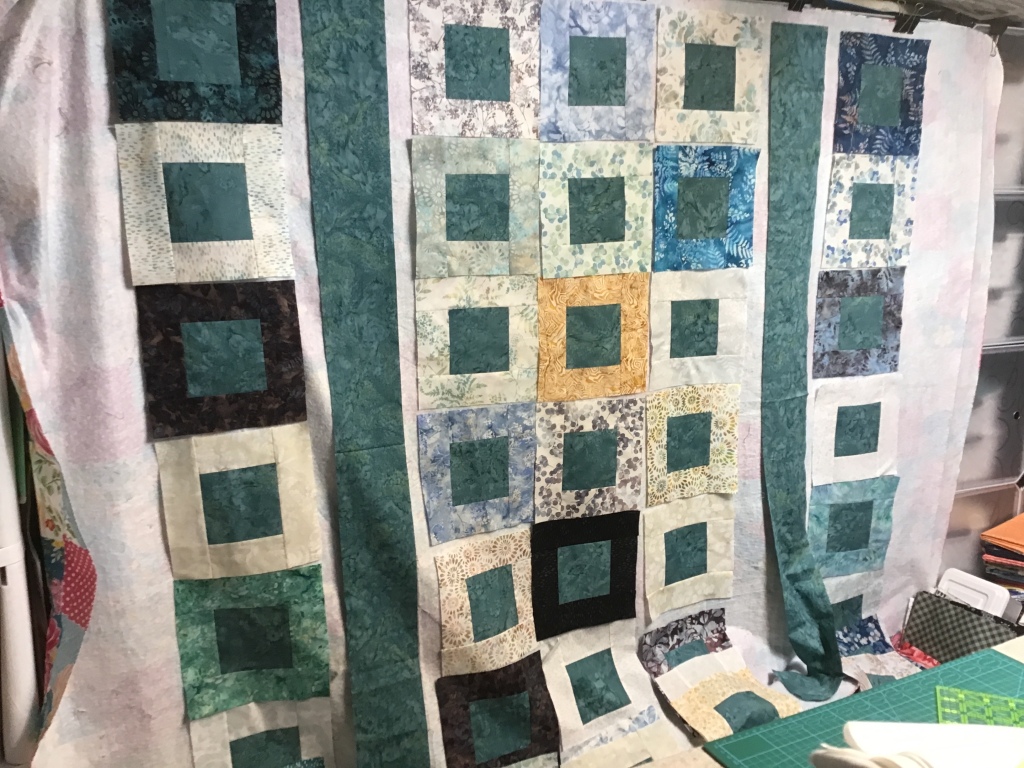
My next step because I used 2 different main prints is to slap my blocks up on my design wall so I can make sure to alternate the 2 blocks. I really like how it looks with 2 fabrics, don’t you? You could even use 12 different fabrics for the squares if you wanted to. Angel Face is a very versatile pattern.

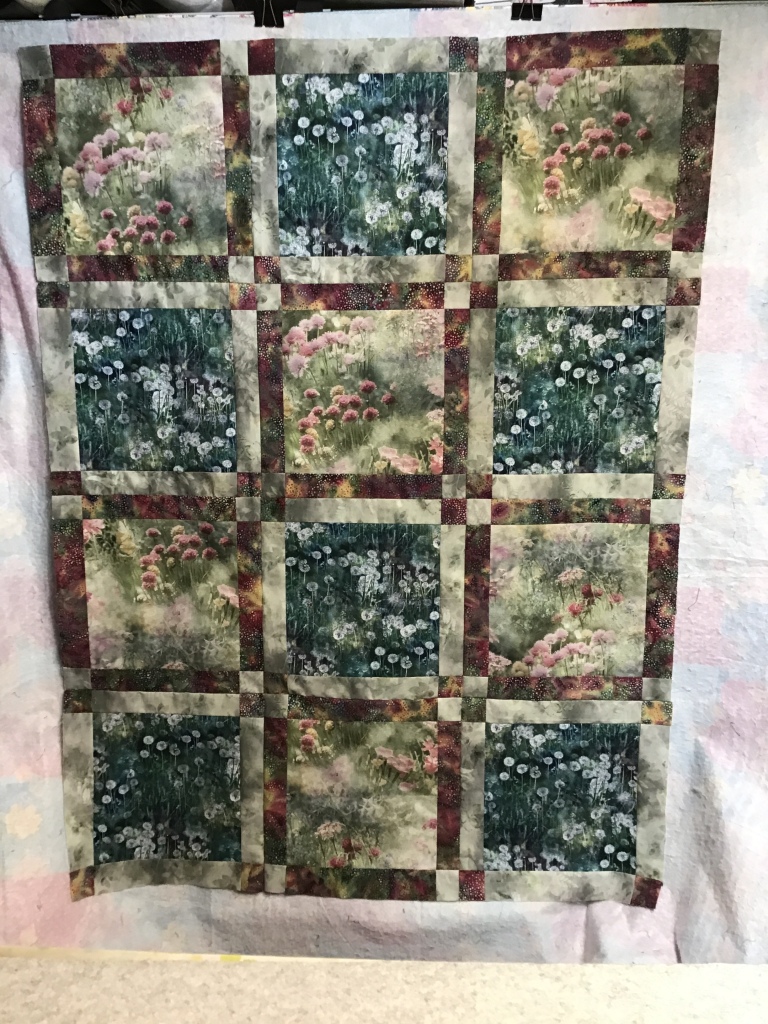
Now let’s sew the blocks together into a quilt top. Remember, that there is some fidgety seam matching when you sew the blocks together, so pin if you need to and go slowly. I promise you, though, that Angel Face goes together super fast!

You can stop here and call your top finished. This size makes a wonderful baby quilt! Layer, quilt, lable, and bind.

OR, you can add a border to make Angel Face the perfect size for a throw quilt.

I’m going to add a border. In fact, I’m using the lighter of the 2 accent fabrics as my border. I think it will make the mottled purple accent strips really pop!

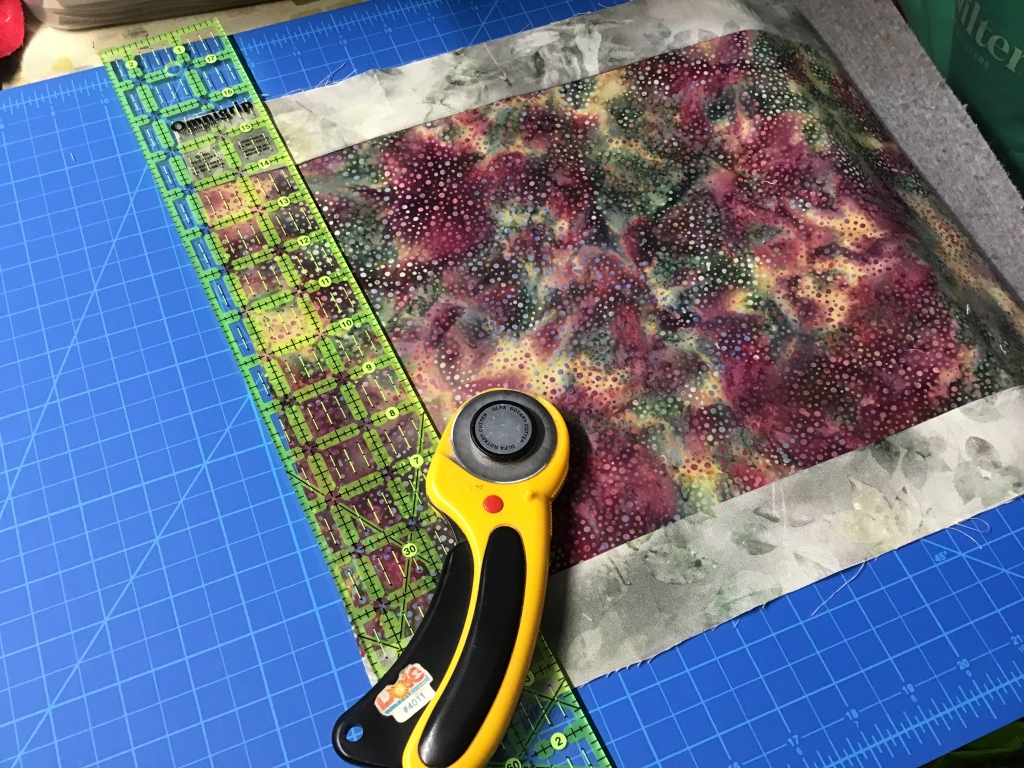
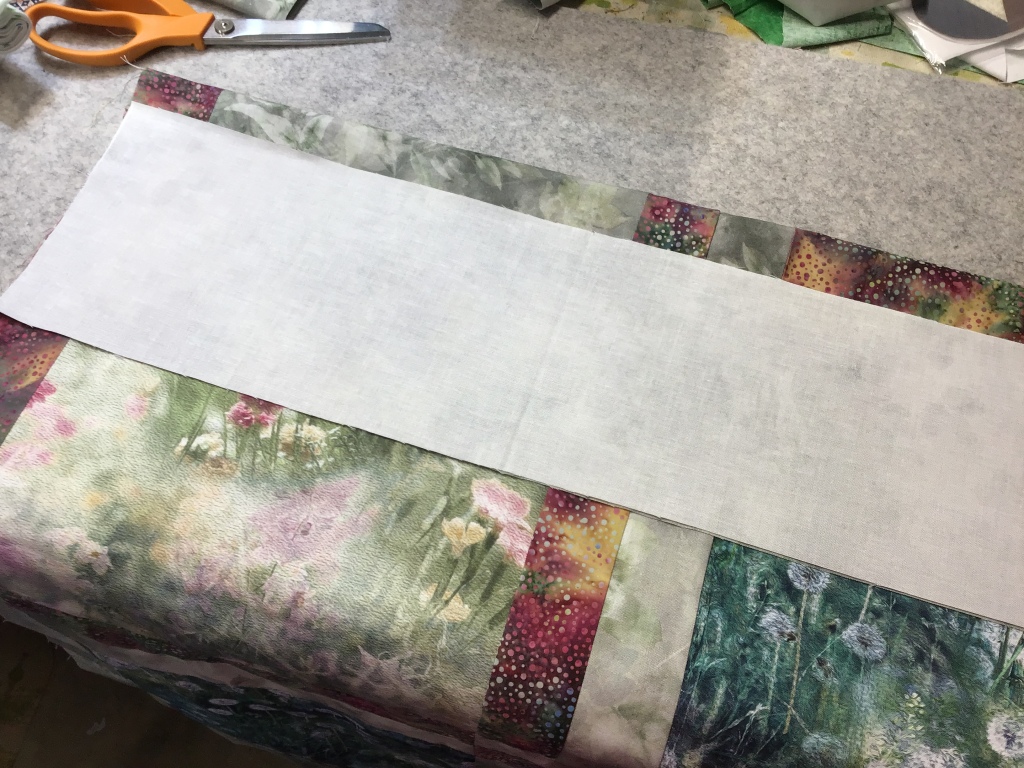
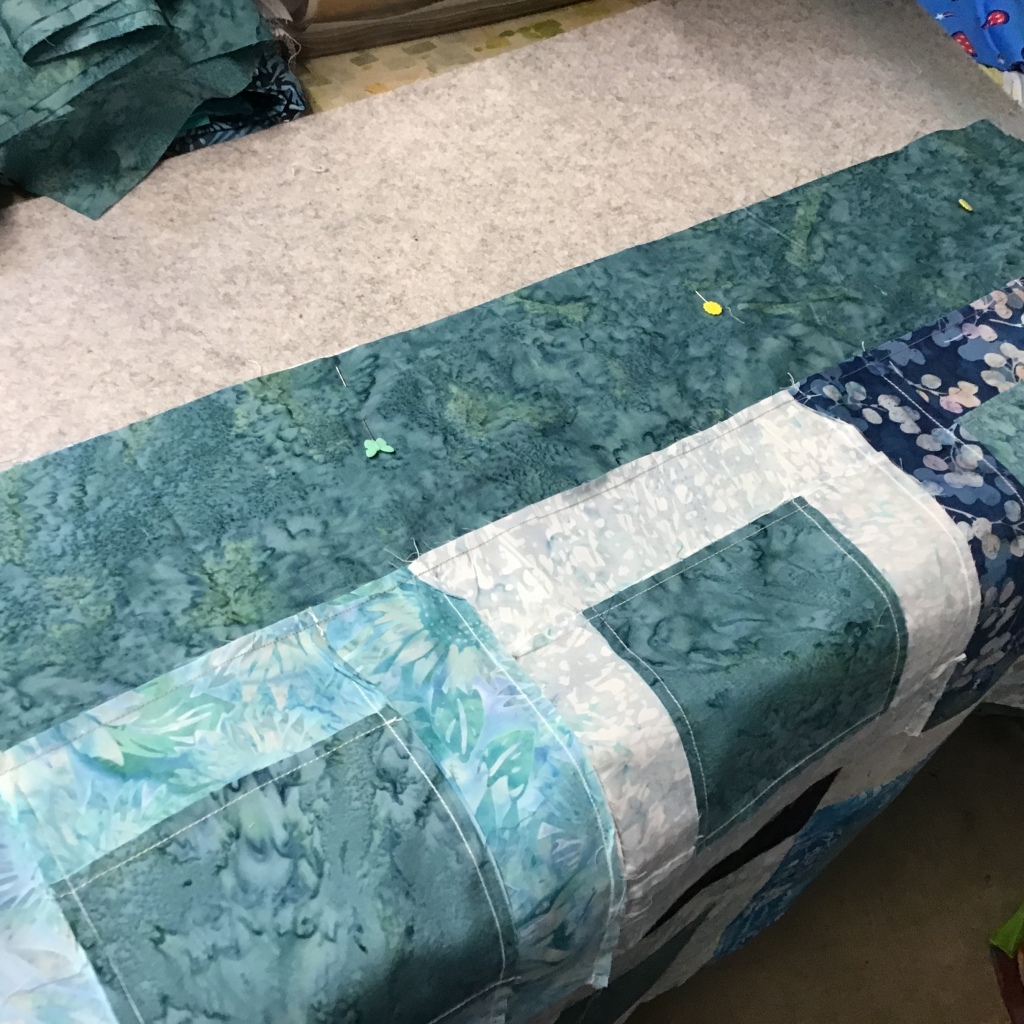
Go ahead and cut out your border strips for the quilt. I chose to add the top and bottom borders on first because the width of the quilt top is less than the width of my fabric, so I won’t have to piece the top and bottom borders.

To measure my top and bottom border strips for cutting, I found the center of my quilt vertically (up and down) and I line up the end of my 2 strips and then I match them up to the edge of the quilt. I pin everything together to keep the 2 borders and the quilt lined up. Then I smooth the strips across the width of the quilt center and cut them to match the width of the quilt top. No more measuring with a measuring tape or ruler for me when cutting border strips.

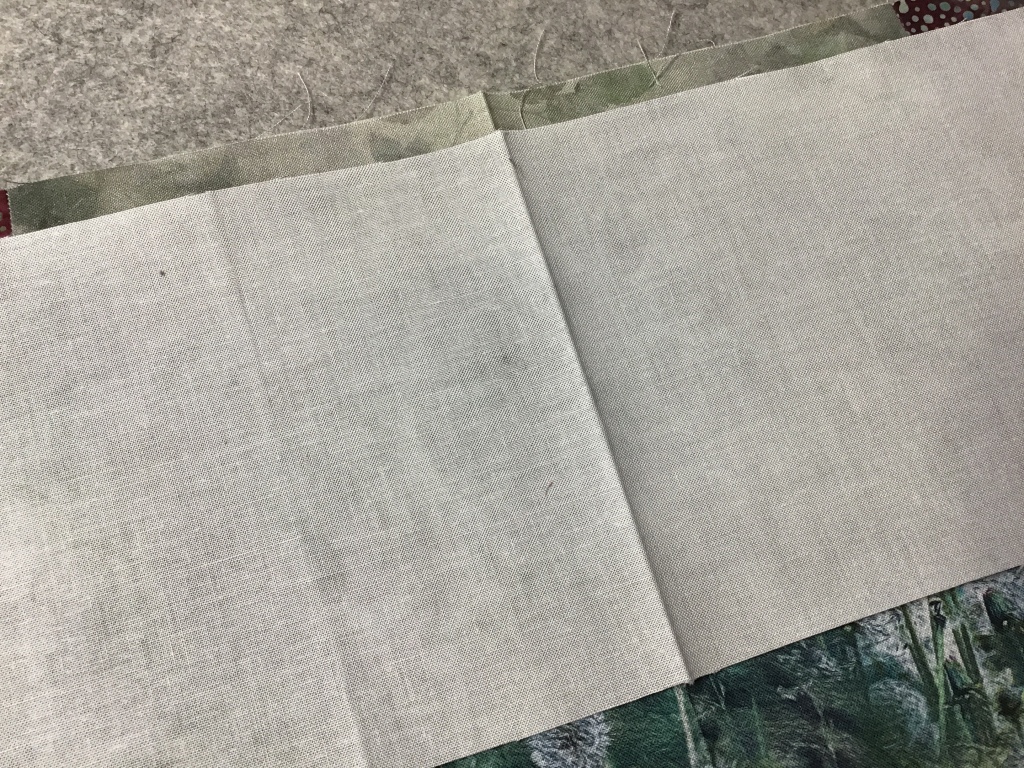
Then I find and make creases at the centers of the top and bottom borders and the centers of the top and bottom of the quilt. This little step makes it really easy to match up the centers to assist in keeping my borders nice and square instead of getting all crazy and wavy.

Match up the center creases and pin. Next match the ends of the border strips to the ends of the quilt. Pin.

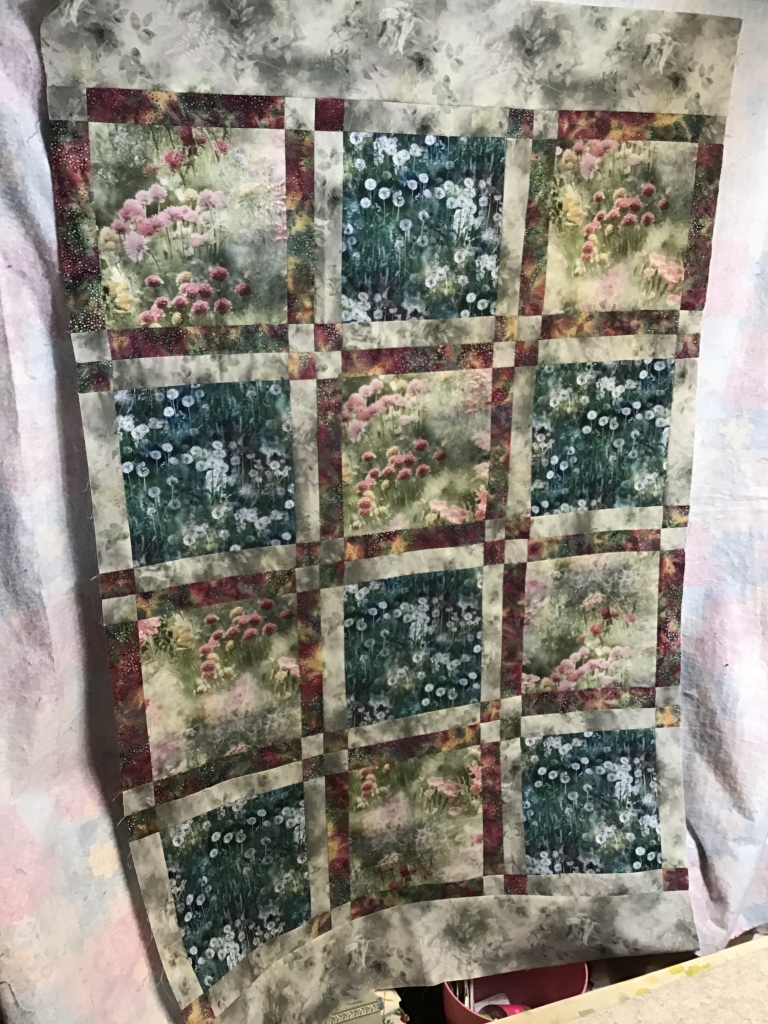
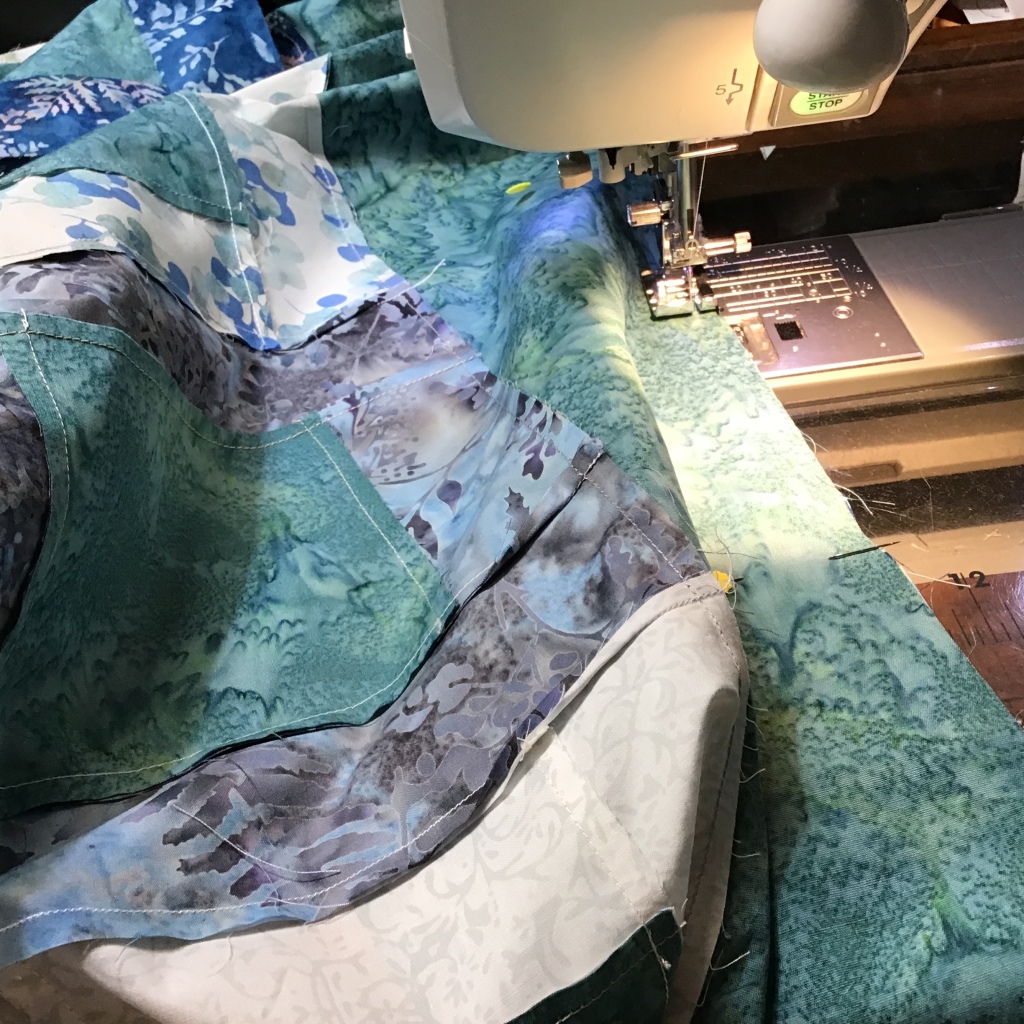
Sew the borders to the top and bottom of the quilt.

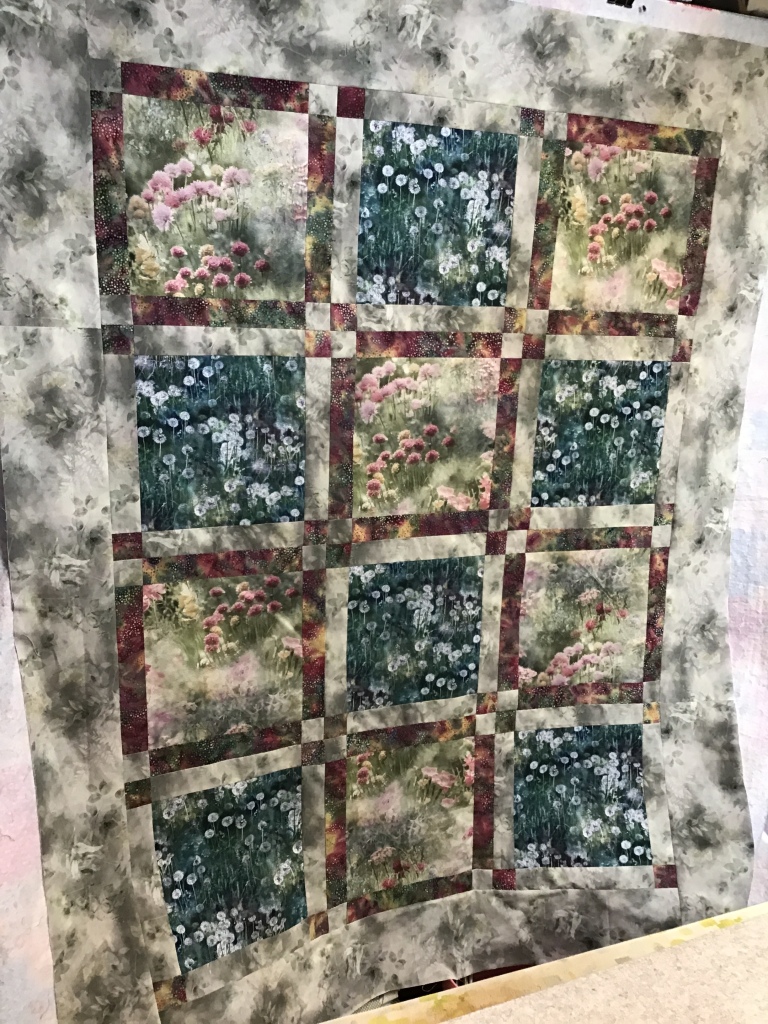
For the side borders, you’ll need to piece the strips. Then measure and cut the side border strips. Crease the centers of the strips and the sides of the quilt. Match them up and pin. Match up the ends of the borders and quilt. Pin some more. Finally, sew the side borders to the quilt.

Isn’t it a really soft and pretty quilt???

Here’s a “beauty” shot on my back porch……….

I hope you enjoyed today’s tutorial. Angel Face is a wonderful project. Perfect for a beginner, yet fun and versatile for a more experienced quilter.

Don’t forget to stop and enjoy summer before it’s gone.

Until next week —

Always,

Tricia @ VRD

Quilt Stories · Quilting Partners · Rose Cards · Tutorials · villa rosa designs

VRD Berry-Licious Quilt Table Runner Tutorial

Happy Thursday to you!

Hope you enjoyed last week’s post about the quilt show I attended. I’m still smiling. 🙂 If you missed last week’s post, you can go HERE to see the fun slideshow I created with some of the amazing quilts on display at the quilt show.

Before we get to this week’s tutorial, Berry-Licious — which is lots of fun and very timely — let me tell you a little bit about the inspiration for this table runner. In my area of Northwestern PA, we always look forward to late spring/early summer for a lot of reasons, but one of my favorites are the local strawberries, which are only available for a few weeks in June. Yum, yum, yummy!

When I was a kid, my older sister and older cousins (I was too little) all worked at a local strawberry farm, picking berries. They would meet in town at like 6 AM, and someone from the farm would pick up the kids and drive them to the farm outside of town. Horrors! The kids actually road in the back of the truck to the farm! Then the kids would pick berries for hours, and got paid per quart that they picked. My sister only did it once because it was such hard work, but my older boy cousins did it every summer all through high school and were often the best pickers. The work only lasted 2 or maybe 3 weeks right after school was out for the summer. If you were a teen in my area, this was kind of a rite of passage. I don’t remember if when I was old enough to pick berries, kids didn’t do it anymore or if I just wasn’t interested, but picking strawberries was a rite of passage I never did.

Strawberries have always been one of my favorite fruits, though. When I was really little, we even had a tiered strawberry patch in the backyard. My Mom (Hey Mom!) would make the most delicious strawberry jam and we’d enjoy that all winter long. If I close my eyes I can almost taste it and my mouth is watering, just remembering….

Ahhhh, good times.

Have you made Berry-Licious yet? It’s a fun and very satisfying runner. You can grab your very own Berry-Licious Rose Card print pattern HERE or digital pattern HERE.

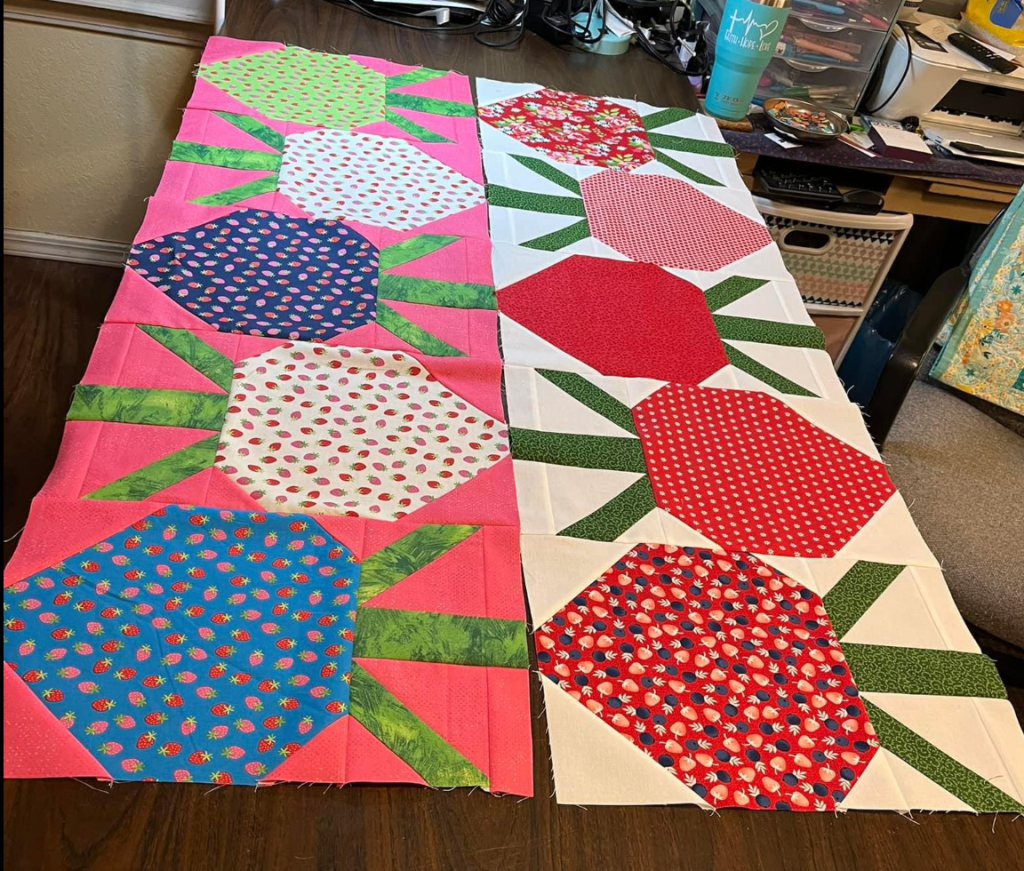
In the sample runner on the pattern, I used a fun collection of plaids, dots, and geometrics in delicious bright red for the strawberries.

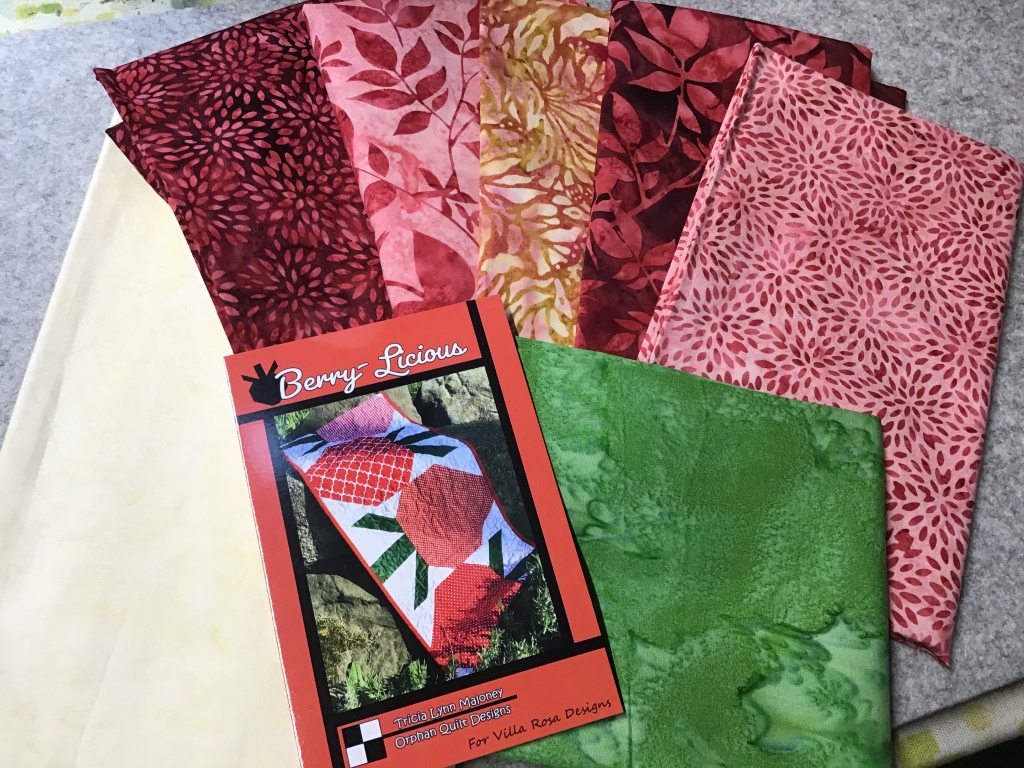
For my tutorial example today, I am using fabric from the Garnet Glow Batik Collection by our pals Hoffman California-International Fabrics. Fun fact — did you know Hoffman’s been around since 1924???

Aren’t they just delish? The peachy fabrics makes me think of a strawberry not quite ripe yet.

I just love seeing how different fabrics look in the same pattern, don’t you? That’s one of my absolute favorite things about our VRD Facebook group.

Check out these Berry-Licious runners made by Renay Trolinger (Hi Renay!) in our VRD FB group! Aren’t they just too much fun??? I especially love the runner on the left — you know, the one with all the attitude. Great work, Renay!

Let’s get this tutorial going, shall we?

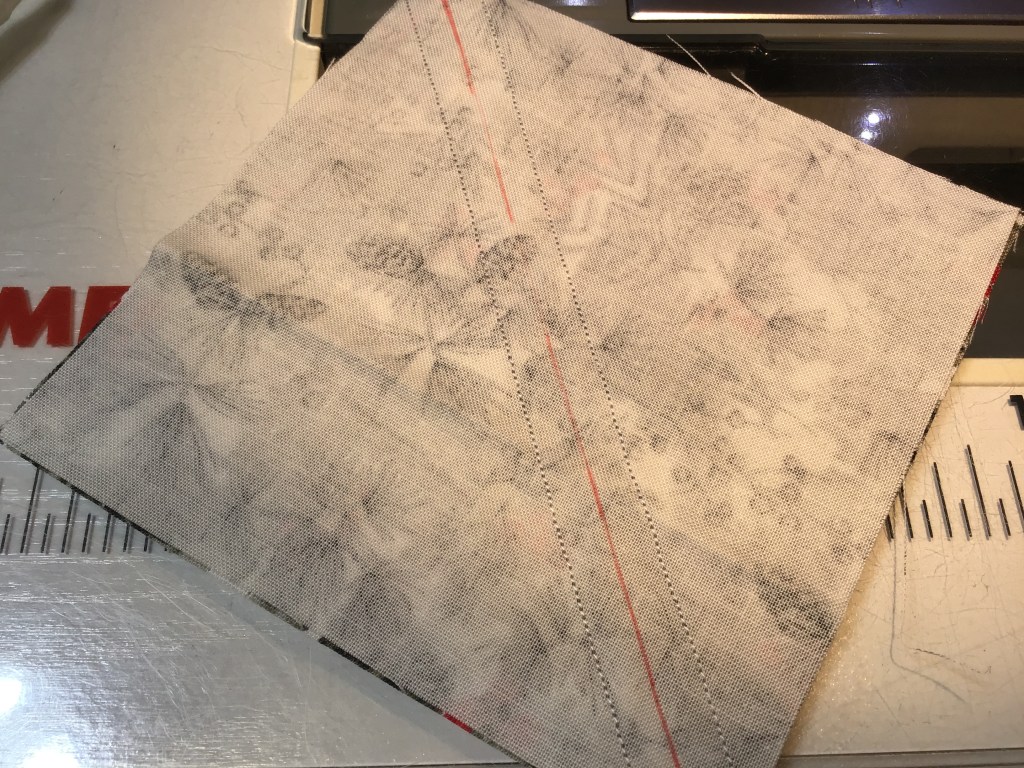
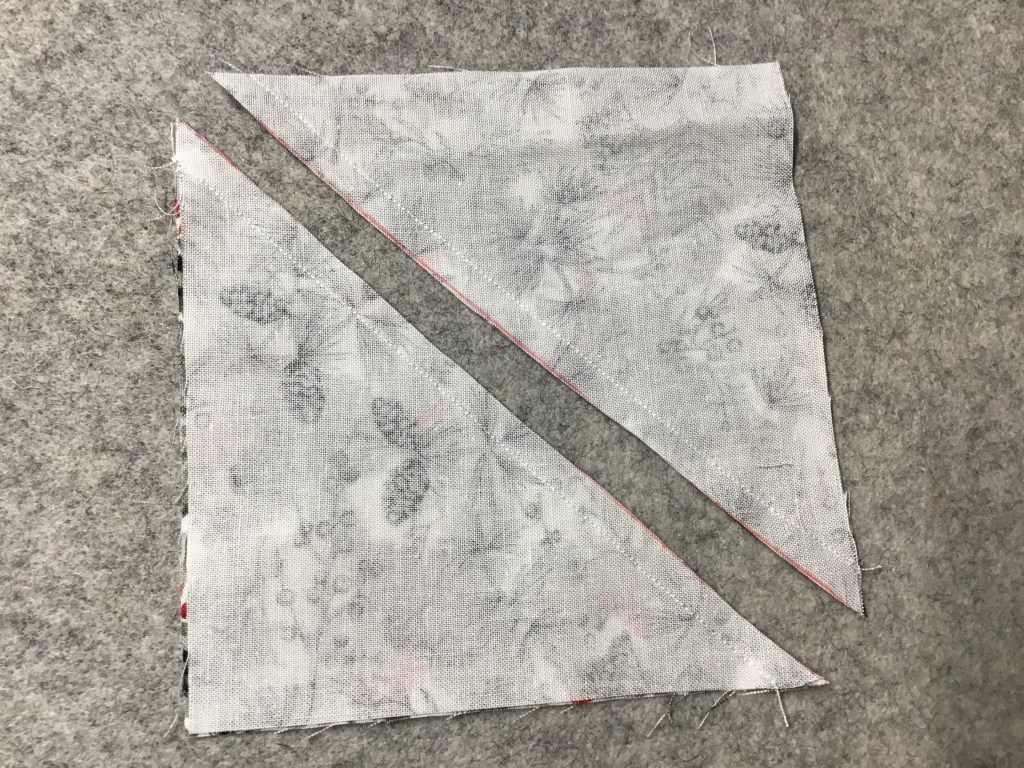
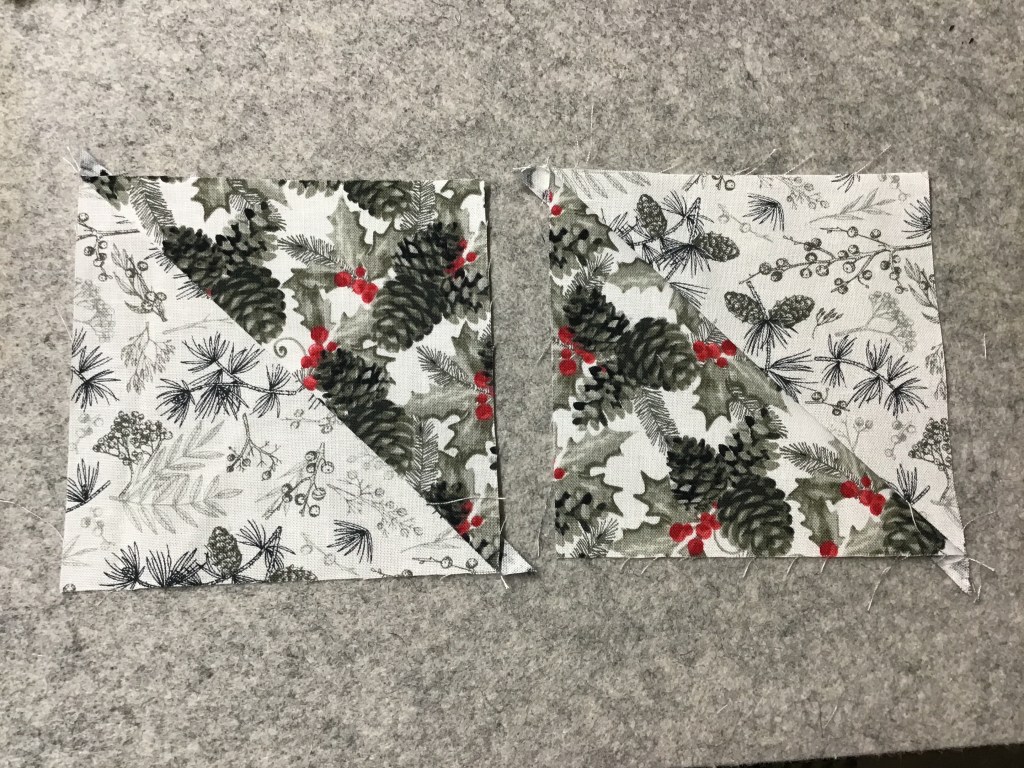
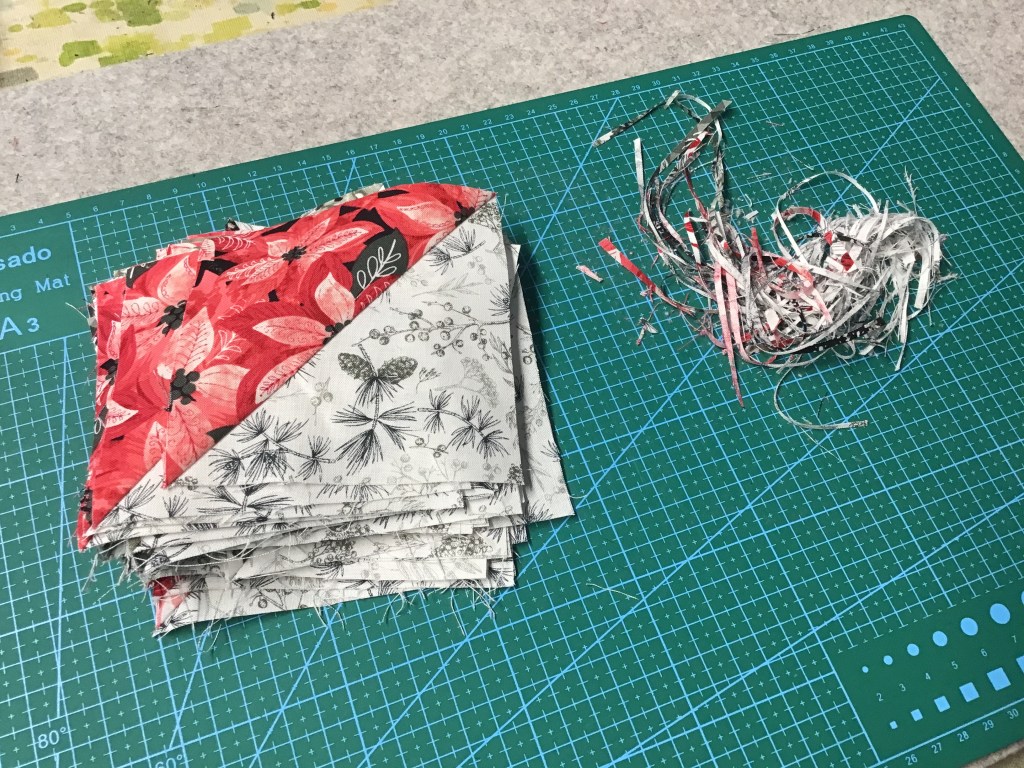
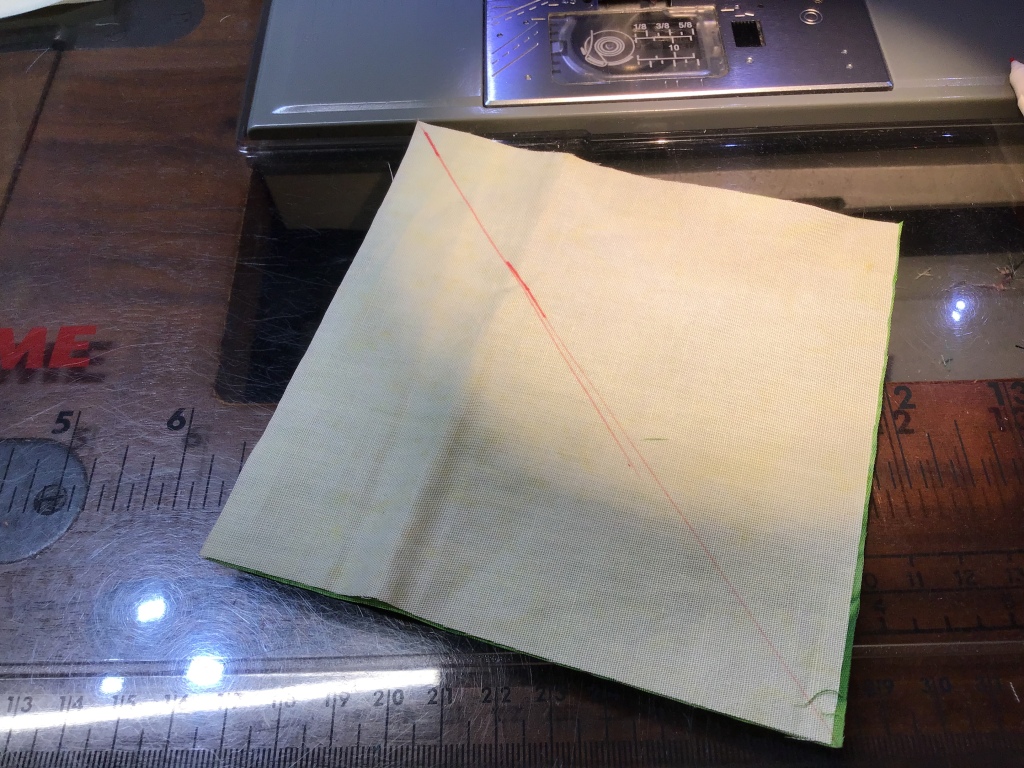
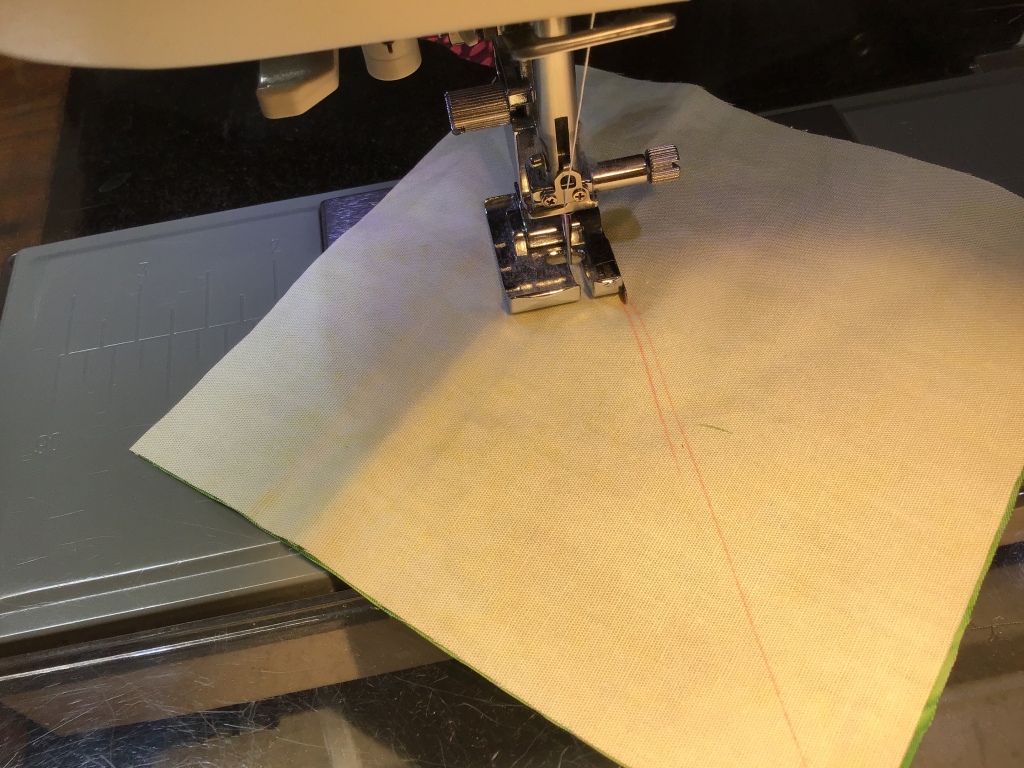
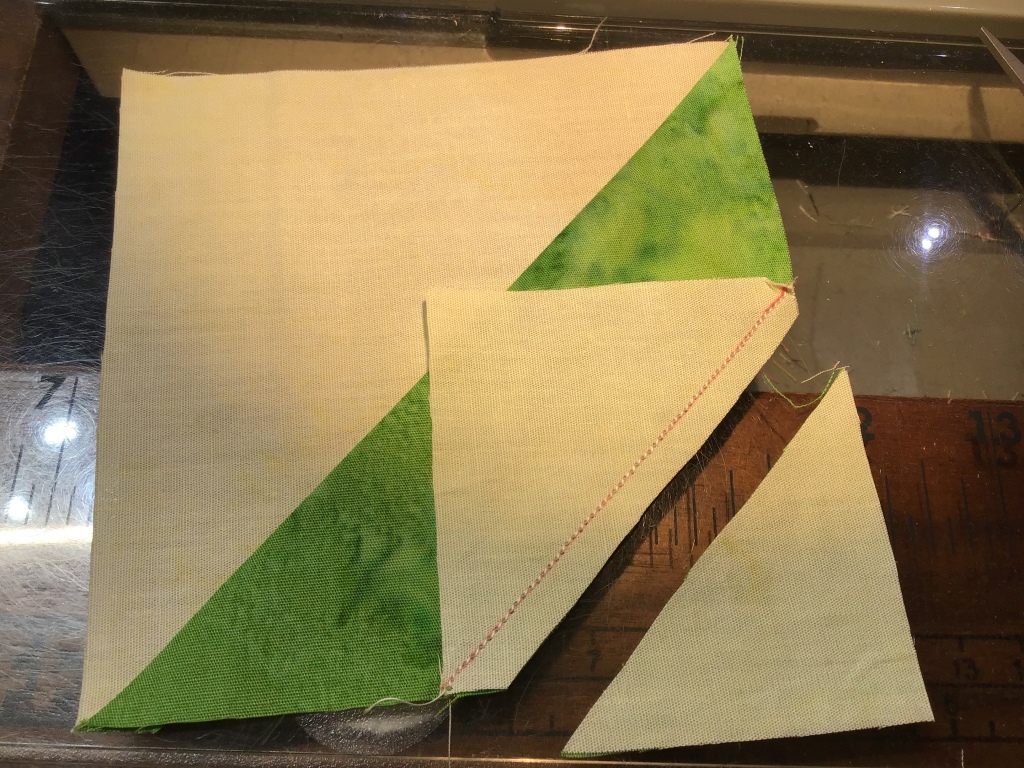
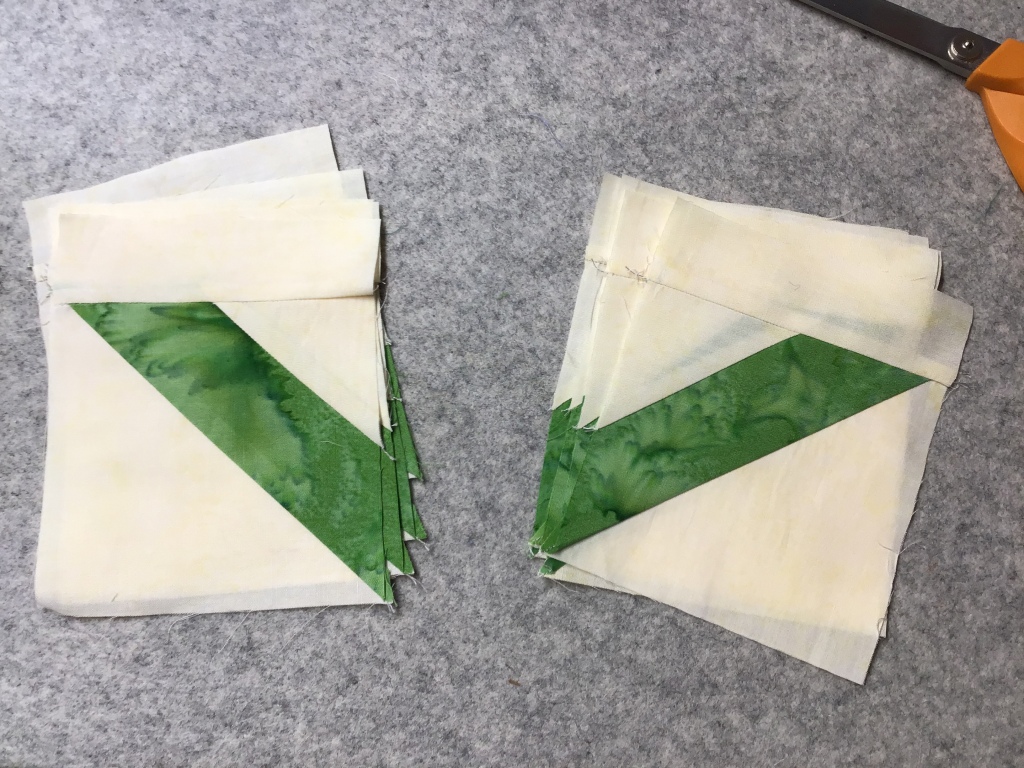
After I cut all the pieces for the runner, I layered my large green and background squares to make Half Square Triangles (HSTs) for the leaves on the stem. Layer those squares right sides together (RST), draw a diagonal line from one corner to the opposite corner, sew on both sides of the drawn line, cut apart on the drawn line, and press the HST open (I like to press my seams to the darker fabric, but that doesn’t always work all the time).

Then like magic you get 2 HSTs! You’ll need to make 10 HSTs. Don’t forget to trim off those little dog ears on the corners!

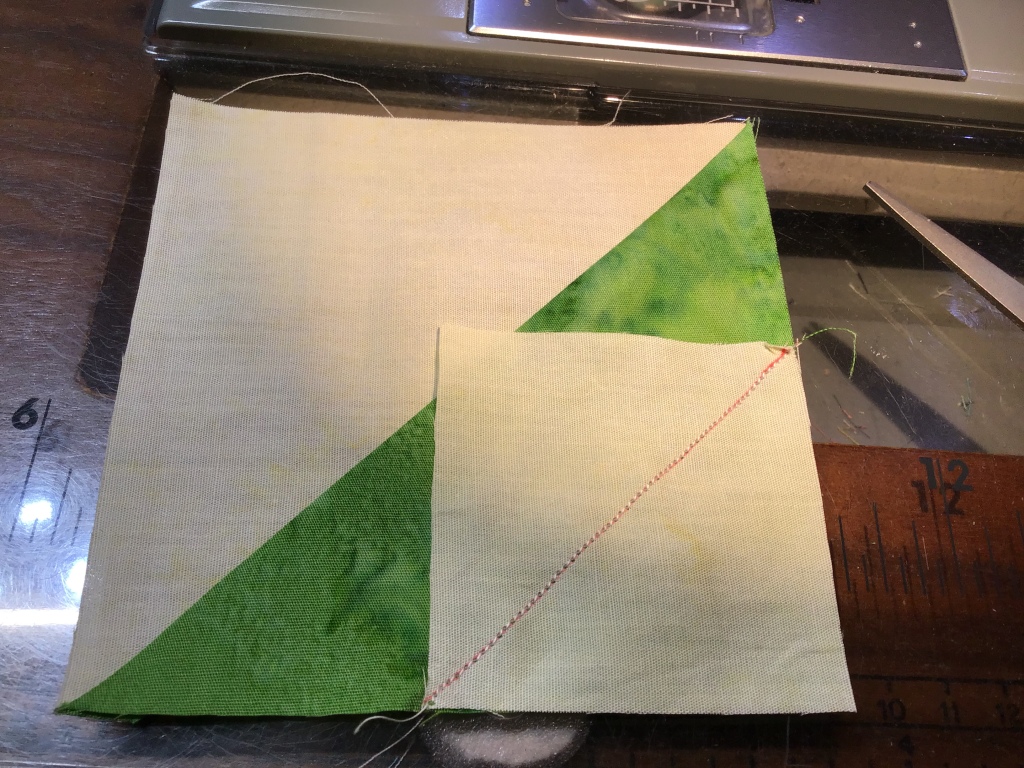
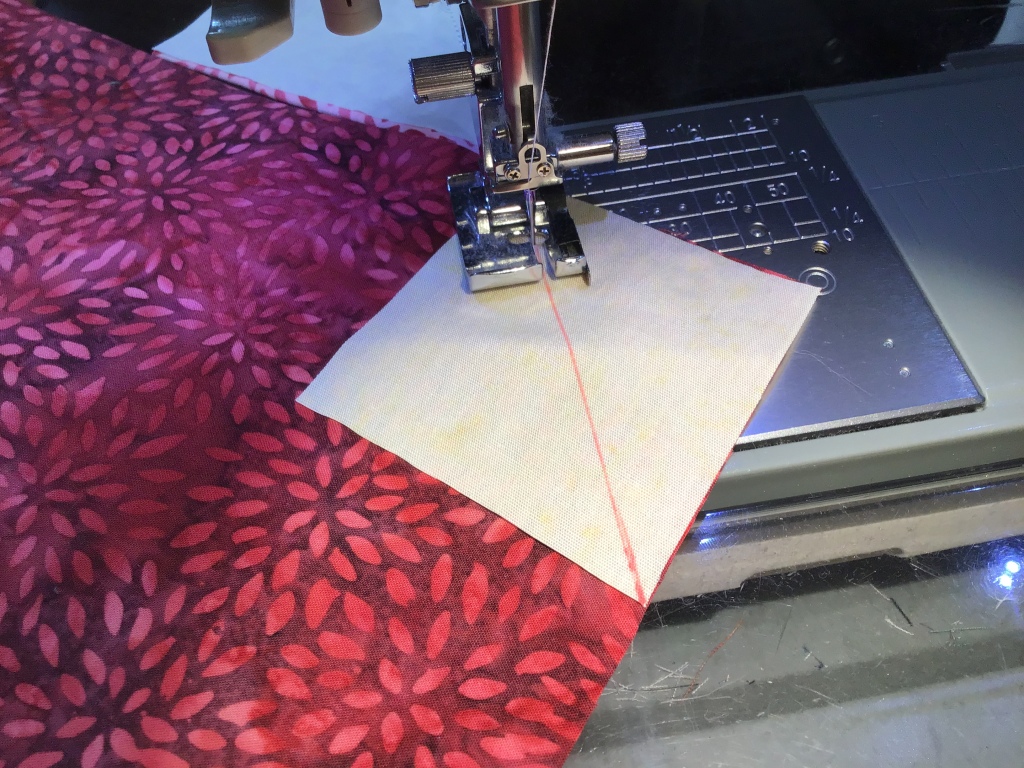
Wait! We’re not done with those HSTs yet. Now we’re going to use the small background squares to make “flippy corners” — yes, I’m using the professional term here — on the green triangles of our HSTs.

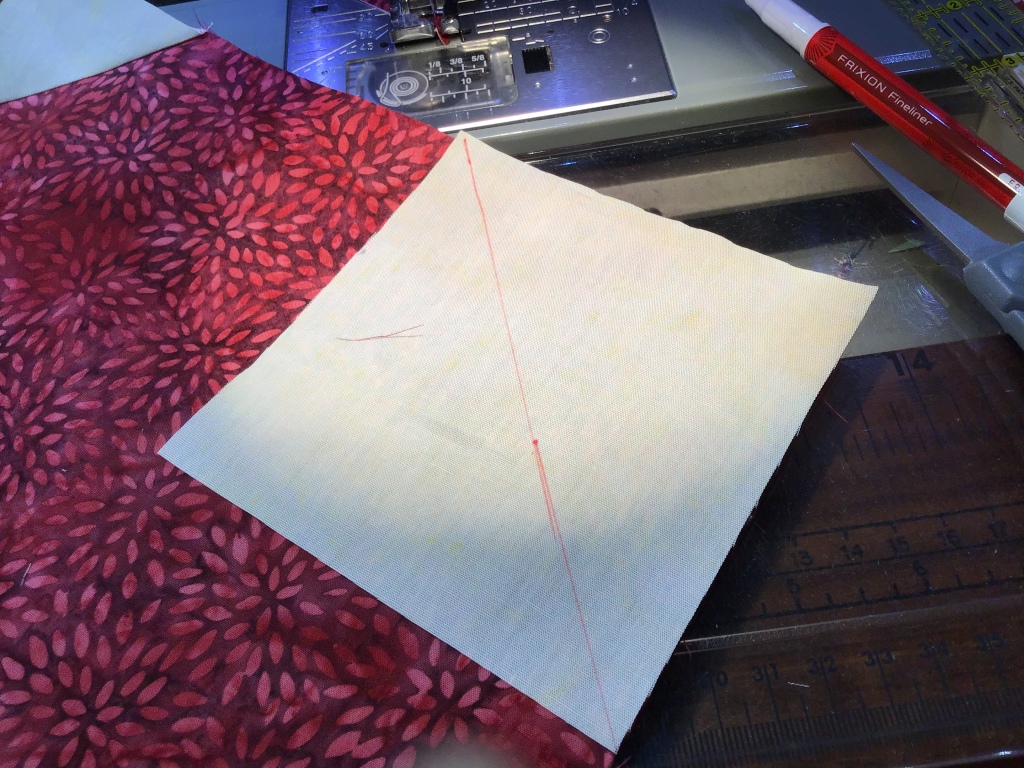
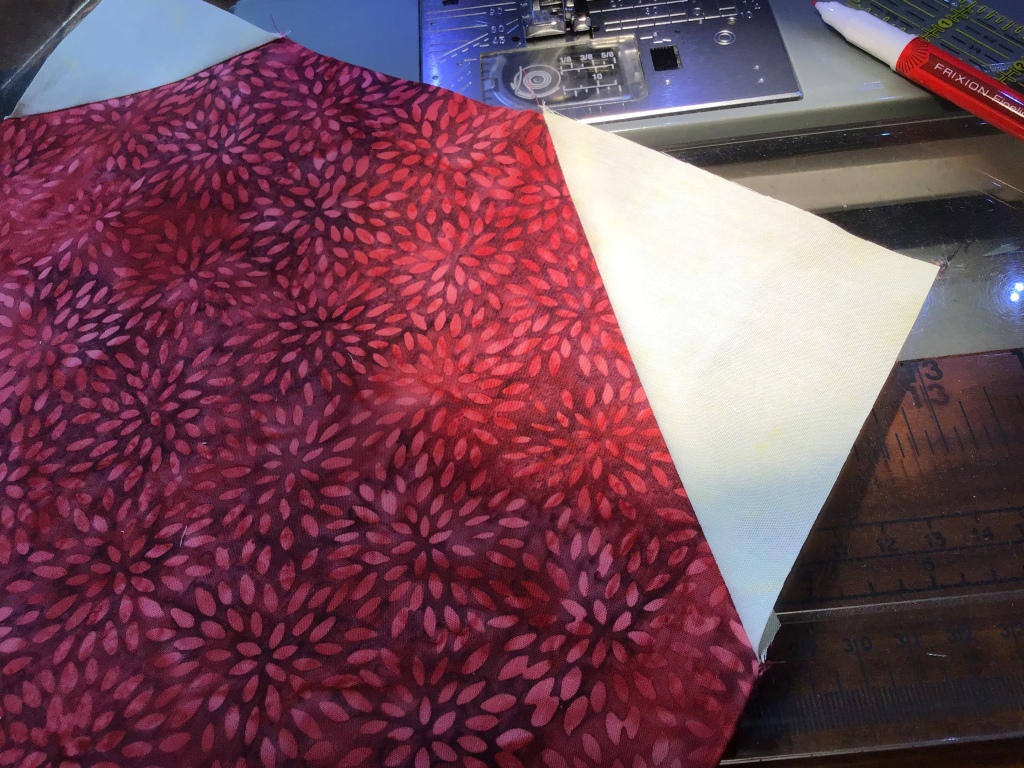
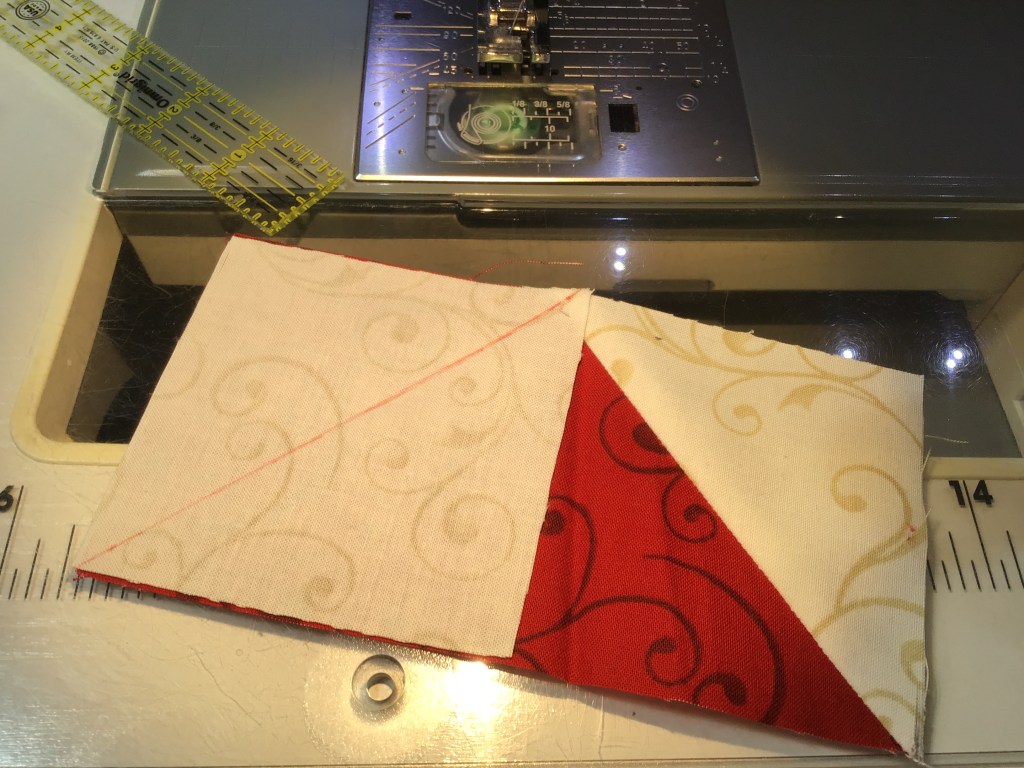
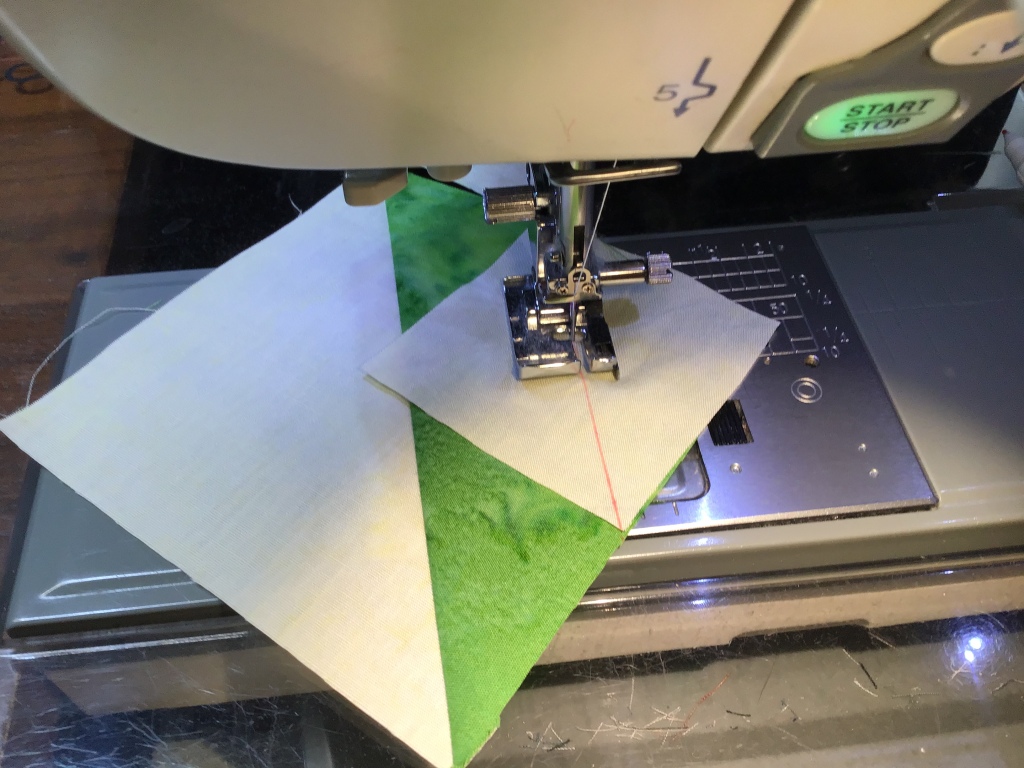
Layer a background square RST on the corner of the green triangle. Draw a diagonal line from the bottom left corner to the opposite corner on the background square. (Yup, LOVE my Frixion pens, especially the Fineliner ones. This red one has been my favorite for a while now and shows up on almost everything.)

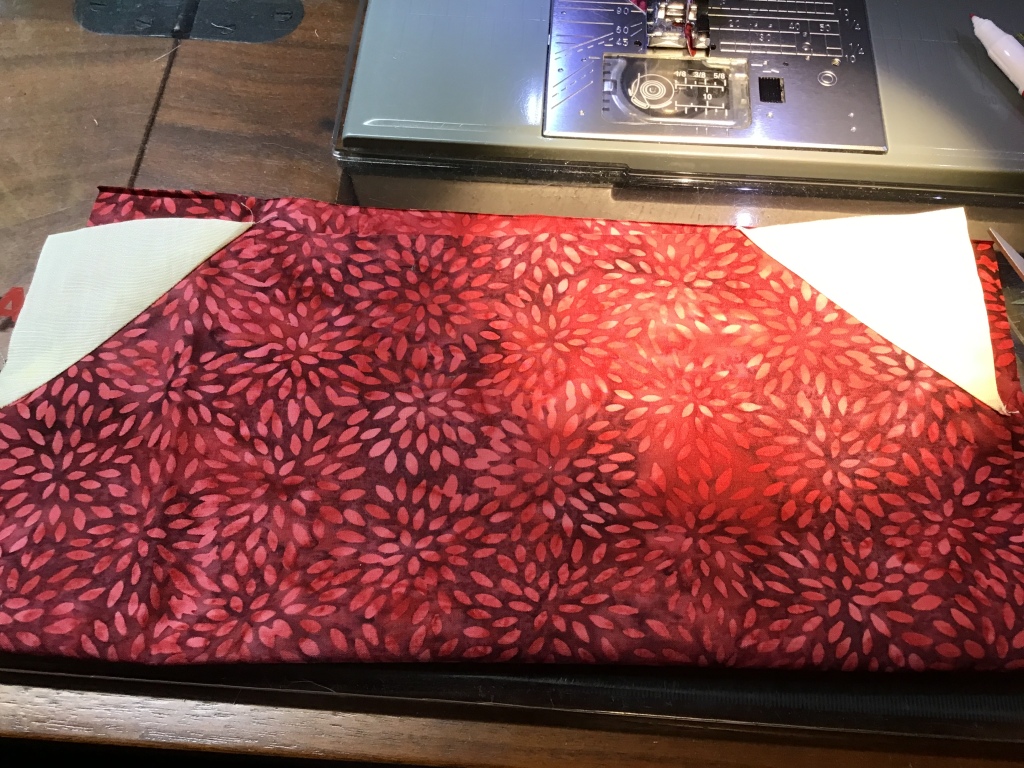
Sew ON the line this time and cut 1/4″ away from the line. Open and press. Repeat with all 10 HSTs.

We’re still not done with these HSTs! Tehehe……

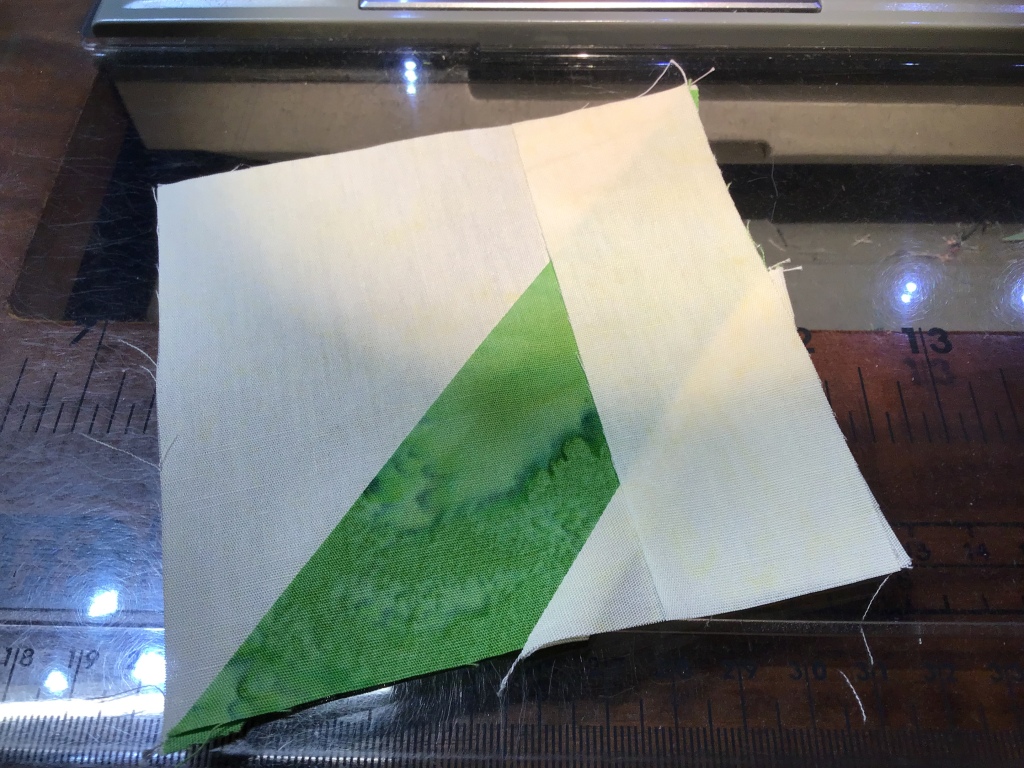
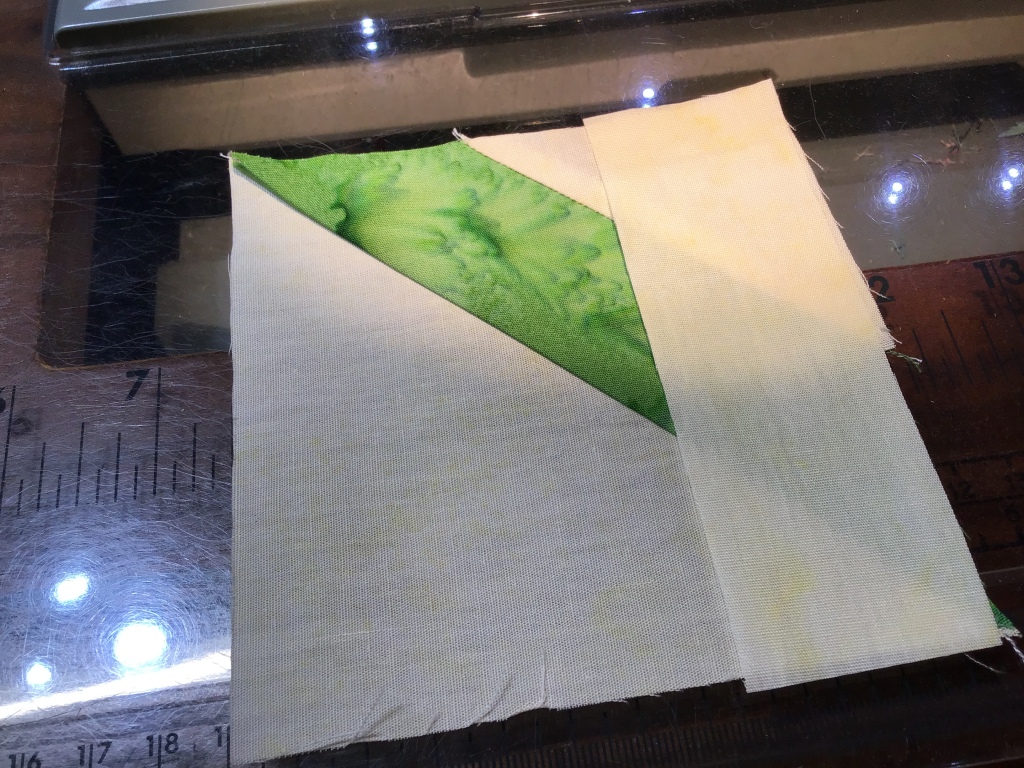
Now we need to sew a background rectangle to the top of each HST, but we need to make 5 left side leaves and 5 right side leaves (simply turn 5 of the leaves so they are mirror images).

Whew! Last step with the HST’s for now!

Sew a left leaf and a right leaf together with a green stem in between. Strawberry tops are done!

Now we’re going to make our strawberries — yum, the best part of the runner!

We’re going to make 2 small flippy corners on the top corners and 2 large flippy corners on the bottom corners. Repeat for all 5 strawberries.

Now let’s add the stems to the tops of the strawberries! Make 5 blocks.

Isn’t this just the cutest yummiest quilt block ever??????

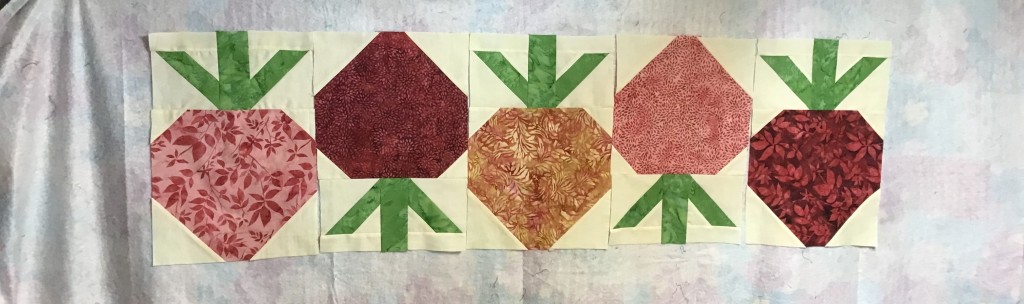
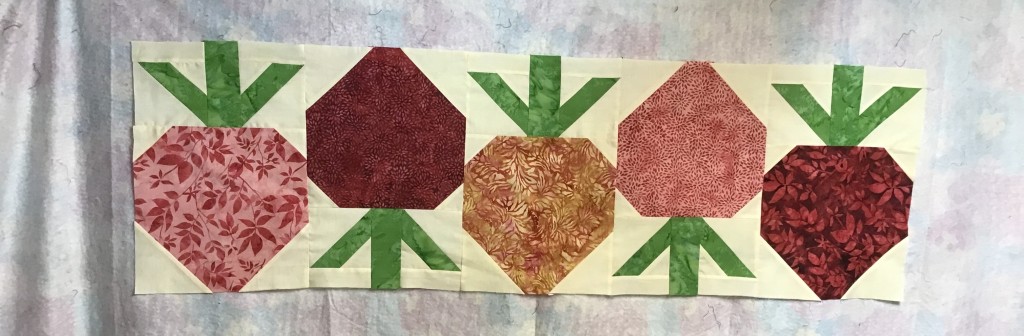
Now the blocks are done, let’s put them together into a runner. You actually have 2 options — you can flip the second and fourth blocks upside down like I did in the original runner on the pattern front or you could have all the strawberries going in the same direction. Which way do you like better?

Which one do you think I chose?

The flipped block version. I just love how the blocks look arranged this way. Take a look at the “negative space,” isn’t it interesting?

Maybe when I go to quilt it, I’ll play around with those cool shapes created by the strawberries and stems. How would you quilt it? My original version was quilted with loopy loops.

I had some fabric left over so I made this fun little wall quilt or pillow — I haven’t decided yet. It’s about 21″ square, so it could go either way. What do you think?

Well, that’s it for me for this week. I hope you enjoyed this truly scrumptious (anyone know what movie this phrase was in???) Berry-Licious runner and I look forward to seeing yours on Facebook soon.

Come back next week to see my next summer tutorial! Hmmm…..what should I do next???

Until next week —

Always,

Tricia @VRD

Quilting Partners · Rose Cards · Tutorials · villa rosa designs

VRD Dusk Delight Quilt Tutorial

Happy Thursday to you!

I’ve been thinking about ideas for summer posts and I think I’ll do a series of Summer Quilt Tutorials. Creating tutorials gives me a reason for getting some sewing in AND I have a stack of wonderful kits just waiting for me to make into quilts. The only problem with making a bunch of tops will be getting them quilted. LOL!

I can’t promise one tutorial a week over the summer, but I will definitely try. I may need to alternate tutorials with text posts because sometimes making the top and doing the photography takes me longer than a week to get ready, especially as summers get busier and busier.

Well, let’s get to it.

I chose Dusk Delight as my first summer tutorial because this pattern has been on my mind recently. I’ve done a few “digital” quilt mock ups with it recently and it really resonated with me for some reason. Maybe because of the controlled scrappy look? Or perhaps the vertical arrangement? Whatever it was, I was itching to make this one. Isn’t it wonderful that I had a quilt kit to make one???

Dusk Delight goes together easily, but I will caution you that making a big stack of blocks does take a little time. The assembly is not difficult, but can take some time to get everything put together. I would call Dusk Delight a quilt that you can make in a long weekend.

Read on!

Get your Dusk Delight physical pattern HERE or your digital pattern HERE.

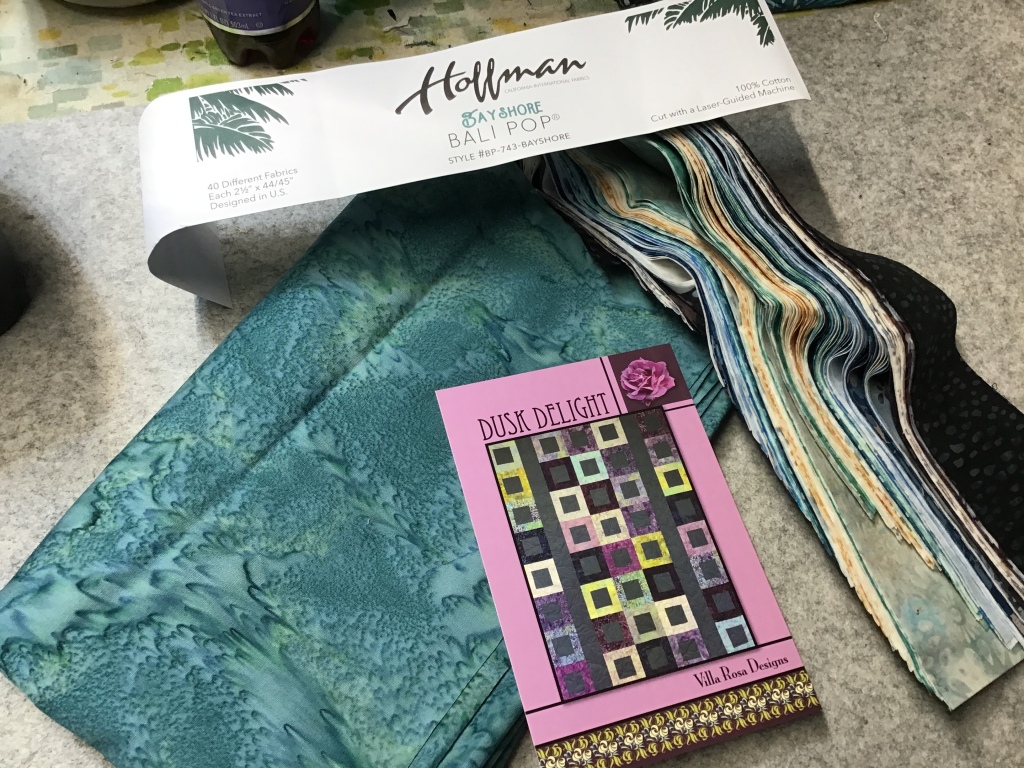
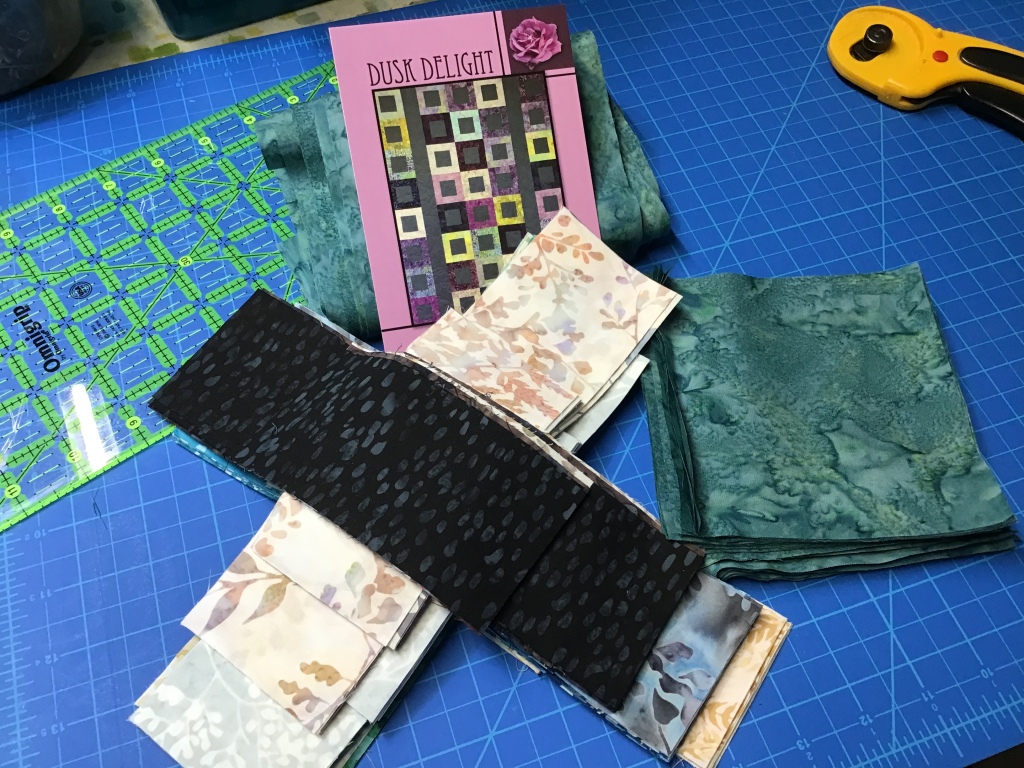
Here’s the fabric I’m using for my Dusk Delight quilt. I just love pairing Hoffman batiks with our VRD Rose Card patterns! I’m using an 1895 Watercolors batik for the block centers and the vertical strips and a Bayshore Bali Pop for the blocks. I can’t wait to see how this turns out because I just love these beachy colors!

The first thing we’re going to do is cut all of our fabrics. We need block centers, vertical strips, and 2 sizes of rectangles for the blocks.

Here’s a couple tips for working with batiks:

  1. Start with a new machine needle because a dull needle will only damage the fabric.
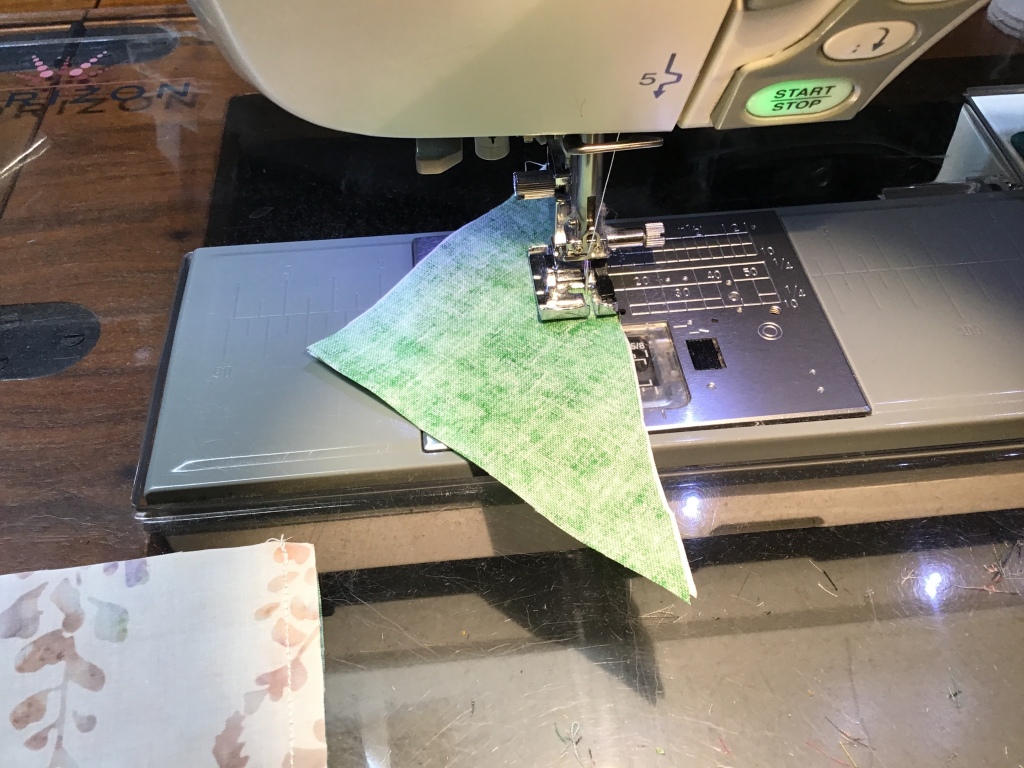
  2. Use leaders and enders so that your machine doesn’t try to eat your fabrics at the beginning of a seam. Want to know more about leaders and enders? Check out this post HERE.

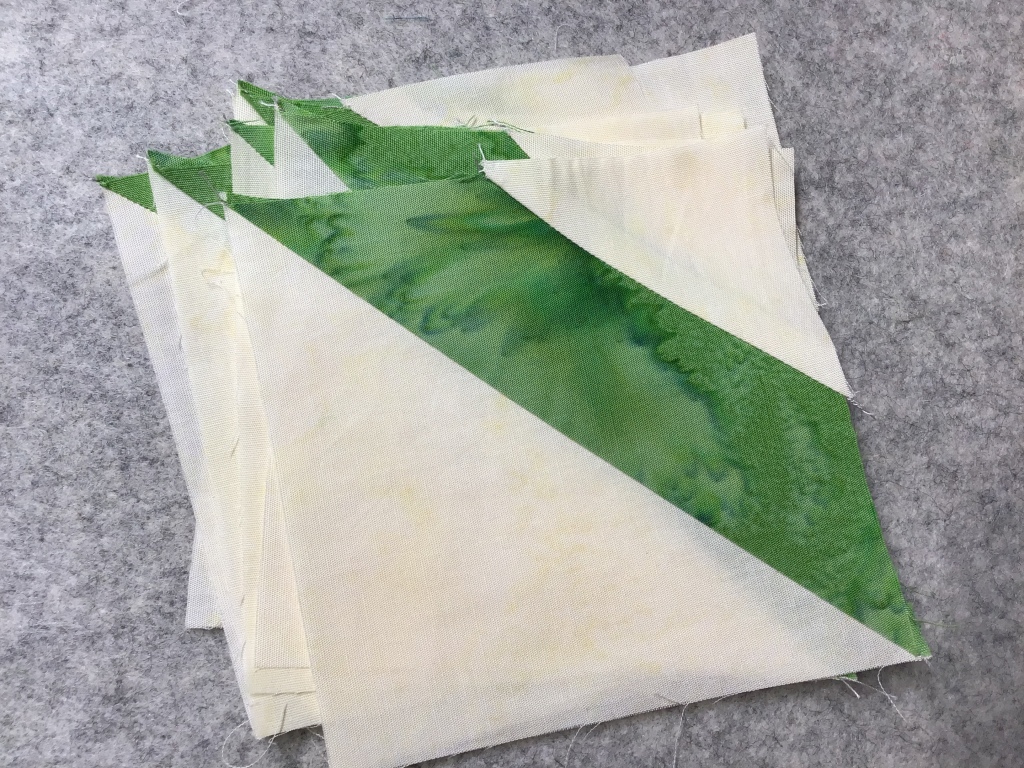
For my leaders and enders, I ‘m using a stack of green and white triangle cut-offs from a previous project. Who knows? Maybe I’ll get another little project out of these cut-off triangles.

Okay, let’s make blocks! A lot of blocks….

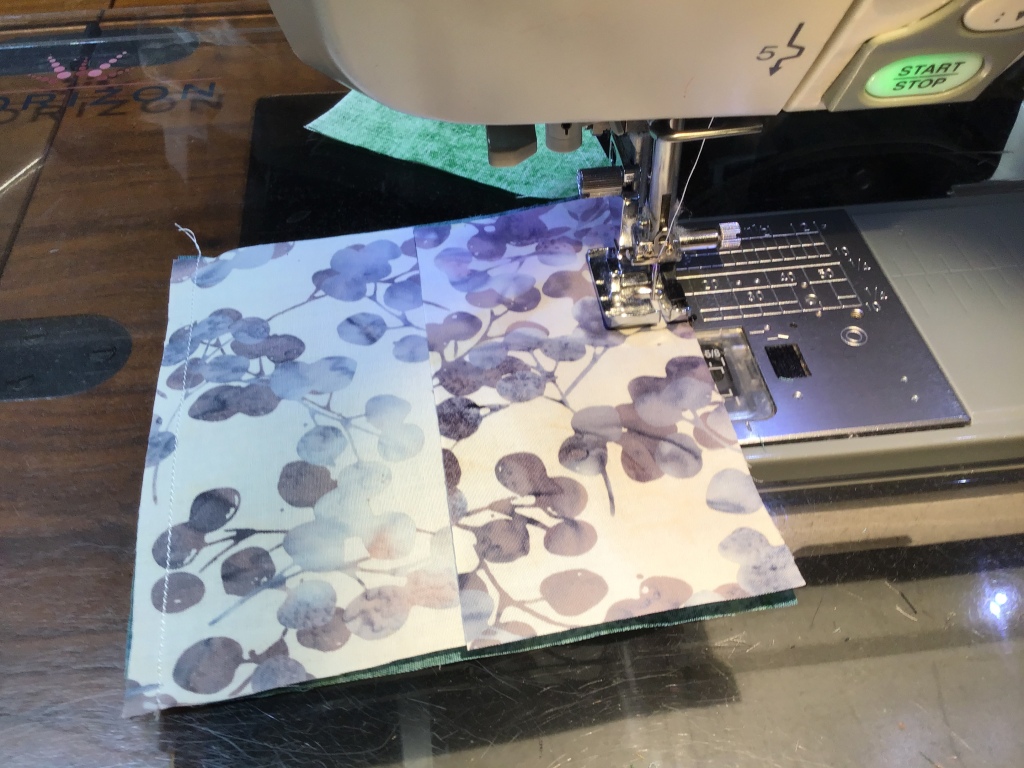
  1. Sew a small block rectangle to the side of a block center.
  2. Sew a matching rectangle to the other side of the block center.
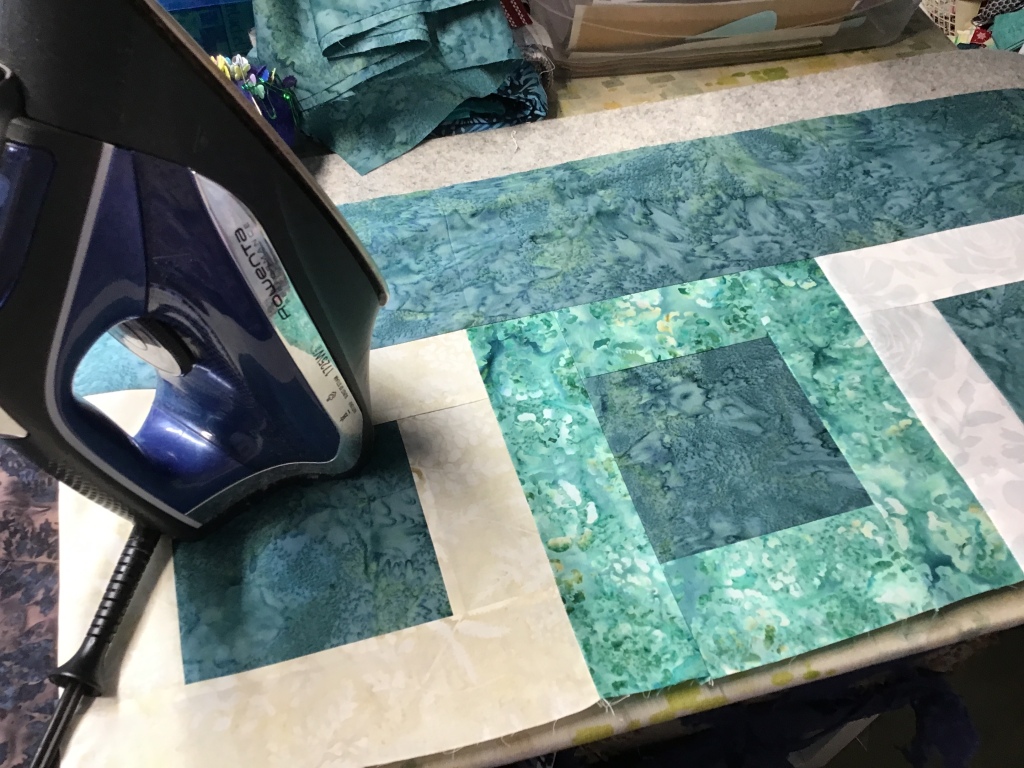
  3. Take a moment and press your unit so far. This helps to keep the block square as you add the next pieces.
  4. Sew a big rectangle to the side of the unit.
  5. Then sew the last matching rectangle to other side of the unit.
  6. Press your block and voila! One block done.
  7. Now make 39 more blocks! LOL!

Another tip — I made 5 or 6 blocks at a time so that I didn’t get the rectangles too mixed up as I sewed. This went faster than sewing a single block together at a time.

Oh goody! Now one of my favorite things — laying out the blocks. Of course, sometimes this part of the quilt-making process takes me longer than actually sewing everything together. The more I look at the arrangement, the more I move things around. But I do definitely love mixing and matching the colors….

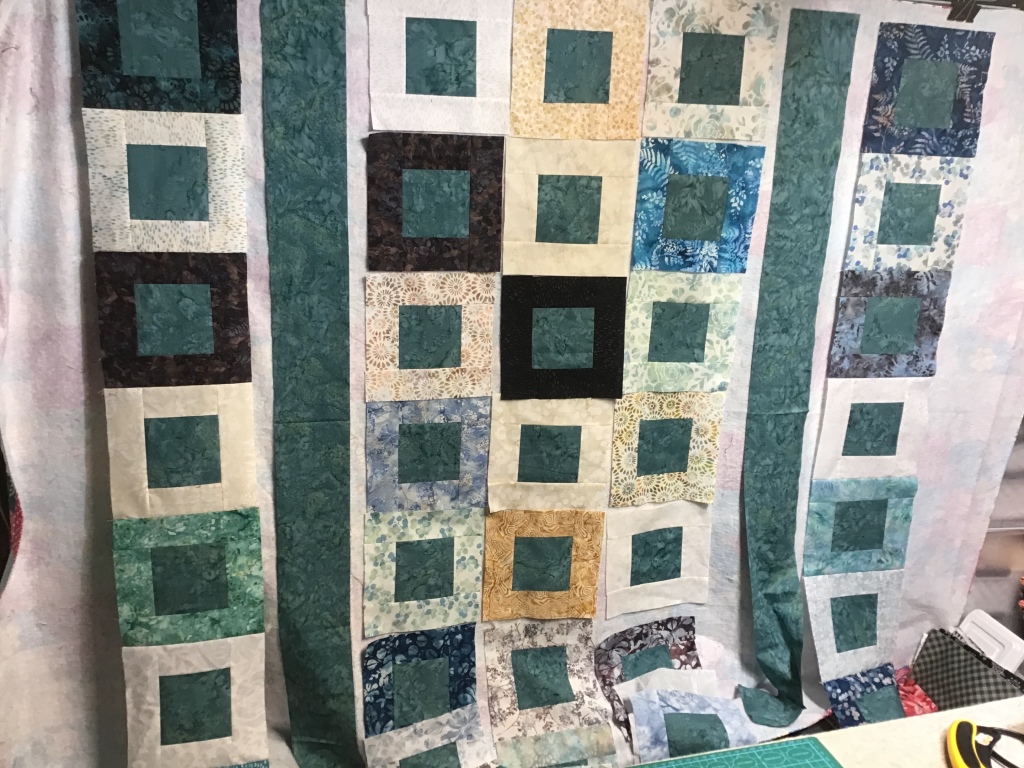
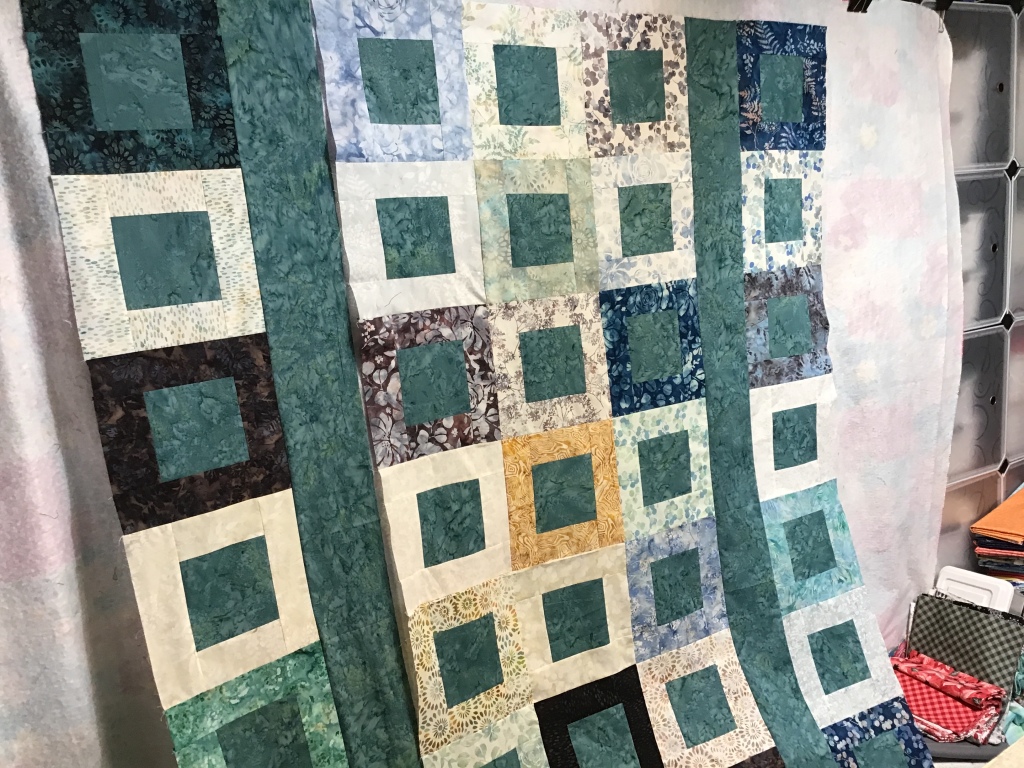
To help me arrange the blocks, I put all the blocks and the vertical strips up on my handy dandy flannel board. It really is handy dandy — I use it way more than I ever thought I would. I have no idea why it took me so long to put one up. The only issue I ran into was that the quilt was longer than my board, so I had to do some creative layering at the bottom so I could see the bottom 2 block rows.

If you’re experiencing flannel board envy, let me tell you how to have your own handy dandy flannel board in a matter of minutes with very little cost. I stole this idea from my quilty pal, Mary Lee (Hi Mary Lee!), who has one up tacked to the top of a set of double doors that lead to her front enclosed porch (which she uses for storage).

Go ahead and get yourself a rectangular flannel backed tablecloth. You will want a heavy duty one with a thicker flannel on the back so that it will grab and hold your fabrics. They do come in different sizes — mine is 50″ x 72″ — so you can choose the one that fits your space. Now that it’s the good ol’ summertime, it’s the perfect time to find your very own flannel backed tablecloth.

There are lots of different ways to put your flannel backed tablecloth up. I use binder clips to clip my tablecloth to the top row doors of my cube storage wall. This way, I can remove it when I need to. If yours is removable like mine, you could even use it as a tablecloth so make sure to pick out a fun pattern on the front that matches your outside decor.

Well, I guess I’ve got the blocks arranged the way I want them…..maybe…….

So let’s sew them together before I change my mind again. LOL!

I’m going to sew the outside blocks together into rows before I tackle the center block section.

Now that the outer blocks are sewn together, I can no longer move them around.

Before I start the center block section, I need to piece my vertical strips together to make longer strips. I don’t want to forget to do this step or else my strips won’t be long enough.

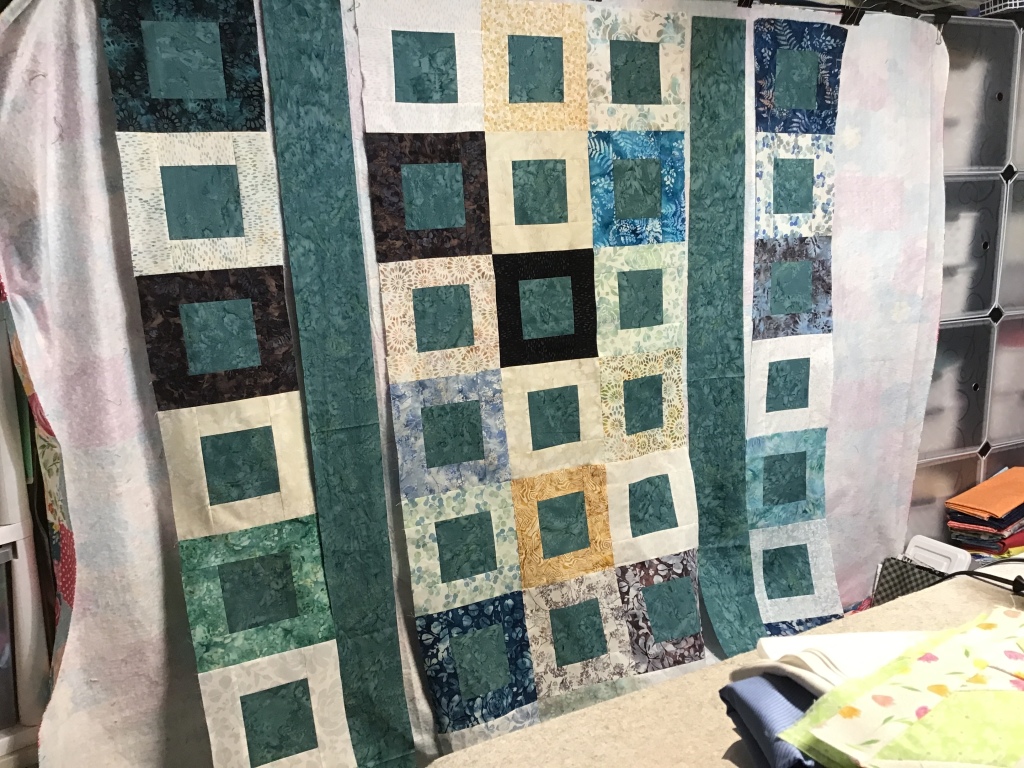
Sew…..sew……sew. Press…..press…..pres…… Yay! The center section blocks are now sewn together. Of course, I had to play switcheroo a couple — or maybe a dozen — times before I sewed them together.

Wait! Which way do I want the center section? Gah! I’m still not done arranging, even though the blocks are sewn together. Which one do I like better — right side up in the left photo or upside down in the right photo. Decisions…..decisions…….

Which ever one I choose, this will be the final arrangement. Of course, I could flip the whole quilt upside down……ARGH!

I take it back, maybe arranging the blocks isn’t my favorite step after all!

Before I can sew the vertical sections together, I need to cut my vertical strips to the right length. Holding my breath here that it will be the perfect length. Of course it will, right?

Time to sew again. I pinned the vertical strip to the inside edge of each of the outer single block sections, matching centers and outside edges before stitching them together.

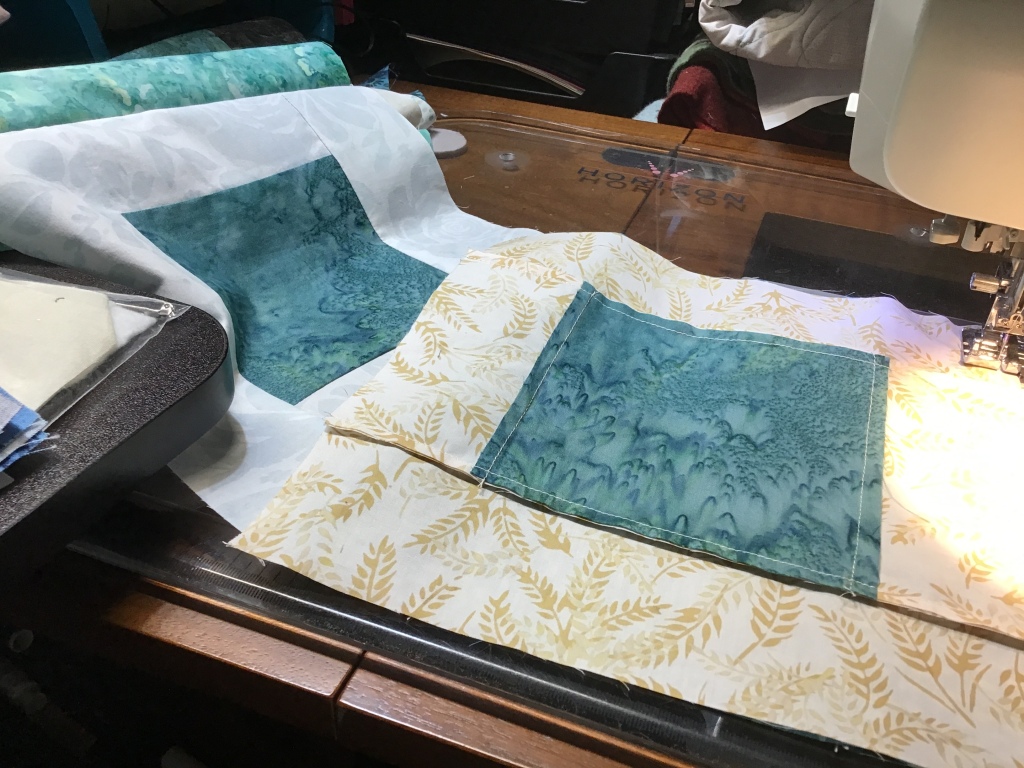
This part looks easy in the photos but it took me quite a while because my work space is so cramped right now. It was like wrestling an alligator from time to time.

I matched up the centers and ends of the left section with the left side of the center section. I crossed my fingers that the blocks would be decently lined up across the vertical strip.

Then I lined up, pinned, and sewed the right section to the right side of the center section.

Yay! Top done!

Wowzer! Why was I even worried??? It turned out great and the colors are just so calming. Ahhhhh! Now to get it layered with batting and backing (or with just fleece) so I can machine quilt it……someday!

I’d love to see your Dusk Delight quilts! If you haven’t joined our rockin’ fun and uber cool Facebook Group, please do! You can find the Group HERE. And post your Dusk Delights so we can all ooooh and ahhhh over them!

Back to my summer sewing, what fun! Next week’s tutorial will be a table runner, so stop back next Thursday to see which one.

Until next week —

Always,

Tricia @VRD

Rose Cards · Tutorials · villa rosa designs

VRD Eclipses Quilt Tutorial and a Little More Quilt Math…

Happy Thursday to you!

Wow! I can’t believe that it’s been 2 weeks since the end of the Blog Hop. We are still getting all the winners organized, so please be patient with us. I promise, just as soon as all the winners have been notified and we have shipping information, then I can start getting prizes out to winners. It will probably be done in several stages, so hang in there if you have been notified that you are a winner. Thank you!

On another note, are you excited about next week’s eclipse on April 8th? Are you in a place to see it or are you traveling somewhere for viewing? I am very excited that NW Pennsylvania will be able to see it, so all I have to do is step outside and look up. Fingers crossed that it isn’t cloudy — that would be a total disappointment if we all can’t see it. Yes, I did finally get my eclipse-viewing glasses, so I’m all set now.

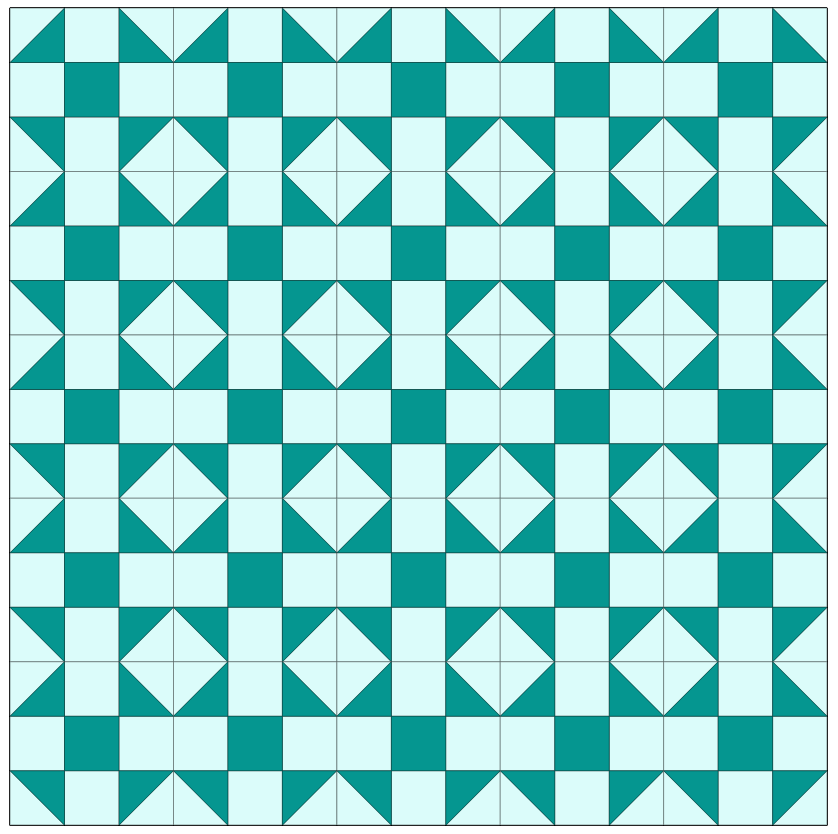
In celebration of this eclipse, I created my own version of Creative Sewlution’s Eclipses which was one of March’s new patterns. I had to hustle to get the top and photos done for today, but I did manage it. And, boy, am I glad I did — it is an amazing design and I can’t wait to show you how to put it all together!

Didn’t get your Eclipses pattern yet? You can find it HERE as a physical pattern OR you can find it HERE as a digital pattern.

But before we do (sorry about the teaser…), I have one more thing to talk about.

Have you ever looked at a big quilt and imagined it as a smaller size so you could use it on a wall? The Eclipses quilt finishes at 59″ x 75″, which is a throw quilt or a REALLY BIG wall quilt. I definitely do not have a big empty wall to hang a quilt of this size, but I really really wanted to make Eclipses.

So, what to do???

Why, I’ll make the quilt smaller so it fits my space! Brilliant!

Have you ever made a quilt smaller or larger than the pattern? There are lots of different ways to alter the size of a quilt, but I thought I’d tell you how I did it with Eclipses.

OH NO — IT’S MATH!!!!!!! RUN!!!!!!!! LOL!

Sorry, couldn’t resist. Teheheh…. You know how much I LOVE LOVE LOVE quilt math!

You can resize most simple quilt patterns by dividing each measurement by whatever fraction you want to make the quilt.

Let’s say I had a 60″ x 60″ quilt with 12″ blocks. No sashing, no borders. Just blocks. Why look, here it is!

Hmmm, that’s just too big. I want to make a nice little wall quilt exactly like the pattern, but half as big. So if the quilt pattern quilt finishes at 60″ x 60″, then I think cutting the dimensions in half to 30″ x 30″ would suit my needs.

So, here’s where the fun begins.

Time to divide all the measurements by 1/2. My 12″ blocks will now finish at 6″. I still need to make the same number of blocks, though, which is 25.

Our repeated block is actually a humble Shoofly block. Isn’t it interesting what happens when you put the blocks side by side without any sashing? Hmmmmmm. Something to play with another day.

There are a couple different ways to figure out the new cutting measurements to make the 6″ finished block.

  1. Redraw the block on graph paper
  2. Divide the original cutting measurements in half (for example a 4″ square would become a 2″ square)
  3. Recreate the quilt in Electric Quilt’s awesome Electric Quilt 8 software and the program will do the math for you!

I don’t usually use graph paper for designing. Most of the time I use a combination of #2 and #3. It also helps if you have some experience with quilt designing.

Shoofly is an easy one to resize, which is why I chose it for this illustration. Because it’s a Nine Patch block, we know that each of the 9 squares in the block will end up being the same size, so we will divide 6″ by 3 (3 squares across, 3 squares down) which equals 2″. Each “square” should finish at 2″. So, we will cut the squares at 2 1/2″ x 2 1/2″ (the 1/2″ is for the seam allowance, so the finished size of the square is 2″ x 2″).

Now what about the Half Square Triangle (HSTs) in each corner? They have to finish at 2″ x 2″ in order to fit properly into the 6″ finished quilt block.

Aha! You do need to know a little bit about quilt math here. Rule of thumb for HSTs is to add 7/8″ to the finished size (to make room for the seam allowance and cutting). So we’ll simply just add 7/8″ to our 2″ finished squares and we get a cutting measurement of 2 7/8″ x 2 7/8″ for our HSTs. Not sure how to sew HSTs? Check out our 2023 Quilt Block Basics Series HERE. Some folks even like to cut their squares a bit larger and then trim them down to the correct size. Do likewise if you prefer.

Something to remember — not all quilts can easily be resized. Who wants to work with pieces that end up needing to be cut 3 5/22″ in size??? Definitely NOT me!

Now that I’ve totally confused you (sorry, not sorry), let’s do the tutorial for Eclipses — the method of construction is the same whether it’s full-sized or mini.

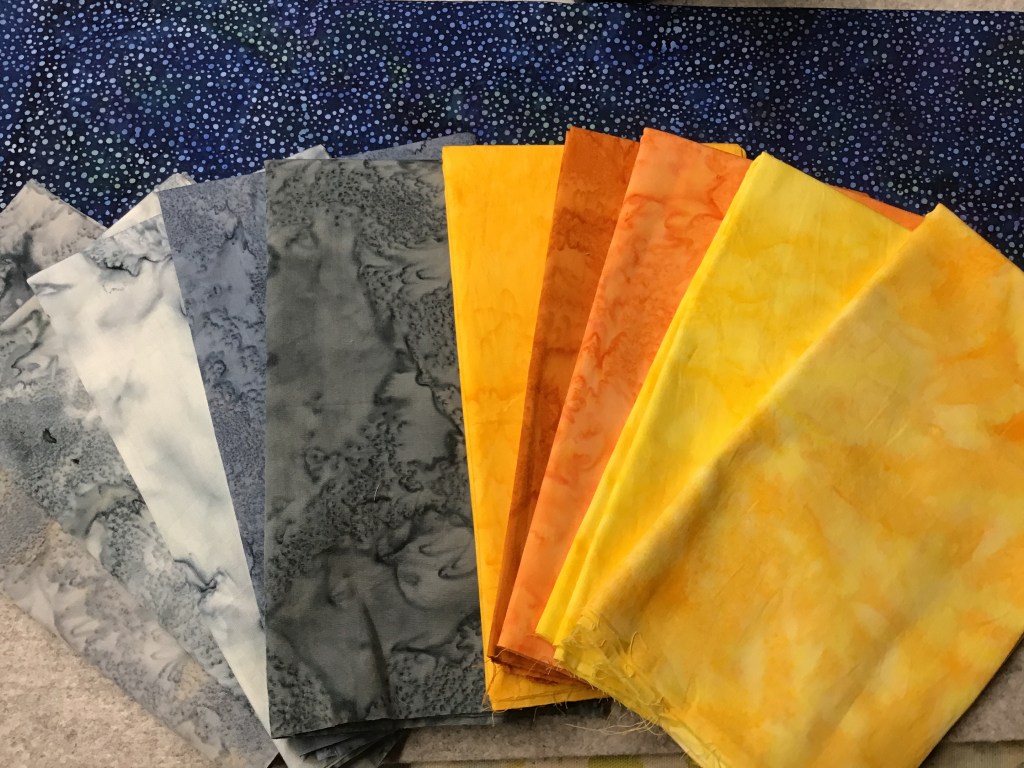
Here are my yummy fabrics for my Eclipses quilt — 1895 Watercolors from Hoffman Fabrics with an 885 Dot rich blue for the background. I love the Dot batik for the background because it actually has little pops of other colors to add lots of interest.

So let’s get started by cutting out all the pieces for the quilt. I do like to cut everything for the blocks before I sew. I save cutting borders until the end if a quilt has borders, though. That way, I don’t have to stop between steps and keep cutting the fabrics I need next. It saves time for me as well as keeping all my pieces organized.

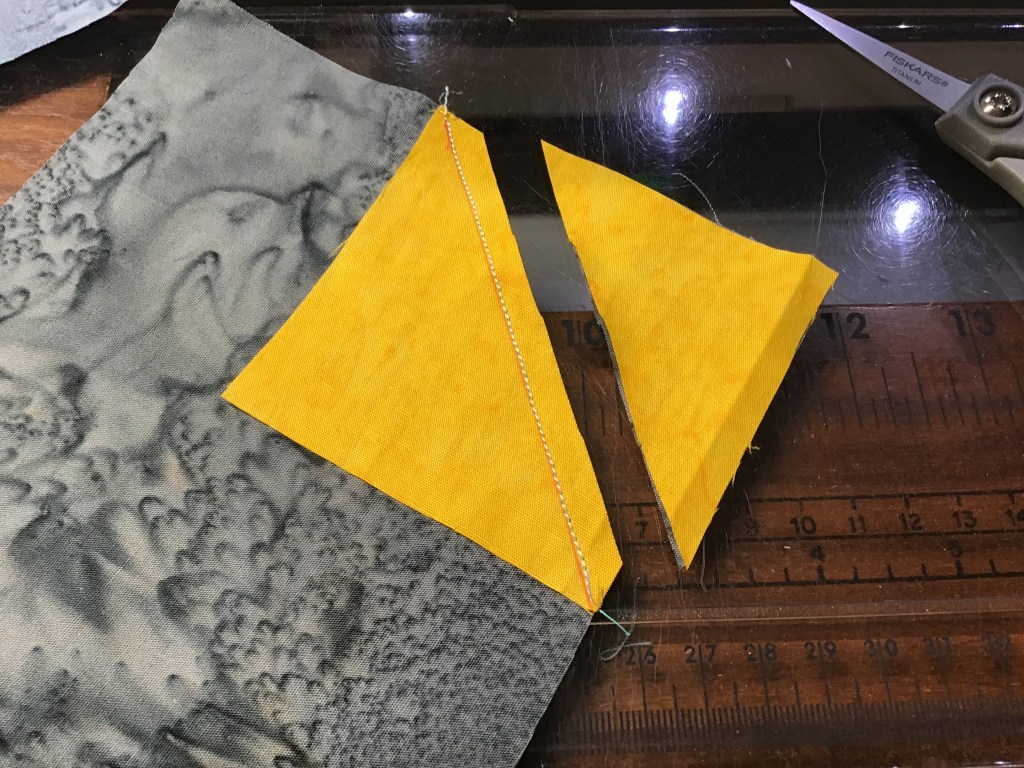
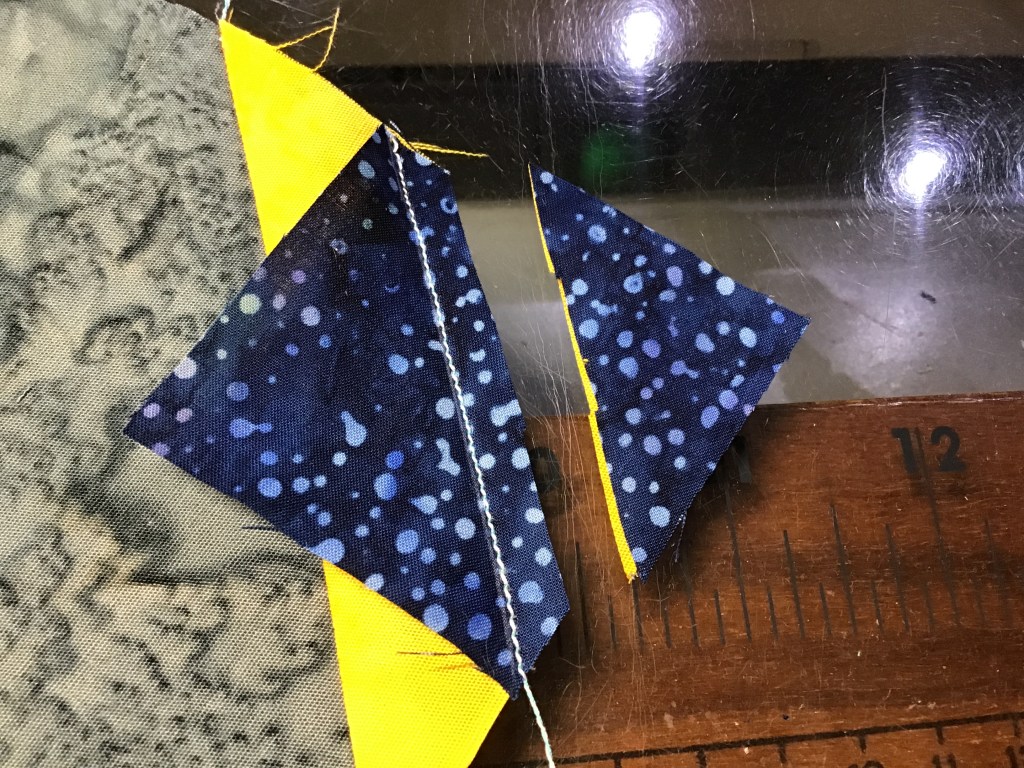
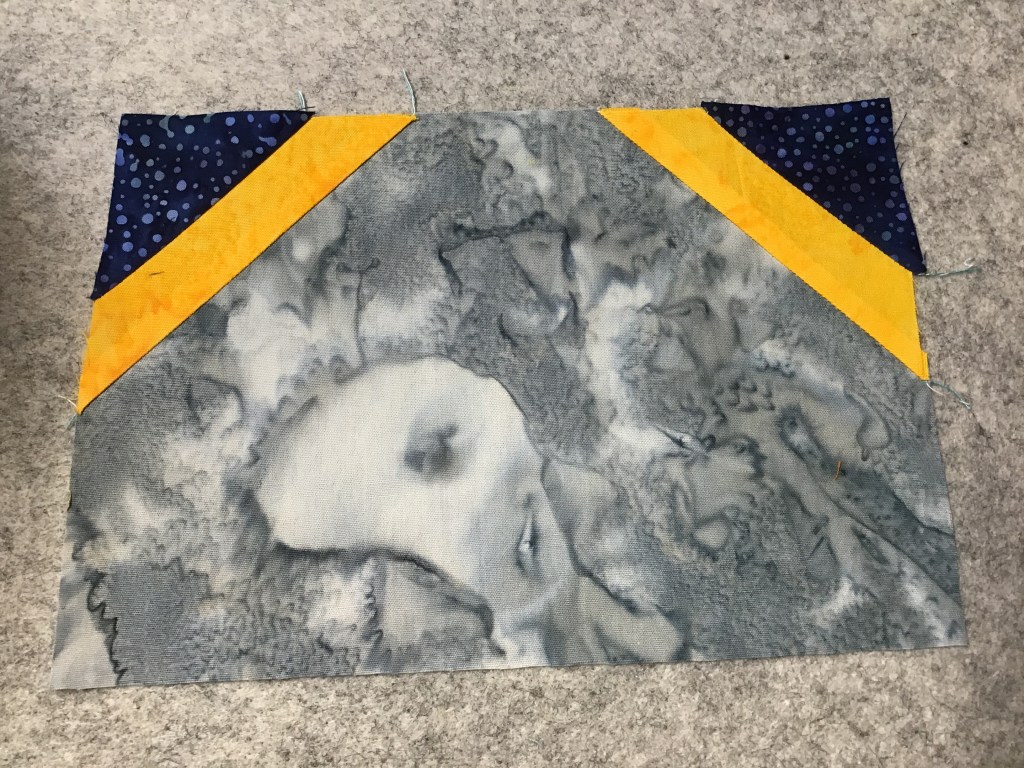
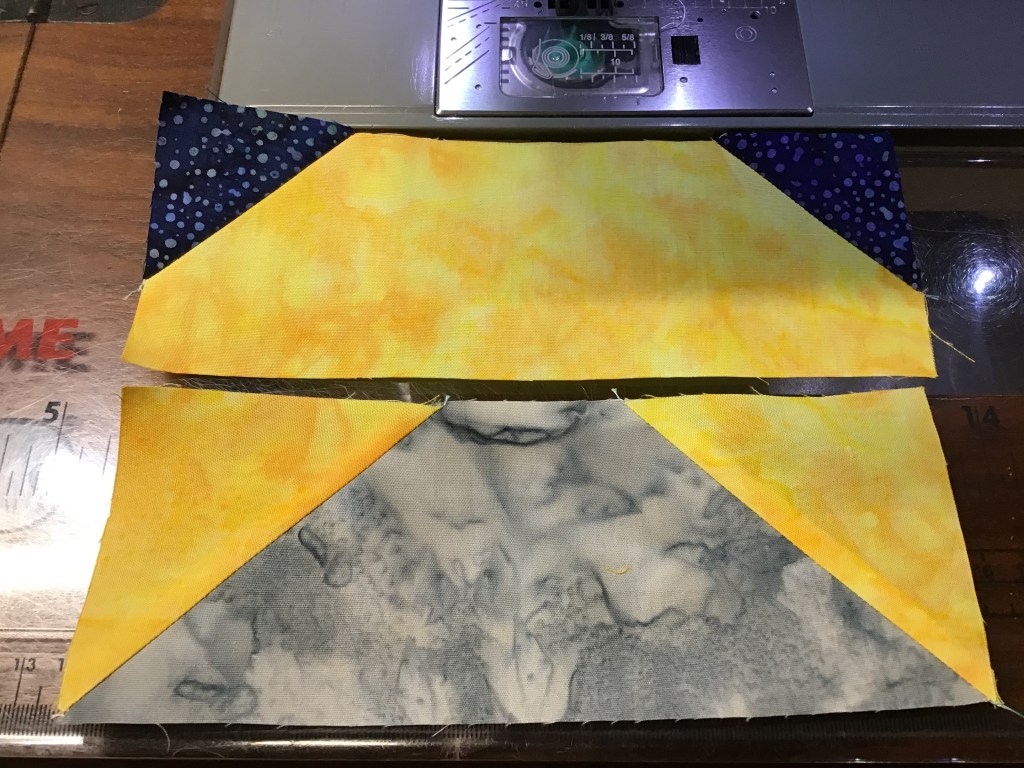
First up is to add yellow/orange “flippy corners” to my grey rectangles. I draw a diagonal line from corner to opposite corner and SEW ON THE LINE. I really like to use my Frixion Pens for this step. I love to have a lot of different pen colors to use on different colors of fabrics — besides, lots of colors just makes me happy. Here, I’m using red.

Trim 1/4″ away from the sewn line. Then open and press.

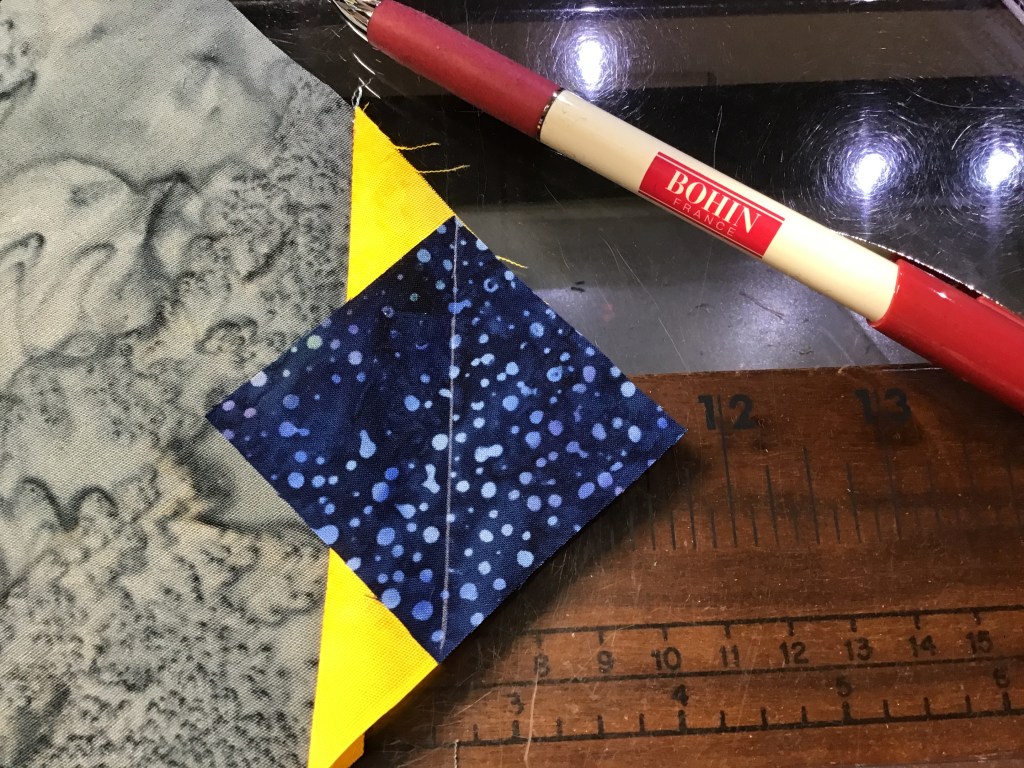
But wait! We’re not done with our “flippy corner” yet! We’re going to add another, smaller “flippy corner” to our yellow/orange corner.

Uh oh! Now what? I won’t be able to see my red Frixion pen on the blue background. Sadly, there isn’t a white Frixion pen, so I use my trusty Bohn Chalk Pencil, which is white so it will show up on the dark blue background square.

Okay, layer that background square on the yellow/orange corner. Draw a diagonal line from corner to opposite corner and SEW ON THE LINE once again. Trim 1/4″ beyond the line. Then open and press.

Go ahead and repeat for the all of the large grey rectangles on 2 sides.

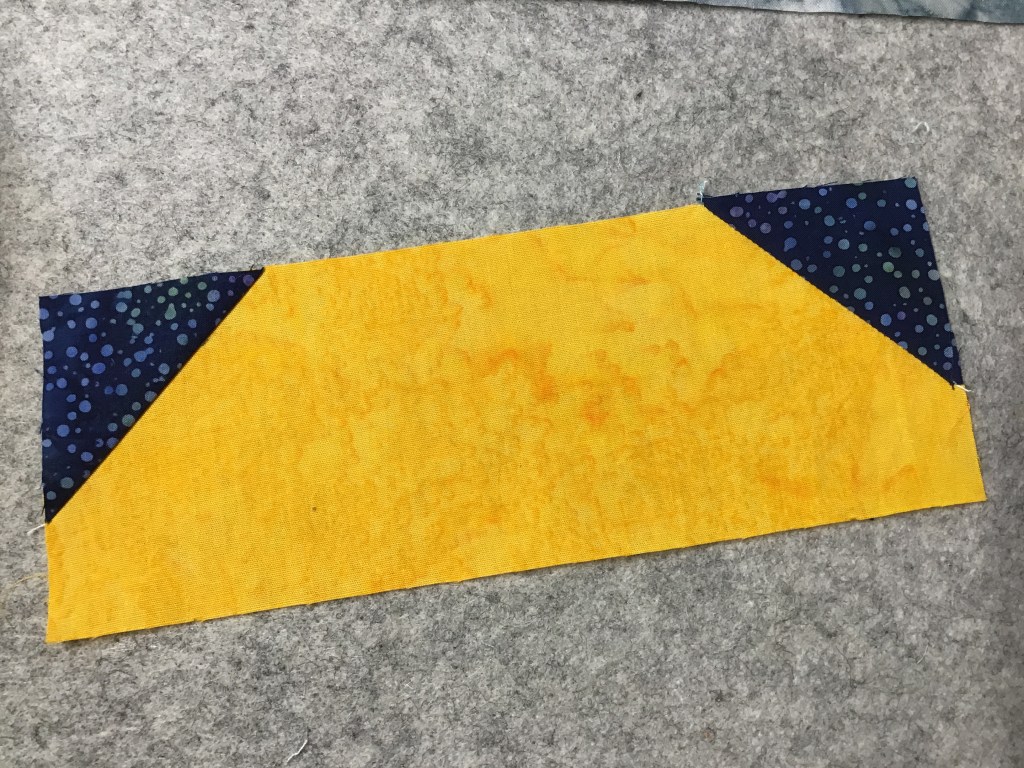
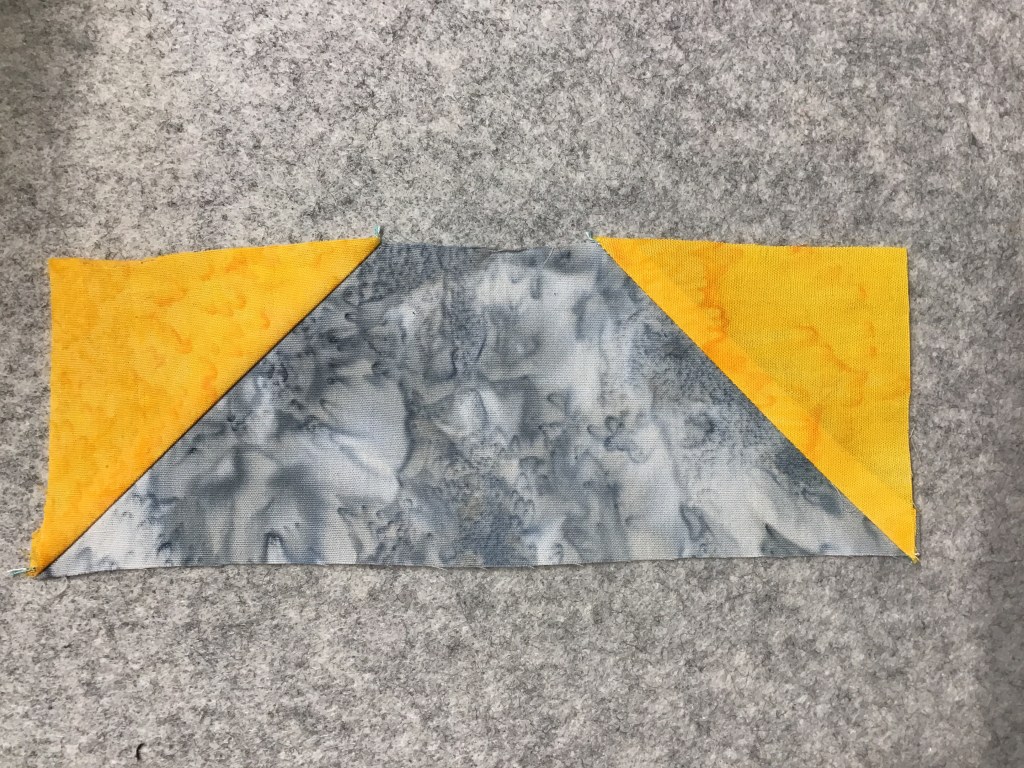
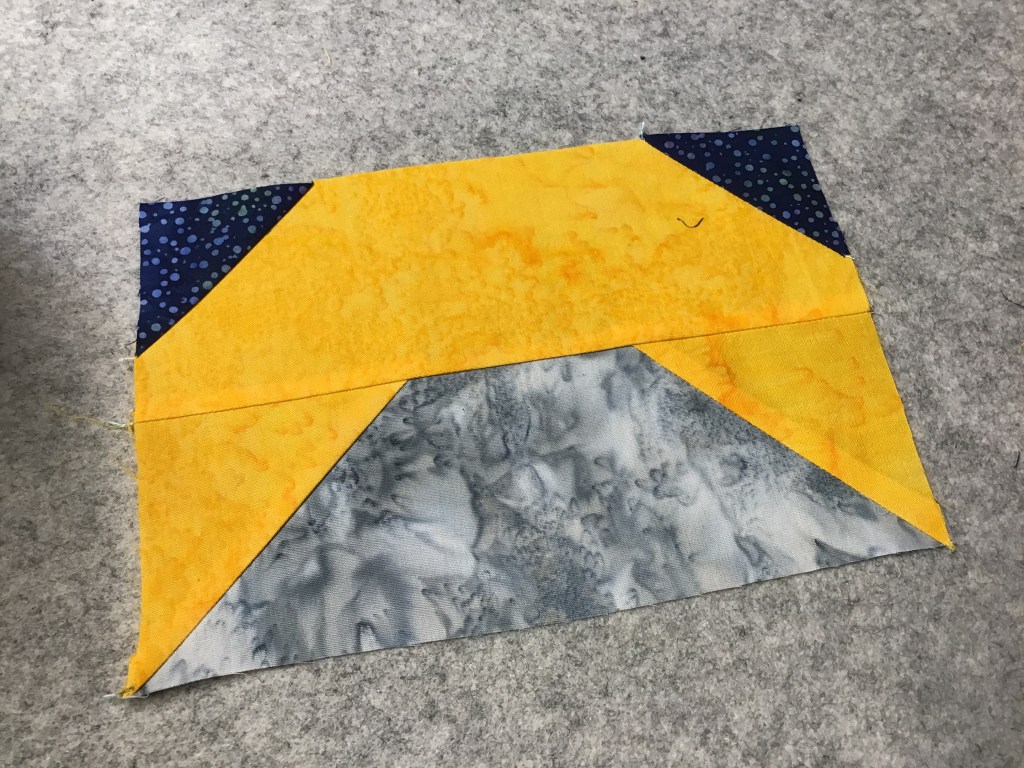
Moving on, we have MORE “flippy corners to do”. In fact, we have to add “flippy corners” to ALL of the rectangles. Add background corners to the yellow/orange rectangles and yellow/orange rectangles to the narrow grey ones.

Sew the 2 units above together into a block. Repeat for all the narrow rectangles.

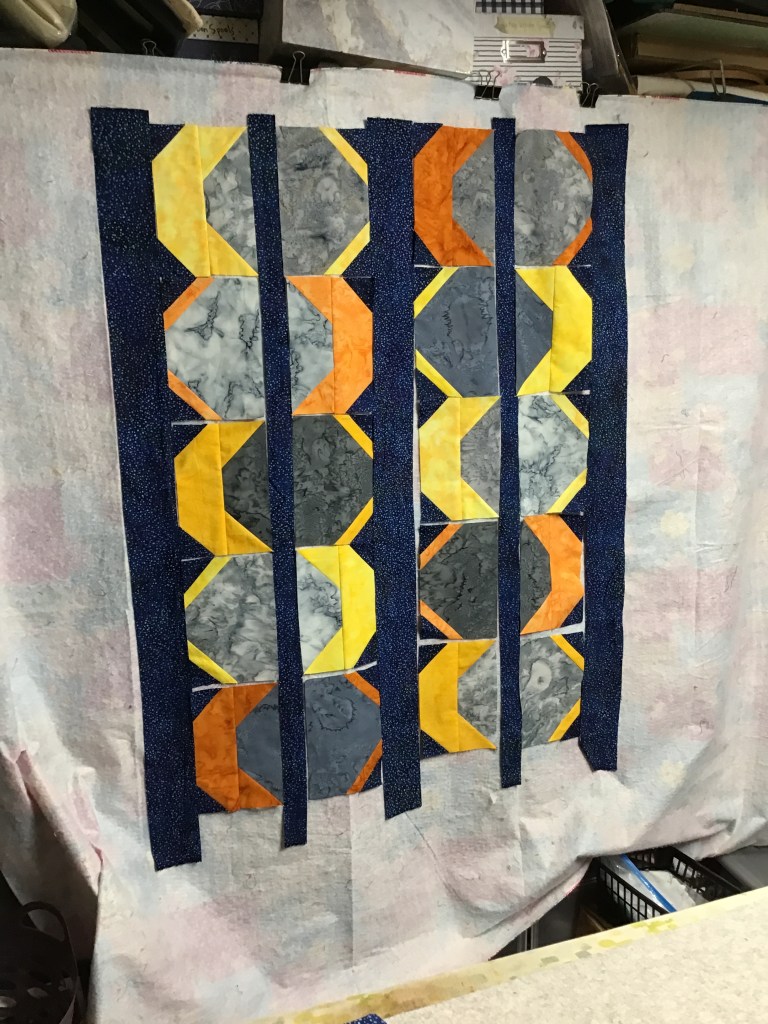
Yay! Here’s my favorite part — slapping them up on the design wall and rearranging them until I like what I see. Make sure to follow the diagrams on the pattern so your blocks are lined up correctly. Don’t forget the sashing and side borders.

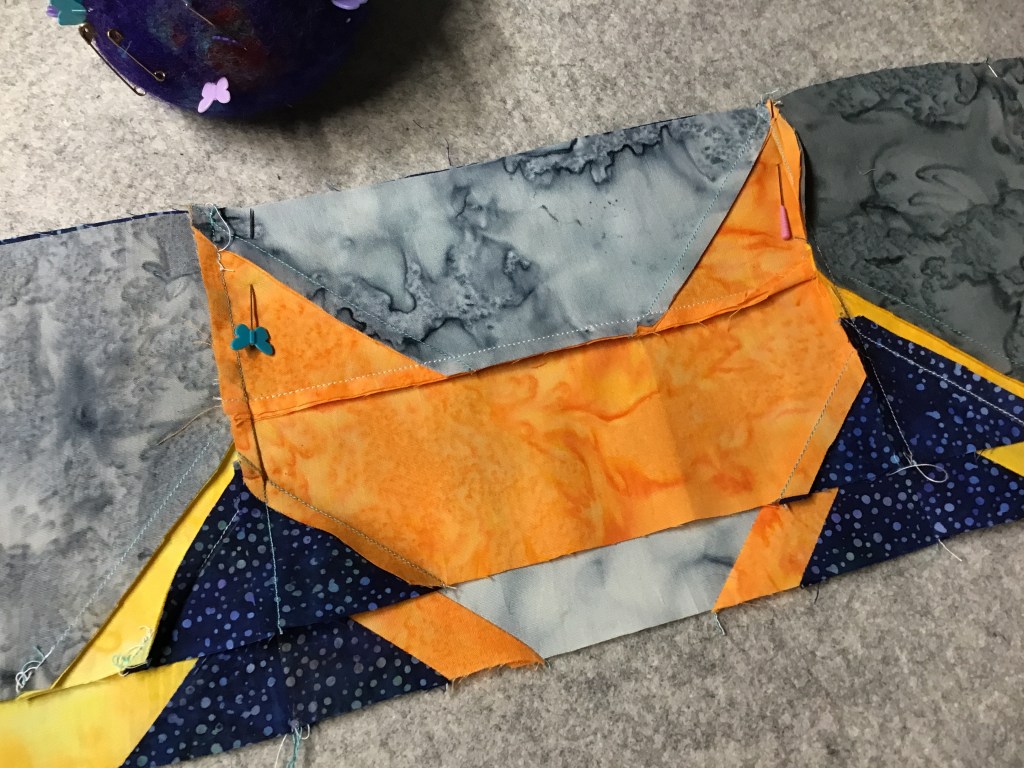
I like what I see — the orange is distributed nicely and adds a good pop of color. Let’s SEW! I am going to start with the left side of the quilt, but I am taking the left background sashing down until I’m ready for it in a few steps.

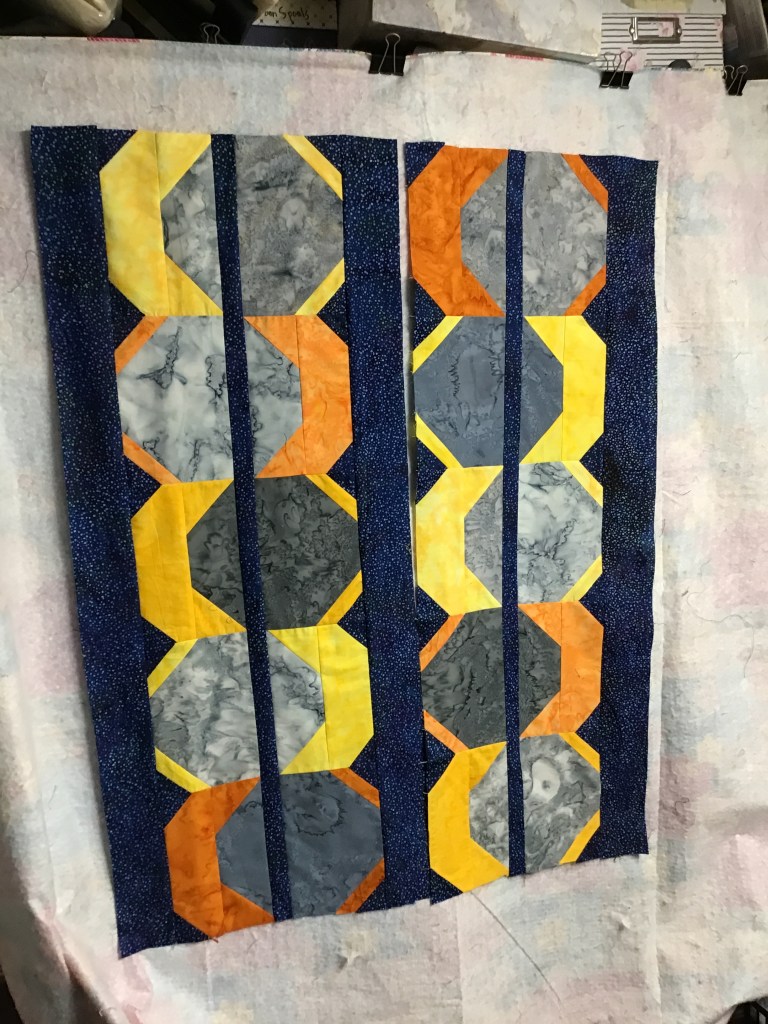
I’m going to sew the blocks bottom to top to make a vertical row (which might feel a little weird if you’re used to sewing horizontal rows). Don’t forget to press your row. (One thing I really like about working with batiks is that they press so crisply that I don’t need any pressing spray to flatten them, which saves a bit of time). I am going to go ahead and repeat this step with the right side blocks.

Now I’m going to sew the narrow background sashing strip between my vertical block rows. I’ll look one more time before I start pinning so that everything is lined up.

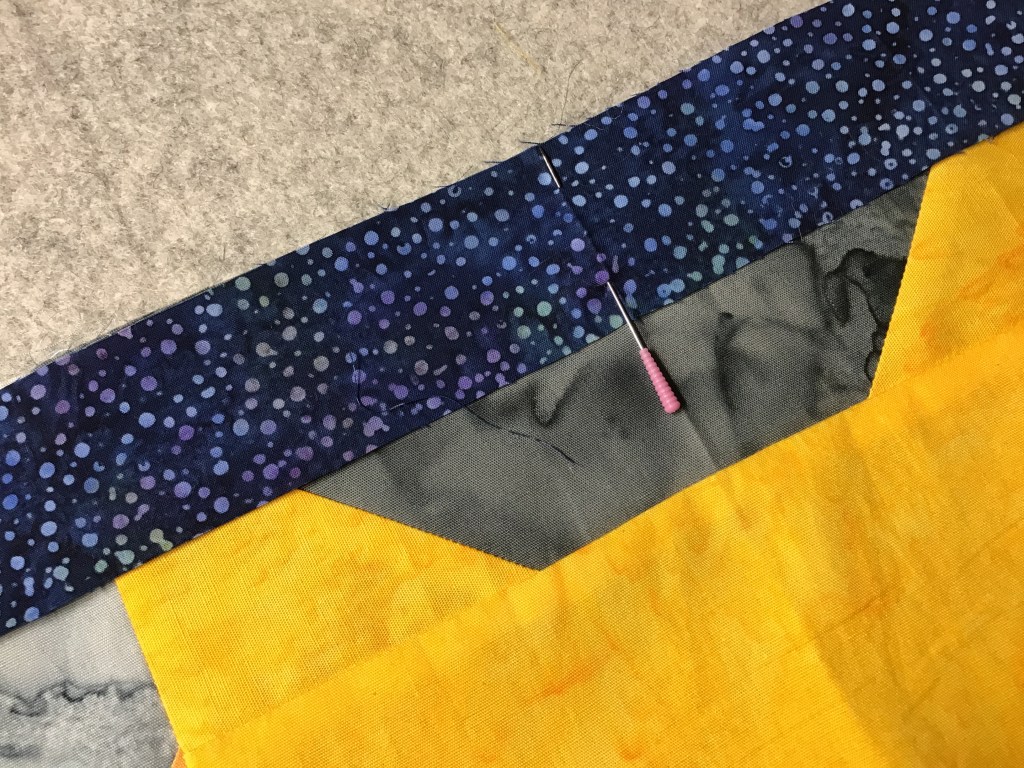
I like to make a crease in the center of my pieced strip and the sashing strip because it helps keeps things aligned. Then I match up the center creases and put in a pin. Next I pin the ends together and add a few pins in between the center pin and the end pins. This helps to distribute any fullness and make my pieces more plumb.

After pressing the seam towards the background sashing strip, I’m going make a center crease in the right side pieced strip. Then I’ll use those center creases again to line up the right side pieced vertical strip with the narrow background sashing strip. By lining up the center creases again, this will help to make sure both sides of the pieced strips are across from each other and not skewed.

In the photo below you can see how well my blocks are lining up by matching the center creases.

WOW! It’s coming together and starting to look like the cover quilt. Yippee!

Now let’s add wide background sashing strips to the left and the right of my quilt section. Again, crease and line up the centers.

Whew! First section of the quilt is done, now let’s repeat for the right half of the quilt.

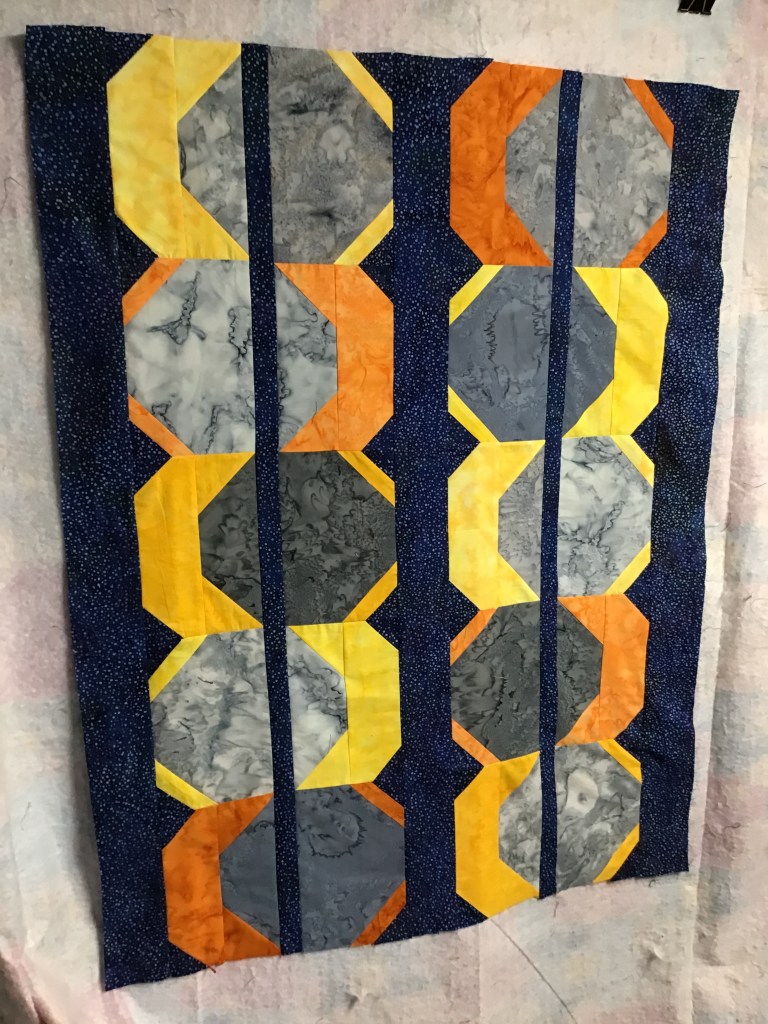
Almost there……….now I’m going to sew the right section to the center wide background sashing, creasing those centers and matching them up so everything fits together nicely.

VOILA! Here is my wall quilt sized Eclipses quilt top. I wonder if I can get it finished by Monday the 8th?

I really like how it turned out! What do you think?

Well, that’s it for me this week. I hope you get to see the eclipse on Monday, April 8th. Here’s hoping the skies won’t be cloudy so we can all breathlessly witness time standing still for a moment.

Until next week —

Always,

Tricia @VRD

Quilting Partners · Rose Cards · Tips and Tricks · Tutorials · villa rosa designs

VRD Pacific Grove Quilt Tutorial and Getting Ready for Our Villa Rosa Blog Hop

Happy Thursday to you!

Mother Nature sure has been trying hard to confuse us up here in NW Pennsylvania! We’ve had temps in the 60’s! Can you believe it? I wouldn’t, except I’ve been reading the temp on the thermometer. Yesterday, I even had peepers (tree frogs) on my basement window in the rain. This is WAY too early for the little dears to be awake! I’m wondering what Mother Nature has in store for us in March and April. Who knows? Maybe we’ll have snow in June?!?

I’ve been on a quilting roll since my curated list of Spring VRD Rose Card patterns a couple weeks ago (you can find the post HERE if you missed it). So I wanted to do another tutorial this week. I reached into my magic project crate and pulled out Pacific Grove.

But first, let’s chat about the upcoming Blog Hop!

Well, it’s now officially 2 weeks until our VRD Fast & More Fun Blog Hop, which kicks off right here on March 14th. I hope you’re getting excited about it.

Prizes keep coming in — it’s like Christmas around here! Except it’s not for me at all, instead — it’s ALL FOR YOU.

So far we have 2 AWESOME Grand Prizes lined up. Nope, I’m not going to show them to you yet. You’ll have to wait until March 14th for our Blog Hop kickoff post. Everything will be explained at that time, I promise.

We now have 26 bloggers participating in the Hop. And who knows? Maybe more if anyone comes late to the party.

We’ve also got the most fantastic and generous Sponsors for the event — Hoffman, Moda, Jaftex, Timeless Treasures, Electric Quilt, Banyan Batiks, C&T Publishing, Hancock’s of Paducah, and Fox Chapel/Landauer.

So, are you excited yet???

Remember, the fun begins March 14th right here on the Villa Rosa blog. So make sure you stop by and hop along with us for the week.

Okay, now let’s get to the quilt tutorial!

I’ve been wanting a reason to make Pacific Grove for a while now. I’ve always thought the quilt on the cover of the pattern looked like a work of art. What do you think? Wouldn’t it look amazing framed and hung on a wall? On my wall???

Finally, today is the day to finally make my very own Pacific Grove work of art.

Get your own Pacific Grove physical pattern HERE or a digital pattern HERE.

I’m using some gorgeous fabrics from the Wildflowers Spectrum Digital Print collection by Hoffman. Did you know Hoffman did digital prints in addition to their amazing batiks?

Special thanks to Hoffman for providing the fabrics for this tutorial.

Before we get started, I do want to say that digital prints can be a little finicky so it’s important to start with a new sharp needle in your machine. If you use pins when you sew, make sure they’re sharp. Why? Because you don’t want to break any threads. Take a look at this photo. Do you see area inside the red circle? See the 2 broken threads? You don’t want this to happen to your quilt because it will probably be visible on the front, not just on the back. Lucky for me, this was in the seam allowance. Whew!

So, let’s get start by cutting the main print and the background fabric. I kind of don’t want to cut this lovely fabric up, but I know it will look fabulous in the Pacific Grove pattern.

Now that the pieces are cut and ready to sew, it’s time to assemble 2 side units. Easy piezy!

Next up is putting together the center of the quilt. I really like how this quilt is coming together into vertical rows. That makes it really simple to put together. And I’m not having to match up a bunch of seams. Yay!

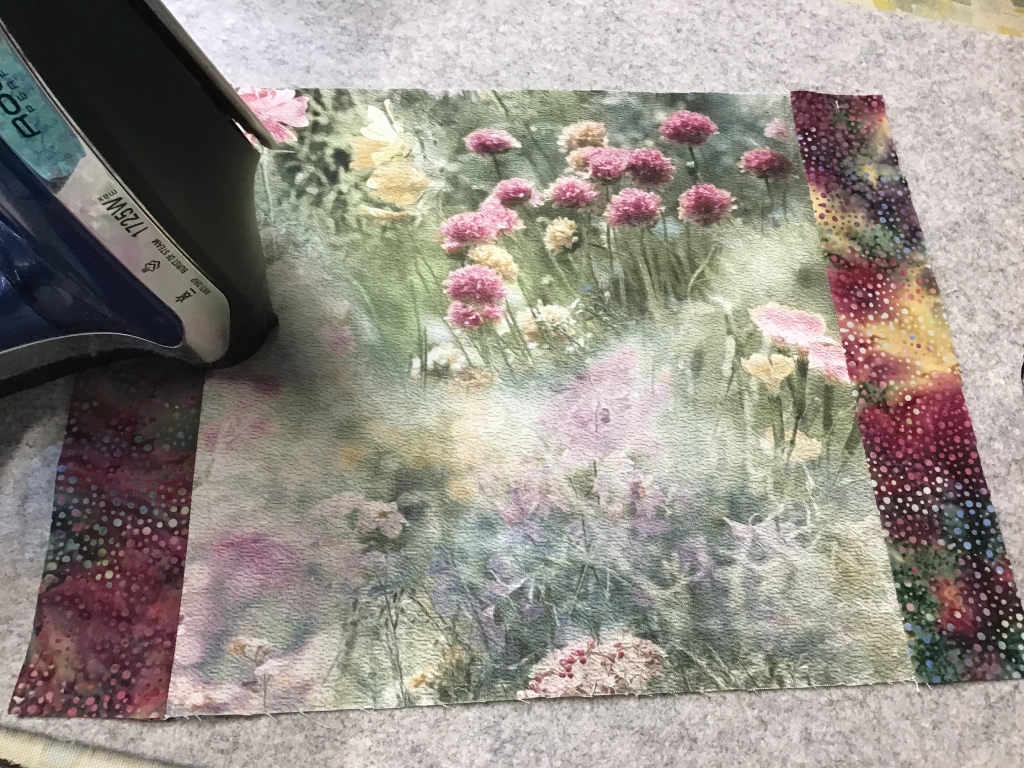
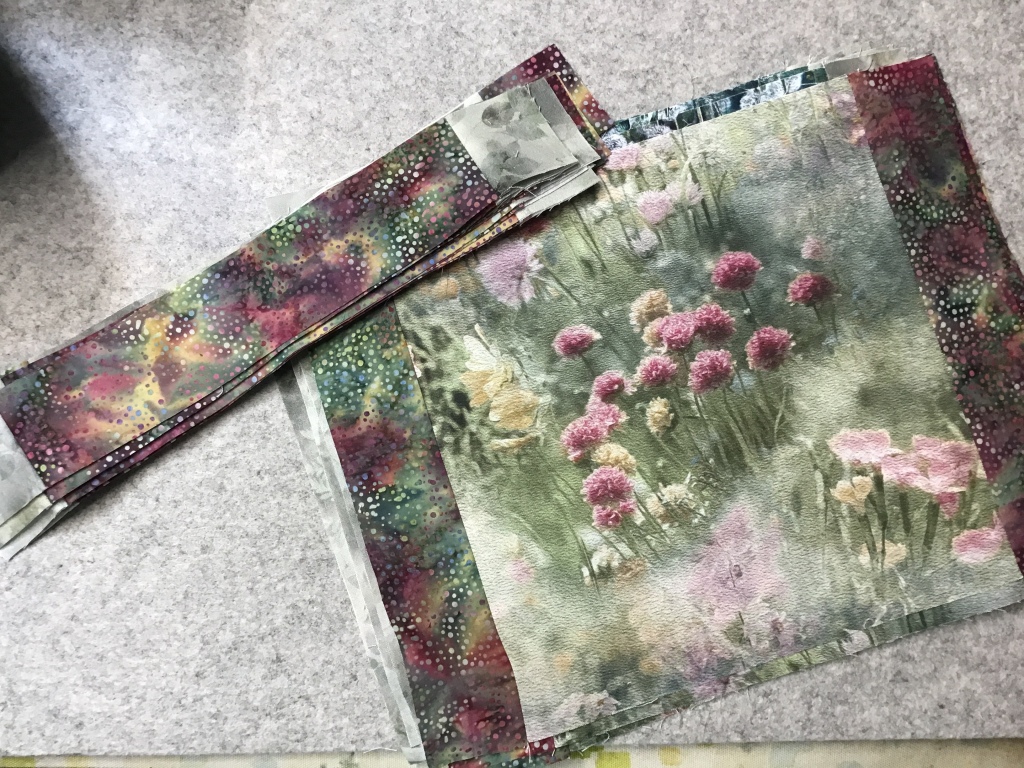
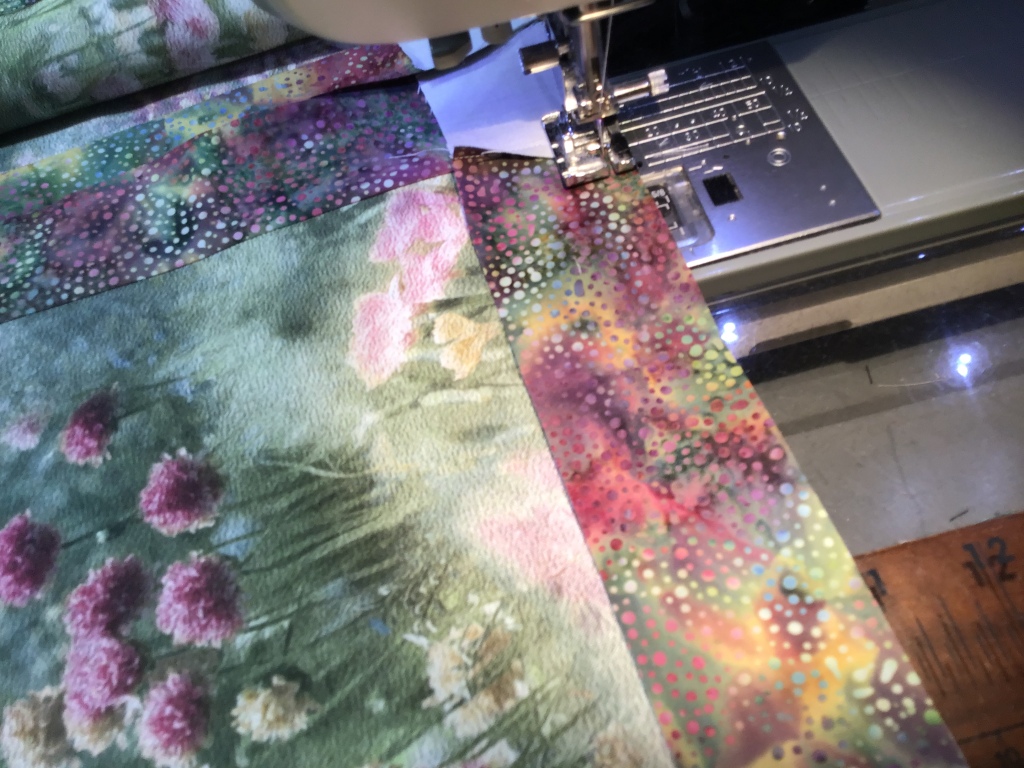
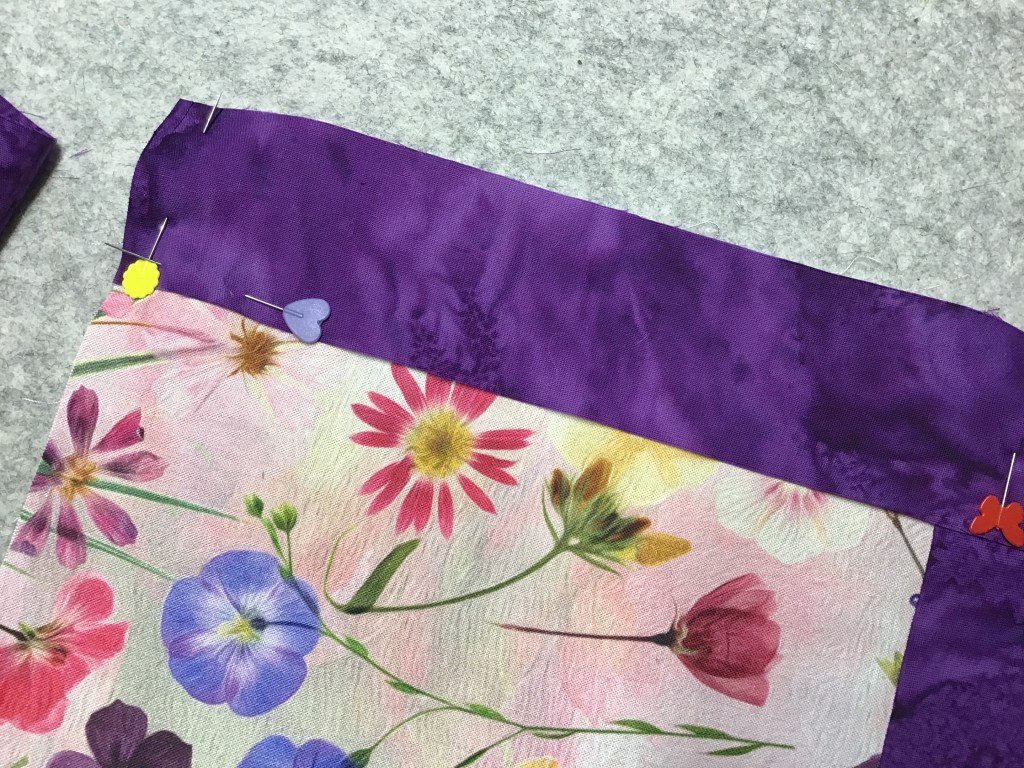
Now that the sides and the center are made, I’m going to work on the purple background strips. Here you can see in the first photo how I creased the center of the side strip and the center of the sashing strip. Then I matched those creased centers and put a pin right there. After I found the centers, I went to the outside edges and lined them up. You’ll see in the second photo that not only do I place a vertical pin, I also place an horizontal pin . That horizontal pin helps to keep my strips straight instead of bowing as I sew (I learned this little trick a long time ago from a quilter friend when I was a new quilter). After the center and the outsides are pinned, I always add a few more pins in between to keep everything from shifting when I sew.

Yay! Here you can see the design taking shape now that I’ve sewed the purple strips to the sides of the quilt center.

Next I’m gong to sew the side units to the center. Again, I will crease and match my centers. I think it’s looking really lovely with these digital prints.

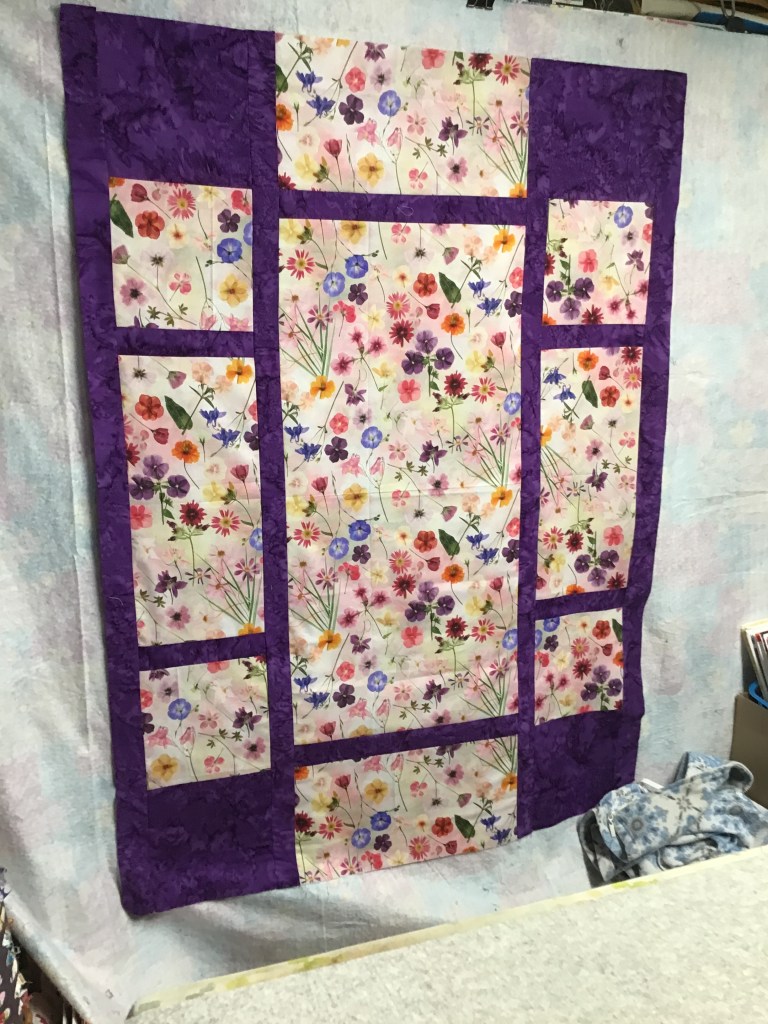
Time to add purple background strips to the sides. It has a bit of an Art Deco feel to it, doesn’t it? Or maybe a stained glass window?

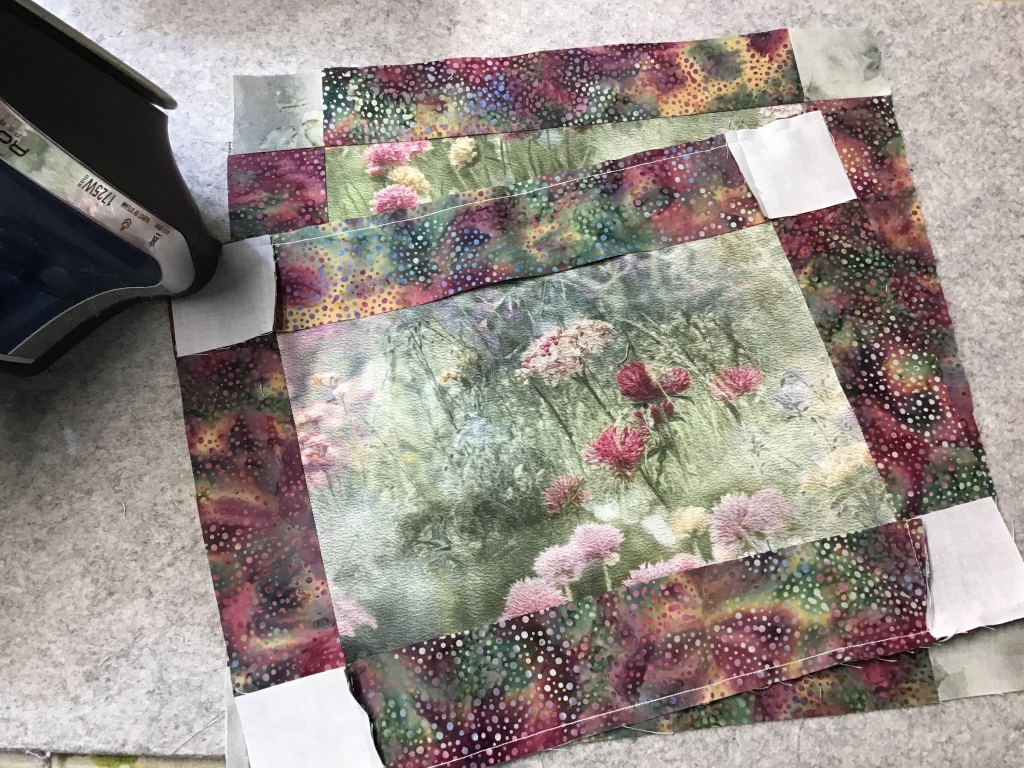
Time to sew background strips to the top and bottom of the quilt. Isn’t it looking amazing???

The borders are next up. What’s cool about this pattern is that you add the top and bottom borders on first before the side borders. When I did the purple strips, I added the sides first. But it does make sense to do it this way because it uses the fabric more efficiently — you don’t have to piece the top and bottom borders if you add them first. Ingenious!

Here is the finished quilt top. It looks like an Art Deco stained glass window garden to me!

With so much open space, I’m just itching to starting machine quilting it, but that will have to wait for a while, I’m afraid.

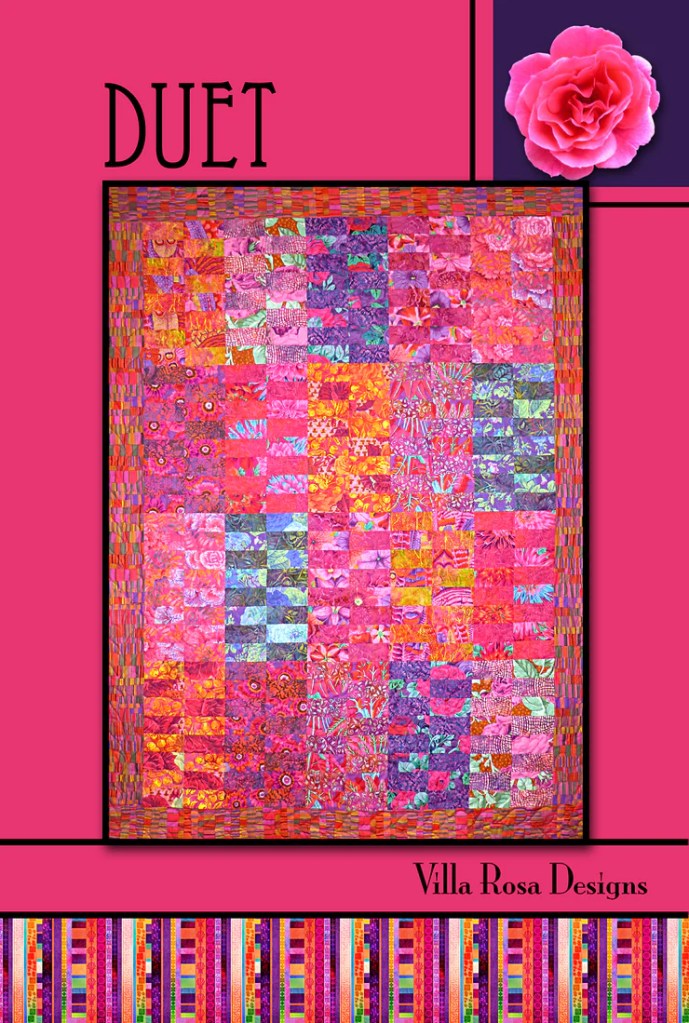
Last week I was debating whether to add a border or not to my Duet quilt top. Then I took a deep breath and just added that outer border. I chose a light batik because Duet felt a bit dark to me. The binding will frame it all nicely — it’s dark blue.

TWO WEEKS TO GO AND COUNTING DOWN……..until the Blog Hop. Get ready.

Take care and Happy Quilting.

Until next week —

Always,

Tricia @ VRD

Rose Cards · Tips and Tricks · Tutorials · villa rosa designs

VRD Duet Quilt Tutorial and a Little Blog Hop Teaser

Happy Thursday to you!

I hope you were as inspired as I was after seeing my curated Spring VRD Rose Card pattern list last week. If you missed the post, you can find it HERE. I was SEW inspired, that I used a new blog quilt tutorial as an excuse to make a pretty new quilt top. (Nah, you’re right — I didn’t really need an excuse. LOL!)

But, first, let’s talk a little bit about our upcoming VRD Blog Hop!

Oh my gosh! The Hop is only weeks away. I hope I’m ready in time. Of course, I’ll be ready on time.

I thought I’d tell you a little bit about some of prizes that are coming in for the Hop from our awesome event Sponsors.

Here’s a glimpse of the goodies that have arrived so far! I can’t wait to send them off to the winners. Maybe you’ll be a winner this year. All you have to do is visit all of the blog posts each day to register for prizes! Lucky you! Yippee!

I am also happy to share that our International friends will have a lot more variety this year for prizes as several of our Sponsors are able to ship directly to you. I’m getting really excited about the Hop. I hope that you are too. Don’t forget to tell a friend…..or two about it (or everyone you know!) so they can Hop right along with you.

Be right here on March 14th for the kickoff to our week-long Blog Hop in celebration of Villa Rosa Designs and all of our bloggers and sponsors. Be here or be square (yeah, you knew I was going to say that.).

Okay, now let’s make a quilt!

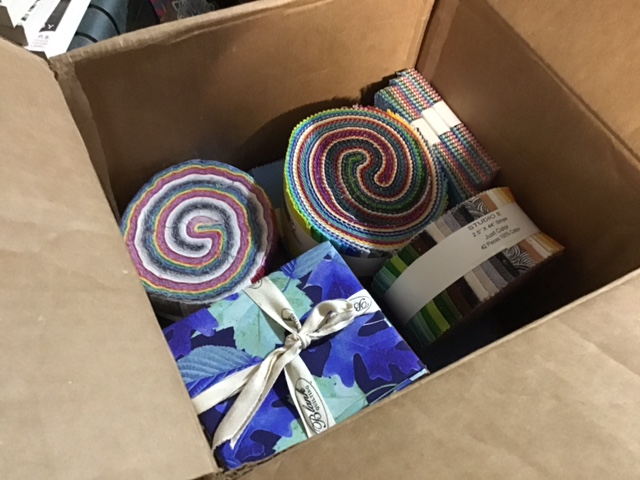
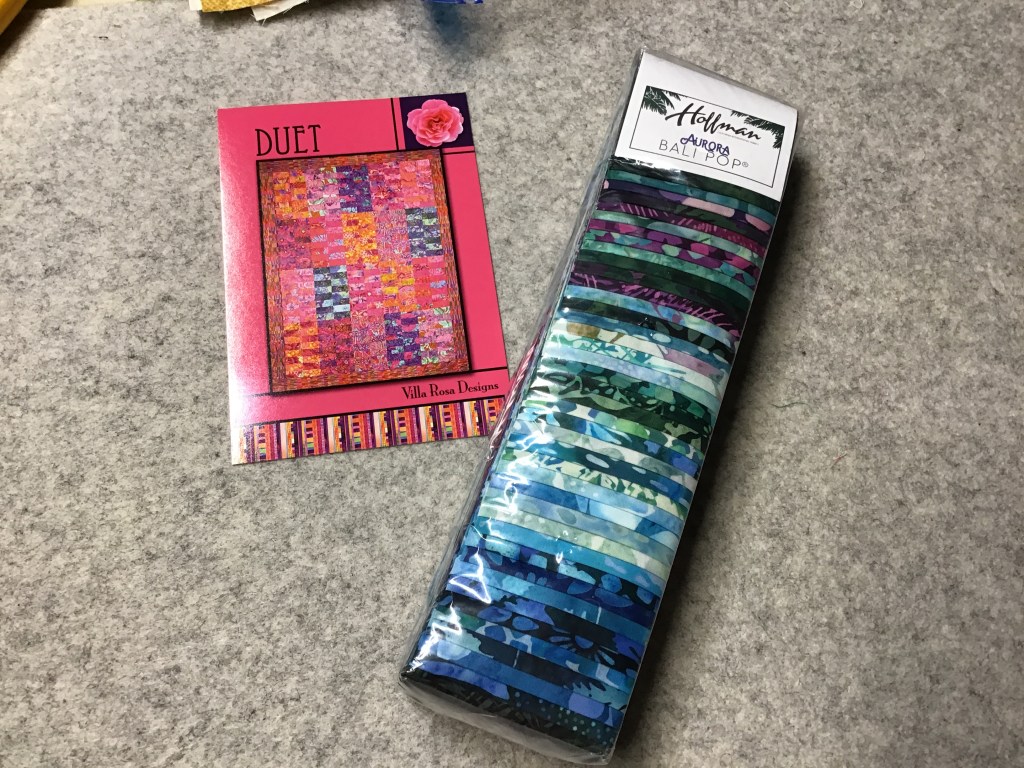
After last week’s post, I just kept telling myself I had to do a new quilt tutorial for the blog. So I dove into my big magic crate of project kits and pulled out a Bali Pop to make Duet.

You can get your own physical Duet pattern HERE or a digital pattern HERE.

I’m really loving this Aurora Bali Pop for Duet. Isn’t it just so yummy with blue, green, teal, purple and all the shades in between. Special thanks to Hoffman for providing the fabric for this project.

Sadly, we don’t have the Aurora Bali Pop in stock at the VRD online shop, but we do have other great options you can use to make this quilt. You can check out our 2 1/2″ strip sets HERE.

Let’s get started!

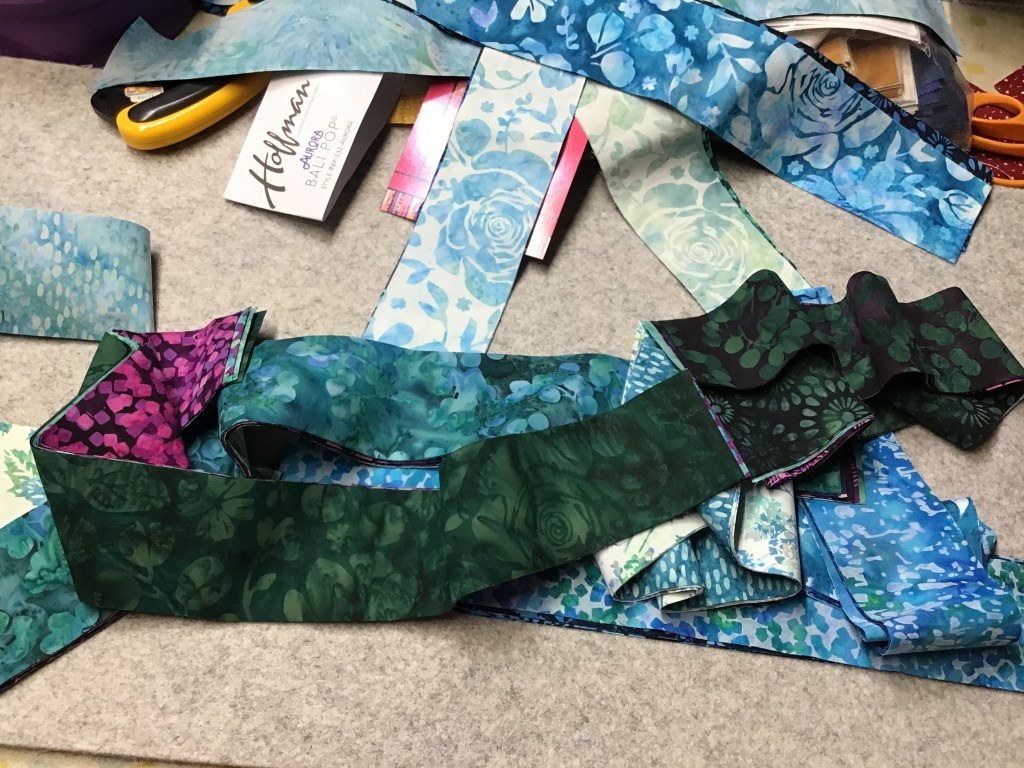
The first thing I did was pair up my strips. You’d think it would be easy to do this — pair a dark with a light — but most strip sets do not have an equal number of each. So that meant I had to use the mediums as either a light paired with a dark or as a dark paired with a light. Here you can see my tangle of strips as I pair them up. And you can see my unique way of keeping my pairs together by stacking them at different angles. Sometimes I don’t know where my ideas come from. And I don’t really care as long as they work.

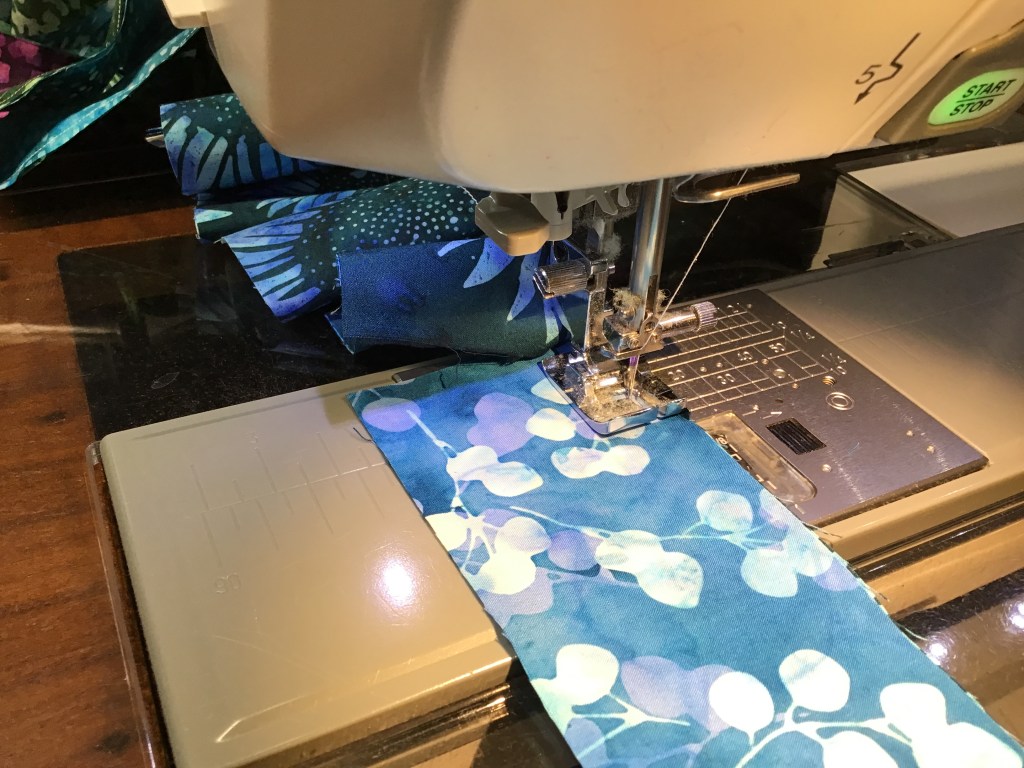
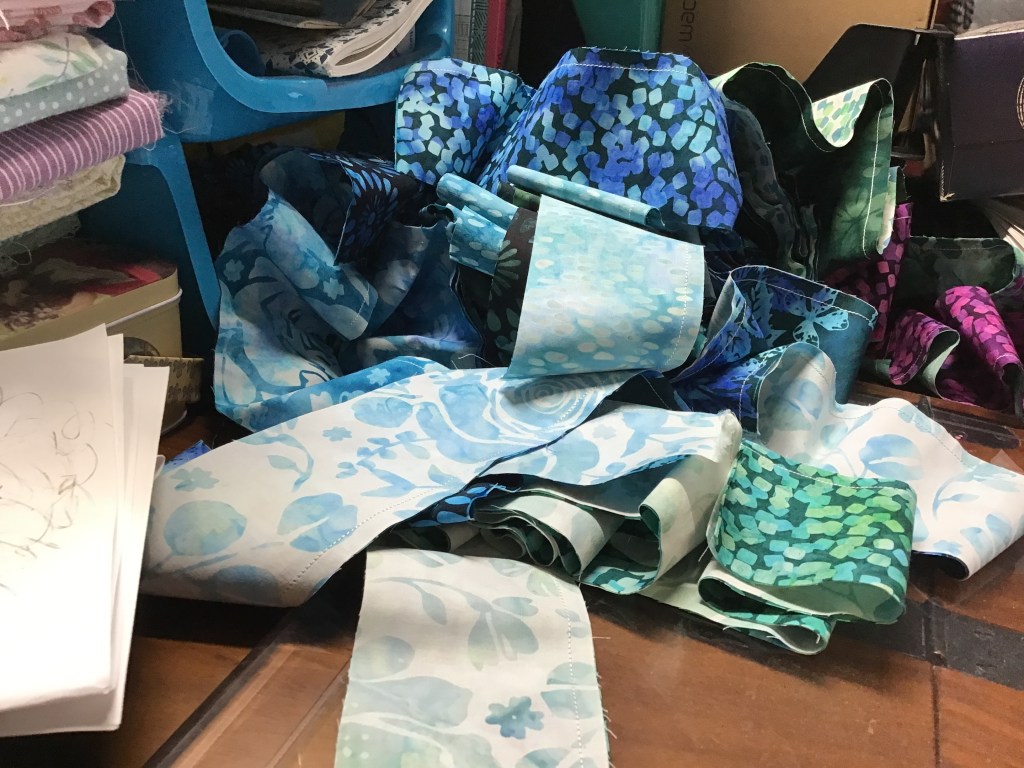
Happily, this strange stack did actually work and I took it to my sewing machine to sew my paired strips together. At the machine, right before I stitched each pair, I cut the strips in half. Or you could cut them in half after you sew them together. I chose to do it first because I really don’t enjoy sewing long strips together. Then I sewed and sewed using the assembly line approach until I had all the pairs sewn together. Check out my tangle of sewn strips in the second photo. Yikes!

Now that my strip pairs are all sewn together, it’s time to sew the 2 matching strip sets into a quartet. No, they really weren’t tied up in knots. I just started at one end and kept working my way through the assembly line, sewing one quartet together after another. Surprisingly, it was a pretty speedy process.

Woohoo! All those quartets are sewn and now I’m going to press the seams on each strip set going in the same direction. This will actually save me some time in a couple of steps.

I really love sewing with batiks. Now.

HOnestly, I’ve come late to the batik party, but I’m here now and that’s what counts. For a long time, my friends Mary Lee and Leslie, were always ooh-ing and awe-ing over the latest batiks while I was always like — okay, pretty fabric.

I’ve learned since then that batiks truly are a joy to sew with. They are smooth and supple, even crisp. And the colors — oh my goodness!

I have found that I do need a brand new needle when I’m sewing a batik project (yes, I know I should start every project with a brand new needle……). Batiks have a much tighter weave and a higher thread count than regular cottons. I have found that a used needle pokes holes in the fabric and may even break threads whereas a sharp needle kind of glides between the fibers. Food for thought……..

Let’s press!

Now all of my quartets are pressed, it’s time to cut the units. Do you stack your pieced strip units for cutting? I do, and here’s a technique I learned a long time ago — stagger the strips when you layer then so that seams are not sitting on top of each other. Cutting is a lot easier and more accurate when you are not trying to cut through a big lump of seams.

I stacked 4 quartets on top of each other when I cut the units. Then I just picked up the units from each quartet and stacked them together. It was kind of like dealing playing cards, in a way. Then I stacked up the units, keeping each quartet together. Easy piezy! Now back to the machine for more sewing!

Next I’m going to take 2 matching units and sew them end to end, making sure that the alternating fabrics are consistent. Then I will sew the second set of units exactly the same way as the first one.

Because I pressed all my seams in each quartet the same direction, sewing the units together is really easy as the seams matched up and nestled together (awwww! They’re so sweet!) when I layered them right sides together.

Quick! Sew, sew, sew!

Yay! Time to finish the blocks! I am going to sew the 2 units from the same quartet together side by side, flipping a unit so the 2 fabrics alternate completely throughout the block. 19 more to go….

Blocks all done! I’m going to press them one more time and then it’s time to do the block shuffle on my flannel board.

Okay, here’s my final block arrangement. The purples and the lights were a challenge to find a way to lay them out so everyone was happy. What do you think?

Back to the sewing machine to sew the blocks into rows and the rows together to make the quilt top.

I’m very pleased with how Duet turned out. I’m considering about adding a border to make it larger. Hmm, methinks I need to think about this a while longer….

Like a lot of our VRD patterns, Duet worked up quickly and I would say it’s probably a one day project to make the quilt top. It’s great to have some one day projects tucked away in your back pocket to pull out when you need a quilt in a hurry. I hope Duet will be one of them for you.

Well, that’s it for me today. One marathon quilt in a day is enough for me for now.

See you next Thursday, same time, same place.

Until then —

Always,

Tricia @ VRD

Quilting Partners · Rose Cards · Tips and Tricks · Tutorials · villa rosa designs

VRD Corners Quilt Tutorial

Happy Thursday to you!

I hope you are all staying warm and cozy, holed up in your sewing room making beautiful quilts! I am happy to say that I’ve been able to get some quilting in since the beginning of the year and thought I’d share a fun tutorial for a terrific small quilt, perfect as a baby quilt.

But before I get started with the actual tutorial, let me share a little bit about one of my favorite things about my job in the quilt industry. I actually wear many hats (don’t we all?) and one of the coolest ones is making sample quilts for fabric companies. Recently I whipped up this adorable Corners quilt featuring the Love and Learning collection by Hoffman. It’s a really sweet collection featuring a charming alphabet panel in your choice of light or dark background. I saw that darling collection and immediately thought it would look great in Molly Cook’s Corners Rose Card pattern.

Here is what the quilt looked like as a digital image before I actually made it:

Don’t you just love it? Yes, it has a little bit of pink in it, but don’t you think it would work for a boy or a girl? I do!

Anyway, I made a sample of this quilt for Hoffman and as I made it, I photographed the steps so I could create a new tutorial for the blog just for you, our loyal readers.

Do you have Molly’s Corners pattern yet? If not, you can get it as a physical pattern HERE or as a digital pattern HERE.

Let’s get started on our first quilt tutorial for 2024! Yay!

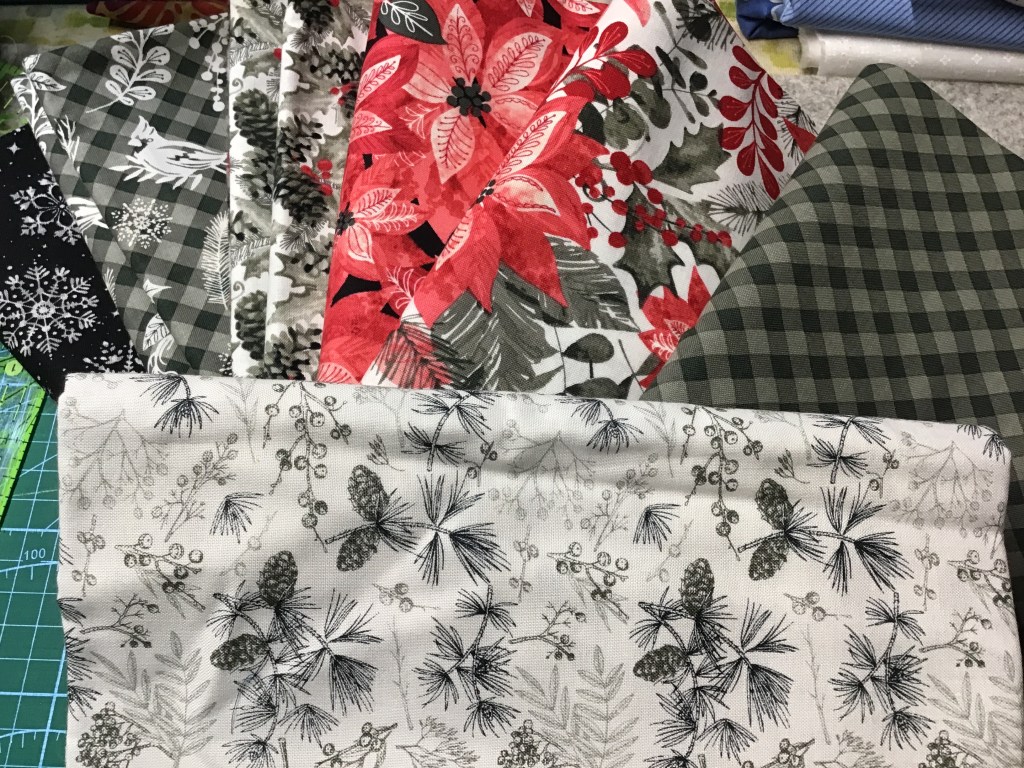
So the first thing you need to do is gather up your fabrics and your pattern. The first image shows the alphabet panel, the second image is the background and coordinates, and the last photo shows the binding, backing, and accent fabrics. Oh what fun!

After you’ve got your supplies together, then it’s time to cut each alphabet letter out of the panel one at a time. I don’t know if you can see in the first photo above, but each letter includes an item that begins with the specific letter as well as the item’s name. 

Time to cut! I used a square ruler the size of the square called for in the pattern (or at least I thought I was). That way all I had to do was center each design and cut around all four sides of the ruler. Unfortunately the letters in the last row of the panel were wider than the rest and I ended up having to cut some of the designs a bit, but made sure the letter was not cut off.

OOPS! Then I realized my ruler wasn’t the right size. Luckily it was a bit bigger, so I could trim those squares down to the correct size.

Whew! Done with trimming down 26 squares. That took me a little while. Make sure you cut your squares to the correct size the first time!

Moving on……….

Next it’s time cut a bunch of strips and sew them together before we cut the units for the half frames. Sewing long strips together is not one of my personal favorite things to do. What’s your least favorite part of quilting?

Okay, the strips are sewn into pairs with a background strip sewn to a colored strip. Next let’s cut all of the units out of the strip sets. To create the corner unit for the block, you will have to sew a rectangle to the squares as in the second photo.

All right, now the hard part — to achieve the same layout as Molly’s sample quilt on the front of the pattern (see above), we will be making 4 versions of the same block.

For most of you, this won’t seem like a big deal, but there will be a few quilters who have trouble getting the right block orientation. Well, I am included in this group, definitely. Blame it on being a lefty for me. 

I strongly urge you to use some kind of flannel board. Make one block at a time and place them in their proper order on your flannel board so you can more easily see the orientation of each block as you sew them together. 

I did try sewing a group of blocks together using my usual speed sewing method, but that ended up being a disaster. I had to do a lot of ripping out and rearranging the pieces of my blocks. So, after that, I made one block at a time.

Once I had all my blocks up on my flannel board and double checked their orientation, I started sewing the blocks into rows and then sewed the rows together into the quilt center. I was holding my breath the whole time………

Once I knew I had conquered the center, it was time to add borders. I added the side borders first and then sewed the top and bottom borders on last.

Woohoo! The top is done! Time to layer, machine quilt, do binding, and add a label. Oh! My last thing to do will be shipping the quilt to where it needs to go. It will come back eventually…………

Have you made the Corners quilt before? Do you have any tips to share?

Before I go, I wanted to give a little update on my decluttering project. I started with my cutting table first. Lately it’s been more of a storage surface than a cutting surface. 

Holy moly! I found several groupings of fabrics paired with patterns as well as yardage and stacks of fat quarters. Some loose patterns, too. Ugh! Now I have to put the fabrics away and figure out where to house the projects. Decisions, decisions! This is why I avoid decluttering — I have way too much stuff and not enough space. 

I need to start pulling stuff out I don’t love anymore and finding it all new homes. Time to start purging my stash or I will never ever find an organization system that works for me because you can only stack so many plastic crates. Well, I’m going to keep plugging away, so stop in next week to see what else I’ve accomplished.

Always,

Tricia @ VRD
Guest Bloggers · Rose Cards · Tutorials · villa rosa designs

VRD Lickety Split Quilt Tutorial

Happy Thursday to you!

PSST!

Hey, it’s me, Molly!

I’m stealing the blog from Tricia this week!

I’m here to talk about one of my own favorite patterns, Lickety Split. I designed this fun and fast pattern using only 10 fat quarters and a background fabric. When I was sewing it up the first time, it went together really quick — hence the name “Lickety Split”.

You can find the Lickety Split pattern HERE.

There’s also a digital download pattern, too. You can find the digital pattern it HERE.

Today I’m using fabric from the Morning Light collection by Northcott, which features digital prints. They do a good job with their digital prints and the colors are just so beautiful. These are definitely my colors — Northcott must have been thinking about me when they designed them. LOL!

Guess what??? We created Lickety Split kits just like my fabrics, above. You can find them HERE.

Or maybe you just want to grab some of your own Morning Light Fabrics? You can find the collection HERE at the VRD shop. Be warned — they’re going fast and when they’re gone, they’re gone. So get ’em while they’re hot!

Let’s get started!

So first things first (well, after you find your fabrics, of course), you need to cut out your rectangles. Grab your fat quarters, and cut them into strips. Then subcut the strips into rectangles. You’ll have a narrow strip leftover — you can use it in another project.

Next it’s time to cut your background pieces. I cut my big pieces first. Then I used the leftover background pieces to cut the smaller/narrower pieces.

Molly’s Tip: Go ahead and pair up your rectangles so the same 2 fabrics are sewn together in each block like I did.

Or scrap it up and be totally random! You do you!

Here, you can see how I stacked up my fat quarter rectangles with the background strips. Now I’m ready to take all my block pieces to my sewing machine. No need to get up and down to get fabrics, because they will all be right next to my machine.

Yay! Time for the fun part — sewing the blocks together! Make sure you sew the pieces all the same for each block or else you will have blocks going in all kinds of directions. Silly blocks!

Look! Here’s a block AND it went together Lickety Split!

Lay out your blocks, turning every other block sideways. The 1st, 3rd, and 5th rows will be the same layout while the 2nd, 4th, and 6th rows will be the same layout.

Sew your rows together and — TA DA — your Lickety Split top is done. Now it’s time to layer, quilt, and bind. And don’t forget your label!

Check out these other color combinations of Lickety Split. Which one is your favorite?

Don’t forget to post your Lickety Split quilt pictures on our Facebook page. I can’t wait to see them!

That’s it from me.

Until next time —

Later,

Molly

Quilting Partners · Rose Cards · Tips and Tricks · Tutorials · villa rosa designs

VRD Beatrice Quilt Tutorial and the Fall 2023 Hoffman Project Catalog

Happy Thursday to you!

I hope you are all getting some sewing and quilting tucked in around your busy fall schedule. I don’t know about you, but if I don’t get regular access to my sewing machine, I get — well, grumpy. I am not kidding. I have found over the years that if I don’t get time to devote to my creative endeavors, I become out of sorts — you can ask my family. LOL! So when I get short-tempered, the best cure is sewing and quilting, even if it’s only a half hour here or twenty minutes there, I absolutely have to have time to be creative.

So I must say that using the excuse of creating a series of fall quilt tutorials with all these glorious Hoffman batik fabric collections, I am feeding my creative soul AND at the same time, I have rekindled my interest in getting back into quilting after basically taking the summer off. Of course, the next part of my making a quilt top or two a week, is to actually get them layered, quilted, bound, labeled — FINISHED. I have started this process by going to my local quilt shop, Homespun Treasures, to pin three of the recent quilts, and now they are ready for machine quilting. I use the tables in the classroom to layer my quilts and maybe I check out the new fabrics while I’m there….

But first, I have another Villa Rosa Designs Rose Card quilt tutorial, Beatrice, for you!

Ever since Beatrice came out earlier this year, I’ve been eager to make it. I love that it pairs two classic blocks — a Rail Fence and a Friendship Star (which is really a Nine Patch block in disguise) — together. You can check out our Rail Fence post and Nine Patch post, which are part of our Quilt Block Basics series, for more block fun and inspiration.

I also love how the Friendship Star blocks are arranged in diagonal rows cascading through woven Rail Fence blocks in a less-than-typical arrangement. Beatrice finishes at a generous 54″ x 72,” which is a very nice-sized throw quilt.

I hope you’ll give this one a try!

Get Beatrice HERE

Let’s take a look at the gorgeous Hoffman Bali Batik collection, Homestead, I am using for my Beatrice quilt. Ask for it at your favorite quilt shop or online retailer!

Isn’t this collection delicious? I added an 1895 Watercolor batik as my star fabric — can you find it?? (Hint: it’s the lightest fabric….)

Ready? Set. Go! Let’s get started on Beatrice!

1. We’re going to cut all of our fabrics before we start to sew. Do you do that or do you cut your pieces out as you sew? Or do you make a sample block before you cut everything out? For my VRD quilts, I feel totally comfortable just jumping in — no need to make a sample block to make sure everything fits together properly because I know that everything will fit together perfectly. Just another thing I love about our Rose Card patterns.

2. Now let’s sew some Friendship Star blocks! The first thing we need to do is make some Half Square Triangles (HSTs) for the star points. When I first started quilting, I did not enjoy making HSTs, but the more I made them (so many quilt patterns use HSTs!), the more I found I actually liked them. Of course, the more I made them, the more accurate my HSTs became, too.

Layer your squares right sides together (RST). Draw a diagonal line from corner to corner. Sew 1/4″ away from both sides of your drawn line. Cut on the drawn line to make 2 HSTs. Press the blocks open. And don’t forget to trim off your little dog ears at the corners (this will help the accuracy of your piecing — trust me).

3. Next we’re going to lay out a Friendship Star block, which is a Nine Patch block with HSTs. That way, we know how the block should look. With Friendship Star blocks, it’s easy to turn the HSTs the wrong way, which makes for some wonky stars. I actually kept this block layout up on my flannel wall so I could use it as my reference as I sewed the blocks together.

4. Time to sew the blocks together. I am happy to say, I only stitched one block wrong, which of course meant that I had to unsew it and then sew it back together the right way. Mea culpa. Press your blocks. Stars done — yay!

5. Moving right along — let’s make some Rail Fence blocks. Now, the pattern walks you through sewing strip sets together and then sub-cutting the strip sets into the units for the Rail Fence blocks.

I prefer cutting my fabrics before sewing them together. I used to do the strip set method, but I always had a problem keeping my strips straight — mine would bow like a rainbow. This, of course, affected the accuracy of my piecing. This frustration is what led me to determining what the (unfinished) length of the unit would be and then cutting all my pieces before sewing the units. The easiest way to figure out the length is to look at the size of the unit you’re cutting out of the strip sets — usually that measurement is what you need.

Here are my rectangles ready to sew together into Rail Fence blocks.

6. Time to sew the Rail Fence blocks together. First, I sew the rectangles into pairs, then I sew the pairs into quads. Another thing I like better about sewing the rectangles together versus strip piecing is that I get a lot more variety in my blocks. After all the blocks are pieced, go ahead and press them. Rail Fence blocks done. Yippee!

7. All the blocks are finished!

8. Boy, am I glad that I have my handy dandy flannel backed table cloth already clipped up on my fabric storage cubes because the next step is to lay out the blocks according to the diagram on the pattern. Whoever discovered that fabric sticks to flannel was a genius! Thank you, thank you!

This quilt is big and I can’t get the entire thing arranged on my flannel wall so I will have to divide the quilt into sections and then sew the sections together. While the blocks are up in the first larger section, I moved a few things around so that the fabrics are well-distributed throughout and not concentrated in any one area.

I will say that these fabrics from the Homestead collection definitely make a gorgeous quilt! It just looks so warm and inviting, like a cup of hot apple cider. Where’s my doughnut??? Boston creme, if you please….

9. I sewed the blocks into rows and then I sewed the rows together into the top section of the quilt.

10. I folded the top section in half and moved it to the top of my flannel wall to make room at the bottom the last rows. That way, I will still be able to move blocks around in the bottom rows if needed. Next I sewed the blocks into rows and the rows into the bottom section. Finally I sewed the bottom section to the top section.

11. Here is my Beatrice quilt top, or flimsy. Yay! I am very happy with how it turned out. It is simply beautiful!

While I was sewing Beatrice together, I kept wondering how it would look in patriotic colors (the quilt diagram on the back of the pattern is done in red, white, and blue). But for this quilt to be large enough to be a Quilts of Valor quilt, you would have to add a border or another column of blocks because it’s not quite wide enough.

Adding a 4″ finished border all the way around would make the quilt 62″ x 80″ which is a wonderful size for a QOF quilt as well as a twin-sized quilt. You would need about 1 1/4 yards fabric for the border (cut strips 4 1/2″ wide) and a total of 5/8 yard for the binding for this larger size.

Who knows, maybe Beatrice will be my next QOF quilt project to make and donate. You’ll have to check back later to see if it is. LOL!

I look forward to seeing your Beatrice quilts! You can post them on our VRD Facebook page. Hope to see you there!

Speaking of Hoffman Fabrics, the new Fall 2024 catalogs have just come out. Check out the Project Book, filled with loads of inspiration and Villa Rosa Design Rose Card patterns featuring the latest Hoffman collections. Truly, a feast for the eyes. Ask at your favorite quilt shop or online retailer for the patterns, fabrics, or maybe even kits. ENJOY!

What quilt will you make first?

Until next Thursday —

Always,

Tricia @ VRD

Quilting Partners · Rose Cards · Tutorials · villa rosa designs

NEW Villa Rosa Designs Rose Card Patterns for September, New Website Content, and VRD Ebb Tide Quilt Tutorial
Happy Thursday to you!

Welcome to September! Now that fall and back-to-school is in full swing, we all need to turn our thoughts to MORE QUILTING! In order to help you get sewing again, today’s post is brimming over with quilty goodness.

First up is our brand new collection of September Rose Card patterns.

YAY! By now most of you know that I just love the Thursday after the first Friday of the month because that’s New Pattern Day here on the blog. So, here they are — Candies, Icing, Elsie May, Delphinium, and Jolie.

Every month the VRD designers never fail to create a new collection of wonderful quilt patterns. I am sew blessed to be part of this VRD family. Just looking at the new patterns every month, I get inspired and can’t wait to spend some quality time with my sewing machine.

You can get all 5 patterns HERE.

But wait……..there’s more! Here is my new September table runner, Carousel.

Get Carousel HERE

I’m not sure if you can really see the background fountain in the cover photo, above, but I took this photo at Diamond Park, a lovely tree-lined park in the heart of my hometown. The land for the Park was gifted to the city in 1795 (Meadville was founded in 1788) by the city founder, David Mead. This gorgeous fountain was then gifted and constructed in the park in 1863 by the Shippen family. It still stands and functions today, after being renovated a couple times through the years.

Image from Meadville Calendar,
https://www.facebook.com/MeadvilleClub

Here’s a photo of the fountain with the park in the background. I didn’t even think to take any photos of the fountain itself when I was taking photos of Carousel. Silly me! Sorry for that. It truly is a beautiful fountain — and well over 150 years old.

As much as I’d like to keep talking history (another of my favorite things), we’d better keep moving or we’re never going to get to today’s tutorial. LOL!

Just this week, a new feature was added to the VRD website — a printable list of all the FAT QUARTER patterns in our VRD Rose Card catalog!
People and fabric companies have been asking for such a list for a while now. The fat quarter patterns on the list are thoughtfully organized by the number of fat quarters needed for each pattern — how ingenius! This awesome list will be updated monthly to include all new fat quarter patterns going forward, so the list will always be current and up-to-date. WOW!

You can find the printable list at the bottom of the website under Patterns (see the screenshot below). In fact, there is LOTS of stuff at the bottom of the website. If you’ve never scrolled down that far, you should. You might just be missing something good down there, like a directory of the tutorials on the blog, for example. Or maybe something important like Corrections.

Here’s a screenshot of the bottom of the VRD website, showing the things
you will find down there.

You can find the printable Fat Quarter Quilt List HERE.

Now on to our tutorial!

Keeping with our recent Fall fabric theme, I have another great VRD quilt tutorial for you today. You will want to add Ebb Tide to your collection of VRD Rose Cards if you don’t have it yet. So far, it’s the fastest and easiest VRD pattern I have made. It also looks great in any fabric, and can even handle large prints with ease. Ebb Tide will definitely become one of your go-to Rose Card patterns, if it hasn’t already.
Get Ebb Tide HERE

Today I’m working with Hoffman batiks again — more yummy luscious fall fabrics. Aren’t they beautiful??? This collection is appropriately called Shades of Autumn. Ask for it at your favorite quilt shop or retailer.

I want to point out a couple things about the fabrics I am using for Ebb Tide. It takes 6 fabrics plus a background. I chose 3 light fabrics and 3 dark fabrics. I liked the idea of a color-balanced quilt. Some other options might be to choose 6 medium or dark fabrics with a light background or 6 light fabrics with a medium or dark background. The fun thing about this quilt is that it really does go together lightening-fast and you’ll probably want to make more than, which will then give you more opportunities to play with different fabric options.

Let’s make Ebb Tide!

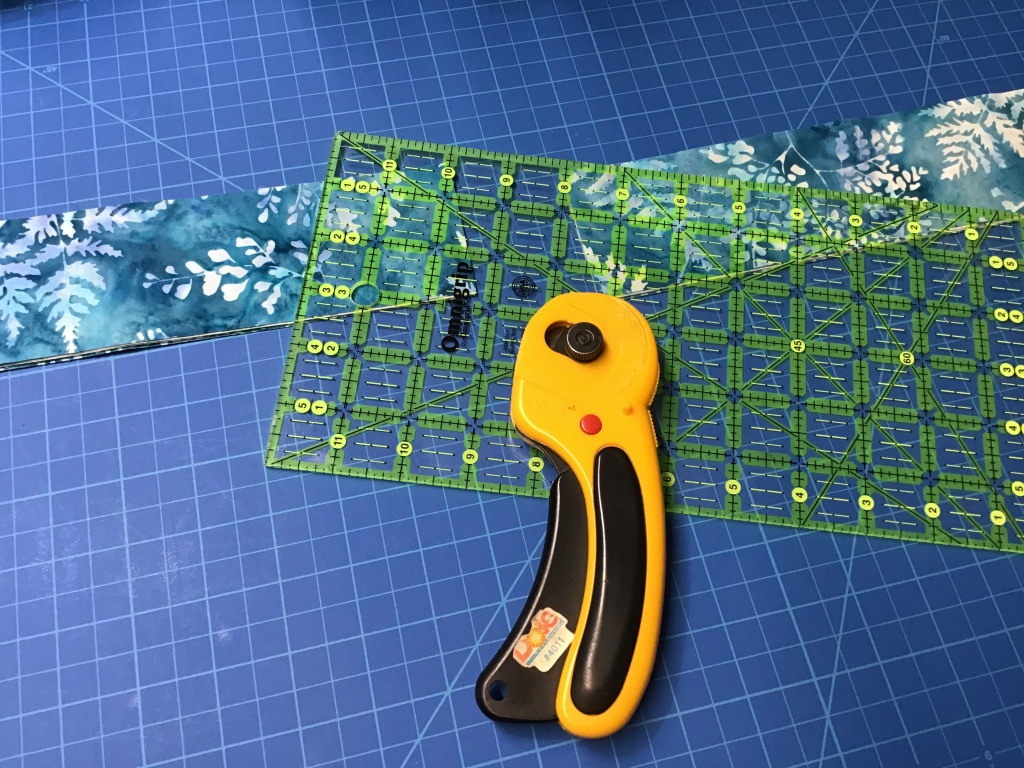
1. After you’ve gathered up your fabrics, it’s time to cut your pieces out. This doesn’t take very long, but keep in mind the pieces you cut out of the fat quarters will be large and you might need a bigger ruler. I used my 8 1/2″ x 24″ ruler to cut the rectangles out. This really helped to keep my cutting more accurate as I didn’t need to joggle multiple rulers around to get the wider strips. I also layered and cut three fabrics at a time, but don’t feel you have to layer your fabrics for cutting if you’re not comfortable doing that. Cutting one layer at time works just as well.

Don’t have an 8 1/2″ x 24″ ruler? You can find it HERE. You can find the my absolute favorite rotary cutter, the Olfa ergonomic cutter, HERE.

2. Now that my fat quarters are cut out, it’s time to cut the background pieces. For this part, I switched to a 2 1/2″ x 18″ ruler, which makes cutting my 2 1/2″ strips and rectangles a breeze. Don’t have a 2 1/2″ ruler? You can find it HERE.

3. I’m going to use my new handy-dandy design wall to lay the quilt out so I can arrange the fabrics before I sew everything together. The beauty of Ebb Tide is that because you aren’t piecing the quilt blocks, you can get right to laying out and arranging the entire quilt. Sew simple!

PSST! In case you didn’t know — my fancy-smancy design wall is actually a flannel-backed large rectangular table cloth clipped to the top of my fabric storage cubes doors with large binder clips. Here’s a great traditional plaid flannel backed table cloth that comes in multiple colors and sizes. What a HUGE improvement this has been for putting quilts together — so much easier than laying blocks out on the floor or on a bed to shuffle things around.

Here is my final layout for the Ebb Tide, not including the horizontal background strips in between each block row. What do you think of this layout? I really like how your eye travels down the quilt, following the light fabrics path, kind of like stepping stones.

4. Now that I’m happy with my layout, it’s time to sew the horizontal rows together. I just gathered one row at a time and took it right to my sewing machine (which is close to my flannel design wall). I sewed the large rectangles and the sashing strips together one row at a time, then I put the rows back on the flannel wall, so I didn’t get things mixed up as I worked.

5. Now I’m ready to sew the long sashing strips in between the pieced rows. One last look to make sure I have the rows in the right order, and back to the sewing machine. I sewed the rows and sashing strips into sections and then sewed the sections together, that way I didn’t have to struggle with the growing quilt top with each row I added.

6. One more step and Ebb Tide will be done (or at least the quilt top will be done). Did you know that a quilt top is called a flimsy in quilt lingo? Isn’t that fun??? Sorry, I’m easily distracted — did someone say squirrel??? Tehehehe……..

Now that the quilt center is finished, let’s sew the top and bottom borders on. But before we do that, I need to cut my border strips to the right size. I like to lay my border strips across the center of the quilt, trimming the strips to the width of the quilt center. I use the center because the edges can sometimes stretch out. By cutting my strips to the center width, I can bring those stretchy edges back to square. I know this sounds weird, but trust me, it works.

Next I pin my borders to the quilt top. I start by matching the center of the border to the center of the side I’m sewing the border to ( I fold them in half to find the centers, making a crease at the true center). Then I match and pin the outside edges. After the edges, I straighten and smooth the quilt and border, adding more pins between the center and outside edges to keep everything in place while I sew. Finally, it’s time to sew them together, knowing that my borders will be flat and not waving all over the place.

7. The side borders are the last thing to sew to the quilt. They will need to be pieced so the border strips are long enough. For this quilt, I used a straight seam to sew the strips together, but sometimes I use a diagonal seam (I do this when fabrics are busy in order to hide my seam a little better).

Yay! Ebb Tide is done. Eventually, I will back it with cozy fleece, machine quilt, bind, and label it. Hopefully sometime in the next 100 years. Ha!

By the way, I wanted to let you know that it took me about 2 hours to make the Ebb Tide flimsy — that included cutting the fabrics, laying it out, and doing the photography for this tutorial. I wonder how long will it take you to make it?

Here’s a “beauty” shot of my Ebb Tide flimsy — I really wanted to get a pretty picture with my Black-Eyed Susans. Sadly, the breeze wouldn’t cooperate with me, so the bottom of the flimsy kept blowing under the porch. Oh well…….

Thanks for sticking with me through the entire blog post, I know it was a long one, but I hope you enjoyed all of the quilty inspiration.

Take care and get quilting!

Until next week —

Always,

Tricia