Rose Cards · Tutorials · villa rosa designs

VRD Falling Quilt Tutorial

Happy Thursday to you!

Happy Fall!

A picturesque autumn scene featuring a cluster of bright orange pumpkins and a white pumpkin surrounded by hay bales and vibrant fall foliage.

Hard to believe it really is Fall now, but I know it’s here whether we’re ready or not. And I’m personally more than ready. We had such a hot and dry summer here in NW PA, so I’m eager for cooler weather.

Fall is definitely my very favorite season with its warm days and cool nights. All the gorgeous colors. The smells of the season. And the sounds. I truly love it all!

Another thing I love about Fall is that I start to feel more energized to get back to my many to-do lists. Summer definitely doesn’t inspire that in me. So now, it’s time to make plans to get things done. What is Fall to you?

I hope you’ve been enjoying our Jump into Fall quilt tutorials. Today’s project is beyond perfect for the season and I know you’re going to be excited to make this one.

Falling is truly a perfect project for this time of year, especially with all of the yummy fall fabrics at your local quilt shop and favorite online retailers. Falling is a pattern by Catherine, of Running Doe Quilts, who is one of our many talented VRD designers as well as a new VRD partner.

The quilt finishes at a generous 54″ x 72″ and goes together quickly with its oversized blocks and no borders (although you could easily add a border to make it bed-sized if you wanted to).

A colorful quilt featuring large, stylized leaf patterns in various shades, displayed outdoors against a backdrop of trees.

Get your digital pattern HERE or your print pattern HERE

Catherine even has kits available for the Falling quilt below – get yours HERE before they’re gone. Tell her Tricia sent you!

Quilt designed with colorful leaf patterns in orange, yellow, red, and blue fabrics, displayed outdoors against a rustic background.

Okay, time to get going on today’s tutorial.

Of course, our first thing to do is gather up our fabrics. Today I’m using a lovely collection from Hoffman Fabrics called Sweet Breeze. It’s a great choice today as we end summer and slide into fall. Sadly, this is an older fabric collection and probably isn’t available anymore, but happily Jason Yenter has a gorgeous fall collection called Falling Leaves, you can find it HERE – I think his wonderful fabrics would make great Leaves.

Here are our Sweet Breeze fabrics for today’s tutorial in lovely greens, a few browns, with a wee touch of orange.

Assorted fabric pieces in green, brown, and cream colors, featuring leaf patterns and textures, arranged neatly with a 'Falling' quilt pattern brochure on top.

Let’s go ahead and cut out all the pieces we’ll need for Falling – the background, the Leaf fabrics, and the stems.

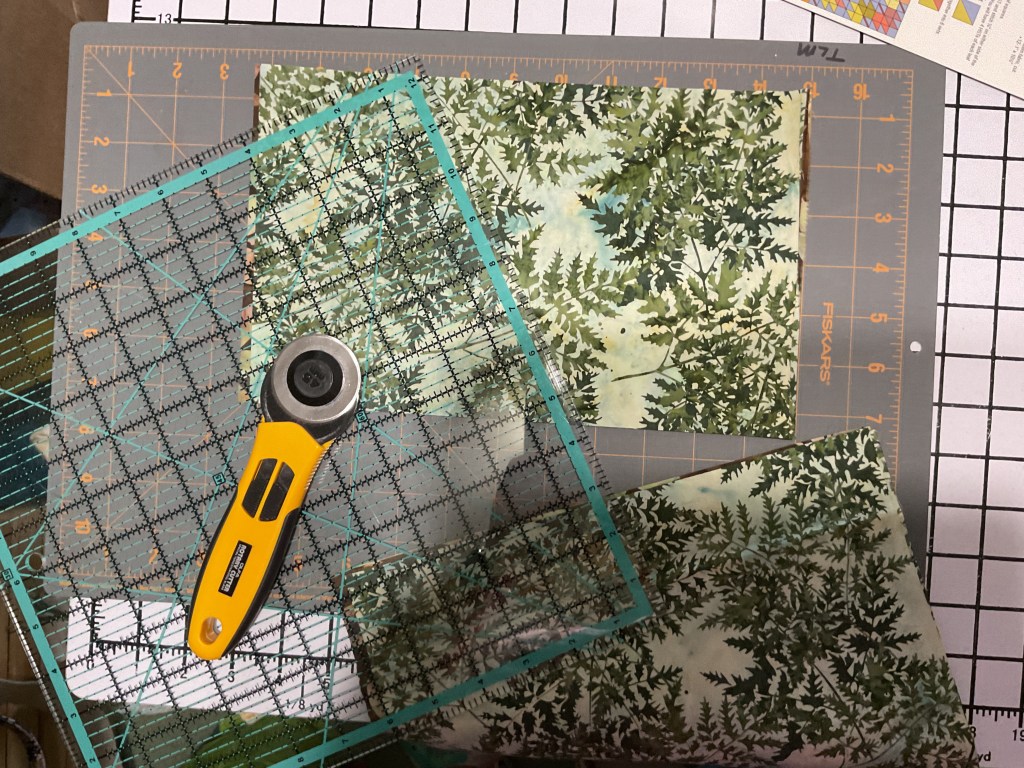
All right! All of our pieces are cut and ready to go.

A variety of fabric squares in green and beige tones on a cutting mat, with a brown strip of fabric positioned in the center.

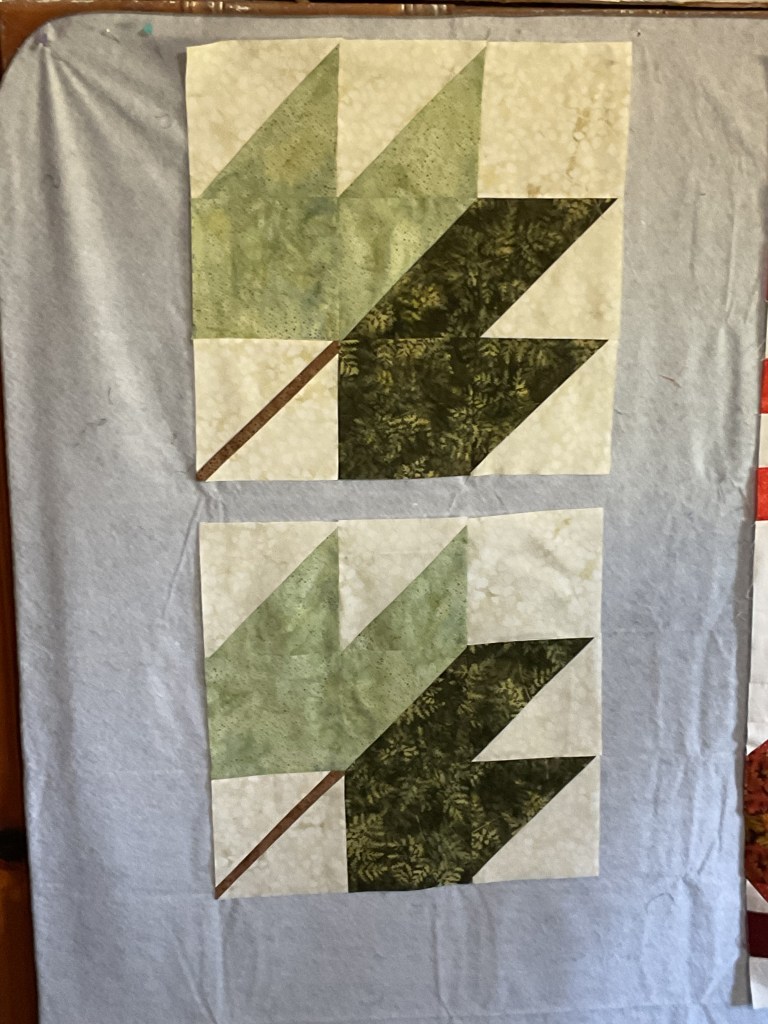
Next we need to pair up our Leaf fabrics as each of the 12 blocks in the quilt uses 2 fabrics. I really love Catherine’s take on the traditional Maple Leaf quilt block, don’t you? She split it down the center so her leaves are two-toned. And the blocks are very big, which adds to the graphic appeal of this quilt.

The pattern suggests making 2 of each Leaf fabric combination, but you can mix and match your fabrics to your heart’s desire if you want, of course. I’m going to stick to the original plan today.
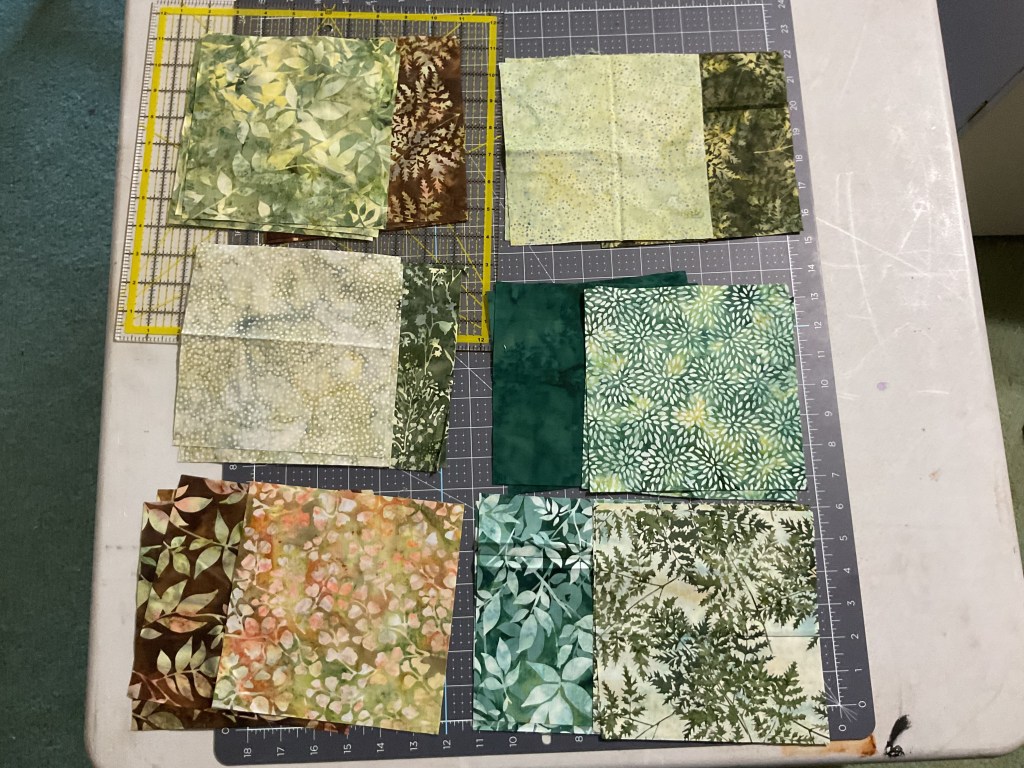
A variety of fabric squares in shades of green and brown, arranged on a cutting mat, ready for a quilting project.

Now we’re ready to sew. We haves lots of Half Square Triangle (HST) units to make for the quilt. I’m going to make 2 matching Leaf blocks before moving on. I don’t want to get all mixed up!

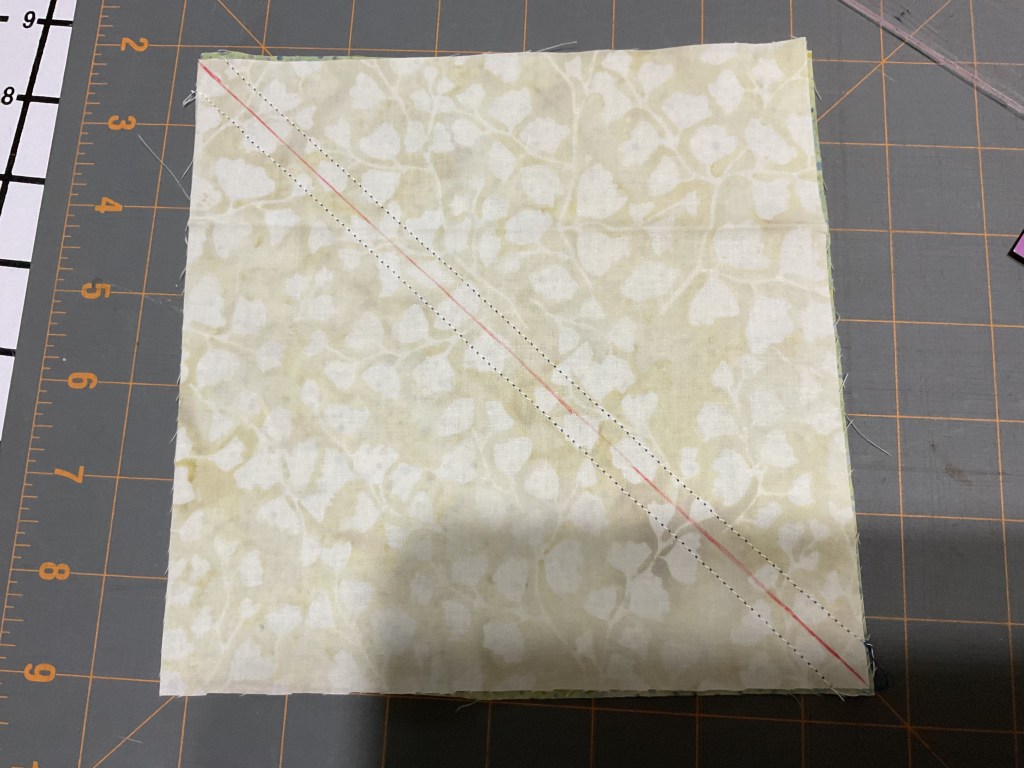
To make HSTs, the first thing you need to do is layer your squares right sides together (RST) and draw a diagonal line – I like to use FriXion erasable pens for marking my fabrics.

Then we’re going to sew 1/4″ away from both sides of our drawn line.

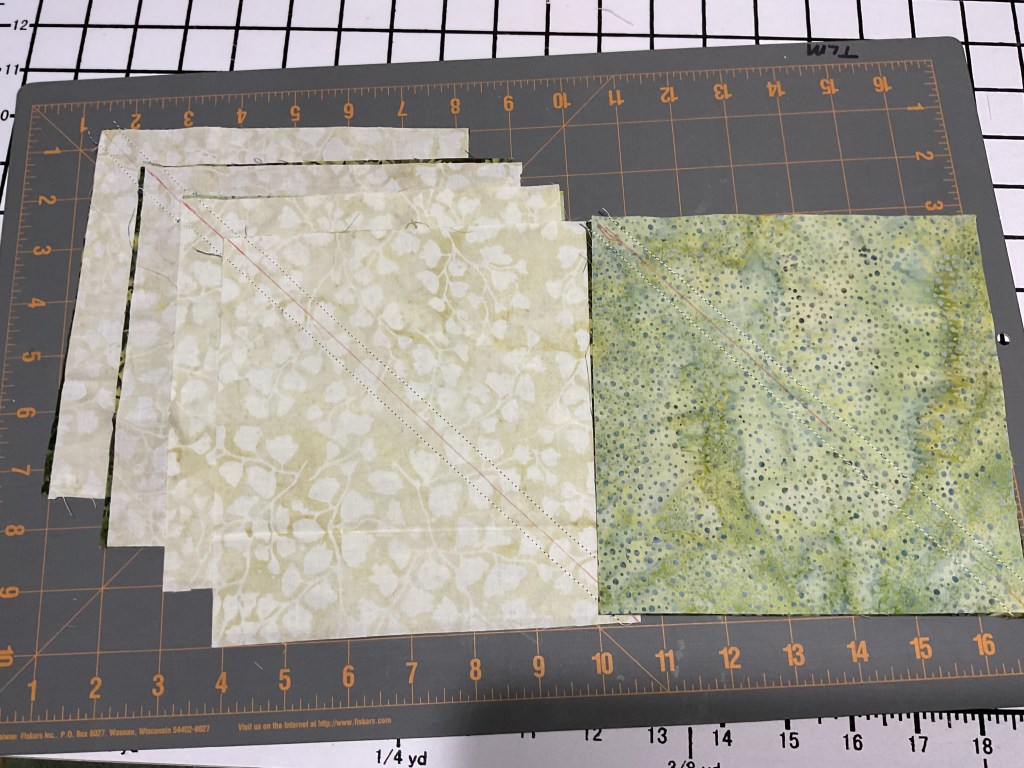
I went ahead and sewed all of the HSTs for my first 2 blocks at one time. Do likewise if you wish.

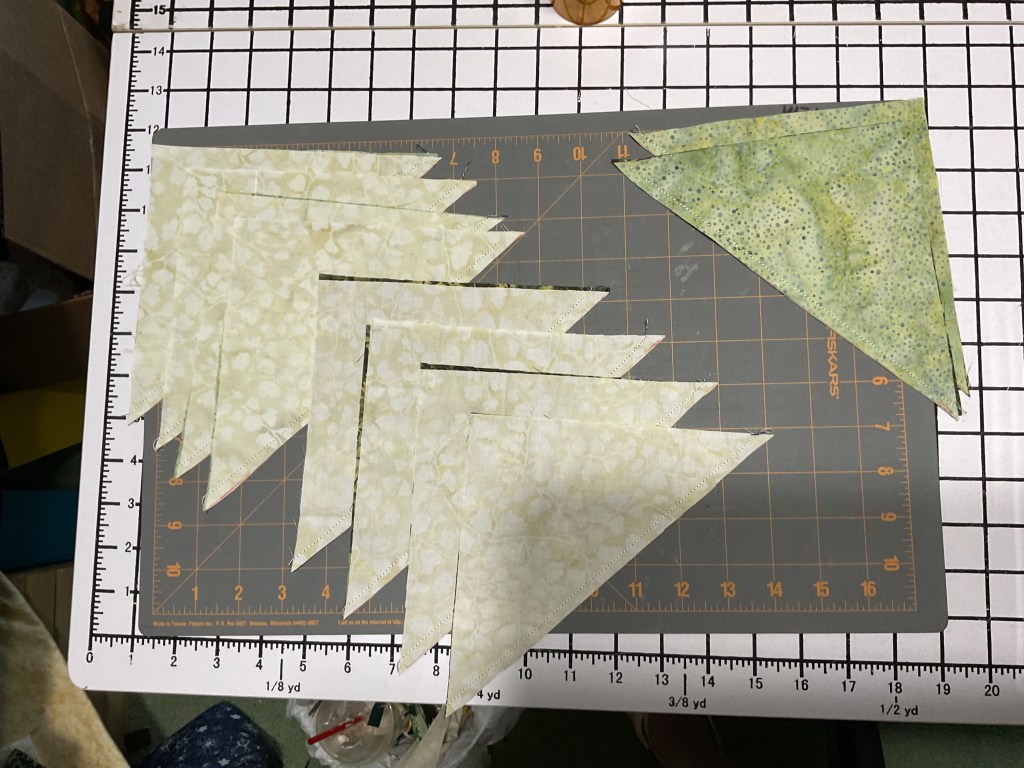
Next we need to cut on the diagonal lines which will give us 2 HSTs.

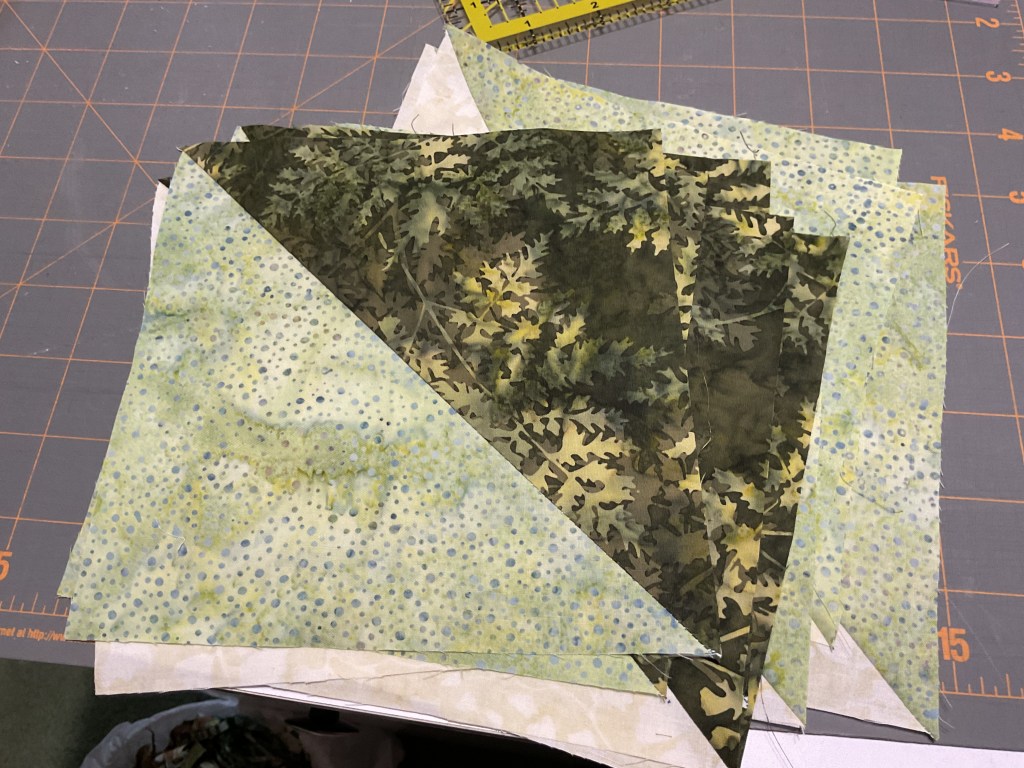
All right, let’s head over to the ironing board to press these HSTs open. Don’t forget to cut off the little dog ears on the corners so your piecing will be more accurate.

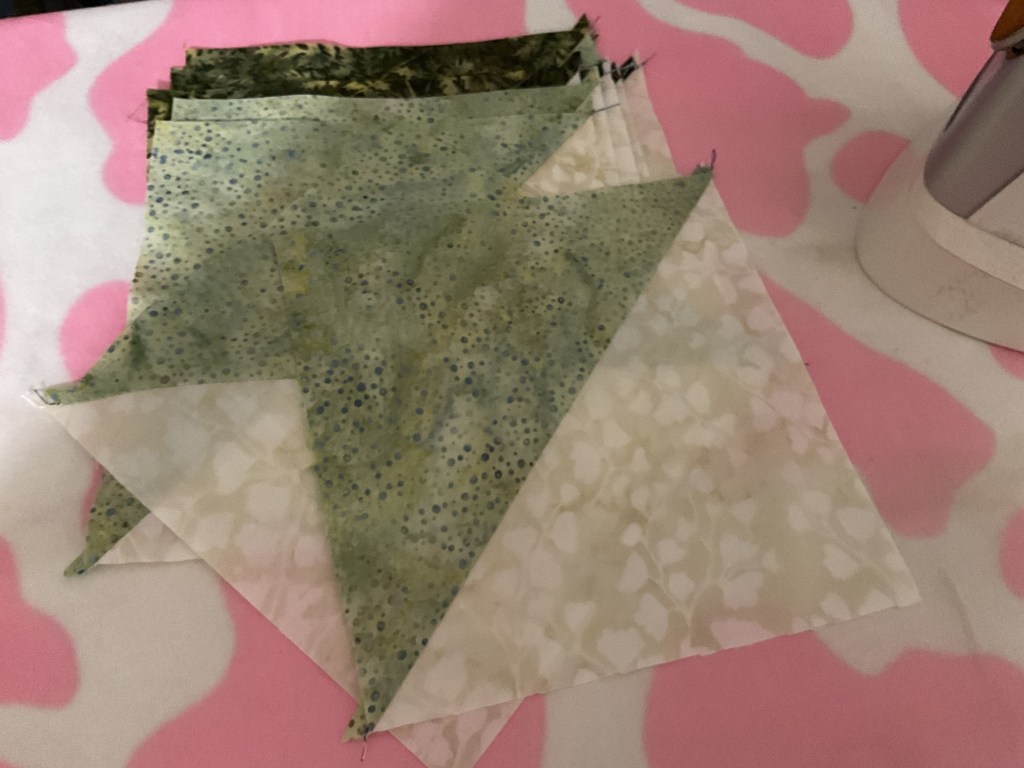
Let’s make the stems next. Cut your background square in half diagonally to make 2 triangles. Then we’re going to center and sew a stem rectangle between those 2 background triangles. I pressed my seams towards the stem so they wouldn’t show through my background fabric. We need to make 2 of these – 1 for each of our matching Leaf blocks.
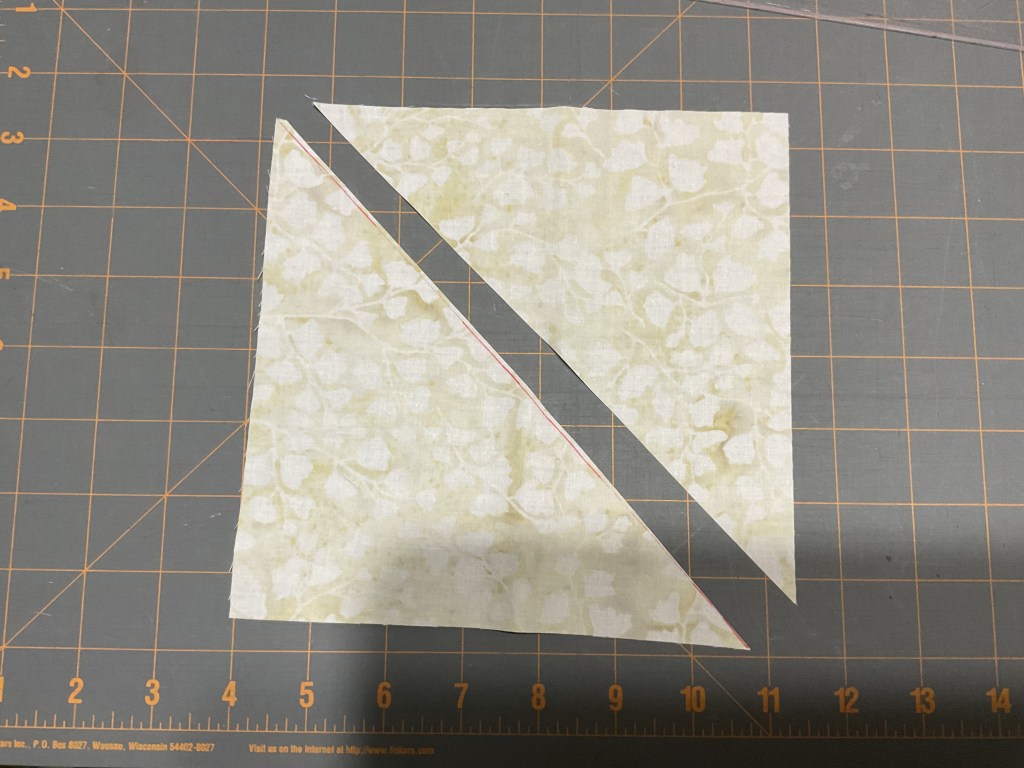
Before out stem units are finished, though, we need to trim them to the right size. Take your time when you do this step because you don’t want to miscut and make wonky stems.
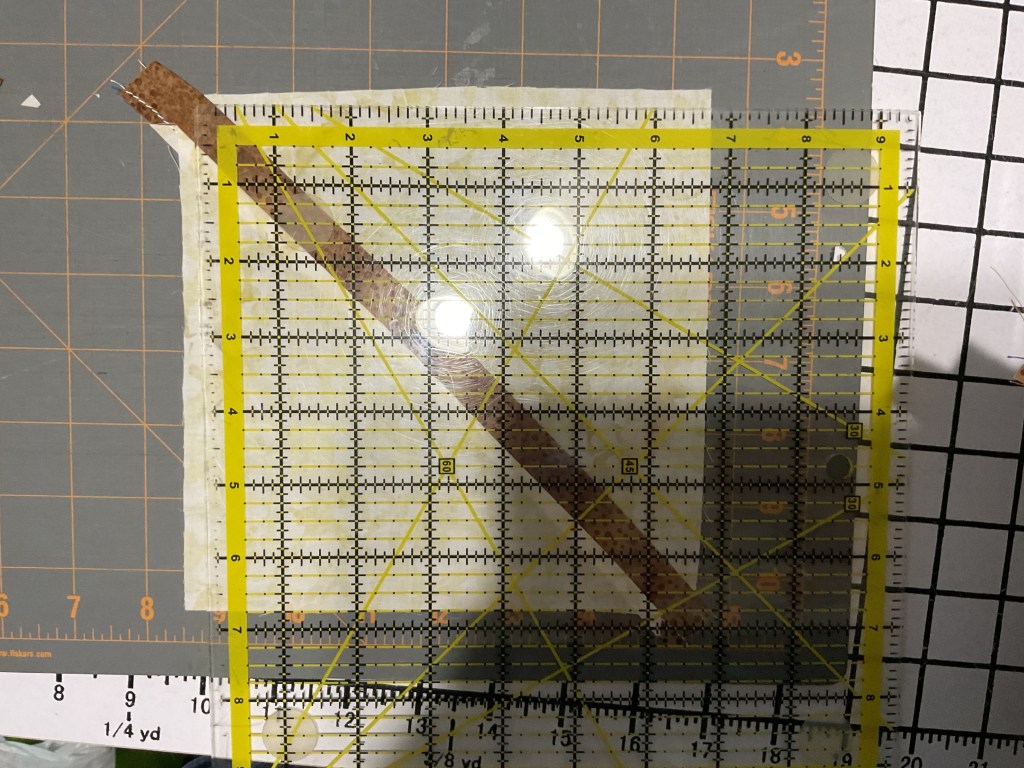
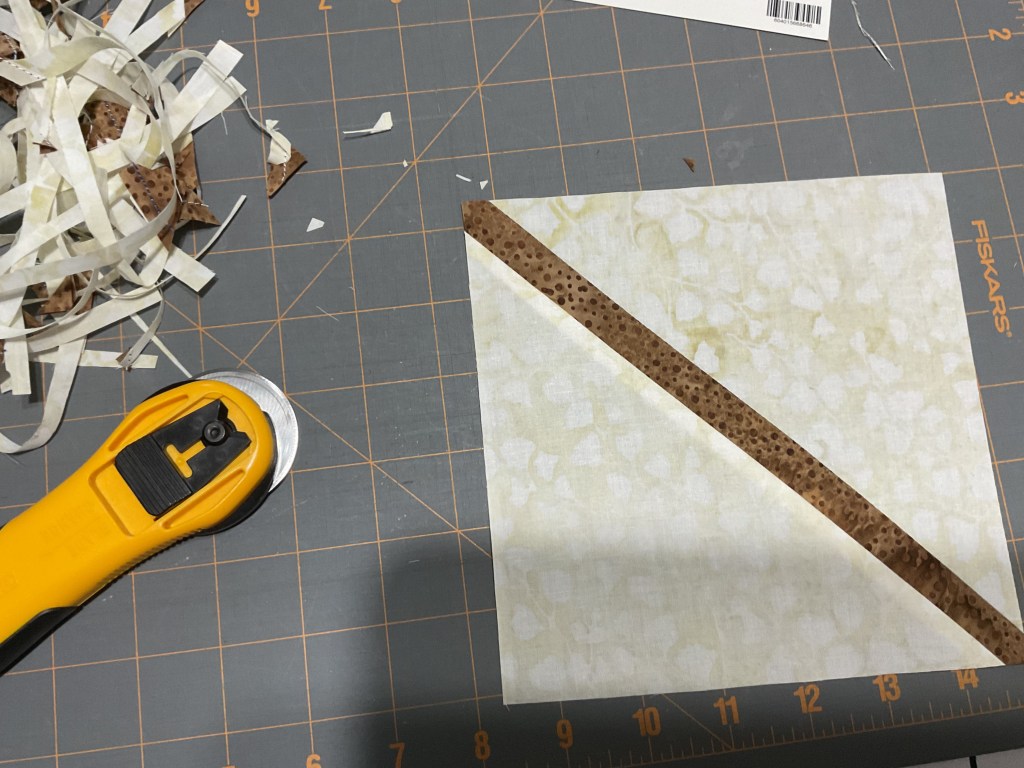
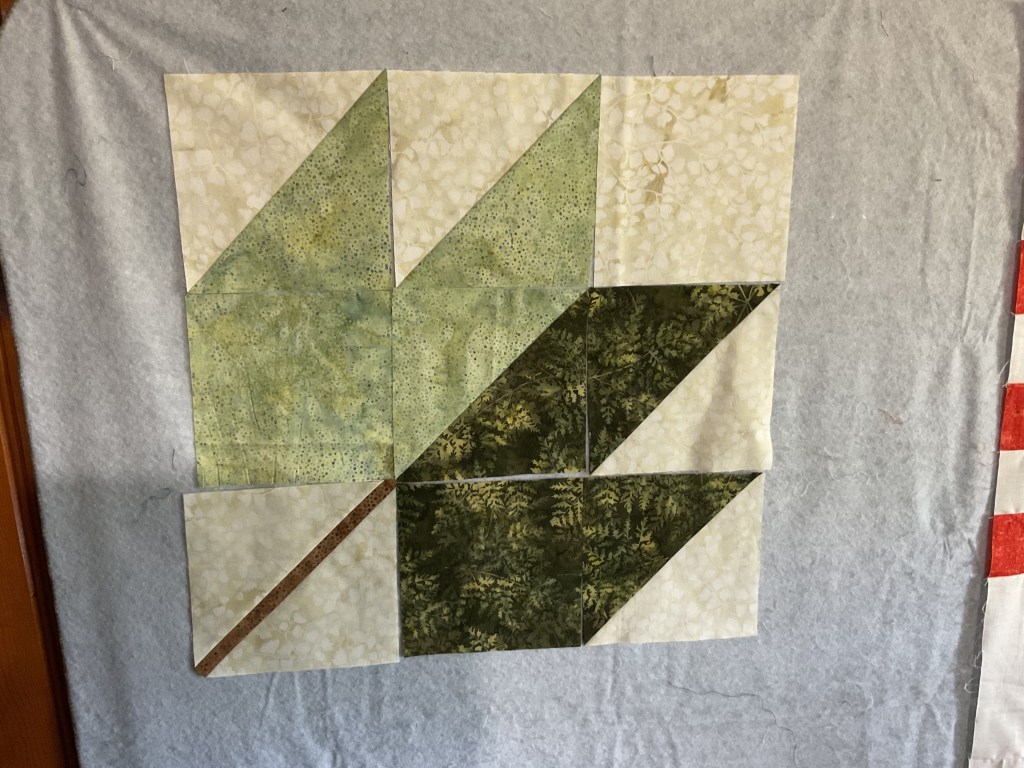
Okay, now we’re ready to layout a block and sew it together. Once I’m happy with how the first block turned out, I’m going to make the second matching block. One Leaf pair done, 5 more pairs to go. Repeat the steps above to make 12 total Leaf blocks.
Woohoo! Here are my 12 Leaf blocks.

A pile of quilt blocks featuring various shades of green fabrics arranged in a leaf design, with a neutral background and some visible stitching.

Now it’s time to arrange the blocks on my design wall. If you want your quilt to have the same movement as the Falling quilt on the cover of the pattern, you will need to flip and flop your blocks like Catherine’s. I only switched 1 or 2 blocks before I liked the arrangement. As you, know sometimes I spend more time arranging the blocks than actually making the quilt. But not today, yay!

You will want to take care while sewing your blocks together because sometimes you are sewing a point to a point. Careful pinning will help keep your points under control and will result in a cleaner and more accurately stitched quilt.

A colorful quilt featuring oversized leaf blocks in various shades of green, brown, and floral patterns arranged on a design wall.

Next we are going to sew the blocks into rows and then sew the rows together to make the quilt top. Oops, this quilt is longer than my flannel wall, so I can’t show you the entire top yet. I told you it was a good sized quilt!

A quilt featuring a pattern of green and brown leaves arranged with a cream-colored background, showcasing various fabric textures and colors.

I just had to take my Falling flimsy outside to snap a photo in natural light so I could show you the entire top. Absolutely LOVE it! Can’t wait to finish it.

A quilt featuring large, stylized leaf patterns in various shades of green, brown, and orange, displayed outdoors on a clothesline with a grassy background.

To complete your quilt, layer it with batting and backing fabric (or fleece like I plan to). Quilt it. Bind it. And don’t forget your label!

Have you made a Falling quilt already? Or if you plan to make one this Fall, please share a photo on our VRD Facebook group – we’d all love to see them!

Well, that’s it for me – I’m heading back to my sewing machine to get some more sewing in.

Take care and I’ll see you right here next week.

Always,

Tricia @ VRD
Rose Cards · Tips and Tricks · Tutorials · villa rosa designs

VRD Discovery Quilt Tutorial and 8 Tips for Photographing Your Quilts

Happy Thursday to you!

Do you have any big plans for Labor Day weekend, the unofficial end to summer? I don’t, I’m just hoping to get a little sewing in. LOL! For me, sewing and quilting are a vacation. Of course, I just had my lovely visit to Colton’s Point last week (if you missed my blog post about Colton’s Point, you can find it HERE) and I’m still feeling the positive vibes from my trip which is why I just want to sew, sew, sew.

Last week I promised you one final Summer Quilt Tutorial, so read on. After the tutorial, let me share some tips for photographing your own quilts.

I’ve been wanting to make Discovery for a long time now, but I just haven’t picked out my fabrics and made it yet So, when I found these adorable fall fat quarters, I couldn’t resist — Discovery it was. In fact, I gave a set of these cute fat quarters to each of my friends, Cathey and Leslie, along with the the Discovery pattern and chocolate, of course. I was hoping they might be inspired to make their Discovery quilts, too, but alas, Cathey and Leslie each had their own projects to work on.

I have found the Discovery pattern really lends itself to novelties and large print fabrics. I’ll bet you have large prints as well as novelties that you have no idea what to do with and you just don’t want to cut them up, losing the fabric design. I feel your pain. I have tons of these fabrics lurking amongst my overloaded shelves, as well. But we are in luck because the Discovery patterns welcomes these hard-to-please novelties and large prints.

If you haven’t added Discovery to your VRD Rose Card collection yet, you really should. It’s a very versatile size at 44×62 which can be used as a baby quilt, a large wall quilt, or even a lap quilt. If you want it bigger, simply add more borders. Did I mention that this quilt almost sews itself together? It truly is that fast!

Get your print Discovery HERE or your digital Discovery HERE.

So, let’s get started on our tutorial for today!

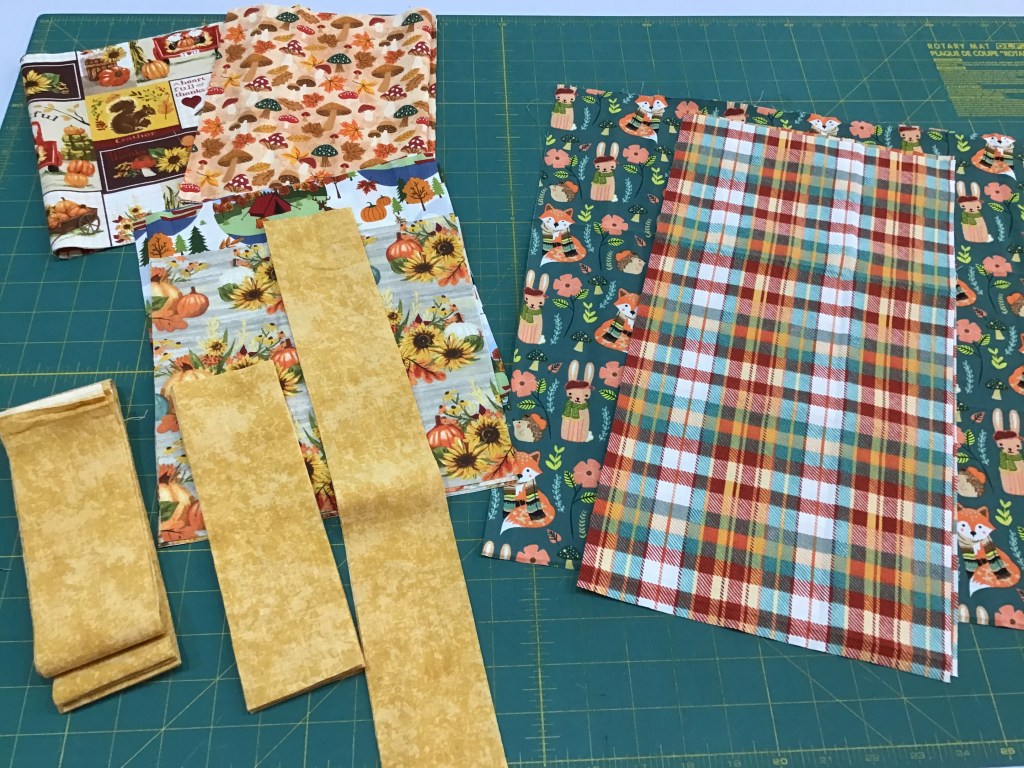
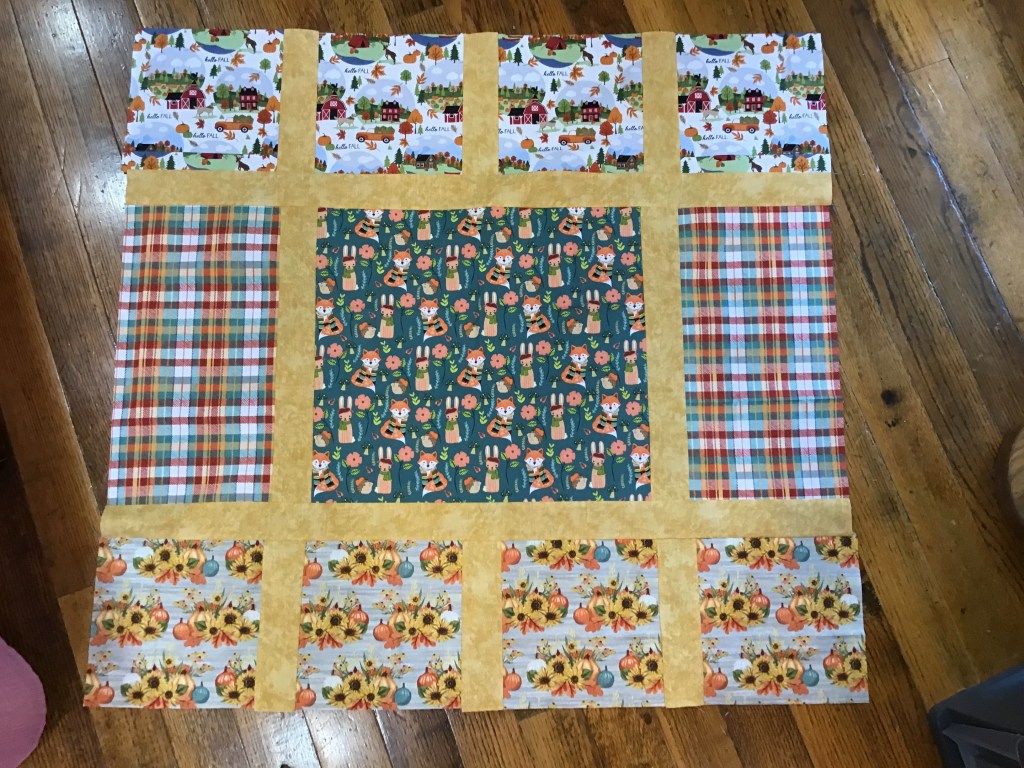
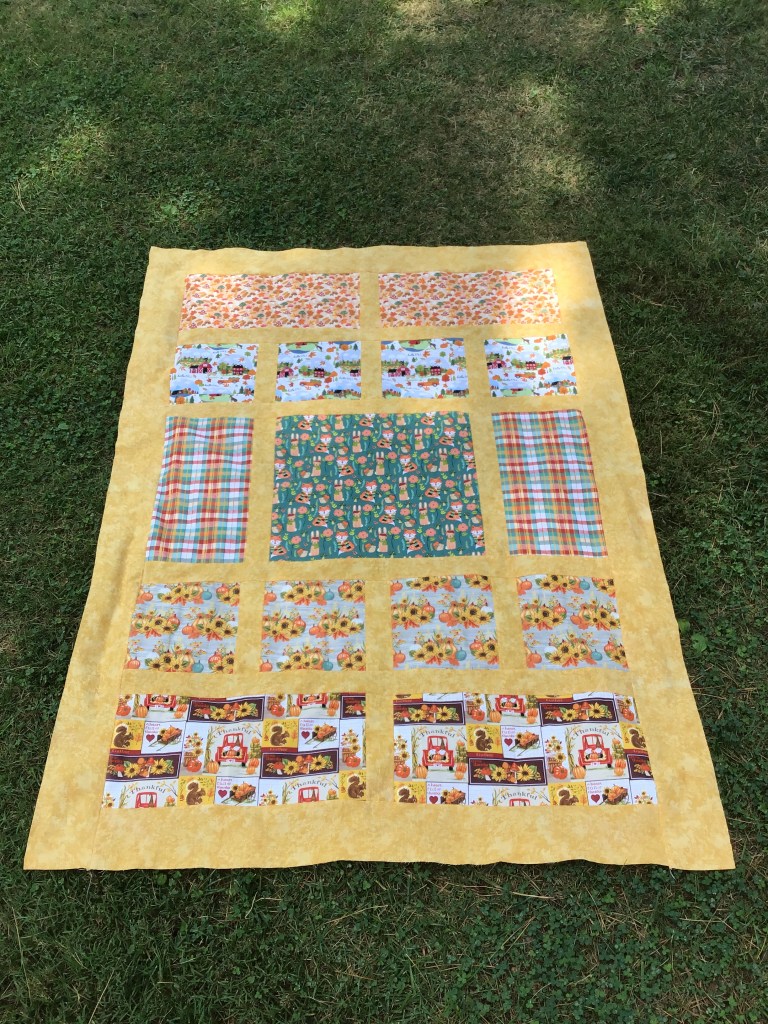
Here are my cute fall fabrics, as you can see most of them are novelties and several are large prints. I chose to use a light gold tonal straight out of my stash. I just LOVE LOVE LOVE the plaid and the teal forest animal print is adorable.

I challenge you to make your own Discovery quilt right out of your stash, too, and then to share it on our VRD Facebook group.

The first thing to do is decide where you want each fabric to live in the quilt. I suggest choosing your favorite for the center and working your way from there.

The second thing, of course, is to cut out all of the pieces. The cutting for this quilt is surprisingly quick with such large pieces. I do suggest you make sure your fabrics are laid out according to the pattern and that you double check the measurements before you cut. Speaking from my own experience (which I did not photograph, sorry), if you make a cutting mistake, you’ll probably have to substitute a different fabric or piece some scraps together (which I ended up doing).

You know the saying, “measurement twice and cut once”? It applies just as much to quilting as it does woodworking.

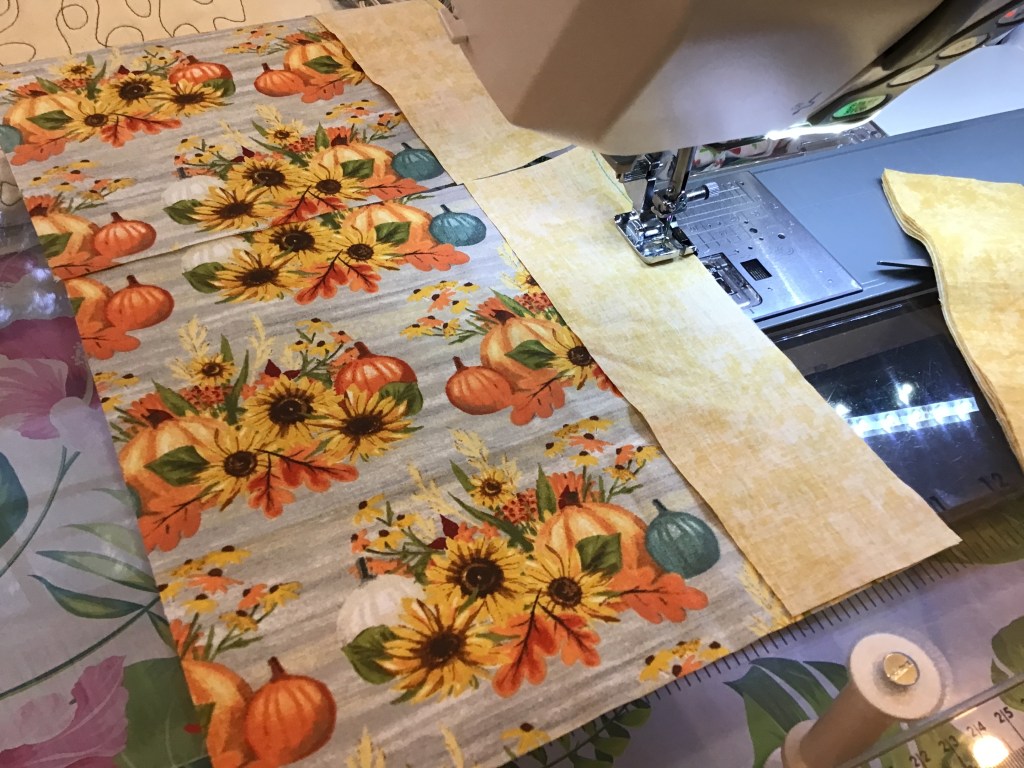
All right, moving on. Let’s sew background strips to the sides of the center square. I pressed my seams towards the background fabric.

Yep, you knew I was going to pick the teal forest animal print for the center, didn’t you?

Now sew rectangles to each side of the center unit. I pressed the seams towards the background strips.

Of course it was going to be the plaid! Was there any doubt in your mind?

Huh. I really like how this is already looking — the plaid is just too fun and the teal forest animal print is really cute.

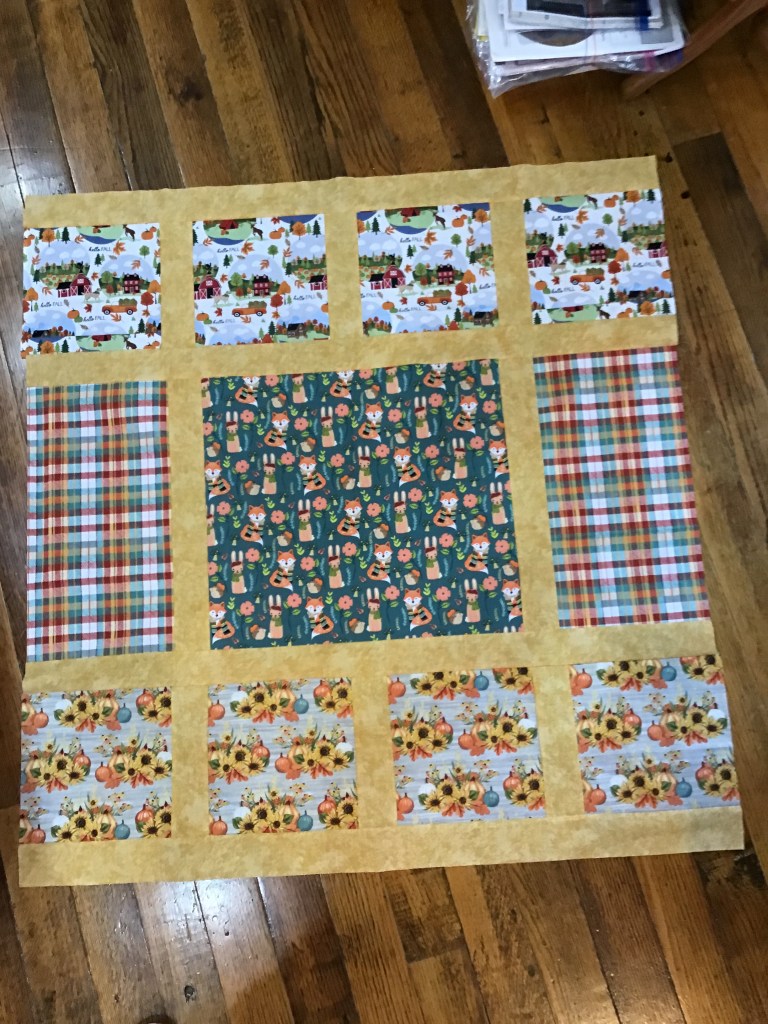
Next let’s sew background strips to the top and bottom of the unit. Again, I pressed the seams towards the background strips.

This is going really fast, isn’t it?

I chose similar-feeling fabrics for the top and bottom rows in the hopes of balancing the quilt. Do likewise if you want, but don’t be afraid to mix things up.

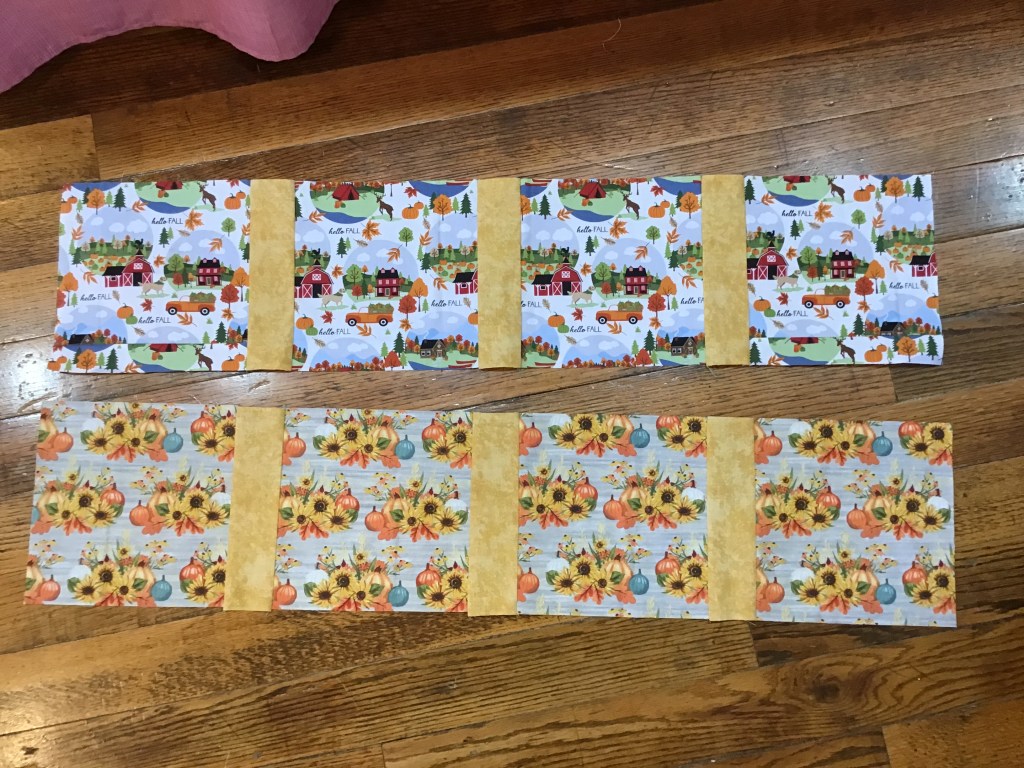
Sew 3 background strips between the 4 small squares. Make one row for the top and one for the bottom of your center unit. I pressed my seams towards the background strips.

Sew a pieced square strip to the top and the other one to the bottom of the quilt center.

Then sew the pieced rows to the top/bottom of the quilt center. Of course, I pressed my seams towards the background strips.

Sew background strips to the top and bottom of the quilt center and press the seams towards the background strips.

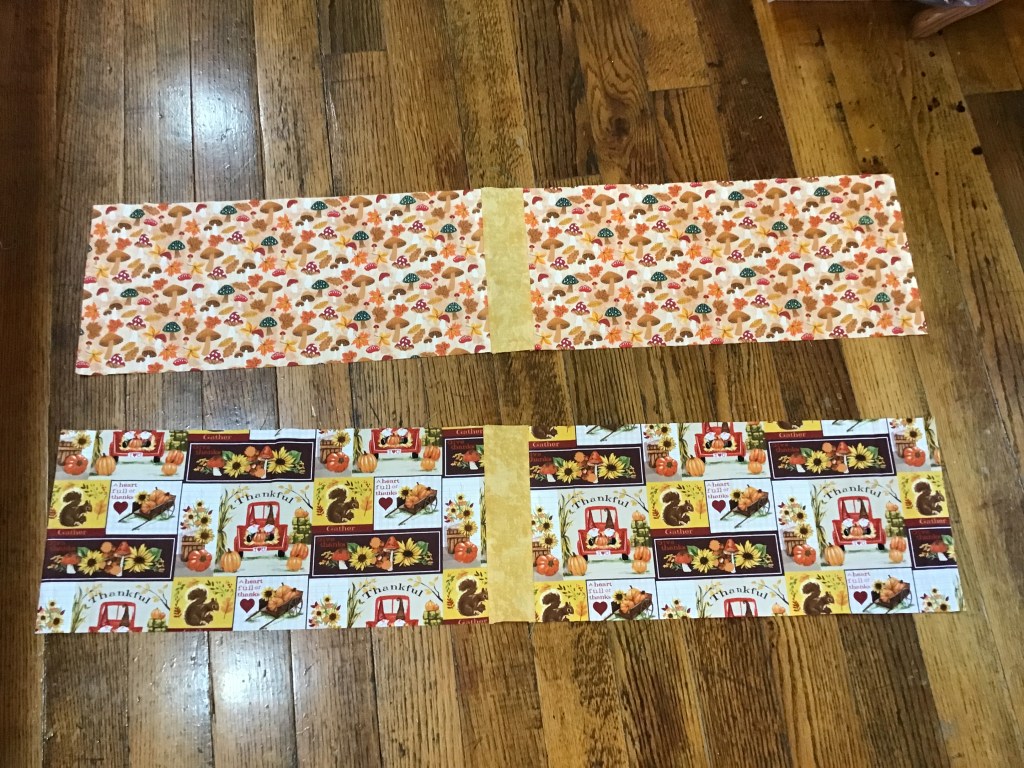
Sew a background strip between 2 matching rectangles. I pressed my seams towards the background fabric.

Make one pieced rectangle row for the top and one for the bottom of the quilt center.

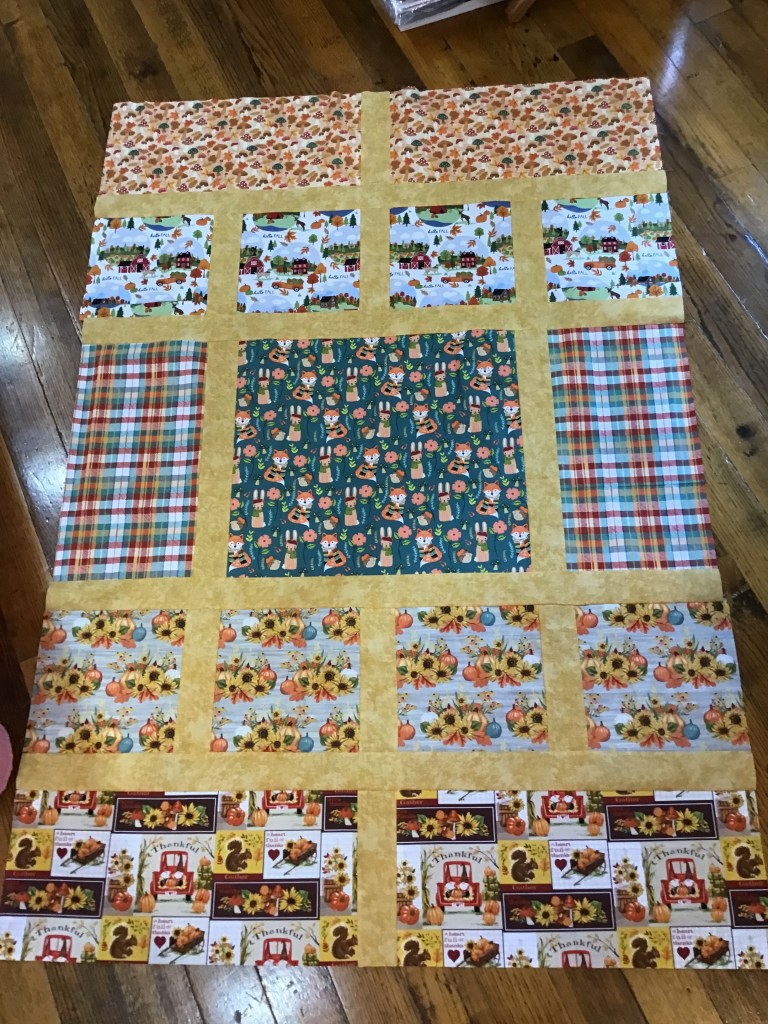
Decide which pieced rectangle row will go on the top and which one on the bottom. Then sew the pieced rectangle rows to the quilt center, pressing your seams towards the background strips.

I hardly broke a sweat sewing this together so far. How about you? Can you believe how fast the center of the quilt came together?

Now let’s add some borders. Go ahead and sew the top and bottom borders on first and press the seams towards the background strip.

Then add the side borders. You will need to piece your strips so you have the right length.

Sew the borders to the sides of your quilt and —

VOILA!

Top done! Lickety Split! Just like that!

I just love how my Discovery quilt top turned out! It’s really fun. And really cute with those whimsical fall fabrics. I’m thinking maybe a teal binding to finish it off after I quilt it. Or maybe orange? What do you think?

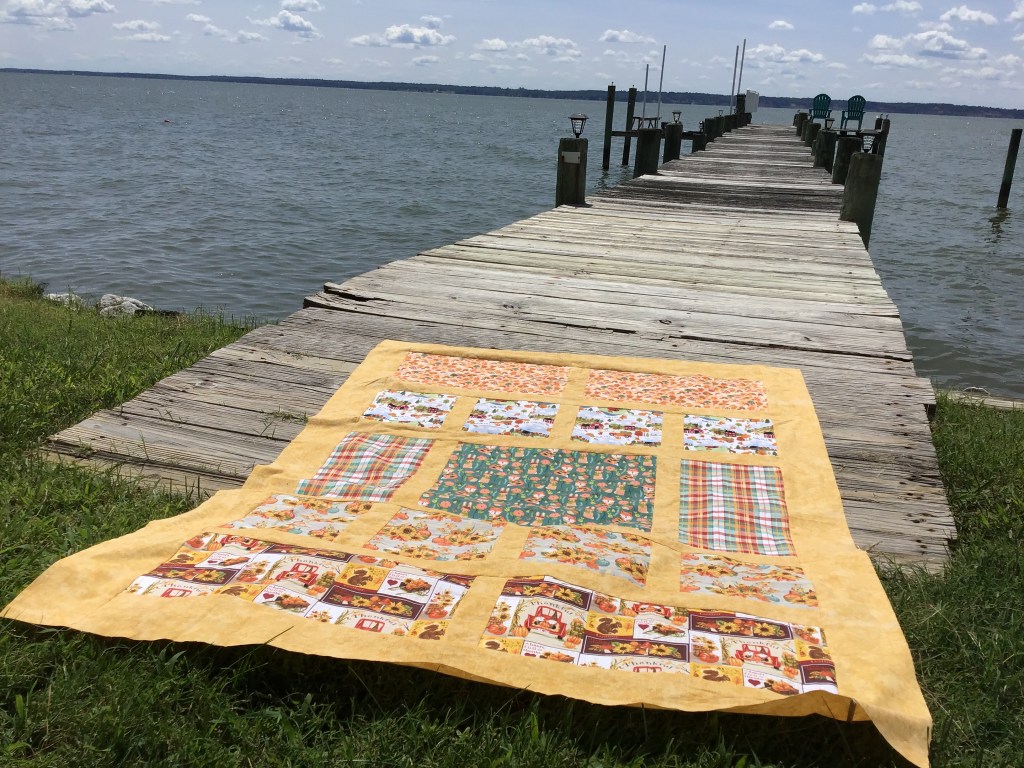
Here’s a photo of my Discovery quilt top down on the pier on the Potomac at Colton’s Point. It was a little breezy and my quilt top just wouldn’t stay still. If it had been a completed quilt, it probably wouldn’t have been fluttering around while I tried to take a photo. I was actually afraid to take it farther out on the pier lest the breeze catch it and I lost it in the river.

Here is one of my favorite photos again — the one I took on the picket fence in front of Cathey’s cottage.

As pretty as it is — almost a postcard — it would look even better if the quilt was finished already. Maybe the next time I go, I can recreate this photo with the finished quilt.

By no means am I a professional photographer — strictly amateur — but I have learned some things that have improved my photos over time and I am happy to share them with you because you really should be taking photos of your quilts.

Why? You might ask.

Some reasons include:

  1. Documenting your work
  2. For insurance purposes
  3. To show your work to others without hauling crates of quilts around with you
  4. For a quilt show or contest, if it’s required

And I bet you could come up with your own reasons for photographing your quilts, too.

Here are my tips. I hope they will inspire you to try your hand at photographing your own quilts if you are not already doing so.

  1. Use natural light — I prefer taking my quilt photos outside. My indoor lighting and space are not the best, so outside it is for the most part. I will even take quilts outside in the middle of winter to take photos.
  2. Get creative with backdrops and props — sometimes I take a quilt to a different location, but mostly I utilize what is in and around my yard — trees, grass, flowers, rocks, the roof of my car, an old tractor, weathered wood porch, a railing, a fence, or whatever I can come up with.
  3. Keep it simple — limit the amount of distractions in your photo, keep the focus on your quilt.
  4. Add a little extra — I like to incorporate natural details in my photos when I can, but I still want the focus to be on my quilt.
  5. Take photos from different angles — I like to do this and then later I can chose the best one because sometimes a straight-on shot doesn’t show a quilt to its best advantage.
  6. Ask for help — Sometimes you just need an extra hand or even a pair of hands to hold up a quilt. Don’t be afraid to ask in order to avoid frustration and failure.
  7. More is better — I end up taking a lot more photos of a quilt than I will ever use, that way I can pick out my favorite(s) and delete the rest. And believe me, I delete A LOT of images.
  8. Practice — It takes a lot of practice to achieve the results you really want when photographing your quilts, so be patient with yourself and just keep practicing.

Well, that’s it for me this week. Have a wonderful and safe Labor Day weekend. Wish me luck with my sewing….

Until next time —

Always,

Tricia @VRD

    Quilting Partners · Rose Cards · Tutorials · villa rosa designs

    VRD Whirly Bird Quilt Tutorial

    Hello Quilty Friends!

    Happy Thursday to you!

    I hope your summer is still going strong and you are getting to do the things on your summer bucket list.

    This has been my busiest summer since before the Pandemic, that’s for sure. I’ve been doing things I haven’t done for years — gardening, the adult summer reading program at my local library (I even won a nice prize at the program potluck last week!), I’ve been to Presque Isle Park (Lake Erie) twice so far, made multiple trips to the big farmer’s market in Erie (PA), and even visited a relatively new local museum I’ve never been to before. Luckily, I’ve been making quilt tops for our Summer Tutorial series so I’ve even gotten in some fun sewing. Yay!

    The only issue with my busy crazy summer is that I’ve been neglecting a lot of things at home and in my studio space. So I guess I’ll have a lot to catch up on this fall. Sigh………..

    Artwork by moi

    This Sunday, I’m even going on a summer road trip with my friend, Leslie — Hi Leslie! — to Maryland to visit our friend, Cathey — Hey Cathey!

    Looks like we’re going to have a good old-fashioned quiltathon/quilt retreat like we used to do years ago at Chautauqua Institution (Chautauqua NY) during Quilting around Chautauqua every September (sadly, the amazing quilt weekend is no more….). The three of us along with our other quilty pal, Mary Lee — Hey Mary Lee! — would rent a cottage and start our quilt weekend on a Wednesday so we could have a quilt retreat as well as enjoy the show on Saturday and Sunday. Ahhhhh, those were the days.

    I can’t wait to catch up with these gals because we’ve all kind of gone in different directions since Chautauqua.

    I’ll tell you all about my adventures in next week’s post, so stay tuned until then.

    Now let’s continue our Summer Tutorial series with an oldy, but a goodie — my pattern, Whirly Bird.

    Today we’re going to have a little fun with Whirly Bird. Have you made this quilt yet? If so, please please please share it on our VRD Facebook page ’cause I’d really like to see them!

    If not, it’s fun and fast (of course) and has a lot of room for creativity.

    Get your print Whirly Bird HERE or your digital Whirly Bird HERE.

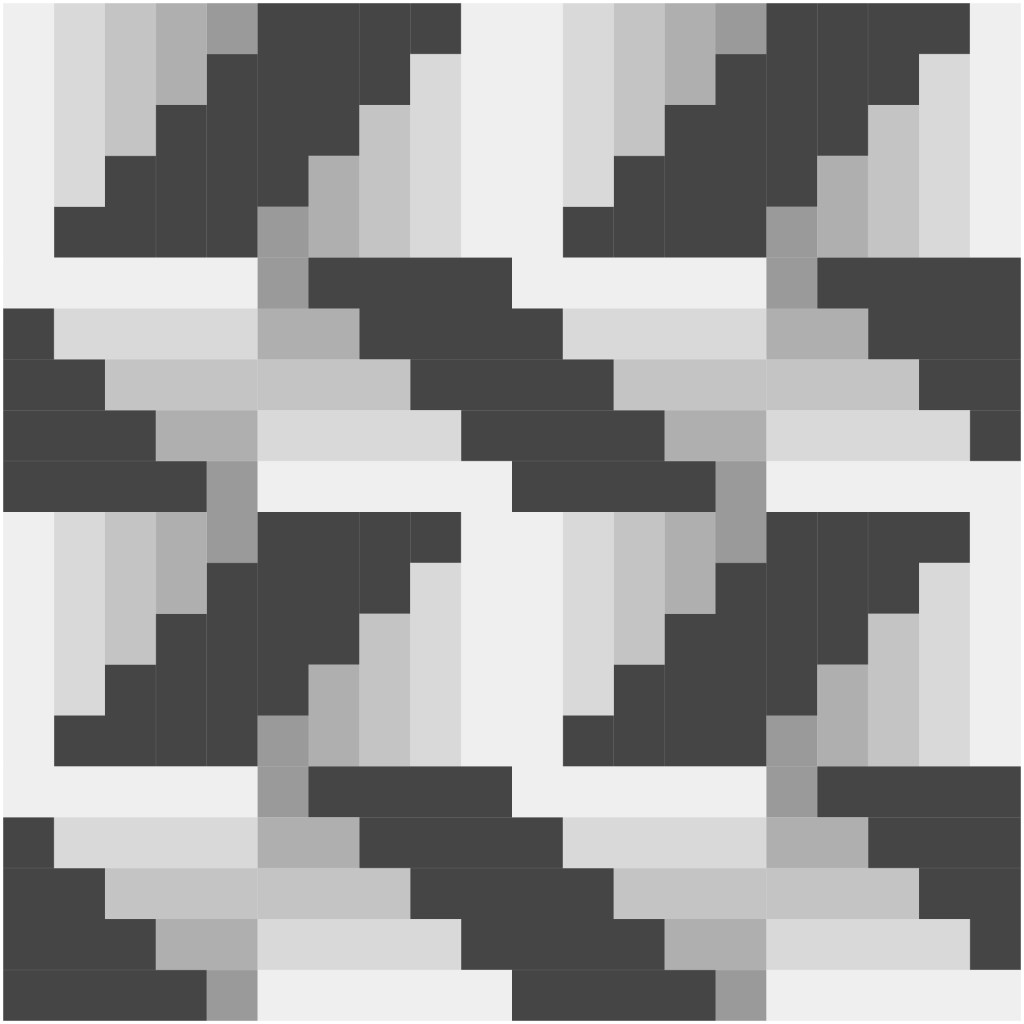
    When I designed Whirly Bird, I really wanted to do a gradation quilt featuring black, grey, and white. It turned out to be a pretty cool quilt with a very modern feel, which was what I was going after.

    Let’s change things up today by swapping the lights and darks! I think you’ll be really surprised when you see the finished top.

    So let’s get this party started, shall we?

    For today’s Whirly Bird, I am using the Touch of Grey collection by our quilting partner, Hoffman Fabrics. Yep, I’m sticking with a neutral theme for this version, but that’s really where the similarities end.

    The charcoal fabric at the bottom of the photo will be my background fabric and the 5 light fabrics in the center at the top will be the gradation strips in the quilt. The border is on the left and the binding is on the right.

    The first thing we’re gong to do is cut the fabrics according to the pattern, but swapping out the dark charcoal for the background (or light) fabric and the light greys for the graduated grey strips.

    While I cut, I am organizing my pieces on a flannel board so that I have the correct background piece paired with the correct light grey strip. Want to make your own flannel board? You can find the tutorial HERE.

    By arranging my pieces on my flannel board in order, I can simply take the board right to my sewing machine and start sewing immediately.

    So let’s do that!

    Let’s sew the charcoal background pieces to the corresponding light grey strips. This step went really fast because I used chain piecing for each pair for each block, stacked them back on my board, and then moved onto the next pair.

    Moving right along, we’re going to head to the ironing board. I pressed my seams to the dark, but this doesn’t work perfectly all the time. So press your seams in a way that makes sense to you.

    A note about pressing — I don’t usually give directions for pressing seams in tutorials and even on my patterns because every quilter has their own way of doing things. For me, I usually make those decisions on the fly as I sew. I usually do press to the dark, but sometimes I find that when sewing the the pieces of a block together, I have to flip my seams to the other side.

    Wanna hear a joke — an old favorite of mine?????

    Keep reading to find the answer. Tehehe!

    After I pressed each strip pair, I put them back on my flannel board to keep things neat and tidy.

    And….back to the sewing machine!

    Next we are going to sew the pieced strips together into a block. One word of caution about having your pieces laid out on your flannel board — make sure you have them laid out in the right order or else your blocks won’t turn out the way you want them to. As a lefty, I sometimes have to double and triple check block or even quilt layouts before I sew the pieces together because it’s just too dang easy for me to flip things the wrong way.

    I used chain piecing to sew the blocks together. This process went super fast as I made all the blocks at one time, one step at a time, without stopping to press in between.

    Now, back to the ironing board to give these blocks a good press. I like to press the seams from the back first. Then I repress the block from the front, making sure everything is nice and flat.

    Remember, we PRESS in quilting, we do not IRON. Need a little refresher on pressing vs. ironing? Check out a blog post about pressing techniques from our 2022 Quilting Basics series HERE.

    Woohoo! The blocks are done and pressed — let’s arrange them on my design wall!

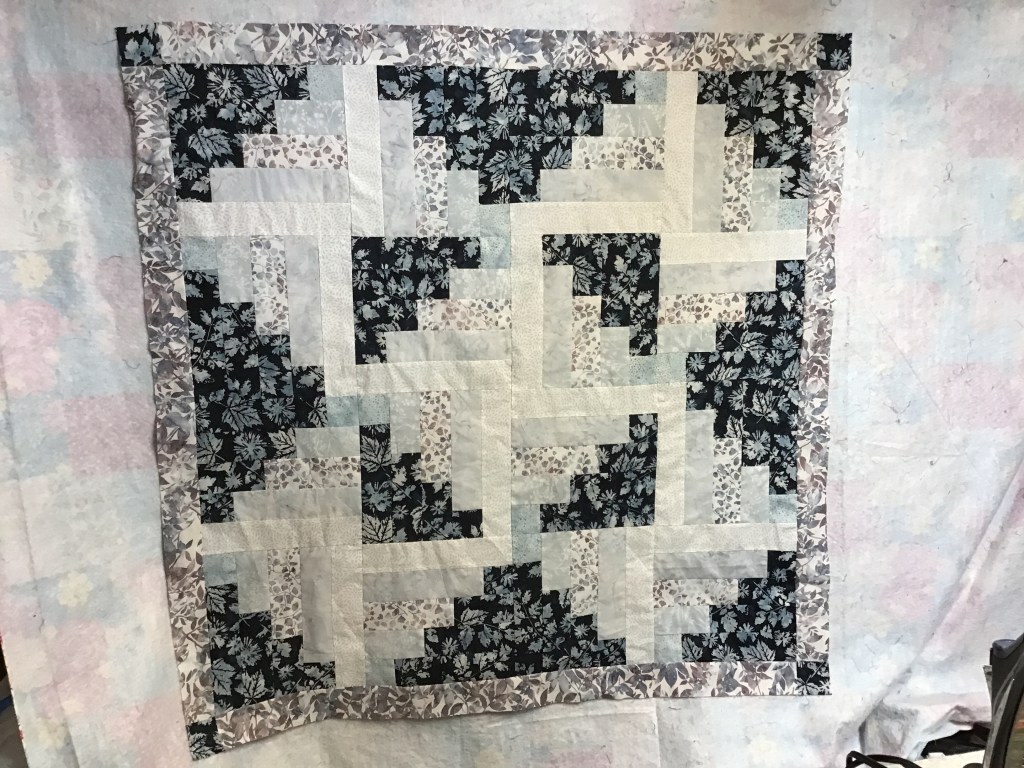
    This is the same arrangement of blocks as in the original Whirly Bird quilt on the front of the pattern. Wow! What a difference when you swap the lights and darks out in this design! What do you think???

    This is just one of many arrangements. Here are some other possibilities to give you food for thought when you make your own version of Whirly Bird.

    I bet you could even come up with 1 or 2 more!

    I decided to go with the original arrangement, so now let’s sew the blocks into rows and then sew the rows together.

    LOVE LOVE LOVE IT! Especially the repeating little pop of grey print in the middle of the light grey tonal strips — yep, I planned that on purpose for added interest. 🙂 I really like how those center print strips flip up, down, and sideways in the blocks — it really does add a bit of a secondary design and helps move your eyes around the quilt.

    Next up, we are going to add the border, although this quilt doesn’t have to have one — it would finish beautifully with a dark binding to frame the blocks. But, we’re adding a border.

    Sew the sides on first and then add the top and bottom. For more added interest, I added dark fabric squares in the 4 outer corners. This is a little bit different than the original pattern, so let me tell you how I did it:

    As this quilt is a square, I cut 4 borders the same length as my quilt top through the center and the same width as the pattern calls for as well as 4 squares. I sewed border strips to the sides of the quilt center. Next I sewed dark squares to both ends of the remaining 2 borders and then sewed them to the top and bottom of the quilt center. Easy piezy!

    If you don’t want corner squares, though, simply cut and sew the borders like you normally would.

    Here it is — my completed Whirly Bird quilt top. I really like how the dark corner squares connect to the dark block sections in all 4 corners.

    What are your thoughts?

    I’m planning to take this quilt with me to Cathey’s — I hope to get some machine quilting done. Fingers crossed……………

    See you back here from Maryland next Thursday and I’ll tell you all about my trip. I hope Cathey’s hubby, Bryon, is doing all the cooking while we quilt, gab, laugh, and eat chocolate.

    Until then —

    Always,

    Tricia @VRD

    Quilting Partners · Rose Cards · Tutorials · villa rosa designs

    VRD 31 (Thirty One) Quilt Tutorial

    Happy Thursday to you!

    I’m going to get right to our tutorial today because you are going to LOVE LOVE LOVE today’s quilt! And I can’t wait to show it to you.

    31 is our project du jour. It was designed by Molly Cook. You can go HERE to read an interview I had with Molly last year if you’d like to get to know her a little bit. Occasionally she pops onto the blog, but it’s been a while, so I’ll have to remind her she has an open invitation to hang out with us anytime she wants. Isn’t it fun to get to know your favorite VRD designers? I know, I know — I need to get my tush in gear and get some more interviews with our lovely designers, don’t I?

    31 is a fabulous asymmetrical panel quilt design and looks great in pretty much any fabric collection!

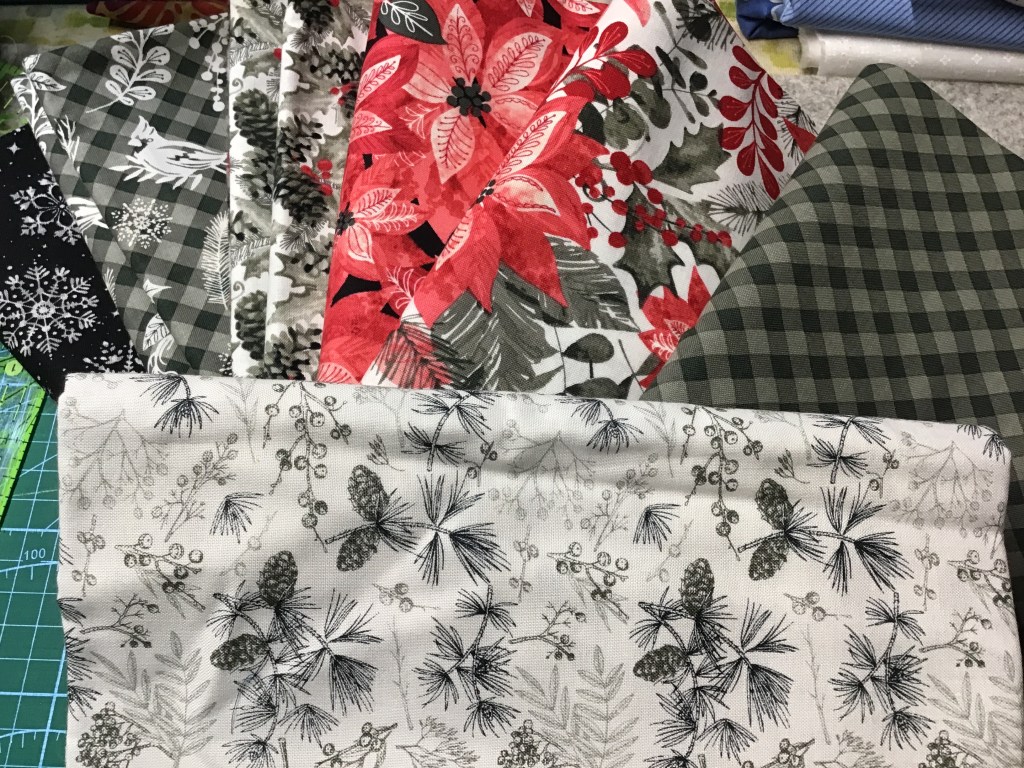
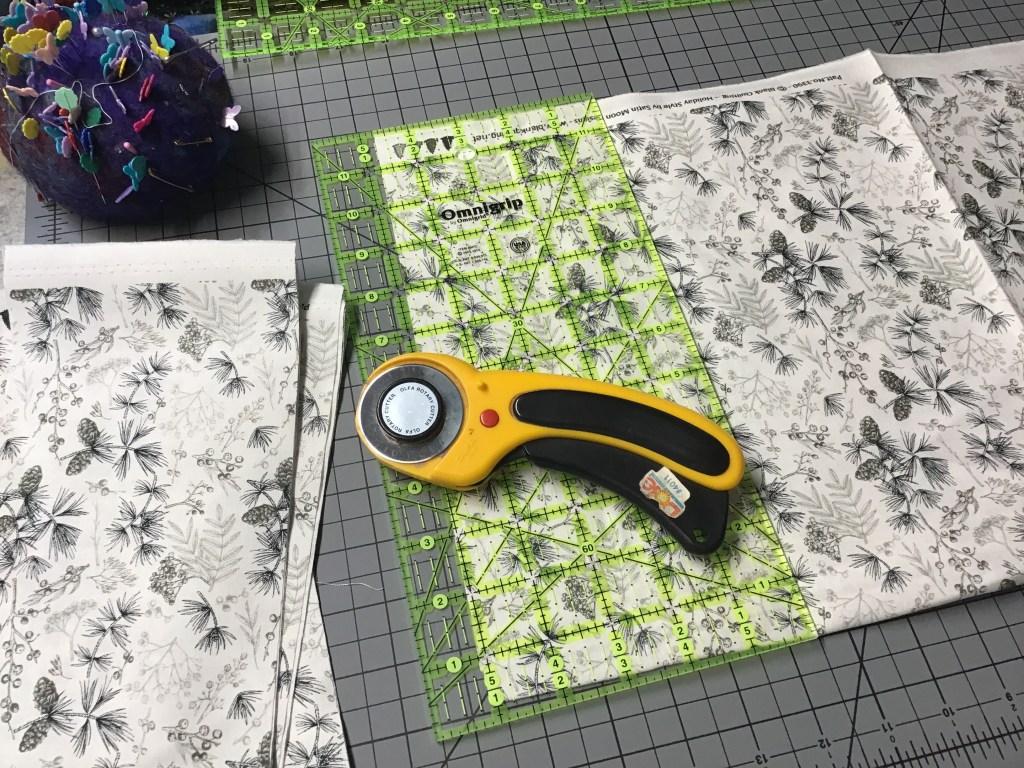
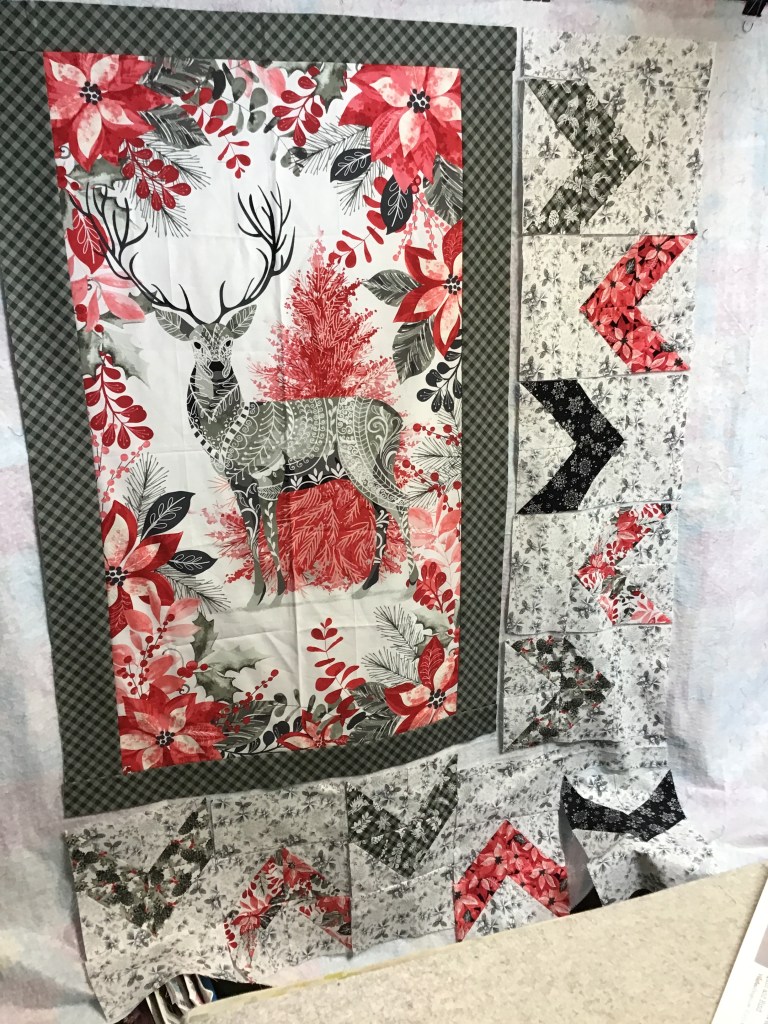
    This week I’m continuing my “Christmas in July” theme. For this quilt, I’m using the new Holiday Style collection by Satin Moon for our quilting partner, Blank Quilting (in store now). This gorgeous collection is traditional (poinsettias) and modern at the same time (red, pink, black, white, and grey colorway)! Which is probably why I adore it. I’m not a huge fan of woodsy deer and bears and such, but the deer on the panel is lovely and delicate with a Scandi feel. The artwork is beautiful and invites a second and even a third look at all of the details.

    And here are the companion fabrics I’m using for 31.

    Let’s get to it!

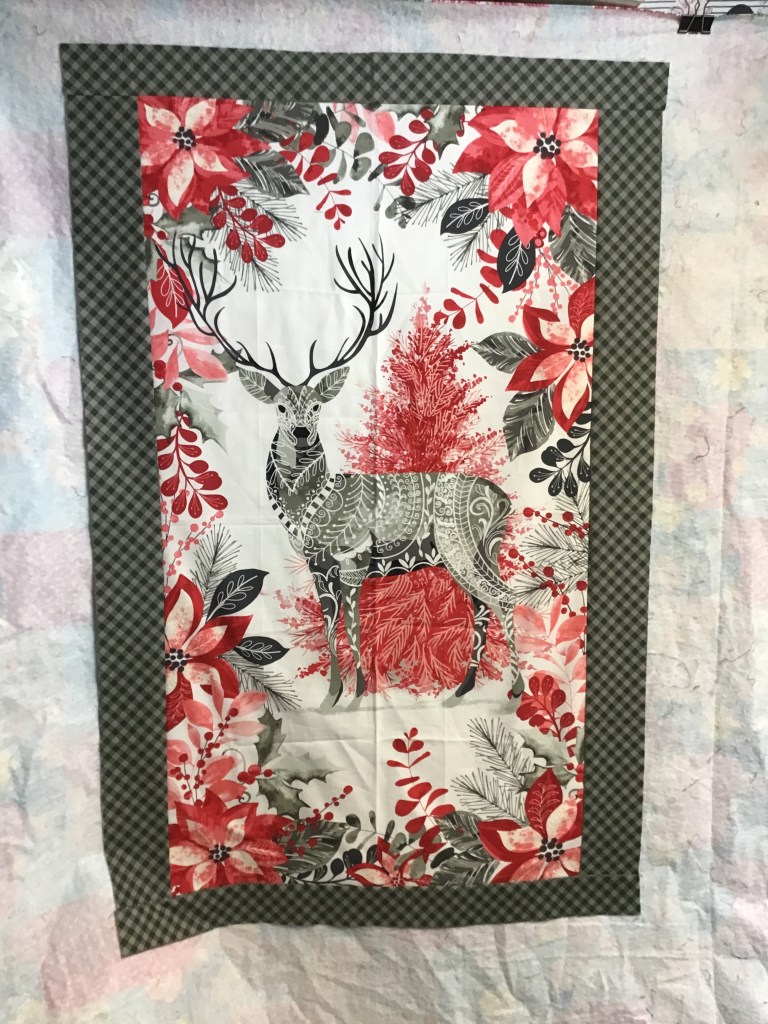
    The first thing we need to do is trim the panel to the correct size. I measured my panel and decided to completely remove the printed plaid panel border and start over from scratch. The problem I ran into once I removed the outer part was that my panel ended up a bit small. But never fear — that’s an easy fix we’ll talk about in just a minute.

    Now to fix the size issue — I did the math and figured out I needed to add 1/2″ to my side border strips so my panel with the border would end up the correct size. Luckily, the pattern includes the figures to guide you through trimming your panel and adding the panel border. Take your time to make sure your panel with the border will be the right size before moving on.

    Please note that if your panel with the border is too small, add another narrow border and then trim it to the correct measurements. Conversely, if your panel with the border is too big, simply trim it to the correct size.

    Once I figured out the math for sure, then I cut my borders. I thought it was kind of funny to cut off the grey plaid on the panel only to replace it with a grey plaid border. Silly me, but now the math works out just right.

    I sewed my side borders on first and then I sewed my top and bottom borders to the panel after that. And PRESTO! My framed panel was exactly the right measurement because I took the time to figure it out before I cut and sewed. Yay me!

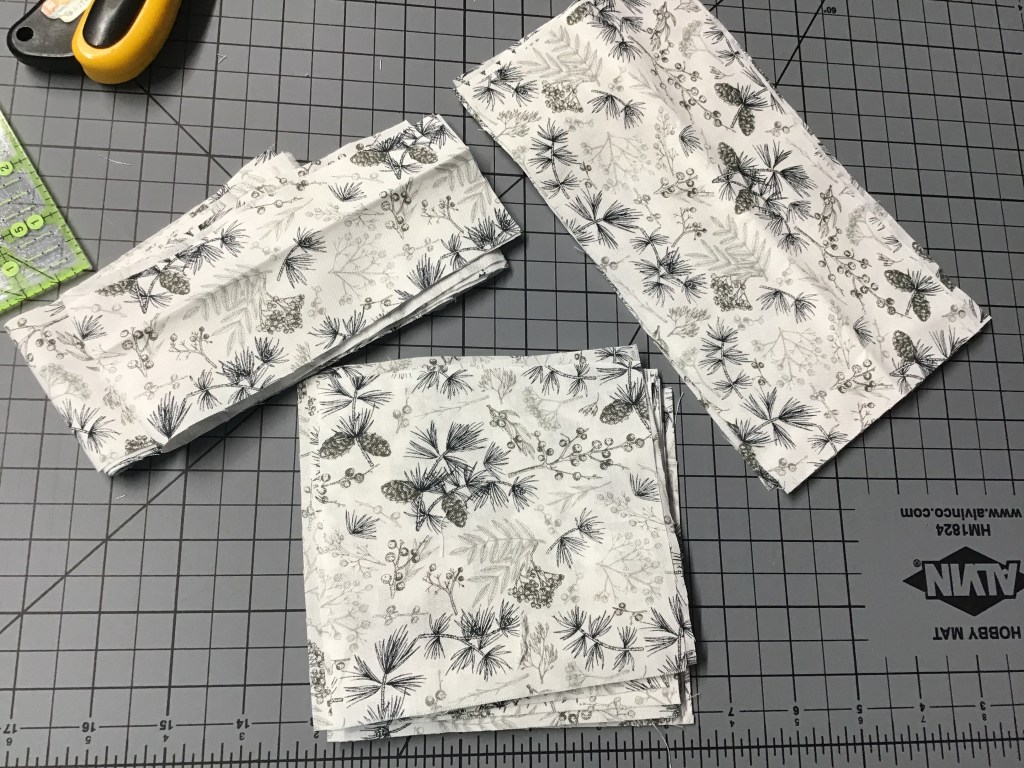
    Now let’s cut the rest of the fabric for the quilt.

    All set! Background and prints are cut and we’re ready to move on.

    Time to make some Half Square Triangles (HSTs)! Believe it or not, but I really like making HSTs — probably because they are building blocks for so many different quilt block patterns.

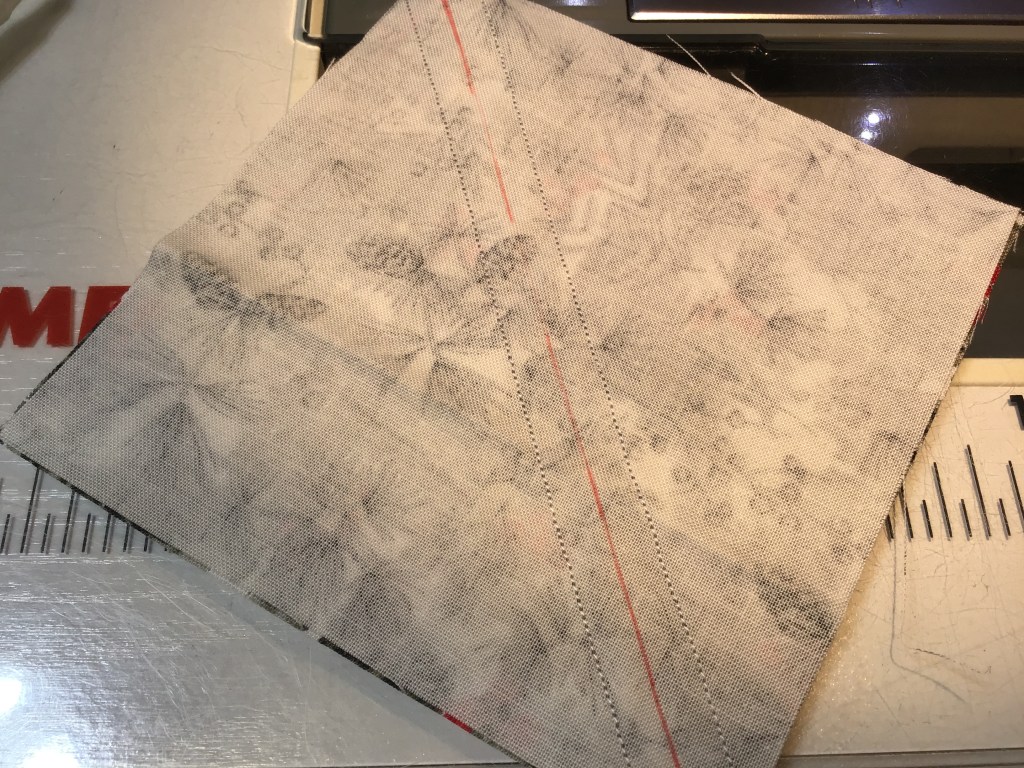
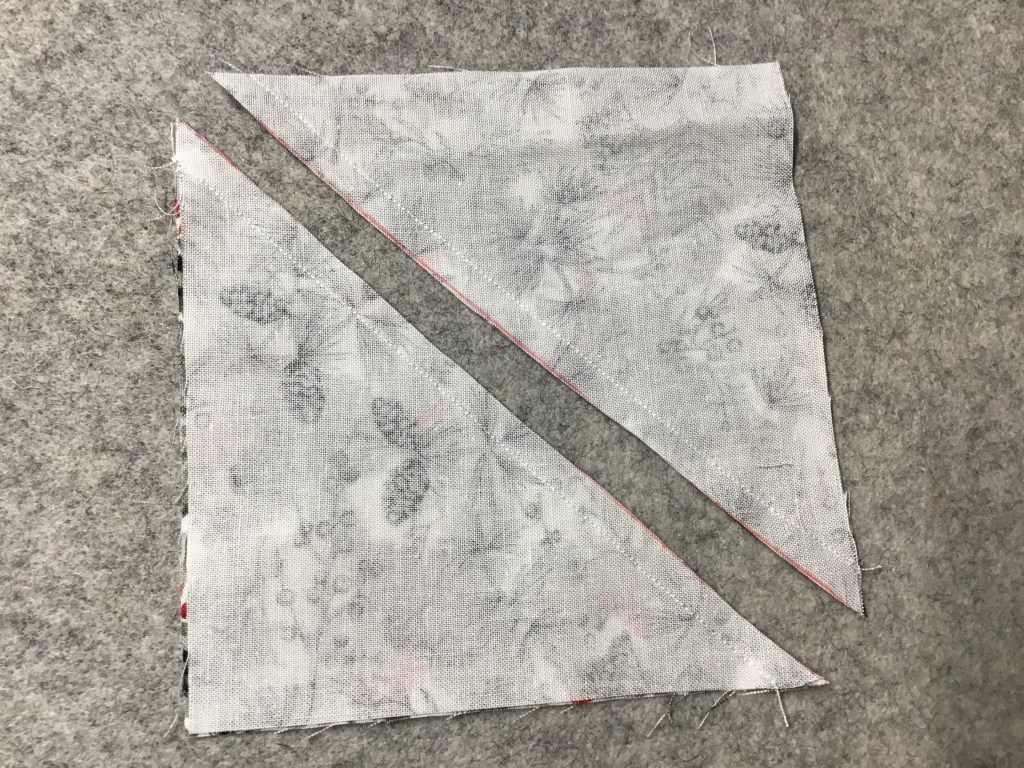
    Layer a background and a print square right sides together (RST) and draw a diagonal line from corner to opposite corner. Using your 1/4″ seam, sew on both sides of the line. Then cut on the line to make 2 HSTs. Easy piezy!

    I like to chain piece all my HSTs before I head to my iron to press them. If you are able, press half of each print/background combination seams towards the background and the other half towards the print. This way your HSTs will nestle together, snug as a bug.

    After you’ve pressed all of the HSTs, it’s time to square them up and cut off the little dog ears, if needed. I literally just trimmed off slivers to get them to the right size.

    Have you ever tried a Bloc Loc ruler for squaring up/trimming your HSTs — there is a little diagonal channel that sits over your seam and keeps everything from moving or sliding around. Very clever ruler that does one thing and does it very well. Of course, there are lots of different square rulers on the market for squaring up HSTs and other blocks. What are your favorites?

    Yippee! Now let’s sew our HST’s into Arrow (or Chevron) blocks. Sew 4 matching HSTs together into a Four Patch block, turning the HSTs as shown. This is where having 2 HST seams towards the background and 2 towards the print really comes in handy so that your seams nestle together and help you to have nicer points with less bulk.

    Repeat to make all the Arrow blocks for the quilt. Then head over to the iron to give them a good press.

    Now sew background rectangles to the top of the Arrow blocks.

    Yay! On to one of my favorite parts (sometimes anyway….LOL!) — laying out and arranging the blocks. Now that I use a flannel-backed table cloth hung up in front of my fabric storage cubes, it’s a lot easier than it used to be when I laid my quilts out on a bed. Ugh! When I was a novice quilter (and a lot younger than I am now), I used to lay them out on the floor. Not anymore, thank you!

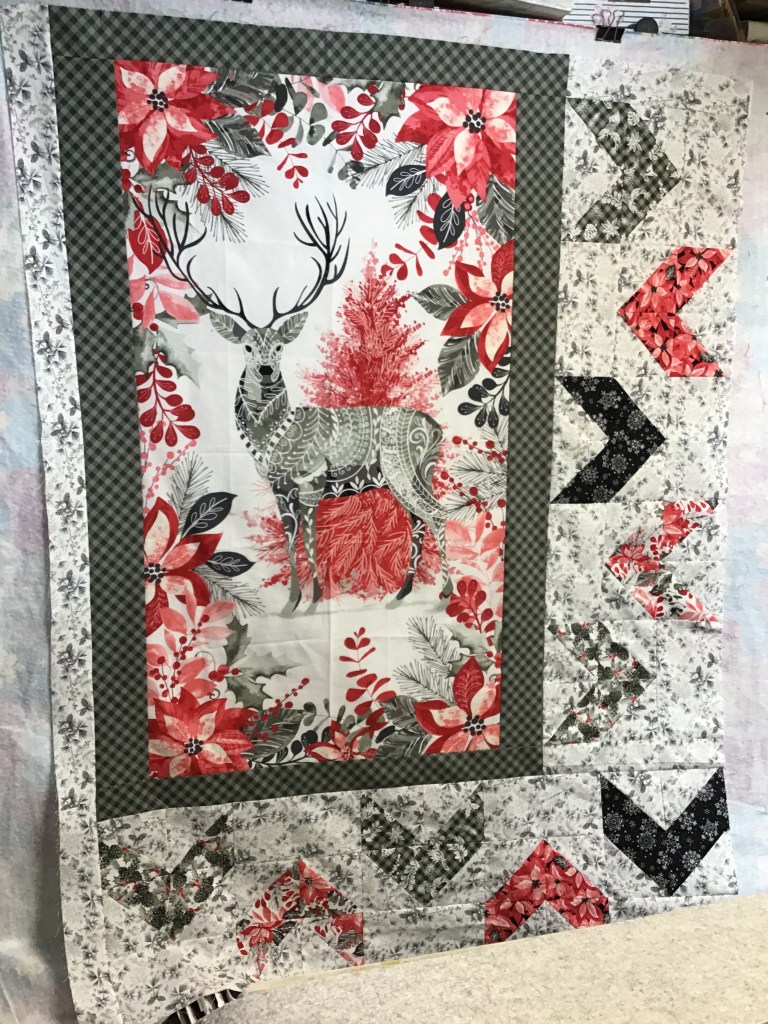
    Lay out the quilt according to the pattern diagram, flipping the Arrow blocks as shown. I played around with my color placement and decided I liked the arrangement in the second photo the best.

    Next, let’s sew the blocks together on the right side of the panel. Please note you will need to add a background strip to the top and bottom of the section so that it will fit.

    Okay, let’s sew the bottom row of blocks together and then sew the section to the bottom of the panel. Yes, the borders are added in a clockwise fashion instead of adding opposite sides at the same time.

    Looking good! Let’s sew a background border strip to the left side next.

    The top background border strip is last.

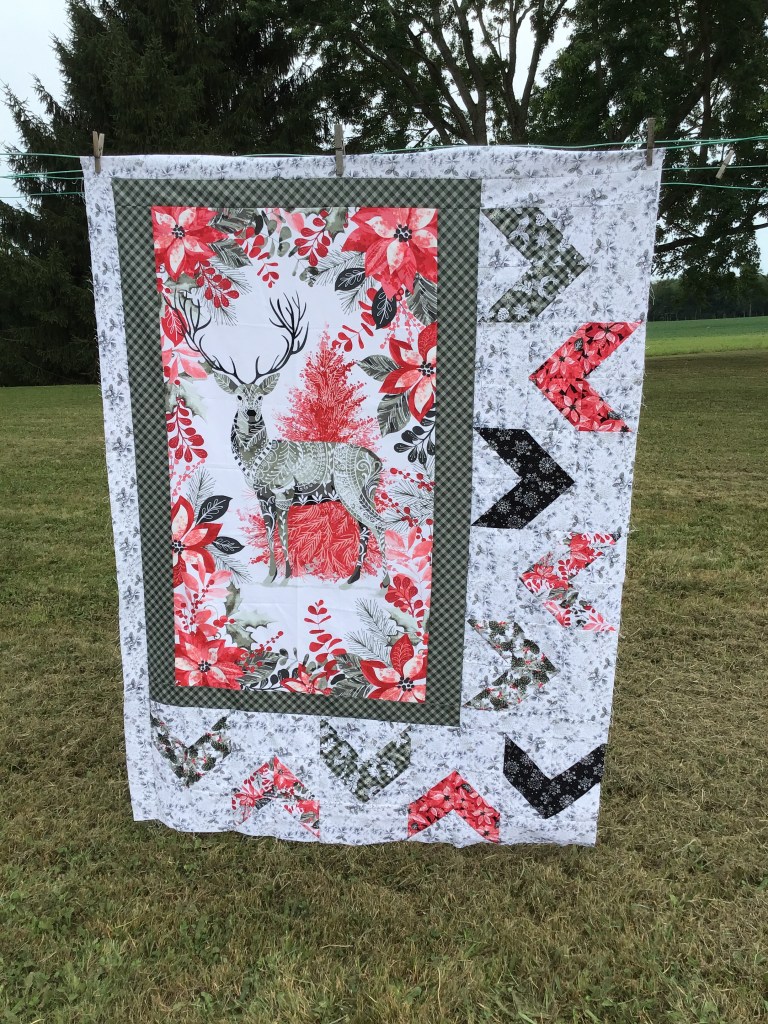
    And here it! 31 is done! Isn’t it lovely??? The colors just glow, don’t they???

    I am thinking about adding an outer border to make it a bigger throw quilt size, but haven’t quite decided yet. What do you think — should I add another border or finish it as is?

    As I am writing this post, I have my 31 quilt top up on my flannel wall so I can just enjoy looking it at. It will stay there until I start my next summer tutorial.

    That’s it for me this week.

    Happy Summer and Happy Quilting!

    Until next Thursday —

    Always,

    Tricia @ VRD

    Rose Cards · Tips and Tricks · Tutorials · villa rosa designs

    VRD Duet Quilt Tutorial and a Little Blog Hop Teaser

    Happy Thursday to you!

    I hope you were as inspired as I was after seeing my curated Spring VRD Rose Card pattern list last week. If you missed the post, you can find it HERE. I was SEW inspired, that I used a new blog quilt tutorial as an excuse to make a pretty new quilt top. (Nah, you’re right — I didn’t really need an excuse. LOL!)

    But, first, let’s talk a little bit about our upcoming VRD Blog Hop!

    Oh my gosh! The Hop is only weeks away. I hope I’m ready in time. Of course, I’ll be ready on time.

    I thought I’d tell you a little bit about some of prizes that are coming in for the Hop from our awesome event Sponsors.

    Here’s a glimpse of the goodies that have arrived so far! I can’t wait to send them off to the winners. Maybe you’ll be a winner this year. All you have to do is visit all of the blog posts each day to register for prizes! Lucky you! Yippee!

    I am also happy to share that our International friends will have a lot more variety this year for prizes as several of our Sponsors are able to ship directly to you. I’m getting really excited about the Hop. I hope that you are too. Don’t forget to tell a friend…..or two about it (or everyone you know!) so they can Hop right along with you.

    Be right here on March 14th for the kickoff to our week-long Blog Hop in celebration of Villa Rosa Designs and all of our bloggers and sponsors. Be here or be square (yeah, you knew I was going to say that.).

    Okay, now let’s make a quilt!

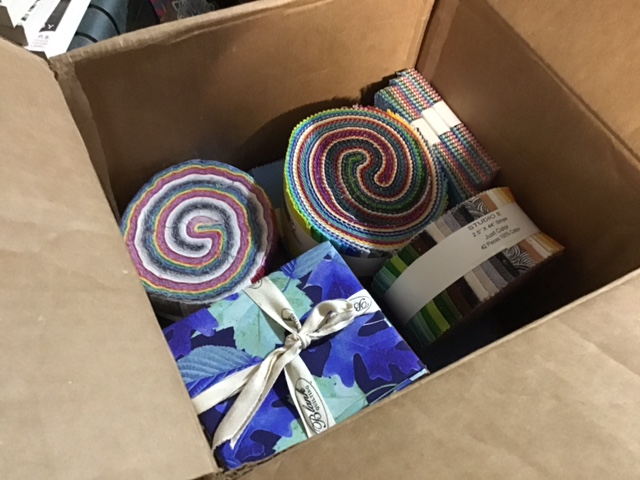
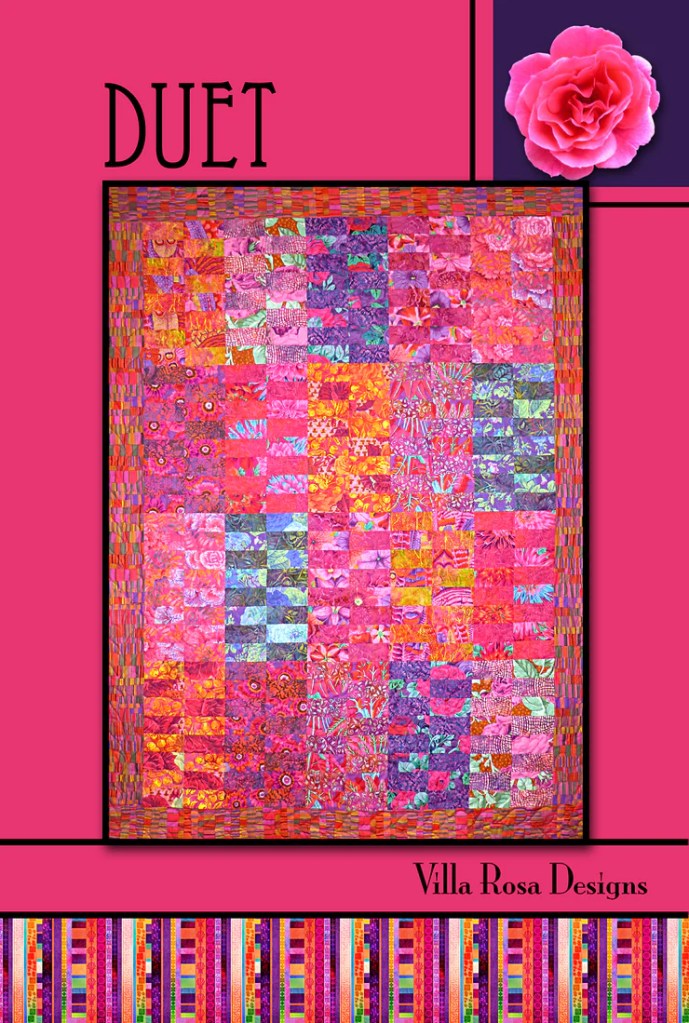
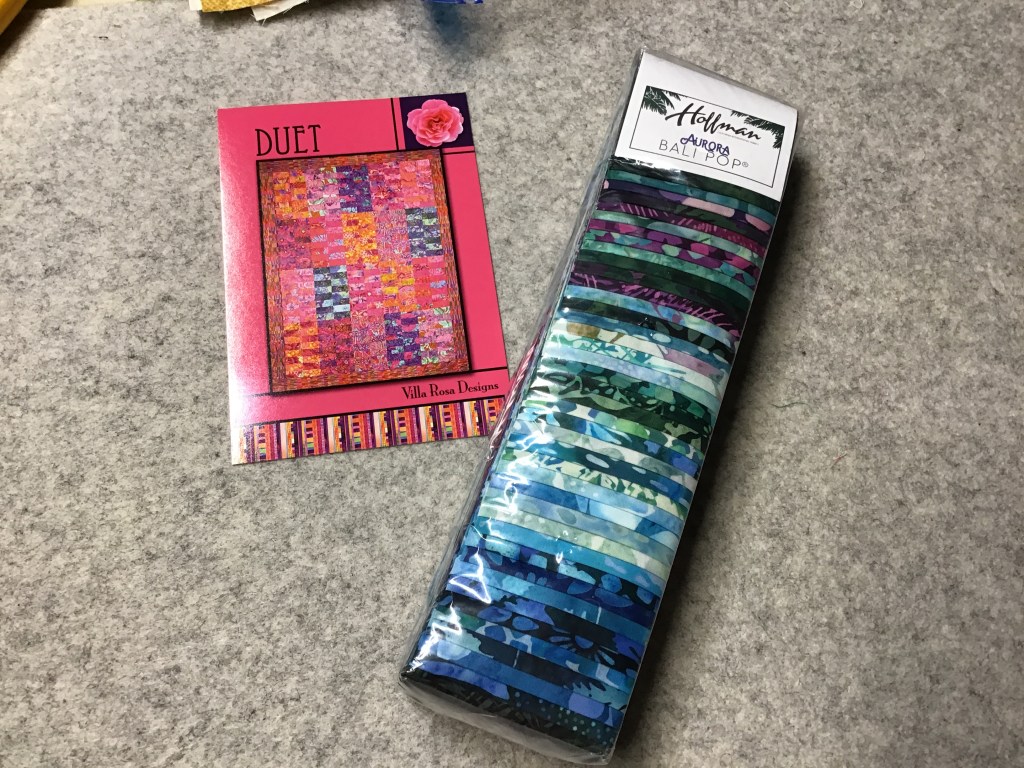
    After last week’s post, I just kept telling myself I had to do a new quilt tutorial for the blog. So I dove into my big magic crate of project kits and pulled out a Bali Pop to make Duet.

    You can get your own physical Duet pattern HERE or a digital pattern HERE.

    I’m really loving this Aurora Bali Pop for Duet. Isn’t it just so yummy with blue, green, teal, purple and all the shades in between. Special thanks to Hoffman for providing the fabric for this project.

    Sadly, we don’t have the Aurora Bali Pop in stock at the VRD online shop, but we do have other great options you can use to make this quilt. You can check out our 2 1/2″ strip sets HERE.

    Let’s get started!

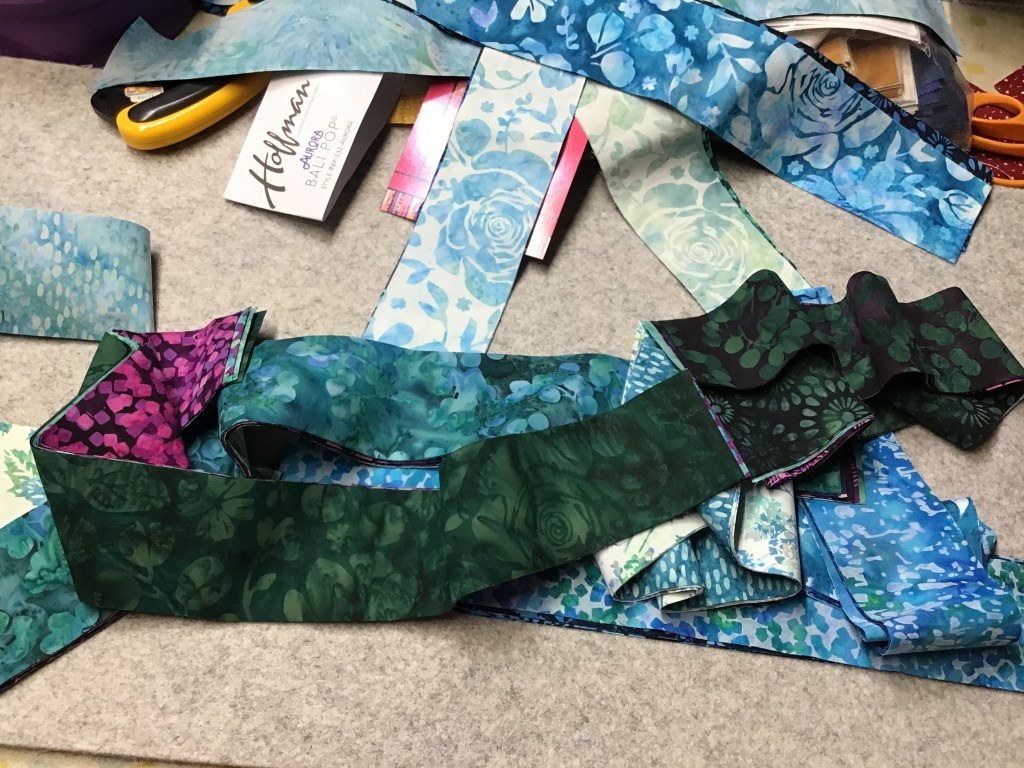
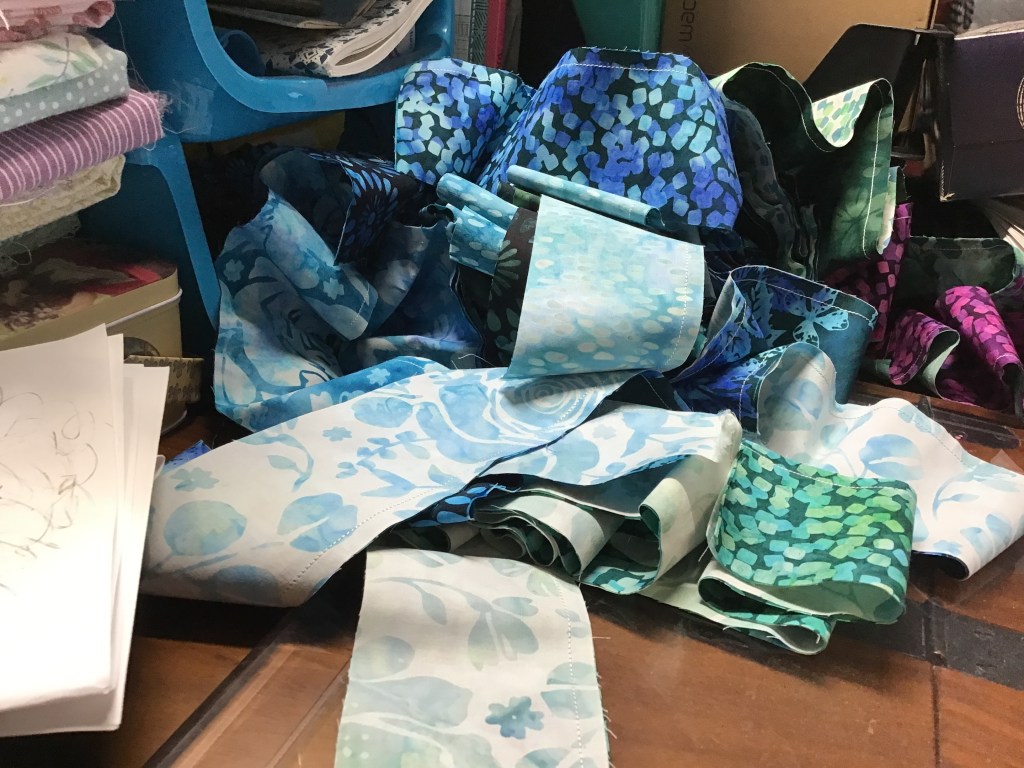
    The first thing I did was pair up my strips. You’d think it would be easy to do this — pair a dark with a light — but most strip sets do not have an equal number of each. So that meant I had to use the mediums as either a light paired with a dark or as a dark paired with a light. Here you can see my tangle of strips as I pair them up. And you can see my unique way of keeping my pairs together by stacking them at different angles. Sometimes I don’t know where my ideas come from. And I don’t really care as long as they work.

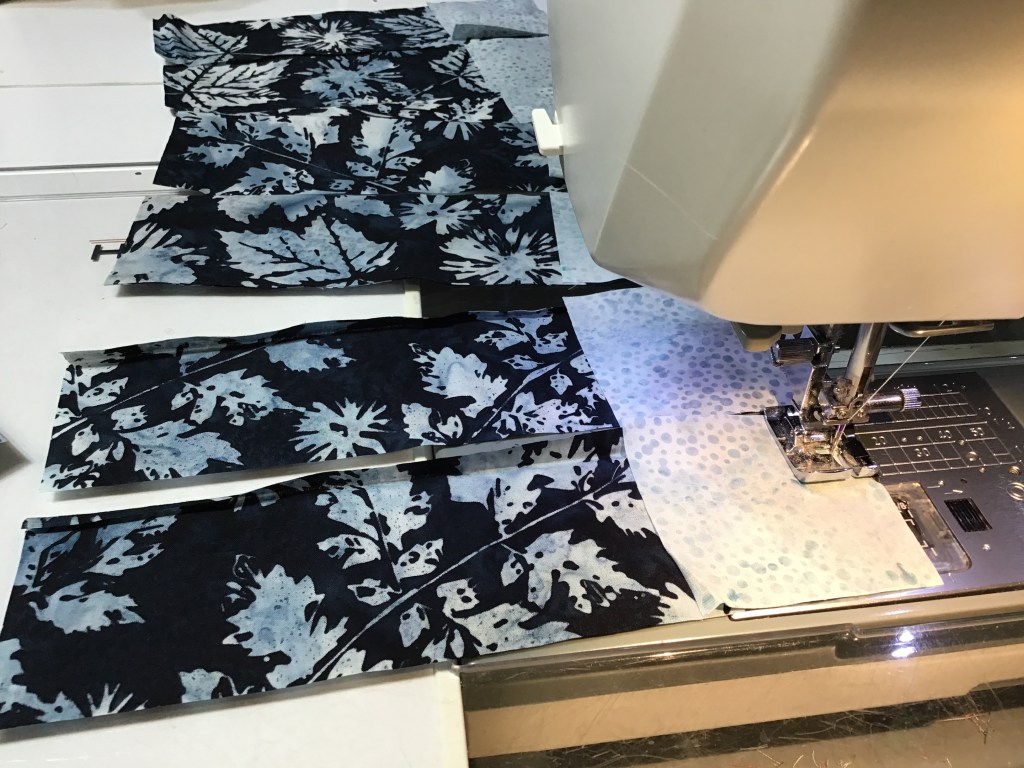
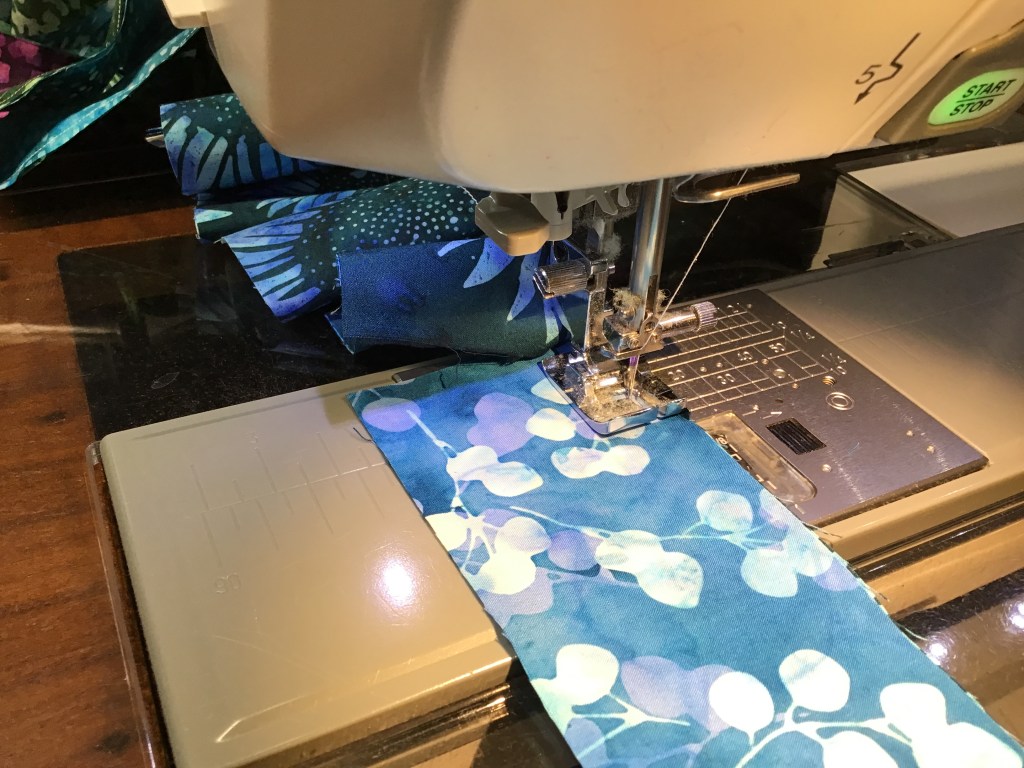
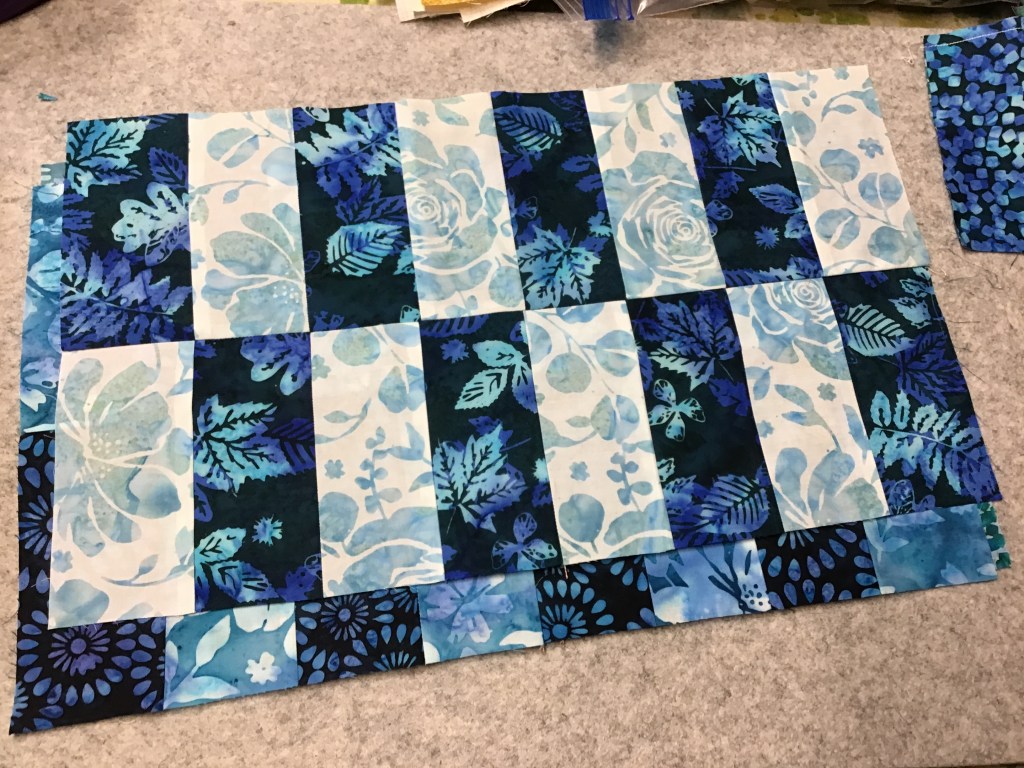
    Happily, this strange stack did actually work and I took it to my sewing machine to sew my paired strips together. At the machine, right before I stitched each pair, I cut the strips in half. Or you could cut them in half after you sew them together. I chose to do it first because I really don’t enjoy sewing long strips together. Then I sewed and sewed using the assembly line approach until I had all the pairs sewn together. Check out my tangle of sewn strips in the second photo. Yikes!

    Now that my strip pairs are all sewn together, it’s time to sew the 2 matching strip sets into a quartet. No, they really weren’t tied up in knots. I just started at one end and kept working my way through the assembly line, sewing one quartet together after another. Surprisingly, it was a pretty speedy process.

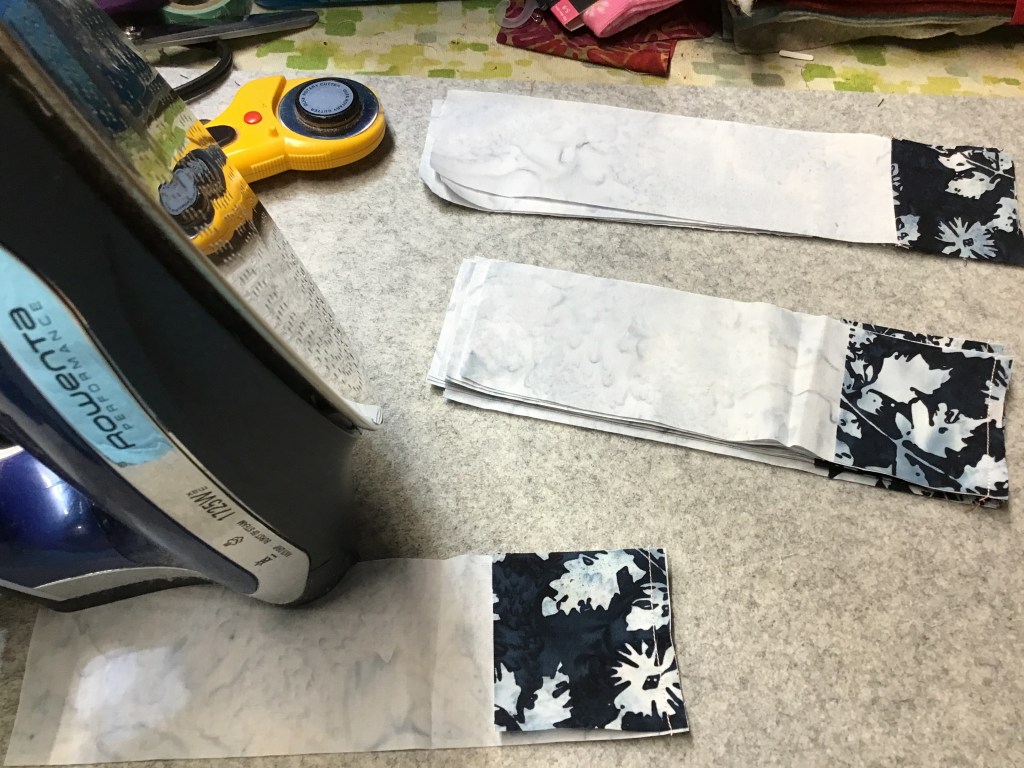
    Woohoo! All those quartets are sewn and now I’m going to press the seams on each strip set going in the same direction. This will actually save me some time in a couple of steps.

    I really love sewing with batiks. Now.

    HOnestly, I’ve come late to the batik party, but I’m here now and that’s what counts. For a long time, my friends Mary Lee and Leslie, were always ooh-ing and awe-ing over the latest batiks while I was always like — okay, pretty fabric.

    I’ve learned since then that batiks truly are a joy to sew with. They are smooth and supple, even crisp. And the colors — oh my goodness!

    I have found that I do need a brand new needle when I’m sewing a batik project (yes, I know I should start every project with a brand new needle……). Batiks have a much tighter weave and a higher thread count than regular cottons. I have found that a used needle pokes holes in the fabric and may even break threads whereas a sharp needle kind of glides between the fibers. Food for thought……..

    Let’s press!

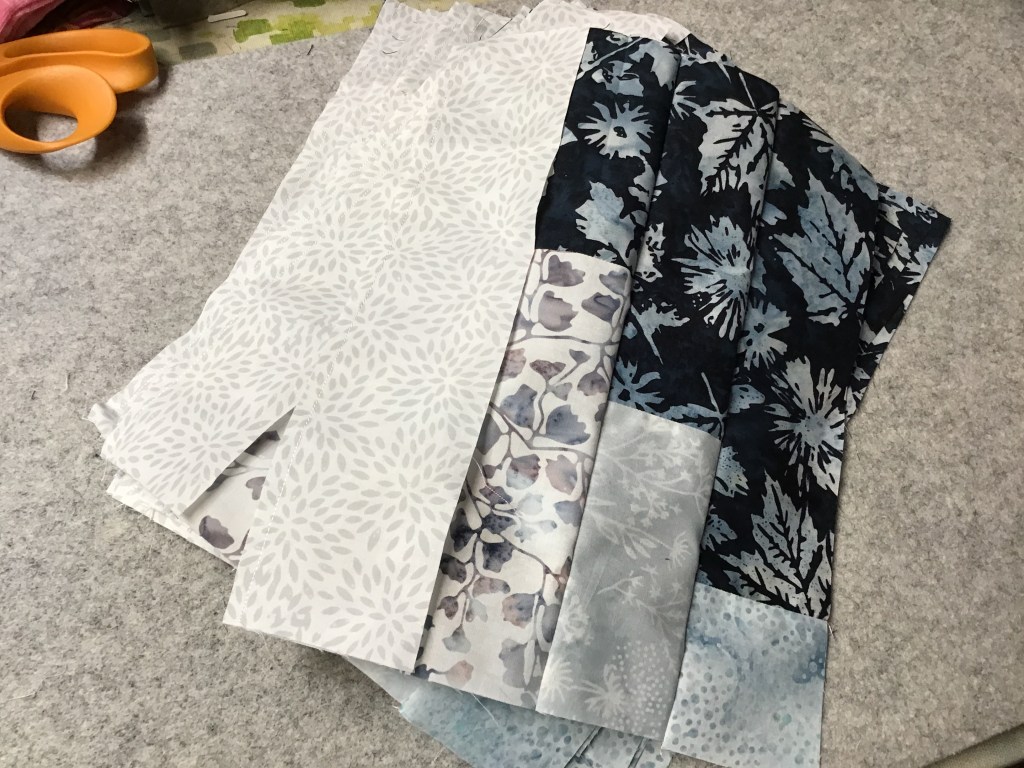
    Now all of my quartets are pressed, it’s time to cut the units. Do you stack your pieced strip units for cutting? I do, and here’s a technique I learned a long time ago — stagger the strips when you layer then so that seams are not sitting on top of each other. Cutting is a lot easier and more accurate when you are not trying to cut through a big lump of seams.

    I stacked 4 quartets on top of each other when I cut the units. Then I just picked up the units from each quartet and stacked them together. It was kind of like dealing playing cards, in a way. Then I stacked up the units, keeping each quartet together. Easy piezy! Now back to the machine for more sewing!

    Next I’m going to take 2 matching units and sew them end to end, making sure that the alternating fabrics are consistent. Then I will sew the second set of units exactly the same way as the first one.

    Because I pressed all my seams in each quartet the same direction, sewing the units together is really easy as the seams matched up and nestled together (awwww! They’re so sweet!) when I layered them right sides together.

    Quick! Sew, sew, sew!

    Yay! Time to finish the blocks! I am going to sew the 2 units from the same quartet together side by side, flipping a unit so the 2 fabrics alternate completely throughout the block. 19 more to go….

    Blocks all done! I’m going to press them one more time and then it’s time to do the block shuffle on my flannel board.

    Okay, here’s my final block arrangement. The purples and the lights were a challenge to find a way to lay them out so everyone was happy. What do you think?

    Back to the sewing machine to sew the blocks into rows and the rows together to make the quilt top.

    I’m very pleased with how Duet turned out. I’m considering about adding a border to make it larger. Hmm, methinks I need to think about this a while longer….

    Like a lot of our VRD patterns, Duet worked up quickly and I would say it’s probably a one day project to make the quilt top. It’s great to have some one day projects tucked away in your back pocket to pull out when you need a quilt in a hurry. I hope Duet will be one of them for you.

    Well, that’s it for me today. One marathon quilt in a day is enough for me for now.

    See you next Thursday, same time, same place.

    Until then —

    Always,

    Tricia @ VRD

    Quilting Partners · Rose Cards · Tutorials · villa rosa designs

    NEW Villa Rosa Designs Rose Card Patterns for September, New Website Content, and VRD Ebb Tide Quilt Tutorial

    Happy Thursday to you!

    Welcome to September! Now that fall and back-to-school is in full swing, we all need to turn our thoughts to MORE QUILTING! In order to help you get sewing again, today’s post is brimming over with quilty goodness.

    First up is our brand new collection of September Rose Card patterns.

    YAY! By now most of you know that I just love the Thursday after the first Friday of the month because that’s New Pattern Day here on the blog. So, here they are — Candies, Icing, Elsie May, Delphinium, and Jolie.

    Every month the VRD designers never fail to create a new collection of wonderful quilt patterns. I am sew blessed to be part of this VRD family. Just looking at the new patterns every month, I get inspired and can’t wait to spend some quality time with my sewing machine.
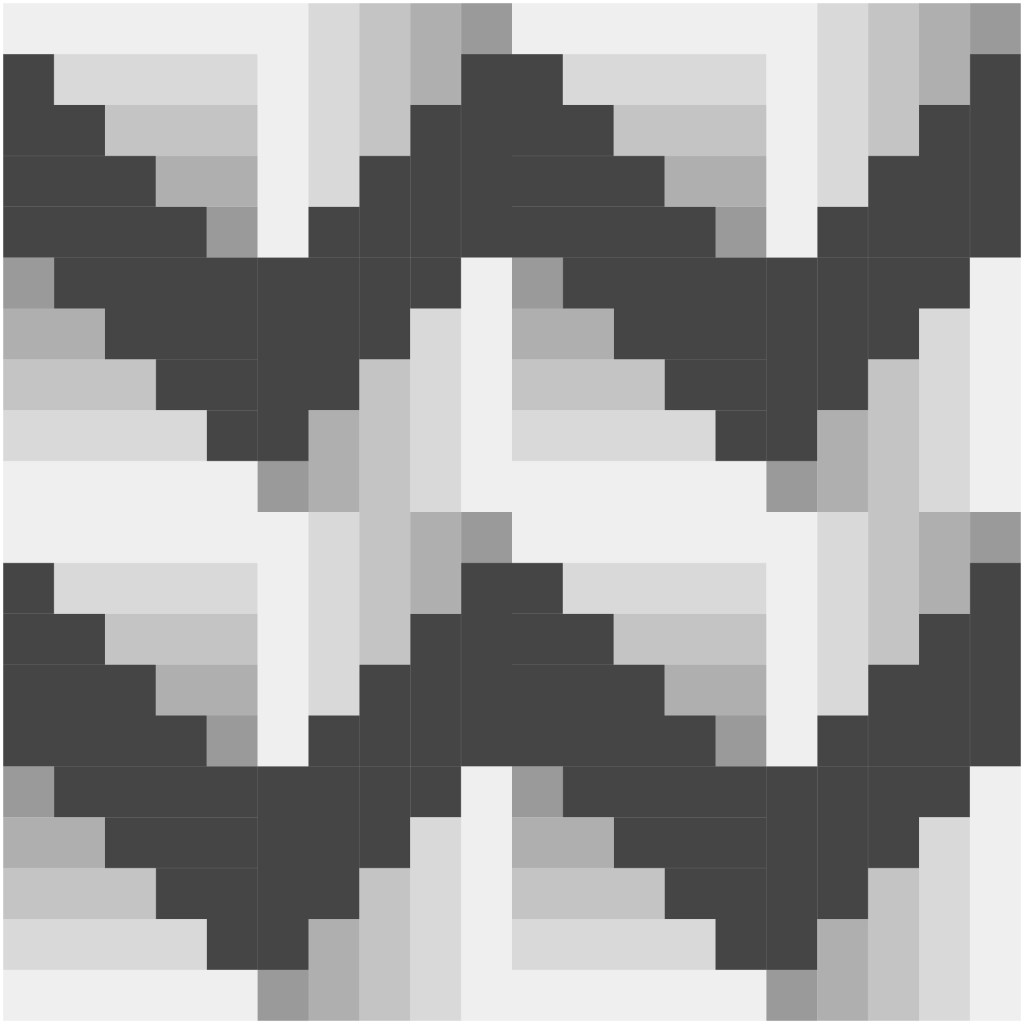
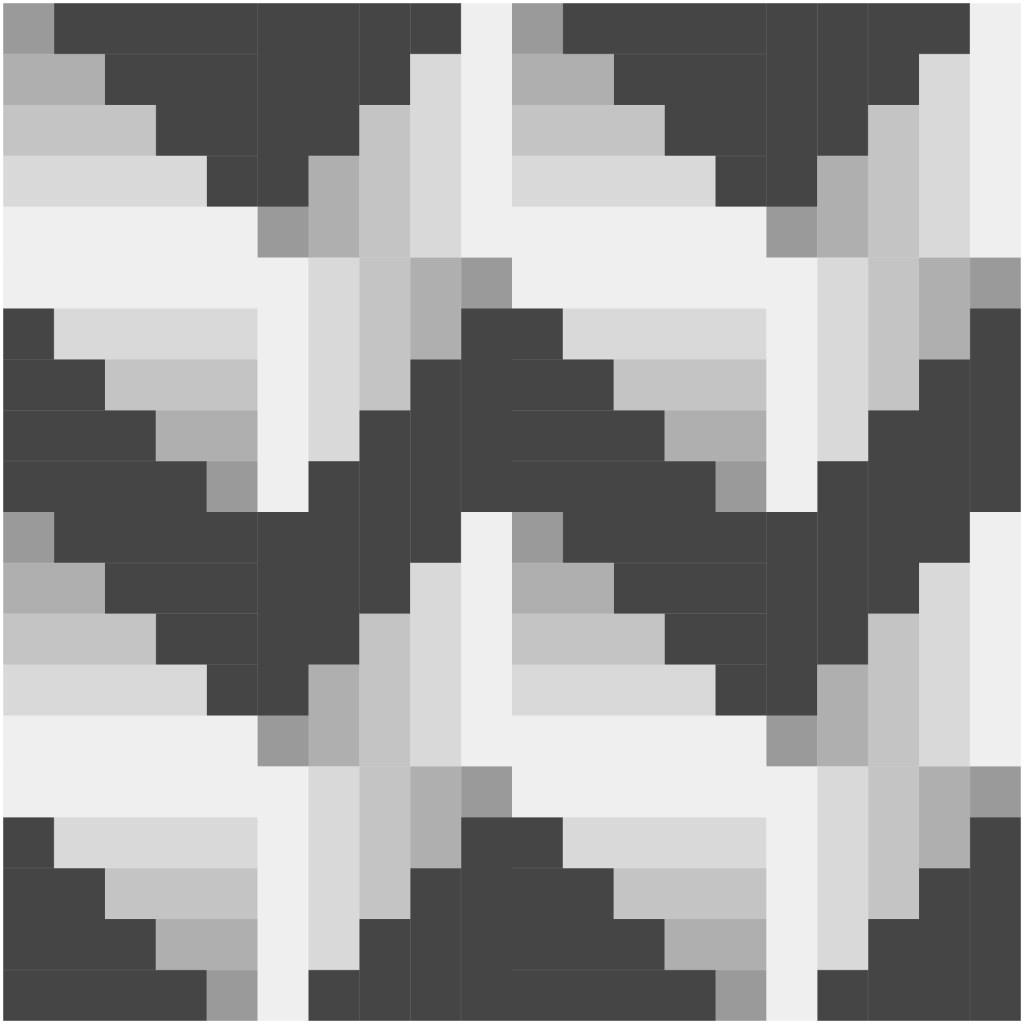
    You can get all 5 patterns HERE.

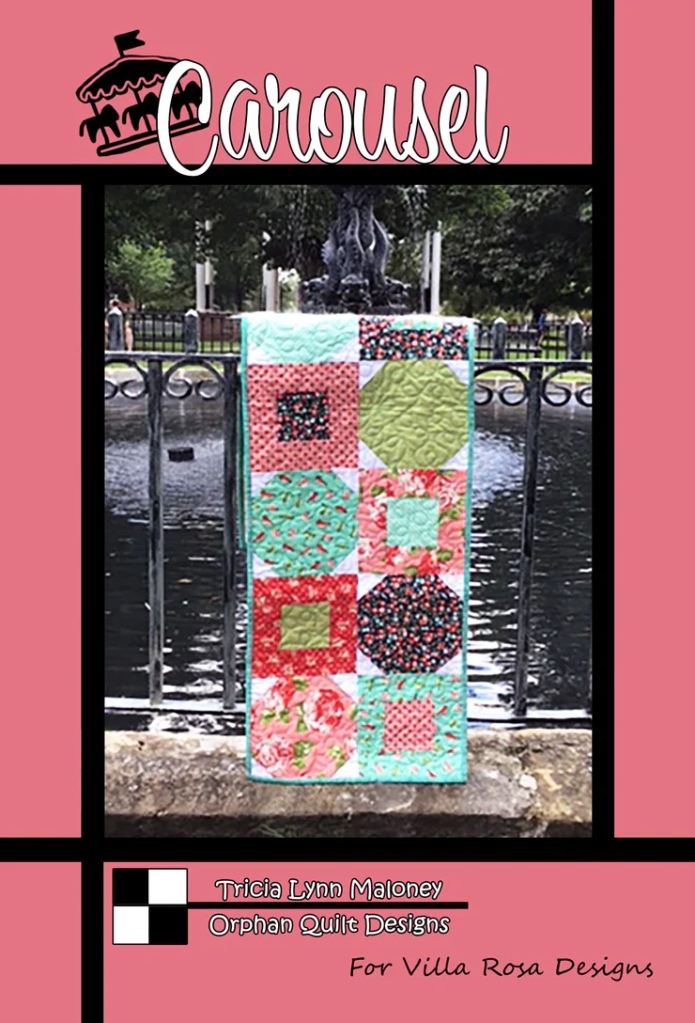
    But wait……..there’s more! Here is my new September table runner, Carousel.

    Get Carousel HERE

    I’m not sure if you can really see the background fountain in the cover photo, above, but I took this photo at Diamond Park, a lovely tree-lined park in the heart of my hometown. The land for the Park was gifted to the city in 1795 (Meadville was founded in 1788) by the city founder, David Mead. This gorgeous fountain was then gifted and constructed in the park in 1863 by the Shippen family. It still stands and functions today, after being renovated a couple times through the years.

    Image from Meadville Calendar,
    https://www.facebook.com/MeadvilleClub

    Here’s a photo of the fountain with the park in the background. I didn’t even think to take any photos of the fountain itself when I was taking photos of Carousel. Silly me! Sorry for that. It truly is a beautiful fountain — and well over 150 years old.

    As much as I’d like to keep talking history (another of my favorite things), we’d better keep moving or we’re never going to get to today’s tutorial. LOL!

    Just this week, a new feature was added to the VRD website — a printable list of all the FAT QUARTER patterns in our VRD Rose Card catalog!

    People and fabric companies have been asking for such a list for a while now. The fat quarter patterns on the list are thoughtfully organized by the number of fat quarters needed for each pattern — how ingenius! This awesome list will be updated monthly to include all new fat quarter patterns going forward, so the list will always be current and up-to-date. WOW!

    You can find the printable list at the bottom of the website under Patterns (see the screenshot below). In fact, there is LOTS of stuff at the bottom of the website. If you’ve never scrolled down that far, you should. You might just be missing something good down there, like a directory of the tutorials on the blog, for example. Or maybe something important like Corrections.

    Here’s a screenshot of the bottom of the VRD website, showing the things
    you will find down there.

    You can find the printable Fat Quarter Quilt List HERE.

    Now on to our tutorial!

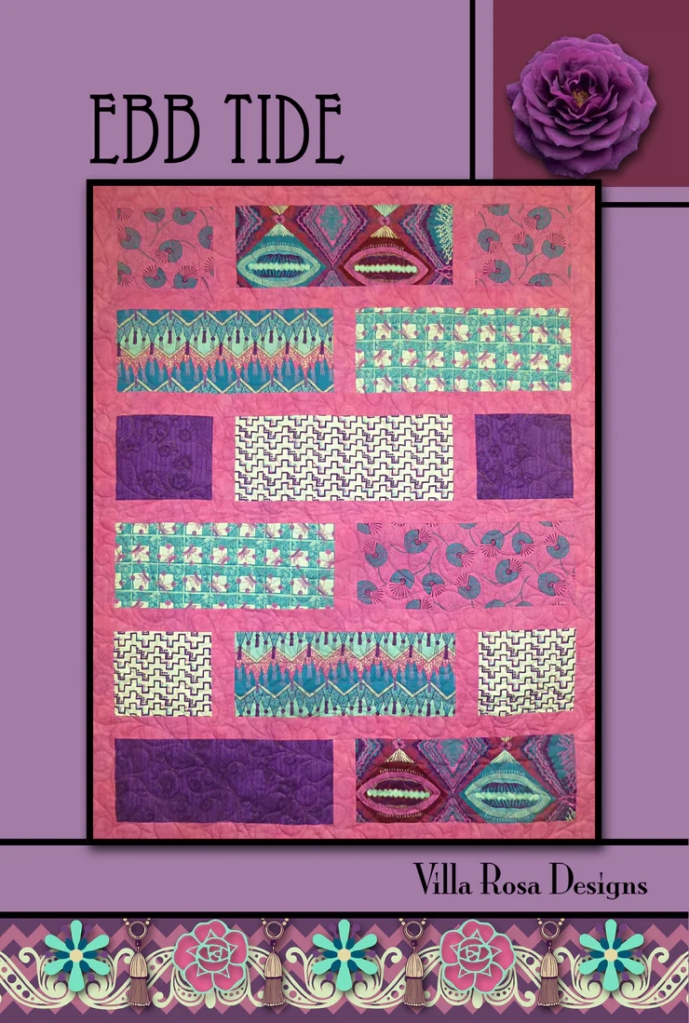
    Keeping with our recent Fall fabric theme, I have another great VRD quilt tutorial for you today. You will want to add Ebb Tide to your collection of VRD Rose Cards if you don’t have it yet. So far, it’s the fastest and easiest VRD pattern I have made. It also looks great in any fabric, and can even handle large prints with ease. Ebb Tide will definitely become one of your go-to Rose Card patterns, if it hasn’t already.
    Get Ebb Tide HERE

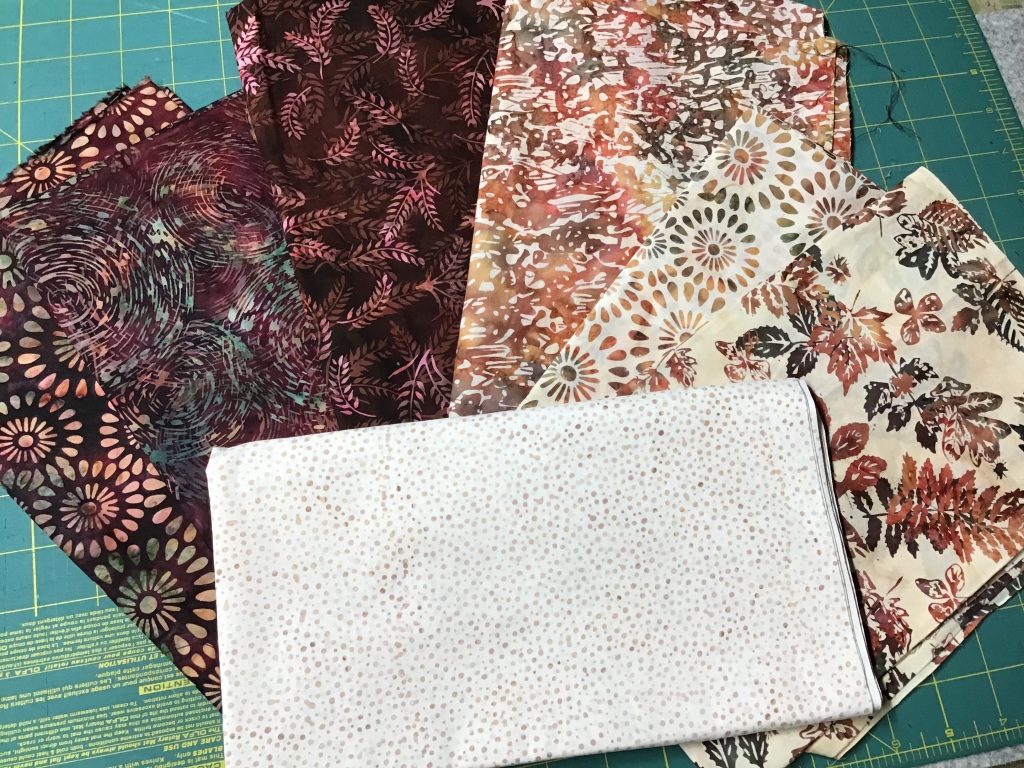
    Today I’m working with Hoffman batiks again — more yummy luscious fall fabrics. Aren’t they beautiful??? This collection is appropriately called Shades of Autumn. Ask for it at your favorite quilt shop or retailer.

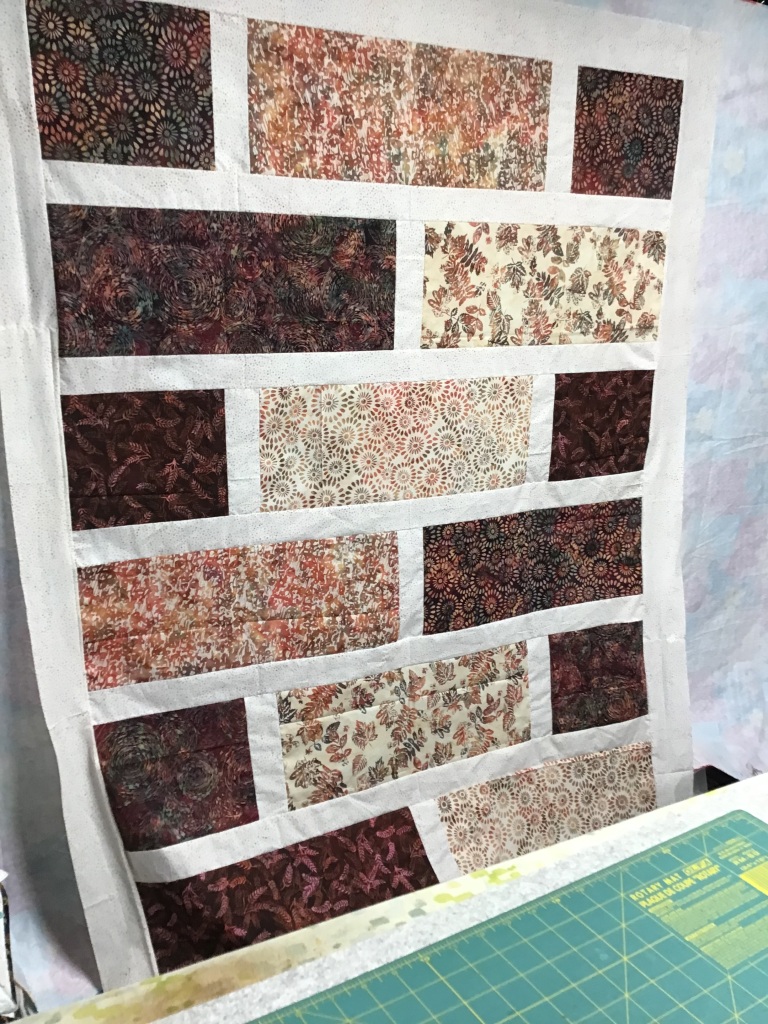
    I want to point out a couple things about the fabrics I am using for Ebb Tide. It takes 6 fabrics plus a background. I chose 3 light fabrics and 3 dark fabrics. I liked the idea of a color-balanced quilt. Some other options might be to choose 6 medium or dark fabrics with a light background or 6 light fabrics with a medium or dark background. The fun thing about this quilt is that it really does go together lightening-fast and you’ll probably want to make more than, which will then give you more opportunities to play with different fabric options.

    Let’s make Ebb Tide!

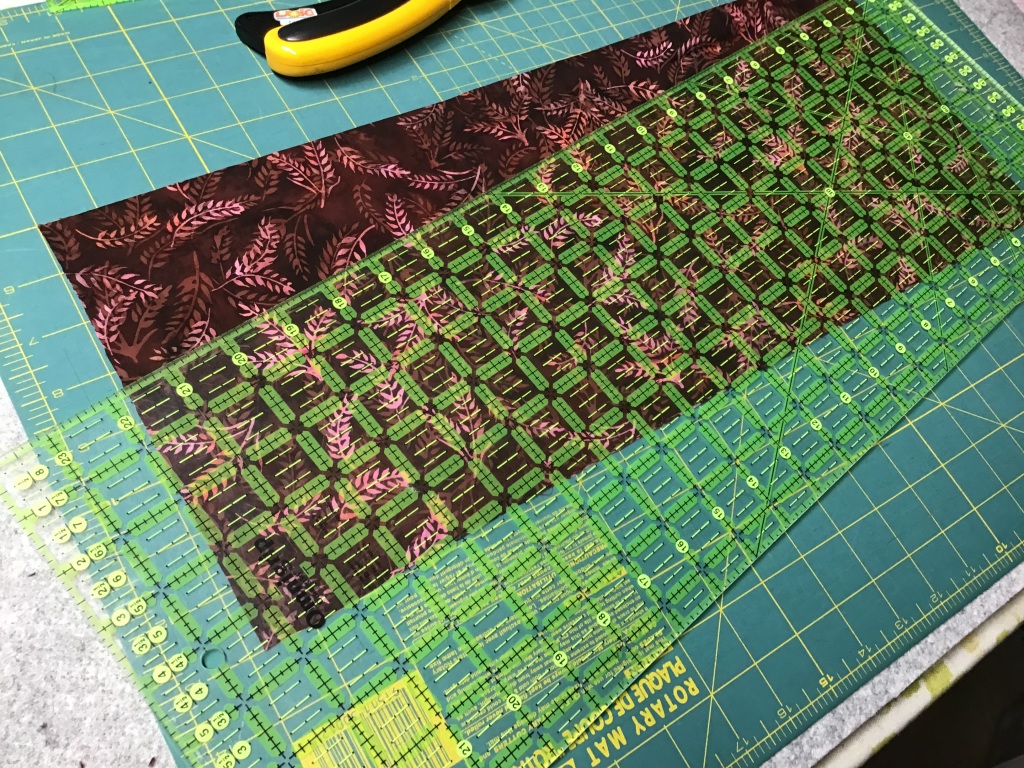
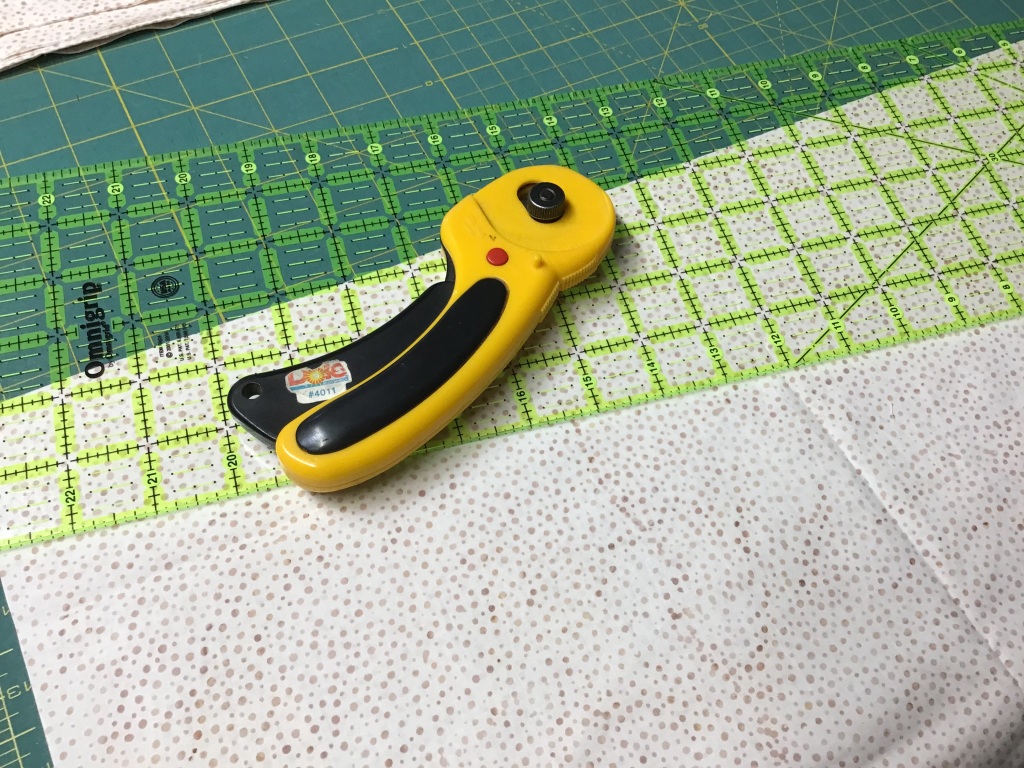
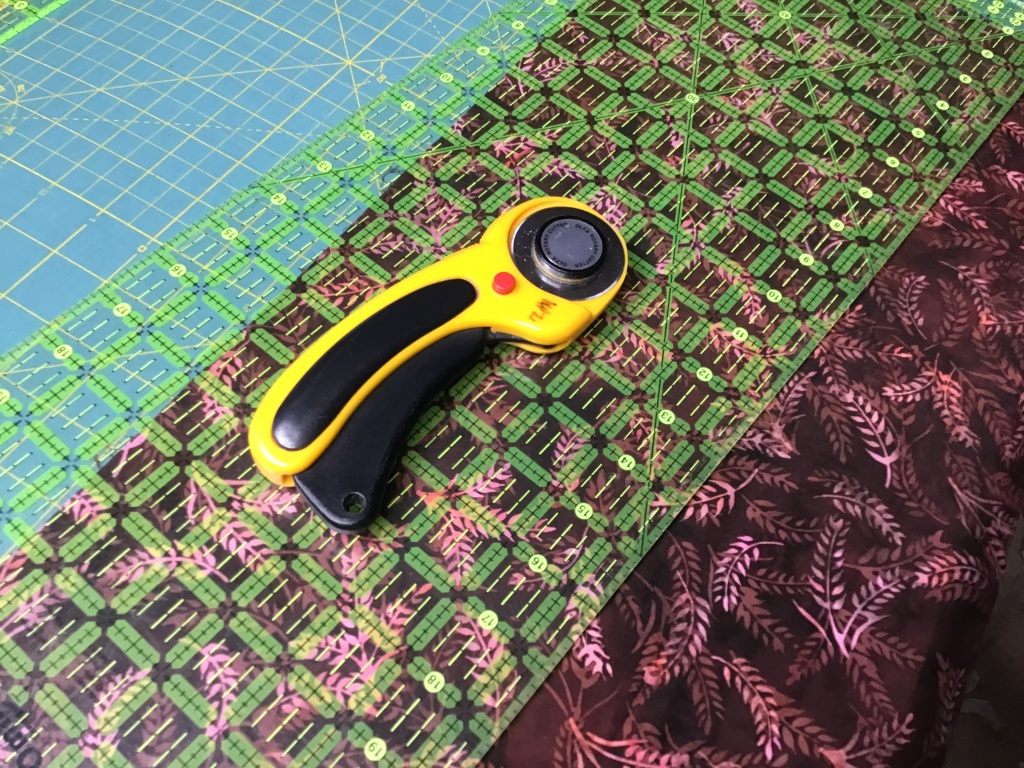
    1. After you’ve gathered up your fabrics, it’s time to cut your pieces out. This doesn’t take very long, but keep in mind the pieces you cut out of the fat quarters will be large and you might need a bigger ruler. I used my 8 1/2″ x 24″ ruler to cut the rectangles out. This really helped to keep my cutting more accurate as I didn’t need to joggle multiple rulers around to get the wider strips. I also layered and cut three fabrics at a time, but don’t feel you have to layer your fabrics for cutting if you’re not comfortable doing that. Cutting one layer at time works just as well.

    Don’t have an 8 1/2″ x 24″ ruler? You can find it HERE. You can find the my absolute favorite rotary cutter, the Olfa ergonomic cutter, HERE.

    2. Now that my fat quarters are cut out, it’s time to cut the background pieces. For this part, I switched to a 2 1/2″ x 18″ ruler, which makes cutting my 2 1/2″ strips and rectangles a breeze. Don’t have a 2 1/2″ ruler? You can find it HERE.

    3. I’m going to use my new handy-dandy design wall to lay the quilt out so I can arrange the fabrics before I sew everything together. The beauty of Ebb Tide is that because you aren’t piecing the quilt blocks, you can get right to laying out and arranging the entire quilt. Sew simple!

    PSST! In case you didn’t know — my fancy-smancy design wall is actually a flannel-backed large rectangular table cloth clipped to the top of my fabric storage cubes doors with large binder clips. Here’s a great traditional plaid flannel backed table cloth that comes in multiple colors and sizes. What a HUGE improvement this has been for putting quilts together — so much easier than laying blocks out on the floor or on a bed to shuffle things around.

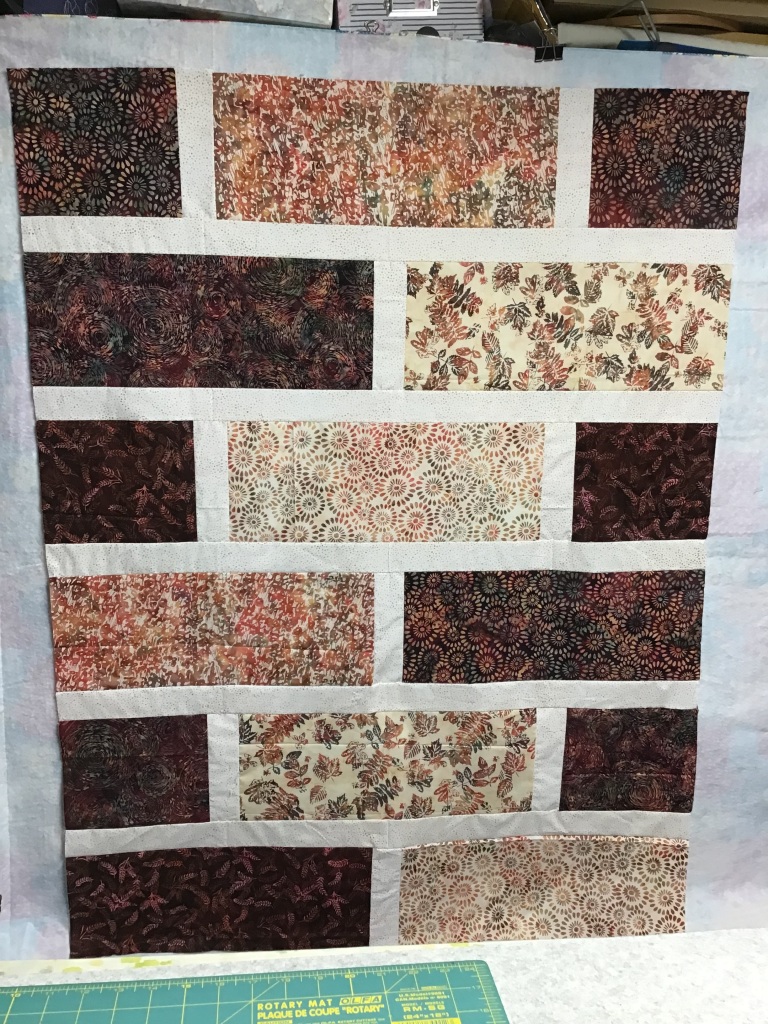
    Here is my final layout for the Ebb Tide, not including the horizontal background strips in between each block row. What do you think of this layout? I really like how your eye travels down the quilt, following the light fabrics path, kind of like stepping stones.

    4. Now that I’m happy with my layout, it’s time to sew the horizontal rows together. I just gathered one row at a time and took it right to my sewing machine (which is close to my flannel design wall). I sewed the large rectangles and the sashing strips together one row at a time, then I put the rows back on the flannel wall, so I didn’t get things mixed up as I worked.

    5. Now I’m ready to sew the long sashing strips in between the pieced rows. One last look to make sure I have the rows in the right order, and back to the sewing machine. I sewed the rows and sashing strips into sections and then sewed the sections together, that way I didn’t have to struggle with the growing quilt top with each row I added.

    6. One more step and Ebb Tide will be done (or at least the quilt top will be done). Did you know that a quilt top is called a flimsy in quilt lingo? Isn’t that fun??? Sorry, I’m easily distracted — did someone say squirrel??? Tehehehe……..

    Now that the quilt center is finished, let’s sew the top and bottom borders on. But before we do that, I need to cut my border strips to the right size. I like to lay my border strips across the center of the quilt, trimming the strips to the width of the quilt center. I use the center because the edges can sometimes stretch out. By cutting my strips to the center width, I can bring those stretchy edges back to square. I know this sounds weird, but trust me, it works.

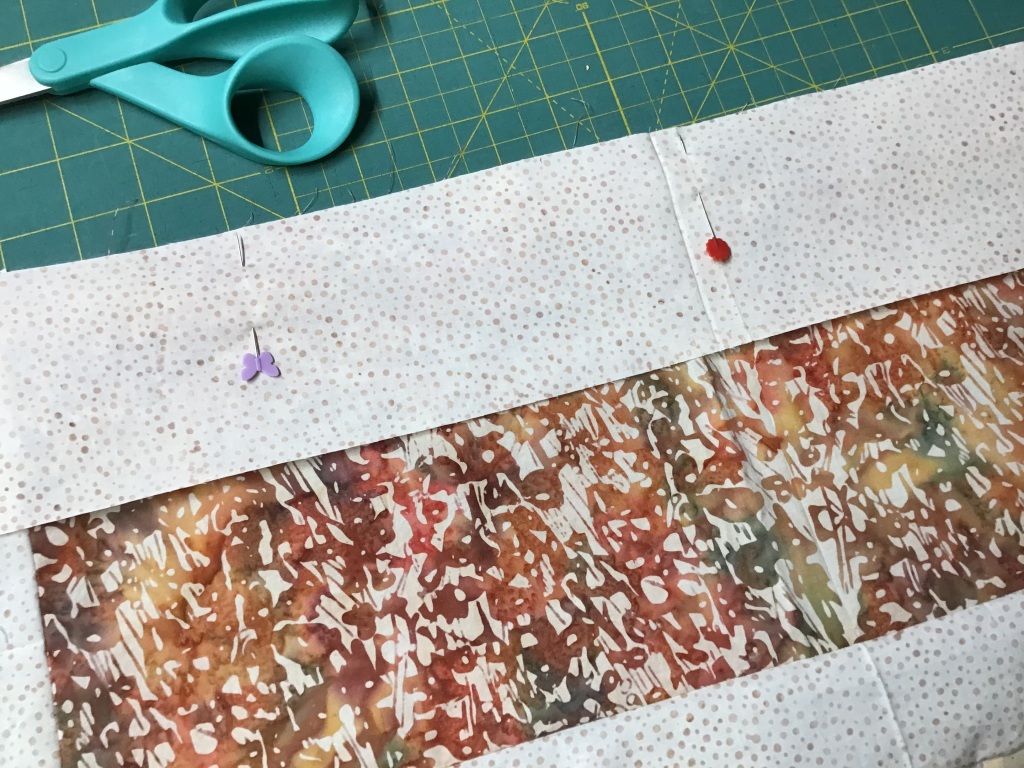
    Next I pin my borders to the quilt top. I start by matching the center of the border to the center of the side I’m sewing the border to ( I fold them in half to find the centers, making a crease at the true center). Then I match and pin the outside edges. After the edges, I straighten and smooth the quilt and border, adding more pins between the center and outside edges to keep everything in place while I sew. Finally, it’s time to sew them together, knowing that my borders will be flat and not waving all over the place.

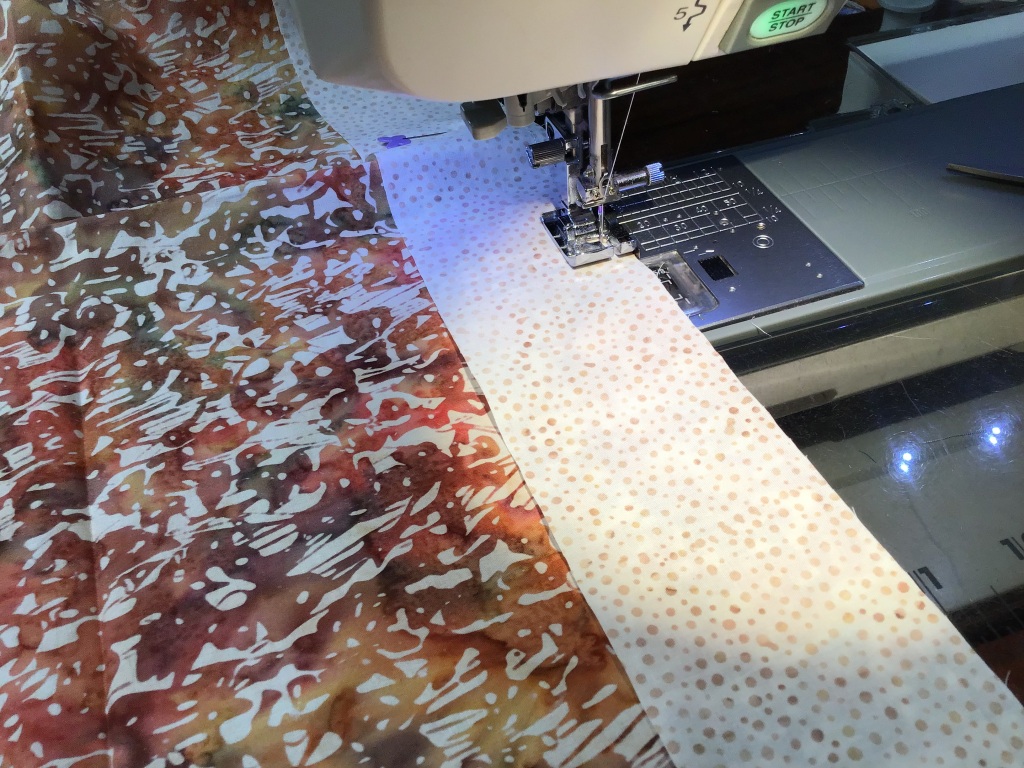
    7. The side borders are the last thing to sew to the quilt. They will need to be pieced so the border strips are long enough. For this quilt, I used a straight seam to sew the strips together, but sometimes I use a diagonal seam (I do this when fabrics are busy in order to hide my seam a little better).

    Yay! Ebb Tide is done. Eventually, I will back it with cozy fleece, machine quilt, bind, and label it. Hopefully sometime in the next 100 years. Ha!

    By the way, I wanted to let you know that it took me about 2 hours to make the Ebb Tide flimsy — that included cutting the fabrics, laying it out, and doing the photography for this tutorial. I wonder how long will it take you to make it?

    Here’s a “beauty” shot of my Ebb Tide flimsy — I really wanted to get a pretty picture with my Black-Eyed Susans. Sadly, the breeze wouldn’t cooperate with me, so the bottom of the flimsy kept blowing under the porch. Oh well…….

    Thanks for sticking with me through the entire blog post, I know it was a long one, but I hope you enjoyed all of the quilty inspiration.

    Take care and get quilting!

    Until next week —

    Always,

    Tricia