2026 Spring 6 Quilts in 6 Weeks Challenge · Rose Cards · Tips and Tricks · villa rosa designs

6 Quilts in 6 Weeks Quilt Challenge Week 2 and 10 Tips for Fast Finishing

Hello Quilty Friends!

Happy Thursday to you!

Welcome to Week 2!

I’m super excited to be hosting (and participating in!) our 6 Quilts in 6 Weeks Challenge. It’s been such a great motivator for me to start moving some quilt tops out of my to-be-finished pile and into my DONE pile… and that’s a big win in my book.

One thing I’m noticing already is how much easier it feels to focus on one quilt at a time instead of staring at my whole teetering stack of UFOs. (Because let’s be honest… those unfinished projects have a way of quietly judging us from across the room. Yours do that too, right? )

I’ve been having sew much fun seeing all the amazing finished quilts popping up on Facebook and in my inbox. Keep them coming! One of my favorite parts of this challenge is seeing what everyone else is working on. It’s so inspiring to watch these quilts come together… and it’s definitely keeping me motivated too.

Ready to see my Week 2 finish???

6 Quilts in 6 Weeks Challenge Week 2

Drum roll please…………………

Pacific Grove is my Week 2 finish. I made the Pacific Grove top for a tutorial here on the blog a while back (yeah……just found it on the blog and it was from 2024, sheesh!). You can find the Pacific Grove tutorial HERE.
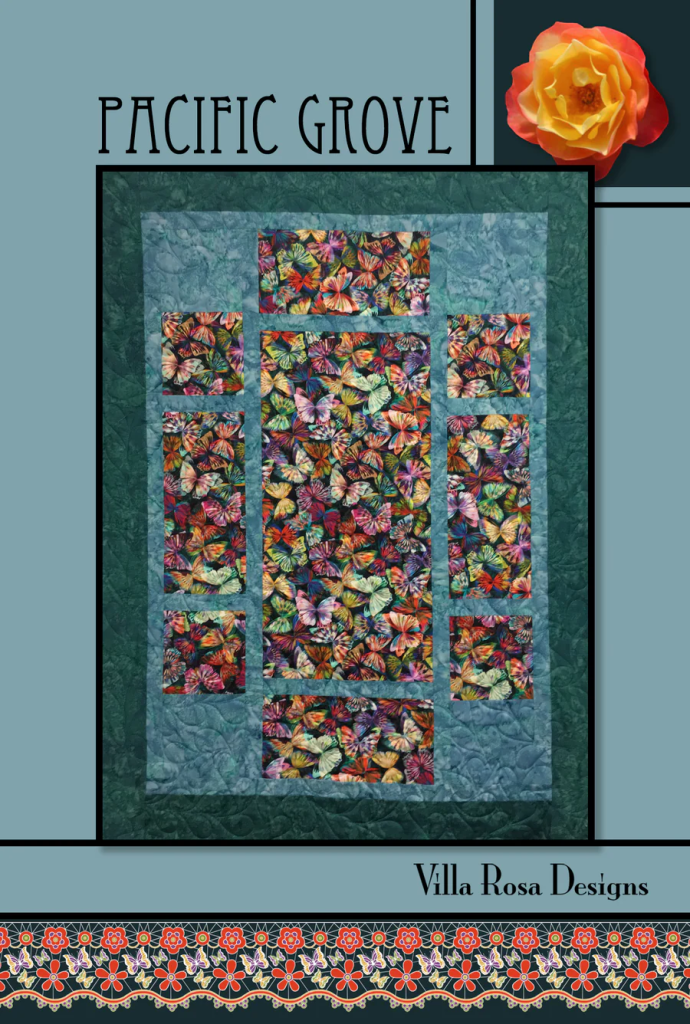
A colorful quilt design featuring butterfly patterns, titled 'Pacific Grove', created by Villa Rosa Designs.

Get your digital pattern HERE or your print pattern HERE

Here is my BEFORE photo:
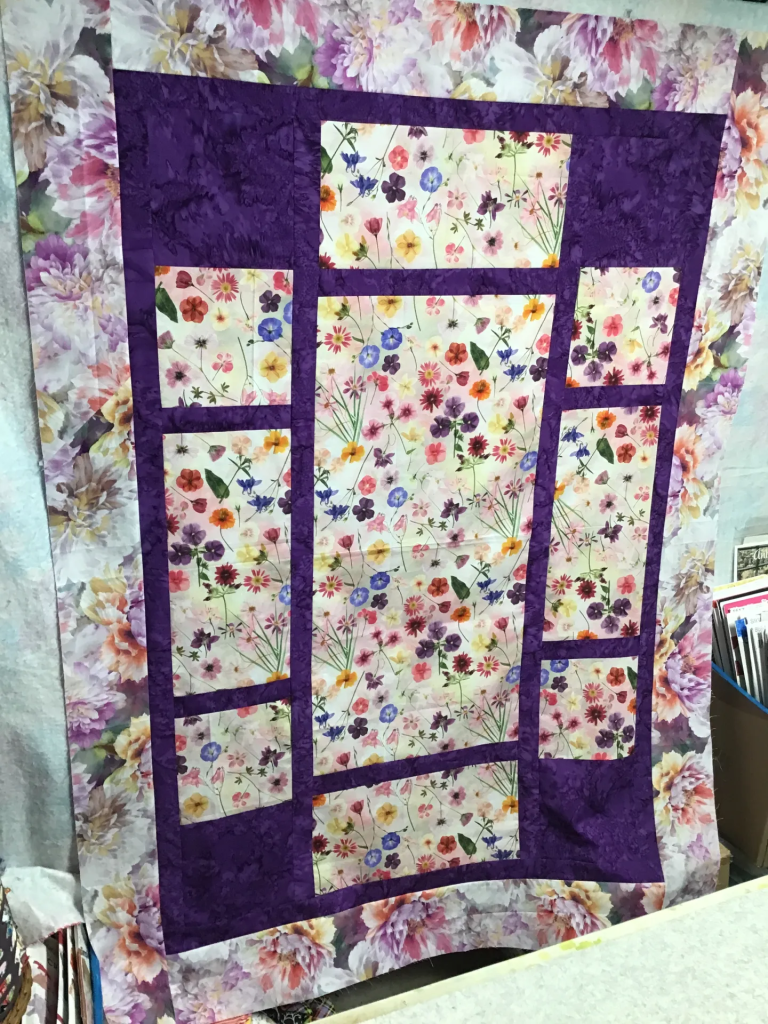
A colorful floral quilt featuring a variety of flower patterns framed with purple fabric.

My version of Pacific Grove, featuring gorgeous digital floral prints from our friends over at Hoffman, is like looking through a pretty framed window at a gorgeous flower garden. I just really love it. I wish I had finished it sooner, but…………..Life always gets in the way, doesn’t it?

And here’s my FINISHED Pacific Grove quilt!
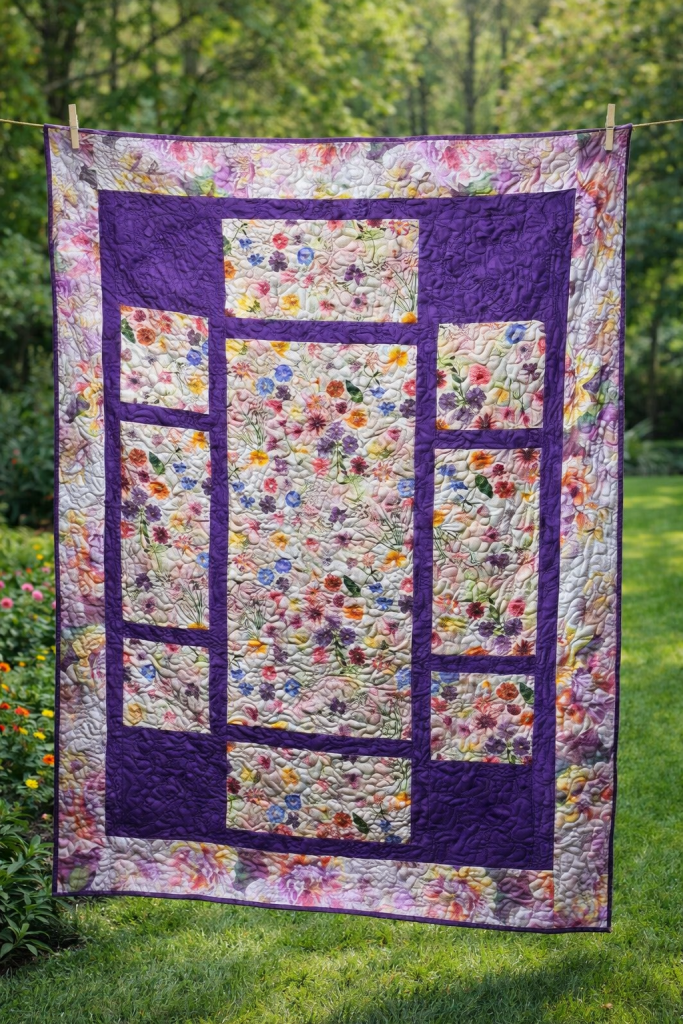
A colorful quilt with floral patterns in various shades, bordered by a purple frame, hung outdoors against a natural background of trees and grass.

Love how it turned out! I machine quilted it using a medium purple 100% cotton thread in a big open meander allover design which looks good on anything and is quick to quilt, too. I used a marbled purple fleece for the back, no batting. And I machine-stitched my binding again. I think I’m getting a little better at the corners. I figured out that if I folded the fabric the opposite way I normally do for hand-binding, it doesn’t get caught while I’m machine stitching the corners. Huh. Live and learn.

Just have to share another photo of my quilt. I wanted you to be able to see the pretty purple fleece on the back. And the great texture the big open meandering makes on the fleece. Have you ever tried using fleece on the back of a throw quilt instead of batting and backing?
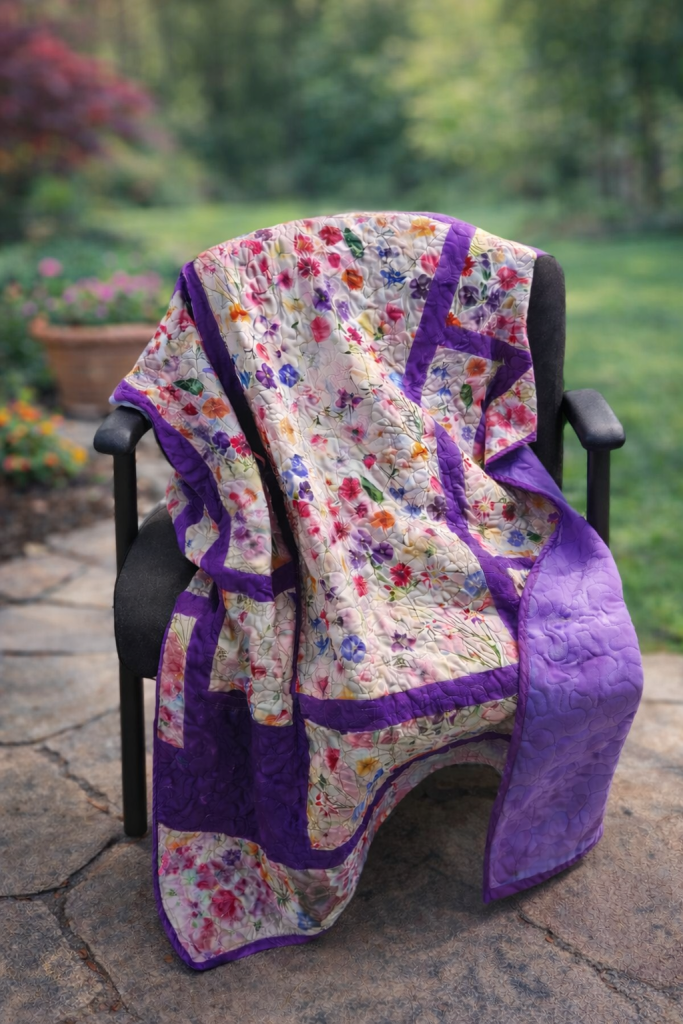
A colorful floral quilt draped over a black chair in a garden setting.

6 Quilts in 6 Weeks Week 1 Winner

Our Week 1 winner for the 6 Quilts in 6 Weeks Challenge is…

Kim C. in Washington

Woohoo!

Throw the confetti! 🎉

Congratulations, Kim!

Here’s Kim’s Week 1 finished quilt:
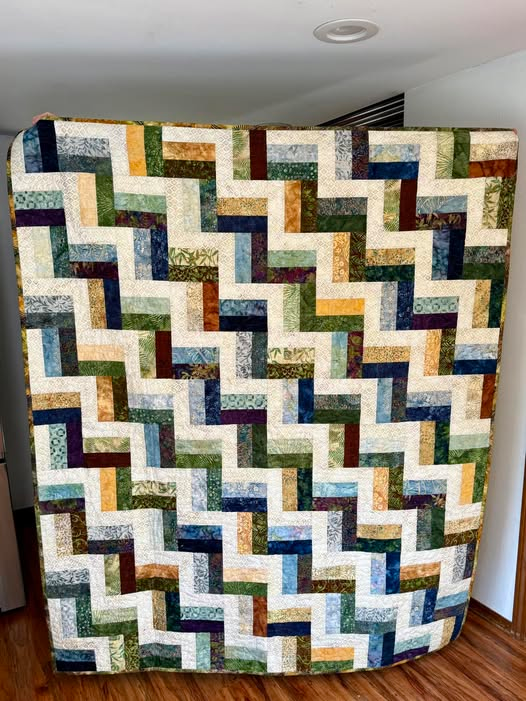
A colorful quilt displayed against a wall featuring a zigzag pattern with various shades of blue, green, yellow, and brown.

Kim’s quilt is the Rail Fence pattern.
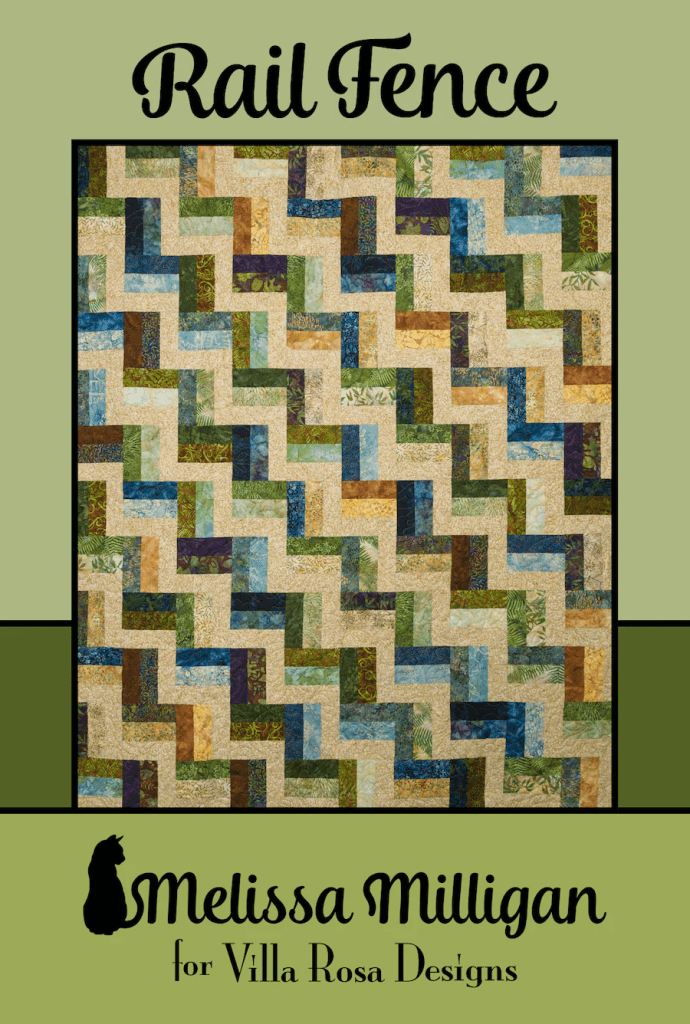
A colorful quilt design featuring a 'Rail Fence' pattern, incorporating various shades of blue, green, brown, and beige fabrics. The quilt is framed with a light green background and includes the designer's name, Melissa Milligan, and the brand Villa Rosa Designs.

Get your digital pattern HERE or your print pattern HERE

So what quilt are you finishing for Week 2 of our Challenge??? You have until Friday, 4/17 midnight EST to post your before/after photos on our VRD Facebook page or email them to me at tricia@villarosaquilts.com. Can’t wait to see them!

10 Tips for Fast Finishing Quilts

After Week 1, I know a lot of you are already feeling that little spark of momentum… and maybe also realizing that finishing quilts can sometimes take longer than we’d like. We start with the best intentions, and then life, perfectionism, or just plain overwhelm sneaks in.

So for Week 2, I wanted to share some of my favorite tried-and-true tips to help you get your quilts across the finish line a little faster. These aren’t about cutting corners… they’re about quilting smarter, keeping things manageable, and actually enjoying the process from start to finish.

Let’s do this! Together.

1. Machine stitch your binding

Yep, we’re skipping the hand stitching. It’s faster, it’s sturdy, and honestly… most people will never flip your quilt over to check. I’m one of those people who sews it to the front and then flips it to the back, but some of my pals prefer sewing the binding to the back and flipping it to the front. There is no wrong or right way to machine stitch your binding. Do what feels the most natural to you.

2. Learn to machine quilt your own quilts

Straight lines, wavy lines, loops… it all works. The goal here is finished, not heirloom show judging. It sure beats waiting your turn at the long arm quilter’s to get your quilt quilted.

If your new to machine quilting, take a class or pair up with a friend who is already doing it. Start out with smaller projects until you feel comfortable and then move on to bigger projects.

For myself, I still send my really big quilts off to the machine quilter while I do my own machine quilting for my throws and smaller projects.

Trust me, if I can machine quilt, so can you. Just remember 3 little words – practice, practice, practice. (Check out our 2025 Beginner Free Motion Quilting Series over on the right side of the blog.)

3. Keep your quilting simple

This is not the time for feathers and custom everything. Save that for another quilt. Today, we finish. My favorite 2 go-to allover quilting designs are meandering and loopy loops. These designs go with everything and they quilt quickly.

Check out our Basic Quilting Skills for Beginners: Quilt as Desired HERE.

4. Press as you go (yes, really)

I know, I know… but skipping this step will come back to haunt you later. A quick press now saves a lot of “why won’t this line up?!” later. And it’s a lot easier to quilt individual blocks and make them behave than saving all the quilting to the end and then trying to get all the blocks to behave. Trust me…..blocks can get very unruly at times (I should know…….I am guilty of saving my pressing to the end now and then).

You can find some help with pressing HERE.

5. Square it up before adding your binding

Crooked quilt tops lead to cranky bindings. A quick trim makes everything behave so much better. I never skip this step, ever because who wants quilts that ripple when there isn’t any breeze? I use a big square ruler on each corner to square up my corners first, then I use a long ruler to straighten the sides so everything is nice and square. I even double check by folding my quilts either on the diagonal (square quilts) or into fours (rectangular quilts) to make sure my corners and sides are even.

Squaring up questions? Get help HERE.

6. Use spray baste, fusible batting, or less pins if you pin baste your quilts

Less pinning, less wrestling, more quilting. Your back (and your patience) will thank you later. I prefer pin basting, but I do not over pin. I take the time to make sure my quilt backing/batting (or fleece) is taped down to my table/flat surface so it’s flat and taunt before I place my quilt top on the batting/backing. Then I use pins sparingly to keep everything together, maybe a pin every 10-12 inches. I first pin diagonally, then horizontal and vertical and finally I add any extra pins if needed to keep things nice and square.

Find out more info on layering quilts HERE.

7. Don’t over-quilt it

Dense quilting is lovely… and slow. Looser quilting still looks great and gets you to the finish line faster. If you’re not sure how loose you can make your quilting design – take a look at the batting you are using. The package will tell you how far apart you can quilt that particular batting.

Quilting bigger takes less time and actually uses less thread is an important lesson I shared with my students when I taught Free Motion Quilting.

8. Batch your boring tasks

Cut all your binding strips at once. Wind extra bobbins. Prep your label ahead of time. Future you will be delighted. Listening to some music or your favorite audio book also makes those boring tasks move a little bit faster.

9. Go with a slightly wider binding for machine stitched bindings

A 2½” strip is more forgiving and easier to catch when stitching down by machine. When I hand-stitch my binding, I cut my strips at 2 1/4″ wide, but I’ve found that the little extra in a 2 1/2″ binding for machine stitching makes a huge difference. With the 2 1/2″ cut binding, I find I have just what I need to wrap my binding to the other side and to catch it with my machine stitching.

10. Work in short, focused bursts

Set a timer, sit down, and just start. Even 30 minutes moves you forward… and forward is the whole point. Not perfect. Forward. I’ve found this technique to be really helpful when I am feeling overwhelmed with everything I have to do. So set the timer and quilt. You will be amazed at how much you can get done.

And a bonus tip or two-

Instead of a zig zag stitch or straight stitch for machine stitching your binding, try using a Triple Zig Zag stitch (also sometimes called a multi-step zigzag or 3-step zigzag). It’s stitch #11 on my Janome Memory Craft 8900QCP. Molly Cook (Big shout out to Molly!) shared this tip with me a couple years ago, and this is the stitch I use for machine binding. I also match my thread color to my binding, too.

    Finally……………………A Little Reminder

    Finished quilts don’t come from perfection… they come from momentum. Done is cozy. Done is usable. Done is something you can actually enjoy.

    Well, that’s it for me this week. I’m off to do some quilting for Week 3.

    PSST! What VRD quilt will you finish for Week 3???

    Always,

    Tricia @ VRD

    Just Quilty Stuff · Tips and Tricks · villa rosa designs

    16 Ideas for Getting Your Flimsies (quilt tops) DONE

    Happy Thursday to you!

    I don’t know if you are like me at all but I have a bunch of quilt tops — or flimsies, as they are often called in quilt jargon — piling up and I can’t work fast enough to make a dent in them. Part of the problem is that I have NEW quilts to make, so it’s hard to work backwards to finish the stack of flimsies that I have already made, but haven’t finished yet. It’s such a vicious cycle….

    Recently, I started brainstorming some ideas to power through those unfinished tops while still working on my current and future projects. Today I thought I’d share my ideas with you. Feel free to leave a comment if you have ideas, too, because I’d love to hear them. Maybe if we all brainstorm together, we can combat the universal quilting problem of too many projects and not enough time.

    • Make a Plan of Action — Maybe it’s time for all of us quilters to go through our flimsies and look at them realistically — a very important first step so we know how many flimsies we really do have. How many of them can we really finish in a lifetime? Let’s be honest with ourselves here. Maybe divide them into 2 piles — the ones we think we might finish and the ones we won’t. Let’s keep only the ones we’ll actually finish and then write down a plan to get ‘em done. Soon that teetering stack of flimsies will be a thing of the past.
    • Share them — Since you’ve decided which flimsies you are going to complete and you’ve made a written plan to accomplish that, why not share those unwanted flimsies with quilty friends, fellow quilt guild members, quilters who make charity quilts, a church quilt group, or some other charitable organization. Then you can clear away those unloved flimsies without guilt and make someone else’s heart happy.
    • Take a Class — Maybe you don’t know how to machine quilt your own quilts. Why not learn how? Check out your local quilt shops or quilt guilds to find a machine quilting class. Or maybe you’ve always wanted to learn hand-quilting? What are you waiting for? Sign up for a class and get quilting those flimsies yourself!
    • Use fleece — I’ve talked about using fleece on the backs of my throw quilts before. Check out my post on quilting with fleece HERE. Using fleece on the backs of throw quilts makes them super cozy and lightweight. Fleece fabric is relatively inexpensive and batting isn’t even needed, which makes using fleece also economical. And don’t forget time-saving — you only have to layer your flimsy with a single layer of fleece, which takes less time than using both batting and backing. Just remember that fleece is very stretchy while your flimsy is not and you may need to adapt your quilting designs to manage the stretchiness.
    • Practice makes perfect — Just get those quilts layered with batting and backing and get quilting. Hand quilter? Set time aside every day to work on your hand quilting. Machine quilting? Use your flimsies as hands-on experience as you master free motion quilting! Start with table runners and smaller projects and work yourself up to larger projects as you feel more comfortable and your machine quilting skills improve. Wiggly lines and straight lines get the job done too.
    • Long Arm Quilting — Find a local long arm quilter and work together to create a plan to get your large flimsies quilted. Maybe you can swing getting one done every month or every few months, or…? Do whatever works for you, just keep working towards your flimsy-free goal.
    • Have a party — Enlist your friends and have a good old fashioned quilting bee, but instead of everyone working on the same quilt, ask each friend to quilt one of your smaller projects. Anything goes! Ask your friends to bring their sewing machines and you will have tables and extension cords at the ready and will provide all the munchies! When you ask your friends to help you, make sure you promise to help them finish their own flimsies.
    • Presto Change-o — Who says a quilt top has to continue its life as a quilt? Why not repurpose a flimsy (or more) into a snazzy jacket. A tote bag or purse? Pillows for the couch? Place mats? Or whatever else your little heart desires. Have some fun with your flimsies and turn them into finished projects.
    • Mix and Match — Speaking of chopping up your flimsies to make new projects, how about mixing and matches bits and pieces from different flimsies together into a new project?
    • Host a Flimsy Swap — Gather up your quilt posse and have a fun flimsy swap. You might need to set some basic rules — the most important one that comes to mind for me would be that each participant must take as many flimsies as they bring for the swap, even if it means taking some of their own back home. Or limit the swap to one flimsy per person. Agree on a future date to have your new-to-you flimsies finished and have a quilt show of the completed projects. With snacks, of course. Then……..repeat. Often.
    • Take Me as I Am — Maybe you don’t machine or hand quilt. Maybe you just don’t have the money to send your quilts out to a long arm quilter. So why not enjoy those flimsies just as they are? Fold them over the rungs of an old ladder. Drape them over the couch. Use them as table covers in the dining room. Fold them prettily and stack them in an old jelly cupboard. Quilts love to be admired and enjoyed, even if they aren’t quite completed. Just remember to continue to work towards getting them done, one flimsy at a time.
    • Tie ‘em Up — Have you ever tied a quilt? This is how I made my first five or six quilts way back when. I backed them with a sheet and used a thicker fluffier poly batting. I sewed the layers together envelope-style and then used cotton crochet thread with a long needle to tie my quilts. I tied double knots and trimmed my threads close because I really didn’t want a hairy quilt. I usually placed my knots at seam intersections to hide them a bit better. Tying worked great and I could finish a throw or bed-sized quilt in a day. This was, of course, before I taught myself to do free motion quilting. Just make sure to put in enough ties to keep the batting from shifting around.
    • Go Small — Maybe you love to make big bed quilts but can’t or won’t quilt them yourself or send them out to a long armer. My solution? Make them smaller! No one ever said you couldn’t cut up your quilt to make 2 or more smaller quilts! Maybe a big bed quilt could become a throw, a wall quilt, a table runner, a set of pillows? Bet you can manage those more easily! This is even a great way to create a new coordinated look for your space, too. Just think how fast you could whip up a stack of table runners or quilted scarves for Christmas gifts when you start with big quilt flimsies? Oh, the possibilities….
    • Swap skills — You’ll need some friends to help you out with this idea. Have a friend who likes to machine quilt? Swap skills with them! If they will machine quilt one of your quilts, you will clean their house, make cookies, bathe their dog, babysit the kids, or whatever skills you can barter with. Maybe you can swap skills with more than one friend or even a local long arm quilter. Write a list of the skills you are willing to barter before you talk to people about swapping your skills for machine quilting. Just keep it legal, clean, and safe please.
    • Make Toys — Why not find a brilliant collection of simple stuffed toy patterns you can make for kids and cut the pattern pieces out of your flimsies. Don’t have kids or grandkids? Donate your soft toys to a children’s hospital or other charitable institution. Lions, tigers, and bears….oh my!
    • Repurpose — Did you know you can repurpose your flimsies? This is kind of like Presto Change-o above, but with a little twist. What else can your flimsies be besides quilts? Maybe you can recover a side chair with a pieced top to create a unique one of a kind accent for your space. Or perhaps you could make dining chair seat covers? Time to think outside the quilt here — anything goes.

    I hope these ideas will inspire you to dive into your own stack of flimsies and get them done. From quilts to decor to soft toys. Upholstered foot stools and lampshades. Pillows and table runners. There are sew many projects you can create with your stack of flimsies. Sew, what are you waiting for???

    Until next Thursday —

    Always,

    Tricia @VRD