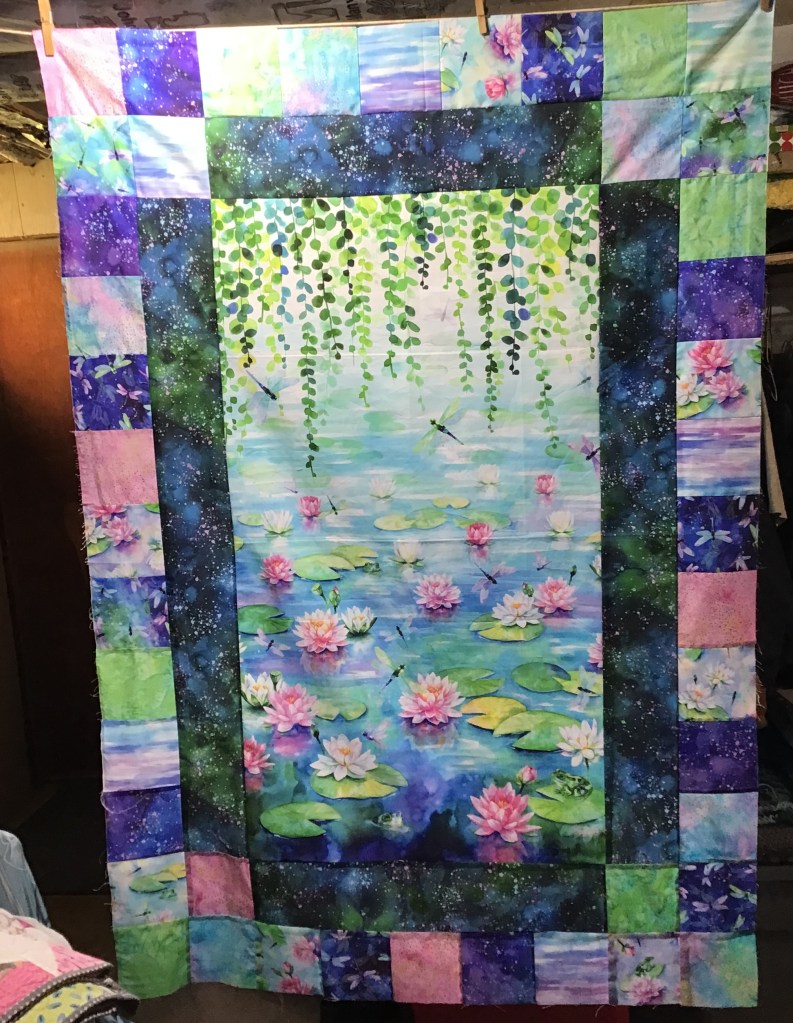
I was so excited after last week’s post about Panels and our Villa Rosa Rose Card patterns that work for panels, I just had to play with my stuff! I decided to go ahead and get the top done for Hypnotized, using my adorable Halloween Gnomes,. Who doesn’t love gnomes???? I just had to, I didn’t want to wait until next year, although I might not get it quilted and bound until next Halloween.
If you missed last week’s Panel Post, you can find it HERE.
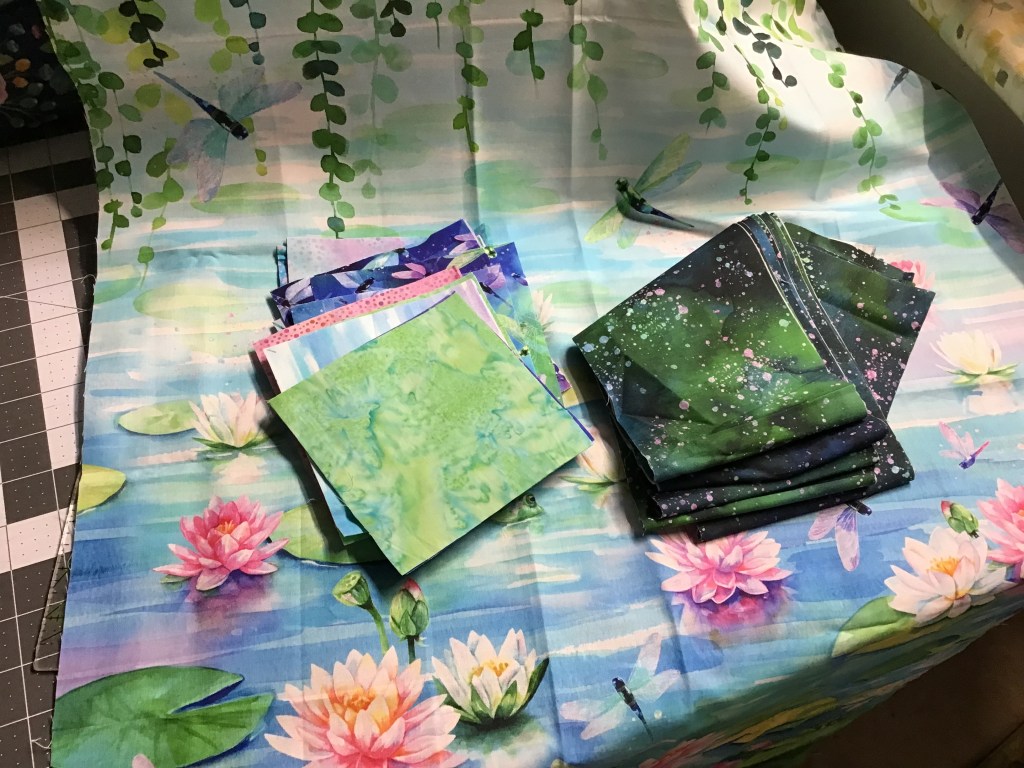
The first thing you need to do is to cut out your pieces. I used this adorable Halloween Gnome novelty fabric from Northcott instead of a panel. The cool thing about quilt patterns made for panels is that you can usually substitute a novelty print as long as you cut it to the right dimensions.
YAY! GNOMIES! (That’s what my sister, Tracy, calls them.)
I did not cut the pieces for the inner and outer border out yet. I like to wait until I have the center of the quilt made because sometimes my measurements don’t exactly match the measurements given in the pattern.
If this happens to you too, don’t cut the border strips until you can measure your quilt center. That way you can cut the border strips (and piece the strips together if needed) to your specific measurements, not someone else’s.
Remember when we talked about the “perfect” quarter inch seam allowance? Go HERE if you need a refresher. There really isn’t one. Basically, everyone’s quarter inch seam is a touch different, either a bit smaller or bigger than that elusive quarter inch. Anyway, as each of us use a slightly different quarter inch seam, the dimensions of our quilts are going to be slightly different too. That makes sense, doesn’t it?
So sew with your best quarter inch seam — accuracy is more important than a perfect quarter inch seam in most cases — and measure your quilt before you cut the borders.
Let’s keep moving!
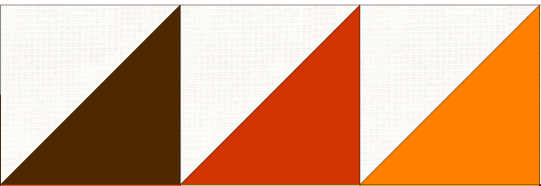
After you’ve cut your pieces, sew strips to the sides of the small square. Then sew strips to the top and the bottom.
You know, I photographed every step of this process, but for some reason all my photos are not on my iPad. Methinks my cat Griffin might have deleted photos when he was painting on his iPad cat painting app.
A cat that paints? No, that’s not strange at all……. What’s strange is that he scratches at my iPad (covered with a protective screen cover) and gets out of his painting game and into other apps somehow. Kids….
Anyway, sew strips to the sides of this block and then add the strips to the top and bottom. Voila! This is your center square. Make 1. (Sorry for the EQ images, but the photos are gone!) Silly Griffy!
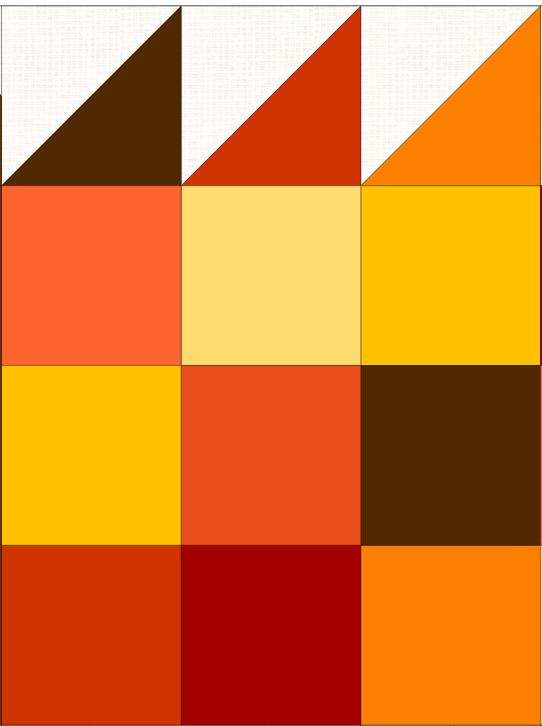
Now sew strips to the side of your other 8 squares. Then add the longer strips to the top and the bottom. Make 8.
Here are all my blocks ready to go. Aren’t they fun???
Wow! This quilt is coming together fast. Now to add some background rectangles to our quilt blocks.
Sew a background rectangle to the top of a Framed block. Make 3.
Please Note: If your fabric is not directional, you can skip adding background rectangles to various sides of the Framed square blocks. Instead, sew background rectangles to one side of each of the 8 Framed square blocks.
Sew a background rectangle to the bottom of a Framed block. Make 3. (Sorry, these photos are gone, too.) Argh….Griffin…….
Now sew a background rectangle to the left side of a Framed block. Make 1.
Lastly, sew a background rectangle to the right side of a Framed block. Make 1.
Whew! That was a little confusing, I know, but now we get to put things together!
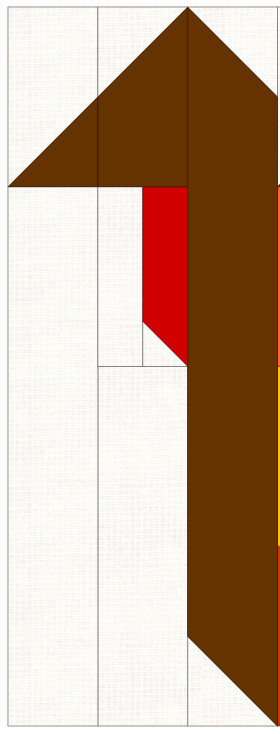
Sew 2 top facing background rectangle units with a bottom facing background rectangle unit in the center. Then sew a long background rectangle to each end of the row. Make 1 row.
Make the bottom row pretty much the same as the top row, above, but reversed — sew 2 bottom facing background rectangle unit with a top facing background rectangle unit in the center. Then sew large background rectangles to the ends of the row. Make 1 row.
Now for the middle row — sew a right facing background rectangle unit, the single center block, and a left facing background rectangle unit at the end. Make 1 row.
Next sew the 3 rows together.
Isn’t this quilt top adorable so far? The orange frame in the center block really pops, don’t you think? Can’t wait to get the borders on next!
Now sew the inner border strips to the sides of the quilt center. You’ll probably have to piece the strips so they’re long enough. Add the top and bottom inner border strips, piecing them too.
Almost there! It’s time to add outer border strips to the sides — piece those border strips carefully, please. Finally! Our last step for the top — sew on the top and bottom borders, piecing your strips.
Houston….we have a problem!
I just discovered I don’t have enough border print fabric to sew borders on all 4 sides of the quilt.
Whatever can I do???
Why, just add borders to the top and bottom of the quilt! Good solution on the fly. That’s how I roll.
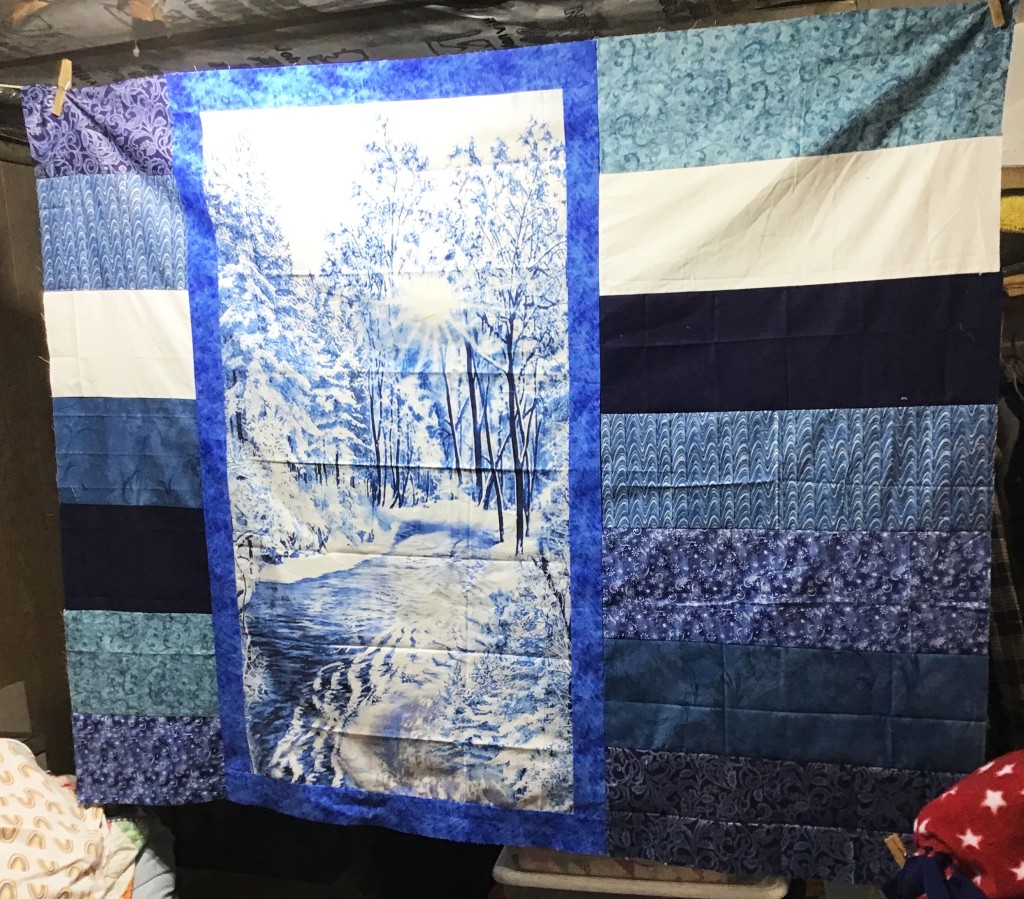
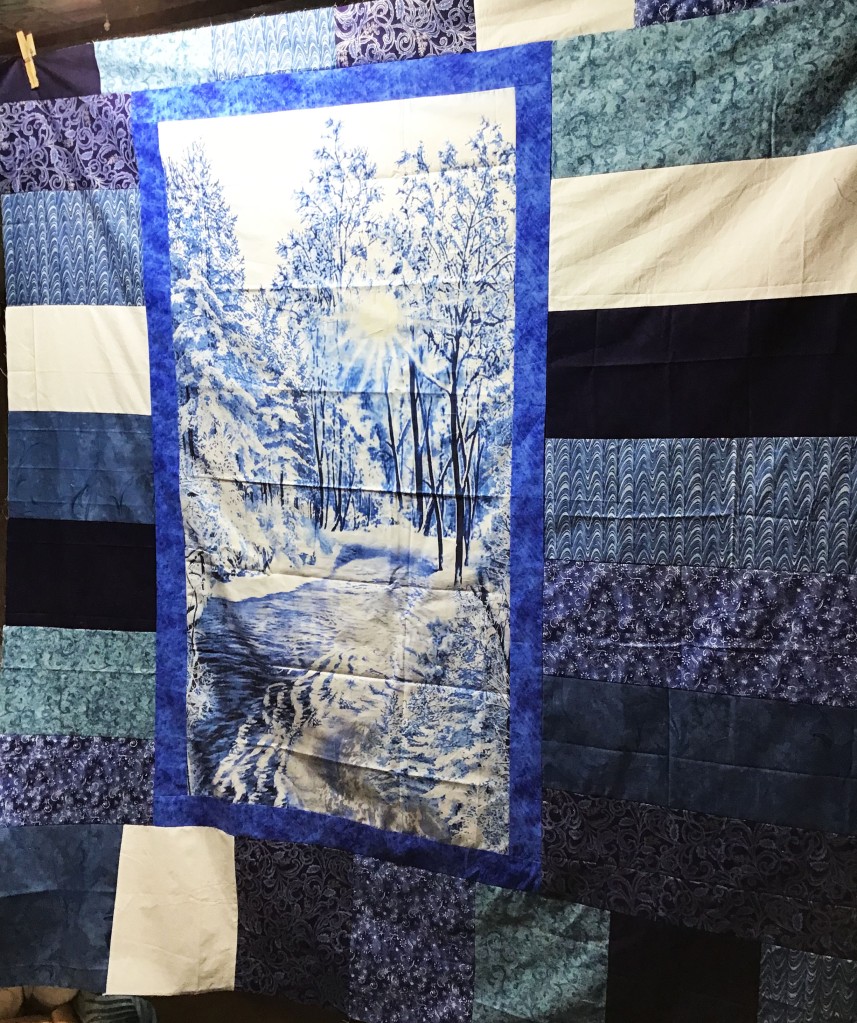
Yay! Mission accomplished — adorable Halloween Gnomies quilt top completed before Halloween! (Sorry the photos of the quilt as it gets put together aren’t very good — I am limited on space for working with larger quilts, so here I’m hanging the quilt top on a clothesline strung in the basement. Hey, we do what we have to do, right?)
What do you think?
As I write this post, I’m crazily packing my stuff to head to International Quilt Market in Houston, TX. I haven’t been to Market since 2019 — before the Pandemic. I’m really excited as this will be my first time being part of the Villa Rosa team.
If you’re headed to Market, stop by the booth, we are Booth #747, right behind the center Info booth on the main walkway. VRD is also doing 2 Schoolhouse lectures on Friday, Oct 28th. If you’re headed to Quilt Festival, Villa Rosa Designs will have a booth there, too. We’d love to say “hi.”
Sigh….Back to my packing.
Stay tuned — next week’s post will be all about my Quilt Market trip. The sights, the sounds, the food….
Again, THANK YOU for following our Basic Quilting Skills for Beginners series. We are all thrilled with your interest to this series of posts. Sadly, this series will come to an end next week with Labeling Your Quilt.
So, I thought I’d ask — are there any other topics you’d like to see here? If so, please leave a comment or you can email your suggestions to me at tricia@villarosadesigns.com. I’d love to have your thoughts and ideas so our blog will continue to be relevant to you, our VRD fans and followers.
Now let’s get to BINDING!
The good news is that once you reach the binding stage, you are totally in the homestretch of having a finished quilt.
Yay you!
This week for our binding tutorial, we’ll use my Halloween Ice Jam table runner again. If you didn’t order the pattern last week, you can order it HERE.
There’s a couple of things we have to go over before we can do our binding.
How wide do I cut my strips?
You could ask a bunch of different quilters this same question and you would get multiple answers, I’m afraid — it’s not a one size fits all situation.
A lot of quilt patterns and quilters prefer to cut binding strips 2 1/2″ wide. As this seems to be the most common size in the quilting world, I too use this width for my patterns, but I personally find 2 1/2″ a bit too floppy, so when I do my own binding, I cut my strips 2 1/4″ wide, which for me makes a nice full binding. Of course, you will have to try both to see which one you prefer.
Yes, I use 2 1/4″ for almost all of my binding, but I must confess that there are a few types of projects I actually cut 2″ wide binding strips for — miniature quilts and any other tiny little quilty projects. Again, you’ll just have to try different widths on different projects to find out what works best for you.
Here’s a little something to consider — I have found that if your 1/4″ seam is a “fat” 1/4″ seam, then you’ll probably like using 2 1/2″ or if you’re like me and you use a “scant” 1/4″ seam, then 2 1/4″ might be a better fit.
As for mini quilts and such, you’ll probably want to use a slightly narrower width than what you use for your regular-sized quilts. You’ll just have to try things out to see what you like better because trial and error is all part of learning, isn’t it?
How do I know how many strips to cut for my binding?
Sometimes you get lucky and your quilt pattern will include the number of strips to cut and it might even suggest a specific width. But, if your pattern doesn’t specify how many strips to cut, read on my friend!
If you don’t know the dimensions of your quilt, you will need to measure the width and the length using your tape measure.
Let’s use my Halloween Ice Jam measurements for this example — it measures 18″ wide x 54″ long, so we need to add together 2 widths and 2 lengths to get the total inches around the outside of the quilt (otherwise known as the circumference).
18+18+54+54=144
Now we are going to divide 144 by 40.
This number will tell us how many strips to cut because we are dividing the total inches by the inches in the width of fabric.
Please understand I didn’t just pull a random number out of the air — ha ha! — 40 is the average width of fabric that I and a lot of other quilt designers use to determine yardage requirements for our patterns. Fabric can vary in width so it helps to use an average number maybe a little smaller than the actual width and 40 does that when fabric generally ranges from 42″ – 45″ wide. Besides, that little extra also helps to make sure you don’t run out of fabric by accident.
So, let’s continue.
144÷40=3.6
Let’s round that number up to 4 — I need 4 strips of fabric for my binding. That little extra is helpful to make room for the corners and joining our binding ends. There’s nothing worse than getting close to the end of sewing on your binding to find you are 3 inches short. When in doubt, add an extra strip.
But what do you do when you get a whole number instead of a fraction for the number of strips needed? Me, I definitely add an extra strip because I don’t want to run out of binding before I get to the end.
Yay! Quilt Math to the rescue again! Three cheers for math! Want to read my post about quilting and math? Check it out HERE.
Moving on……
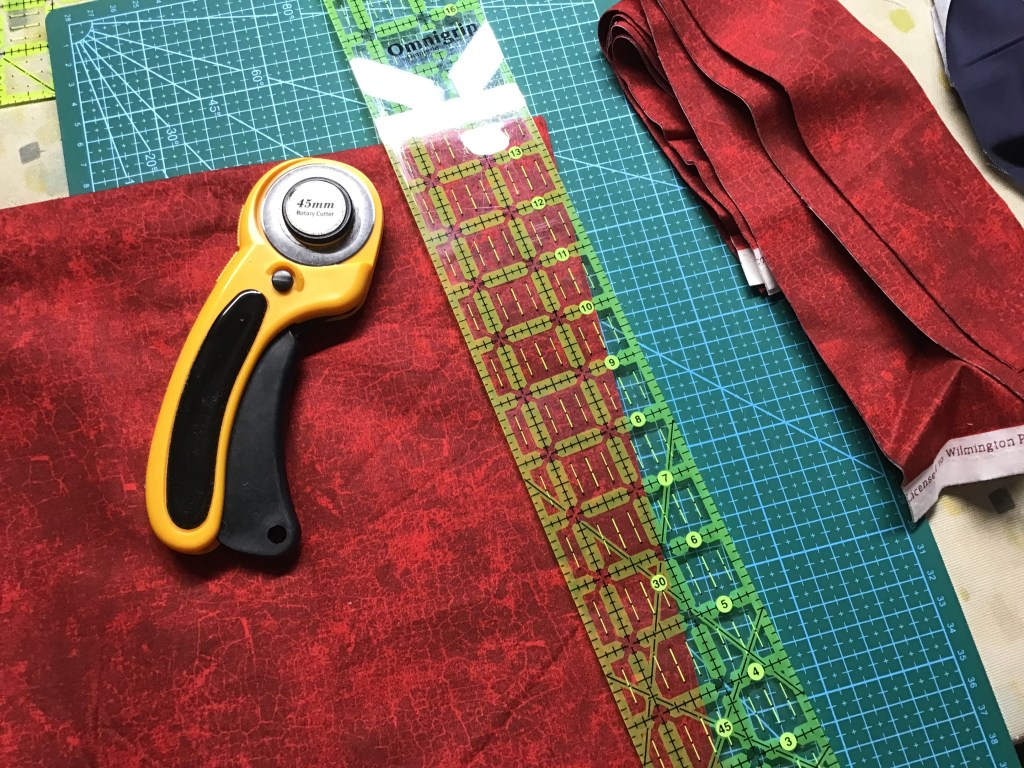
Cut the required number of strips and then cut off all the selvedges. The selvedges are those tightly woven long sides of the fabric which usually have little holes in them. Off with the selvedges, I say, off with those selvedges!
Now we’re heading back over to the sewing machine.
There are a couple different ways to sew your binding strips together.
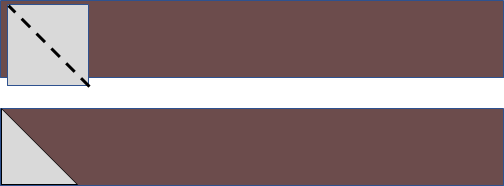
The first way is to layer 2 strips right sides together with the ends lined up. Use a 1/4″ seam to sew the strips together, just like in piecing. Press the seam allowance open to reduce bulk in the binding — nobody wants a lumpy binding. LOL!
The second way to join the strips is on the bias or diagonal. Lay a strip right sides up on your flat surface. Place a second strip perpendicular to (NO, not another math word! Horrors!!!) and on top of the first strip with the wrong side up, that way the strips are right sides together. Next, draw a diagonal line from corner to corner.
Then — you guessed it! — sew on the line. Does this sound familiar? It should because quilters use this technique for making triangles (HSTs) and flippy corners.
The next thing you need to do is find the end of the strip that is on top. Turn the strip over so it is now facing right side up. This is really important or else your binding will not have all the seams on the back of the strip. Take another strip and place it perpendicular to the second strip with the right side down, again making them right sides together. Draw a diagonal line and sew on the line again. Repeat this until you’ve sewn all the strips into one long binding strip.
Clip the threads in between the strips if you chain-piece and then cut off the waste triangles where the strips meet, leaving a 1/4″ seam allowance.
Time to press our binding strips. Let’s head back to the ironing board.
Place your binding strip right side down on your ironing board. Using your iron on a cotton or hot setting, fold the strip in half with the wrong sides together, pressing as you go. Remember, you are pressing, not ironing here. We just want to make sure the strip gets folded and creased.
When you come to a seam, press the seam allowance open like we did when we joined our strips into one long binding strip. Then fold, press, and keep going.
Almost done now. Just keep folding and pressing until you get to the end of the very long strip. Keep in mind the bigger the quilt you are working on, the longer the strip and the more time it will take to do this step.
Let’s head back to the sewing machine once again because it’s time to sew the binding onto your quilt. I know this seems like a lot of steps, but writing/reading about it takes longer than actually doing it. After some practice, it will become second-nature and you won’t even have to think about it, you’ll just do it.
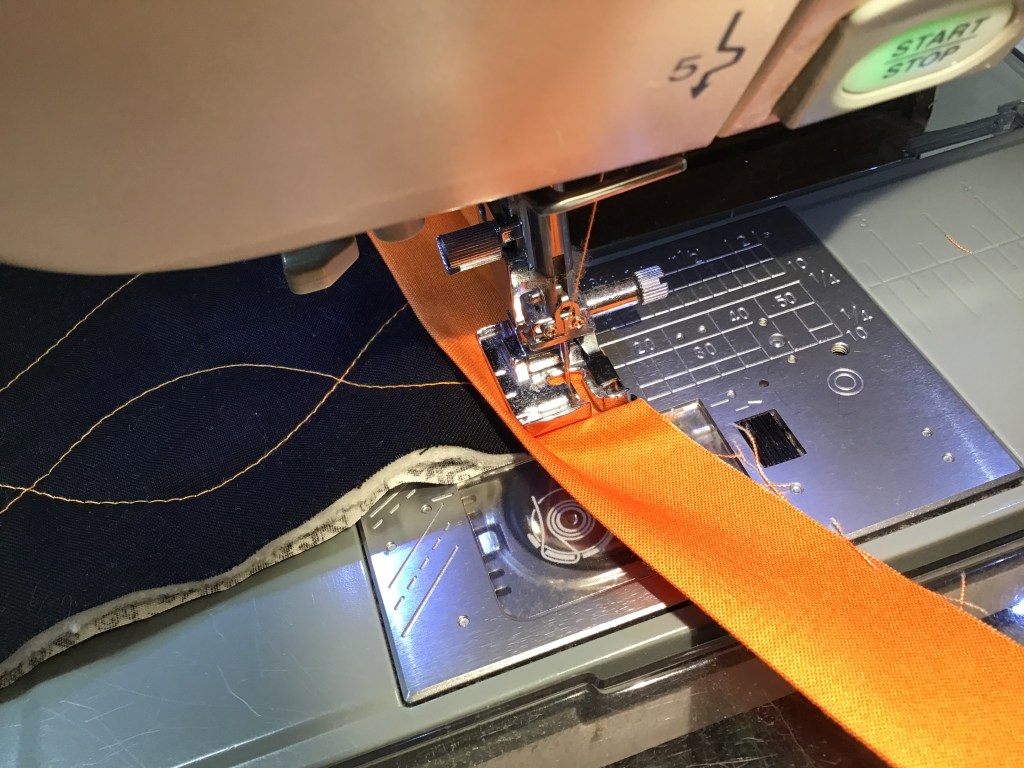
Lay your binding on top of the right side of your quilt with the raw edges lined up. I usually start my binding somewhere towards the middle of a long side. Be careful here because you want to avoid placing binding seams at your corners because the added bulk can make your corner turn out weird. Trust me on this. Been there, done that. It’s okay if you want to pin your binding all the way around your quilt, but with a little practice, you’ll have a fairly good idea how to avoid the dreaded seam allowance at the corner issue.
Pin the layers together about 10-12 inches from where the binding strip starts. Then place a pin through the quilt right before the binging begins, but not through the binding, only the quilt. This second pin right before the binding starts is a marker you will need later.
Start sewing at the pin 10-12 inches from the beginning of the binding strip. Backstitch a few stitches, and….GO.
Most people use a 1/4″ seam for sewing on their binding, but I personally use about a 3/8″ seam because I like a nice full binding. Try both ways to see which one works best for you.
Sew until you get to about 1/4″ from the corner.
When you get to 1/4″ from the corner — STOP and backstitch to secure the stitching. Cut your thread and pull your quilt out from under the needle.
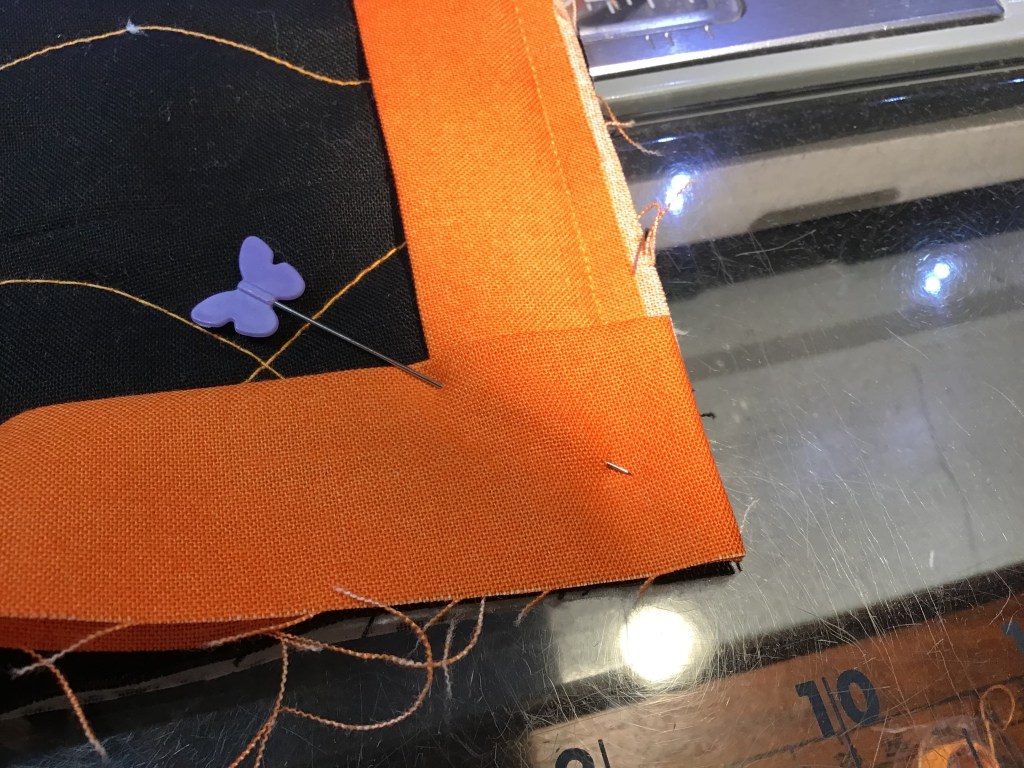
GULP! Here comes the scary part — making a French fold mitered corner. Cue the scary music….
Fold your binding strip at a 45 degree angle towards the right.
Now fold the binding strip back over itself to the left. Place a pin if you need to. This little fold here makes you able to overlap the binding into a nice miter on the back which will give you a really nice square corner.
Turn your quilt and start sewing at the corner, backstitch a couple stitches and sew until you get to 1/4″ from the next corner. Not scary, easy peasy!
Repeat the mitered corner fold, turn your quilt again, and keep going. When you finish the fourth corner, keep your eye out for the pin marking the place where the binding strip began. Stop sewing 3-4 inches before that pin and backstitch to secure the stitching. Once you’ve backstitched, cut your threads and pull your quilt out from under the needle.
Here’s a helpful little video from Alex Anderson and Ricky Tims about mitering corners.
Now we’re going to sew the ends of our binding strip together. This next part is really a leap of faith, but it does work, I promise you. Just stick with me, I won’t steer you wrong.
Smooth your binding strip over and beyond where the marker pin is (move the loose beginning binding tail out of your way). Use a ruler and measure from the marker pin the length of how wide you cut your binding strip. For a lot of you, that would probably be 2 1/2″ but for me and some others, that will be 2 1/4″. Draw a line with a fabric pen at that measurement from the marker pin and cut on the line.
Next open both ends of the binding, overlap them with the the ends right sides together at an angle, and then pin the binding layers together. Draw a diagonal line if you like or just eyeball it.
Please note that this technique isn’t the only one out there. If you want to learn other ways of doing binding, you can do an Internet search.
Sew on your drawn line and trim away the waste triangles 1/4″ beyond your sewing line.
Finger press the seam open to reduce the bulk and refold the binding with wrong sides together again.
Your binding strip should now lay nice and snug against your quilt. Yay! Next pull out the pins and use them to keep the rest of the binding lined up with the quilt.
Now it’s time to finish sewing the binding on. Start where you stopped before we sewed the ends of the binding together until you overlap where you originally started sewing the binding on. Backstitch at the both the beginning and the end of your stitching line.
Finishing Binding by Hand or Machine?
While doing this series about beginning skills, I have discovered that I am an “old school” quilter. It pains me that I am starting to show my age, but I know these tried and true methods work. Feel free to explore different methods to do any of these skills, but keep in mind that it’s important to know the old skills before you can learn the new skills — you have to have somewhere to start. So, maybe I’m not as antiquated as it sometimes feels these days. LOL! But that’s okay, those old skills serve me well and keep me making quilt after quilt with excellent results.
That being said, there are 2 ways to finish your binding on your quilt — by hand or by machine.
I finish all my binding by hand. After writing multiple books and making oodles of samples for magazines and patterns, I know I’ve probably hand-sewn miles and miles and miles of binding. But that’s okay. I like how a hand-stitched binding looks.
If you are interested in learning to finish your binding by machine, here’s a nice video from Jenny at Missouri Star Quilting. It’s actually a complete binding tutorial and shows you how you can sewn it down by machine.
If you prefer finishing your binding by hand, you can check out this video by Quilting in the Rain as she shows you how to sew a hidden blind stitch.
You might wonder why I’m giving you videos here, but I learned a long time ago that as a lefty, there are just some things I can’t teach to righties and sewing down binding is one of them!
BIG SHOUT OUT to my pal, Cathey Laird of Cathey Marie Designs, the inventor of the Y Block Ruler.
Long long ago, I tried to teach Cathey how to do mitered corners like I did, she found out hours later that a lefty can’t teach a righty how to do that because we fold our corners in different directions. Oops, sorry, Cathey!
Anyway, I don’t want to confuse anyone, so here’s a righty doing the hidden blind stitch for you. If you are a lefty and need a little help from a lefty, just shoot me a message and I’d be glad help you.
Here is my cute little Halloween Ice Jam table runner! Now all I have to do is sew the binding down and put a label on it.
Whew! I’m totally worn out now! I guess that’s about it for binding, folks. I can’t think of anything else to add.
If you have any questions, though, just ask. Did you know you can send us a message on the blog? You can go to our Contact Us page and scroll down to the bottom to find a form to fill out.
Stay tuned for next week’s post about labeling your quilt.
Happy Thursday to you! I hope you all are having a wonderful summer so far.
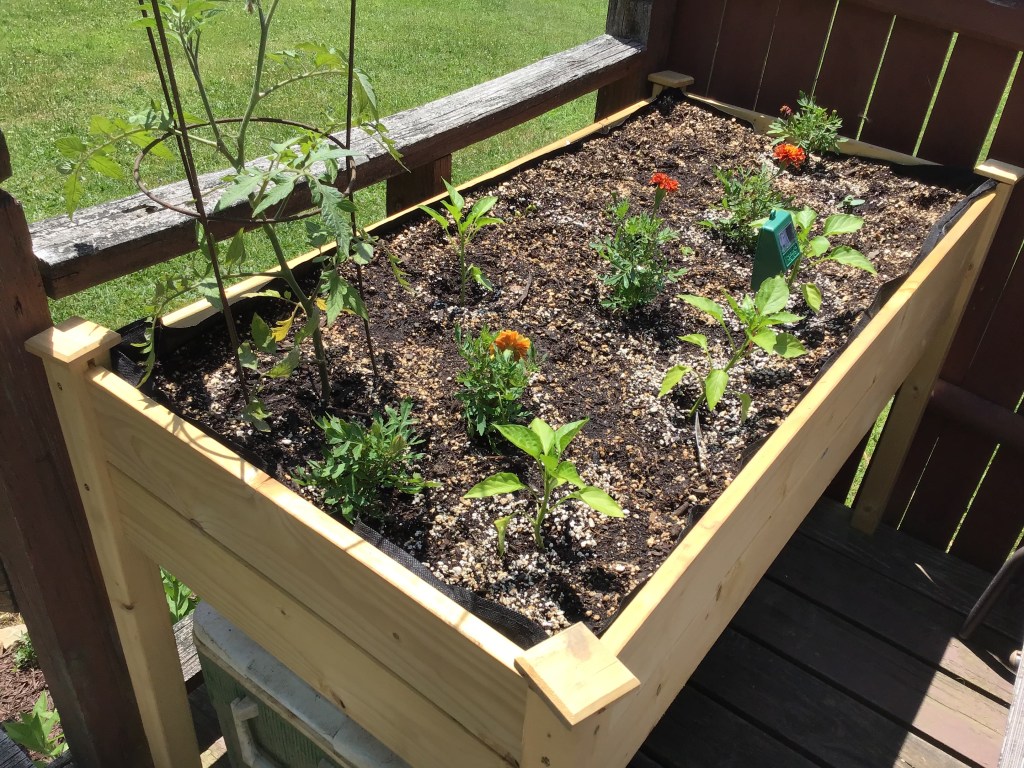
My summer just got a whole lot better! Just recently my family got in gear and finally got our little back porch raised garden planted. And our flowers, too. We may be running a little behind, but I have hopes that in late summer/early fall we’ll be enjoying some fresh veggies picked right out of our little garden pf goodness. If it goes well, next year we are going to add a second raised bed garden.
I used to be an avid gardener way back when, but gave up the year I planted my garden twice and the critters ate everything before it even had a chance to grow. That was it.
But now I’m excited to try container gardening. Besides, ”container gardening” sounds so trendy, don’t you agree?
Cake Day Quilt Block Assembly Tips
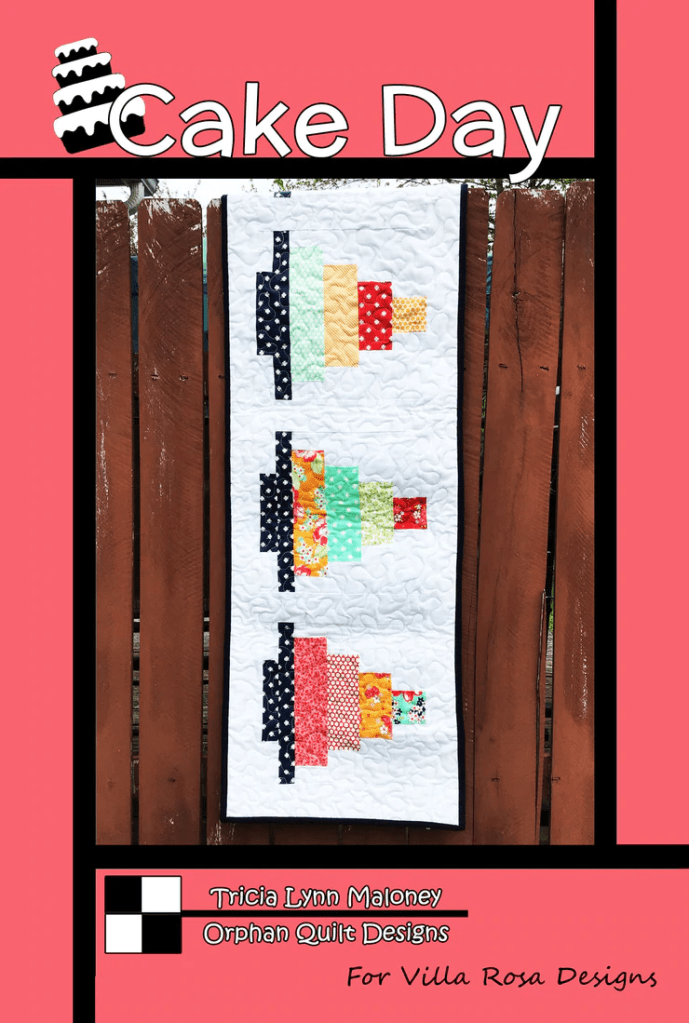
I thought I’d share a quick tutorial on how I put the Cake Day table runner quilt block together along with some of my favorite piecing tips.
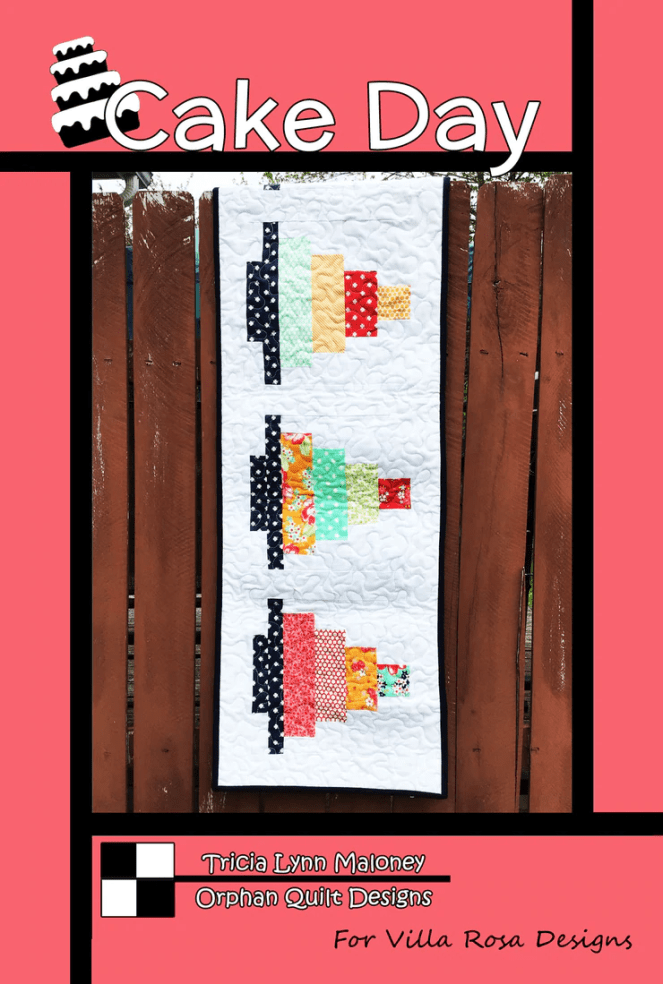
Cake Day Table Runner Rose Card Pattern
You can get your own Cake Day Table Runner Rose Card pattern HERE.
Often, I prefer to cut out all my pieces for the blocks before I start sewing. I find this is usually quicker than cutting and sewing one block at a time.
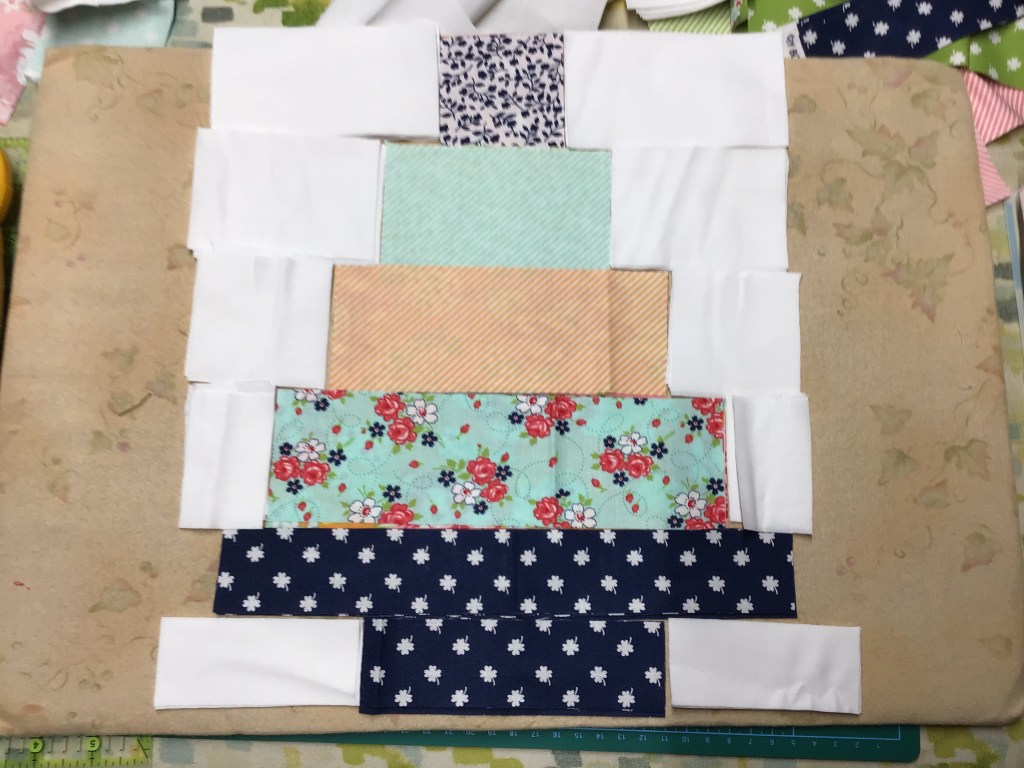
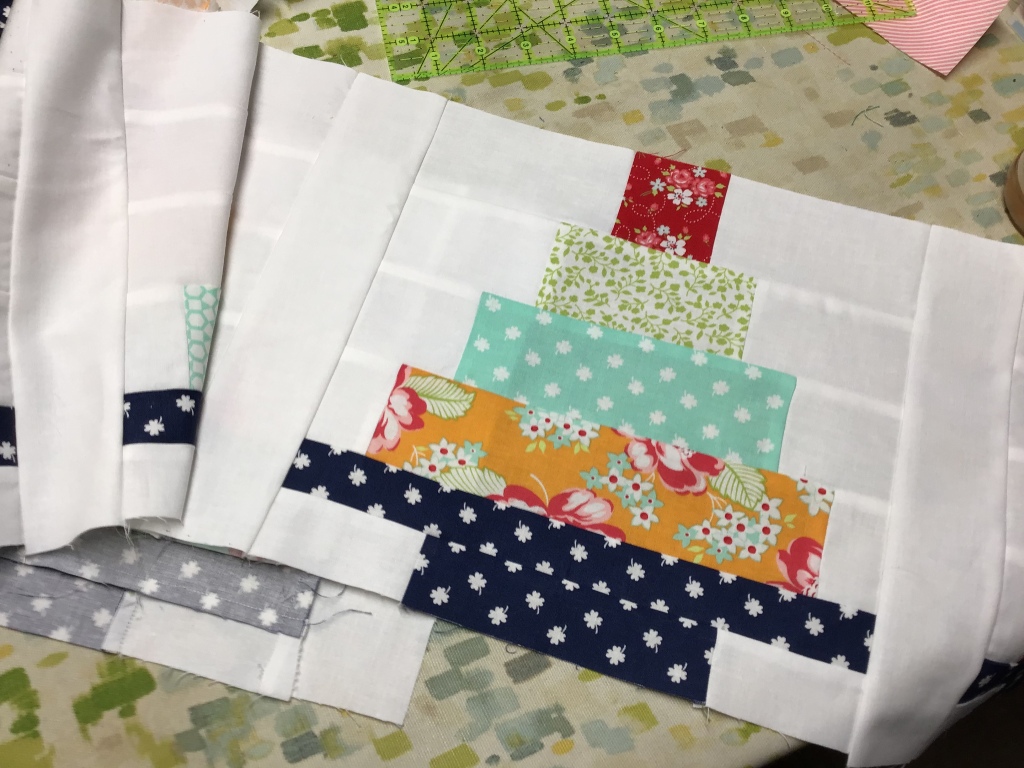
Here you can see the pieces all laid out in the right order (all four blocks are stacked) on a flannel board and then I can simply take everything to my sewing machine. This works well if you have to stop in the middle and come back to your project later. Everything stays right where you left — unless of course, you have gremlins or leprechauns or some other little mischievous creatures running around your sewing room when you are not looking.
I have also found that laying out and stacking the pieces in order makes sewing them together faster and easier because I don’t have to stop and figure out where each piece goes.
With all the pieces cut and laid out right sides up, sewing them together is a breeze, especially when I chain-stitch the units one right after the other without cutting my thread in between the units.
Nope! No need to head to my ironing board after clipping the thread between the units, I just kept sewing and chain-stitched the other side too.
I have discovered that the less I press as I’m putting together quilt blocks, the less the blocks stretch or get distorted, which of course improves the accuracy of my sewing.
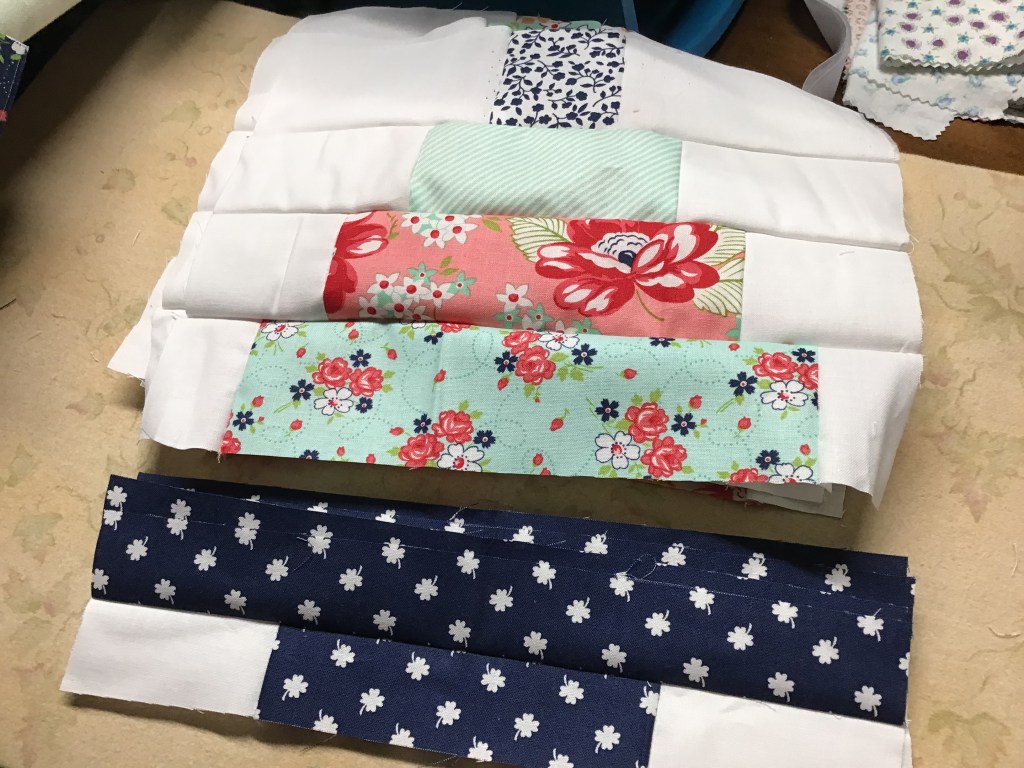
In the next photo you can see I have the left side background sewn to the Cake print rectangles. Now it’s time to sew the right side.
All right! All the units are sewn together and I’ve clipped the threads between them. I made double sure I layered the units again exactly the same as when I started — we’re ready for the next step.
Again, I’m going to ignore my iron (it must be getting lonely). Time to sew the units together. More chain piecing.
Want to know what happens when I get to seams (remember I haven’t done any pressing at this point)? I’ve already decided which way I wanted my seams to go so as I sew, I hold them down and keep on sewing. Pedal to the metal!
In this next photo you can see I sewed the top unit to the second unit. We’re on a roll — let’s keep sewing.
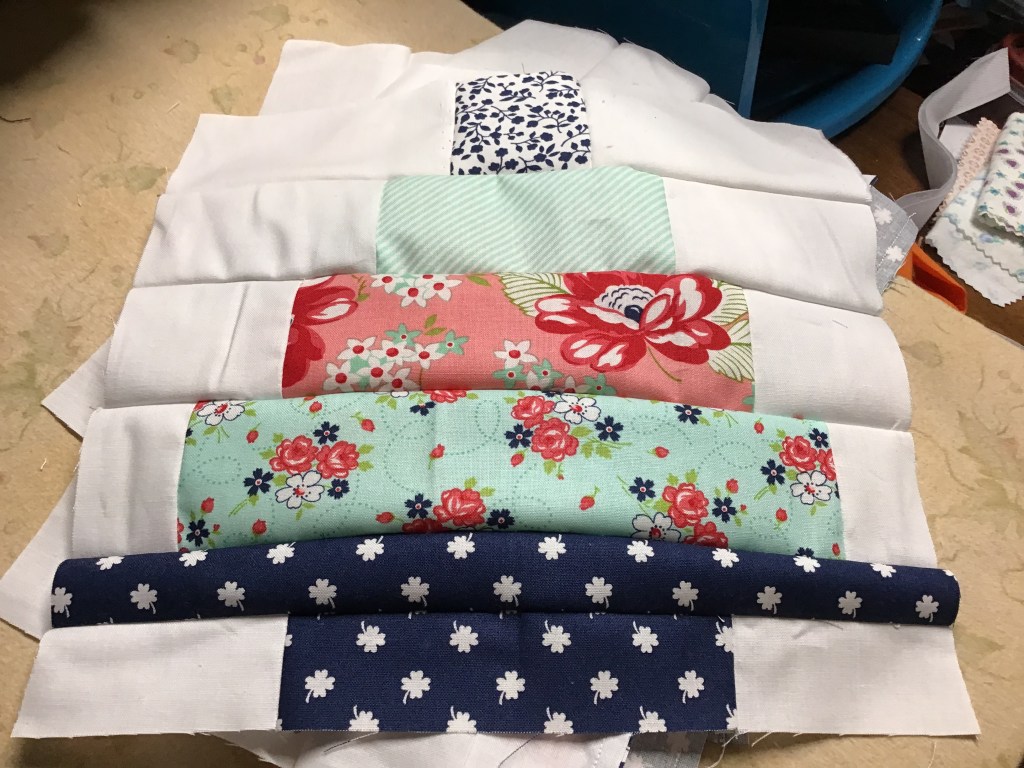
Okay, we’re almost there! I sewed the rest of the units all together and presto — all 4 of our blocks are now complete and I didn’t even have to get up from my sewing machine.
All right, all right, I relented and finally pressed my blocks — my iron was getting a little dusty from disuse.
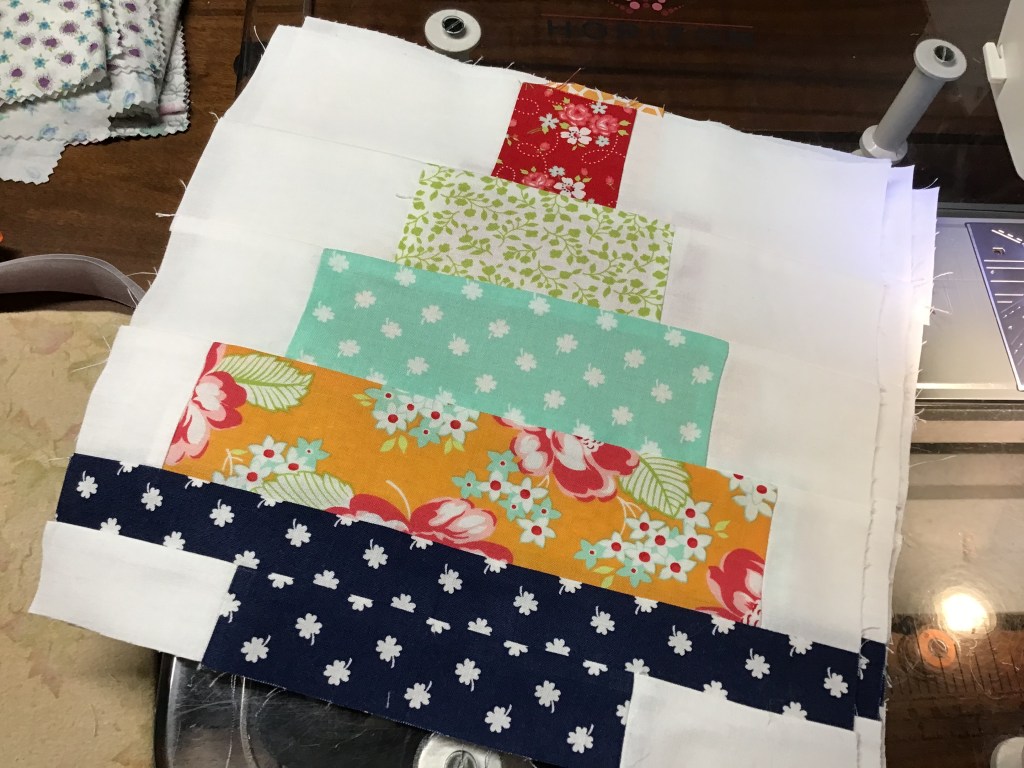
Voila! Here is a finished Cake Day block. It’s a cutie, isn’t it?
My 4 blocks are now ready to assemble into a runner. There are sew many possibilities for this runner — birthdays, weddings, showers, parties, and the list goes on and on.
Welcome to another Thursday — the first Thursday in June. Summertime, right? The kids are out of school or will be soon. Life will get crazy. Fun. And more crazy.
Are you kidding? I thought it was still March.
At least, it should still be March, don’t you think?
Que sera, sera.
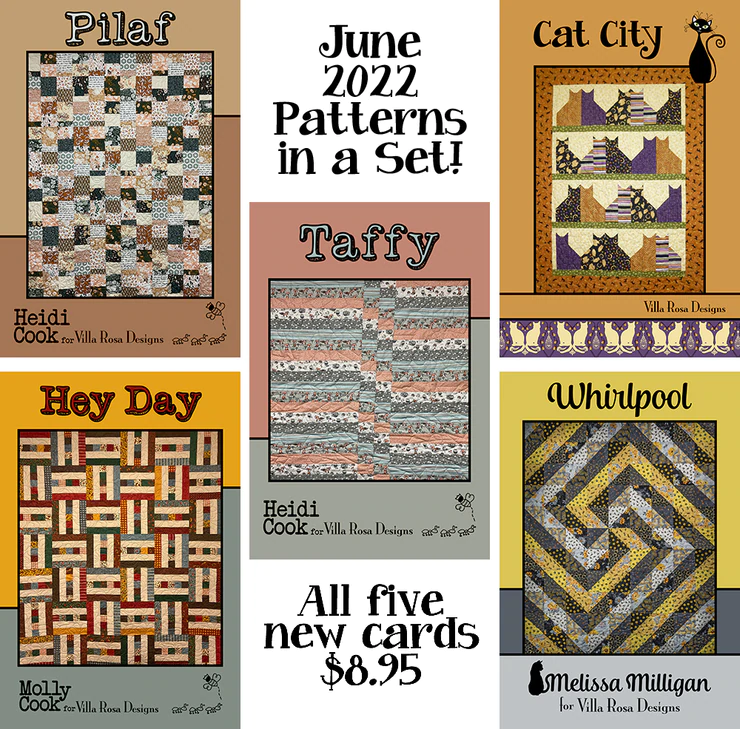
OH! Did you see the new Rose Cards for June yet???? As always, our VRD designers didn’t let you down.
Did you know you can actually join the Rose Card Pattern Club and get the new monthly Rose Cards delivered right to your mailbox every month without you having to do a thing????
If you live out of the USA, you can sign up for the digital Rose Cards, which will be delivered to your inbox without you having to do a single thing.
There are even several different Pattern Club options to consider. Cool, huh?
Another really AWESOME thing about Villa Rosa is that we create a lot of kits using our Rose Card patterns. You can find kits for this month’s new patterns AND you can find kits for lots of other favorites, too. You can visit the websiteHERE to see what our selection of kits are. Please remember that we add new kits all the time, with all kinds of different fabric, so make sure you stop in often to see what’s new.
A Little Bit of Free Motion Quilting and a Video Demo
How many of you are a little bit afraid of free motion quilting on your own domestic sewing machine?
Be honest!
Okay, that’s better, I see a lot of hands raised and heads nodding out there.
Well, I’m here to tell you that you don’t have to be afraid anymore. I’ve been teaching free motion quilting (FMQ) for more than 10 years and I haven’t lost anyone yet!
Here’s my TOP 12 TIPS for FMQ:
1. Find a teacher at your local quilt shop to show you how and to guide you so you feel safe. Don’t try to teach yourself by using YouTube videos.
2. Start out small — the smaller the project the better for beginners. Potholders, table runners, place mats, wall quilts, or other small projects.
3. Start with a beginner-friendly design like wavy lines or loops. Meandering and stippling are NOT beginner-friendly.
4. Try to relax. The more tense you are, the worse your quilting will be.
5. Play music while you quilt, something with a beat. A beat will help you find your rhythm for FMQ on your own machine.
6. Keep practicing, every day if you can, even if it’s only for 10 minutes. The more you practice, the more comfortable you will feel, and the better your quilting will get.
7. Practice machine quilting with a friend. You can encourage each other and laugh together.
8. Try machine quilting gloves. There are a lot of different types of gloves out there, so you might have to try different kinds to find the ones that work for you. Machine quilting gloves will help you get a good grip on the fabric so you can move the quilt more easily when you are quilting.
9. Doodle. Doodle a lot. Practice drawing the designs before you quilt them — this builds some muscle memory between your hands and you brain.
10. Practice…….practice……..practice…….
11. Practice……practice…..practice……. (I can’t stress this one enough)
12. HAVE FUN!
Here’s a little video I put together demonstrating how to free motion quilt wiggly lines on last week’s Ying Yang Cats. Enjoy!
I hope this video inspires you to try free motion quilting some wiggly lines on your own little project.
Sigh……I’ve been thinking about cats lately. A lot. In addition to my own cats, I’ve been working on a couple cat quilt projects. If you don’t like cats, you might want to turn around now before it’s too late. (You can’t see me of course, but I’m rolling my eyes here. LOL!)
Let me tell you a little bit about MY CATS (sorry, not sorry — I did warn you).
Pip is my beautiful 12 year old silver tortie. She is sweet, rarely says a word, and is very generously-sized. Pip is a real foodie like me. I tell her frequently that she’s “practically perfect in every way,” but she can be very stubborn. And sneaky! Especially when she thinks no one is paying attention and she tries to get her little brother’s food (she is usually successful, too). Silly Pip!
Practically-perfect Pip!
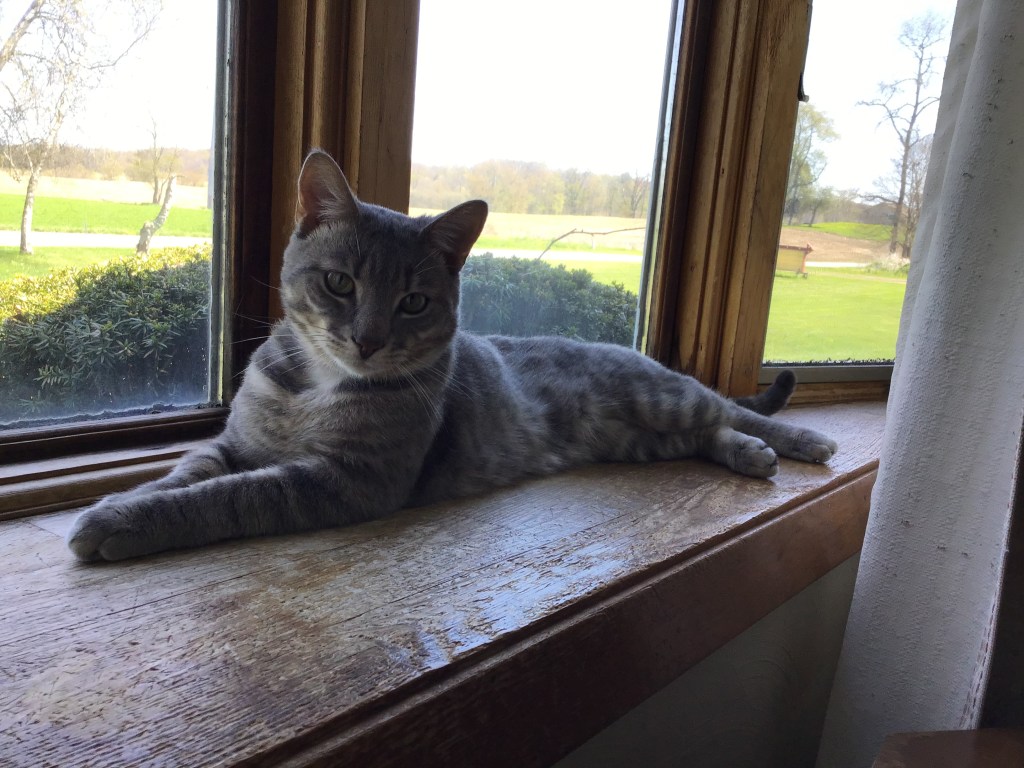
Griffin just turned 1 at the end of April and is my little wild child. He zooms from one end of the house to the other and then back again. Over and over. As energetic as he is, he’s also my snuggle bug when he eventually slows down. Seriously. He loves to be held and snuggled! Griffin likes to watch “bird TV,” loves to be rocked, likes music, and even enjoys painting on a cute game on my tablet. He’s quite a fella!
Crazy man Griffin in a brief moment of stillness.
For some reason, cats and quilting just seem to go together. Like peanut butter and jelly! I just love seeing photos of cats “helping” their human quilters on social media, don’t you? Too bad neither of my cats are into that, but then again, if they were, I’d probably never get any quilting done.
In fact, as I sit here writing, Pip is hanging out in her favorite chair upstairs and Griffin is watching his birds on TV about 10 feet away from my desk. He is not only my little buddy but he’s also THE best coworker I’ve ever had.
Not long ago, Pat, our “Rose Queen” and the owner of Villa Rosa Designs, asked me to help her with some new quilt diagrams for her VRD pattern, Cat City.
To purchase the Cat City Pattern, click HERE Or to purchase the Cat City kit, click HERE
I was really intrigued by the cat block in the pattern, and thought I’d try it out before making the diagrams so I knew exactly how to put the block together. I discovered it’s a really fun block, but it can be a little tricky the first time you make it.
Let me show you how to put the Cat City block together.
Cat City Block Tutorial
First things first, follow the cutting instructions for the pattern. I chose a white fabric and a black fabric for this tutorial (you’ll see why a little bit later). I layered the two fabrics and cut the pieces out at the same time.
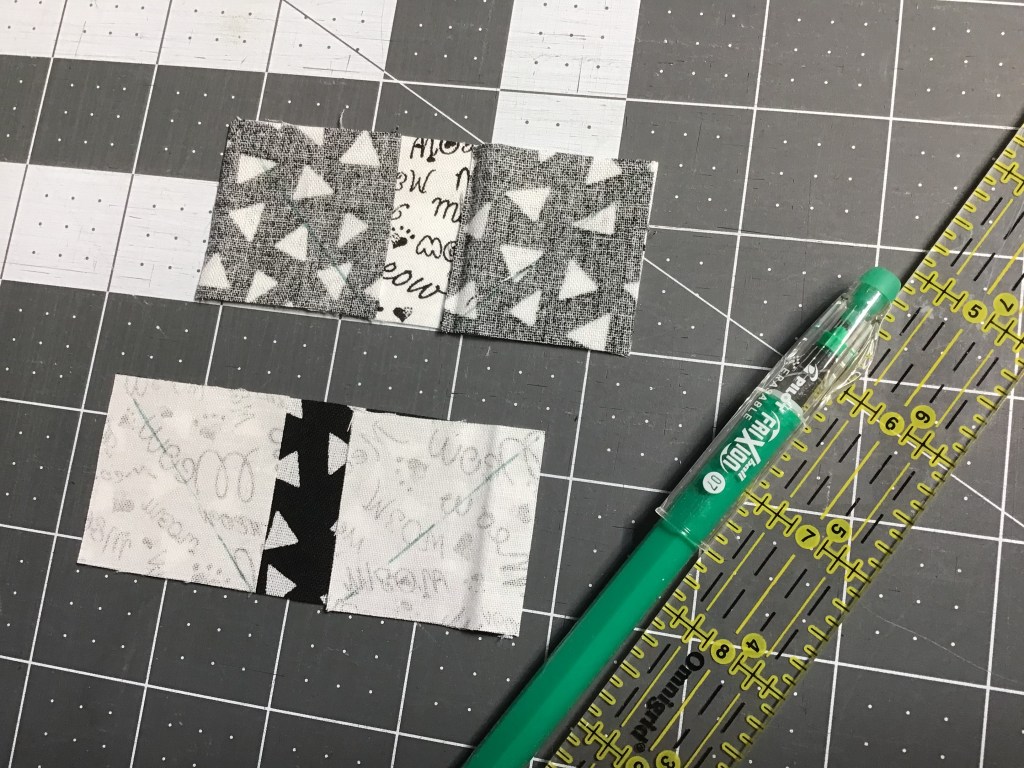
Layer your background and cat fabrics as you see here. I am making 2 cats at the same time and they will be a mirror image of each other. I used a pin to help hold things together on my way to my sewing machine. I also drew a sewing line with my marking pen (I LOVE Frixion pens for marking sewing lines on my fabric). Now off to my machine to sew on the line.
Next, trim off the waste triangles and press the unit open. I pressed my seams to the dark fabric.
Now to make some little ears! Layer your squares right sides together (RST) on the background fabric. Draw diagonal sewing lines on your squares with your marking tool. Sew on the line. Then cut away the waste triangles and press the units open. I pressed the seams towards the cat fabric.
Okay, we’re in the home stretch now. Yippee! Sew the ear unit to the top of the cat body — the ear fabric should match the cat (unless you’re feeling wild and crazy) and then sew the bottom of the ears to the cat body.
OOPS! You will see in the second photo, my cat ears didn’t line up very well with my cat body. Argh! No, it’s okay after all — the one edge of the cat fabric was folded under — whew, I was afraid my cat was growing right before my eyes!
Darn, time to use the tool all quilters and sewists run from in fear — THE SEAM RIPPER. (Cue creepy music.)
Done. It only took me a quick minute to rip out the seam, press the folded-under edge straight, and resew. Now we’re back in business. I pressed the seam towards the cat body.
In the first photo here, you can see how my cats will look after I sew the cat backs to the cat body/ear unit. I am planning to sew my cats front sides together. Ying and Yang, I think I will call them.
The middle photo shows the cats stitched together …….furever (sorry, I couldn’t resist).
The third photo shows how I pressed the seams — center seam between the cats open because of sewing the fiddly little ears together and the cat body/back seam I pressed towards the cat body. The ears wanted to be a bit difficult but I pressed them into submission with a little pressing spray (my favorite is Mary Ellen’s Best Press).
There you have it — a cat block with mirror-image cats. Of course, instead of sewing them fronts together, you might want to sew them with their backs together — would this be a cat fight???? — take a look at the quilt on the front of the Cat City pattern above for ideas.
BUT WAIT — there’s more! I just love saying that, don’t you?
I decided to cut 2″ strips for a border around my cat blocks for a fast to finish little quilt. I sewed the sides on first and then the top and bottom strips.
Voila! A little quilt, mini quilt, doll quilt, table quilt, place mat or whatever you want to call it.
Now I just need to layer my little quilt with batting and backing. Quilt it. Bind it.
DONE! My favorite kind of project. 🙂
Here is my black and white Ying and Yang alongside my first little Cat City quilt in pink and brown. When I finished the pink and brown one (which was my original example to figure out how the block went together), I decided that I had to make a black and white one.
I hope you will enjoy making your own Cat City quilt. Or maybe you just want to play a little bit and make yours mini. Whatever you choose, I can’t wait to see your cat quilts (and maybe your cats)!
You can share them on our Facebook page. Not a member yet? Join us to take part in all the Villa Rosa Designs fun HERE . We really are a fun bunch. Really.