Yep – you’re right, it’s not Thursday yet, but I had some important information to share with you about Villa Rosa Designs and it couldn’t wait until our usual Thursday post.
Please read on –
Moving Along
Pat Fryer is making changes – all toward scaling back her personal work load and concentrating on the Villa Rosa patterns.
California fabric shop and online fabric store –
All of the fresh new fabrics will be handed off to Heidi and Molly Cook. The location is the same and all of the good things will be there. They have a new name – 3 Aunts Quilt Shop. The website 3AuntsQuiltShop.com will be live October 1. There will be links on the VillaRosaDesigns.com website and in our newsletters. All of Villa Rosa Designs patterns will be available at the shop and on 3AuntsQuiltShop.com. 3 Aunts Quilt Shop will carry on as the California home of Villa Rosa Designs. Great things are in store!
VillaRosaDesigns.com –
The website will continue to have all of the Villa Rosa Designs patterns, and will still have close-out fabric and kits. There is much remaining inventory after years of buying and overbuying fabric.
Pat and company [me included!] are going to be adding much more in the way of videos, tutorials, challenges, social sharing. Let’s keep Villa Rosa Designs quilting and connected!
The new Texas home of Villa Rosa Designs –
A new East Texas location is opening in October. The location is a partnership between Pat of Villa Rosa Designs and Catherine of Running Doe Quilts. Running Doe Quilt Shop is expanding there – more machines, more fabric and notions, more classes. Running Doe’s new shop will be renamed Rose City Sewing. The location will have all of the Villa Rosa patterns available, along with close-out Villa Rosa fabrics. Great things are in store!
Wholesale Operations –
Austin, TX is still home to Villa Rosa Designs administration and print shop. Leann Fryer handles operations, web design, programming, wholesale ordering, and special orders. Wholesale orders for quilt shops can be placed on VillaRosaWholesale.com.
Pattern Shipping –
Central Missouri houses the patterns. Eric Aitken fills pattern orders – wholesale and retail. Nancy Aitken heads our art department from there.
With all these moves, Villa Rosa Designs continues to be scattered over 3 states. Centralizing contacts – phone and emails – will be a challenge we hope to simplify.
Contacts –
3 Aunts Quilt Shop – Molly Cook, Heidi Cook 3auntsquiltshop@gmail.com 530-509-5133 530-798-8506 530-755-6467 3AuntsQuiltShop.com 12438 Loma Rica Dr., Ste. A Grass Valley CA 95945
I hope you enjoyed last week’s tutorial, Morning Tea, with Molly. It was wonderful that she could stop by the blog and visit with you. Things have been super busy over there at the VRD shop in Grass Valley, CA, so she just hasn’t had a lot of extra time to hang out with us on the blog. What a great quilt she made, too, huh? Blue and white Australian fabrics – wow! If you missed last week’s Morning Tea tutorial, you can find it HERE.
High British Tea and a Quilt Exhibit/Tour
Last Friday, I was delighted to attend a High British Tea and Quilt Program/Tour at the Gibson House Manor Museum in Jamestown, PA. I was invited by my sister’s aunt-in-law (is this even a word???), Anita, to attend as her guest. Anita is not only a quilter, she also volunteers at the Museum.
The Gibson House Manor has had a very interesting history, indeed. It was built by a local doctor, William Gibson in the 1850’s. It is also known as the Mark Twain house because Mark Twain actually stayed there after the Civil War. He liked the house so much, he even included it in one of his stories! But even more interesting, it was a vital stop on the underground railroad with hidden secret rooms and so much more! You can visit the website HERE for more information.
Here’s the museum – isn’t it gorgeous???
Lucky me – not only was the new quilt exhibit debuting, the curator was giving a tour of the quilts, AND it was the monthly High British Tea day. What fun!
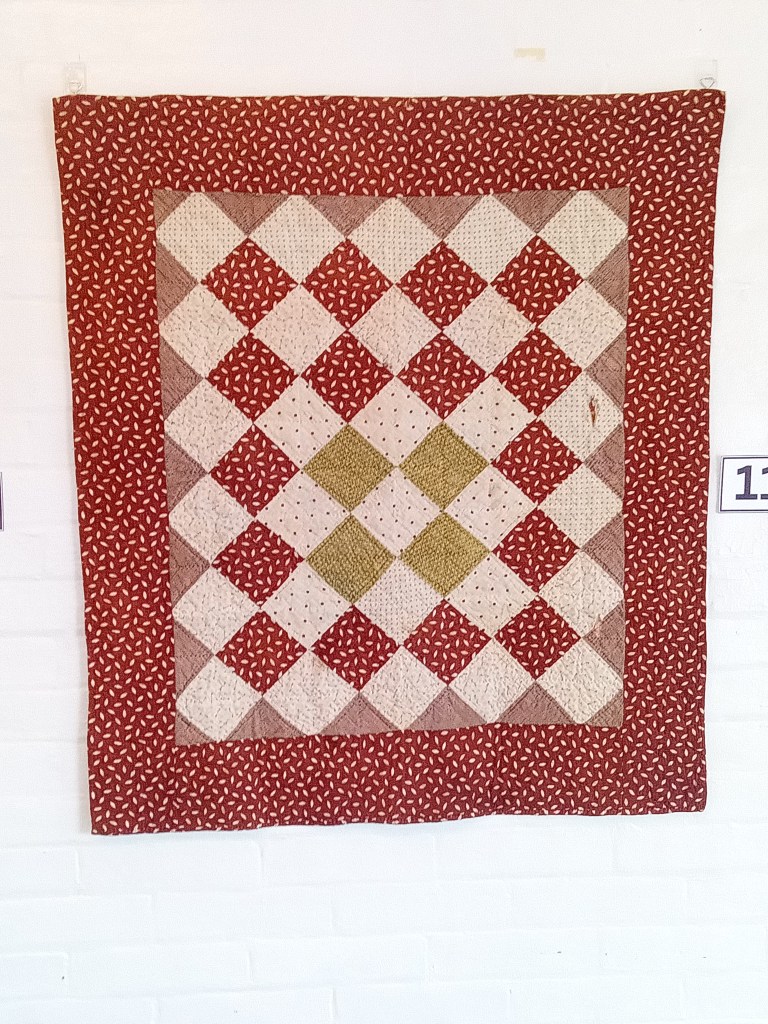
Here’s a few photos of the exhibit, showing some of the quilts on display.
You can see this lovely exhibit (and the museum!) until October. It’s called Quilted Layers: Piecing Together History and it is curated by Jill Mezaros. You can make reservations on the website to see the exhibit. While you’re there, you might want to take the Underground Railroad tour and maybe have High British Tea, which is usually the last Friday of the month. Yum!
Now let’s get started on this week’s quilt tutorial to help you restart your quilting this fall.
VRD Midnight Pathway Quilt Tutorial
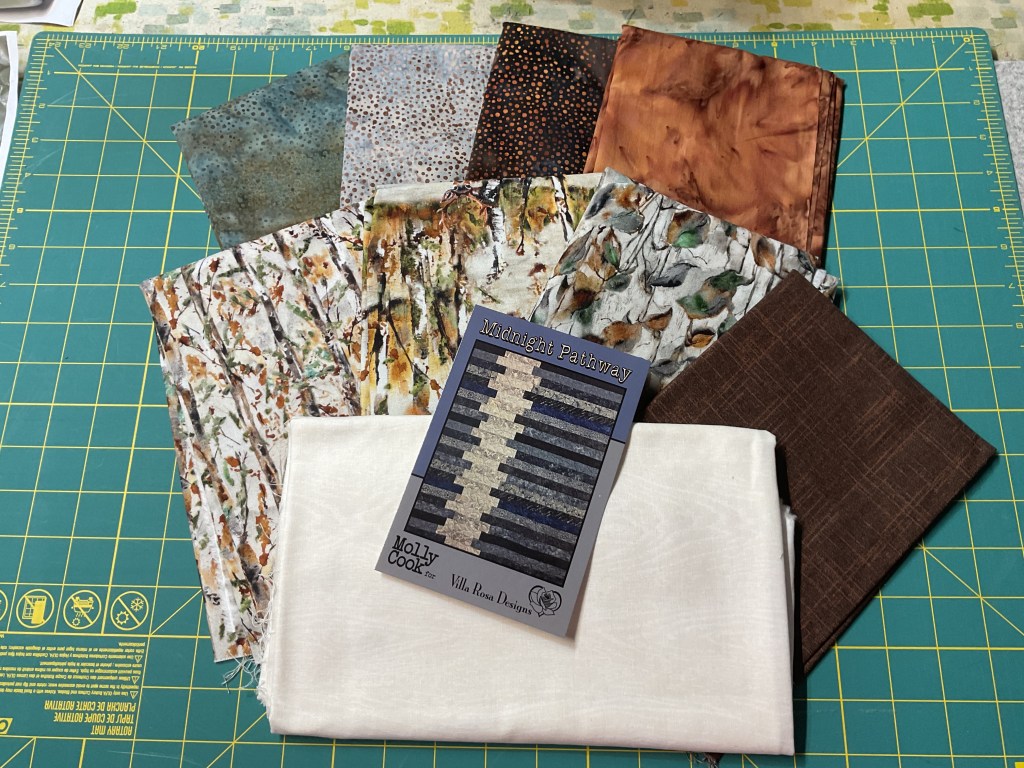
Midnight Pathway is another great VRD pattern by our own Molly Cook. It finishes at a big 52″ x 72″ and makes a good-sized throw quilt. Want it bigger? Simply add a border.
To me, this pattern has a more masculine feel to it. It’s very straightforward without any extras. I think you’re going to like it!
Don’t have this pattern yet? Then get your digital pattern HERE or your print pattern HERE.
Today we’re using a rich earthy fabric collection. This collection is called Into the Woods and is a Hoffman Fabrics digital fabric collection with companion batiks.
Sadly, this collection is an older one, so you might not be able to find it anymore. This time of year, though, you’re bound to find something with a fabulous autumn woodsy feel that would work equally well like the Jason Yenter collection Falling Leaves or maybe Deb Tucker’s Forest Flora collection.
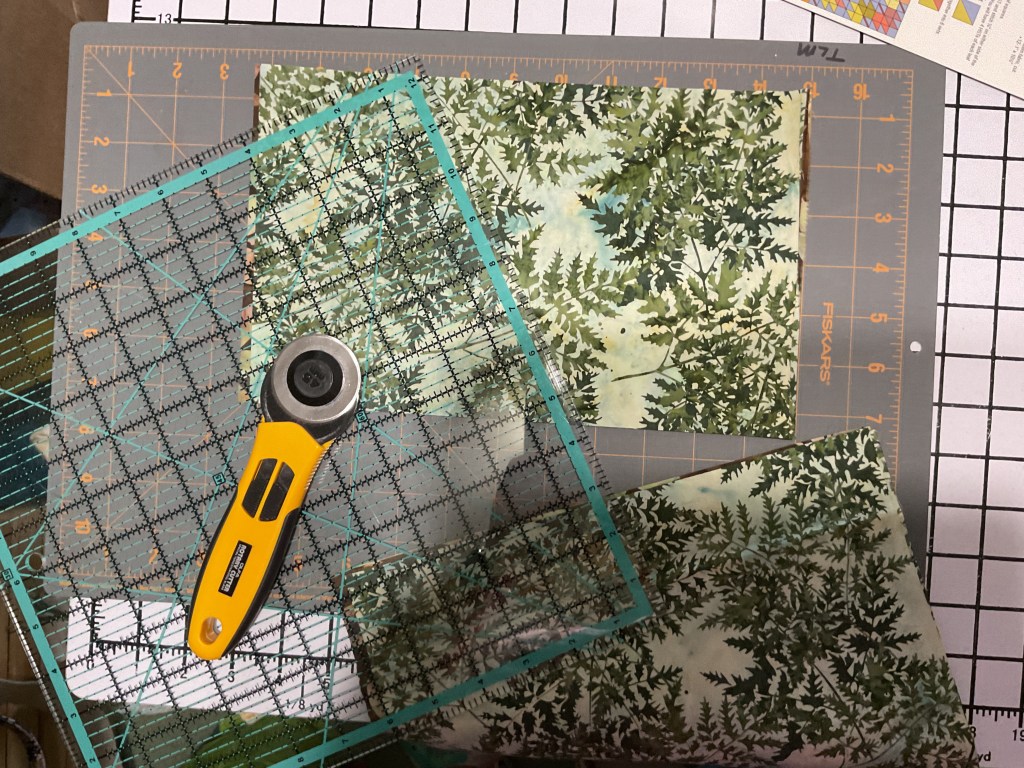
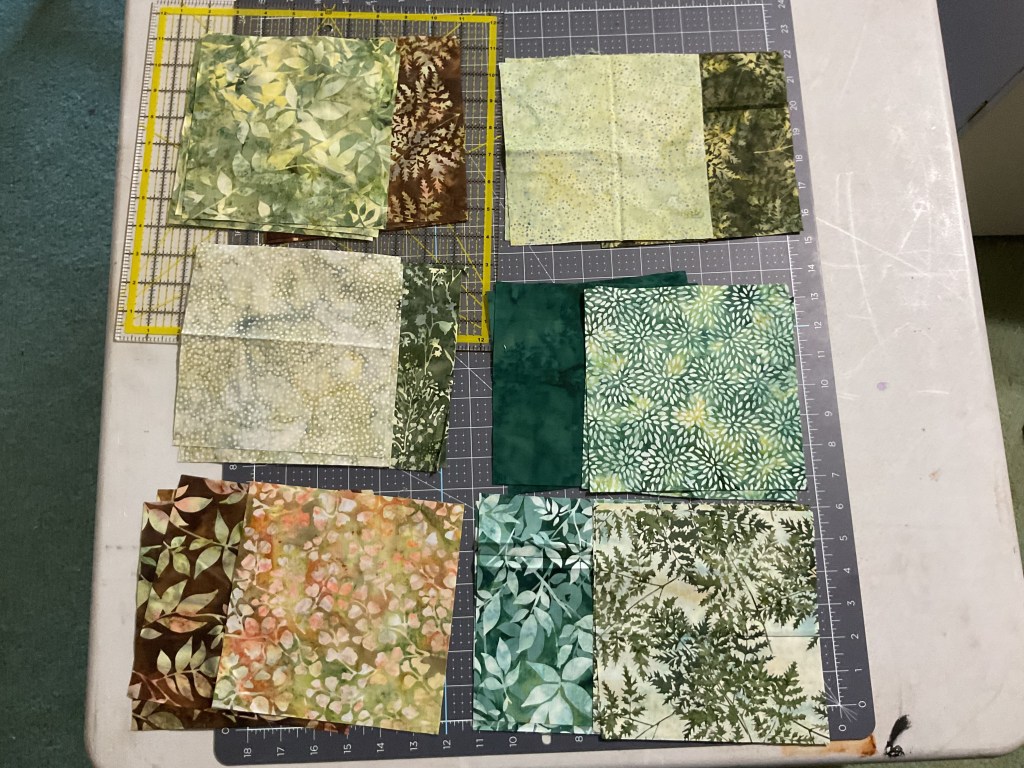
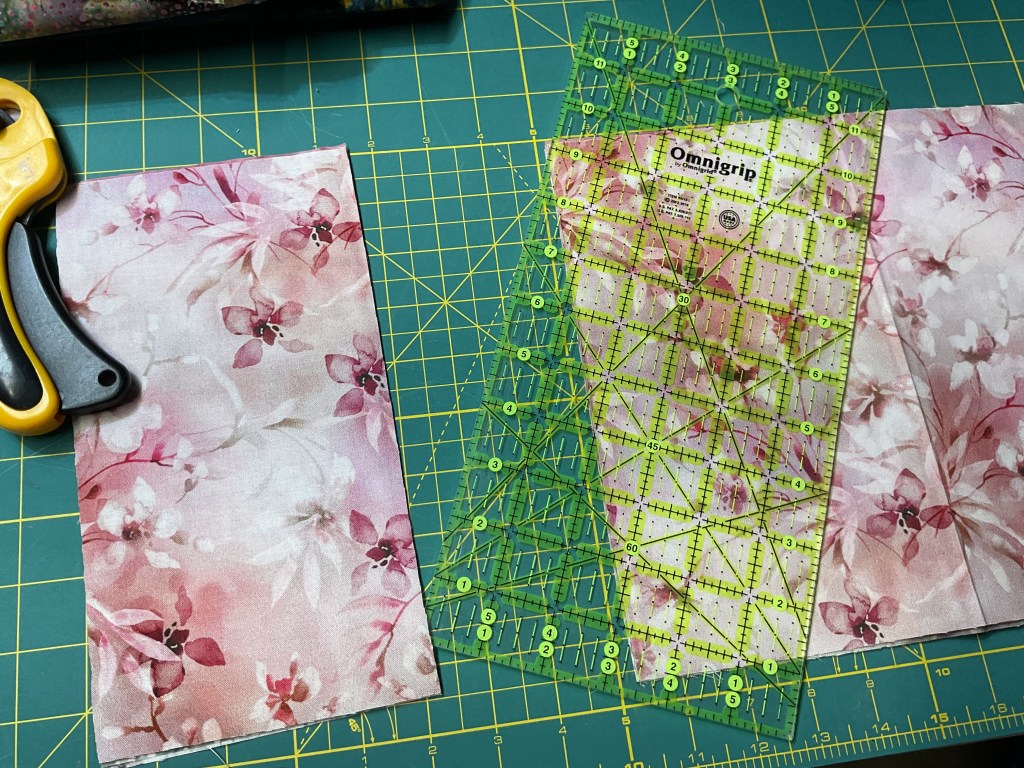
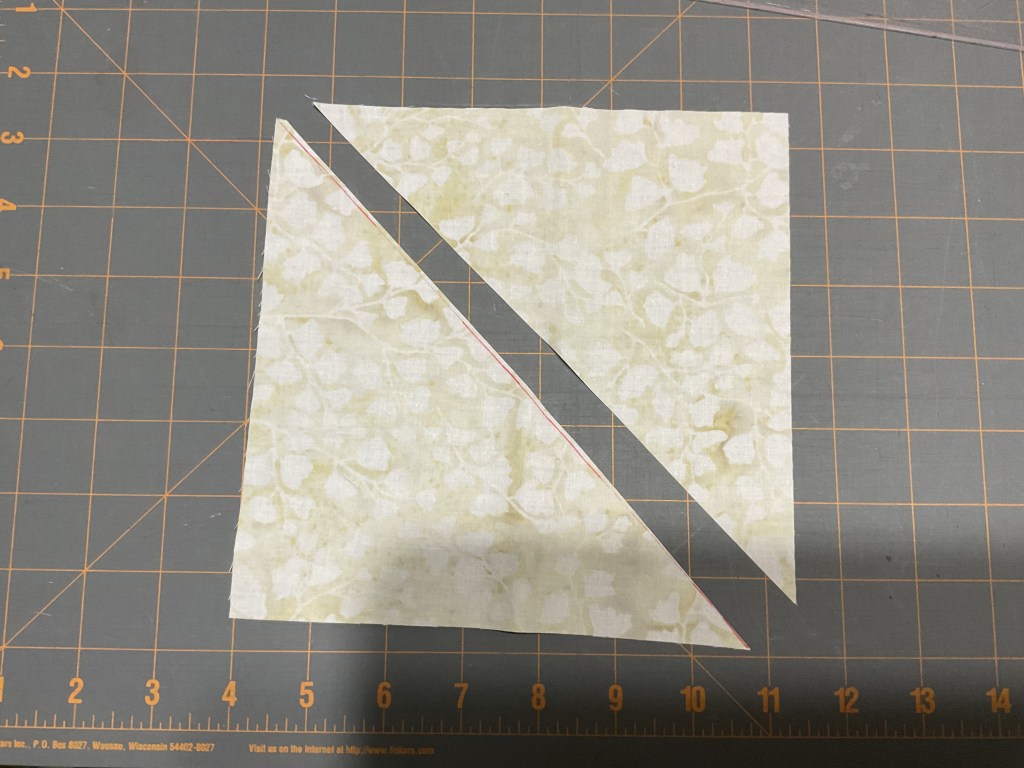
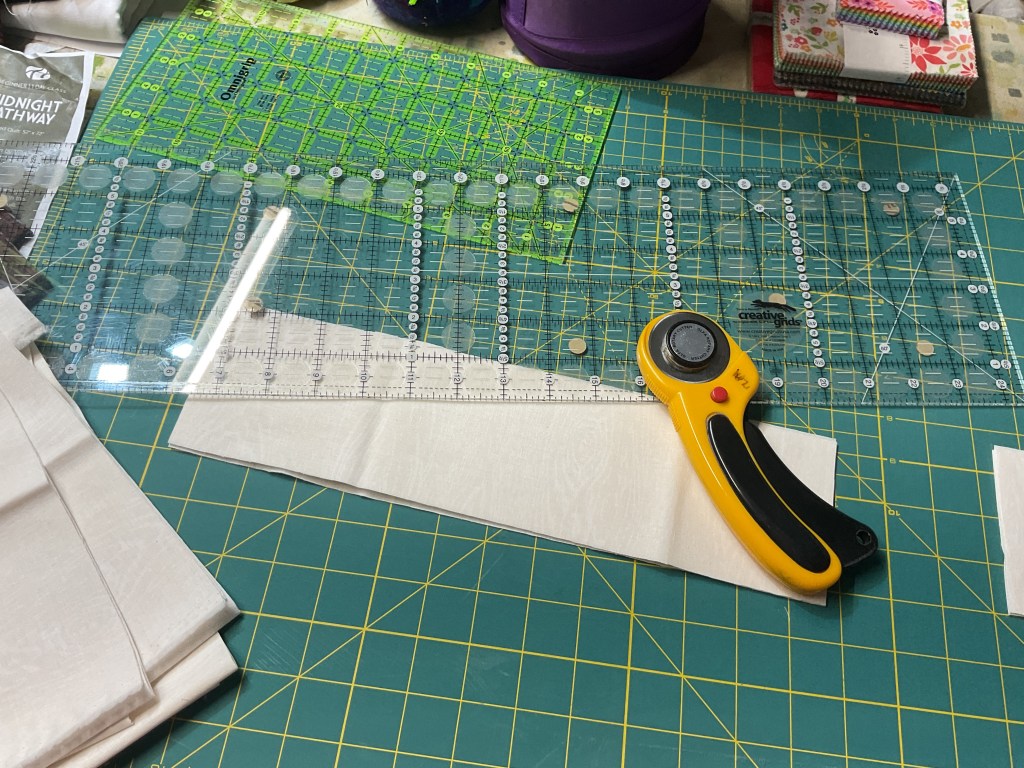
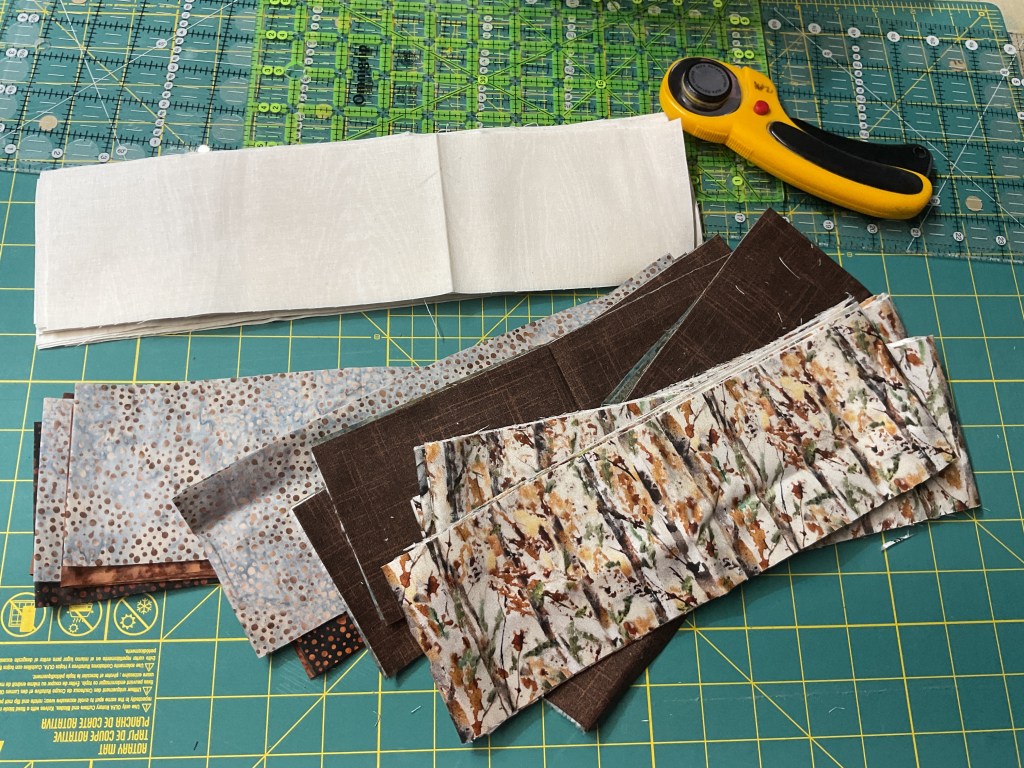
The first thing we’re going to do is to cut a lot of strips from our prints.
Then we’re going to cut more strips from our contrast fabric.
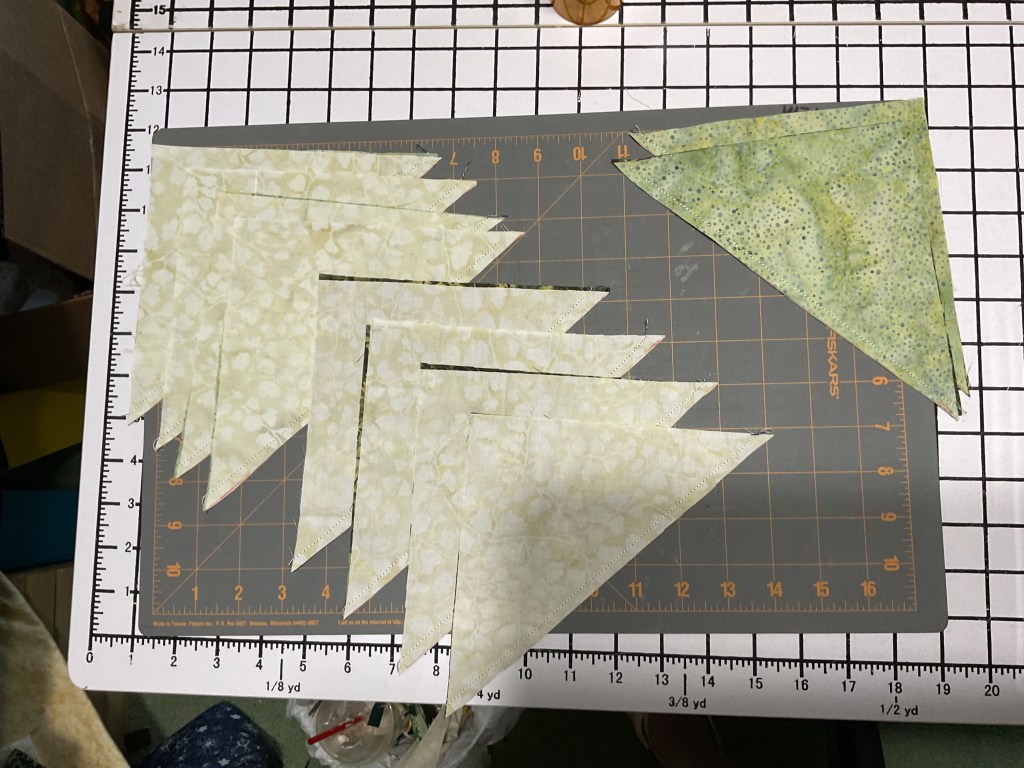
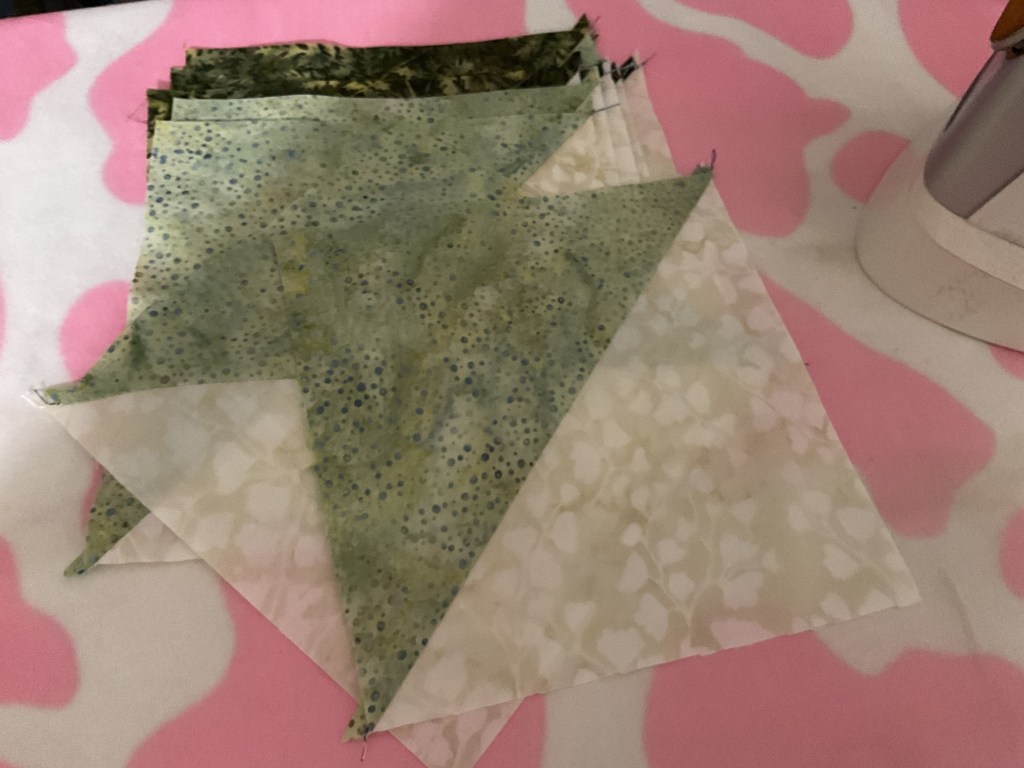
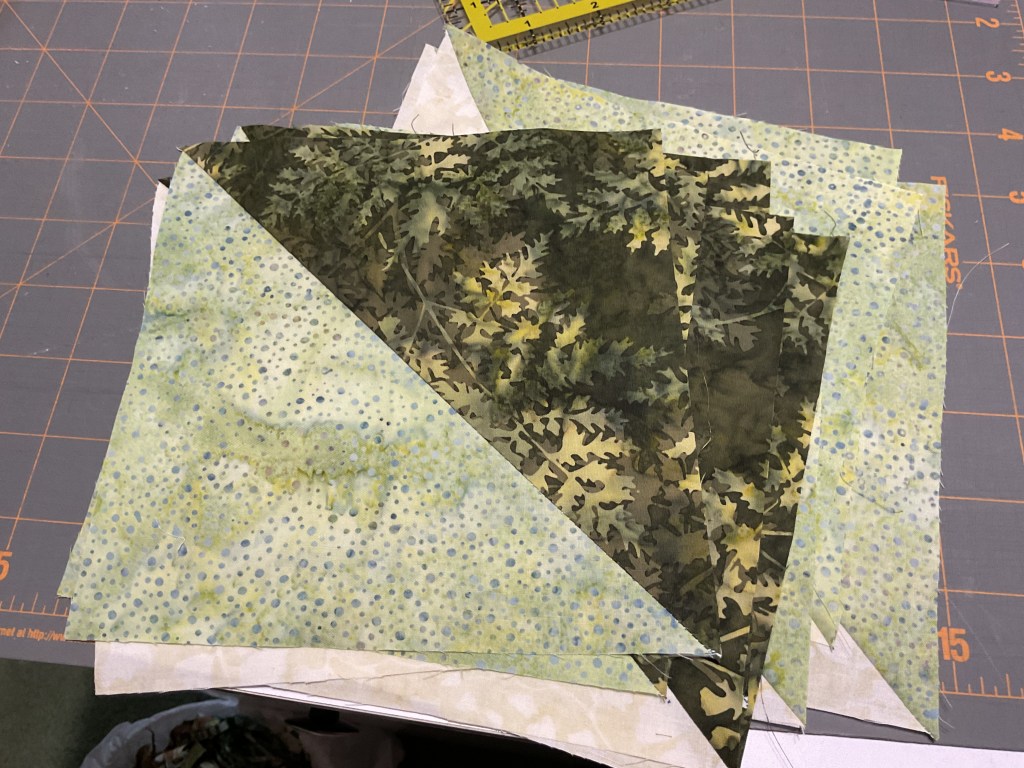
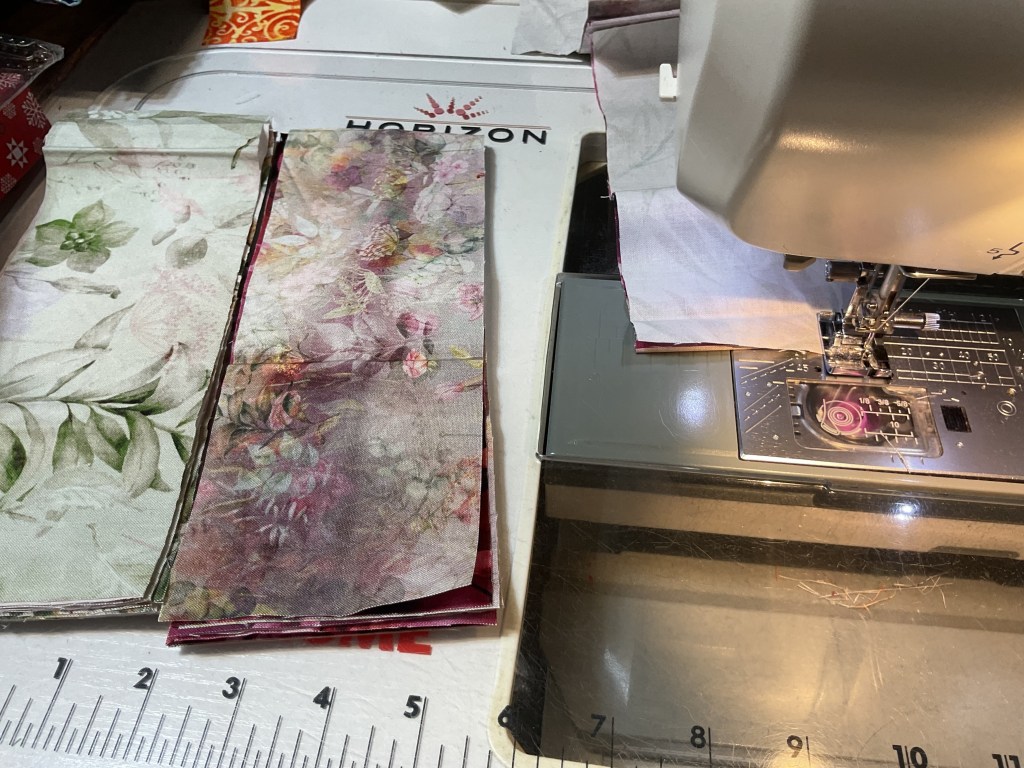
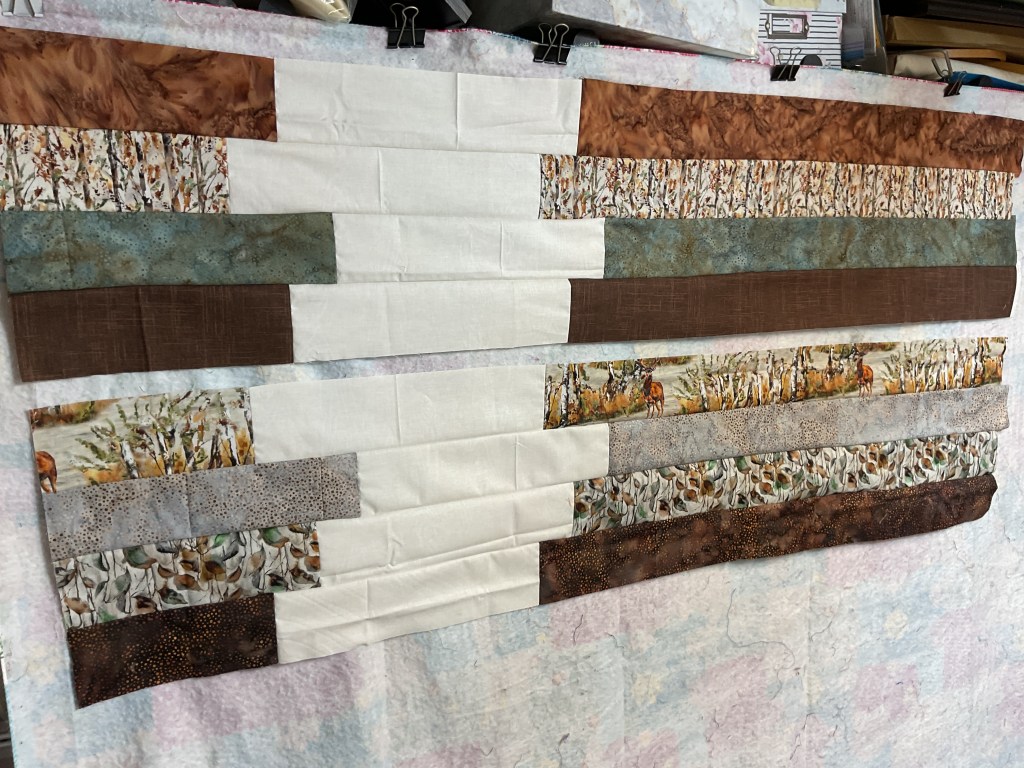
Once we’ve got all of our strips cut, we’re going to cut our strips into different sized pieces. It’s important to keep all the pieces from one strip together. I folded the smaller pieces inside the longer pieces so I wouldn’t lose them.
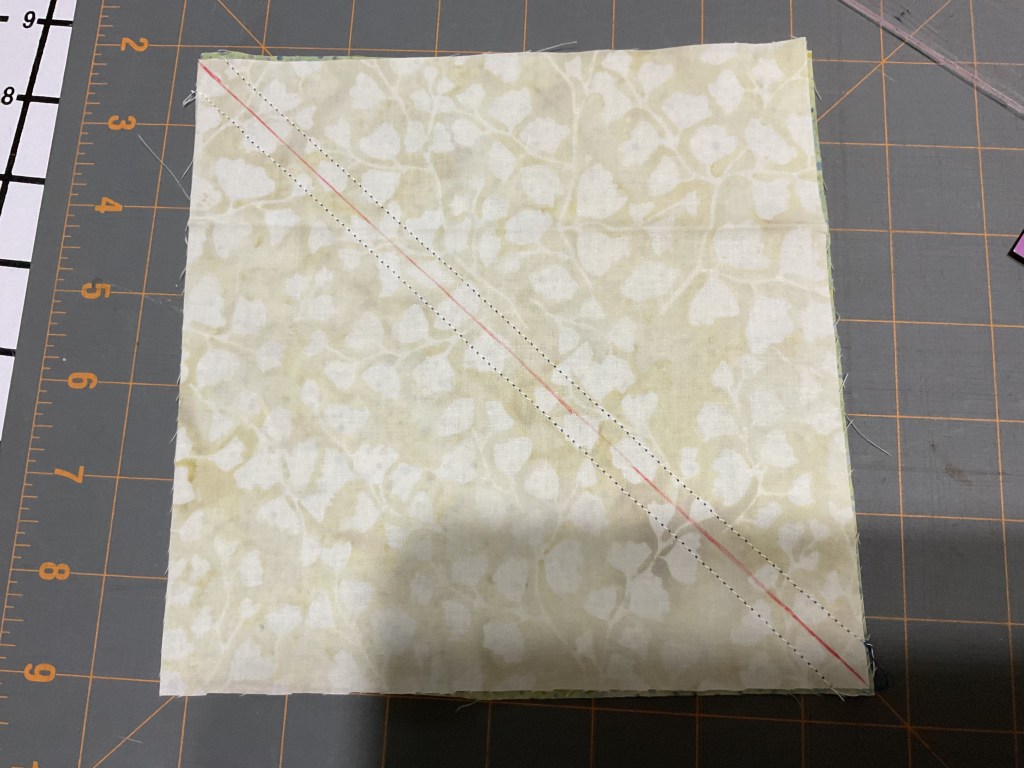
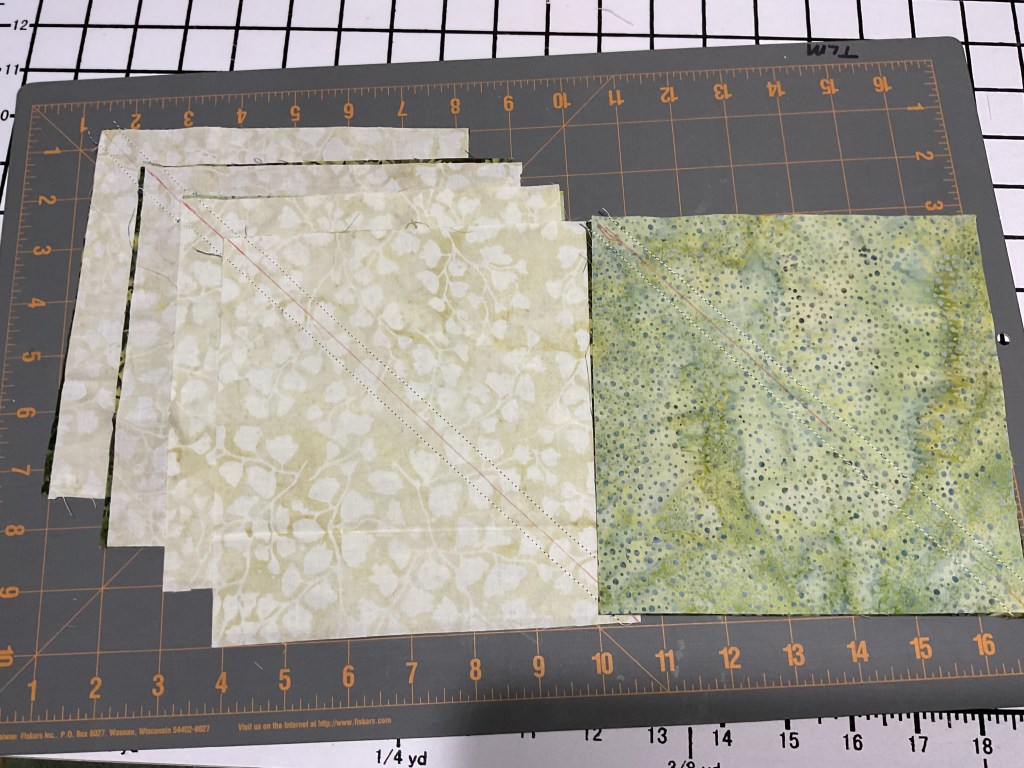
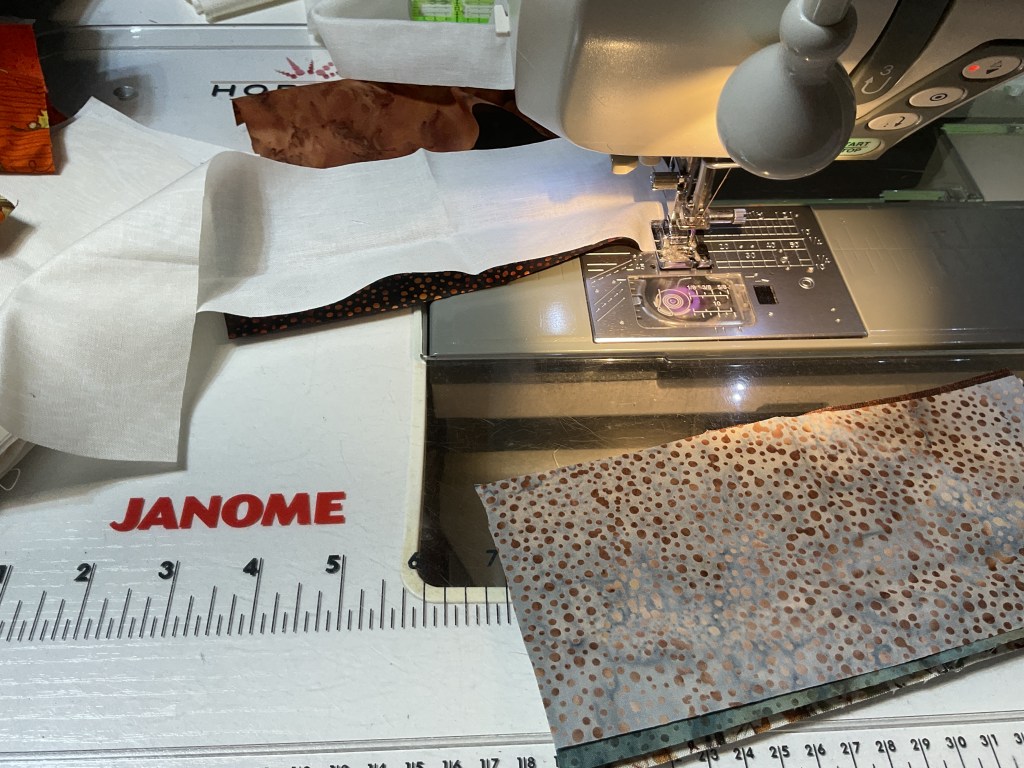
We’re heading to the sewing machine next so we can add contrast rectangles between the small and larger pieces of the strips. You could mix and match your pieces for a really scrappy look (or even shop out of your stash and scrap bins), but I’m sticking with the pattern and going to keep each original strip together.
As there are three different pieced strips, I’m going to sew the strips together in 3 sections, then I’ll sew all the sections together.
I’m going to pin all the same pieced strips together to stay organized as I work on each group.
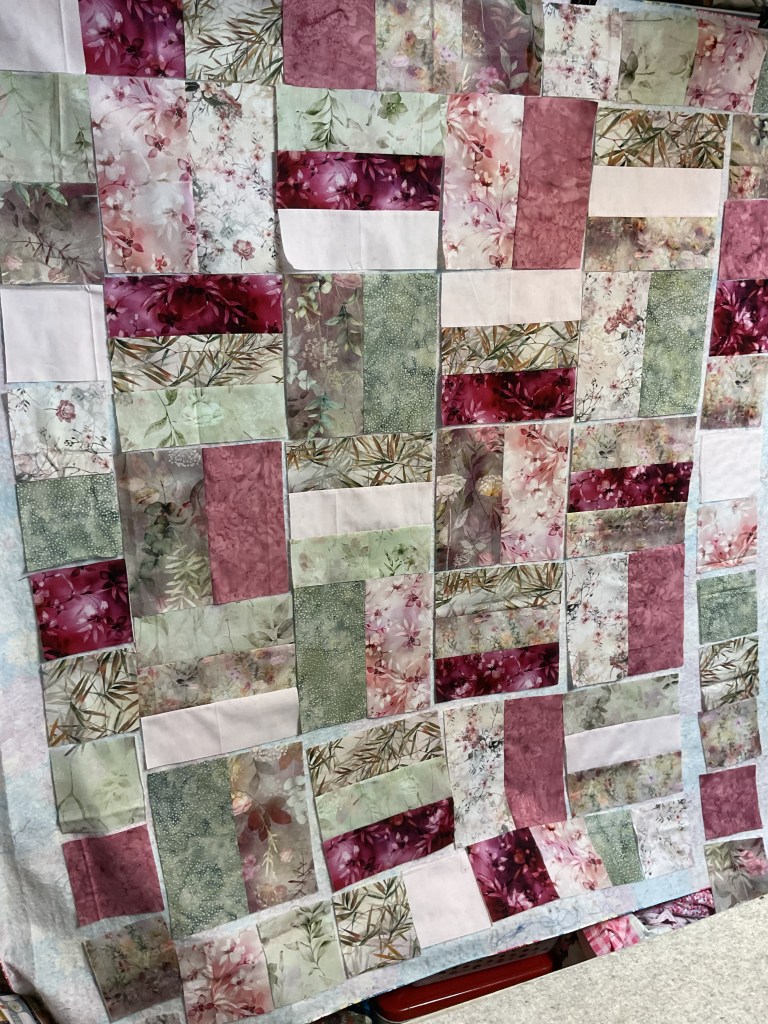
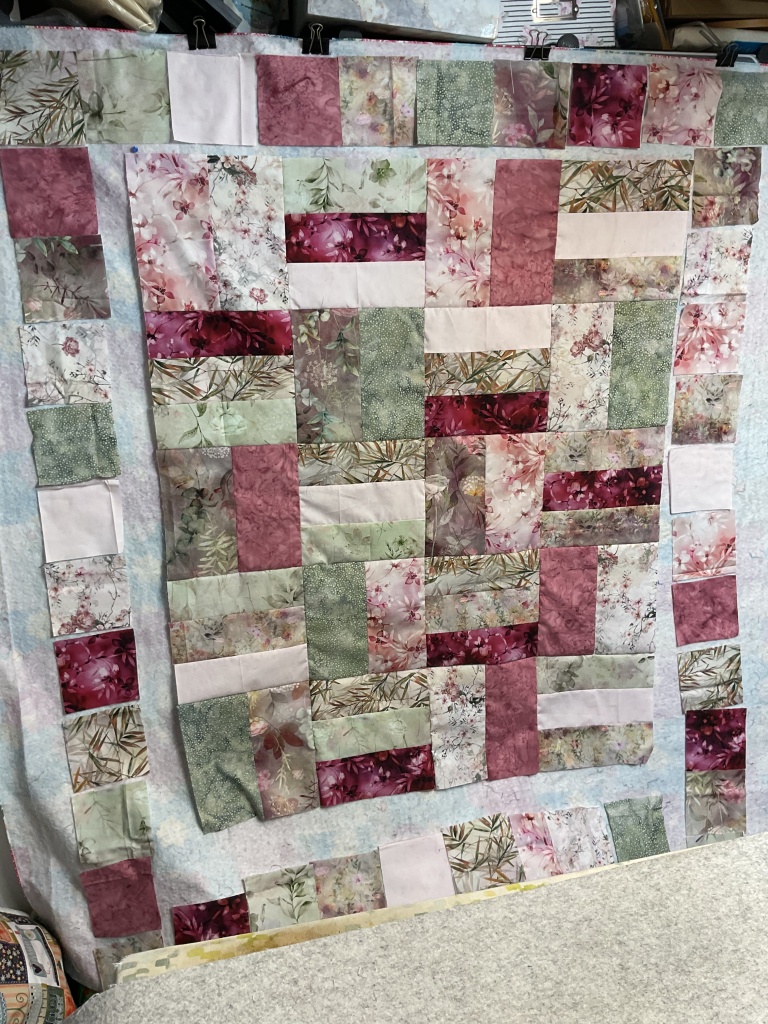
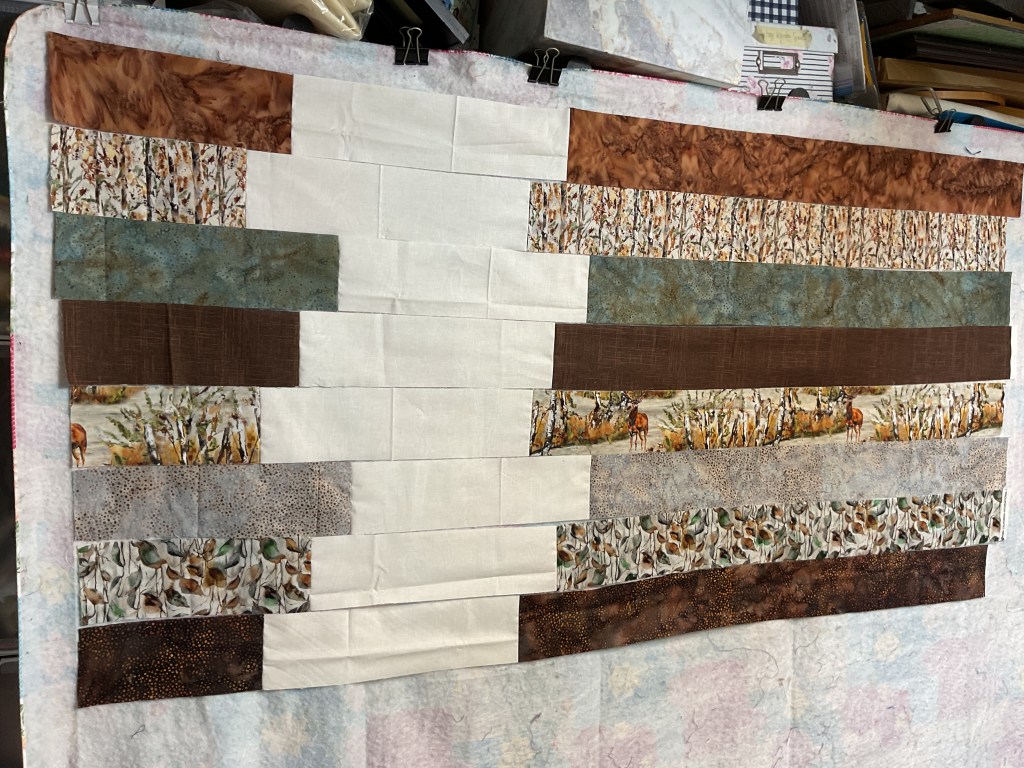
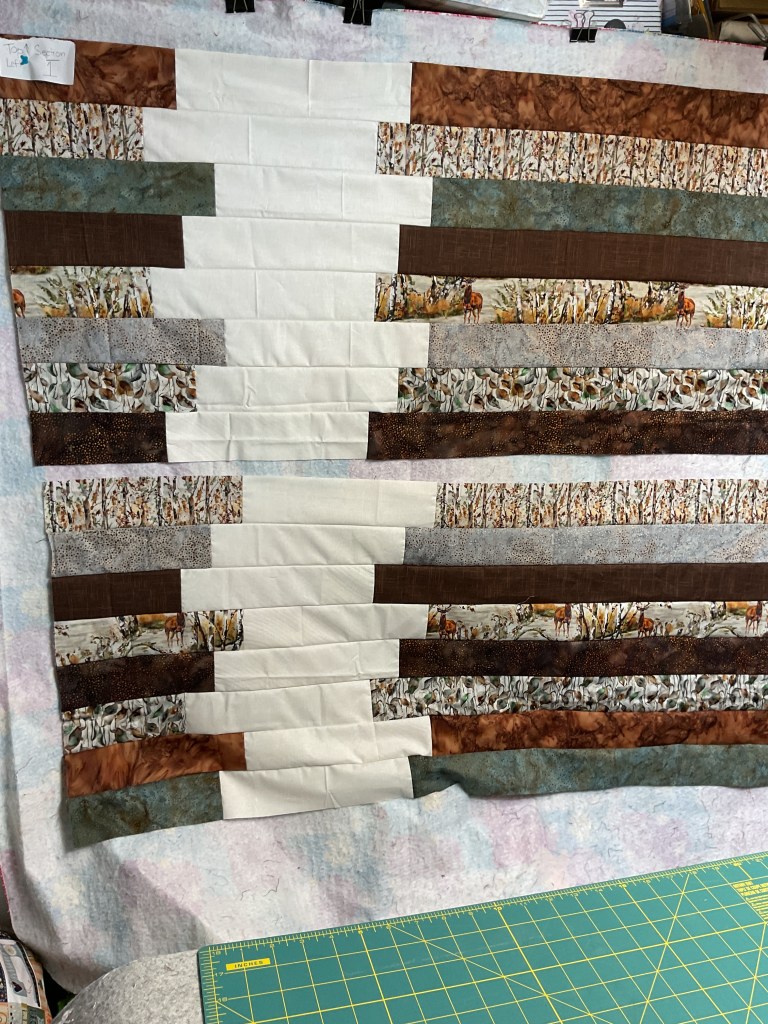
Now that all my strips are pieced, the fun can begin! Time to arrange the strips on my flannel board. Because I have my strips already divided into 3 groups, I’m also going to work on sewing the pieced strips together into 3 sections.
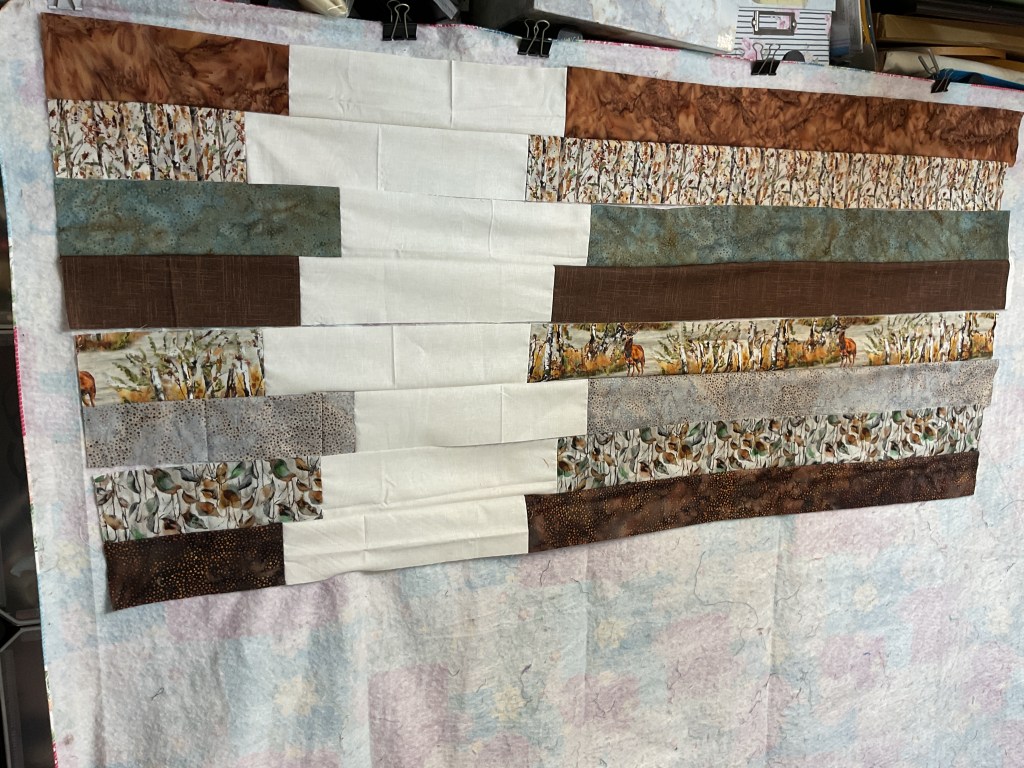
You can really have some creative license with this design because you can arrange the strips any way you want! There are so many ways you can put these strips together, so make sure you play a little bit before you commit.
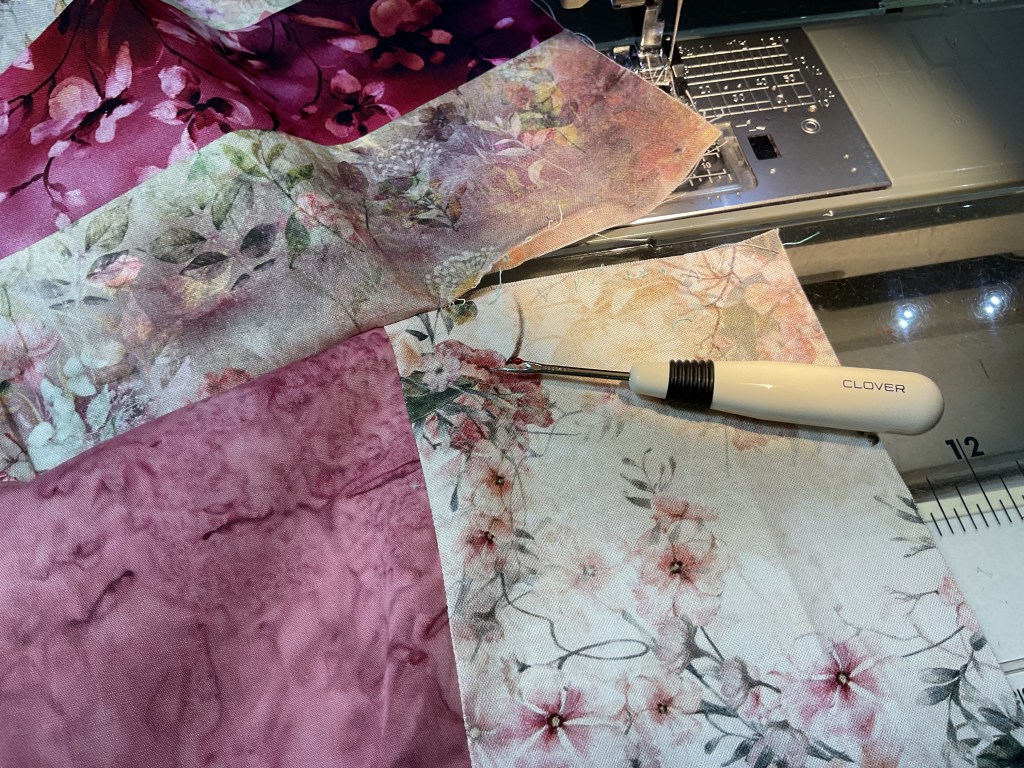
Okay, I’m happy with my first section, so I’m going to sew the pieced strips together – first into pairs, then into quads, then finally sewing the quads together into one section. This helps me to keep from mixing up the strips as I sew.
I added this piece of paper to the top left corner so I wouldn’t flip things all around as I went.
Great! Time to move onto the second group of pieced strips. I’m going to continue using the same technique as I did with the first section (twosies and foursies) after I’ve decided how I want this section arranged.
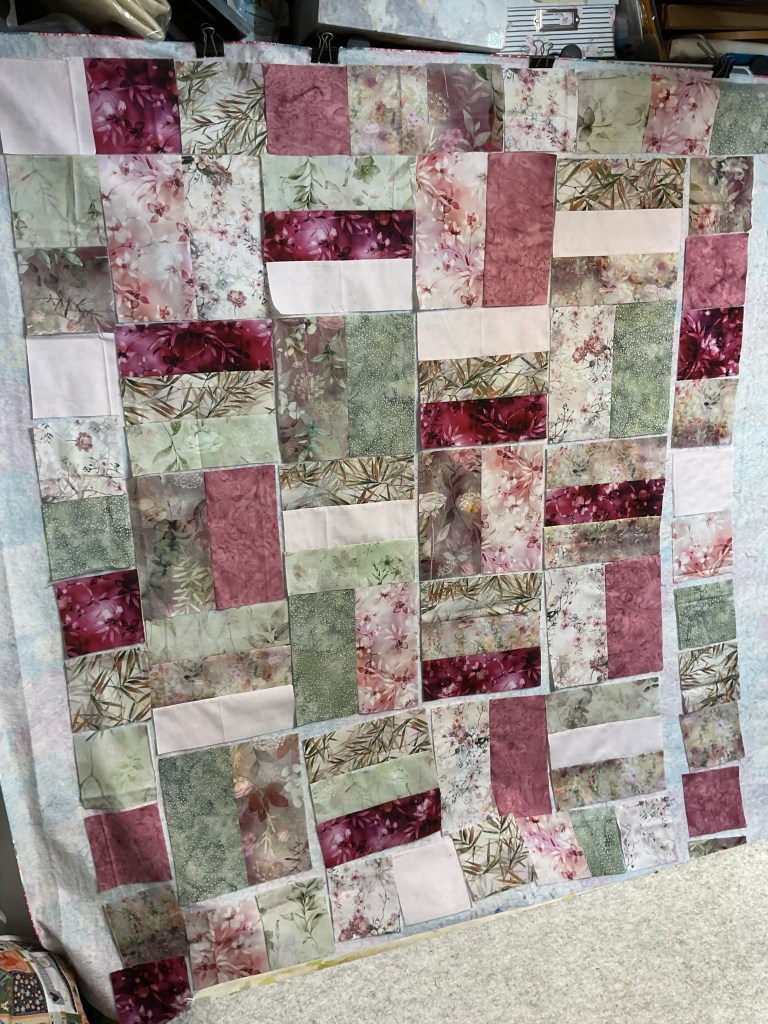
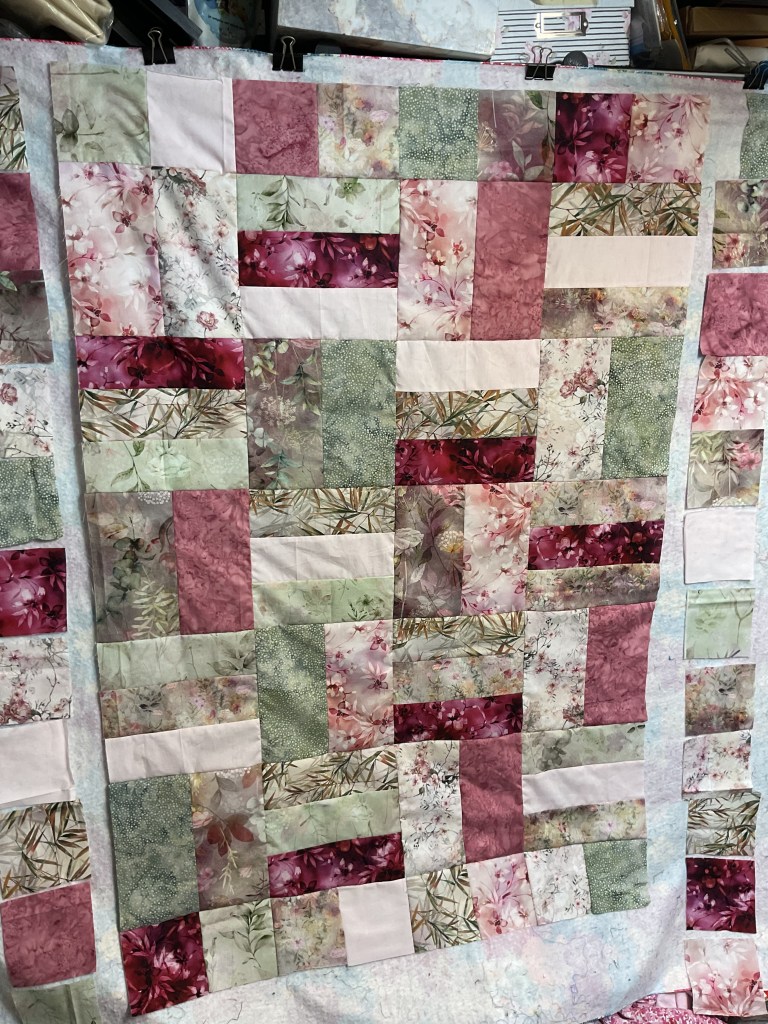
Now onto the last section. Because the quilt top is getting so long, I’m pretty much standing on my head to arrange the last pieced strips. LOL! I can barely show you the entire quilt top now – my pressing counter is in the way and I’m running out of flannel board.
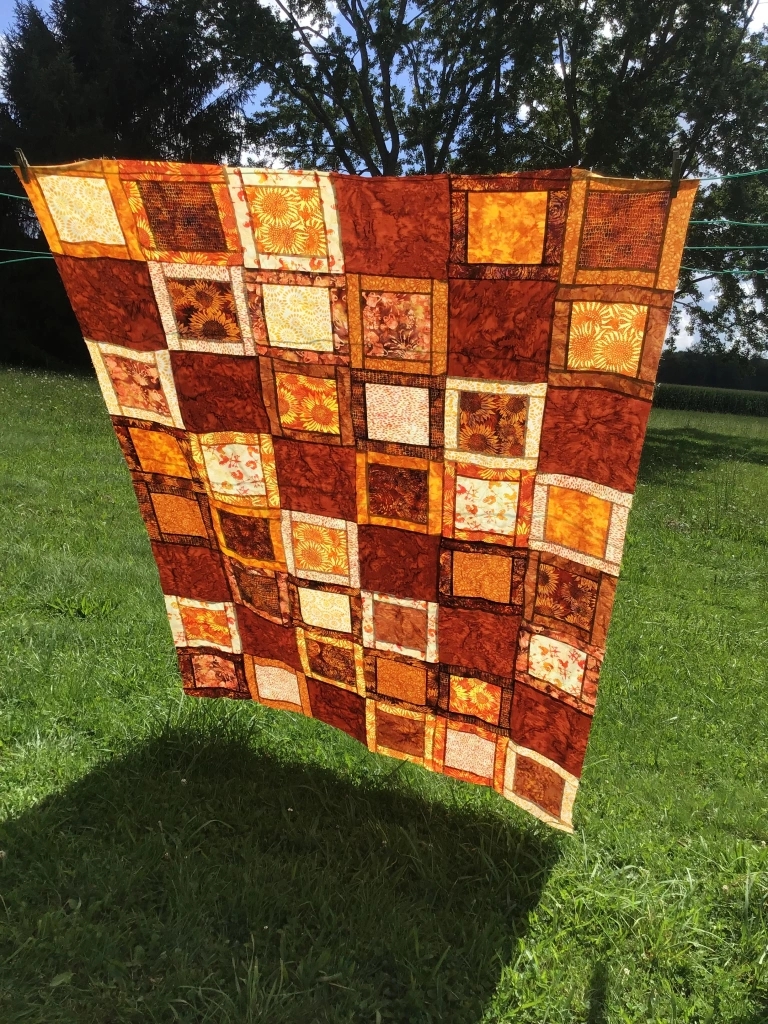
So I’m going to take the top outside for a photo so you can see the whole thing. And here it is! I really like how warm and cozy it looks and how any guy or gal would love it!
Now all I have to do is layer it with batting and backing (or fleece as I plan to do), quilt it, bind it, and put on a label. Ho hum…..I’ll be adding it to my mountain of projects that need finished, I’m afraid. Seriously, I have no idea how many flimsies (quilt tops) and layered quilts I have on my pile – so, what’s one more???
Fingers crossed I’ll get some time this winter to work on them. Of course, the more tutorials I do, the more flimsies I add to my teetering pile. What a delightful conundrum.
Bet you don’t have any WIPs or UFOs (works-in-progress or unfinished objects) in your sewing space, do you???
See you next week for another great tutorial and NEW September patterns!
Long time no see! I’m stealing the blog from Tricia this week – it’s been a while since I snuck in here and did a tutorial. Sorry it’s been so long, but things have been awfully busy at the VRD shop and I’ve been working hard to create new patterns for you, too.
I heard Tricia’s doing a bunch of tutorials to help everybody get back into quilting this fall, so I thought I’d add one to the mix – Morning Tea. Yup, another Tea quilt. LOL!
Anyway, let’s get back to today’s tutorial, Morning Tea.
VRD Morning Tea Quilt Tutorial
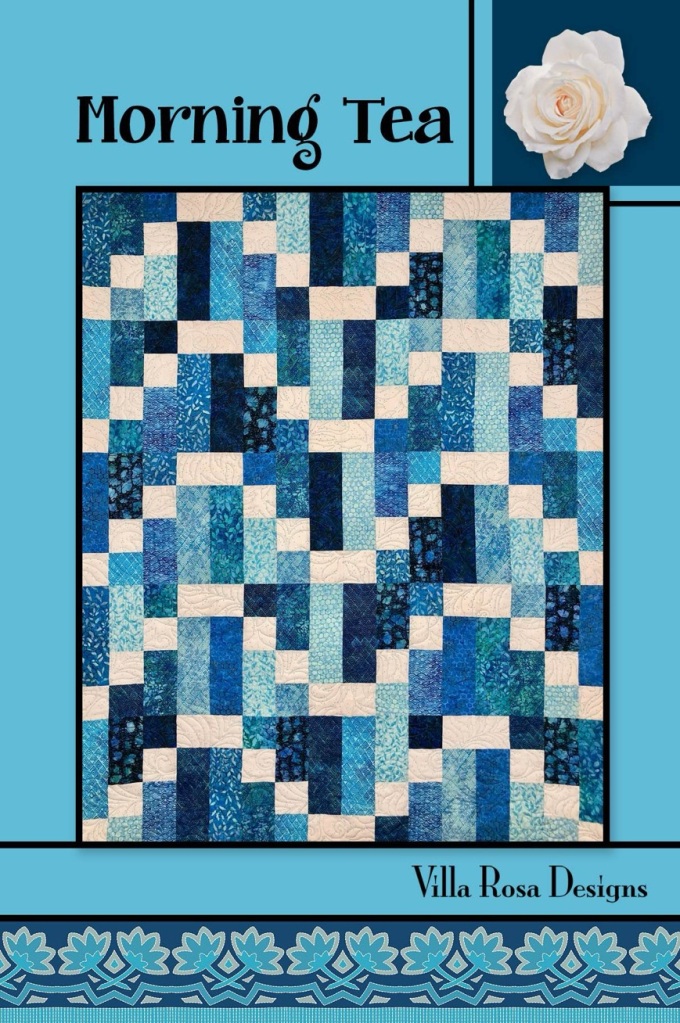
Here’s Morning Tea, designed by our very own VRD Rose Queen, Pat. It’s a fat quarter (18″ x 21″) friendly pattern plus you need to add a background fabric. And of course, it’s fast and fun!
If you don’t have the pattern yet, you can get your print copy HERE or digital copy HERE
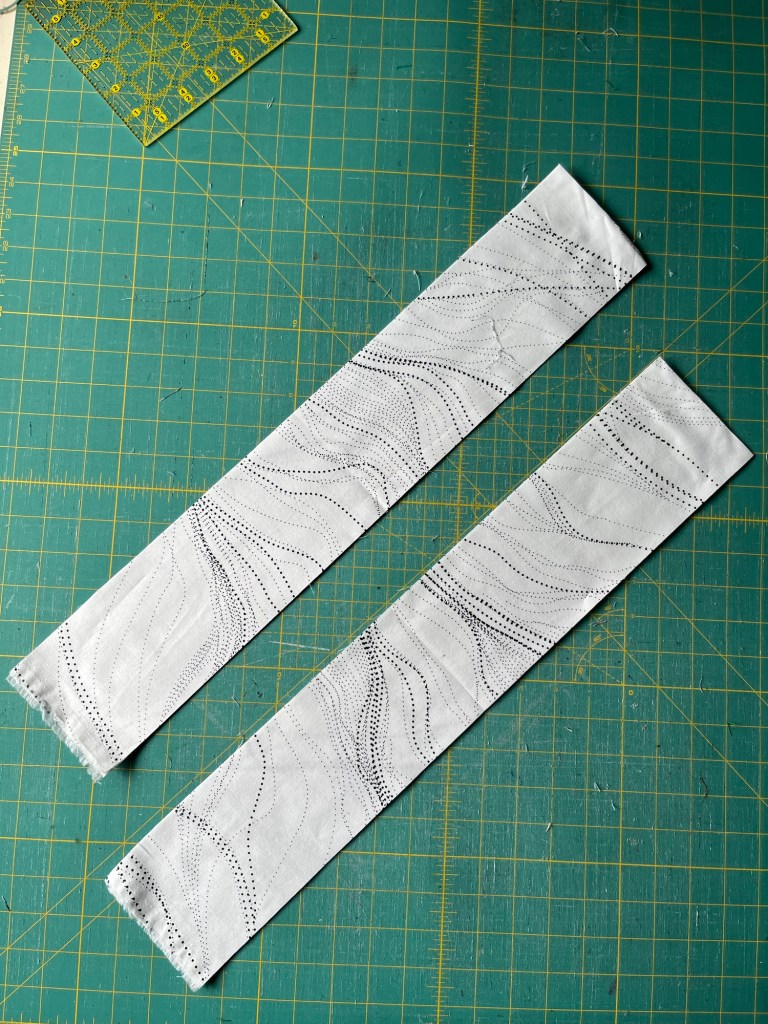
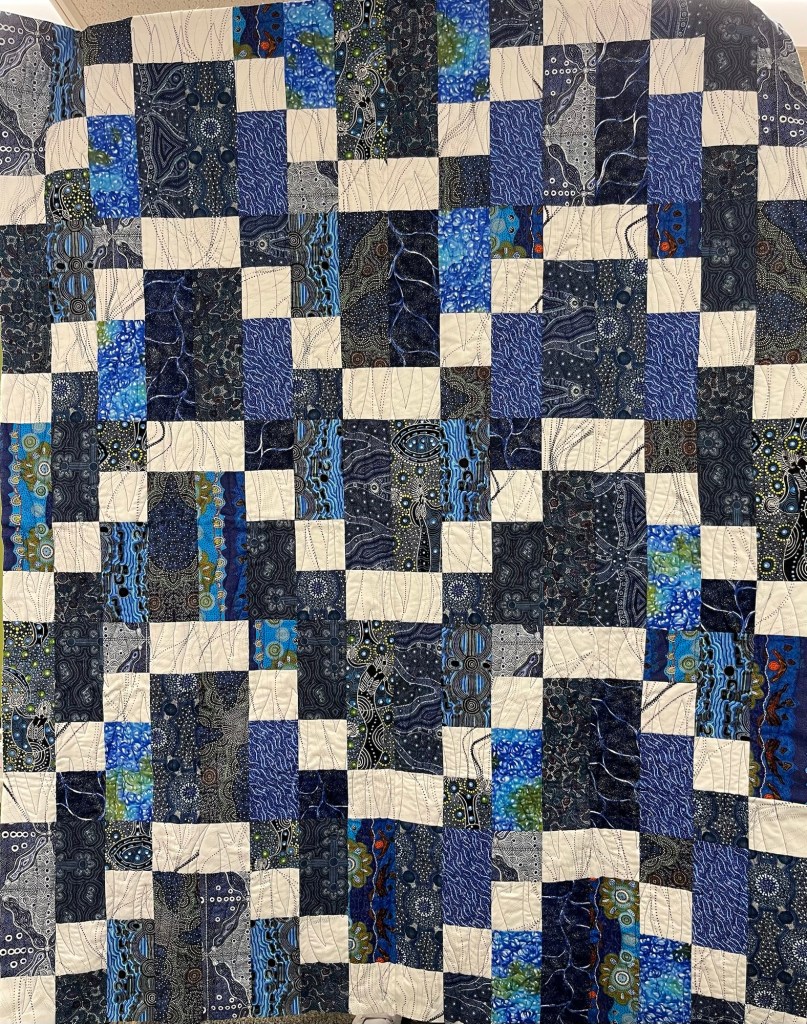
I wanted to play around with some of our Aboriginal fabrics in the VRD shop again and decided on this range of blues. Fun, huh? The squiggly light fabric towards the bottom of the photo is my background and the one in front if it is my binding.
Lucky you! We even have some kits left, and you can get yours HERE. Your kit comes with the fat quarters (FQs), background fabric, binding, and the pattern. I do have to say some of the fabrics have been discontinued but we did add some great replacements and they work perfectly too.
Let’s rock this quilt!
First step is to divide your fat quarters into 2 piles. From the first group, we’re going to cut them into 2 different widths.
2. From the remaining smaller group of FQs, you’ll cut the strips all the same width.
3. The background strips are all cut the same size by the width of the fabric, then we’re going to cut the long strips in half so our strips are the same length as our fat quarter strips. Genius!
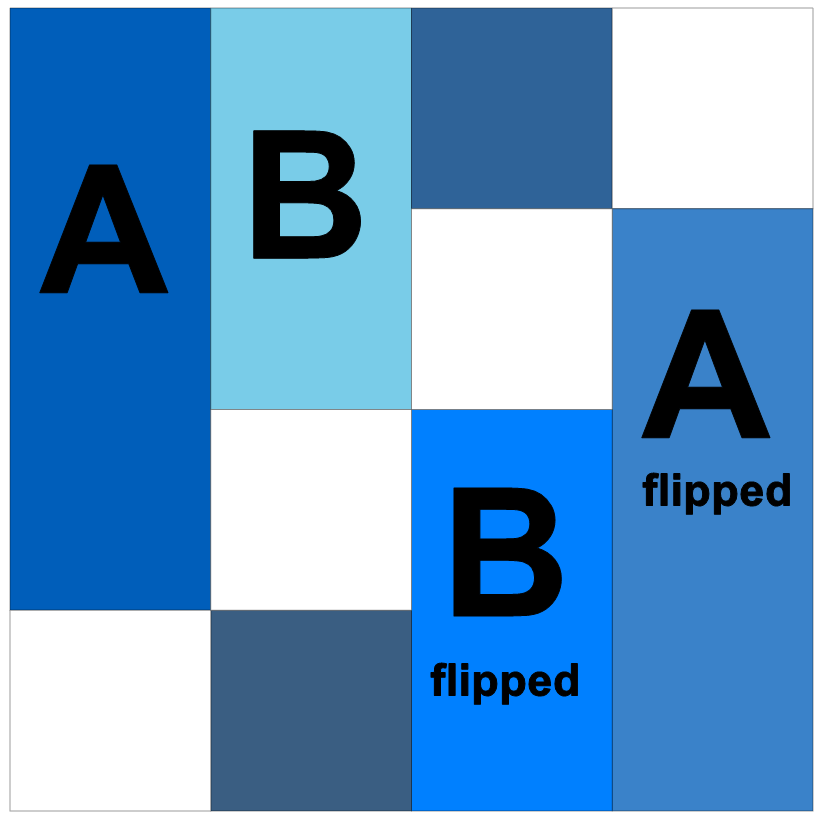
4. Sew a background strip to each of the largest FQ strips. Next cut each of those strip sets into segments. I’m going to name these Unit A so we can keep everything straight as we go along.
5. Sew the remaining background strips between the small and the medium FQ strips. Subcut them into segments. These strip sets, I’m naming Unit B.
6. Are you following along? Because now we are going to sew our A and B units into blocks. Taking 2 of unit A and 2 of unit B, sew together with As on the outside and Bs in the middle. You’ll need to flip the last 2 units.
7. You will now make a reversed block with 2 more of each A & B units, turning the last 2 units as shown.
8. You should now have the same number of each block. Time to play! You can lay your quilt out just like the pattern or you can play around with the layout and create some fun variations.
Here’s the original layout.
And here’s some cool variations to try out.
I bet you can even come up with your own block arrangement, so have fun!
9. When you’ve decided how you want to arrange your blocks, it’s time to sew the blocks into rows and then sew the rows together into the quilt top.
For my Morning Tea quilt, I’m going to stick with the original layout. Totally loving how it turned out!
10. Next up – layer, quilt, bind, and label your quilt.
Don’t forget to post your quilts on our VRD Facebook page or tag us on Instagram, #villarosadesigns. We love seeing your creations!
Thanks for stopping by and sewing with me!
Next week, Tricia will be back with another great tutorial for you.
After our super fun Let’s Design a Quilt series (if you missed it, please check out the right side bar on the blog to find all of the links for the series) wrapped up last week, I promised a new group of tutorials to jump-start your autumn quilting.
You know how this time of the year is filled with local fairs and such right before the kiddos go back to school? Well, this week we’re off to the rodeo! Yippee!
Have you ever been to a rodeo? I have a vague memory of going when I was a kid. My Grandma (my Dad’s mom) was always crazy about horses and always had at least a couple on the farm (my Grandpa always had his cows). I spent a lot of time on the farm as a kid as my grandparents’ farm was just down the road from our house. I have lots of good memories on the farm from when I was a kid. Baby animals were probably my favorite. Of course, running through the fields at midnight in the summer chasing down stray cows or horses was always fun, too. Good times.
Let’s slap our cowgirl (or cowboy) hats on our heads, put on our boots, and get started!
VRD Tea With Mara Quilt Tutorial
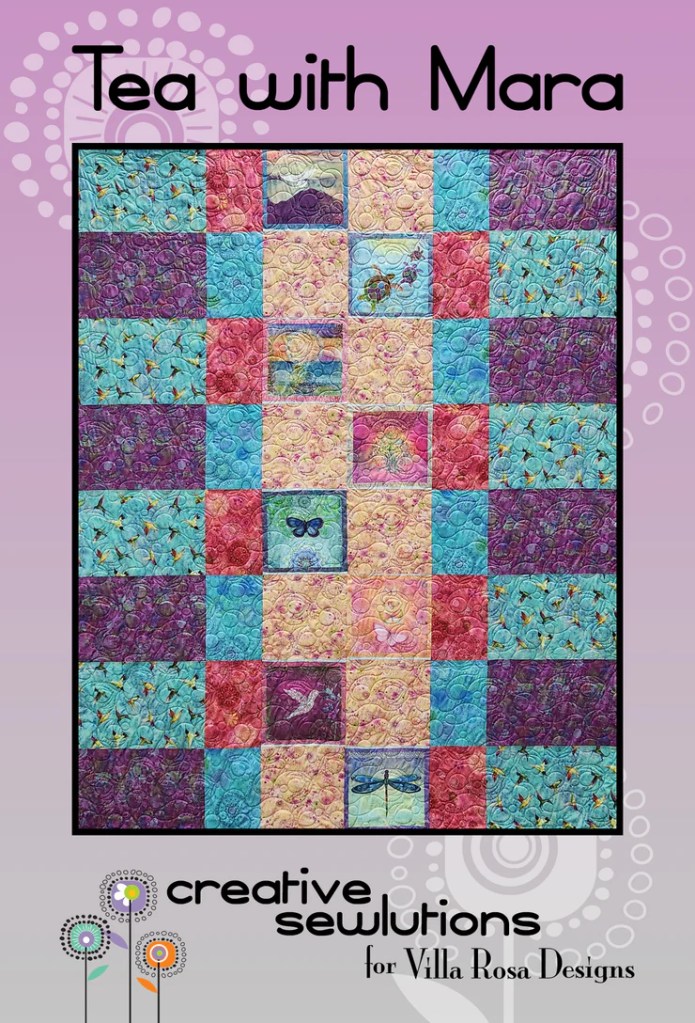
Tea With Mara is designed by Deanne of Creative Sewlutions, one of our talented VRD designers. This quilt finishes at a generous 58″ x 72″ and it can handle those large prints we are so loathe to chop up. Use printed panel squares……or not down the center. Sew many options……..sew little time!
PSST! Don’t forget, patterns always ship free, so grab a few more while you’re perusing the VRD patterns at the online shop.
For today’s tutorial, I’m using fabric from our friends over at Hoffman. It’s a digital-printed collection called Rodeo Dreams. When I saw this collection, I loved it! Maybe because it brought back fun memories from my childhood? So I’m letting you know right now that you’ll be seeing a couple more tutorials featuring Rodeo Dreams.
Just a quick word of caution when using digitally-printed fabrics – start with a brand new needle because if your needle is dull, you run the risk of damaging the fabric and we certainly don’t want to do that.
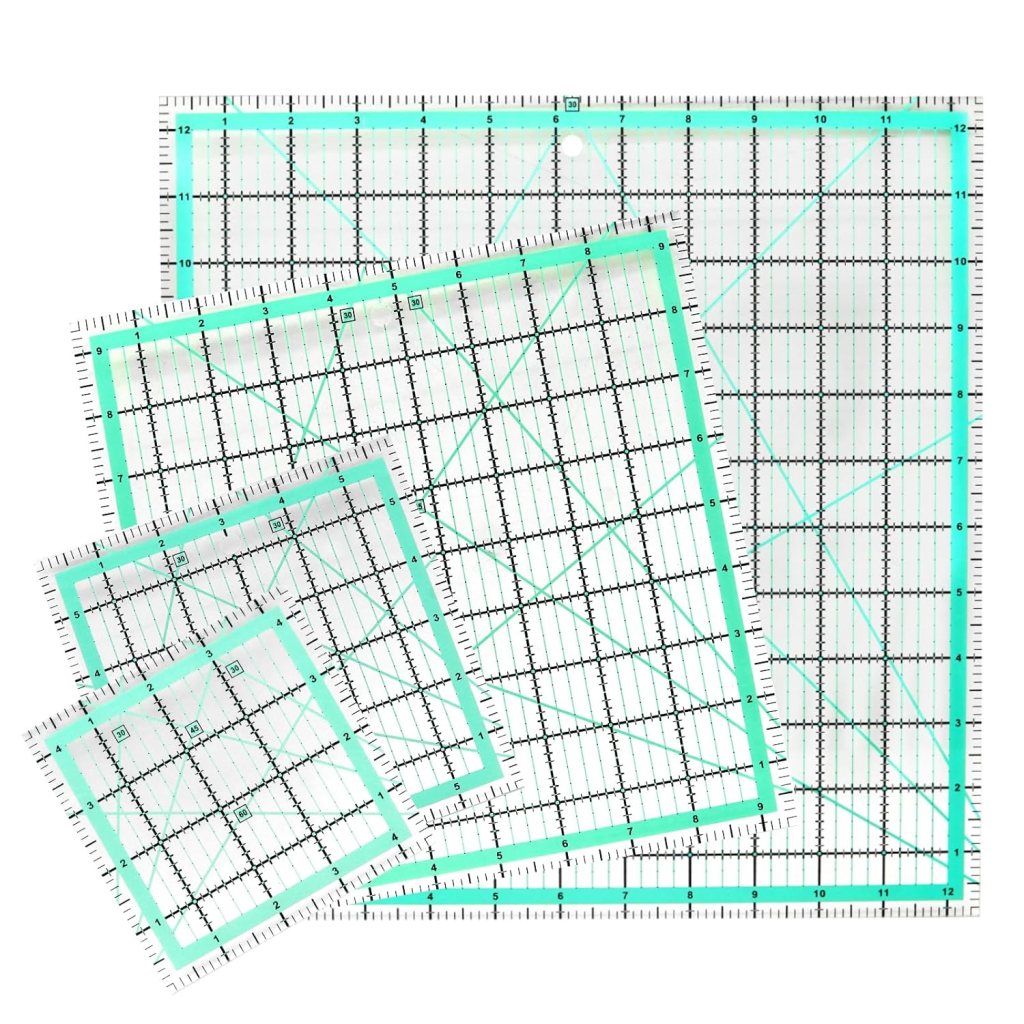
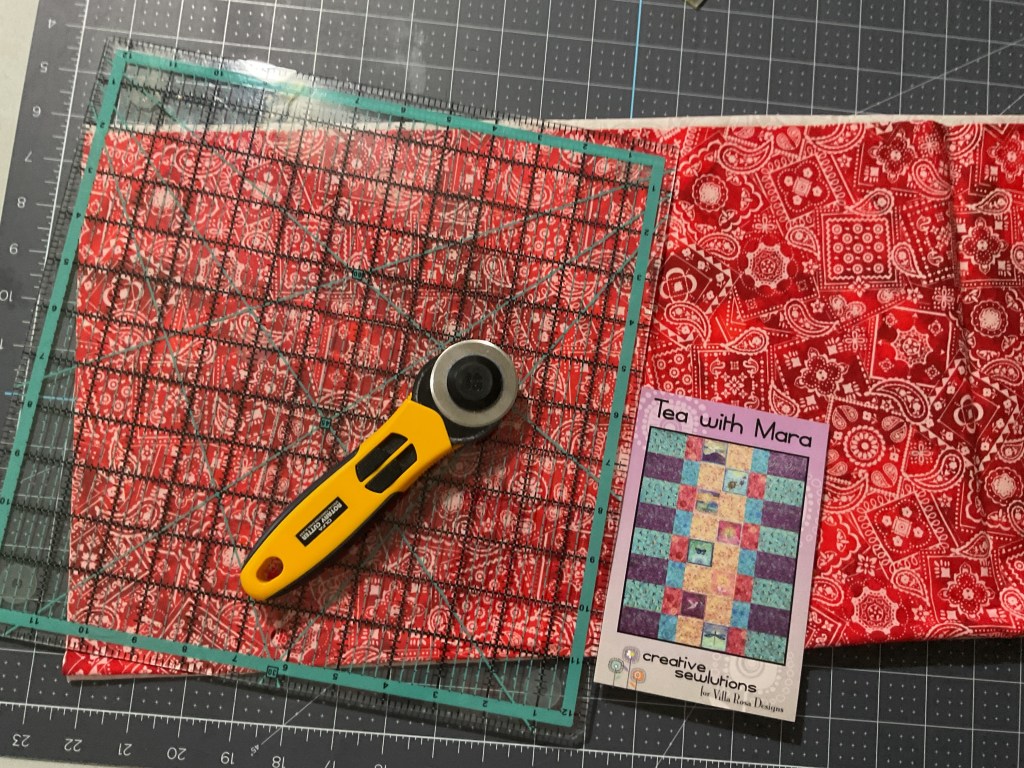
The first fabric I’m going to cut is the running yardage of the rodeo vignettes. I’m very glad I have a ruler the same size as the required block size in the pattern so I can fussy cut the squares easily and accurately.
Having the right sized ruler makes it a lot easier to fussy cut these vignettes than trying to cut strips and then cutting the strips into squares. This type of fabric makes strips and squares kind of tricky because the vignettes aren’t all the same size nor do they line up in a perfect grid.
Love quilting rulers! Boy, they do make quilting so much easier, faster, and more accurate.
Mostly, I rely on my 6×24 and 6×12 rulers for cutting, but it’s always a great idea to have a collection of square rulers in the most common sizes, which are not only good for fussy cutting, but also for squaring up blocks.
The only problem with fussy cutting is that your fabric will look like Swiss cheese when you get all done! LOL! Check mine out below. I can still fussy cut more pieces out of the fabric, but there is definitely more waste doing it this way than cutting strips into squares. Just something to think about if you’ve never fussy cut before.
Now I’m finished making Swiss cheese, it’s time to cut the rest of my fabrics. Loving this red bandana print – it looks like the real thing (digitally printed, of course)!
Here are all my fabrics cut and ready to sew.
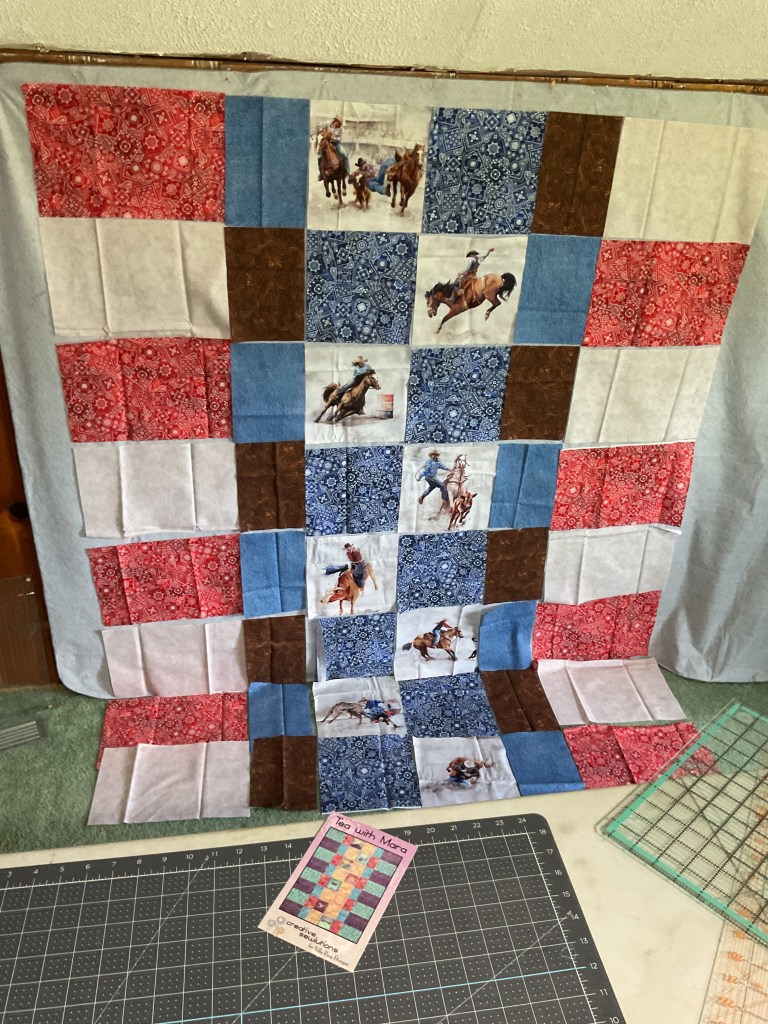
But before I start sewing, I’m going to lay out all of the pieces on my flannel wall. I want to make sure I like the placement of the rodeo vignettes before I commit to their positions permanently.
I really like the nice big pieces in this quilt, even if I have to layer pieces on the floor because the quilt is going to be longer than my flannel wall. It’s going together surprisingly fast, though.
Of course, you don’t have to fussy cut your fabrics like I did – you could use any fabric you wanted for the center squares. Or you could even scrap this quilt up and use some of your stash. Such a versatile pattern – I could totally picture this quilt in a great collection of fall or harvest fabrics! Hmmmmmmmm….
You could even add a 6″ finished border, which would make the quilt a big 70″ x 84″!
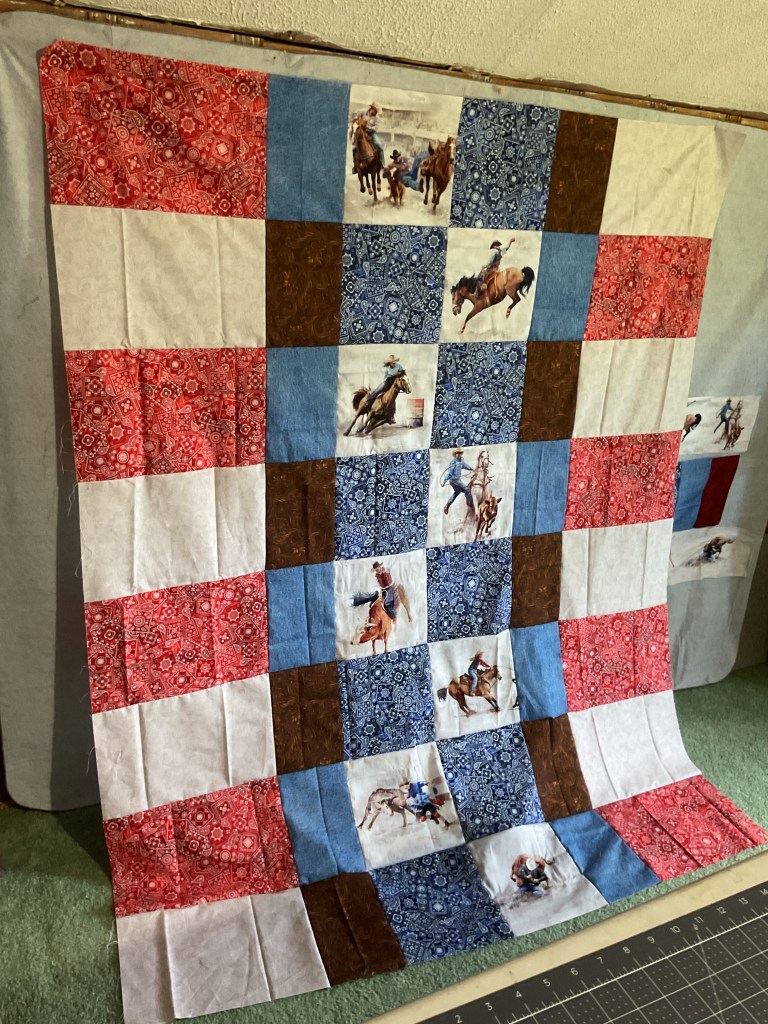
Now I’ve got all my pieces up on the flannel wall. I switched a couple of the rodeo vignettes around, but other than that, I think it’s ready to sew. I like how it looks.
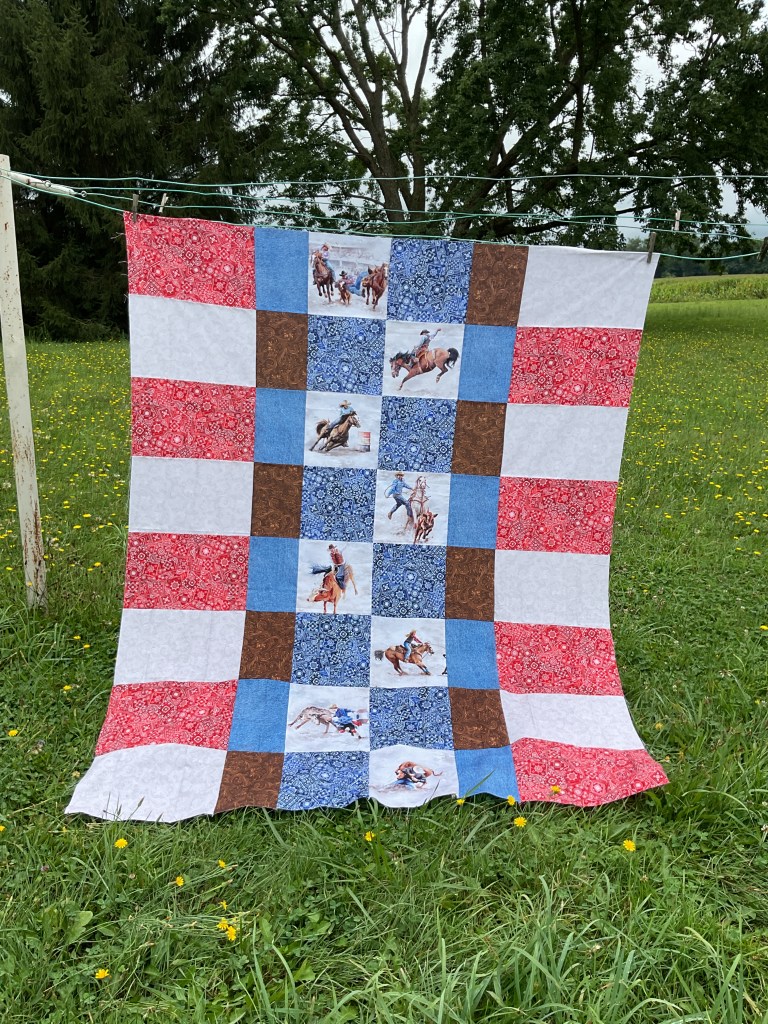
Yippee-ki-yi-yay! Let’s sew this little dogie together! I really like how the fabrics alternate in placement from side to side – it definitely helps to keep your eyes moving around the quilt. The red and blue bandana fabrics really make this quilt in addition to the rodeo vignette squares. LOVE IT!
And here it is outside on the clothesline. All I need is a horse or 2 grazing in the backyard, right? I’ll be binding this quilt with the dark blue batik you see in the fabric and pattern photo way up at the beginning of this tutorial. I think it will frame the quilt nicely.
Now to get this quilt top layered, quilted, bound, and labeled…….some day, anyway. Right now I’m going to add it to my teetering pile of flimsies and UFOs. I’m hoping to make a good-sized dent in that pile this fall and winter. It’s just been way too hot this summer to machine quilt and do binding.
Here’s to autumn with its warm days and cool nights. And the brilliant colors of the season…. I can’t wait!
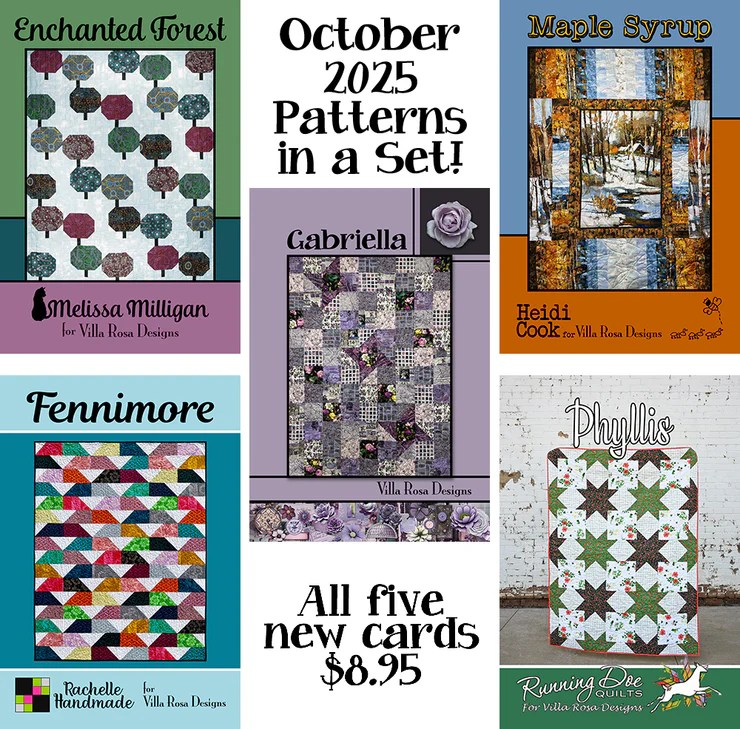
I know I say it every month, but our VRD designers are totally outstanding! Every month, they exceed the previous month’s designs. Let’s take a look at each pattern this month.
Grated by Heidi
Grated uses a stack of fat sixths (which are between a fat eighth and a fat quarter, measuring 12″ x 21″) or 10″ squares. This is a big quilt measuring 65″ x 75.” There are still kits available, which feature Klimt fabrics like the pattern cover. You can get your Grated kit, which includes the pattern, HERE.
Lady Banks by VRD (Pat)
If you are following along with the Tim Holtz Palette collections then Lady Banks is for you. It features the blue palette and finishes at 45″ x 60″. You can find the kit (including the pattern) HERE.
Catherine is back with 2 new mod patterns this month! Jasper is FQ friendly and finishes at 36×48, which makes a nice baby quilt or lap quilt. You can find the kit HERE featuring the Camp Canine collection at Running Doe Quilts.
Jolene is Catherine’s second quilt this month. It uses FQs and finishes at a generous 63″ x 84″. You can find the kit HERE at VRD featuring the Thirty-One collection or HERE at Running Doe Quilts featuring the Camp Canine collection.
Snap Shot by Molly
Snap Shot is another one of Molly’s creative panel quilts. It is FQ friendly and finishes at a nice 45″ x 54″, which could be a wall quilt or a throw. Sorry, but VRD is out of Snap Shot kits already.
Apologies, but there is no table runner this month. Stay tuned for next month’s runner!
SEW, which NEW pattern are you going to make first?????
Now let’s turn our thoughts to our ongoing Quilt Design series.
Let’s Design a Quilt: The Farmer’s Daughter Block
Here is the traditional Farmer’s Daughter block. According to Barbara Brackman, this block was first published in Clara Stone’s 1906 booklet, Practical Needlework: Quilt Patterns, which was part of a needlework booklet series by C. W. Calkins & Co. in Boston. Of course, like most quilt patterns, it was probably being made long before it was published. One of our readers suggested this block last week and I just couldn’t resist it. Thank you, dear reader! I hope I do the block justice for you!
Yikes! See how the four corners of the block feature set-in seams? Well, the first change to this block we are going to make is to change the four corners to be much friendlier by using Half Square Triangles (HSTs) instead of set-in pieces. Ahhhh! That’s more like it!
Now we’re ready to play — er, design! Let’s put Farmer’s Daughter blocks in a quilt. Huh! When you set the blocks side to side, you lose the block and a whole new design emerges. Pretty cool!
Now let’s add some sashing to see what that looks like. Neat-o! Sashing shows off the block. I just love the secondary design where the block corners (with the green squares) meet the sashing squares. Both designs have a lot of movement already and I haven’t done anything except the HSTs.
Wowzer! Look what happens when I change the colors to black, grey, white, and red. I’d call this a finished design right now, wouldn’t you???? It almost has a 3D effect. Cool beans!
Here’s the same design, but I changed the red to white. Holy cow, Batman! It’s really eye-catching and the black negative space is just itching for some really cool machine quilting.
Here’s the same design again, but I changed the grey to red. Oh my! It just about leaps off the screen. Just by playing around with the colors.
This is only ONE of sew many reasons why I love my Electric Quilt 8 software. I can tweak some tiny little thing and if I don’t like it, I can go back or keep tweaking. If you haven’t ever tried EQ8, you really should. It is a total game changer for quilters everywhere!
But wait! We’re not done yet. Let’s go back to the block and split the corner sections into 2 colors, instead of just 1 color. I also changed the center square to blue, which gives it an interesting pinwheel design in the center.
Let’s see what it looks like in a quilt. Hmmm. Not very interesting. At least not yet.
Let’s add some sashing. I’m gong to introduce black for the sashing squares. Better, but no way near finished. Let’s keep going.
Let’s flip the black and white for the sashing and sashing squares. WHOAH! I am loving this sashing idea – it is incredibly graphic! But now we need to tweak the blocks some more.
Before we work on the blocks some more, it needs a border to frame it. It just looked a bit unfinished without it, don’t you think?
That’s it! Okay, on to the blocks. Let’s swap the blue and yellow in the 4 corners back to 1 color, red. And change the blue center to white so it repeats the white sashing square. I love how graphic it is. Your thoughts?
One more tweak. Let’s change the center square in the blocks to black. Yup! That’s it! Love the plus sign in the center of the blocks! This design has a clean modern look yet it feels traditional, too. It is totally the best of both worlds.
All right! Let’s add some fabric. Again, I’m using batiks from Hoffman’s 1895 Watercolors collection. I did make one more tweak by changing the sashing squares to match the plus signs. Don’t you just love it in pinks? The black has a slight bluish tinge for added interest. Again, it has a bit of a 3D effect. Done and done!
Do you remember where we started? A Classic Farmer’s Daughter block.
How far we came just by changing the colors, playing with the fabric placement, and adding sashing/border.
How are you going to explore these ideas with your quilts???
Well, that’s it for me for our 4th week in our Let’s Design a Quilt Series. If you missed any posts, you can catch up here:
The forecast for today is sum-sum-summertime with a strong chance of quilting! SEW much to do today, so let’s get started.
Before we jump into this week’s Quilt Design adventure, though, I want to share a fun SNEAK PEEK with you from our friends over at QT Fabrics. You might recall that VRD has been working closely with QT to pair their new fabric collections with our patterns. Here is our latest collaboration:
These upcoming fabric collections are being shown to quilt shops right now and will ship in late 2025/early 2026. If you see something you like — ask for the collection (and VRD patterns, of course) at you local quilt shop.
Churn Dash Challenge Winner
As part of my Quilt Design series last week, I offered up a challenge to you – see what you could do with the Churn Dash block.
First, I want to thank those of you who shared your ideas, creations, blocks, and quilts.
And the winner is………………………..
Lisa from KY
Lisa won with her charming Churn Dash quilt, below, featuring multiple sizes of her Churn Dash blocks with the added fun of novelty farm panels and prints inside each block. Way to go, Lisa!
Log Cabin Inspiration
Folks were really inspired by last week’s Courthouse Steps block quilt design party and suggested we stay in the Log Cabin zone. Thank you for those suggestions, but I want to keep addressing different kinds of blocks to maximize your inspiration when it comes to designing quilts. There are entire books written about Log Cabin blocks and quilts and a few blog posts just can’t do the topic justice, I am afraid.
In lieu of more Log Cabin blocks, here is a short list of Log Cabin books for you to explore. I tried to choose a variety to show you here on the blog, but believe me – there are tons more out there just waiting to inspire your next Log Cabin quilt.
After enjoying your Log Cabin comments and quilt photos, it occurred to me that I have not done a Star block yet……..so today’s the day!
The Sawtooth Star Block
I chose an oldie, but a goodie for today – the Sawtooth Star.
Sawtooth Star is known by many names and has a lot of different variations. Apparently, it first appeared in print in the 1880’s or 1890’s in popular publications such as Farm and Fireside Magazine as well as in the Ladies Art Company catalog in 1895. The Sawtooth Star block was block # 5. Like most quilt blocks, however; Sawtooth Star blocks were probably being made long before they ever appeared in print.
Here is our classic 2 color Sawtooth Star block.
So, let’s make a quilt. Here are 20 blocks set side by side. This makes a lovely classic 2 color quilt, but of course we’re not going to stop there.
Here it is with sashing in between the blocks. Again, super classic. I do like how the sashing gives the stars room to breathe, plus this layout would be a lot easier due to not having to match up all those points. Win, win….
Let’s go back to our block and tweak it a little bit, shall we? Let’s change the solid center block into an Hourglass.
Here are the blocks set side to side. I find it interesting that I’m not seeing the stars so much now, but rather, all the triangles seem to jump out at me now. And I see “V” shapes, too. Huh.
Let’s tweak the block again by adding Half Square Triangles (HSTs) in the 4 corners.
Okay, now let’s set the blocks side by side in a quilt. Wow! There is so much more movement – almost to the point of being distracting. Really cool, though.
Let’s add a 3rd color to the blocks now.
Here is the same layout as above, but with the added 3rd color. It looks totally different and not as dizzying.
What if we add sashing again? Cool – we now have a Shoofly block where the sashing square meets the blue HSTs – this adds a lot of interest to the design. Liking this, but not quite there yet. Let’s keep tweaking.
I think the blocks look a bit heavy, so I’m going to lighten them up a bit by changing the inner blue triangles back to white. Yep, liking this one more.
It’s a bit too vertical for me, though, so let me make one more tweak by alternating the direction of the blocks. Yes, I think that does it. This one’s a wrap!
But wait – I’m not done yet. I’m having way too much fun to stop now. Let’s go back to our block and tweak it a bit more by adding blue triangles on the sides only.
Here’s our updated block set side to side in a quilt. You totally lose the star block, don’t you? I like the horizontal repetition of the triangles, too.
Let’s add fabric! Here it is using the QT fabrics from American Tapestry again. Love it, yet……
One more tweak……let’s rotate every other block. Yup, that’s the one. Finished. Great movement – I can’t even see the stars now, can you?
Do you remember where we started? A classic 2 color Sawtooth Star.
YAY! This has been another fun quilt design adventure! Sew glad you came along.
If you’ve missed any posts in our Quilt Design Series so far, you can catch up below:
What a fun blog post last week! It was great to share a little bit about my quilt design process with you. It was such fun, we’re doing it again this week, but with a different quilt block.
Before even starting this post, though, I must admit I cheated a bit and began playing with this week’s quilt block. Let me tell you – it never fails to amaze me how a simple block can create such amazing designs.
According to Barbara Brackman’s Encyclopedia of Pieced Quilt Patterns, this specific Spool block appeared in the book, Polly Prindle’s Book of American Patchwork Quilts by Alice Gammell in 1973. Of course, it wasn’t really a new block in 1973, but this simplified Nine Patch version appeared in Polly Prindle’s. Previous versions included set-in seams as well as 4 small Spools in a single quilt block. Today, though, we’re going to start with Polly Prindle’s version.
As you can see, our Spool Block is a Nine Patch block with a 3×3 layout. Of course, we’ve added some Half Square Triangles (HSTs) to create the Spool shape.
Time to Play!
The first thing we’re going to do is to simply our Spool block by using flippy corners instead of HSTs for the top and bottom of the spool. This tweak would actually save time when piecing the blocks for a quilt without changing the overall design. And we all know that saving time is golden in the quiltmaking process. The tweak also cleans up the look of the block by removing some of the seams.
Let’s see what a quilt looks like using just this block, shall we? This design shows the blocks all pointing in the same direction. Hmmm. I like it, but I think we’re just getting started with the Spool block today.
Let’s try alternating the block directions. Better, but not there yet.
Next up – let’s alternate block direction by row. Better and better! I really like the play between the different block directions. Reminds me a little bit of the vertical and horizontal strips I added to last week’s classic Nine Patch block.
Let’s add some fabrics to this one. I’m using a few prints from Moda’s Acorn Hollow collection. This layout definitely has some potential. I’m not usually a big fan of 2 fabric quilts, but I am liking the crispness of the design with only the 2 fabrics.
Okay, let’s go back to our Spool block again. Instead of it being a 2 color block, let’s make it a 4 color block with a black center.
Huh. Intriguing. Let’s see how it looks in a quilt. This is the same layout as our first red/white layout above. What a difference color can make!
Now let’s alternate the block directions. This is the second red/white layout above.
I like it, but with so many colors, you kind of lose the interesting design. Let’s back off on colors a little bit by adding more neutrals. Not loving it, but I do like the diagonal thing happening.
Not quite what I was expecting. Let’s tweak the colors some more. I’m going to use red, black, white, and grey which is one of my favorite colorways when I’m trying to perfect a design. I like working with these colors because of the strong contrast. I also changed the center square to black, so I get an interesting black shape in the blocks now – kind of looks like a megaphone to me.
Let’s rearrange the blocks to see what happens. This is interesting. It has a lot of movement.
Let’s add some fabric now to see what it looks like. Here it is in 4 Hoffman batiks. I like it – it has a woven effect which keeps my eye moving over the design.
Let’s play with the block arrangement a little bit more. I think there’s another better option still out there. We just have to play a bit until we get there. Almost there.
I think it needs just one more thing tweaked. I’m going to reintroduce the 5th fabric in the block for the center squares. Yup! Got it. This is the one! A beautiful finished design! LOVE the 3-D effect. Lots of movement. Tons of interesting things going on.
Do you remember where we started? A simple Spool block.
An here’s where we ended. Still a simple Spool block, but so much more!
Isn’t quilt design a fascinating journey? For me, it’s a lot of “what if?” questions. Also, I’m not afraid to make something really ugly – I can always delete it, right? And sometimes “something ugly” just needs another tweak or 2 to become something amazing.
I hope you give designing a try. I think you’ll be surprised at how fun it it. Whether you use graph paper and a pencil or Electric Quilt 8 software, I think you can come up with something that’s truly your own, something you love.
Stay tuned next week for another fun quilt design adventure! Any suggestions on a simple quilt block you’re just dying to see turned into an interesting quilt design? Leave a comment and tell me!
Hope you are enjoying these lazy, hazy, crazy days of summertime. Me, still making my summer to-do list. Ha Ha!
We’re just going to jump right in today because I’ve got some fun stuff for you. Yippee!
First up – NEW July patterns.
NEW July VRD Rose Card Quilt Patterns
I just love the first Thursday after the first Friday of every month because it means NEW VRD patterns.
Here’s the set of 5 patterns. As always, our talented VRD designers do not disappoint! You can get the print set of 5 HERE (they are also available individually as print patterns too) or you can get the digital patterns individually below:
Happy Daze features a panel (or substitute a novelty print if you wish) in a fun modern setting. Quilt kits are still available HERE, but get yours ASAP because they’re going fast.
Fondue is also a panel quilt with a very interesting and unique setting. We still have a few quilts kits left, so get ’em HERE while they last.
Snowdrop uses your favorite collection of fat quarters. This is Pat’s latest pattern in her Tim Holtz Palette patterns. You can get the kit HERE.
Ixonia is Rachelle’s latest mod quilt. It also uses fat quarters.
Willow is a super versatile pattern – use a single fabric for the centers, panel squares, or even quilt blocks! We kitted it up with the Playgrounds collection (see below), get your kit HERE.
Willow kit in Moda’s Playgrounds collection
And here’s this month’s table runner, Bubblegum. It uses a collection of fat sixths, but works equally well with leftover Jelly Roll strips or your stash.
Get your digital pattern HERE or your print pattern HERE.
I know it’s summer and most of us don’t quilt as much, but I think these new patterns will inspire you. Besides, VRD patterns go together like greased lightening. Make one in a weekend or even a day.
Why not get your quilty friends together for a summer sew day? You could each have a quilt top done at the end of the day and enjoy some overdue friend time, too.
Next up – let’s play with the Nine Patch block and design a quilt together.
Let’s Design a Quilt Together: Nine Patch Blocks
Nine Patch blocks were on my mind the other day. Why? Because I was thinking about antique quilts and Nine Patch blocks are one of the oldest quilt block patterns as well as one of the most humble. Have you ever gone to see an antique quilt display or perused a book about antique quilts? If you have, I bet you’ve seen A LOT of Nine Patch quilts.
I started wondering what kind of interesting designs I could create from the historic humble Nine Patch. Then it hit me – this would be a really fun blog post idea. So here we are.
If you’re interested in designing your own quilts, there are several ways to do so.
1. Graph Paper
Graph paper, a pencil, and a calculator are often a designer’s first tools for creating one of a kind quilt designs. I started out with this, but quickly found I didn’t have the patience for figuring everything out all the time. I still draw lots of doodles with blocks or setting ideas, but these aren’t my primary design tools anymore.
And guess what?!? Even graph paper for quilting has evolved over time! There are many different options available these days for quilters such as quilter’s graph paper books. Some even include stencils and other goodies to help you in your design process, like C&T’s QuiltGenius Design Tool kit.
A design workbook with prompts and space to draw is a step up from plain old graph paper. Last year I actually created such a workbook because I got tired of losing all my little scraps of paper when I came up with a new idea. Now I can keep all of my ideas in one place.
Electric Quilt 8 software by the Electric Quilt Company is a fantastic design program! I couldn’t do what I do without it. Seriously. One of the great things about this program is all the support out there so you can learn how to use it. The EQ website offers tutorials, classes, and even fun design challenges. There are books galore available to teach you all the ins and outs of the program. And EQ is always coming up with new add-ons to enhance your design capabilities.
So now we’ve talked about the 3 top ways to design quilts, let’s play with Nine Patches using EQ8, of course!
Here is our humble Nine Patch block. It uses 9 squares all the same size in a 3 square across by 3 square down layout. Easy peasy.
This block is a Nine Patch, too. Nobody ever said you had to use only 2 fabrics for a Nine Patch block. The 3 across by 3 down is what makes it a Nine Patch. And my personal philosophy is the more fabric, the better!
Time to play — er, design. To me designing is playing with blocks, colors, fabrics, shapes. I ask myself a lot of “What if?” questions as I go along.
What happens if we make our Nine Patch block rectangular instead of square?
It’s still a Nine Patch, only it’s elongated. Let’s see what this block looks like in a quilt.
Hmmm. It doesn’t really do anything for me, but it would make a nice simple scrap quilt, wouldn’t it? Let’s add some sashing.
Okay, I’m liking this one better. Now I can see the individual blocks. But it’s still basically a decent scrap quilt. Let’s try taking away the sashing and adding plain alternate blocks instead.
This one’s okay, too, but it just doesn’t quite do it for me, either. I could use a cool novelty for the alternate blocks and use coordinating fabrics in the Nine Patch blocks. Let’s try that.
Here is our design using Moda’s collection Acorn Hollow. I like it, but something is still missing. What do you think we need?
Let’s go back to our elongated Nine Patch block and try splitting some of the rectangles into 2 pieces so we can add more fabric.
Okay, that’s interesting, but now I think I want to split the other 4 patches horizontally to add movement.
Yay! Now we’re getting somewhere. I like the look of our Elongated Rainbow Nine Patch block. Like I said, designing is all about playing and exploring. Ask those “What If?” questions and you’ll be surprised where they will take you in your designing.
Let’s try our block in a quilt setting now.
Now that is starting to look like something. I really love the diagonal thing going on with the black rectangles. Hmmm. Let’s keep going. It still needs tweaking.
With a little flip flopping and switcheroo, I discovered this layout. I am loving the elongated Four Patches in black and white that showed up when alternating blocks were turned upside down. What are your thoughts on this design?
Let’s try it in real fabric this time.
LOVE LOVE LOVE it! I am using a selection of Hoffman’s 1895 Watercolors batiks in pink and grey with solid black and white here. I added the solid black binding to frame everything nicely as well as accent the black in the blocks. Now it’s a finished design. And it started with a humble little Nine Patch block.
Well, that’s it for me today. I hope you enjoyed coming along on a quilt design adventure with me. After showing you how much fun I have designing a quilt, I thought maybe this would make a fun new series for the summer. What do you think? Would you like to see more of this in maybe a 4 or 5 part series using different quilt blocks as the inspiration? Any suggestions on blocks you’d like to see (think simple and pieced, though)?
See you next week, right here at Villa Rose Quilts.
Hard to believe it’s July already and the July 4th holiday is tomorrow. It’s not every year that the holiday falls on a Friday, so I see a 3 day weekend ahead for many of you. What are your plans for the holiday weekend? Me, I plan to take in some fireworks and maybe eat some fab picnic foods. Yum, yum, yummy!
Happy Independence Day!
July 4th with Quilts
In celebration of Independence Day, I have a few fun quilty things to share with you today! Woohoo!
So I wanted to feature our 12 Quilts of Valor Pattern Collection on the blog. A lot of you probably already have the 12 QOV collection among your VRD patterns, but for those of you who are new to VRD or haven’t added the collection yet, let me tell you about this great collection of patterns.
The collection includes 12 patterns sized perfectly for your Quilts of Valor (QOV) projects – no more trying to figure out if a pattern is the right size for a QOV. You will find patterns that use yardage, fat quarters, 5″ squares, and panels (4 panel quilts in the collection and 1 of them uses horizontal panels). Finally, several of our talented VRD designers have patterns in the collection so you get a nice variety of styles in this collection. And of course, all of the patterns are fast, fun, and quickly done!
Almost forgot to mention – shipping is free on patterns on the VRD website, regardless of how many print patterns (or collections) you order!
At this time, the collection is only available in print format, but if you prefer our digital patterns or are an international friend, the patterns are also available as individual downloads. Please note that the download pattern covers will be different from the print pattern collection covers.
Last year on the blog for the 4th of July, I created a curated a Red, White and Blue Pattern list. You can find it HERE.
I hope your July 4th holiday is filled with new memories, American pride, picnic food, and quilts!
Dolls and Quilts
I realize this section of the blog isn’t really connected to the 4th of July at all, but I just had to tell you about my very first Sasha Doll Festival. Oh! I’m wrong – I just realized the theme for this year’s Festival was “Sasha Explores the USA” so it is kind of related to the 4th of July after all.
This past weekend I had the absolute pleasure of attending my very first Sasha Doll Festival. It was held in Columbus, Ohio which made the drive doable for me. Let me tell you though, last Thursday when I was on my way to the hotel/conference center where the Festival was being held, I kept running in and out of severe weather. There were times when I couldn’t seen anything at all due to the deluge and the steam coming off the road (the temps were in the 90s). It was kind of scary as this was my first longer road trip alone, but I followed the big trucks in front of me and everything went okay.
I got to the hotel/conference center safely, although it did take me an extra couple hours. I must admit I missed one exit and had to drive back around to catch the exit again. Thank goodness for my GPS.
Maybe you’ve never heard of Sasha dolls. Sasha dolls were created by Swiss doll artist Sasha Morgenthaler. She created personally created dolls in her studio from the 1940’s to the 1970’s (these surviving dolls are called studio dolls). She also taught classes to others about her techniques and the dolls created during those classes are called course dolls today. In the mid 1960’s, Sasha worked with the German doll company Gotz to manufacture vinyl play dolls based on her studio dolls. She wanted children to have quality dolls at an affordable price. Gotz made Sasha Serie (series) dolls from 1965-1969. A company in England also began making Sasha dolls in 1966 and continued until 1986. Then, Gotz made Sasha dolls once again from 1995-2001.
For more information about Sasha the artist and her dolls, you can go HERE.
I am a relatively new collector and enthusiast, although I saw my first Sasha doll as a child at my local public library. The library had a very special toy collection and you could check out the toys just like books when I was a child. They had Sasha dolls in the collection and I was so in love with the blond girl doll in the blue gingham dress (she would have looked something like this, below). Over the years I saw Sasha dolls here and there in doll clothes books or on the Internet. A couple years ago, I wondered if I could find Sasha dolls for sale online. And I did. My modest collection now includes 11 girls, 10 babies, and 7 boys.
Image from eBay
Here are 3 of the 10 dolls I took with me to the Festival. All 3 dolls are from the English production. Eden (1968) is on the left, Penny (1975-1980) is in the middle, and Annabelle (1969) is on the right.
I just love that the dolls are so realistic looking and no two are alike. They are lovely to pose and to dress (and make clothes for!), and each one seems to have their own personality.
It was an amazing Festival (of course being that it was my first one, I don’t have anything to compare it to). I met so many lovely people! I went to the Festival hoping to find some Sasha people in my own area, and I did! I even met Gina (Hi Gina!) and discovered not only did she live within 2 hours of me, but we actually know some of the same people. Crazy, isn’t it???
At this point, you might be wondering how Dolls and Quilts go hand in hand? Doll Quilts, of course!
As a gift to you, I am sharing a sweet and simple little doll quilt pattern. Make it for yourself, a child, or even another doll lover.
Sweet and Simple Doll Quilt
By Tricia Maloney
18″ x 23″
Fabric
20 – 5″ Charm Squares or 20 assorted scraps at least 5″ square
½ yd for backing
20″ x 25″ thin batting or flannel
¼ yd binding
Cut
20 – 5″ squares
20″ x 25″ for quilt back
3 – 2″ or 2 1/4″ width of fabric strips for binding
Sew
Sew 4 assorted 5″ squares together into a row. Make 5 rows.
Sew the rows together.
Finish
Layer your quilt top, batting, and backing.
Quilt as desired.
Bind your quilt.
Don’t forget your label!
If you’d like to download and print my Sweet and Simple Doll Quilt pattern, you can find the PDF below:
WHEW! If you’re like me, you are having a heatwave right now. 90’s every day. It even hit 100 on the thermometer on Monday! YIKES! I’m sooooo not ready for these temps. It’s like we went straight from 50’s to 90’s in a couple weeks.
90’s are definitely not normal for this time of year here in northwestern Pennsylvania. AND we have high humidity to go with the heat which makes me want to just melt into a puddle on the ground every time I have to step outside. I literally had to scramble on Sunday to get the window AC units in, but we’re all good now. I just don’t want to go outside anymore.
I’m melting into a puddle………!!!!
Luckily my dungeon studio is still cool enough (sadly, it is not air conditioned) to work in comfortably. I have several fans on to keep the air moving, but when the heat finally infiltrates my space, it’ll get quite uncomfortable. That usually isn’t until August and September, though, but we’ll see what summer brings this year. Northwestern Pennsylvania is an interesting place to live – record amounts of snow and cold in the winter, a wet and cold spring, then – POOF! – record high temps in June. Only the strong survive……..
I finally got a little quality time with my sewing machine this week so I decided to put together a new tutorial for you. Augustina is a such great project for summer!
Of course Augustina is fast and fun – it’s a VRD pattern, but it’s also not so big that you feel like you’re wrestling an alligator while your body is dripping with sweat. I promise you, this quilt really is quick – I made the top in a couple hours and that included both cutting and photographing my step-outs for the tutorial. It’s a very satisfying afternoon project.
VRD Augustina Quilt Tutorial
Augustina is a great sized quilt for a small throw or a juvenile quilt. And this is a pattern you are going to turn to over and over again for a beautiful quilt with little effort, yet it looks like a million bucks (sorry, it’s late and I couldn’t think of another phrase to use). So don’t forget to get your own Augustina pattern if you don’t have it yet.
The first thing we need to do, of course, is round up our fabrics. Augustina is a fat quarter project, so you can march right over to your stash and find some coordinating fat quarters or you can use this project as an excuse to visit your local quilt shop to buy new fabric. Yeah, I know, we quilters really don’t need an excuse, but it is handy to have one anyway, isn’t it?
For this tutorial, I am using Flower Shoppe fabrics from our quilty friends over at Hoffman Fabrics. The flower fabrics are all amazing Hoffman digital prints – have you seen these in person yet? The colors are so bright and clear – I feel like I could pick these flowers right off the fabric. We’ve paired a few Hoffman batiks to balance out the gorgeous flower prints.
Please remember when using digital prints, that they do not react exactly the same as regular quilting cottons. Always start with a new needle in your machine so you are not pulling threads when sewing as well as a new rotary cutting blade so you are cutting cleanly through the fabric instead of sawing at it, which can damage the fibers.
Next up…..cutting.
SHHHHH! The secret of this quilt is that the pieces are big. Big pieces mean you don’t have to spend loads of time cutting little squares, rectangles, or triangles. Big pieces are a huge time saver! Big pieces also mean you can use bigger prints (when you use big prints in small pieces, the design gets all chopped up and you tend to lose what you loved about the print to begin with). Yay! Let’s GO BIG!
In the photos, below, we’re cutting our accent fabric into strips and then into rectangles.
Below, we’re cutting our FQs into strips and then into 2 different sized rectangles.
VIOLA! Cutting done. Easy peasy. Here’s all the pieces we need to make Augustina.
Before we can sew Augustina together, we have to lay out our fabrics. I’m going to put them up on my handy dandy flannel board which consists of a flannel-backed table cloth clamped to the tops of my fabric storage unit doors. As I’ve mentioned before, this idea came from my pal, Mary Lee. Kudos to you, Mary Lee! It’s a great option if you don’t have a spare wall to put up a more permanent quilt wall solution. I can simply take it down when I need access to my yardage stash. I’ve actually had this tablecloth for years now, so it’s even an economical option.
Hmmm……I think I need to move some fabrics around.
After several switcharoos, I think I’m happy with the layout now.
Let’s sew!
This quilt is sewn together in vertical rows. I took my time, only taking one vertical row off of my board at a time. I worked from the top down to sew the pieces together. It doesn’t matter whether you sew your strips top down or bottom up, just be consistent with all of your rows or else you might get your fabrics out of kilter.
Okay, all the fabrics are now sewn into vertical rows.
Now I’m going to sew the vertical rows together into pairs. As this quilt has an odd number of rows, the last row will have to hang out all by itself for a while.
Next, I’m going to sew the first 2 pairs together into a foursome. Then I’ll sew the third pair and the last row together into a trio.
One last seam to sew the 2 sections together and the Augustina top will be finished. Fast as can be! There isn’t a lot of matching seams, but you do want to make sure your accent pieces are relatively even-looking across the quilt.
And here it is! Our completed Augustina quilt top.
Although it was hot, I decided to take Augustina outside for a glamour photo. Sigh…….it was a little breezy out and I couldn’t get a photo with it hanging nicely for you. Bummer. But I do love how it looks surrounded by all the green – the flowers look like they are about to burst right off the quilt! That’s digital fabric for you – the number of colors that can be printed on fabric is phenomenal and creates stunning designs.
And that’s it! Finito! Next I need to layer, quilt, and bind it…….someday, anyway.
If you’re looking for another great summer quilt pattern, check out the Jubilee tutorial from a few weeks ago. It’s also a super go-to project.
That’s it for me today, gotta go have me some summer……..in the air conditioning. LOL!