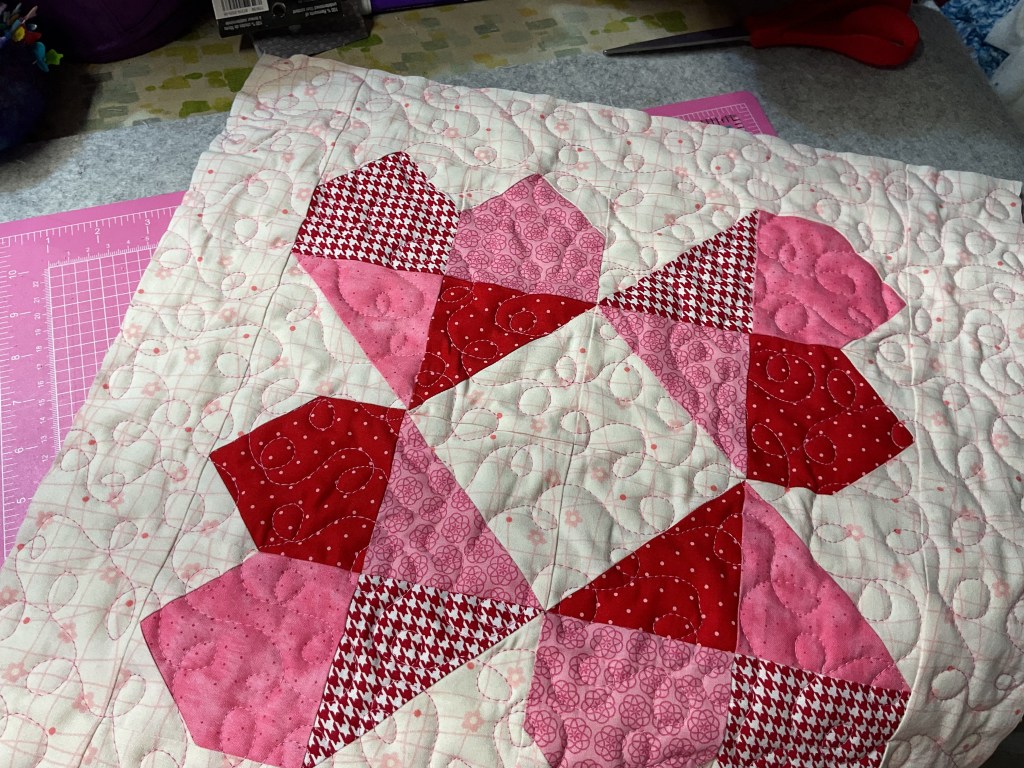
Spring literally starts a few days, which is probably why we have snow on the ground again and it was like 16 degrees last night. BRRR! Regardless, I’m definitely thinking spring! So I thought it would be fun to leap into some fun spring quilt tutorials to get me into the spirit even if the weather doesn’t cooperate with the season.
I’m also thinking it’s time for a spring 6 Quilts in 6 Weeks Challenge. Anyone up for that? I did a 6 in 6 last fall and we had great time. It was incredible to finish one VRD quilt a week for 6 weeks. 6 completed quilts at the end. Which was rockin’ awesome! Especially considering all the tutorial sample tops that I’m accumulating. LOL! So……who’s in? I’m thinking to start this the first week of April, 2 weeks from now. It would last for 6 weeks. Right now, I’m just putting feelers out to see who wants to join me for this 6 in 6 challenge? I figure if I do this challenge twice a year in spring and fall, we can all get up to 12 quilts finished in a year.
There are a few rules, though, I’d better mention –
1) Quilts must be made from VRD patterns
2) You must post a before and an after photo on our Facebook page or email them to me if you’re not on FB to be entered in the weekly drawings
3) Anyone can participate
4) If you don’t have stacks of VRD UFOs like I do, no problem – you are welcome to make new VRD quilts/accessories to participate
I think that’s pretty much it for the rules to get started.
If you’re interested, you have 2 weeks to email me your name and email address at tricia@villarosadesigns.com. I promise your email address will only be used by me to notify you if you win a prize.
Now….on to our first Spring into Spring VRD quilt tutorial!
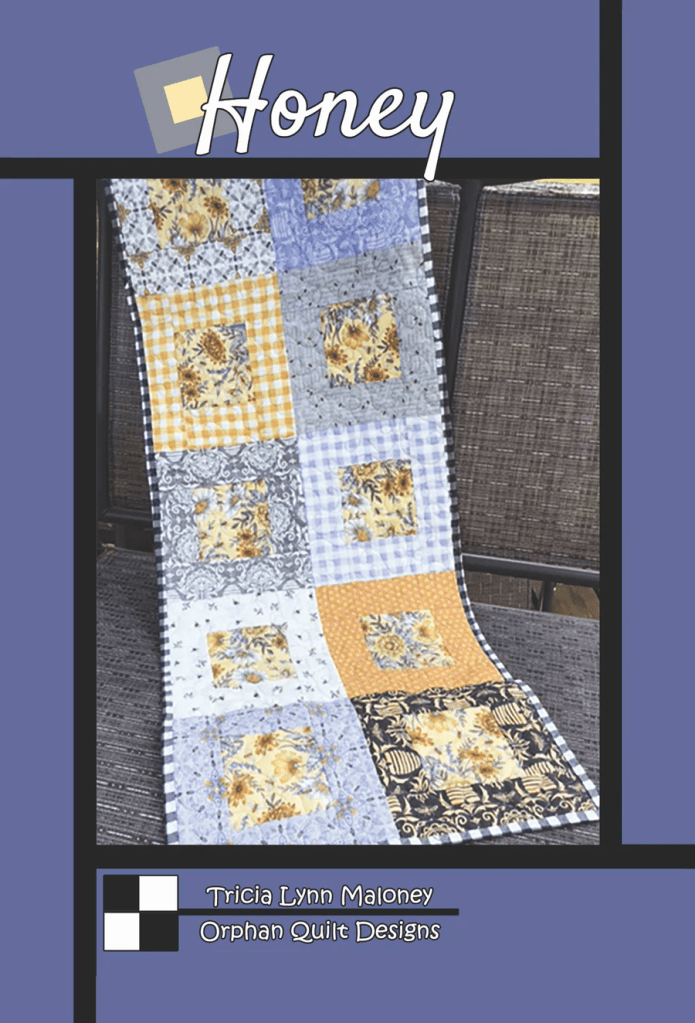
VRD Quilt Pattern Tutorial Honey
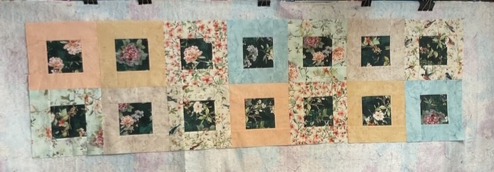
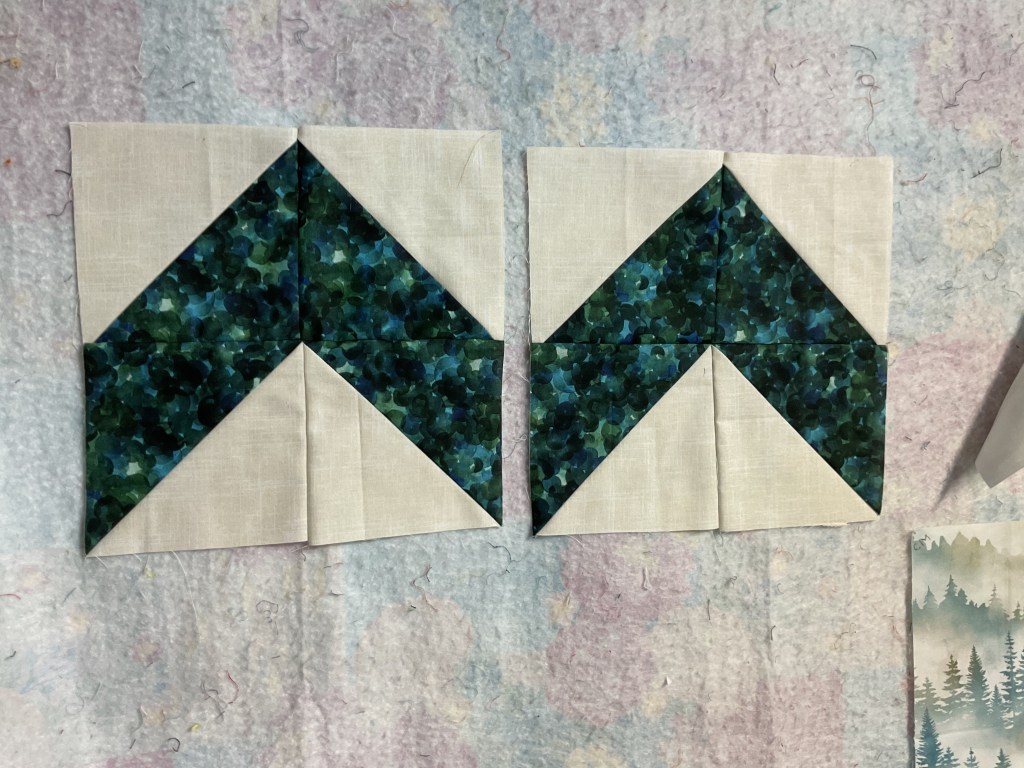
There’s nothing like a new table runner to add a touch of spring to you space! Have you ever made Honey before? If not, you’re in for a treat because this runner goes together quick as bunny and looks great in just about any group of fabrics you want to use.
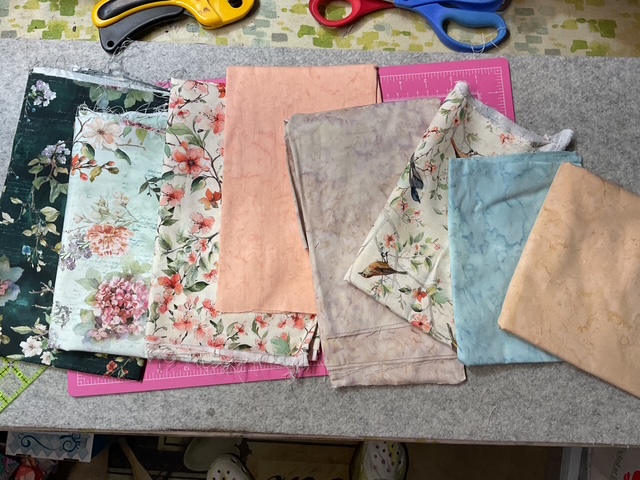
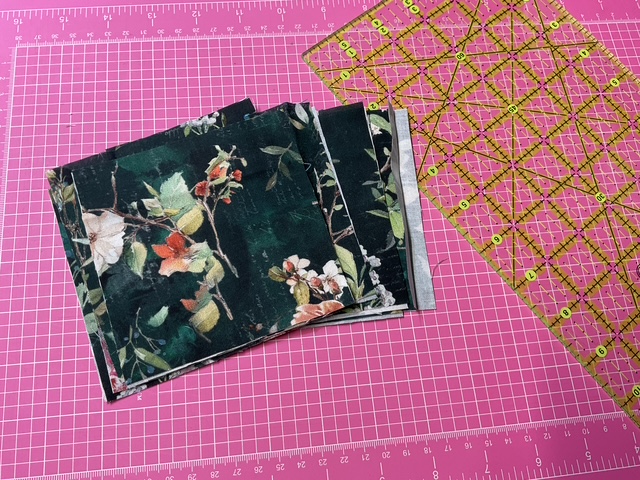
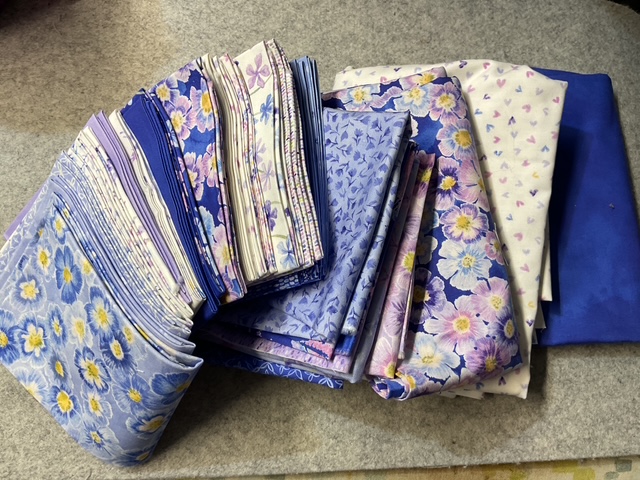
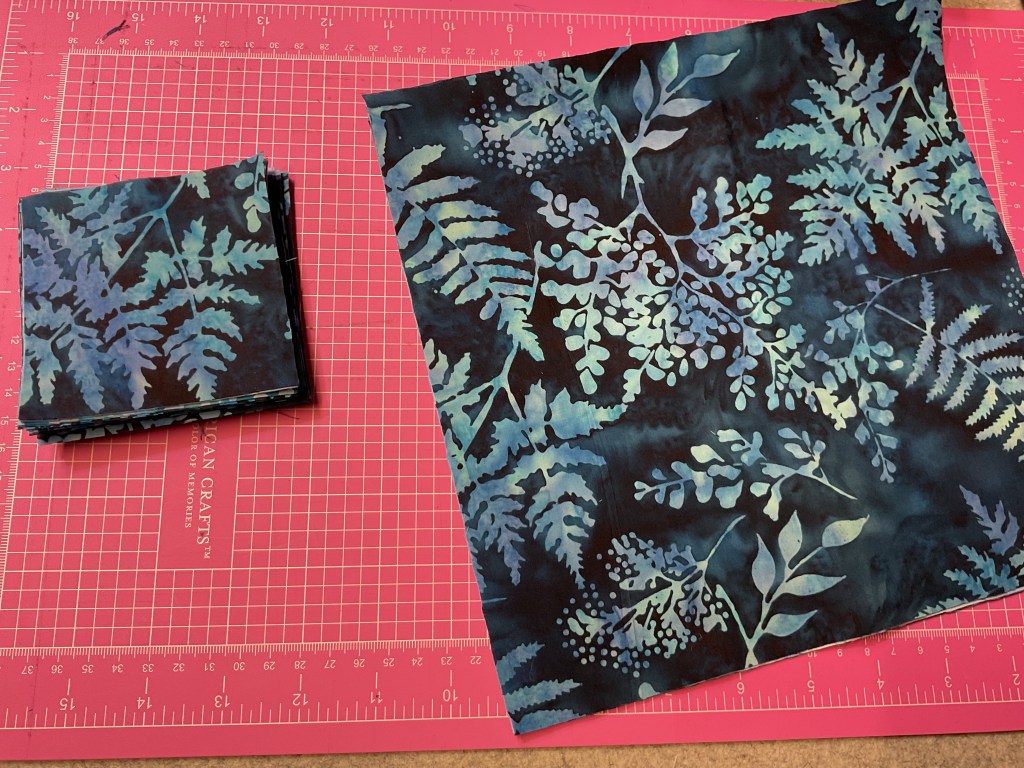
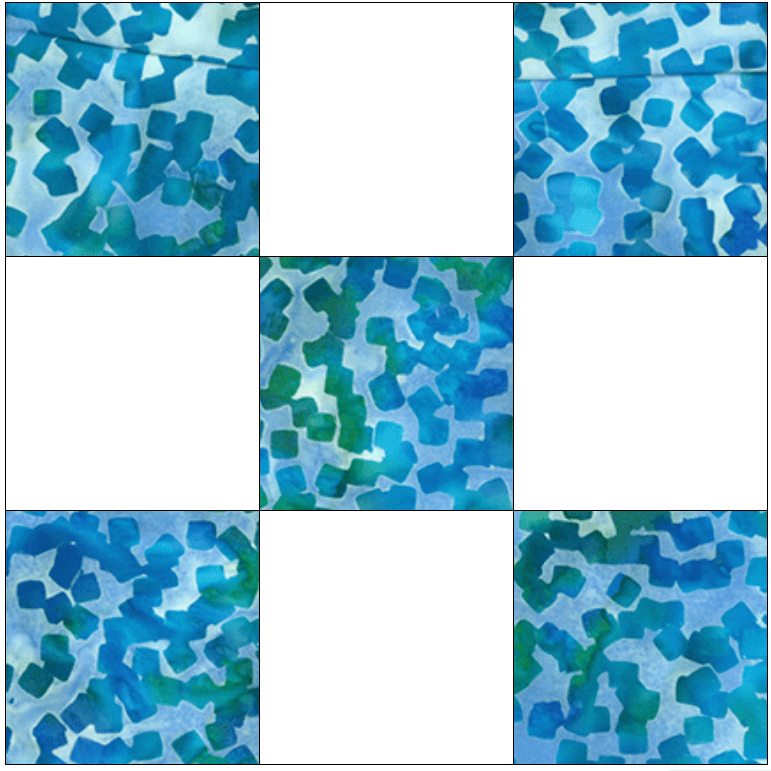
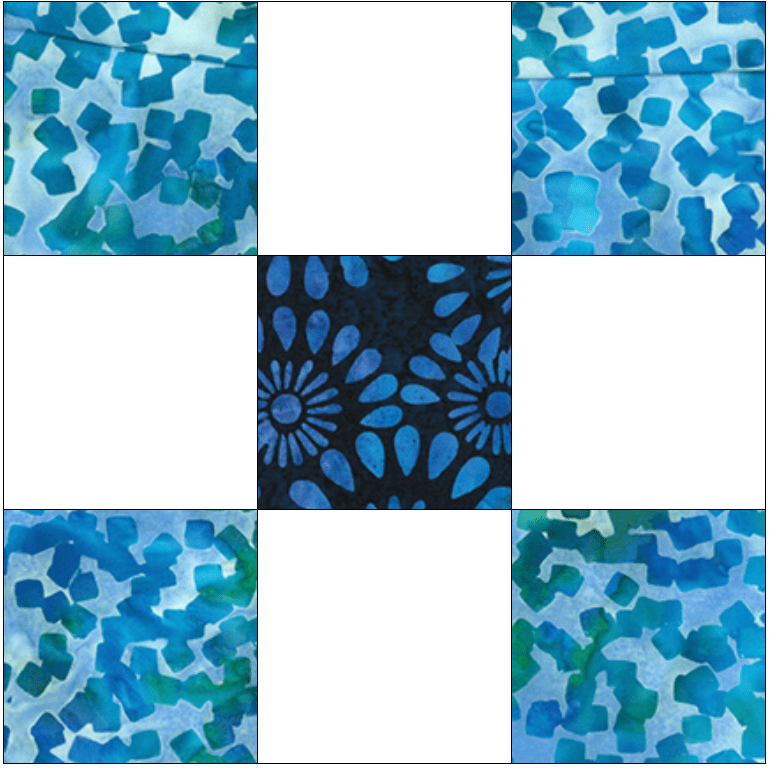
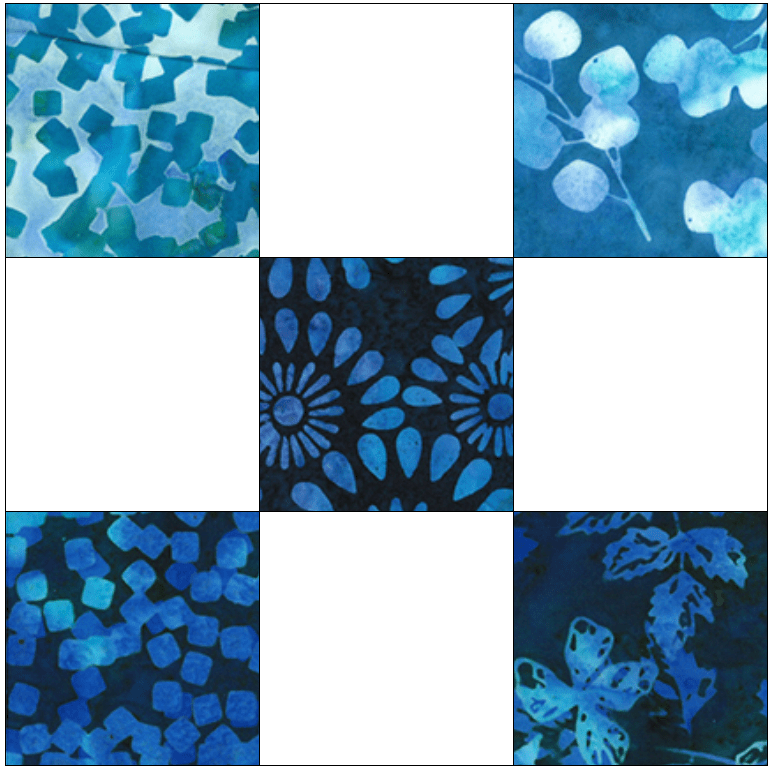
1. Time to gather up our fabrics. I’m using lovely sample fabrics from our quilty pals over at Hoffman Fabrics today. SHHH! This fabric isn’t even available yet, so you’re getting a sneak peak!
It’s an upcoming new collection called Nesting Hour and there are some lovely sherbet-y 1895 Watercolors batik coordinates, too. Quilt shops will be able to order this fabric next month and it will ship to shops in September. So ask your favorite retailer to order Nesting Hour!
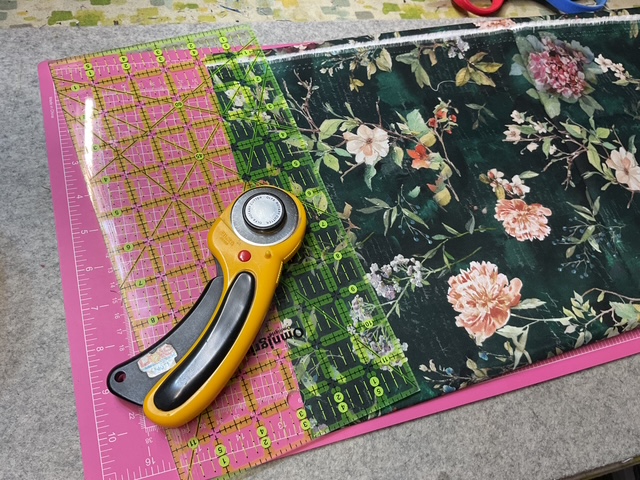
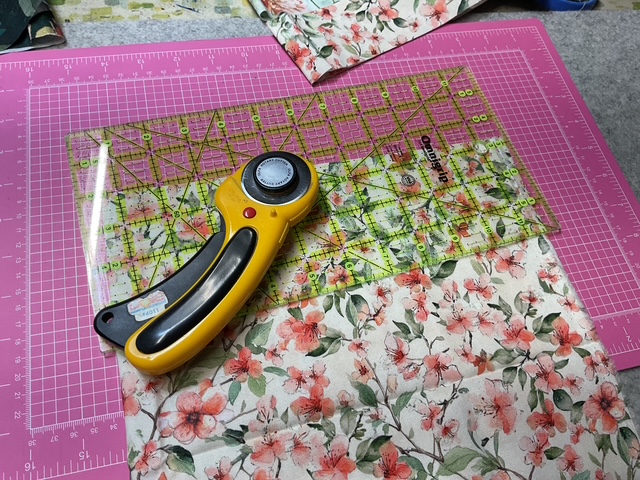
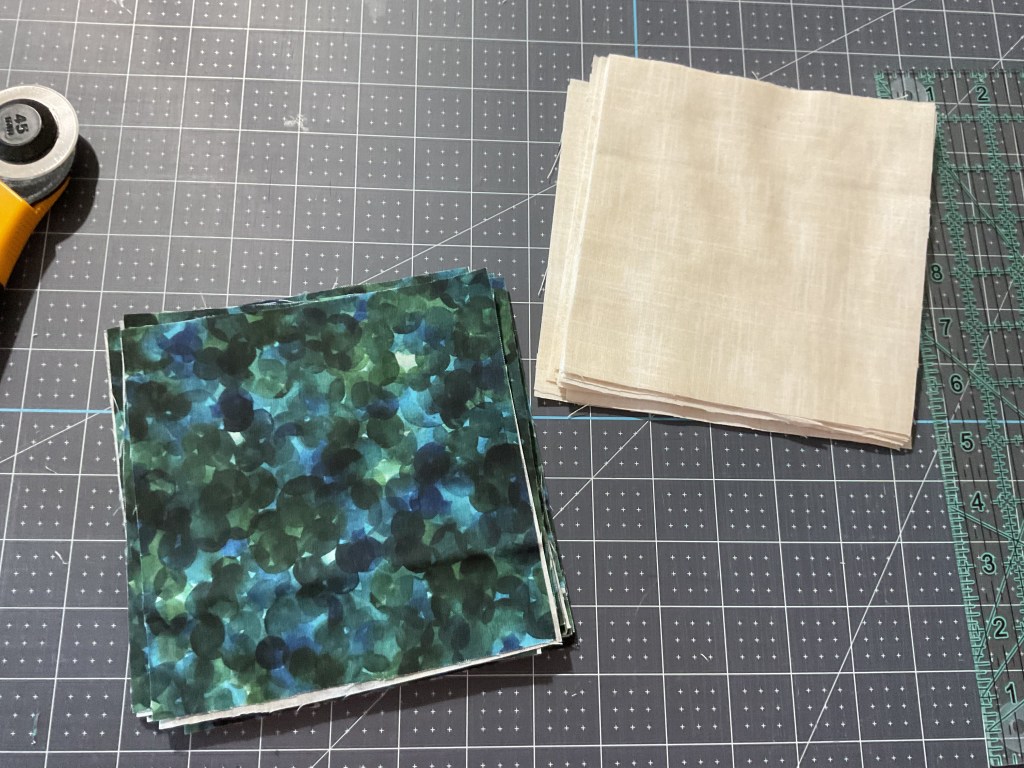
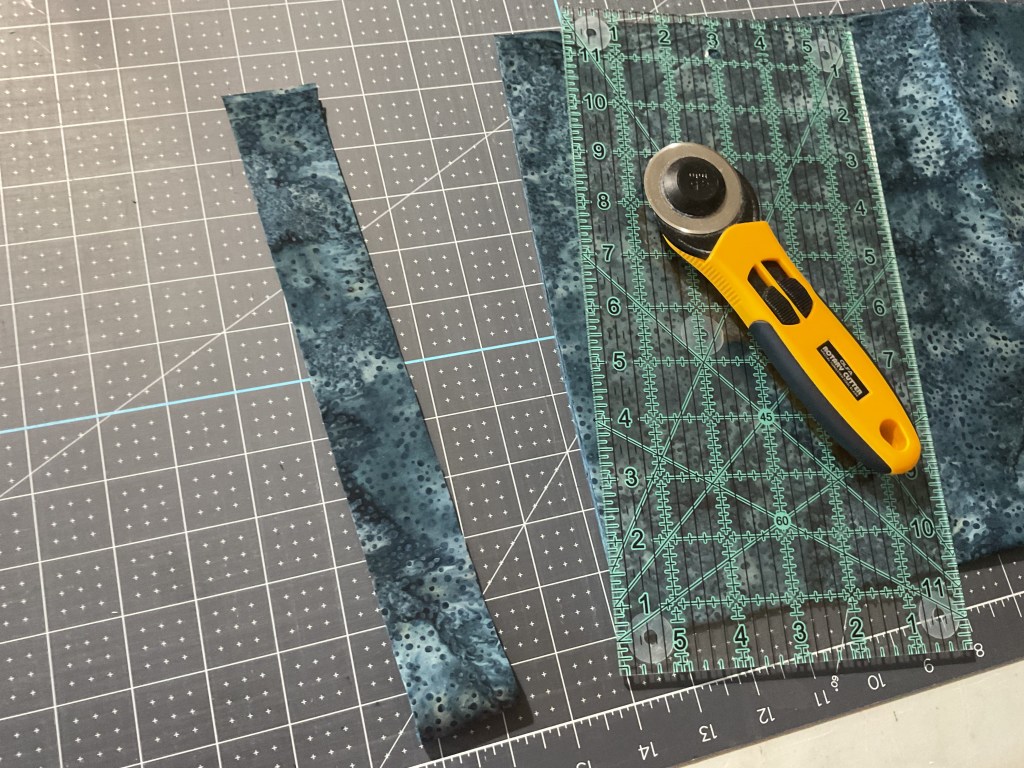
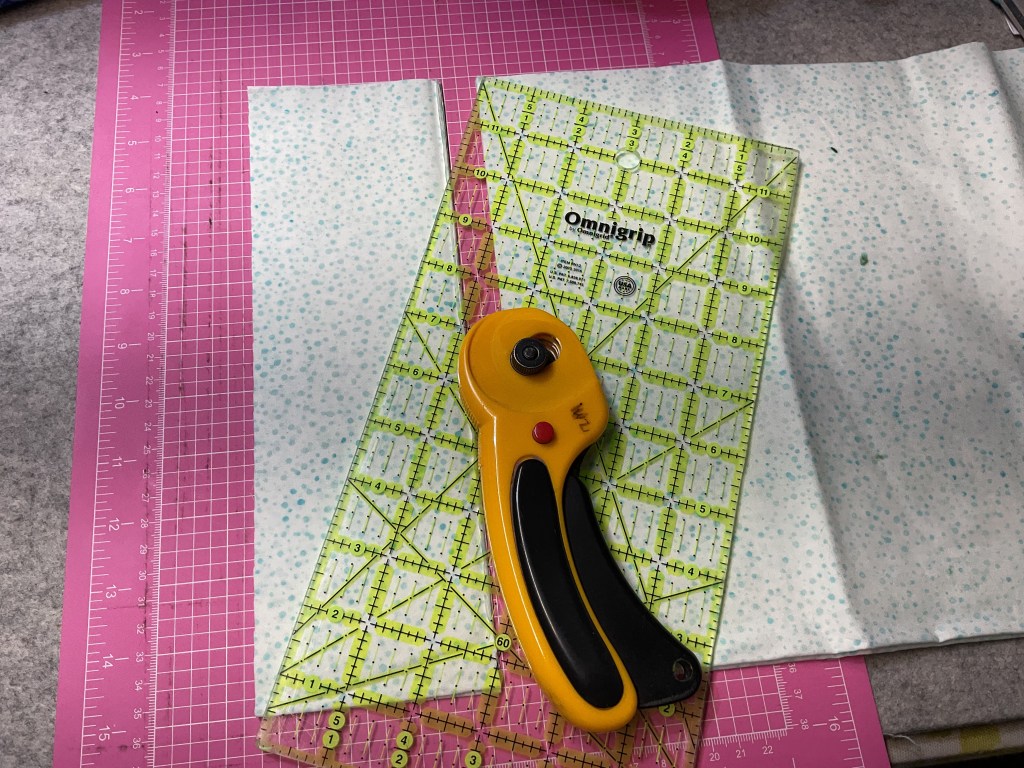
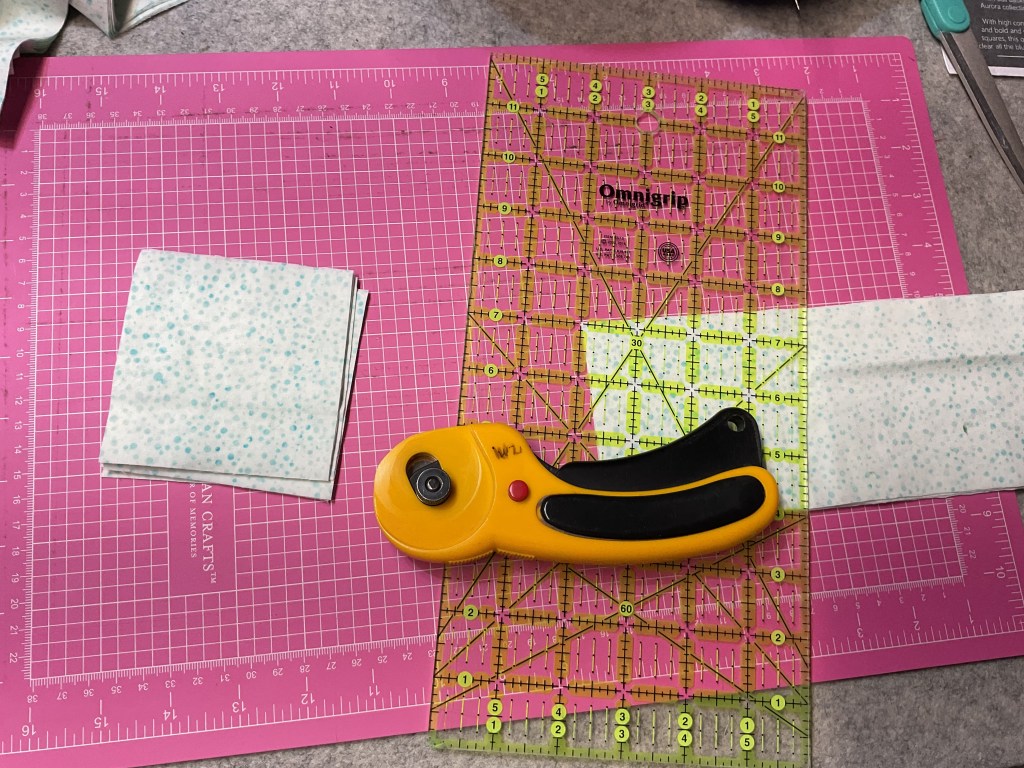
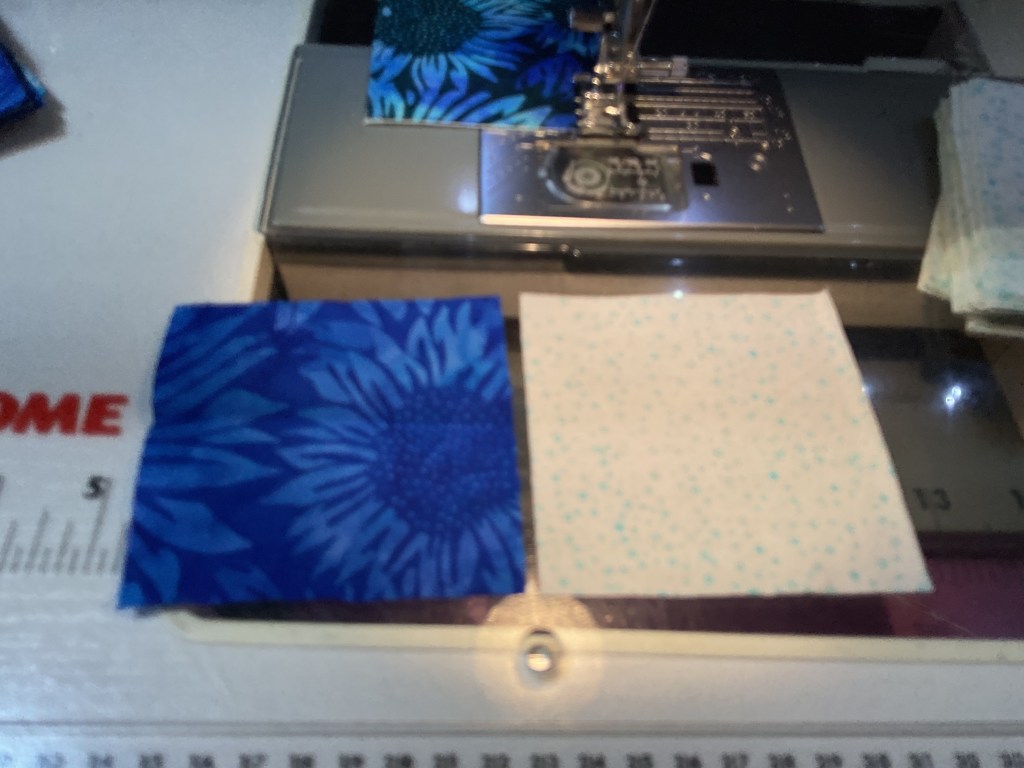
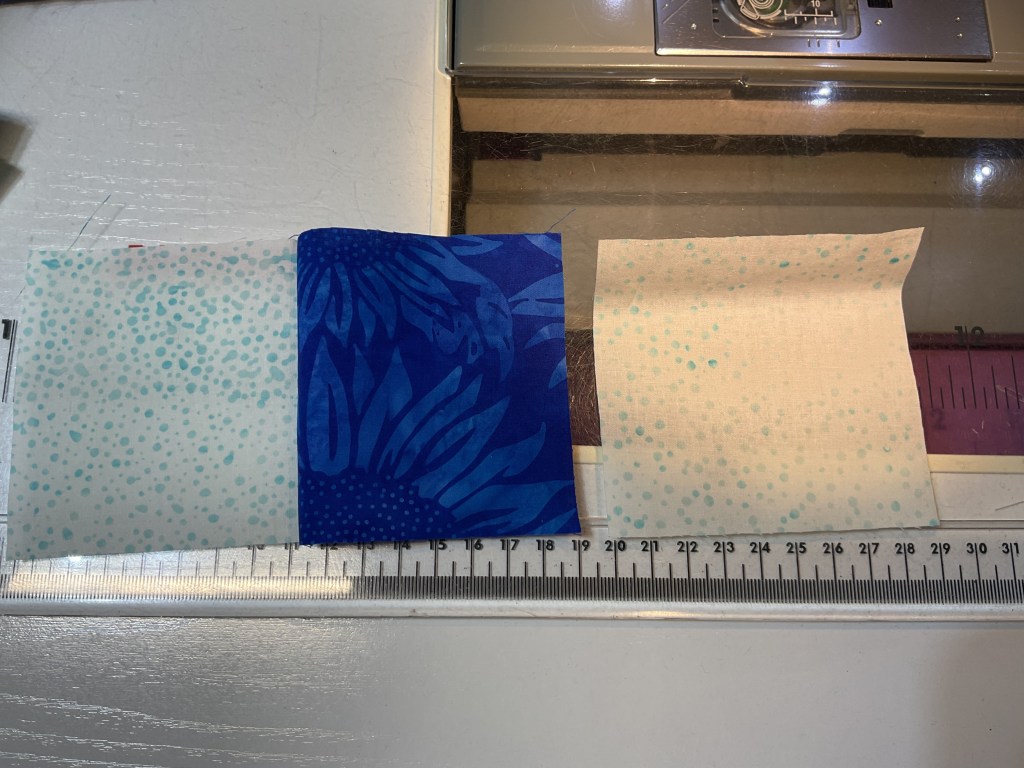
2. All right! Let’s get some cutting done. First, I’ll cut strips for the block centers and then I’ll cut the strips into squares.
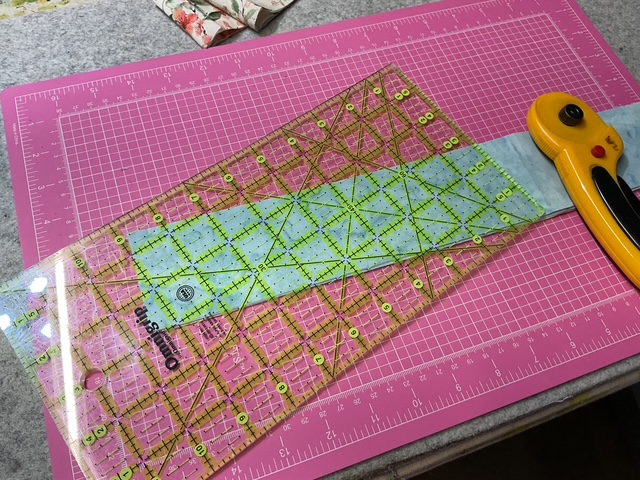
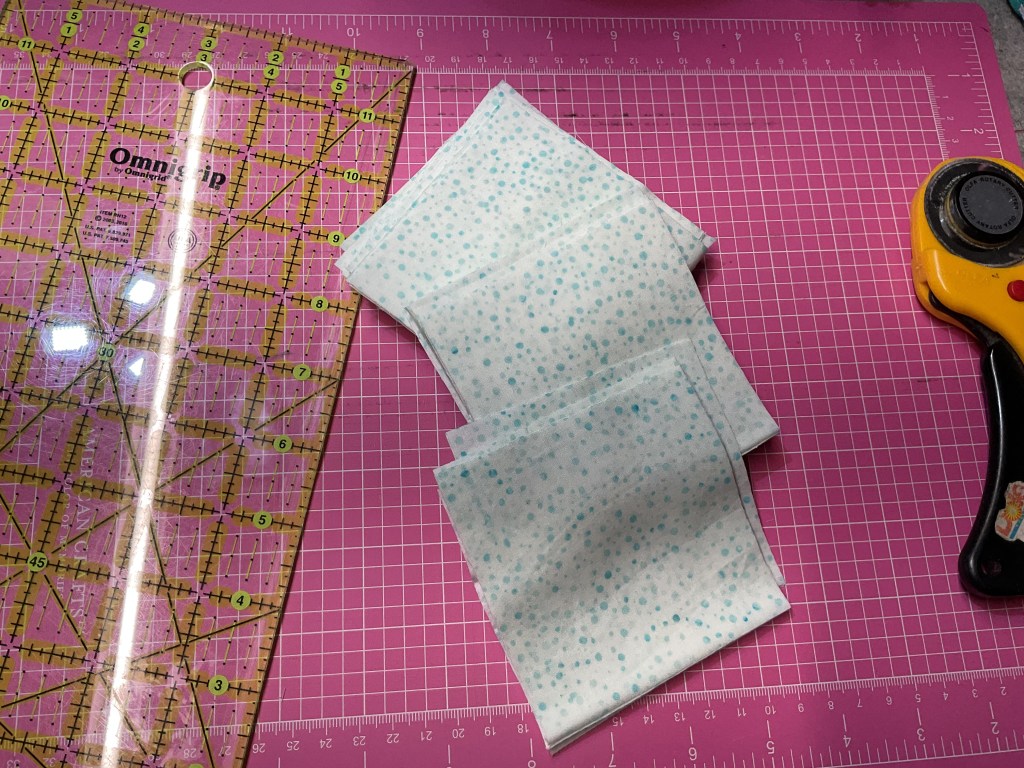
3. Next I’ll cut the strips for the frames and then subcut the strips into the needed smaller pieces.
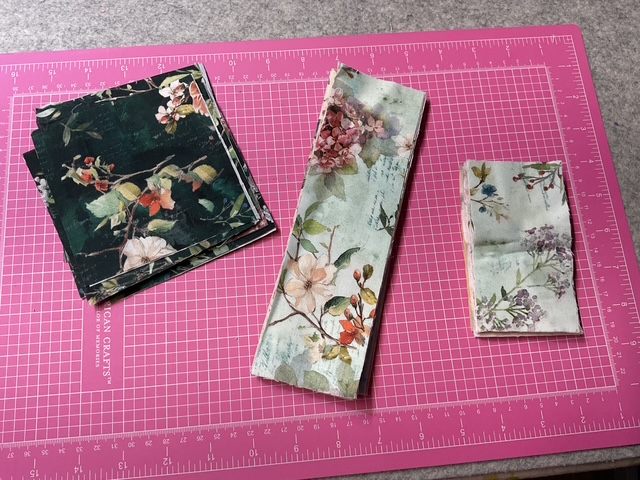
4. All the pieces are cut, organized by shape, and ready to sew. Yay!
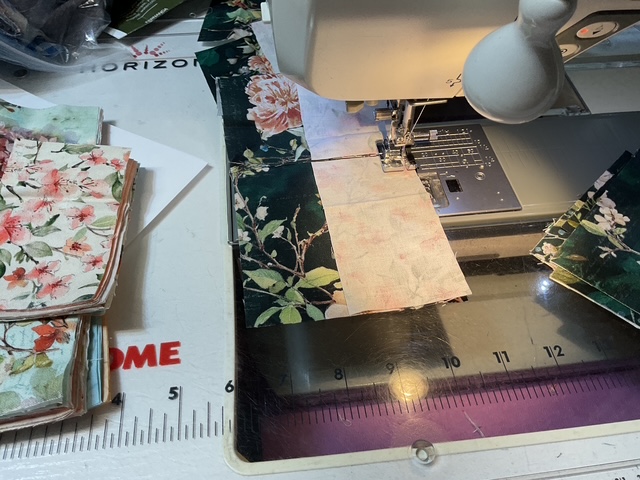
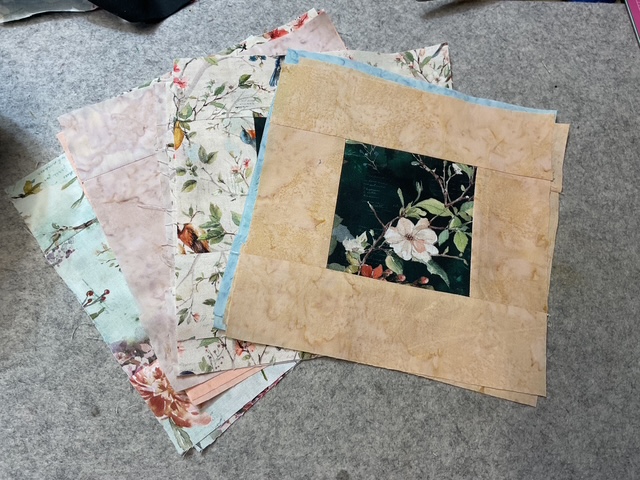
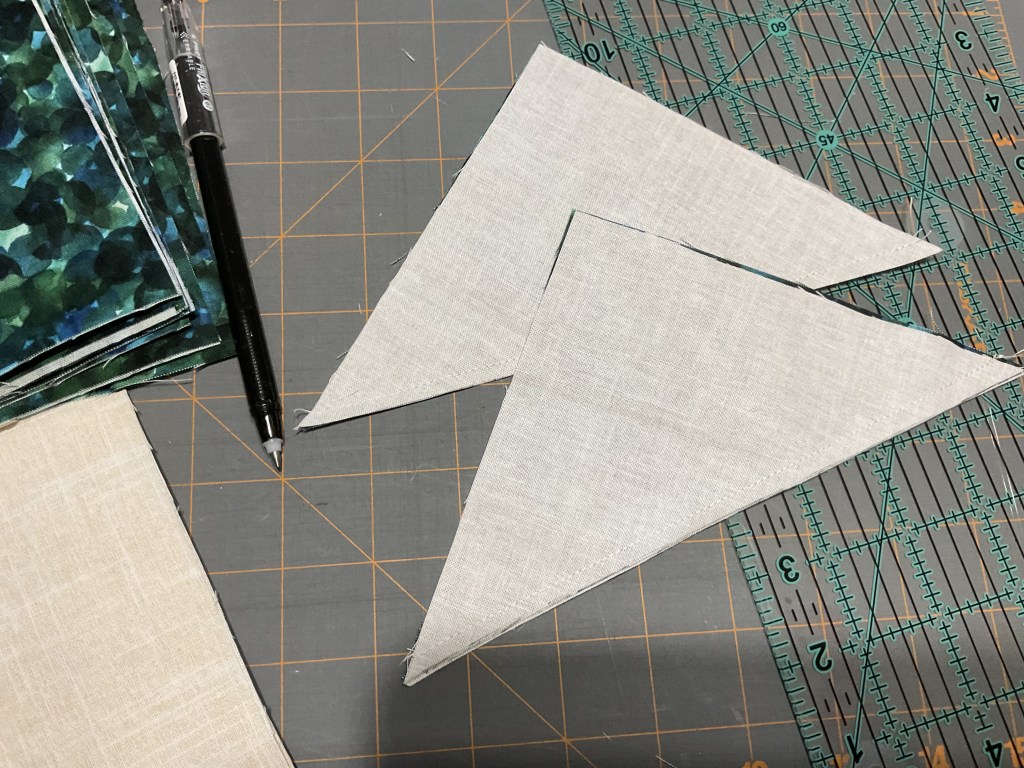
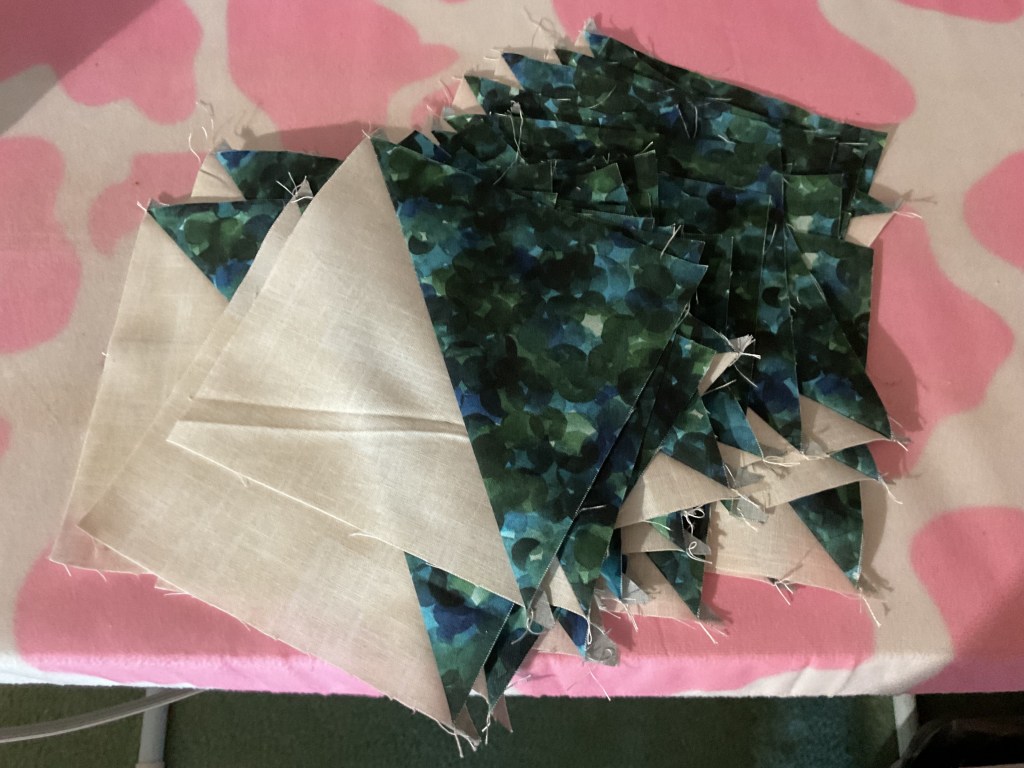
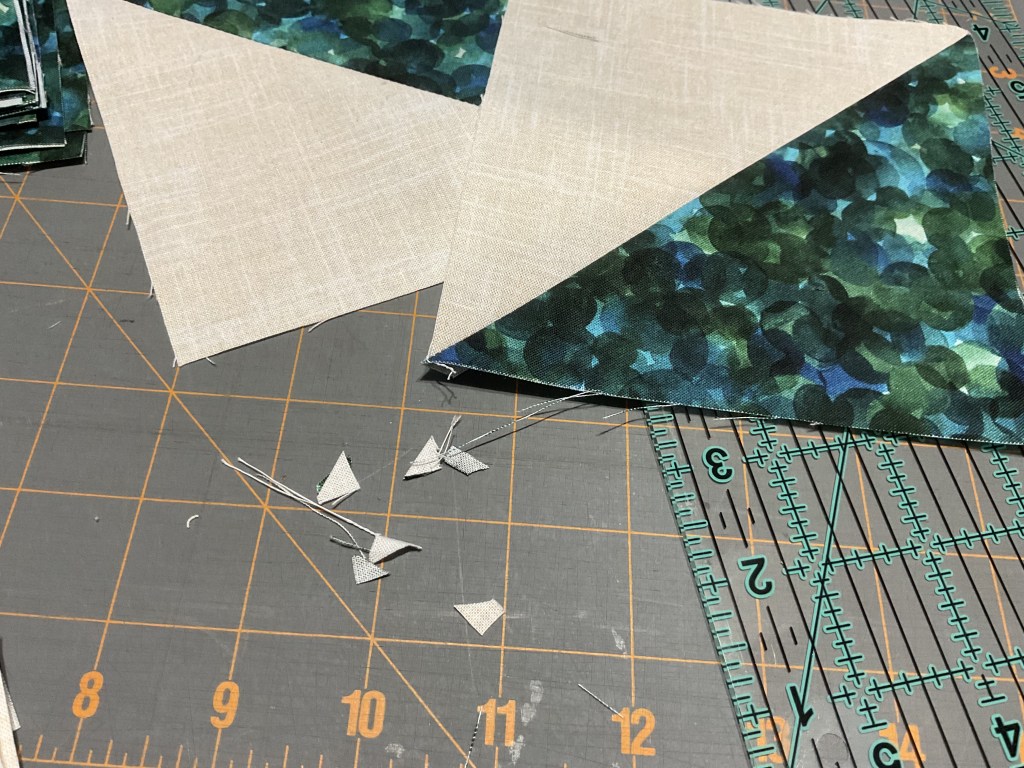
5. We’re headed to the sewing machine to make the blocks. I’m going to sew the short strips onto opposite sides of the center square. When I’m sewing the same step over and over, I really love chain piecing because it saves both time and thread.
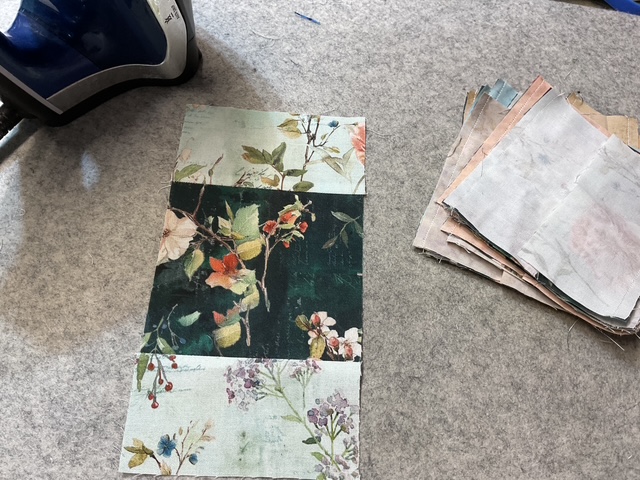
6. After I sew the matching short strips to opposite sides, I’m headed over to the ironing station to press my block so far before adding the next strips. I don’t always press in the middle of sewing a block together, but today I am because I want the blocks to turn out really crisp.
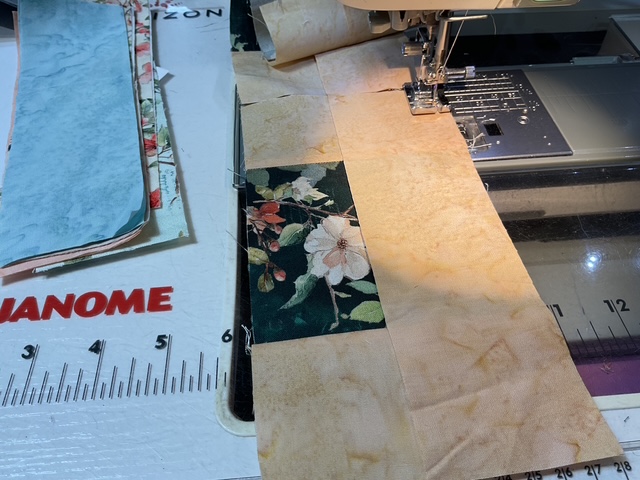
7. Then back to the sewing machine to add the long matching strips to opposite sides of the center square to complete the frame for each block.
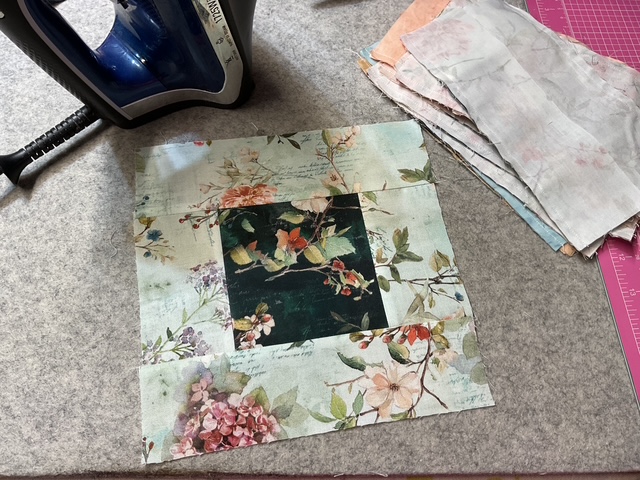
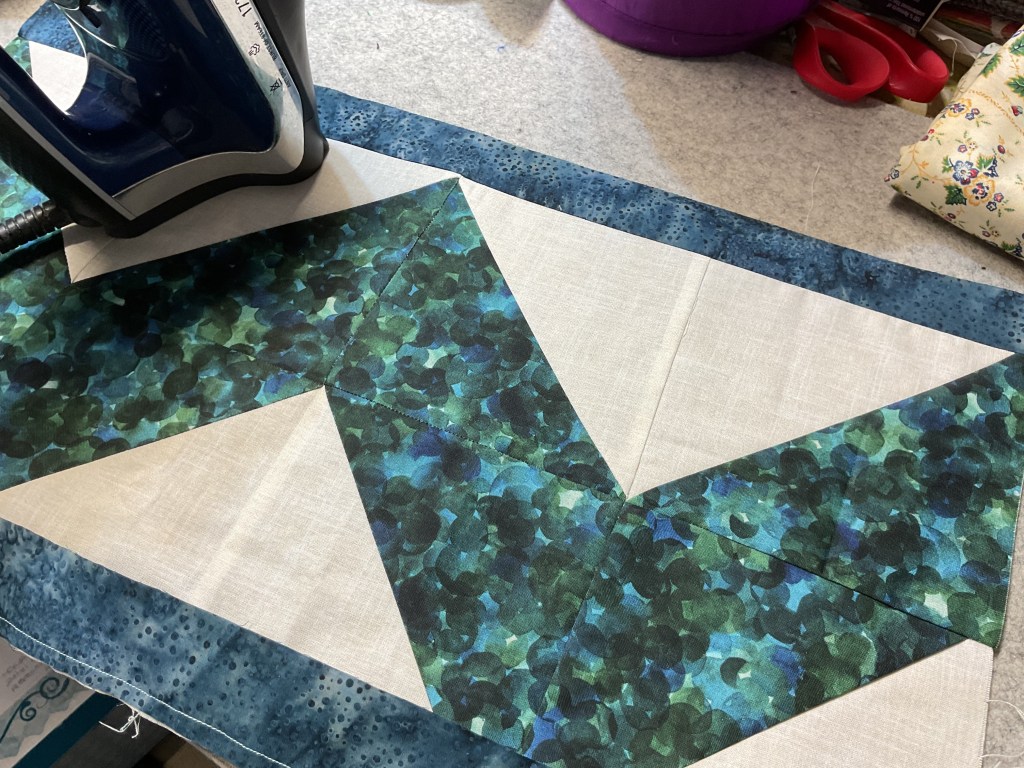
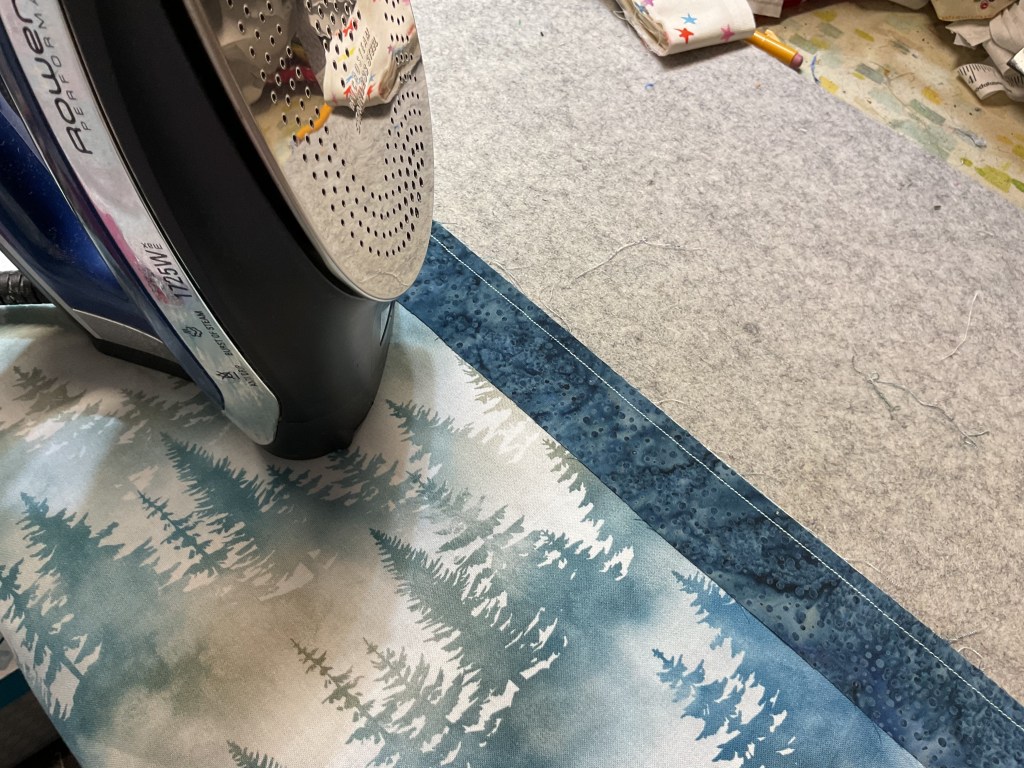
8. And back to the iron to press the completed blocks so they will be nice and crisp. I’ve noticed that when I press blocks on my wool pressing mat, I don’t have to use pressing spray to get sharply pressed blocks.
Right now I have an 18″ x 60″ mat on my 24″ X 60″ ironing station. My Dad designed and made the ironing board for me years ago. My lovely big board sits on top of an Ikea Kallax 8 cube shelf on casters and it’s the perfect height for me!
The 18″ wide mat just seems too narrow for me now, so I’m thinking of upgrading. I see mats are now available in 22″ x 60″ and 24″ x 60″, which is really great. Maybe I won’t run off the edge anymore. Definitely worth thinking about now if they have the exact size I need.
9. Yay! My blocks are all pressed!
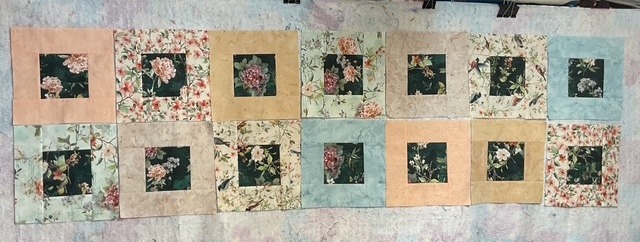
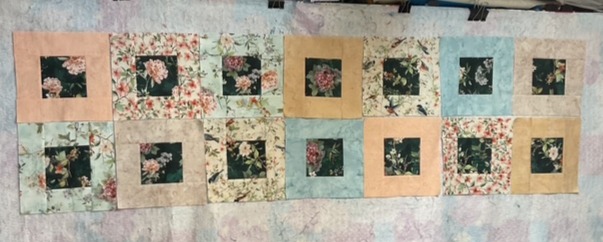
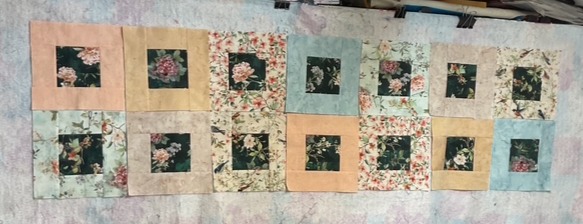
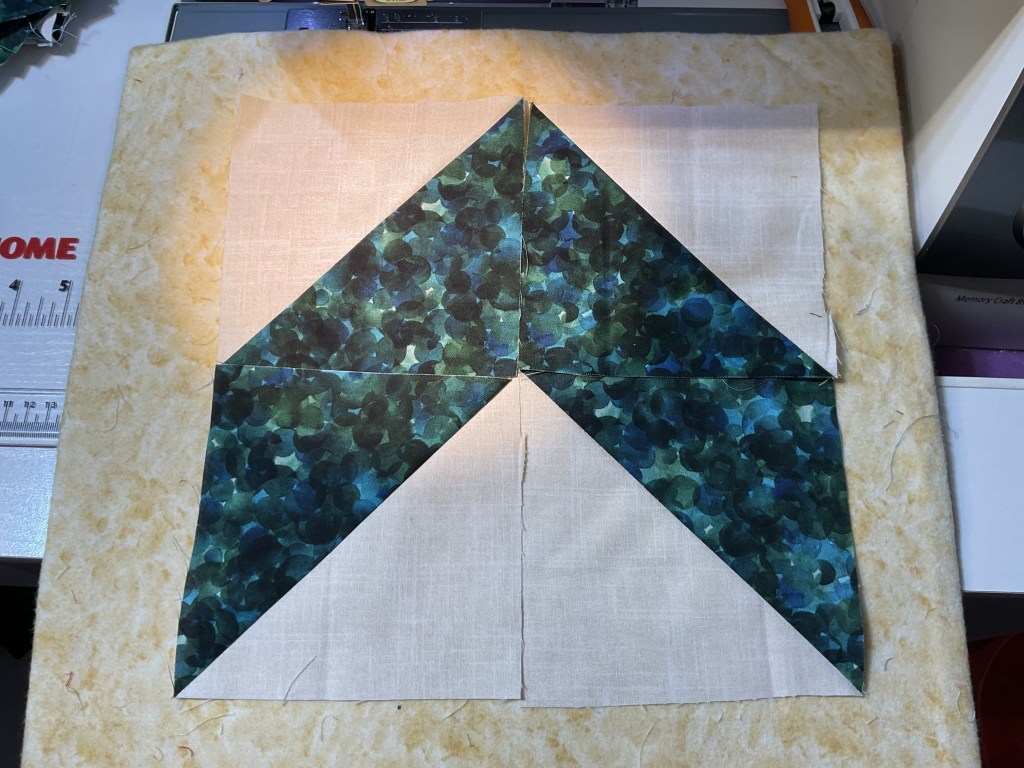
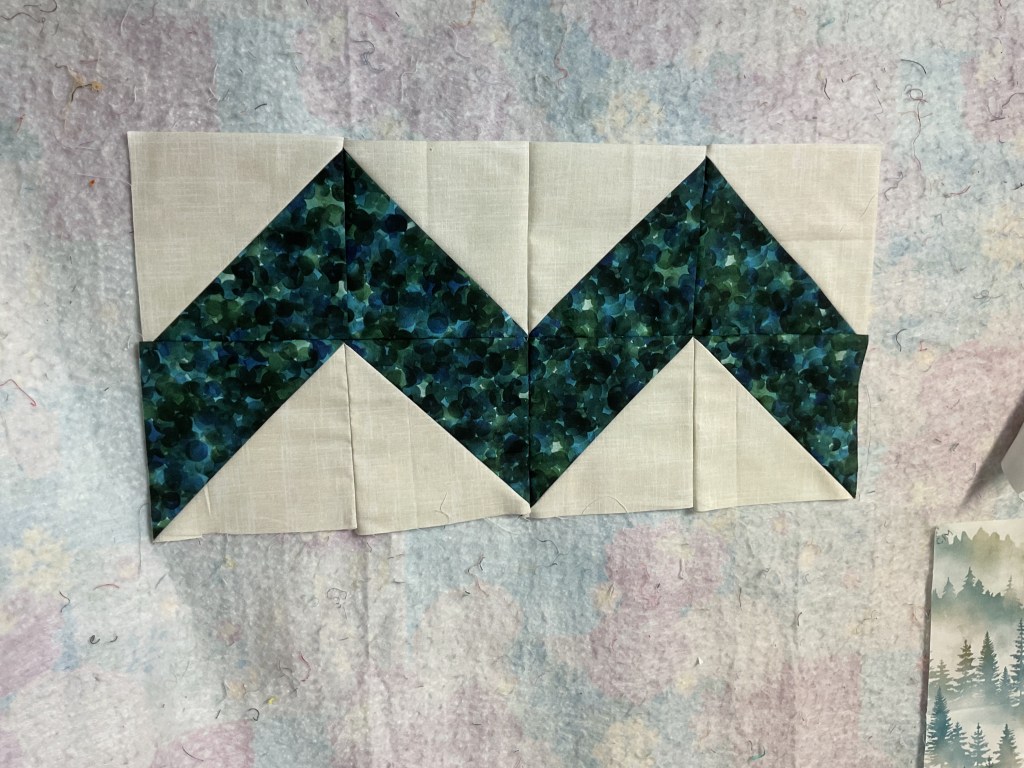
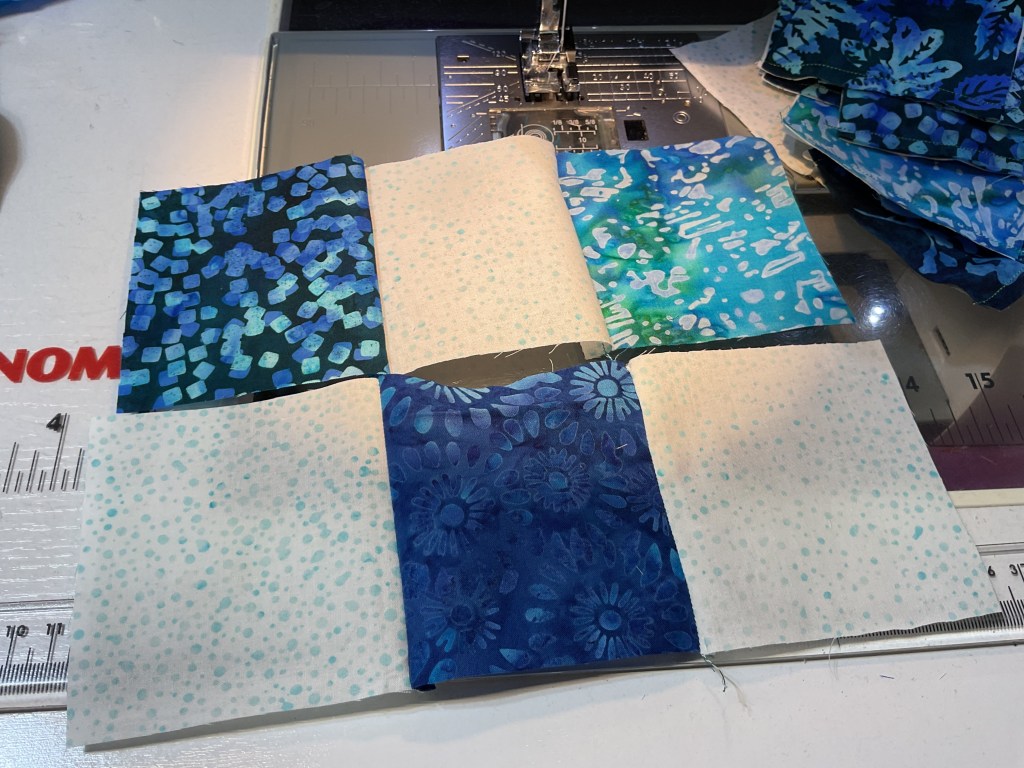
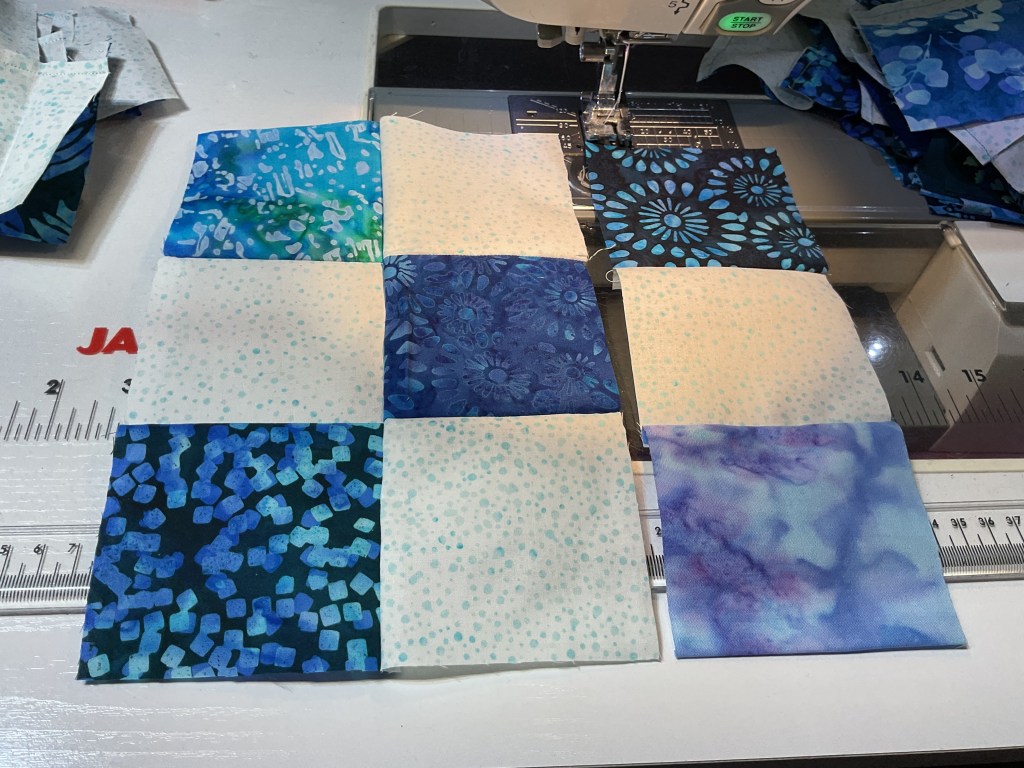
10. Next up is putting my blocks up on my design wall so I can rearrange them. Here’s a few photos showing how I’m moving things around. Sometimes this step takes more time than I’d like, but it is a really important one because nobody wants a visually lopsided quilt.
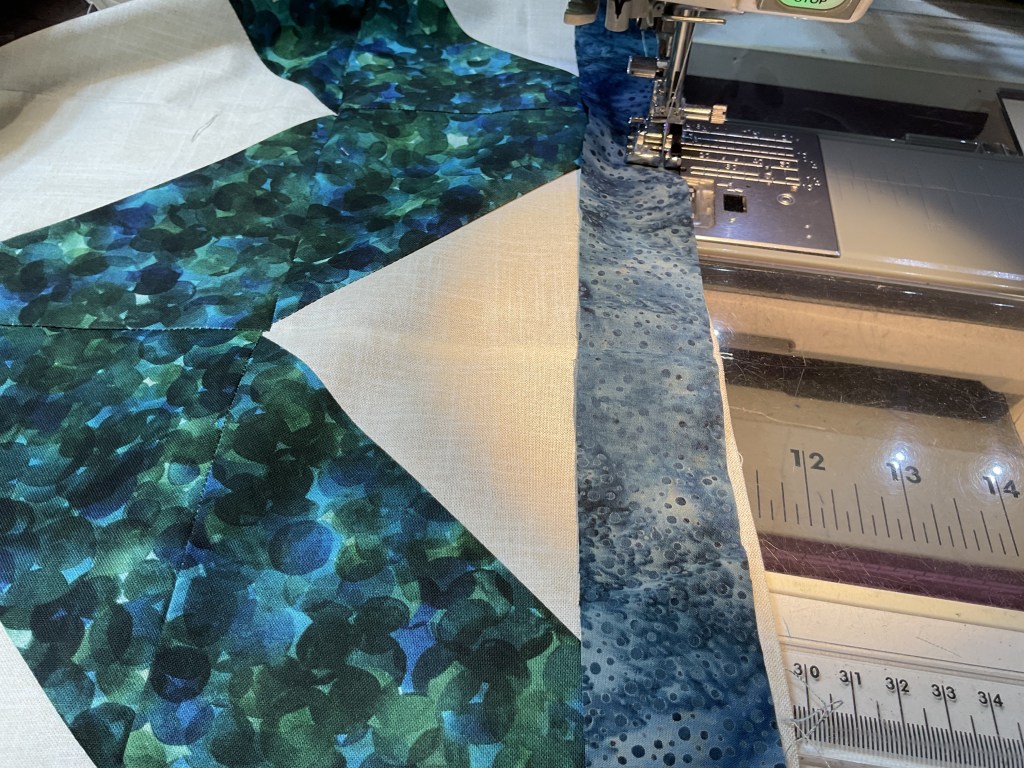
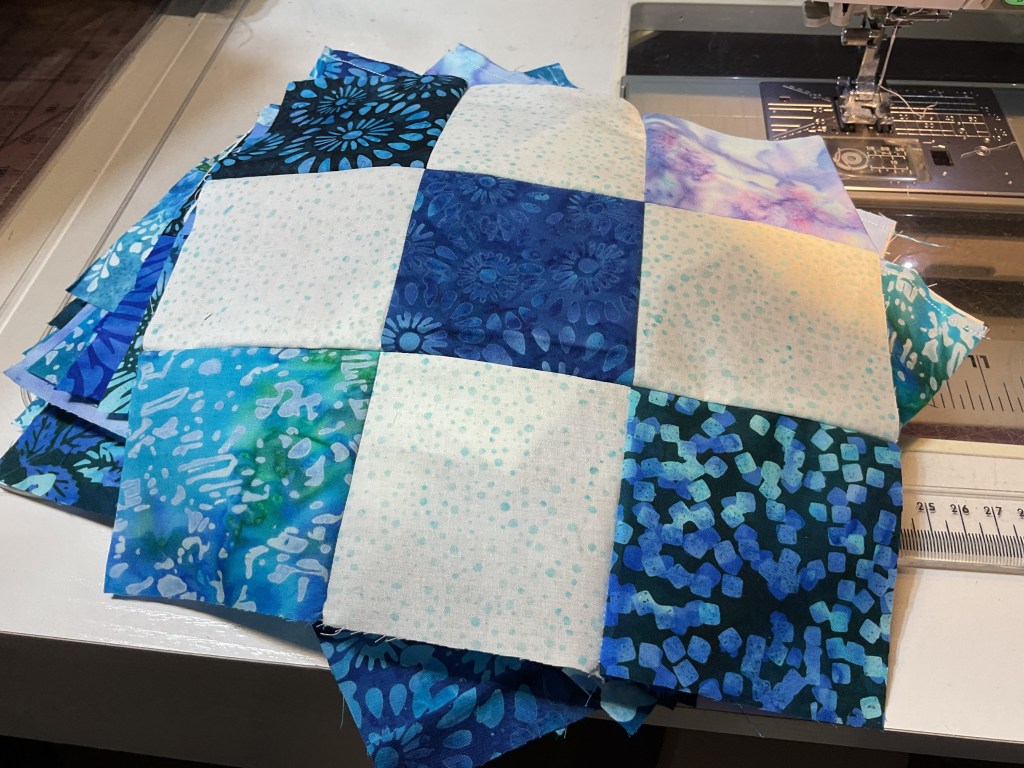
11. Here’s the arrangement I decided upon. Then it was back to the sewing machine to sew the blocks together. Next up with be layering, quilting, adding a label, and binding…….sometime.
I really like how it turned out, don’t you? So soft and fresh. I can’t wait for the fabric to be available in quilt shops come September 2026.
Your homework for the next couple weeks is to decide whether you want to join me in a Spring 6 Quilts in 6 Weeks Challenge. Drop me an email (tricia@villarosadesigns.com) if you want in. I’ll post more info next week.
Let’s get quilting and finishing together! YEAH!
See you right here next week for another Spring into Spring tutorial.
I hope you’ve gotten the chance to watch some of the Paralympics this week. I have, and the athletes are so so inspiring. I’ve never seen anyone work harder than they do. I am truly at a loss of words to describe how I feel watching and cheering the athletes on.
In honor of all Olympic and Paralympic athletes, today I’m doing a tutorial for Arctic Flame, which I really felt embodies the whole Winter Olympic theme. So stay tuned after the NEW patterns for the tutorial.
OH! Before I forget, I want to say HI to all of our new subscribers. We’re glad to have you aboard the VRD ship. I’m Tricia, your Cruise Director.
Now, let’s cue the marching band and let the balloons fly to celebrate the new March VRD patterns!
NEW March VRD Quilt Patterns
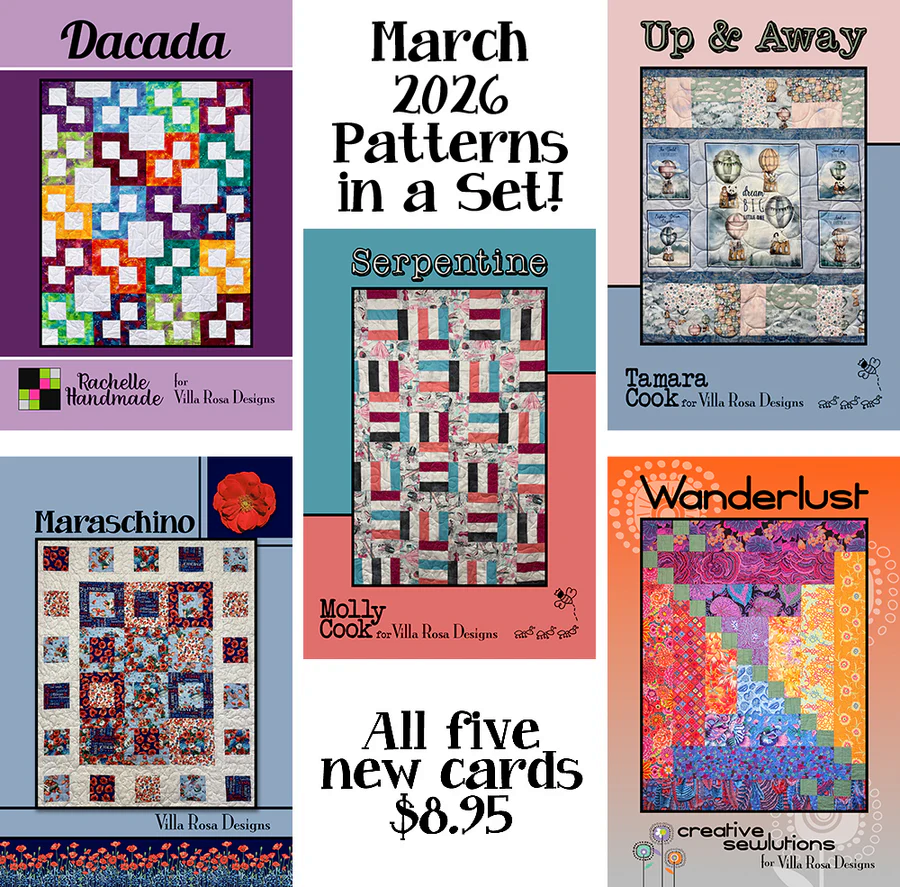
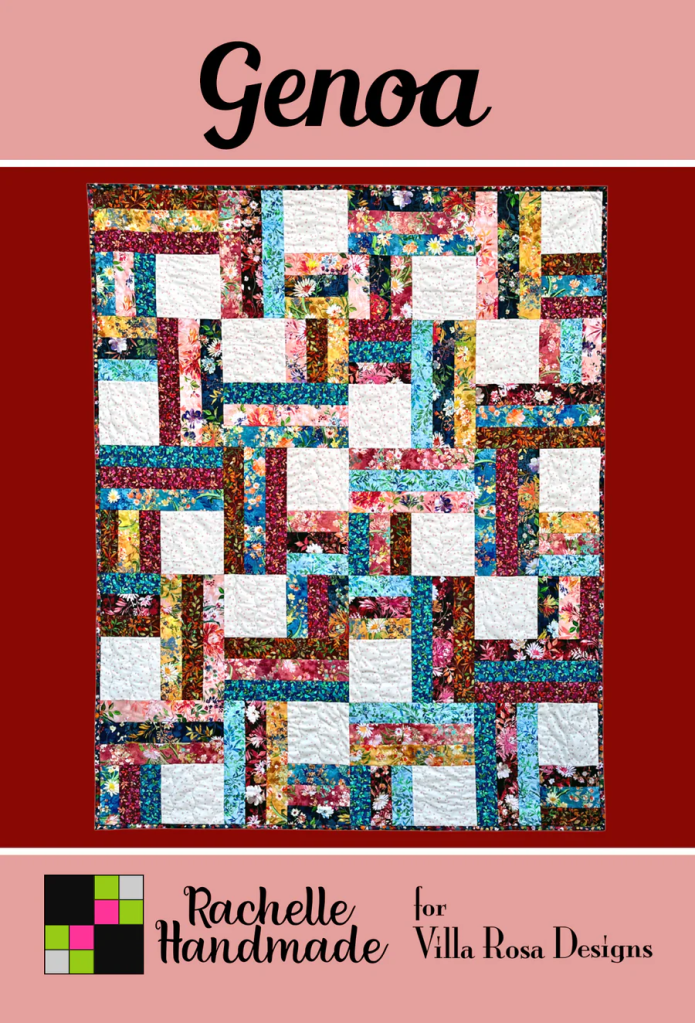
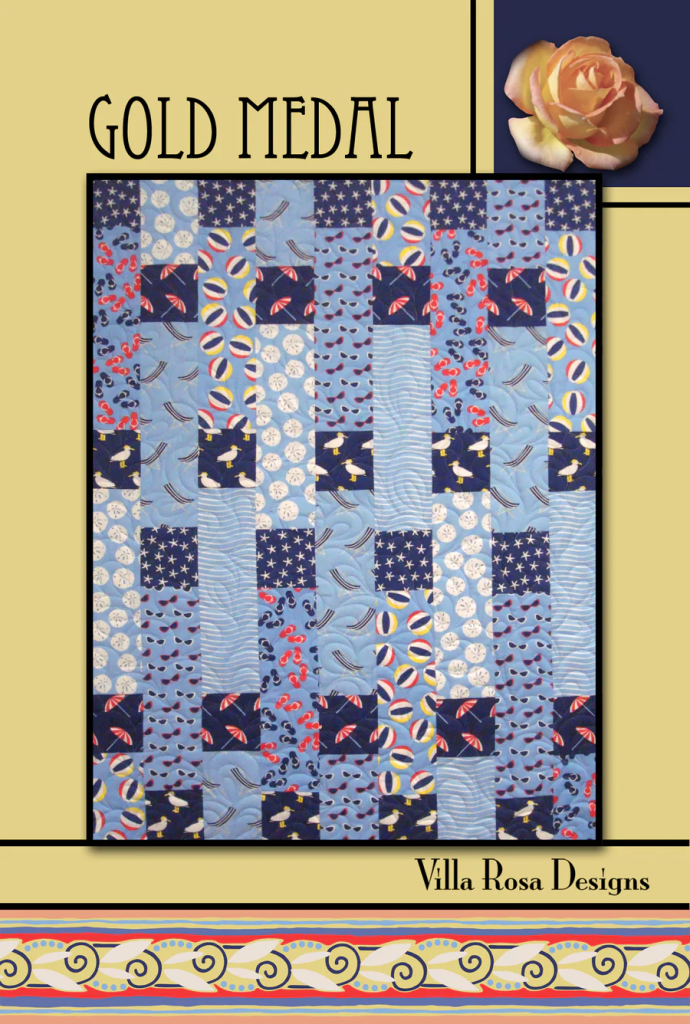
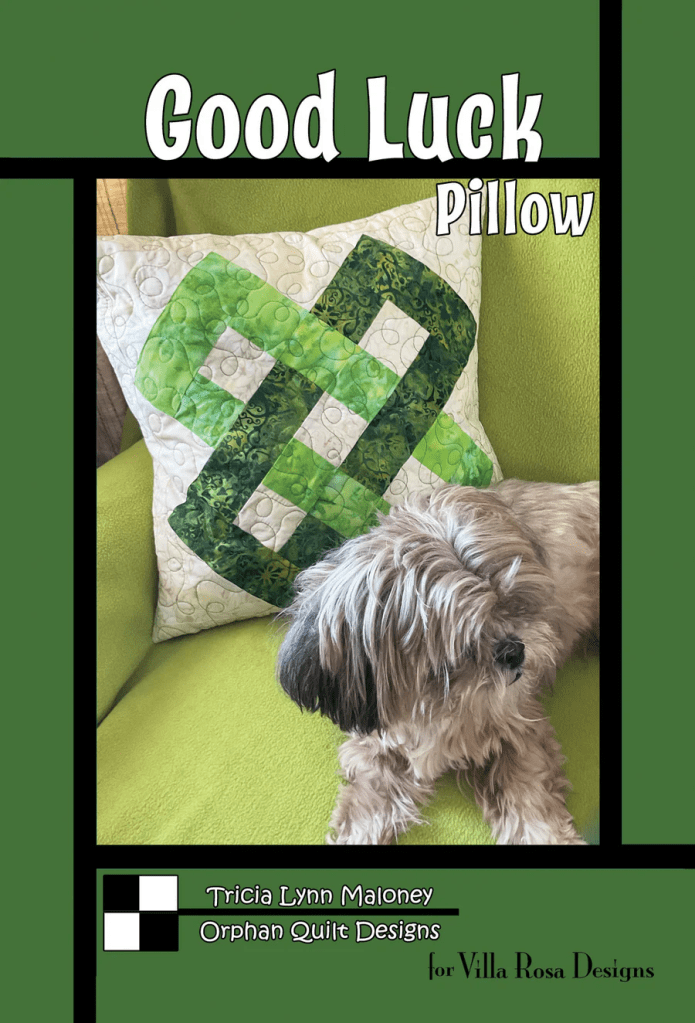
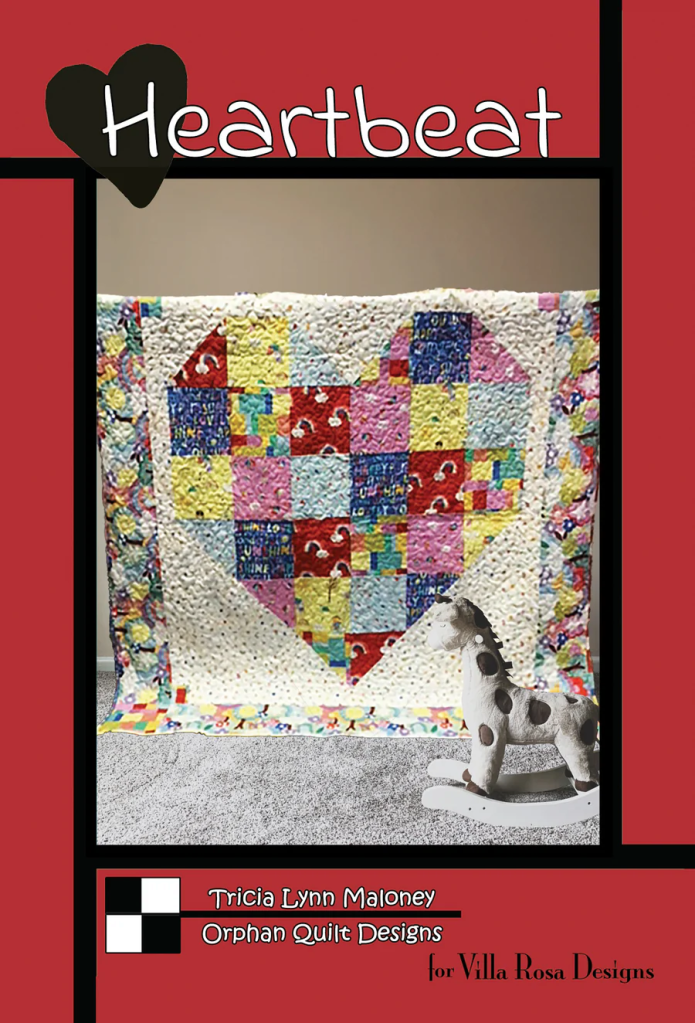
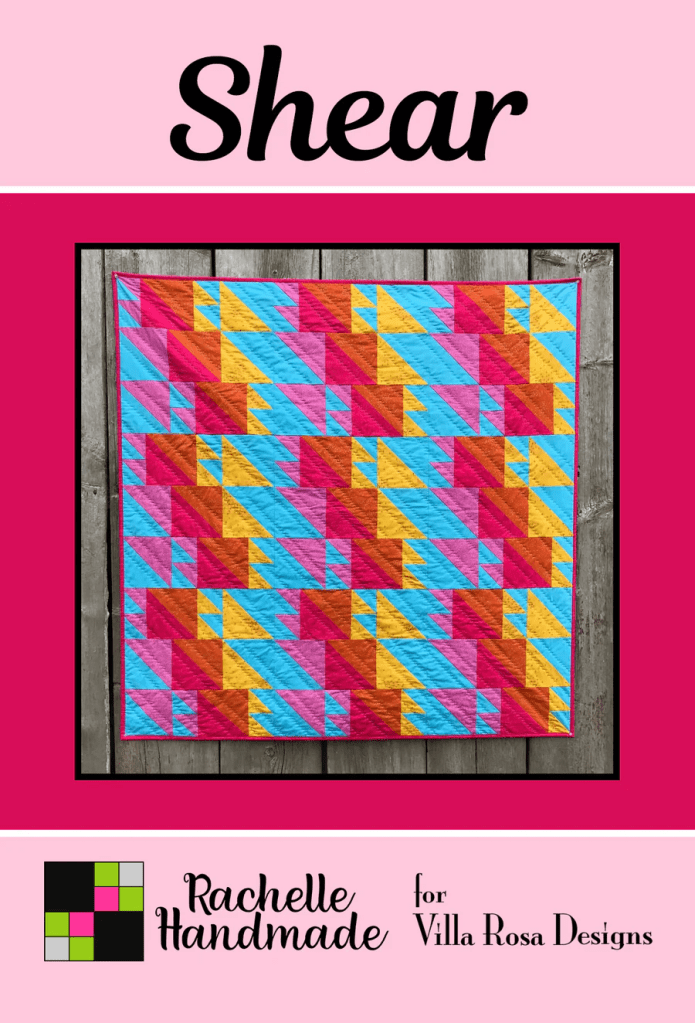
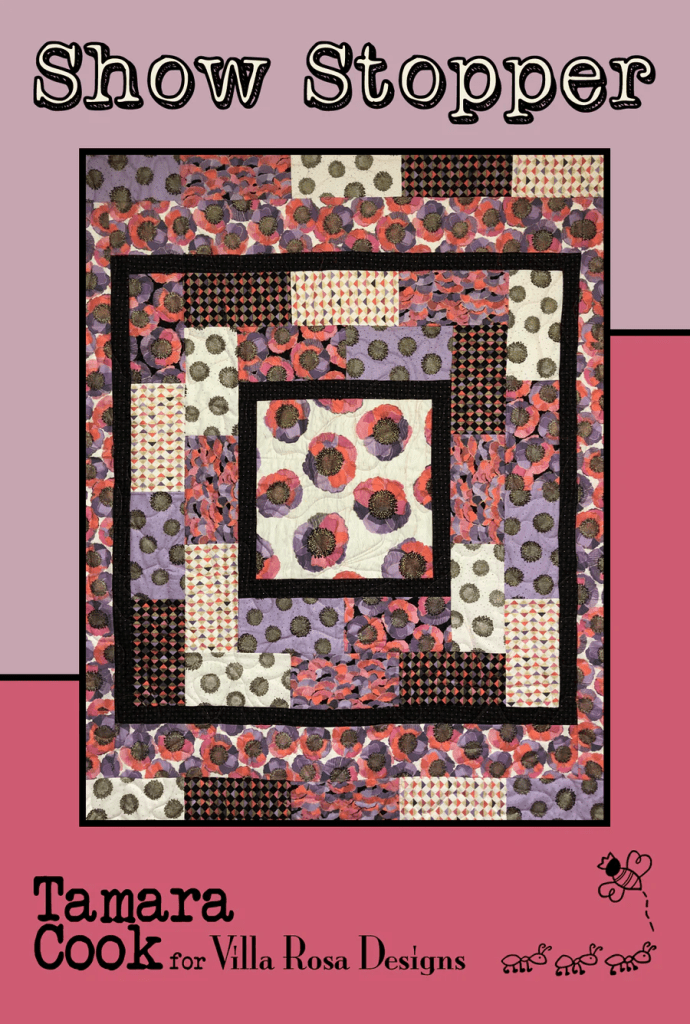
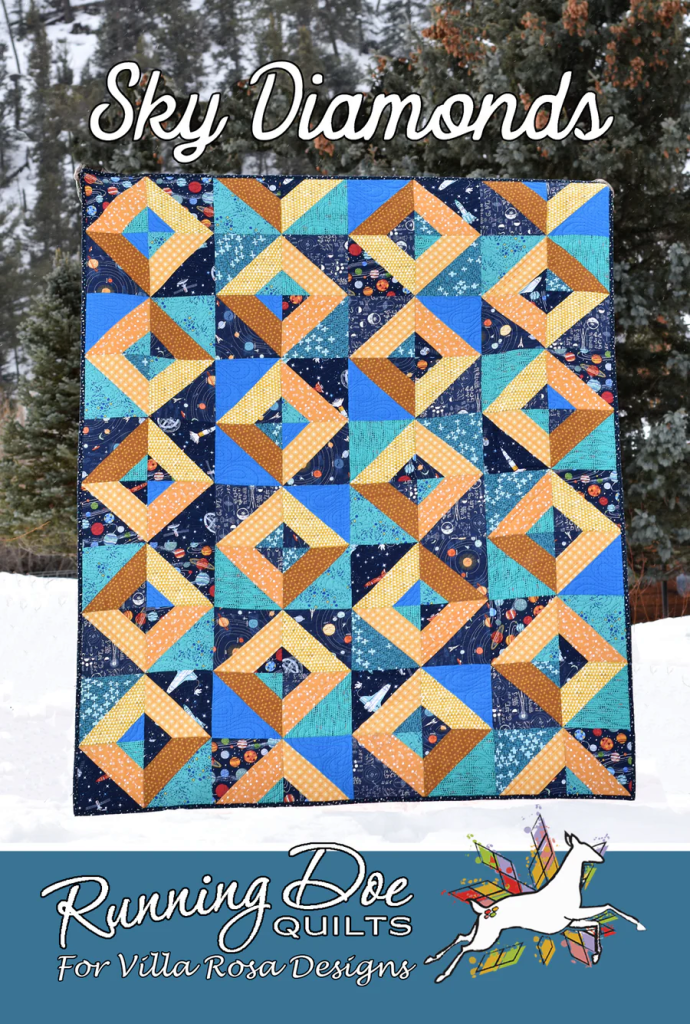
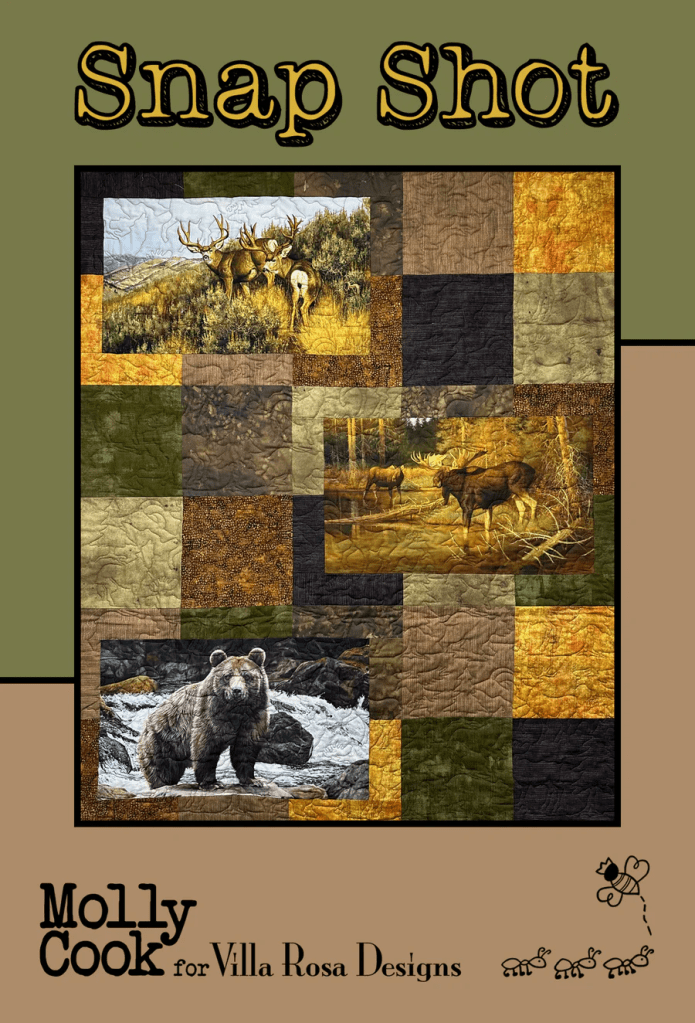
Hard to believe another month of 2026 has passed and it’s time for another collection of new patterns. I think you’re going to LOVE this month’s patterns. When I saw all of them, I was really amazed by the creativity of our designers. They are bright, bold, visual, and fun.
Dang! I’m not sure which one I want to make first.
Argh! Guess I’ll just have to add ’em to my mile long list that just keeps getting longer. I don’t think I’ll ever reach the end of the list, though.
Dacada is Rachelle’s latest modern design and it almost leaps off the pattern. I wonder what it would look like with black or navy background instead of white? It finishes at 48″ x 60″ and is fat quarter friendly. You can find a kit featuring Bold in Bloom batiks HERE.
Serpentine by Molly is a fast and super fun strippy quilt that you can make in a wink. I love that you can use a favorite novelty fabric in her pattern. It finishes at 40″ x 60″ and uses yardage. You can find a kit featuring the same fabrics (Dressmaker) that Molly used HERE or a kit using batik fabrics HERE.
Up & Away is Tamara’s new pattern and it is as sweet as can be. It features a horizontal panel – 23″ and up so it gives you lots of options. With a 23″ panel, it finishes at 41″ x 49″, which is a lovely size for a baby quilt. Using a 36″ panel, the size would be approximately 41″ x 61″ which would be a small throw quilt. You can find a kit with the same fabrics Tamara used (Let’s Go on an Adventure) HERE.
Maraschino is Pat’s March pattern and it couldn’t be more fun. It finishes at 45″ x 54″ and uses fat quarters and a little bit of yardage. You can find a kit with the same fabrics Pat used (Red, White, and Sweet) HERE.
Wanderlust is Creative Sewlutions’s latest modern design. It finishes at 49″ x 63″ and uses yardage. I’m itching to make this one out of my stash with an awesome pop of color.
But wait – we’re not done yet!
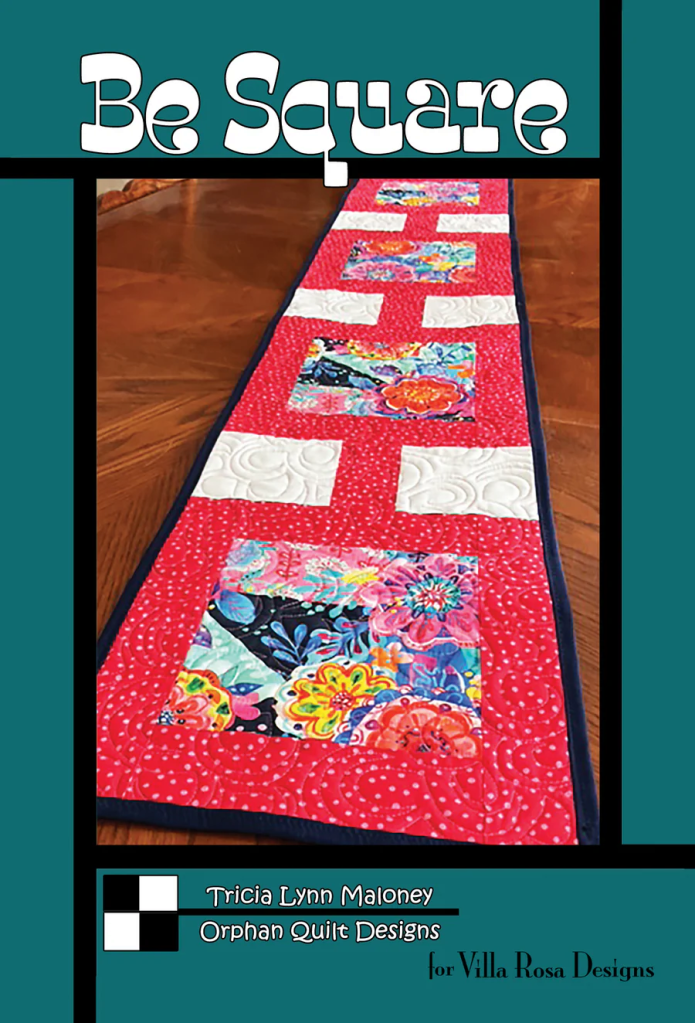
Here’s my March Table Runner, Be Square. The center blocks are great for using your favorite fun novelty fabrics, printed panel squares, or even stray quilt blocks. It’s a very versatile design. And it goes together really fast.
Get the digital pattern HERE or the print pattern HERE.
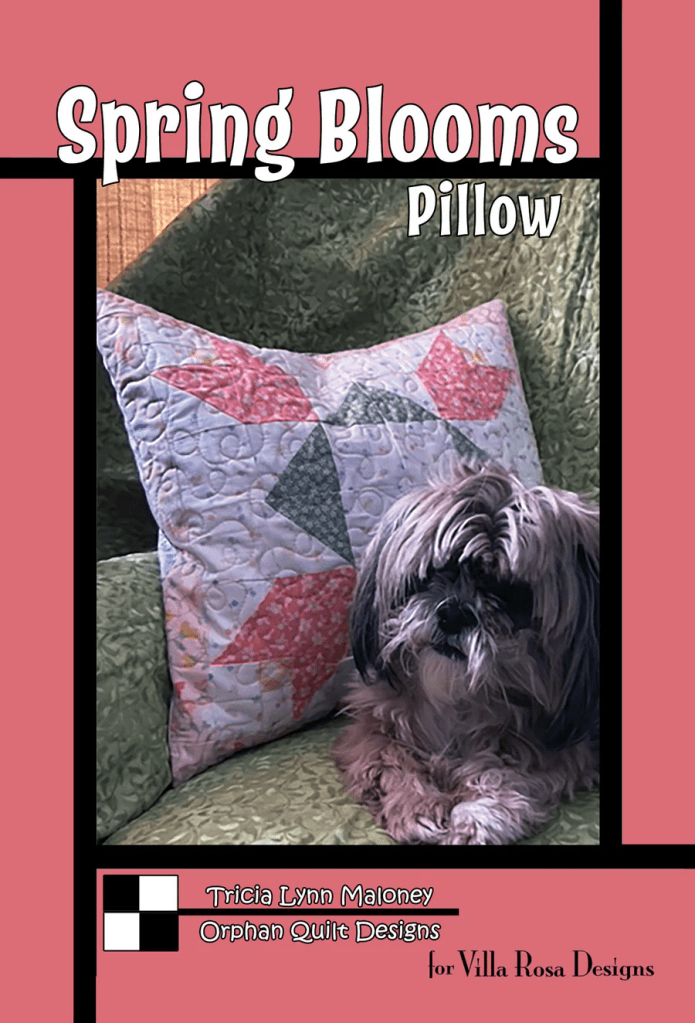
And last, but certainly not least, is the third Pillow pattern in the 2026 Seasonal Pillow Series. It’s called Spring Blooms. This pillow design would look great in so many different color combinations! What would your favorite combination be?
Guess what? My Mom claimed this pillow for herself even before it was finished! Moms can be like that sometimes…….LOL!
And a star is born! My cute little Shih Tzu girl, Bailly, is always happy to pose for me. Isn’t she a cutie?
Get your digital pattern HERE or your Print pattern HERE.
3 Aunts Quilt Shop is doing a Block of the Month with the Pillow series this year and you can find the new Spring Blooms kits below:
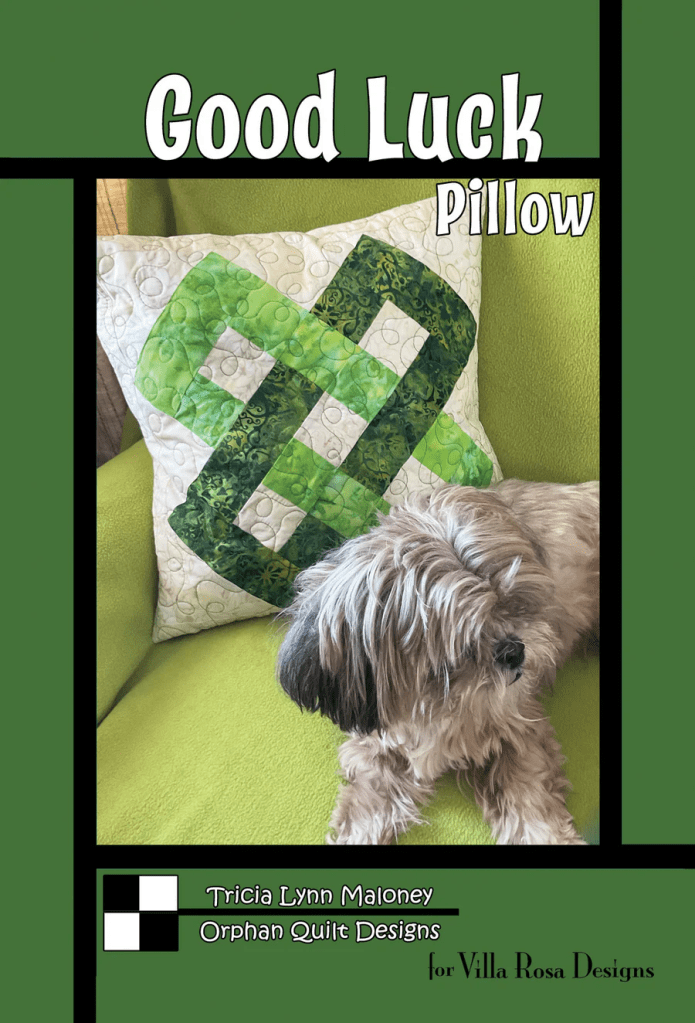
They still have some kit options available for Happy Hearts (Jan) and Good Luck (Feb) available HERE if you haven’t made yours yet.
All right! What an awesome collection of patterns for March! Which one are you going to make first?
Now let’s dive right into our tutorial for today – Arctic Flame.
VRD Arctic Flame Quilt Tutorial
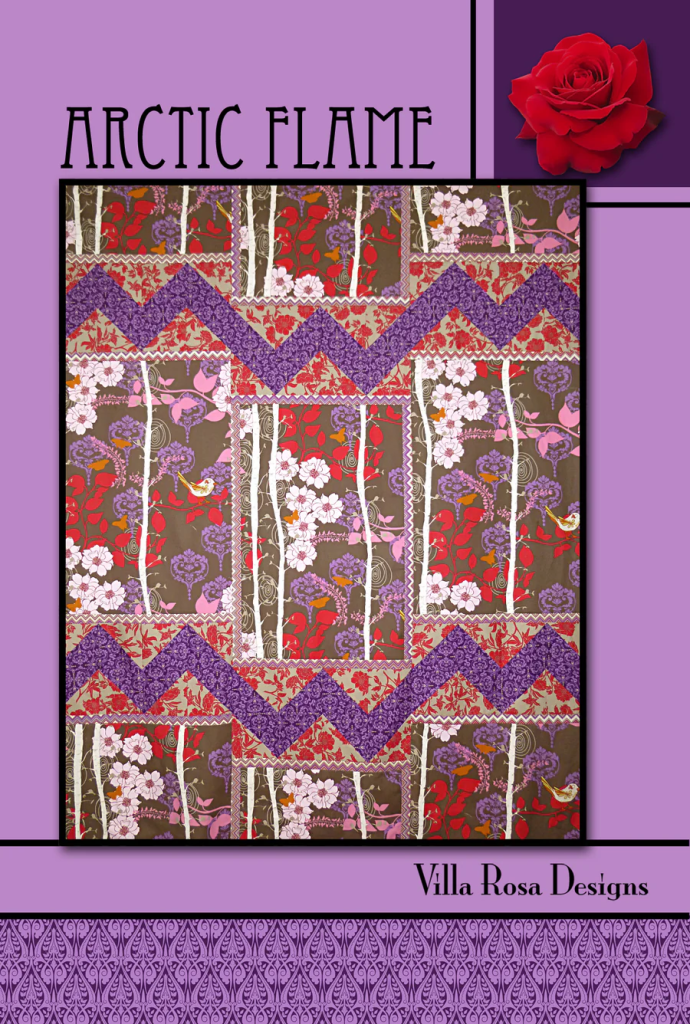
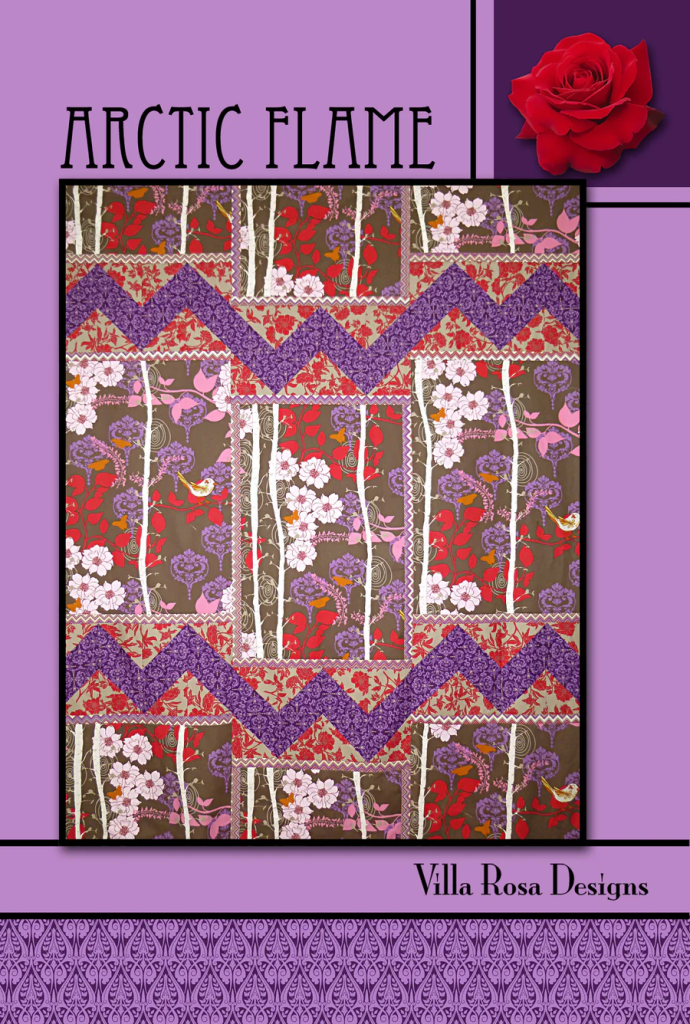
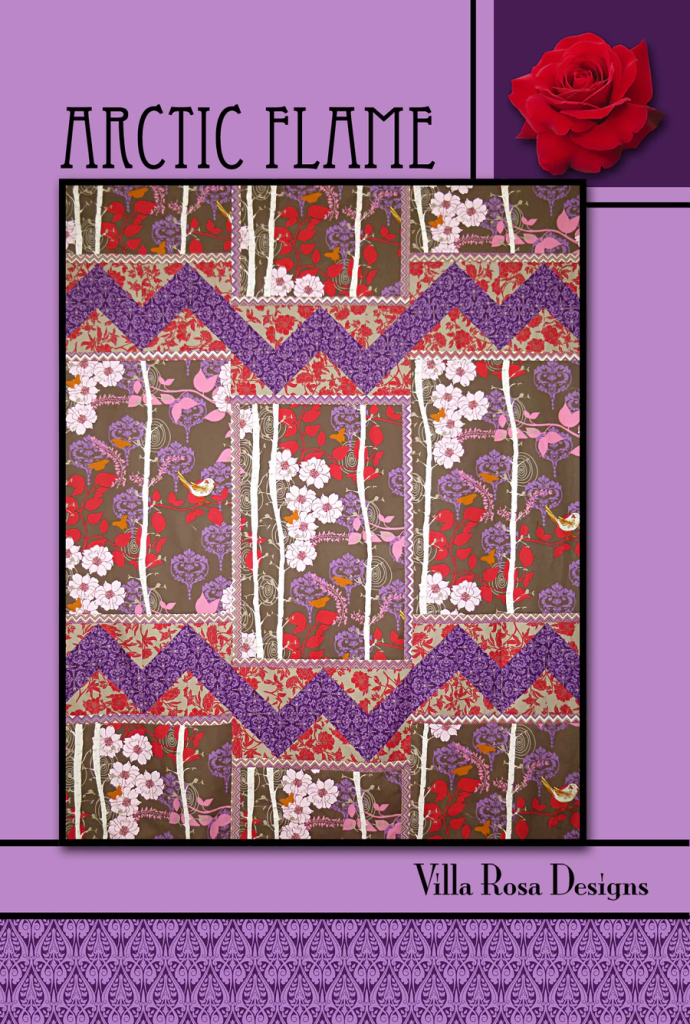
Are you familiar with the Arctic Flame pattern? It’s an oldie but definitely a goodie! This is one of Pat’s clever designs.
I’ve always wanted to make Arctic Flame, but for some reason I thought it looked kind of daunting and…I just didn’t. So, I keep coming back to it and then telling myself “someday.” Have you ever felt that way about a pattern?
Well, someday has finally come. I chose to do the Arctic Flame tutorial today in celebration of the 2026 Winter Olympic Games. The pattern name just sung for me and seemed to embody the spirit of the games. And I had just the perfect fabrics to use – wait ’til you see them!
Get your Digital pattern HERE or your Print pattern HERE
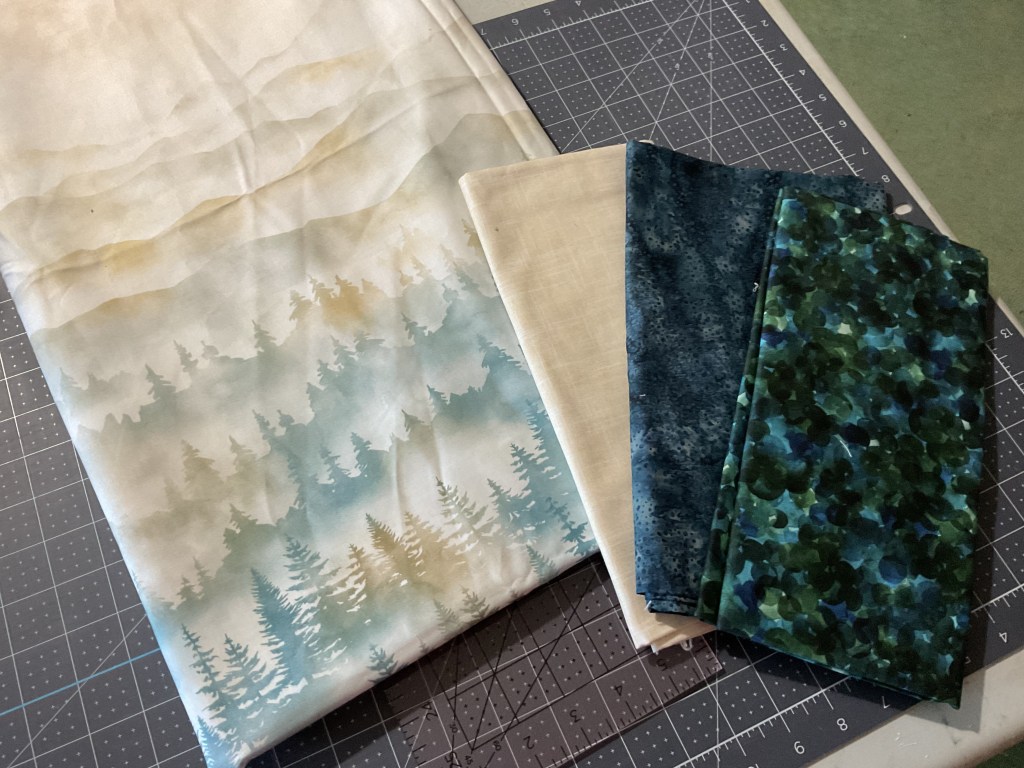
1. Time to gather up our fabrics. The fabrics I’m using today are from an older Hoffman digital collection called Starry Nights. I’ve had these fabrics hanging out for a while and now they’re ready to shine! Just wait until you see what I’ve got planned for the mountain and trees running yardage print.
2. Next up we’re cutting our light and dark fabrics into squares. Easy peasy.
3. Another easy one – cutting the strips for the sashing. Please note that my binding will be the same fabric as the sashing which will give the quilt a wonderful finish (that is when I quilt and bind it in 2099). Do likewise if you want – just make sure you have enough fabric for both.
4. Now for the piece de resistance – the mountains and trees theme fabric. Oh my goodness! I’m almost afraid to cut into it.
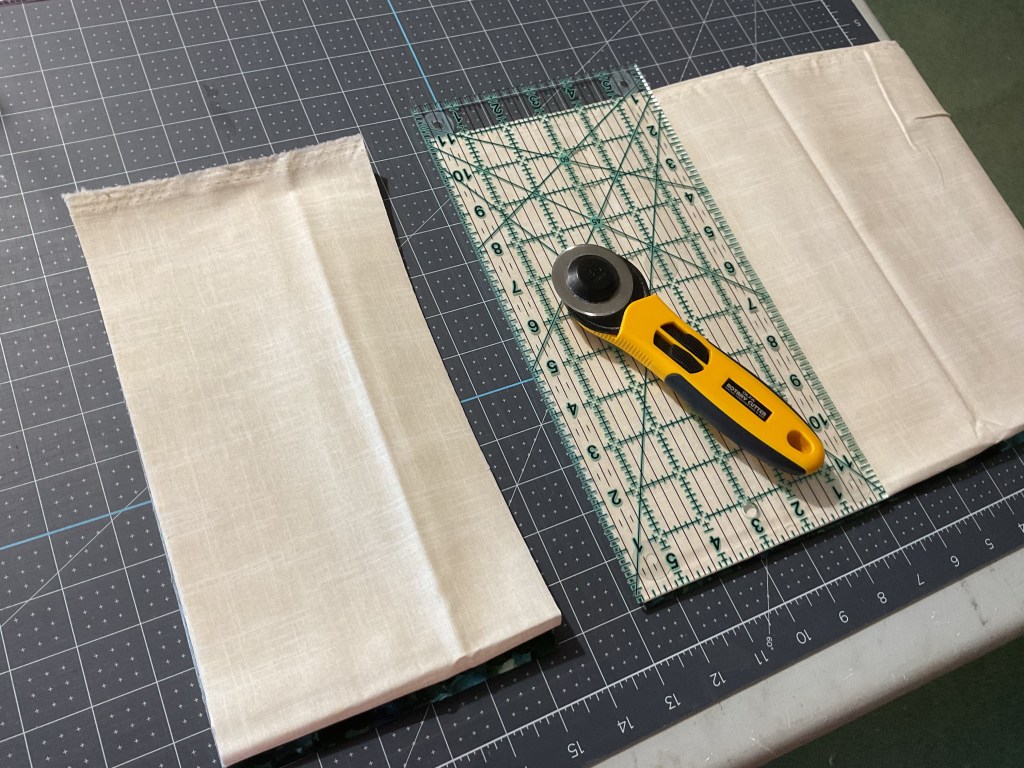
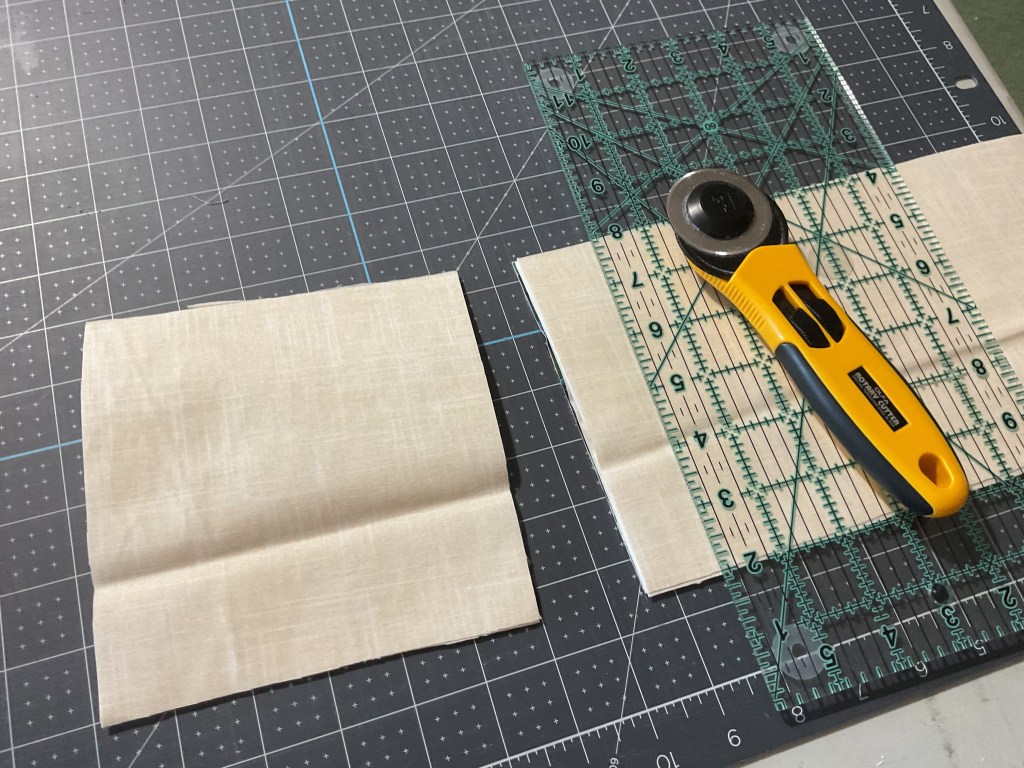
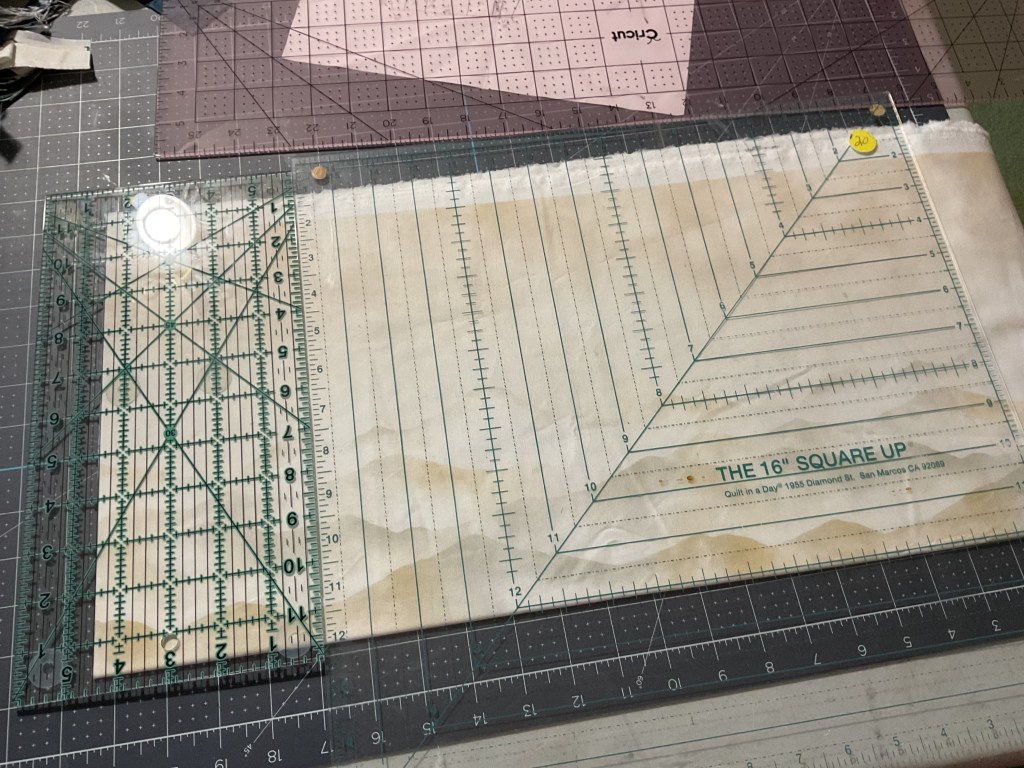
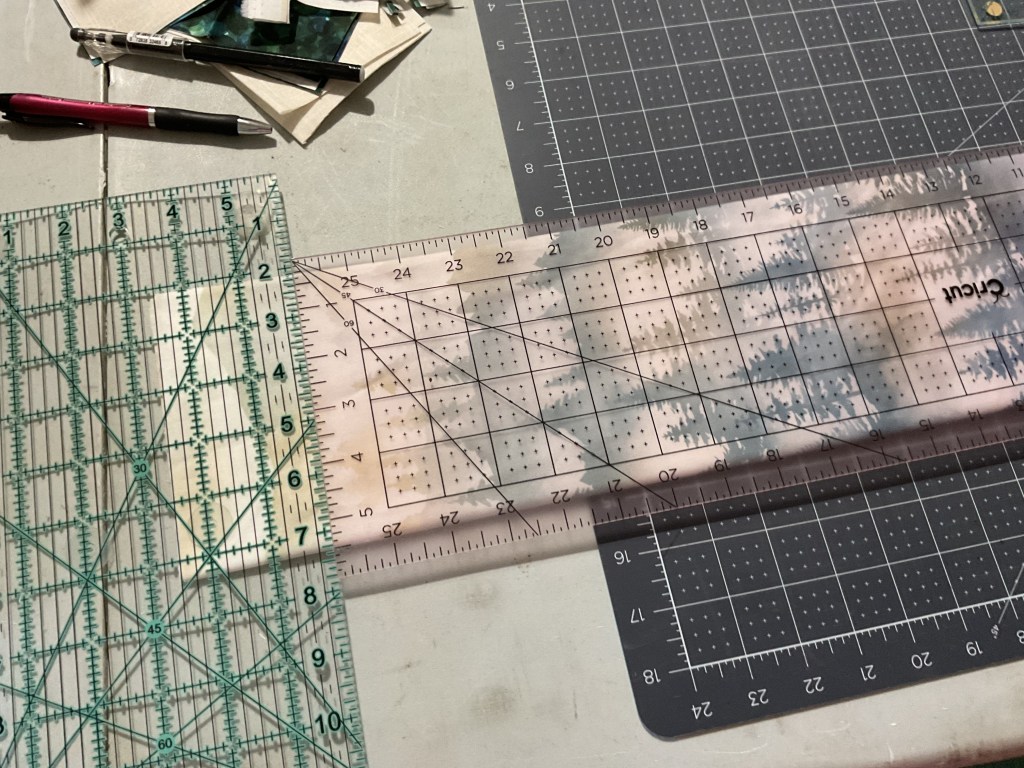
Do you have issues when trying to cut large pieces of fabric for a pattern? Well, let me tell you a little trick that I use – I use 2 rulers end to end to create the right size because I don’t have any gigantic quilt rulers to work with.
In the photo on the left, I’m using a 15″ square paired with my favorite 6″ x 12″ ruler to get the correct fabric width.
In the right photo, I’m using a 6″ x 26″ and my 6″ x 12″ ruler again to get the correct length.
PSST! I really do try to use the same manufacturer when using multiple rulers for a project so the measurements will more likely be the same, but sometimes you just have to do the best you can with what you have available. And I’m definitely taking the time to triple check my math before cutting.
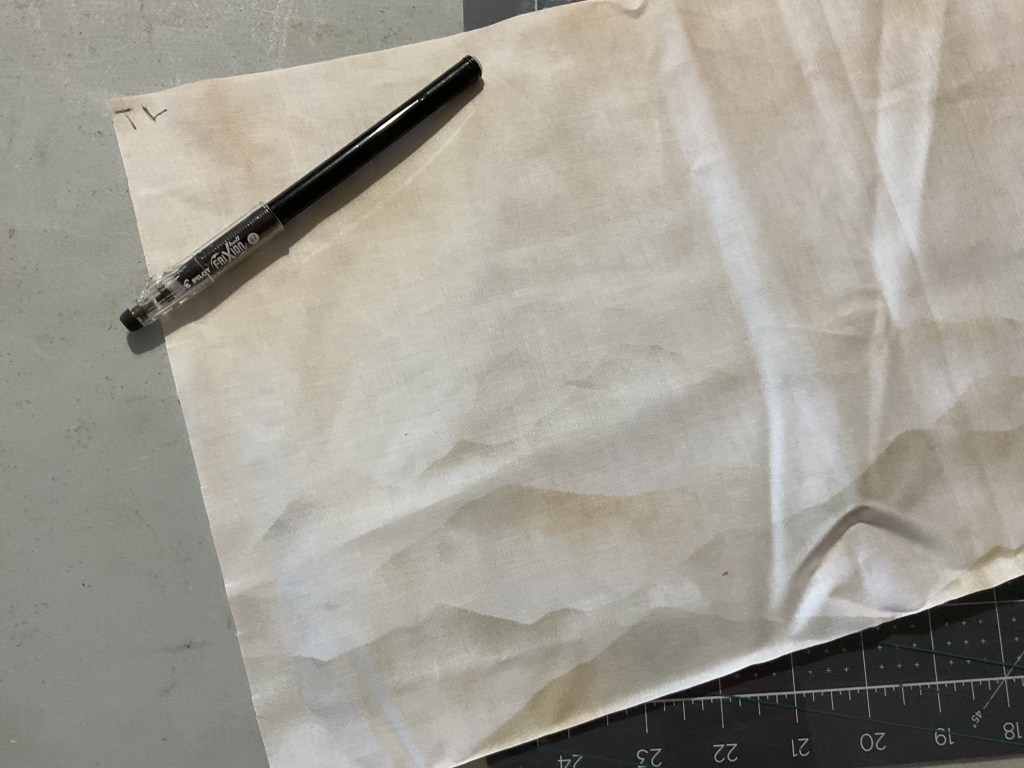
In the bottom photo, I used my Frixion pen to mark which section the cut piece was so I didn’t get the pieces mixed up. I used TL for top left, TC for top center, TR for top right and so on.
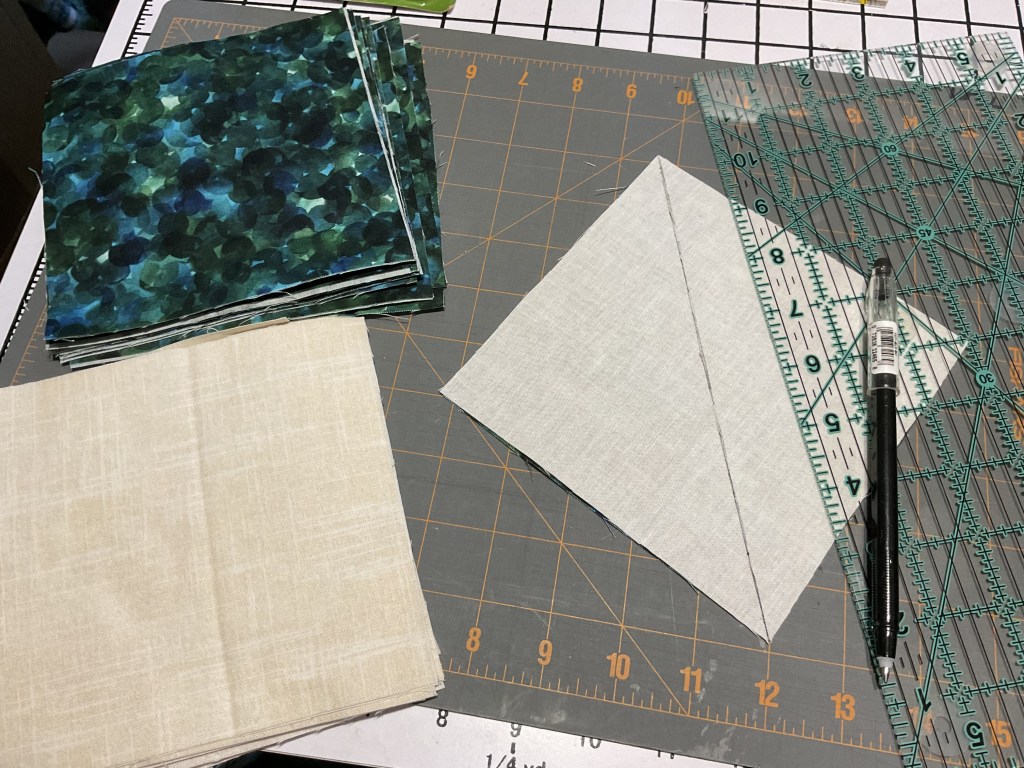
5. Okay, we’re going to make some Half Square Triangles (HSTs) with our light and dark squares. Oops! I’m just rereading the instructions on the pattern and I realized I did the tutorial slightly different. Let me explain – the pattern calls for you to cut the squares on one diagonal and then sew dark and light triangles together to make HSTs.
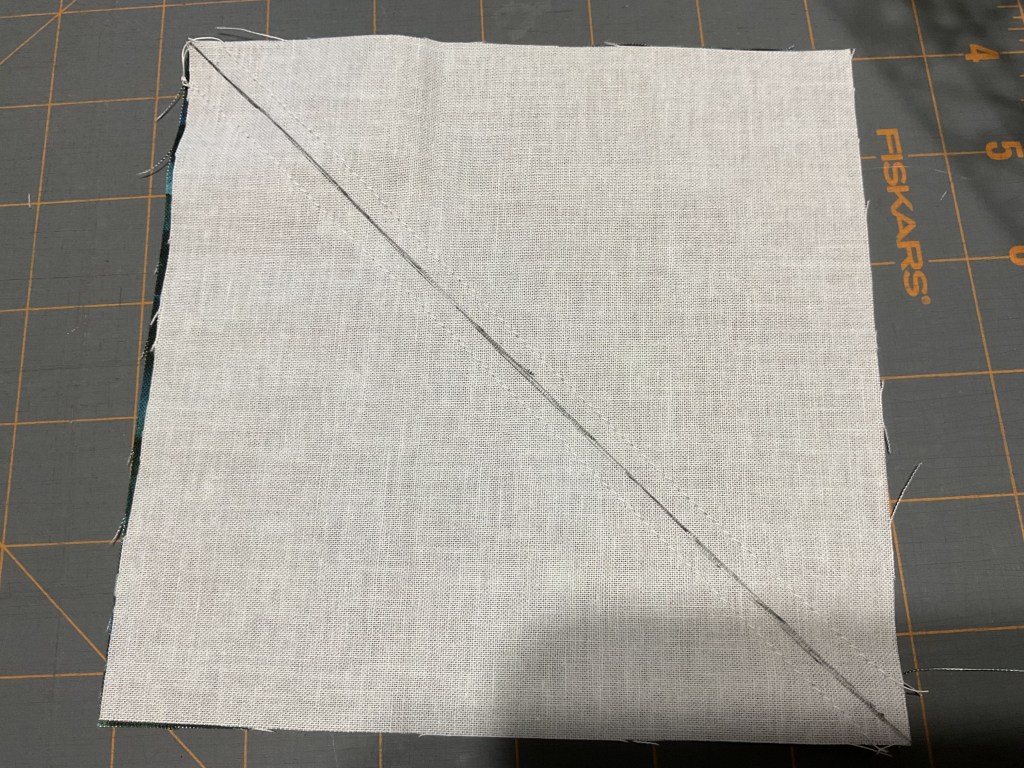
My usual method, shown here, gets the same results, but is slightly different. I layer my light and dark squares RST and draw a diagonal line with my Frixion pen. Then I sew 1/4″ away from both sides of the line. Finally I cut on the line to make my 2 HSTs.
Same results, but I have found making HSTs this way eliminates sewing on the bias which can make the units stretch or do other funky things.
You do you, though – whichever method works the best for you.
6. We’re off to the iron now to press all of the HSTs open. Looking ahead at how we’re going to assemble the HSTs, I am going to err on the side of caution and press half my blocks to the dark and half to the light. Don’t forget to cut off all those little annoying ears after you are done pressing.
7. Now let’s sew those HSTs together into larger units of 4 HSTs. Having the seams pressed to both light and dark is going to make this a lot easier than if they were all pressed to the dark (which is what I normally do). I laid one of the units out on one of my small flannel boards so I wouldn’t get confused while sewing them together (Hey! Wanna make your own small flannel board? Check out this tutorial!)
8. Now that we know how to assemble the larger units, let’s sew them together, following the layout on the flannel board above. First, I’m going to sew the top 2 HSTs together. Second, sew the bottom pair together. Third, sew the top pair to the bottom pair. I often skip pressing until the end when I’m putting together a block or unit, but please press each step if you need to. Because I pressed the HST seams to both the right and the left, it’s a snap to nestle my seams to achieve good crisp points.
9. Now that the 4 HST units are sewn and pressed, we are going to sew 2 of those units together into a big 8 HST unit. This was really a lot easier to put together so far than I thought it would be. Yay!
10. Next step is to sew the sashing strips on according to the pattern. I am definitely pressing all of my sashing strips to the dark side (Huh….and it’s not even May 4th yet).
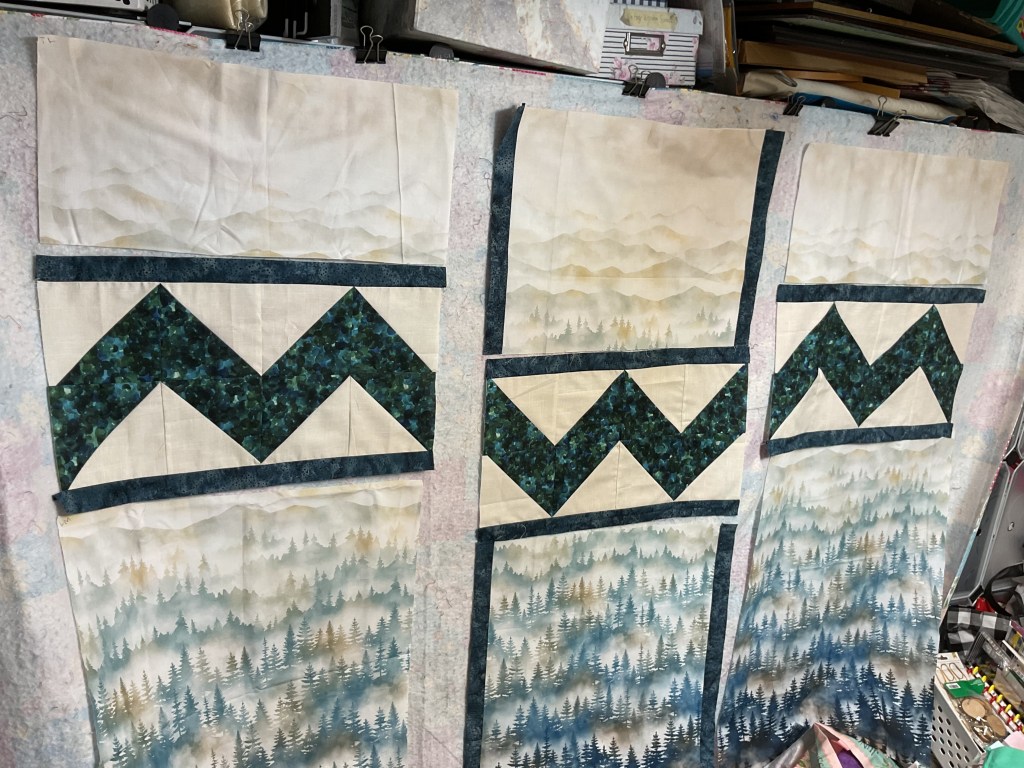
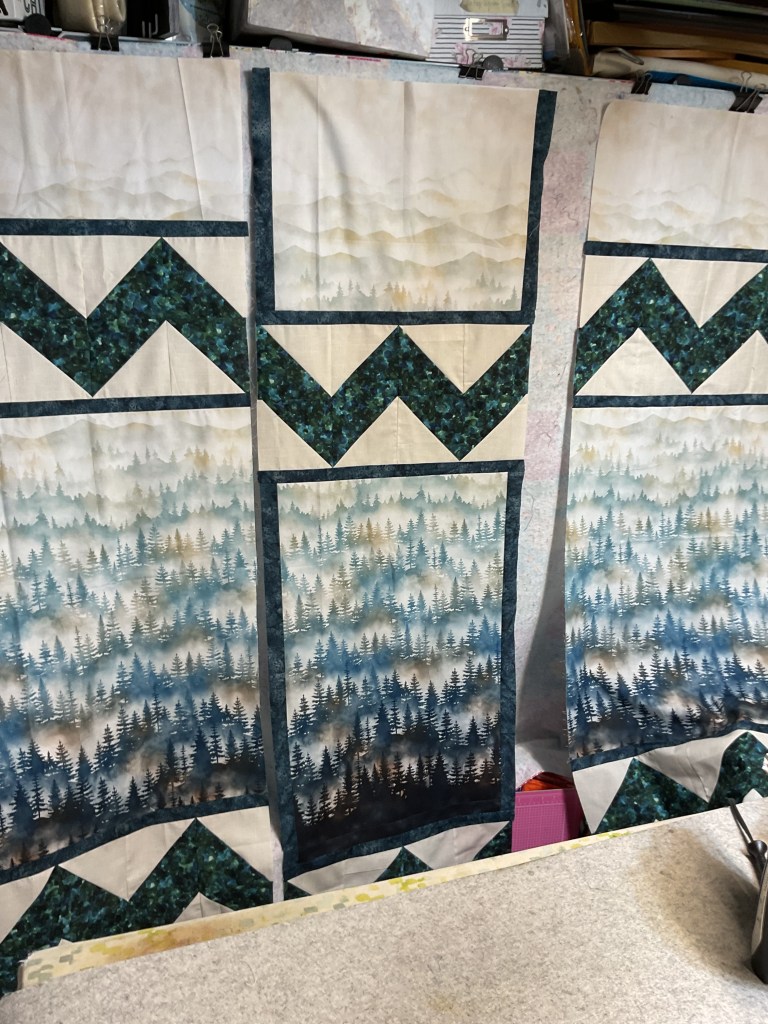
11. Now it’s time to lay everything out on my design wall before I can sew the sections together. WHEW! This is where I’m really glad I wrote fabric positions in the corners earlier so I don’t get the large pieces mixed up.
12. I need to sew all the pieces in each section together before I can sew the 3 vertical sections together. OH NO! I ran into a little unexpected problem with the bottom of my quilt –
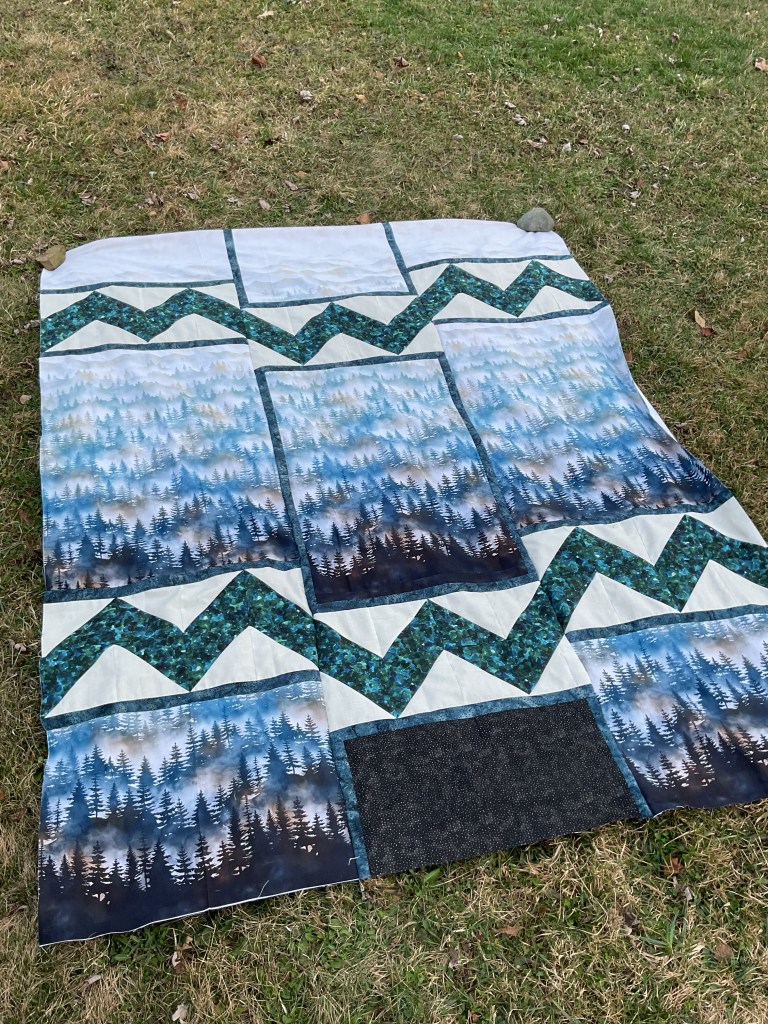
I LITERALLY RAN OUT OF THE TREES/MOUNTAINS FABRIC. Because I wanted to arrange it vertically instead of cut random or scrappy. It’s an out of print fabric and no longer available and I have to complete the top now. Ugh! What’s a quilter to do? Improvise, of course.
Sadly, I can’t show you my solution yet because the quilt is too long and is hiding behind my cutting and pressing station. You’ll have to wait until the end when I show the entire quilt.
13. Now I’m going to sew the 3 vertical sections together. And suddenly the quilt came together like magic! I have no idea why I felt intimidated by it for so long. Silly me.
I really love how the sashing frames the center sections – it’s almost like looking out a window at the Alps in Italy, isn’t it?
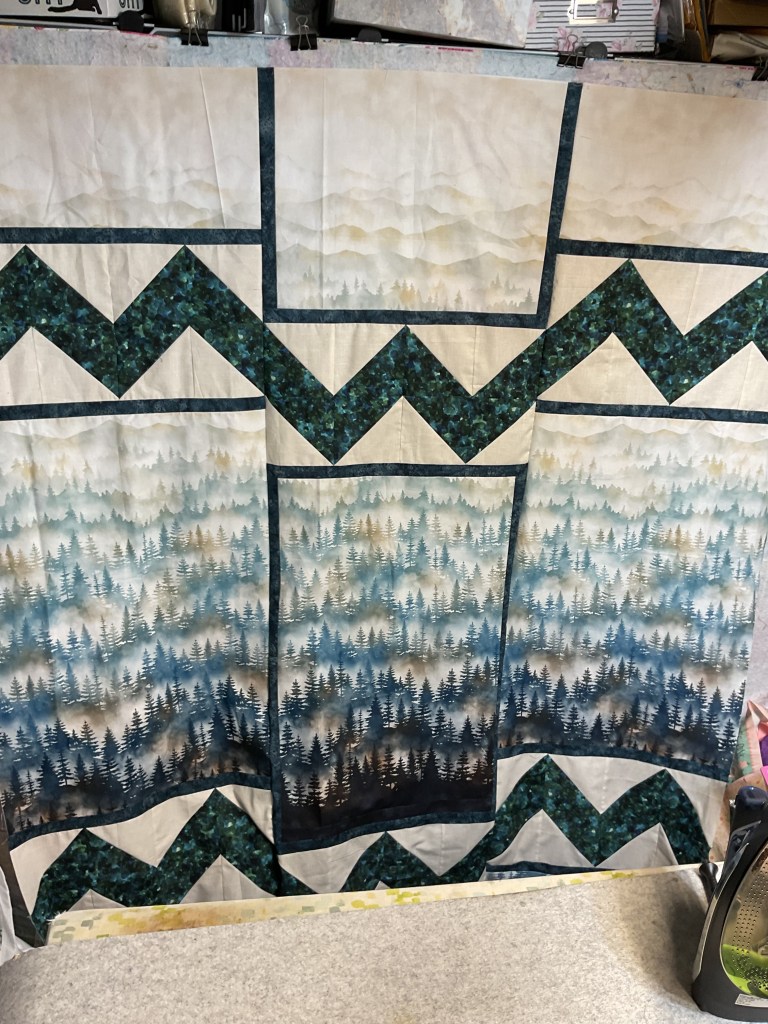
14. And here’s the completed Arctic Flame quilt top. Please forgive the rocks anchoring the corners of the quilt top, but it’s a typical windy March day here in northwestern Pennsylvania.
Can you see my solution for running out of the trees/mountain print? The bottom center piece. I found a dark mottled fabric in my stash to place there. It works, doesn’t it? It really does. As the bottom of the center middle section is dark, like it’s fading into the shadows, the dark mottled fabric continues the shadow idea. What are your thoughts on my design decision? Have you ever run into a similar situation when you ran out of fabric and had to improvise? What did you do?
I really love how Arctic Flame came together and how the HST sections now mimic the mountains in the digital trees/mountain fabric by our friends over at Hoffman’s.
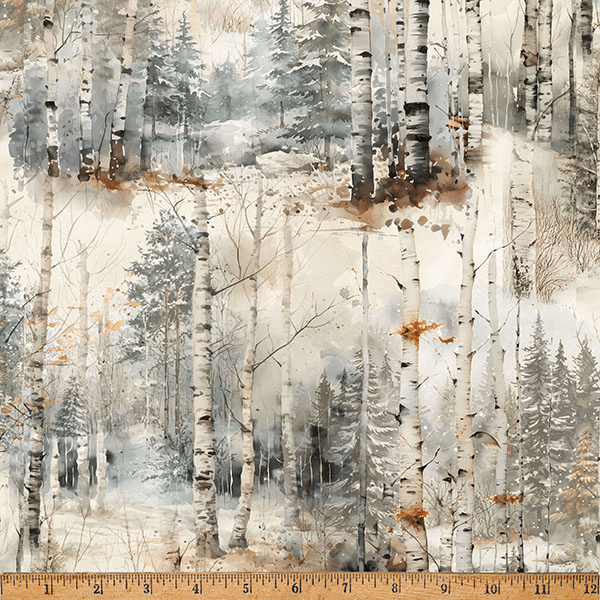
Hoffman’s sometimes creates landscape running yardage for their digital collections. Here is a great one from the current Stag and Stone collection:
Wouldn’t this print be gorgeous in the Arctic Flame pattern? What would you choose for the light and dark fabrics for the HSTs and the sashing?
Who knows? Maybe Arctic Flame will be your next quilt project.
As the Winter Olympics and Paralympics draw to a close, so does our Olympic celebration here on the blog. Stay tuned next week to see what mischief I’m cooking up for you next.
Warning: I am still in Olympic mode. Besides, the 2026 Milan Cortina Paralympic Winter Games being March 6th and run through March 15th. I really hope the major TV networks will carry the Paralympics (not just on streaming or cable channels) because I really want to watch these incredible athletes get to represent their countries in their respective sports. Honestly, it doesn’t really matter who places 1st. Every one of these athletes is already a winner for overcoming innumerable obstacles just to be there. And we all need to show up and cheer.
You can find more information about the Paralympic Winter Games in Milan Cortina HERE.
Speaking of the Olympics – did you get a chance to enjoy my fun (and slightly silly) Quilting Olympics post last week? If not, you can find it HERE.
While I was thinking about the Games, it occurred to me that there are actually quite a few similarities between the Olympics and quilting. Have you ever considered that, too?
Athletes spend tremendous amounts of time and energy perfecting their sport. They refine their techniques, build skills, and train for years for the chance to represent their countries at the Olympics. Their goal is to become the very best version of themselves.
Don’t we do something similar as quilters – just without a stadium full of screaming fans?
It takes discipline and dedication to become the best quilters we can be. Practice, practice, practice. Mistakes that turn into learning opportunities, and those learning opportunities strengthen our skills.
And as our skills grow, so does the beauty of what we create.
Of course, Olympians don’t succeed alone. Behind every skater, skier, and snowboarder stands a whole team of coaches, trainers, technicians, and supporters helping them perform at their very best.
And when I looked around my studio the other day, it suddenly struck me – I have a team, too.
Meet My Sewing Room Team
Allow me to introduce Team Sewing Room — my loyal crew that helps me train, practice, and occasionally recover from minor stitching disasters.
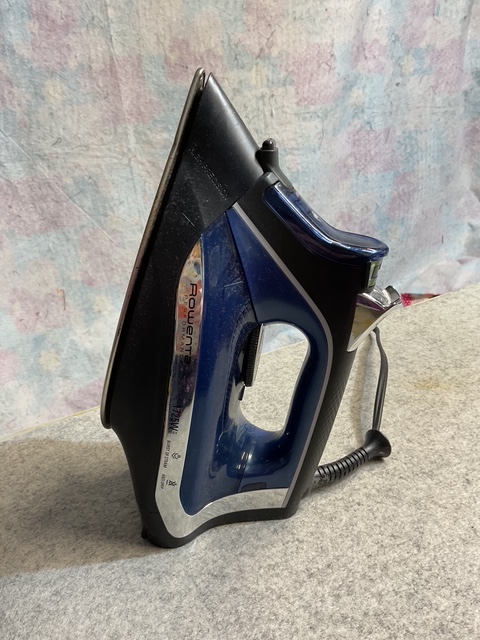
🔥 The Coach: My Iron
Keeps everything disciplined and sharp. Accepts no excuses. Although sometimes my iron can be the toughest coach – the results are totally worth it. Constantly reminds me that good results require proper pressing. Not ironing. Pressing. (There is a difference, and the iron knows it.)
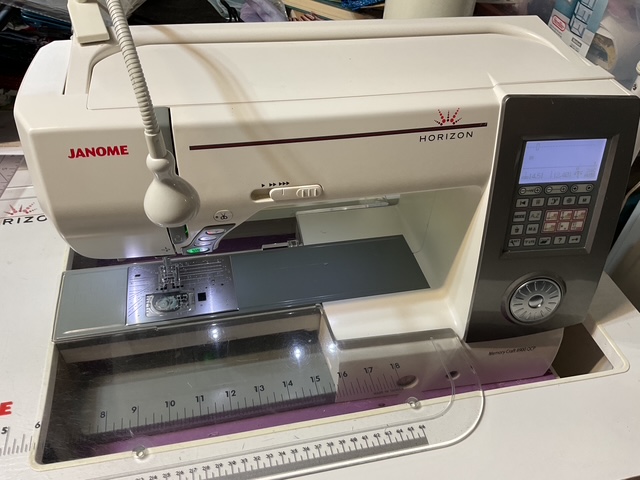
🧵 The Veteran: My Sewing Machine
Reliable, hardworking, and always ready to go. Occasionally a little dramatic when the bobbin tension isn’t quite right. But when everything is running smoothly, there’s nothing more satisfying than the steady hum of stitches marching perfectly across a quilt top. This is the team member who puts in the most miles. Always the first one to show up and the last one to leave.
🧵 The Team Captain: My Thread
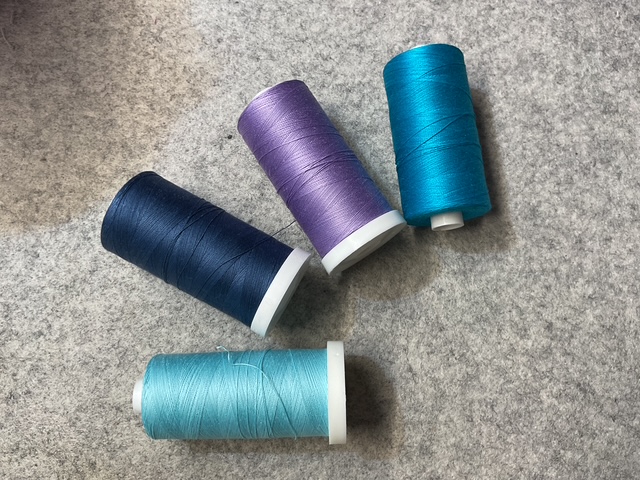
Strong, steady, and always working behind the scenes. The ultimate team player who quietly holds everything together. Thread doesn’t demand attention. It doesn’t make a lot of noise. But without it, nothing happens. Every seam, every block, every quilt relies on those tiny strands doing their job stitch by stitch. When the tension is just right, thread performs beautifully. When it isn’t… well, let’s just say the whole team knows about it pretty quickly.
📏 The Technician: My Favorite Ruler
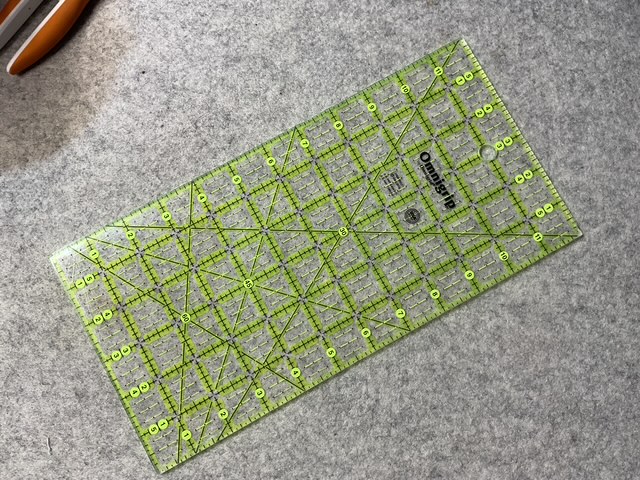
Accuracy expert. The quiet perfectionist of the group. When precision matters, this team member steps in. Always measuring, always checking, always making sure those seams line up just right. Without rulers, things would quickly descend into geometric chaos.
⚙️ The Speed Specialist: My Rotary Cutter
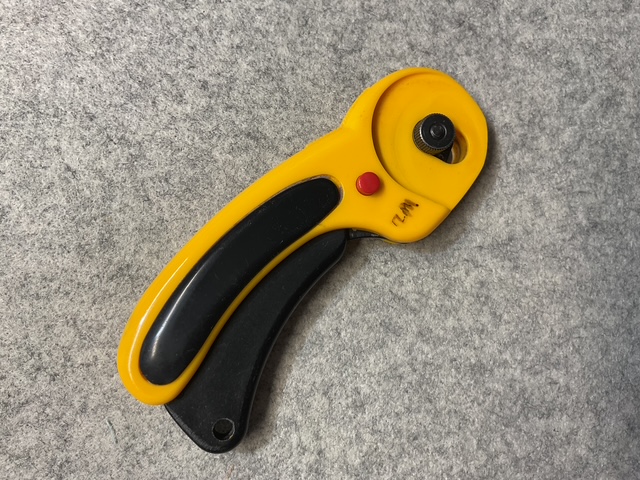
The speed specialist. Sprinter of the sewing room. Sharp and efficient, capable of transforming a stack of fabric into perfectly sized pieces in record time. Fast, precise, and just a little intimidating when you realize the blade could probably cut through a small tree branch. Every team needs someone who can move fast and get things started.
✂️ The Precision Specialist: My Scissors
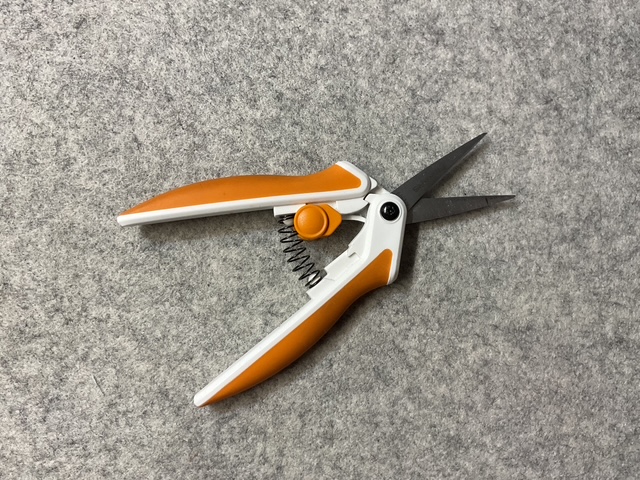
Detail-oriented. Precision when and where it counts most. They may not be as flashy as the rotary cutter, but they are endlessly dependable. Snipping threads, trimming seams, rescuing corners, and occasionally performing delicate surgery when something needs a careful fix. A good pair of scissors earns its place through years of loyal service… and every quilter knows you guard your fabric scissors with your life. Paper scissors may roam freely. But fabric scissors? Those are sacred.
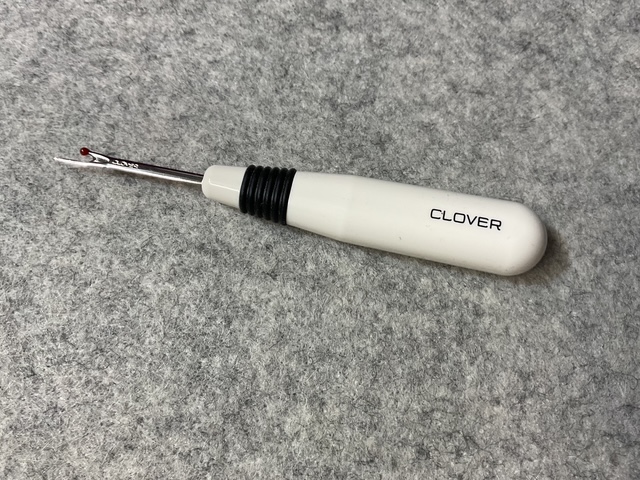
✂️ The Comeback Specialist: My Seam Ripper
Calm in a crisis. Fixes mistakes and keeps the team in the game. Nobody likes to call them in, but when they do arrive, things start to get better. When a block gets twisted, a seam wanders off course, or someone confidently stitches the wrong sides together (not that this has ever happened to me…), the seam ripper steps in calmly and says, “Don’t worry. We can fix this.”
🧺 The Support Squad: My Fabric Stash
The deep bench of the team. Endless possibilities waiting their turn. Inspiration, neatly folded. Always ready to contribute to the next project. A well-stocked stash is like a deep bench of talented players.
Training for the Quilting Games (No Stadium Required)
When you stop and think about it, quilting and the Olympics really do have a lot in common.
Olympic and Paralympic athletes train for years to refine their skills. They practice the same movements again and again, learning from mistakes, building strength, and improving little by little until those skills come together on the world stage.
Quilters do something very similar. We practice cutting accurately. We work on keeping that elusive quarter-inch seam consistent. We learn how to match points, press seams, and solve problems when something doesn’t go quite as planned. We rely on our sewing room team.
Every quilt we make teaches us something new. Sometimes the lesson is patience. Sometimes it’s perseverance. And sometimes it’s simply learning how to laugh when the seam ripper has to step in and save the day.
But whether you’re an Olympic athlete or a quilter in your sewing room, the goal is the same: to keep learning, keep improving, and keep creating something you’re proud of.
And just like those athletes competing in Milan Cortina this year, we show up, do our best, and cheer each other on along the way.
Because in quilting — just like in the Olympics — the real victory isn’t just the finished result. It’s the journey that got us there.
Who’s on your sewing room team?
Cheering Each Other On
As the Olympic and Paralympic athletes compete in Milan Cortina, I’ll be cheering them on from my living room. Their determination, perseverance, and dedication are inspiring reminders of what can happen when people commit themselves to learning, growing, and never giving up.
And while most of us will never stand on an Olympic podium, we have our own version of the Games happening every time we sit down at our sewing machines. Every quilt is a new challenge. Every block is another opportunity to practice. Every finished project is a small victory.
Some days everything goes smoothly and the seams line up perfectly.
Other days… well, that’s when the seam ripper earns its place on the team.
But just like the athletes competing, we keep showing up. We keep practicing. And we keep cheering each other on.
So the next time you sit down in your sewing room, remember that you’re training too — one stitch at a time.
And in the quilting world, every finished quilt deserves a gold medal.
I hope you are following along with the Winter Olympics in Milan Cortina right now. I know I am. Every day has been hurry up and finish work, get dinner, take care of the fur babies, and finally collapse in my comfy chair for another evening of the Olympics. What are your favorite events? For me skating, skiing, bobsledding, and snowboarding are probably my top favorites but I enjoy watching pretty much any of the sports.
I am so in awe of the Olympians whether they win gold or are in last place – they worked incredibly hard to get there, overcoming many obstacles along the way, and earned the right to represent their respective countries. I am not the most coordinated person (I trip on air – LOL!), so seeing the amazing skills and sheer determination of the Olympians is very inspiring to me. And watching the Olympics brings to mind a lifetime of warm memories when everything stopped for 2 weeks so my family could watch the Olympics together. In fact, for the most part, we are still doing that now. To me, the Olympics means family.
In celebration of the Winter Olympics, I thought it would be fun to create a new curated list of VRD Rose Card patterns. But before, we get to that, I’m going to give you the answers to the “Who and I?” and “What am I?” quilt riddles from last week’s post. If you missed last week’s quilty silliness, you can find it HERE.
I’m measured in quarters, yet I’m not a coin. I’m bundled and tempting, a fabric siren. “I’ll take just one,” is what you’ll say… Then I bring friends home anyway.
What am I? FAT QUARTER
I’m a block with a name that sounds like a bird, Yet feathers aren’t needed, and that’s not absurd. I travel in flocks, pointy and neat, But one flipped triangle ruins the beat.
What am I? FLYING GEESE
I’m a pattern you can’t always see, But I make the quilt feel extra “me.” Loops or lines, I’m stitched with care, Across the top and everywhere.
What am I? MACHINE (OR HAND) QUILTING
I’m a friend with numbers and lines, Quilters trust me all the time. I help make seams straight and true, But don’t get too close when the blade comes through.
What am I? QUILTING RULER
Did you get all of the quilt riddles correct? If not, which one stumped you?
Now let’s take a look at my new curated list for the 2026 Winter Olympics in Milan Cortina. Maybe you’ll find a few new-to-you patterns to add to your VRD Rose Card collection….
Curated VRD Rose Card Collection for the 2026 Winter Olympics
With as many curated collections I’ve created with our VRD Rose Cards, I’ve pretty much decided I could probably create a group of patterns to correspond with almost any topic. I guess that’s what happens when you put together such a talented group of designers like our Rose Queen Pat Fryer has done. And don’t forget our 700+ patterns in the VRD catalog. You can find some of the other curated lists I’ve put together with VRD patterns HERE. Is there an idea percolating in your mind that you’d like to see as a curated collection of VRD patterns?
I just had one more thought today about the Olympics – what would a Quilt Olympics look like? Any ideas for events for such an event? Where would we hold it? What would the awards be for 1st, 2nd, 3rd places? Let’s revisit the Quilt Olympics in next week’s post – I hope you leave a comment with your thoughts.
Until then, enjoy the 2026 Winter Olympics in Milan and Cortina. And quilt. Maybe you’ll be inspired by the Olympics or the curated list above to start a new project.
I trust you are surviving this weird and wacky winter. Hopefully, your quilting space has become your happy place and you’ve gotten extra sewing in while the weather did whatever it wanted to outside.
After shocking temperatures as low as -15 degrees F – that’s without the windchill – we’re having a little warm up this week here in good ol’ PA. Tuesday was actually around 50 degrees. And SUN! I felt like throwing on my swimsuit and frolicking through the sprinkler. Sigh….I resisted the urge – too much snow and I didn’t relish freezing my toes (or anything else). Wednesday was a balmy 29 degrees. We even have some bare patches in the yard now, and yes – there really is grass under all that snow. I was beginning to wonder.
Did you know??? Today is the Thursday after the first Friday of February. You know what that means don’t you? NEW PATTERNS!
Woohoo!
Where’s the marching band? Huh. Maybe they found the sprinkler?
Oh well, we’ll just have to make do with the confetti and balloons.
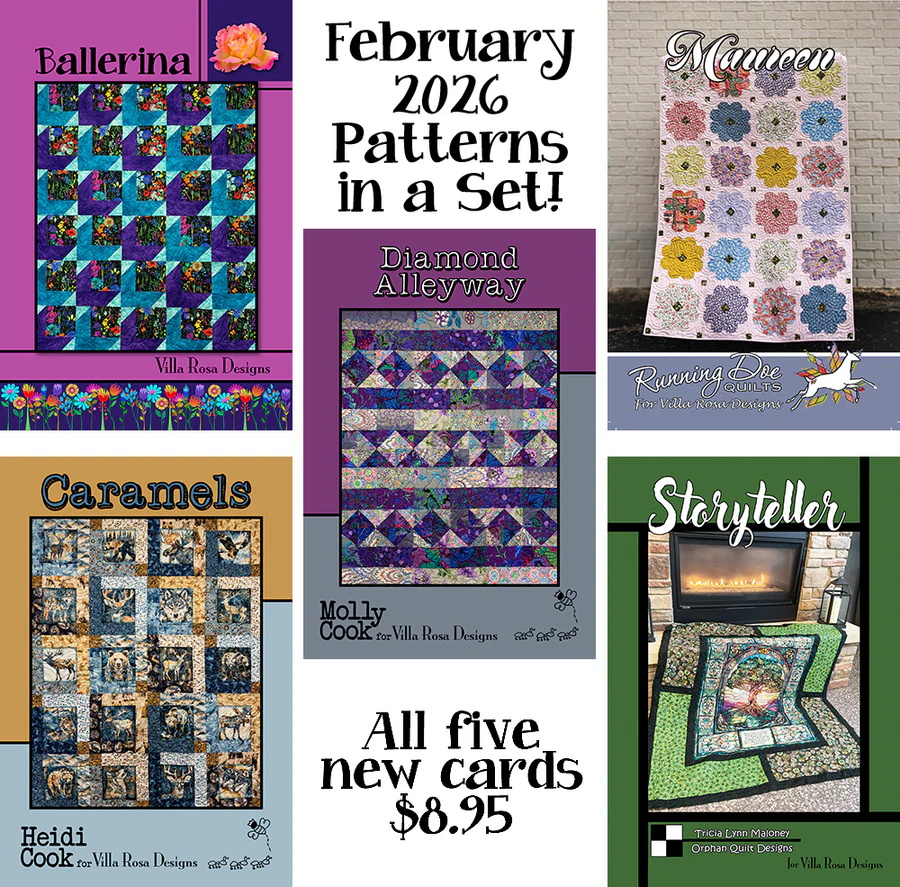
Ballerina is Pat’s latest pattern. It’s a great pattern for your favorite theme fabric along with a few coordinates. It finishes at 45″ x 54″.
Diamond Alleyway is Molly’s new design for February. It is fat quarter friendly and finishes at 42″ x 53″. You can find a kit for Diamond Alleyway in Kaffe (the same as the pattern front) HERE or in Robert Kaufman Songbird HERE.
Maureen is Running Doe’s newest pattern. It’s also fat quarter friendly and finishes at a generous 56″ x 84″. You can find a kit for Maureen featuring the same fat quarters as the sample quilt HERE.
Caramels is Heidi’s latest design for February. It uses a novelty fabric or panel squares along with some coordinates and finishes at 48″ x 60″. You can find a kit for Caramels with the Mountain Splendor fabrics (the same fabrics you see on the pattern front) HERE.
Storyteller is a new 36″ panel pattern by yours truly. It finishes at 59″ x 66″ or 67″ x 74″ with the addition of an outer border. You can find a kit for Storyteller featuring Charlie Harper Montevede Habitat HERE.
But wait……….we’re not done yet!
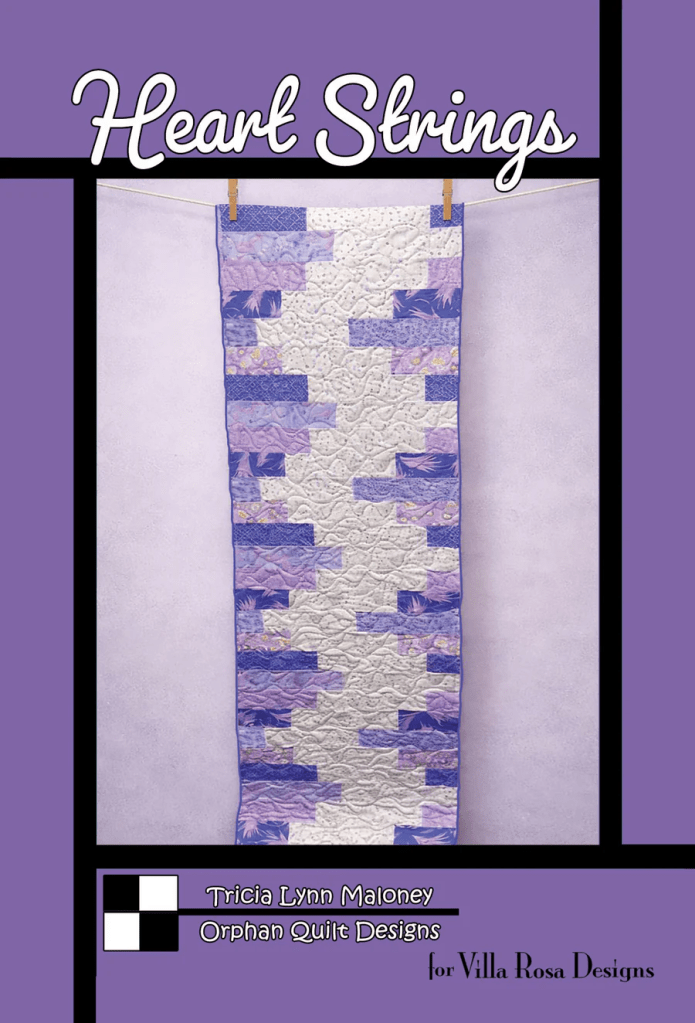
Here is February’s new table runner pattern, Heart Strings, by yours truly. Heart Strings uses fat eighths and finishes at 16″ x 60″.
I’m really excited about this new seasonal series because pillows are an easy way to add a little seasonal quilt touch to your space each and every month. At the end of 2026, you could have an entire year of fun quilted patchwork pillows to enjoy for years to come.
What are you waiting for? The ice to freeze? (PSST – can you name the movie this quote is from?)
Time to get quilting. YEAH!
How about some quilty fun now?
Quilt Jokes…Just for You
I was trying to think up something to add to today’s post with the new patterns and decided on some quilty humor. One of our VRD blog readers, Susan, inspired me to share some rib-tickling quilty jokes with you. These are for you, Susan!
Please enjoy this selection of jokes, puns, tongue twisters, and more. Get your giggle on!
Why did the quilter bring a ladder to the sewing room?
Because her stash was getting out of hand and she needed to take it to the next level
I’m measured in quarters, yet I’m not a coin. I’m bundled and tempting, a fabric siren. “I’ll take just one,” is what you’ll say… Then I bring friends home anyway.
I’m a block with a name that sounds like a bird, Yet feathers aren’t needed, and that’s not absurd. I travel in flocks, pointy and neat, But one flipped triangle ruins the beat.
A quilter walked into a bar. The bartender said, “What’ll it be?” She replied, “Just something light. I’m trying to cut back.” The bartender nodded and handed her a charm pack.
A quilter walked into a fabric store and gasped, “I have nothing to match this at home.” Somewhere in her stash, 47 perfectly coordinating prints fainted.
I’m a friend with numbers and lines, Quilters trust me all the time. I help make seams straight and true, But don’t get too close when the blade comes through.
Punxatawney Phil (the groundhog extraordinaire) saw his shadow on Monday, February 2nd, which means 6 more weeks of winter. Like that’s a big surprise this year, right?
Have you ever attended the spectacle in Punxatawney? I have not, but when I was an early childhood educator in a former life, I would get up early and watch it on TV as I always planned some fun things for the kiddos. Now? I tend to agree with all the fun and silly memes on Facebook. MY favorite showed a wolf in a winter landscape and said something like “The groundhog saw his shadow – 6 more weeks of winter. So I ate him.” Succinct. Punchy. Perfect. Huh. That’s winter for you.
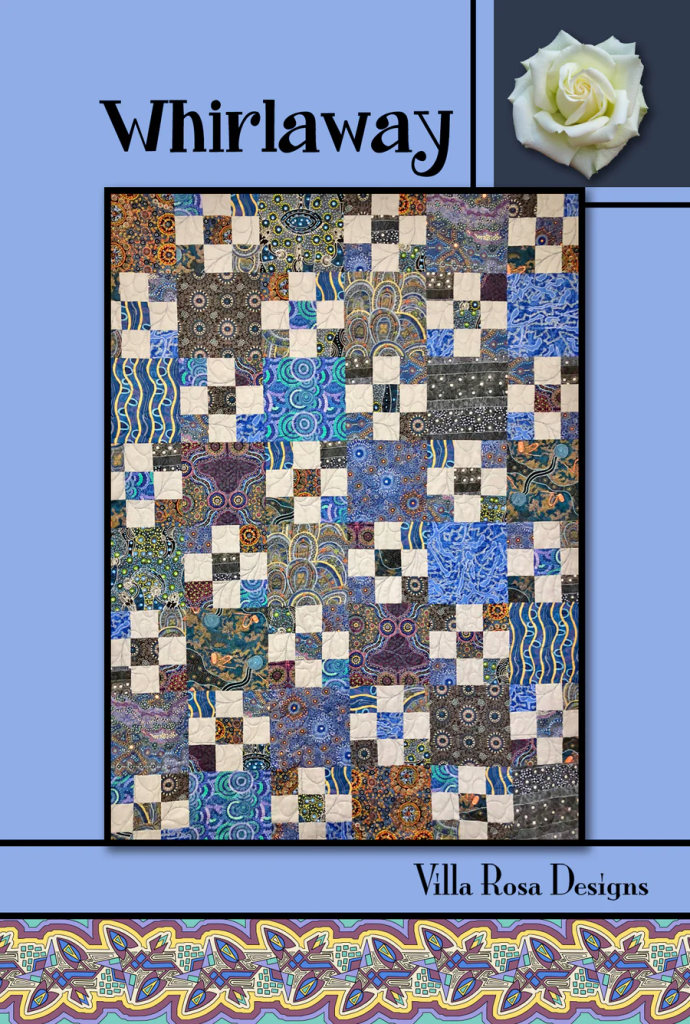
As promised last week, I’m back with my Blue and White quilt tutorial featuring Pat’s Rose Card pattern, Whirlaway. Have you ever made Whirlaway? It’s a really fast and fun quilt. Perfect for beginners. And it looks great in any fabric combination, even fabrics right out of your scrap stash. And the best part – it’s fat quarter friendly so it’s a fantastic pattern to use up some of those delicious fat quarter bundles gathering dust on your storage shelves because they’re just too pretty all tied up with a ribbon to cut them up. Well, now you can. The alternating squares give you plenty of space to enjoy the fabrics and Whirlaway handles large prints like a dream. So what are you waiting for??? Grab your fabrics and the Whirlaway pattern and make a quilt with me.
Before I begin the tutorial, though, I have a quick question for you, dear readers. Which tutorial format do you prefer?
Each step numbered with the written instructions first followed by the image(s)
Each step numbered with the image(s) first followed by the written instructions
Steps are not numbered, with the written instructions first followed by the image(s)
Steps are nit numbered, with the image(s) first followed by the written instructions
I would appreciate you weighing in on this because I seem to go back and forth among these different options and I would like to make the tutorials as useful and easy to follow as I can.
As I mentioned above Whirlaway is fat quarter friendly and uses a single background fabric to unify everything together. It finishes at a very nice 54″ x 72″, which is a great throw-sized quilt. Of curse, you can add or subtract blocks to make it larger or smaller. Or you can out an outer border. If you added a 6″ finished border, the quilt would become 66″ x 84″ which would work on a twin sized bed. Just remember that if you decide to make more blocks or add an outer border, you will need additional fabric.
Let’s gather up our fabrics now!
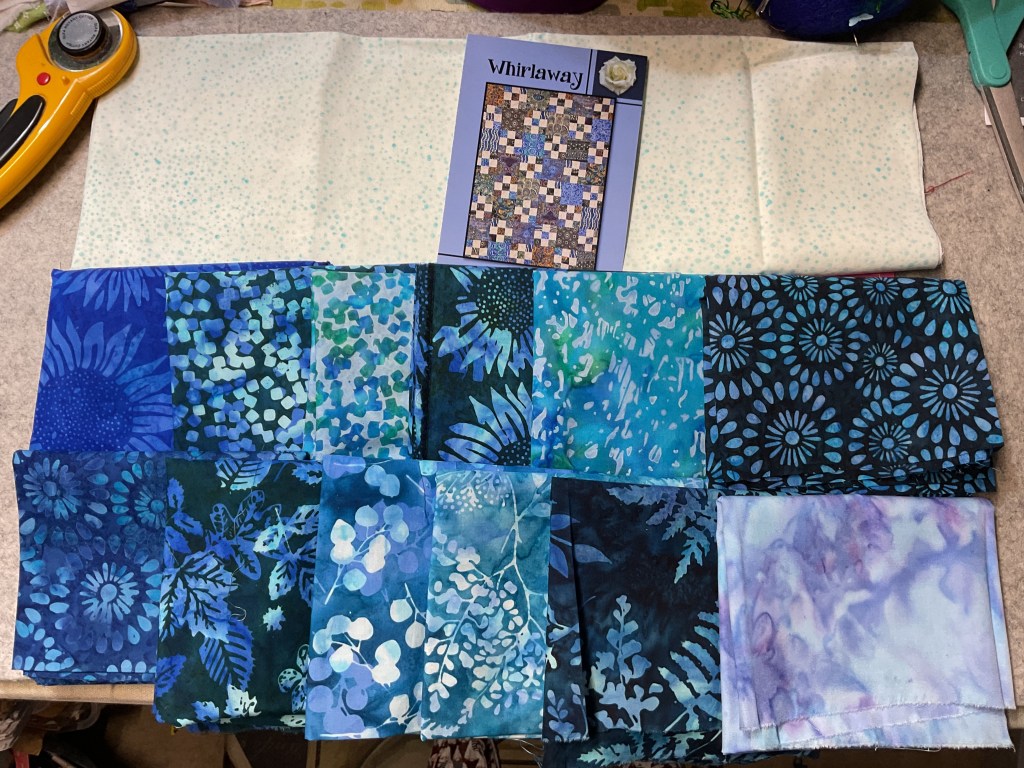
Today I am using yummy batik fabrics from our friends over at Hoffman Fabrics. This is an older collection called Aurora, which probably long gone. I am totally in love with the range of colors – medium blues to brighter blues to deep blues to a touch of purple just for fun. I’m using one of my favorites – Hoffman’s Ocean Aquatic Dot Batik – for my background. I find myself using the lighter Dot Batiks as backgrounds and I love love love the darker ones for binding.
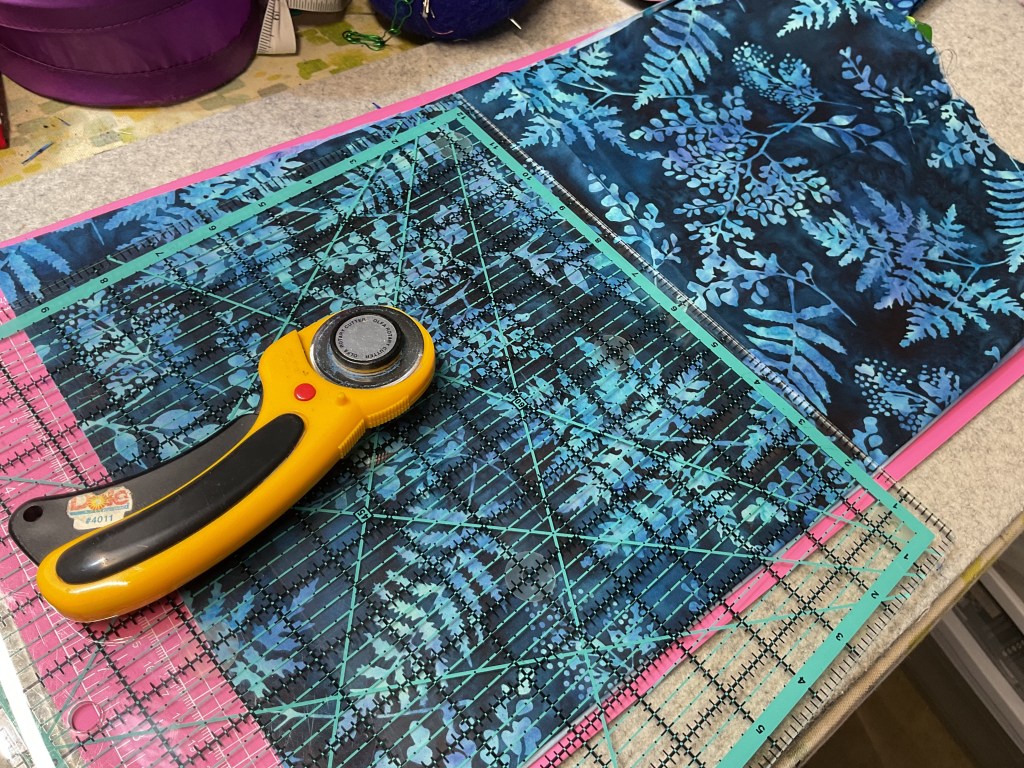
Now that we’ve gathered everything up, we are ready to begin cutting out fabrics. For Whirlaway, we are cutting 2 different sized squares from our FQ’s and that’s it. Fast and simple. Easy peasy.
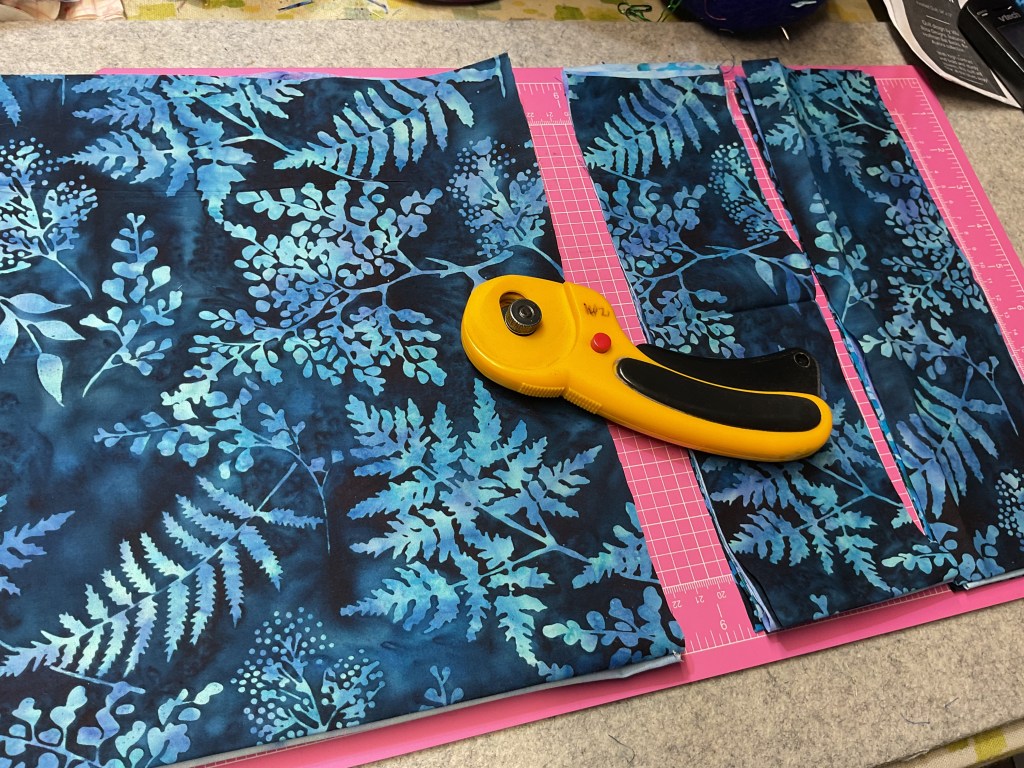
I like to layer 3-4 fabrics at a time when I cut. Do likewise if you feel comfortable, but don’t feel like you have to. Whether you cut one fabric at a time or multiples, we’ll all get to the finish line. Here you can see that I cut my fabric into strips and then cut my strips into squares. Efficient and accurate.
We only need to cut the smaller size squares from the background fabric. Again, I cut the strips first then cut my strips into squares.
Next we’re going to make a stack of Nine Patch blocks. Yay! You have some options to consider for your Nine Patch blocks. It’s like being a guest quilt designer for your very own project!
A). You can use only 2 fabrics for each Nine Patch – the background fabric and 1 of the FQ’s.
B). You can use 3 fabrics for each block – the background fabric, 1 FQ square for the center square, and a 2nd FQ for the 4 corners
C) 5 assorted FQ squares and 4 background squares to make fun scrappy blocks
I chose option C. Surprised?
What’s your process for making Nine Patch quilt blocks?
I like to make all of my Nine Patch blocks at once, using chain piecing, without stopping to do any pressing in between. I have found this to be the most efficient way for me to make a bunch of Nine Patch blocks in the shortest possible time. I am all about finding the quickest, easiest, most successful – LAZY – way to quilt and sew. That attitude has earned me the nickname, “the Lazy Quilter” amongst my friends. LOL!
Let me share with you how I do it.
First, I need to know the number of Nine Patch blocks required for the quilt.
Now it’s time to sew a FQ square and a background square together. I need to make pairs 3x the number of blocks required for the project.
Once I have all of the pairs sew together, next I’m going to add a third square to each pair. The first group will have a background square on each side of a FQ square and I need to make 1 of these rows for each block, so I will need to make the same number as the number of blocks I need for the quilt. Gosh, I hope this isn’t confusing……
When that is done, I will sew a different FQ square together with each remaining pair. If I did the math right (YAY MATH!), I will have 2X the number of blocks for this row as I will use 2 of them for each Nine Patch block.
Then it’s time to sew 3 rows together (a background-FQ- background row between 2 FQ-background-FQ rows) into a scrappy Nine Patch block. I sew 2 rows together and then after I’ve done that, I go back and add the third row to make me a big passel of Nine Patch blocks all at the same time.
Whew – that was really fast! Now all of my Nine Patch blocks are finished. I can press the blocks at this point, or if I’m feeling really brave or pressed for time, I’ll save the pressing until the whole quilt top is finished before I press the whole thing.
I’m feeling brave so let’s skip the pressing for now. I have found that batiks usually behave themselves better than standard quilting cottons because of their denser weave so I feel pretty confident that the quilt will still turn out well. Besides, this is a very forgiving pattern with Nine Patches alternating with big squares. I guess it all really depends on your personal comfort level. If you need to press, then by all means, press. No judgements here, just quilts.
If you’ve been following the blog for a while, then you might already know how much I adore simple quilt blocks like Nine Patches. Here are a few past blog posts about Nine Patch quilt blocks you might find interesting:
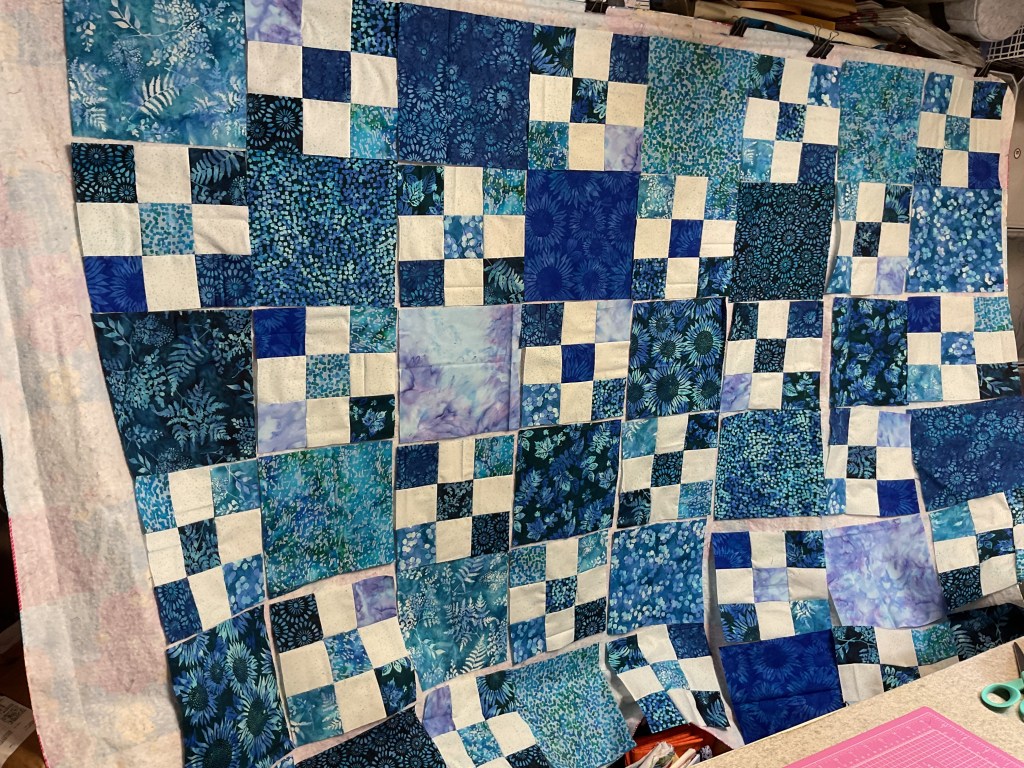
All right, time to put all the blocks and squares up on my design wall and play switcheroo with them until I’m happy with the arrangement of the blocks. I am trying not to have any squares of the same fabric touching, but we’ll see how well that’s going to work out for me.
I seriously didn’t have much trouble getting the blocks to play nice with their neighbors. WHEW! Sometimes this part of making a quilt takes longer than the actual cutting and sewing, but not today.
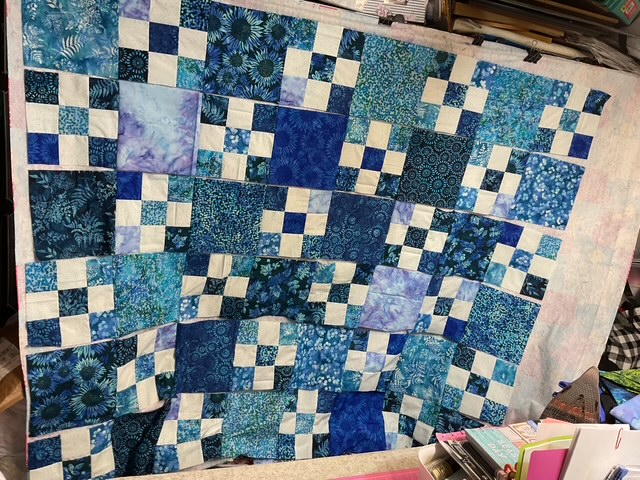
Voila! Here is my blue and white Whirlaway arranged and ready to sew together. Please note, I had to lay the quilt blocks and squares out sideways to fit on my design wall.
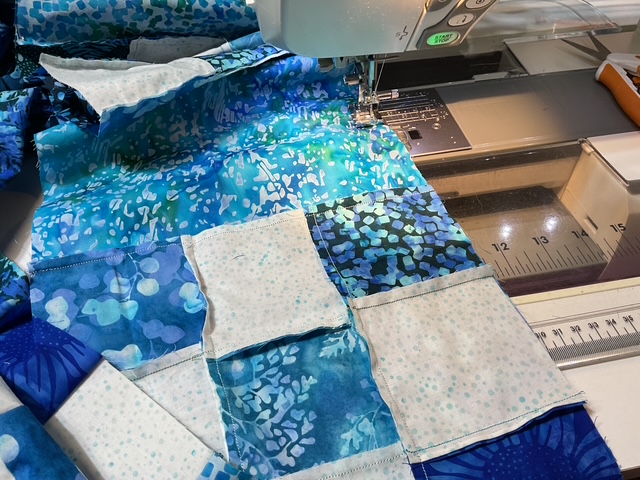
WOOHOO! Now it’s time to sew the blocks into rows.
You really can make this lovely quilt top in a weekend or even a day if you’re in a hurry.
Here we are, almost done! Rows are stitched and now it’s time to sew the rows together.
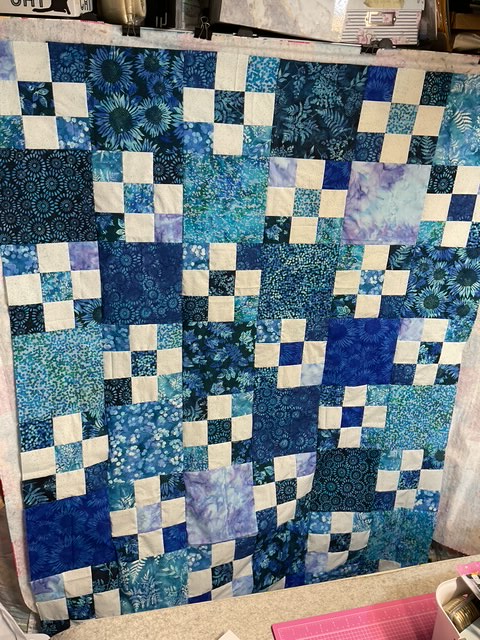
And finally, here is my finished Whirlaway quilt top. I really like how it turned out, don’t you? It’s very wintry and perfectly appropriate for this Polar Vortex weather pattern we’ve been stuck in.
I really love how the purple adds a lot of interest to the quilt.
Now I’ll have to add it to my to-be-quilted pile. Sigh……you know the towering teetering pile that would be taller than me if I stacked all of them in one pile for real? Yup, that one.
Well, that’s it for me this week. Let me know your thoughts on your preferred tutorial format, please. And I’ll adapt my format to whichever one seems to be the most popular.
Stay warm and stay busy. Spring will come someday. I think.
Anyone who knows me – or has spent more than five minutes looking at my quilts – already knows I love blue-and-white quilts.
It’s gotten to be a little embarrassing – my friends now roll their eyes every time I start another blue and white quilt. It’ not like I don’t make quilts in lots of different color combinations, but I just can’t seem to help myself when it comes to blue and white quilts.
Snowy blues, washed indigos, crisp whites – all those porcelain-inspired palettes…they get me every time. Would you believe I even collect blue and white china – Blue Willow?
For me, winter and blue just seem to go together like peanut butter and jelly.
Snow, sky, quiet mornings – blue and white quilts capture all of that beautifully for me.
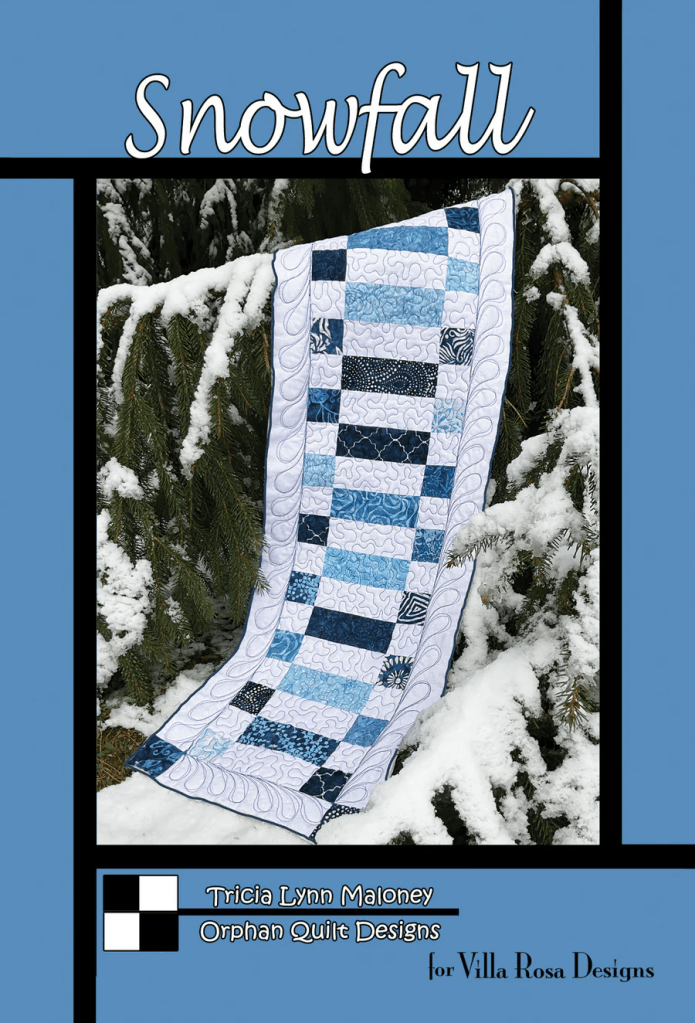
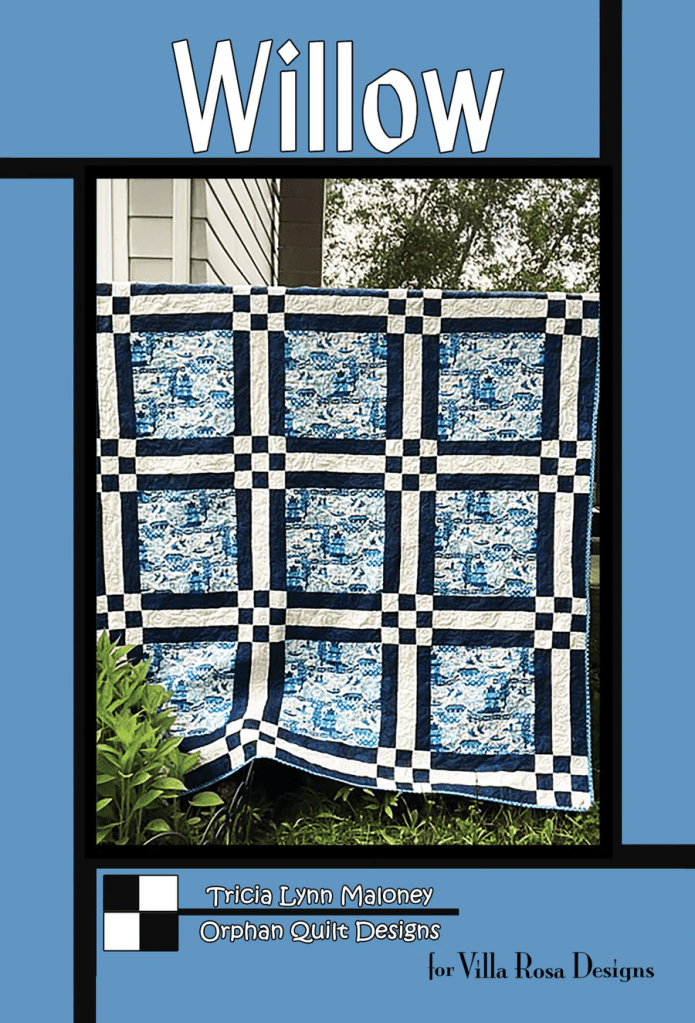
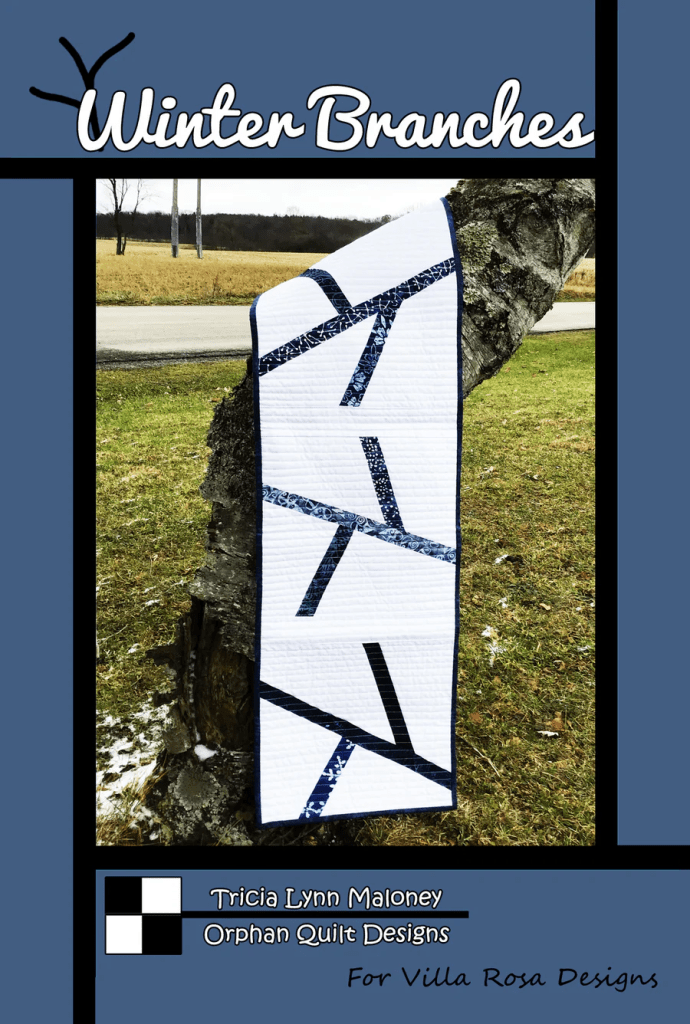
To provide evidence of my blue and white quilt addiction, here are my blue and white VRD Rose Card quilt patterns (of course, that doesn’t mean you have to make them in blue and white just because I did):
WOW! Until I put them all in one place, I didn’t really realize I had designed so many VRD Rose Card patterns with blue and white cover quilts. LOL! What can I say? I’m crazy about blue and white.
But here’s the thing – I have to admit that winter has more colors than simply blue and white.
So today, let’s talk about winter quilts that aren’t blue . Even though I’ll probably come back to blue quilts at the end. Sorry, not sorry.
Soft Neutrals Feel Like Fresh Snow
Have you ever heard the snow when it drifts softly down to the ground? Or have you ever smelled snow (yes, it really does have a scent). Have you ever noticed the many shades of snow (no, I’m not talking about yellow snow here)?
Creams, linens, soft greys, and warm whites might be the most underrated winter palette of all. These colors are peaceful and feel like freshly fallen snow.
If you love a calm, uncluttered look, winter neutrals are hard to beat.
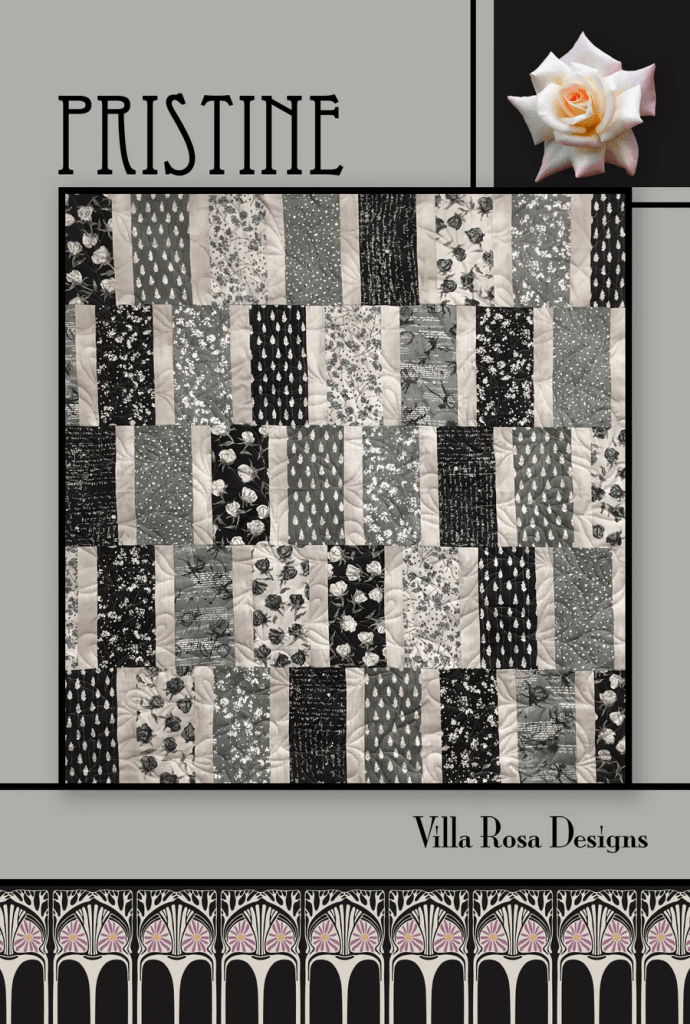
Here are a handful of patterns that have that “Neutral Winter” look:
Pine Green and Winter White – Cozy Without the Holiday Feel
Not all green quilts have to turn into classic red-and-green holiday combination. What about snow-kissed evergreens standing tall in a soft white winter landscape? Can you hear the gentle hush? Smell the sharp fresh scent of pine in the air?
Deep pine, evergreen, and soft sage paired with winter whites and creams feel seasonal without being tied to Christmas.
Winter doesn’t necessarily have to be cold in color even if the temperature drops to below zero. Taupe, oatmeal, caramel, soft browns, and warm grays bring a completely different kind of comfort to winter quilts. These palettes feel like wool sweaters, mugs of tea, and fireside evenings.
If you like drama and excitement in your quilts, but still want that winter feel then jewel tones might just become your new BFFs.
Think burgundy, plum, rich teal, or navy blue paired with light backgrounds. When those darker colors sit against whites or pale neutrals, they still read as wintery, just richer and more layered.
Red and White (or cream) is another great palette for winter without necessarily meaning Christmas. Think cardinals, red berries, sleds, and scarves.
Cherry, crimson, cranberry, or primary red paired with winter whites and creams make a bold yet classic combination for winter quilts. For a fun variation, add a little pink for warmth if you’d like.
These examples capture that classy Red and White winter feeling:
After all that, I’ll admit it – I will probably always circle back to blue.
But even blue has a range. Dusty blue, denim, slate, soft indigo, stormy navy—each one brings a different winter mood. Some feel crisp and bright while others are quiet and cozy.
Blue-and-white quilts will always have my heart, but exploring other winter palettes has made me appreciate them even more.
After all, Winter Is a Mood, Not a Color.
And at the end of the day, winter quilting isn’t about following rules or sticking to a specific palette. It’s about how a quilt feels.
Quiet or bold. Cozy or crisp. Calm or dramatic.
Blue-and-white will always be a classic, but winter has room for so much more. So whether you’re reaching for blues, greens, neutrals, or something unexpected, if it feels like winter to you, then it is.
By the way……………………………I was planning to share a tutorial with you today, but like many good quilts, it’s still in progress. SURPRISE! it’s blue and white! LOL! Apparently, some habits are worth keeping.
I’ll be back next week with the tutorial, and until then, I hope this gives you a little winter color inspiration to carry you into your next project because the way it looks now, it’s going to be winter until July.
Have you been following the recent geomagnetic storms and the resulting Northern Lights displays which have been seen even in the Caribbean? I am thrilled to say I saw the Northern Lights both Monday and Tuesday night right from my living room window, which looks north (here in northwestern Pennsylvania). With my naked eye, all I could really see was green and pink, but boy – the colors flowed across the sky like waves on a beach. It was almost mesmerizing.
Every time I am blessed enough to see the Northern Lights, it always reminds me of the first time I saw them. I was sixteen or seventeen years old and spending the night at my cousin (and bestie), Karen’s house. We sat on her front porch and our eyes were glued to the northern horizon. I remember that the colors were bright rippling ribbons in the sky and they were simply breath-taking! I will never forget that moment.
Image created by moi with AI tools
I’ve tried taking nighttime photos before with my iPad, but I’ve never been very successful. I wish I’d have been prepared the other night so I could have taken photos, but I wasn’t. So this morning I downloaded a nighttime photo app called NightCap. With a little luck, Tuesday night we might still be able to see them. I’ve got my fingers crossed that perhaps I’ll snag a photo or 2. If I manage to actually get any photos, I’ll upload later, but looking at the NOAA Space Weather Prediction Center, it’s not looking too good for tonight. Sigh, it figures. A day late and a dollar short – that’s me.
When I was thinking about a topic for today’s blog post, I wanted to somehow connect to the Northern Lights because it’s a pretty special thing to see and then I had the idea to curate a new VRD Rose Card pattern list with a nod to the Northern Lights.
I hope you’ll enjoy this latest curated list. Maybe you’ll be inspired to make a new-to-you pattern.
Well, that’s it for me today. Take a little time to marvel at the night sky this week. Then go inside where it’s warm, make a cup of tea, and plan your next quilt project.
Have you ever looked at a quilt pattern and said to yourself, “That is just too simple.” Then either kept walking or scrolled right past to find a different pattern? Yeah, we’ve probably all done this at one time or another.
If you read the title of this post, then you already know I’m going to talk about why simple quilt patterns are for everyone from the beginner up to the expert. Let’s bust that “too simple” myth today!
Some thoughts right up front –
Simple does not mean basic, boring, or not as good.
Simple gives the fabric, colors, blocks, etc. room to breathe.
In this crazy hectic world, simple quilt patterns can give over-stressed and overbooked quilters some much needed calm and relaxation.
I am not suggesting that we totally give up complex patterns, instead I am saying that there is beauty in simplicity, too.
Whenever I think about simplicity, I remember a song from my junior high chorus days called “Tis a Gift to be Simple,” which happens to be a lovely Shaker song written by Elder Joseph Brackett in 1848. You can hear the song HERE. The funny thing is, a million years later (well, maybe not quite that many years LOL!), I still remember that song. You may be wondering why I’m diving down this rabbit hole, but I promise there really is a connection – “Tis a Gift to be Simple” reminds me that simplicity is beautiful and can be quite memorable, too.
Simple Patterns Let Fabric Be the Star
Have you ever fallen in love with a large print fabric and just had to have it? Of course you have. Me too. Then you chop it up into little squares and triangles and it just doesn’t look the same anymore. And perhaps you set that project aside, forgeting all about it and why you purchased that gorgeous to-die-for large print fabric in the first place.
This is one example where a simple quilt pattern becomes your best friend because it allows that big bold fabric room to just be. To just breathe – that simple quilt pattern quietly provides a space where you can still enjoy what attracted you to the fabric to begin with.
Let’s take a look at some quilts that demonstrate this idea.
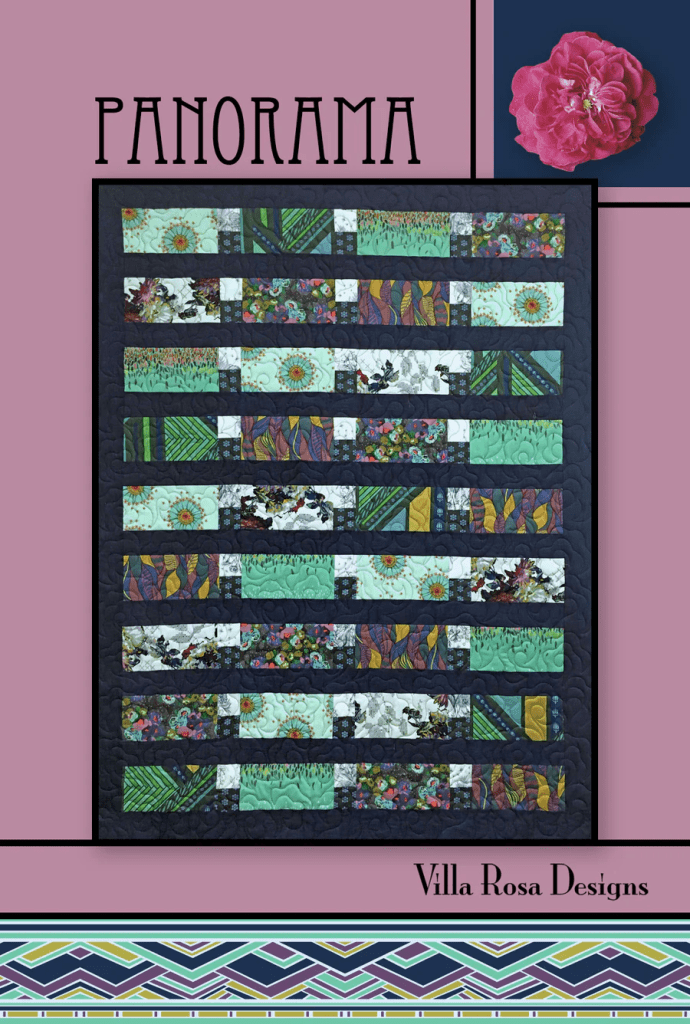
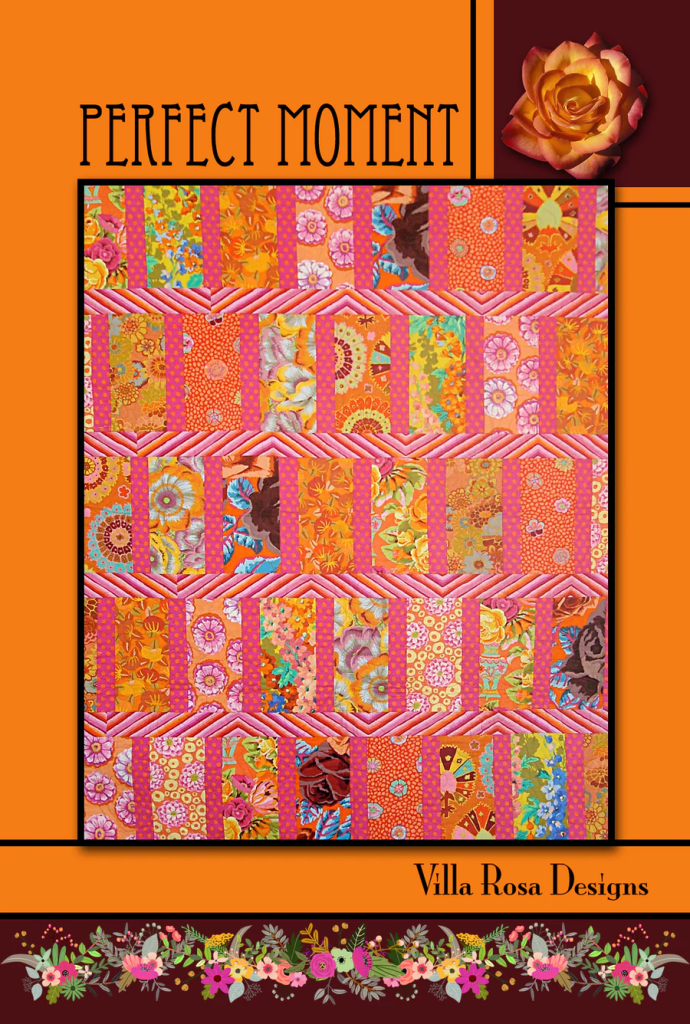
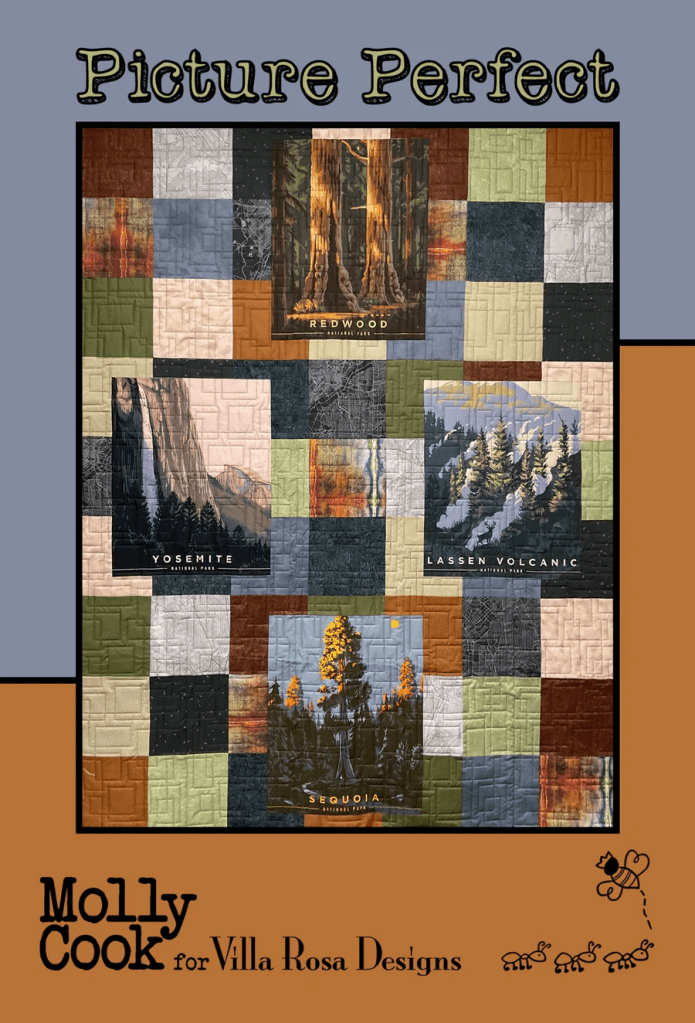
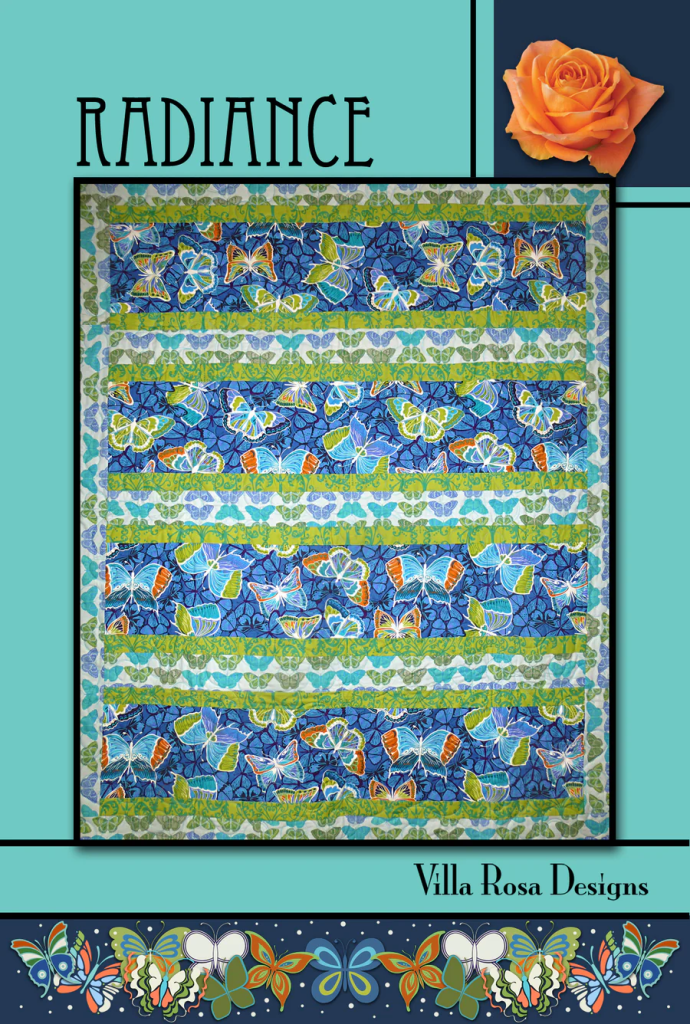
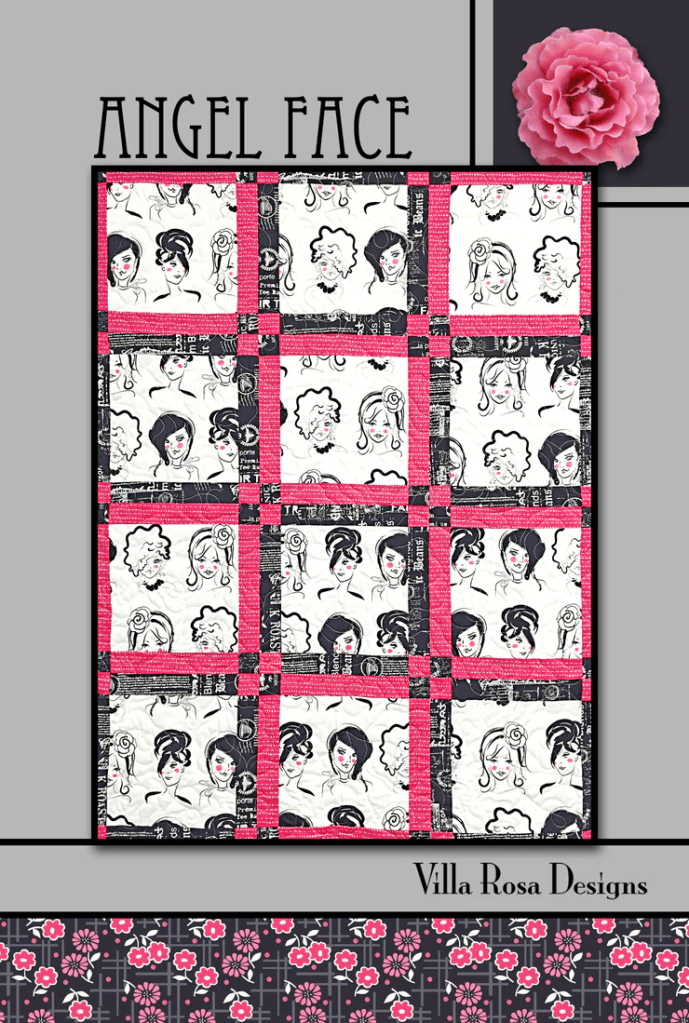
Here is Angel Face. The wonderful fun bold print used in the large squares would really lose A LOT if you chopped it up – you’d have all kinds of bits and pieces of facial details and hair (ewwww! – a nose here and an eyeball there). The fabric wouldn’t make much sense anymore and chopping it up wouldn’t do this fun fabric justice at all. The alternating pink and black frames provide a barrier around the large print squares to keep them from blending into each other. Can you see how the understated repetitive design really compliments the large print fabric without being boring?
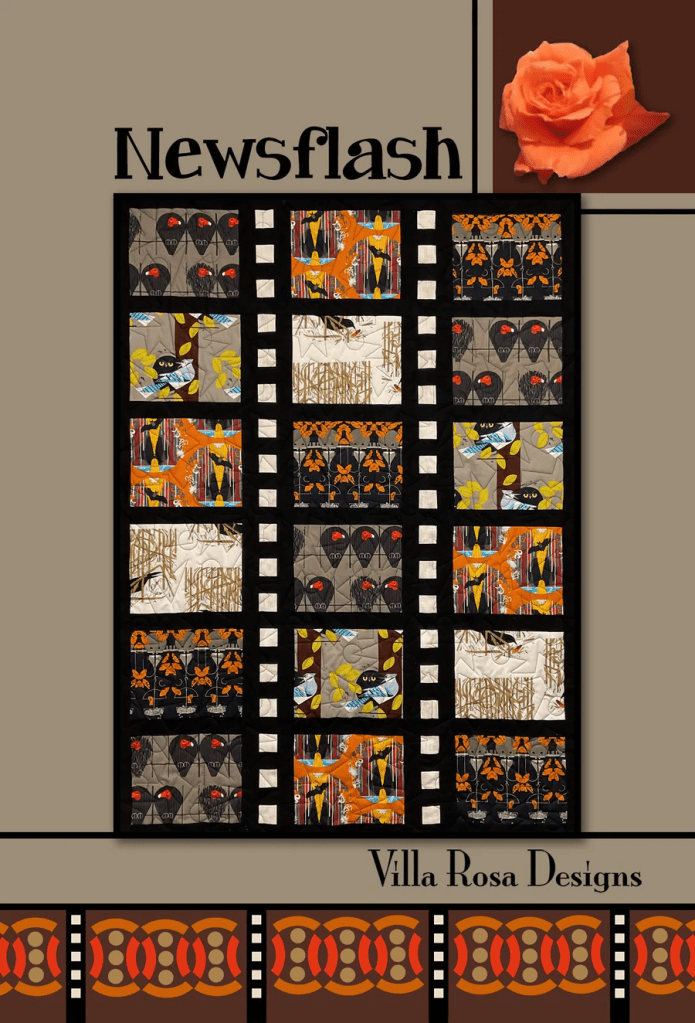
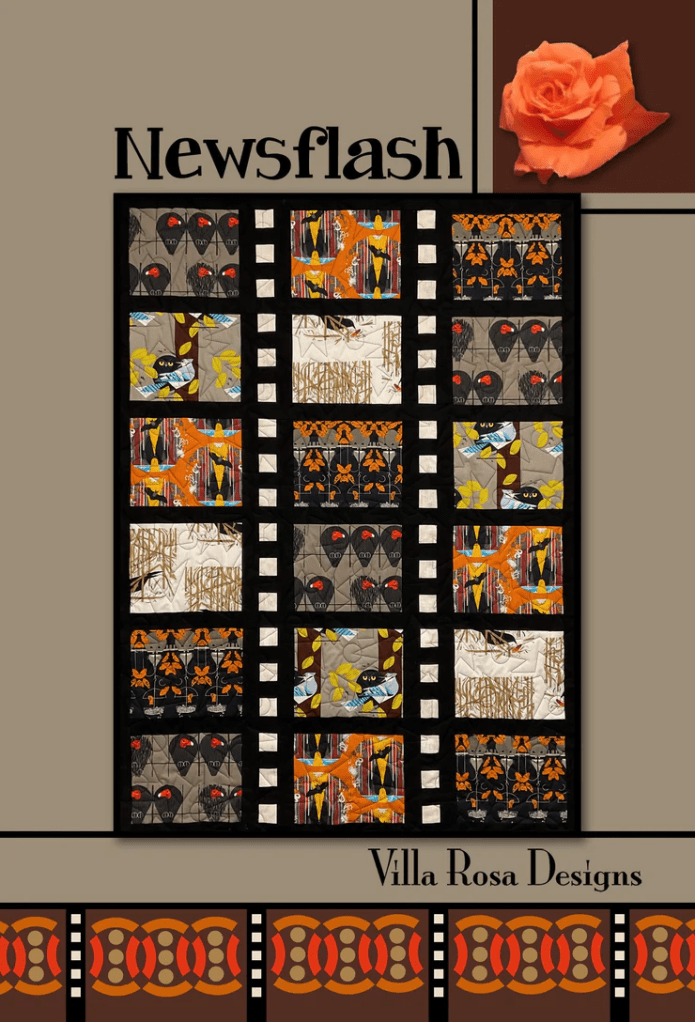
Next let’s take a look at Newsflash. Notice how each large print rectangle is identical in size and framed in black. The fun unexpected twist is the 2 vertical columns of off-white squares and black rectangles which give the quilt a definite old film feel. What a clever way to contain a variety of large prints in the same design! This pattern is exciting and far from boring, yet it is repetitive and quite simple to make.
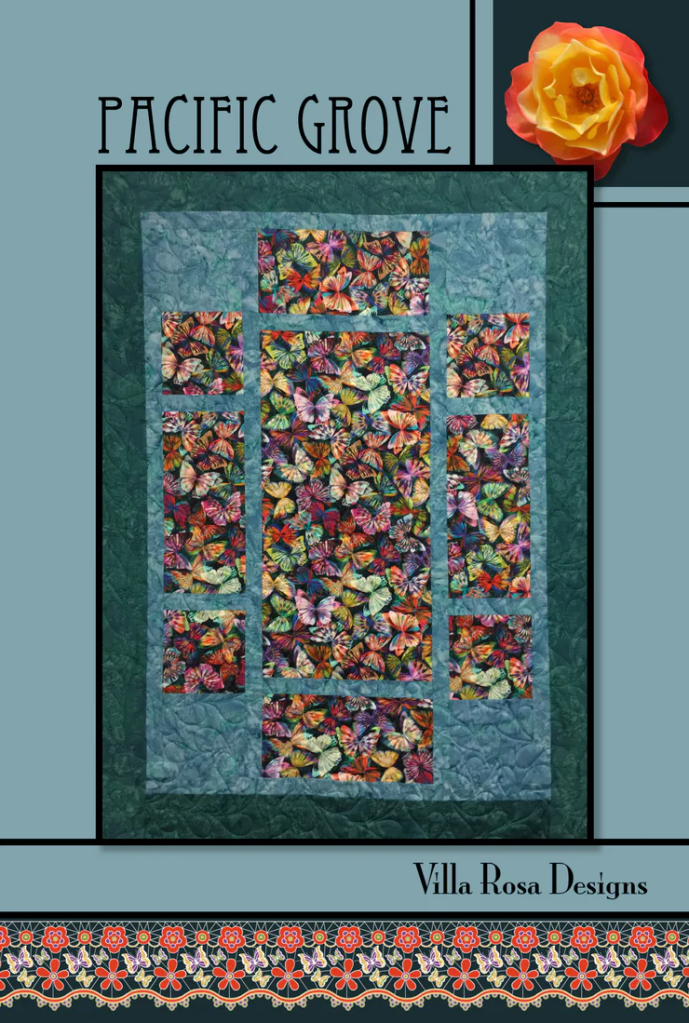
What do you see when you look at Pacific Grove, below?
I see Pacific Grove is another great use of a large print fabric. The large horizontal and vertical rectangles/squares give you plenty of opportunity to enjoy the print itself and the teal sashing provides space between the squares/rectangles so the large print fabric isn’t overwhelming. In addition to breathing room, the teal tonal also provides a great space for fancy quilting which would otherwise be lost in the very busy large print. The wide blue-green border then provides a nice frame around everything.
After taking a look at these 3 VRD Rose Card patterns, I think you will agree that simple quilt patterns DO make the fabric the star of the show. Plus, you still get to enjoy the fabric you fell in love with in a finished quilt. Additionally, a beautiful finished quilt doesn’t need to take a lifetime to make.
Repetition Creates Rhythm (Not Boredom)
Now let’s shift our thoughts to repetition. If you’re already familiar with VRD patterns, then you’ve probably already noticed that we often employ a single quilt block or shape and repeat it to create an overall design. There are several reasons for doing this, including the physical space on the back of a 4″ x 6″ card to actually write a pattern, but also because repetition creates balance and harmony.
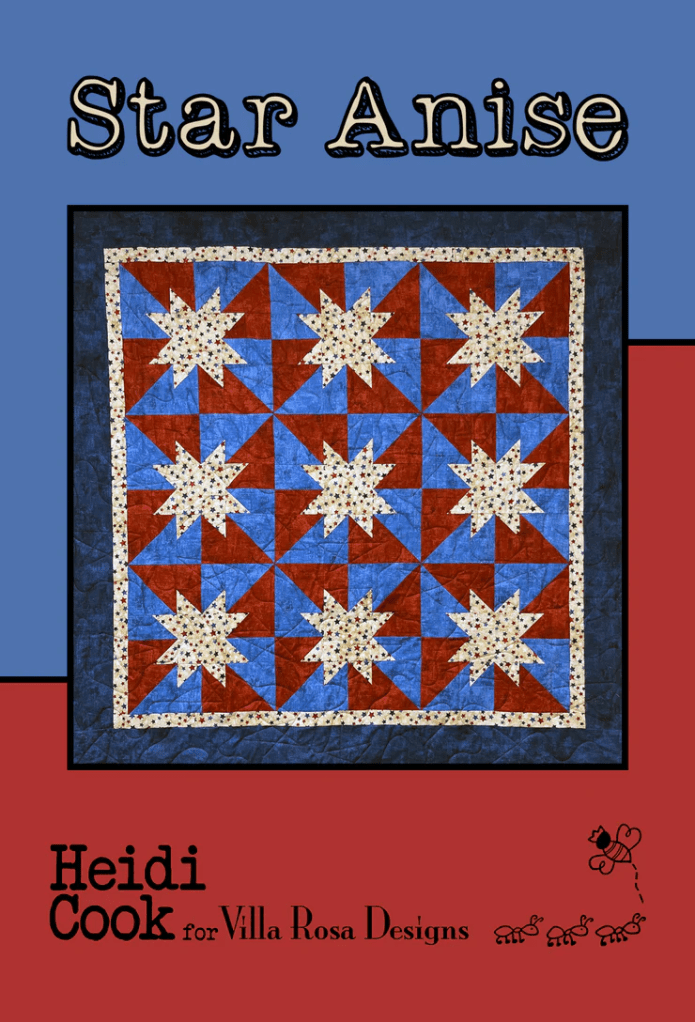
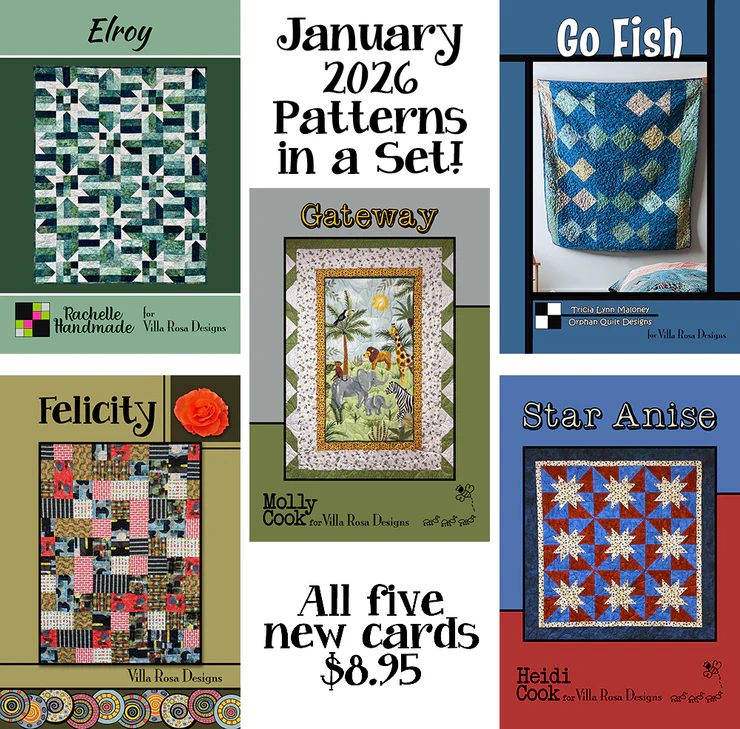
Heidi’s brand new January pattern, Star Anise, is a great example of repeating a single block to create a completely balanced interesting finished quilt. Definitely NOT boring! In fact, the red and blue shapes provide a lot of movement behind the stars. Heidi chose tonals for the red and blue so they recede while the busy-printed stars seem to float on top. Then the 2 borders contain everything. This is a well-thought out quilt pattern featuring a relatively simple repeated single quilt block and 2 borders. This design is so NOT boring!
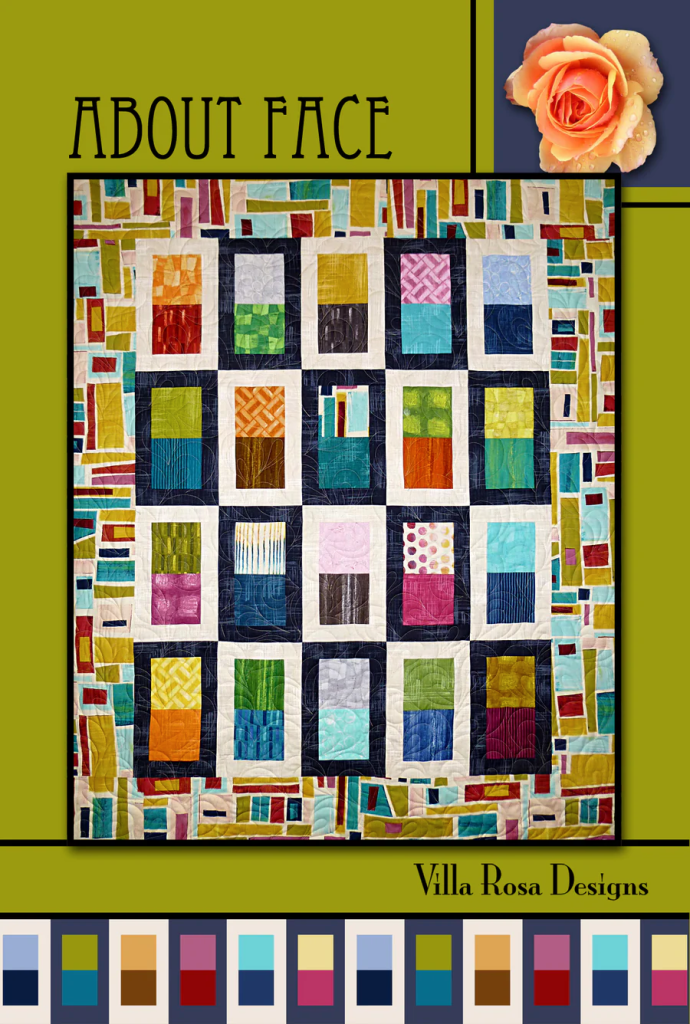
Now let’s take a look at About Face. First, the framed stacked blocks repeat throughout the quilt. Alternating the color of the frames really adds a lot of interest and excitement to this pattern. Then of course, there’s the fabric, which is equally exciting. I love how the stacked squares look different in each block depending on the combination of fabric used. And, of course, the framed stacked block is super simple to make. What a marvelous pattern for big bold colors and fabrics!
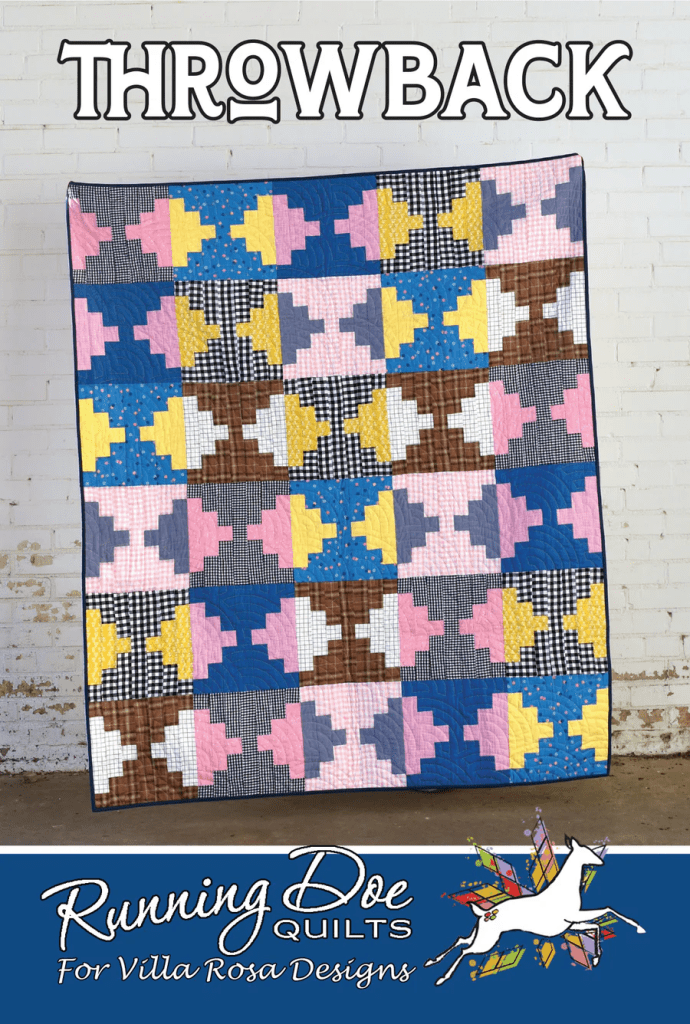
Here’s what I see: with Throwback, the single Courthouse Step block repeats throughout the quilt. That repetition manages the bold fabrics and colors without the need for any frames or borders. Why does it work? The simple block itself is very rigid so it keeps the fabrics organized and under control. And this pattern is far from being boring, even if it’s only a single repeated block.
We’ve explored how simple quilt designs work well with large and busy fabrics and how repeating simple blocks in a quilt pattern is anything but boring. What might look “too simple” at first glance often becomes “just right” when we take the time to examine what makes that simple pattern really work.
Simple Patterns Highlight Quilting, Not Hide It
Up above, in Pacific Grove, I mentioned how the open space not only gave the very busy large print fabric room to breathe it also allows for the quilting to shine. If you want your quilting to be the main event in your quilt, you need to carefully consider batting, thread color and choice, as well as the quilting design and its size. Please note that really busy prints tend to hide quilting, but you can still see the texture that quilting gives the quilt.
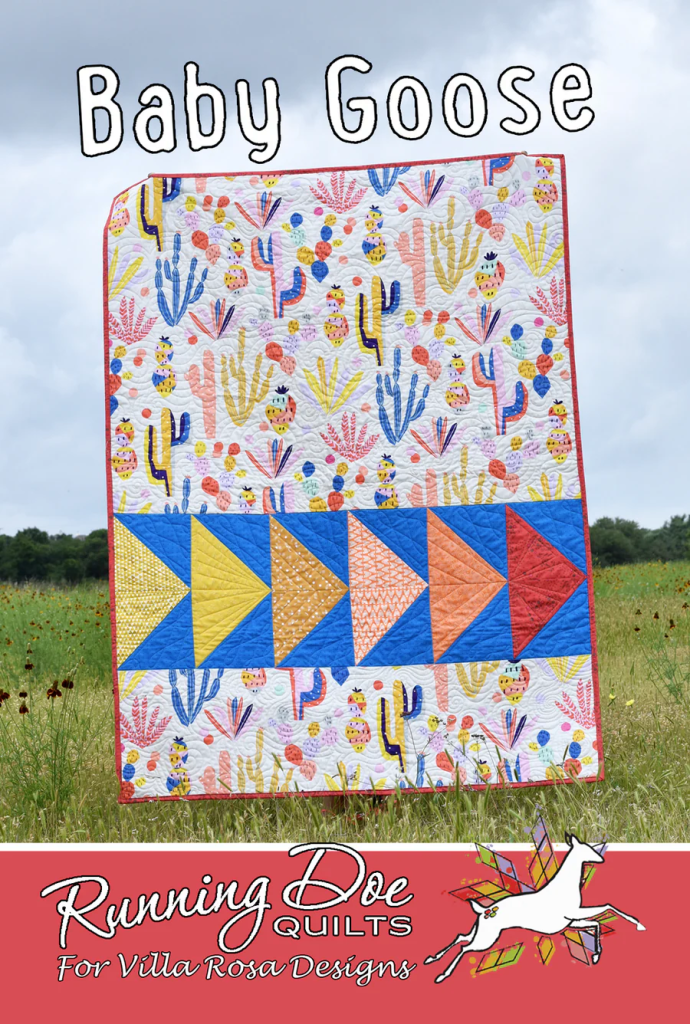
Let’s take a look at the really quick and fun pattern, Baby Goose. The large succulent fabric is the main event here. The horizontal band of Flying Geese blocks breaks up the large print into smaller bites for our eyes. Can you see the machine quilting on this quilt? The thread colors blend more with the fabrics than stand out so mostly, what you are seeing is texture. What if you wanted the quilting to be the star of Baby Goose? I would probably choose a smaller print fabric or at least a less busy one as well as a strongly contrasting thread color so that it stood out. I might also choose a thicker batting or even layer 2 batts in order to give the quilting more definition.
Check out Kate Griffin’s Color Block pattern! It’s a simple pattern with a lot of room to showcase your quilting. Kate used an overall geometric design in a subtle contrasting color – do you see how it pops on the solid fabrics? If you look closely at the quilting, you can easily make out the shapes, yet with the overall quilting pattern it provides a tremendous amount of texture. In this quilt, the simple design, the fabrics, and the quilting all compliment each other.
Here’s what I see – a simple repeating/alternating Nine Patch block with lots of open space to allow the quilting to shine. Want to quilt feathers? Yep, this pattern can handle that. Want to use bold fabrics in the Nine Patches? Go for it! Use a funky binding to tie everything together? Absolutely! This pattern can handle just about any fabrics you throw at it all while giving space for the simple blocks to breathe and providing the perfect canvas for your quilting.
Everything should be made as simple as possible, but not simpler.
This quote really resonates with me as it truly describes my personal design aesthetic. Funny that Al Einstein and I would agree on something, especially as it applies to quilting. I like my designs simple, but they are not simplistic or basic. Sure, once in a while I feel the need to tackle something challenging, but simple quilts are my go-to designs – the ones I turn to time and time again. Simple is hardworking and reliable. Simple is the way I roll.
They’re More Forgiving Than You Think
Simple quilt designs are also great for beginners. I can’t tell you how often I have suggested Villa Rosa Rose Card patterns to new quilters. I’ve even personally used VRD patterns to teach both new and experienced quilters.
I have found that simple patterns set quilters up for a more pleasant experience as well as more success and satisfaction.
Simple quilts have fewer seams which equals less stressful piecing.
Simple quilts are often easier to enlarge or reduce by adding/subtracting rows and/or borders without struggling with tough math to figure it all out.
Simple quilt patterns often employ clear easy-to-understand instructions, too, which helps new quilters gain confidence in their abilities. For experienced quilters, clean straightforward instructions are a breath of fresh air in our complicated busy lives.
With easy-to-read instructions, simple repeating quilt blocks, and space for fabrics and blocks to breathe, it’s no wonder that simple quilts are more forgiving than complex designs with intersecting seams, set-in seams, complicated piecing, tiny pieces, etc.
Yay! Let’s hear it for simple quilts!
Simple Patterns Age Gracefully
What are your favorite go-to patterns? The ones you turn to when there’s a new baby, a birthday, a wedding, a holiday? I bet most of you have at least one pattern you’ve made over and over – that pattern that has stood the test of time. And I wouldn’t be surprised if your go-to pattern is a simple one. One that you can make up quickley, yet looks different depending on the fabrics and other choices you make as your create.
It’s the simple quilts we turn to for comfort.
They are often the ones that get used, washed, and loved. Every day.
The ones the grand kids drag around until the quilts are frayed and worn. Maybe it’s the quilt your great grandmother made for your grandpa as a young man – a simple 4 Patch quilt with leftover fabrics from household sewing.
Maybe it’s the sweet little baby quilt that’s now tattered and torn but has been passed down for a hundred years.
Trends and colors may come and go, but simple quilts are always in style. Always will be. Always.
Are you ready for a FUN and exciting new year of quilty goodness here on the VRD blog? We’re working on all kinds of cool ideas for 2026, including another 6 Quilts in 6 Weeks Challenge, lots of new patterns (as you probably already know we release 5-7 brand new patterns each and every month), and lots of other great stuff. You just need to hang out every Thursday with us to see what’s up.
Speaking of new patterns, I’m excited to share with you our brand new January patterns. If you’ve been hanging out with us for a while, then you probably already know that I totally live for the Thursday after the first Friday of every month. If you’re new to the blog, first – WELCOME, we’re SEW glad you’re here – and second, our new monthly patterns are released on the first Friday of each month. Here on the blog, I love to share our new monthly patterns on the Thursday post following Pat’s reveal of the new patterns on the first Friday. Whew! I hope that makes sense.
(patterns are also available individually as both digital downloads and printed patterns)
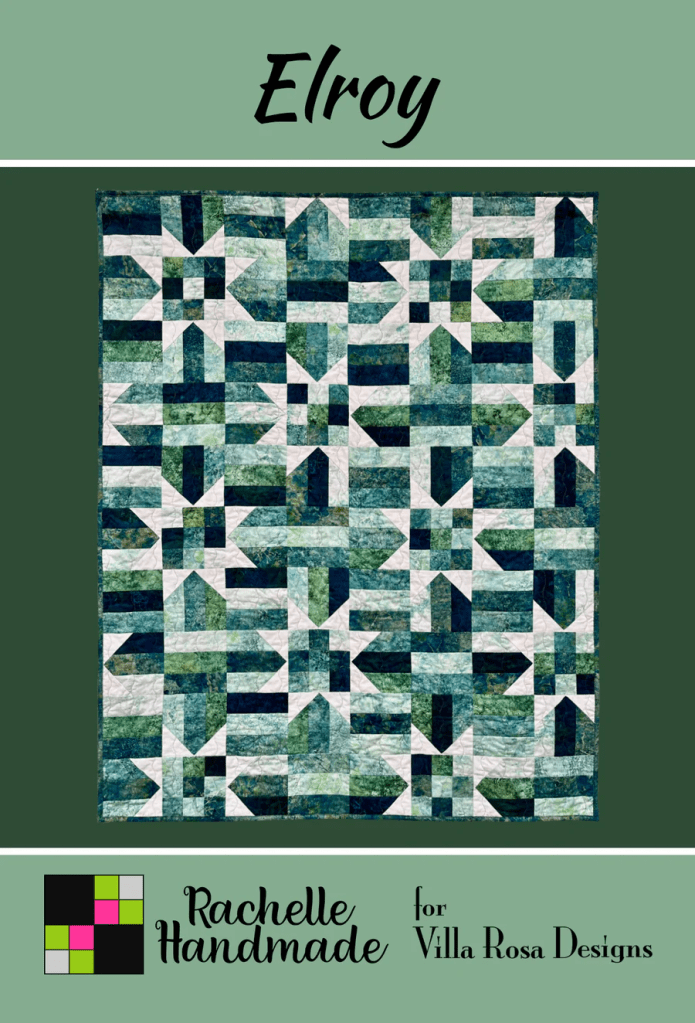
Elroy – Rachelle Handmade is back with this clever star-worthy fat quarter friendly quilt that finishes 48″ x 60″. So grab your favorite FQ collection and this quilt go together in a jiffy.
Felicity – Here’s another super quick fat quarter patterns from Pat. It finishes at 42″ x 54″ and makes a fun throw or kids’ quilt.
Gateway – This is Molly’s latest panel quilt design. It finishes at 42″ x 62″, which is a nice small throw or even a large wall quilt.
Star Anise – Heidi’s new design this month is a fab graphic star pattern. It finishes at 58″ x 58″ and makes a good-sized throw. You could add another row at the bottom to make this quilt longer if you wanted to and it would be the right size for a Quilts of Valor quilt.
Go Fish – This cutie was created as a child’s quilt for a new baby in my cousin’s family. It finishes at 46″ x 52″ and uses fat quarters.
Because of the holidays, I didn’t get a runner finished in time for January, but I have something else for you this month!
New Seasonal Series for 2026
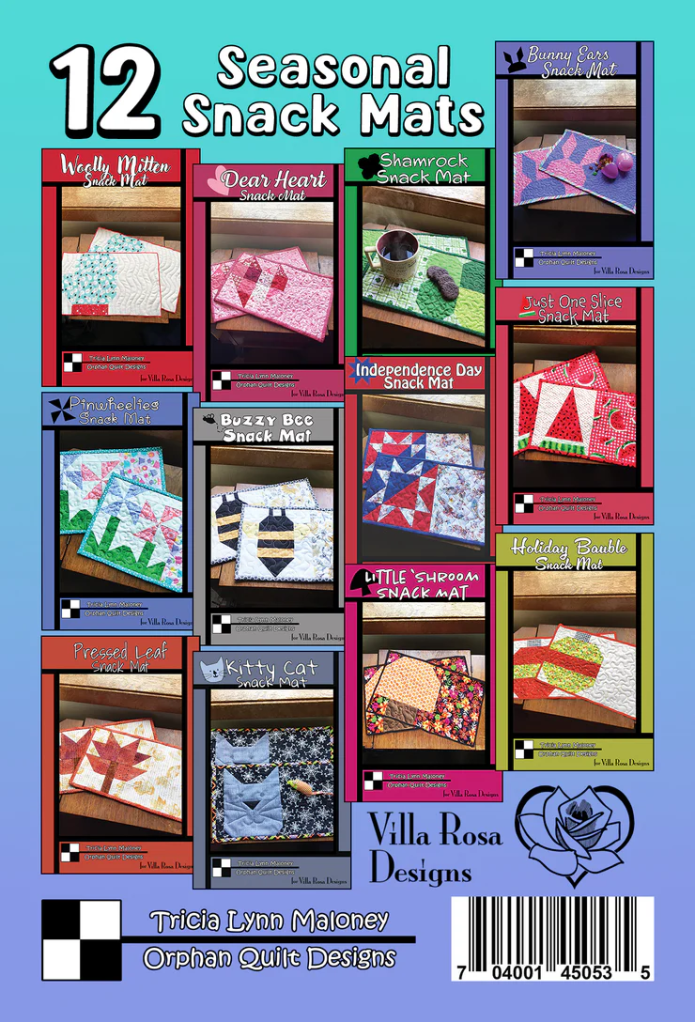
I hope you enjoyed the Seasonal Snack Mat Pattern Series from 2024-25 as much as I did. It was really fun to come up with a new design for each month of the year.
Did you know we have all 12 Snack Mats together in a print collection now? You can find it HERE.
Hey! How about another Seasonal Series for 2026???
Great idea – it just so happens that this month we’re kicking off a new Seasonal Accent Pillow series. The patchwork pillow covers will finish at 18″ square and can be used as small wall or table quilts.
WOOHOO!
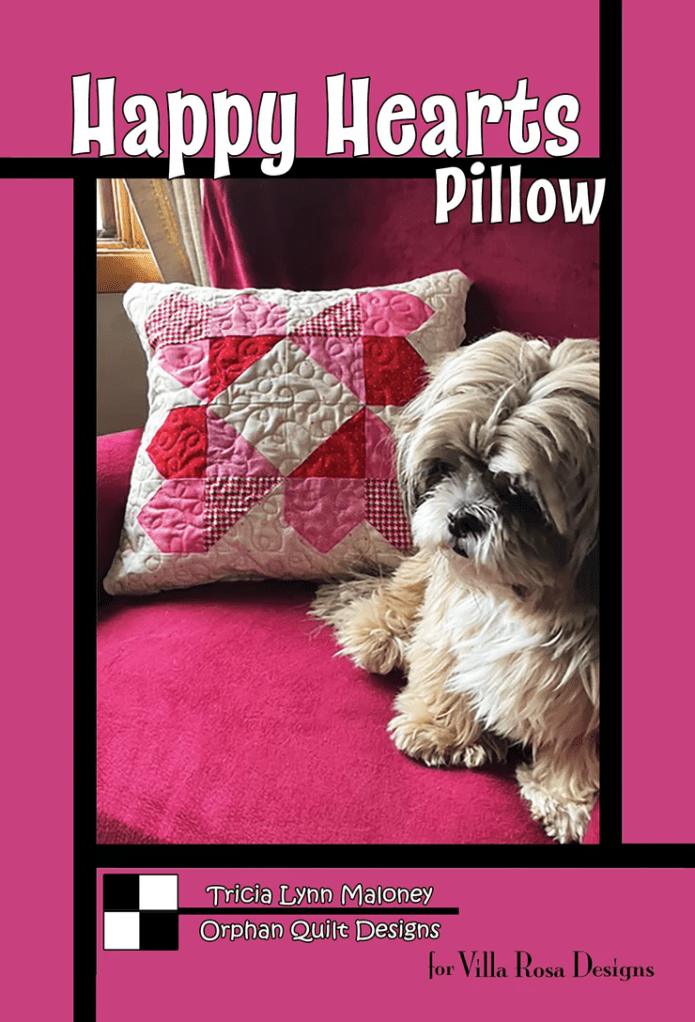
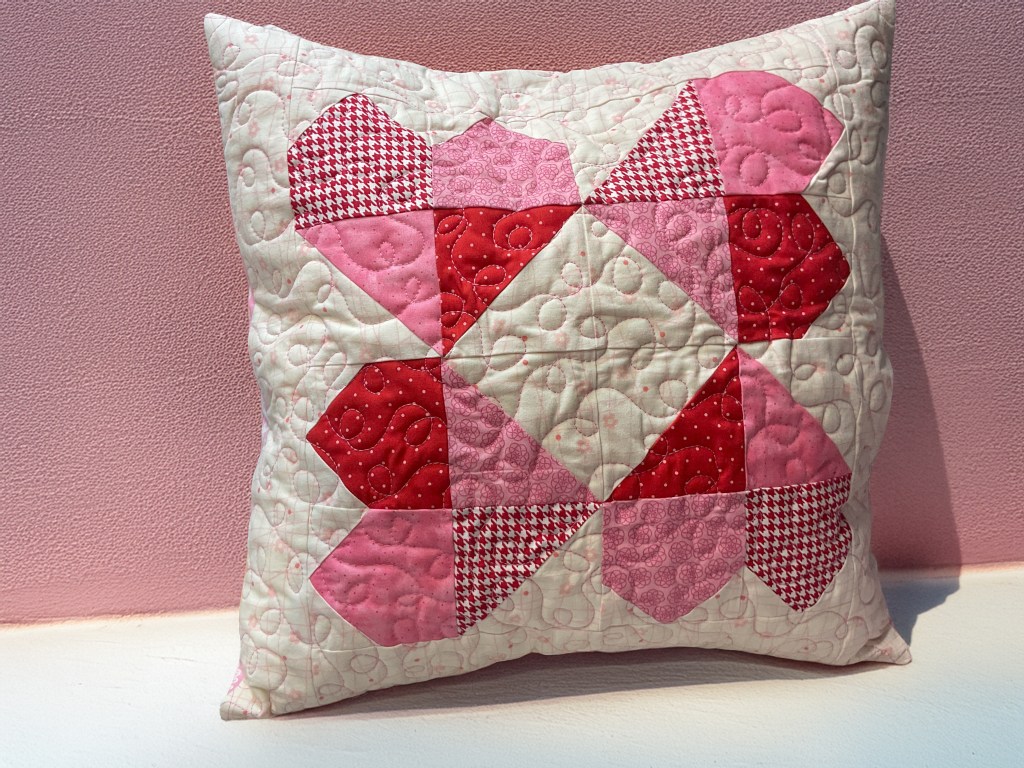
This month’s Pillow is called Happy Hearts.
My furbaby, Bailly, decided she wanted to be in the photo with the pillow. To be fair, I did use her favorite chair. LOL! Silly Bailly.
I hope you are as excited about this new series as I am. By now, you’ve probably noticed that I tend to create a lot of seasonal and holiday patterns. I wonder if that comes from living my entire life here in northwestern Pennsylvania where we can have all 4 seasons in one day. Yeah….maybe.
To jump-start your Year of Seasonal Pillows, I thought it would be a good idea to share with you how I like to finish the backs of my accent pillows. Yep, there are lots of different ways, but my absolute favorite is the Envelope Pillow Back.
Read on for a quick tutorial.
Envelope Pillow Back Tutorial
Have you ever made a throw pillow and wondered how to finish the back? Maybe you added that unfinished pillow top to your stash of UFOs and forgot all about it.
Let me show you my favorite method for finishing a pillow top with no zippers. Yep – you heard me right – no zippers! And that’s a good thing, too, as I am terrible at sewing zippers.
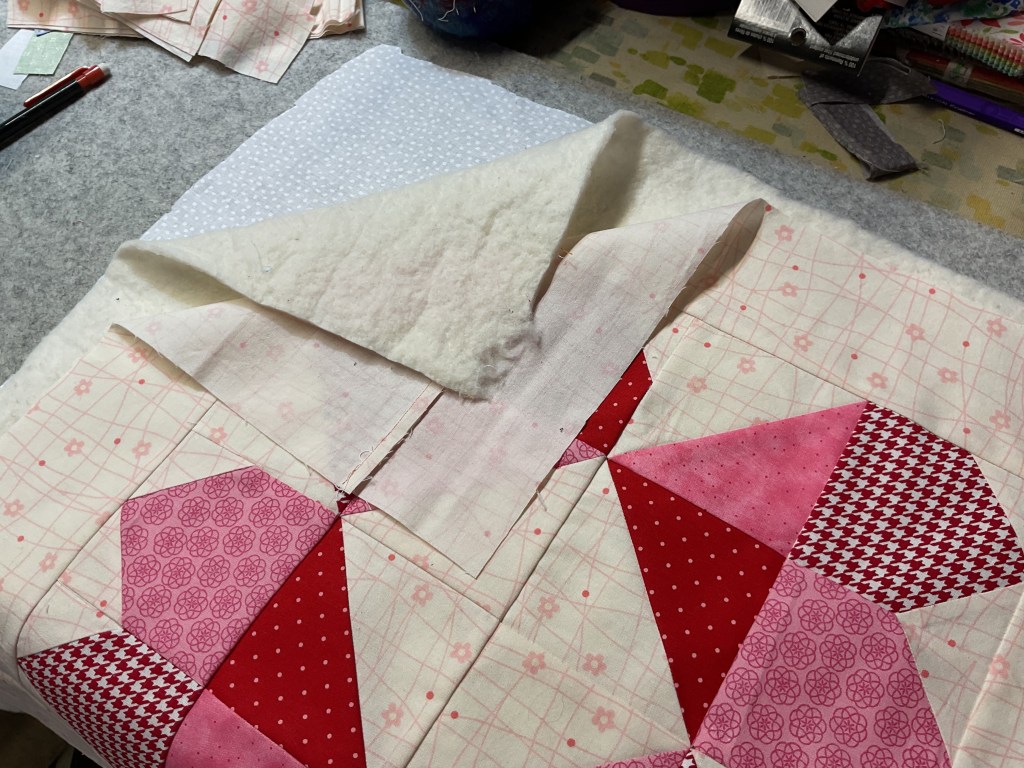
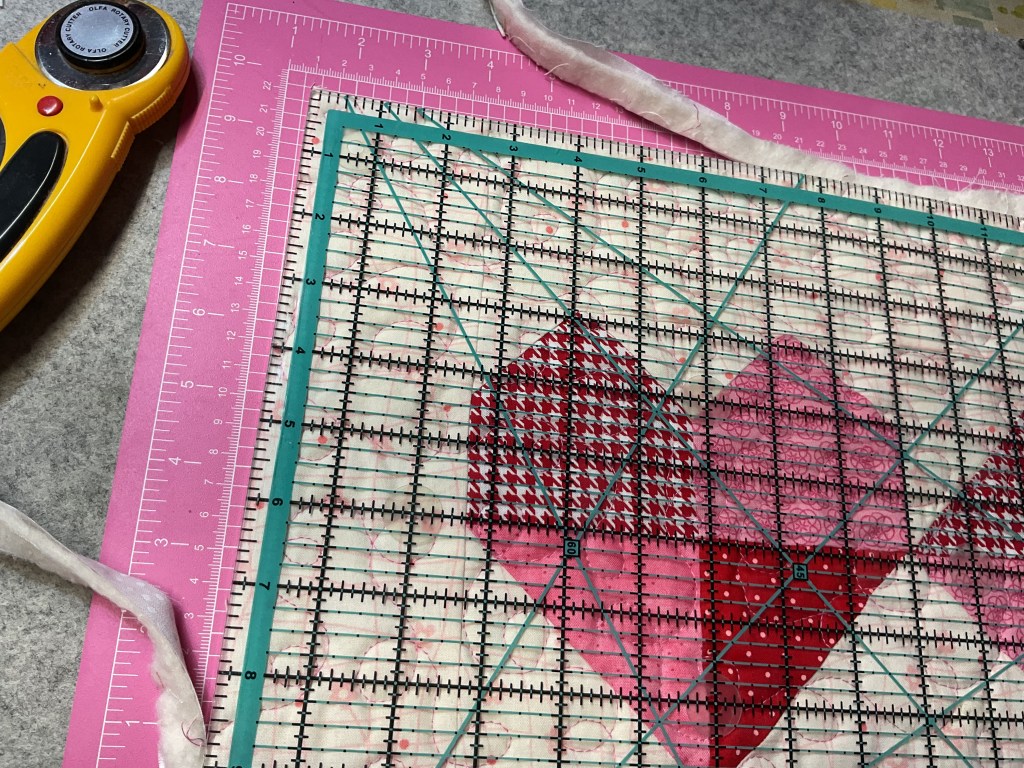
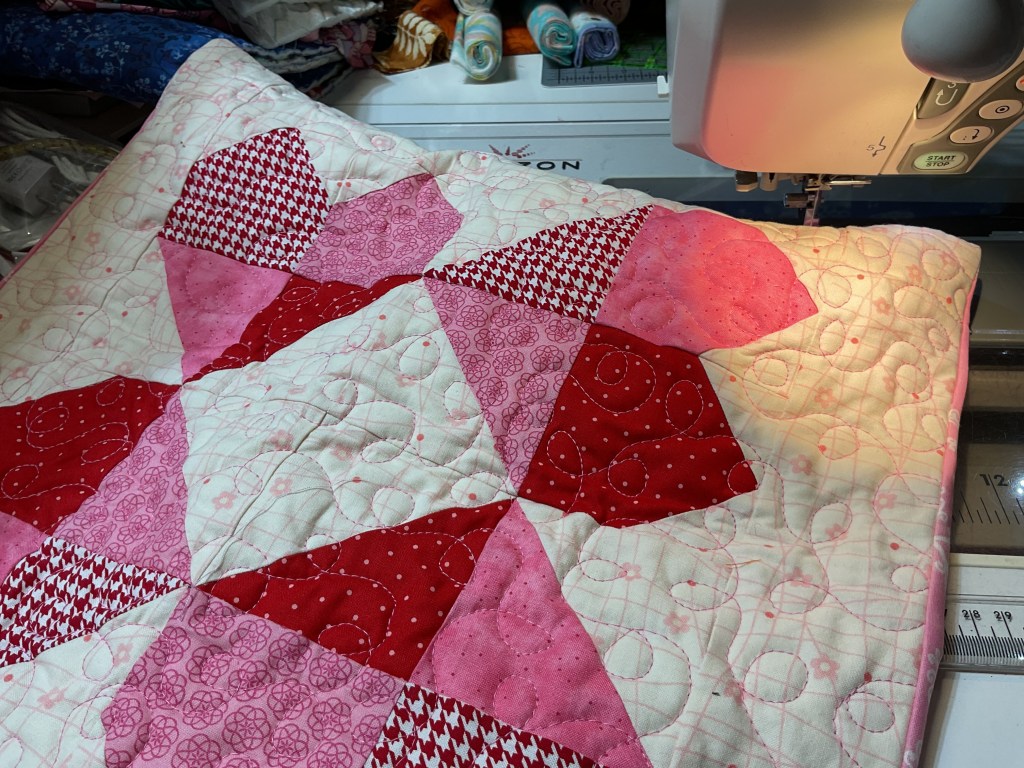
I layered my pillow top with batting and lining fabric and machine quilted it. Then I squared it up to 18 1/2″ x 18 1/2″. Now we’re ready to rock and roll!
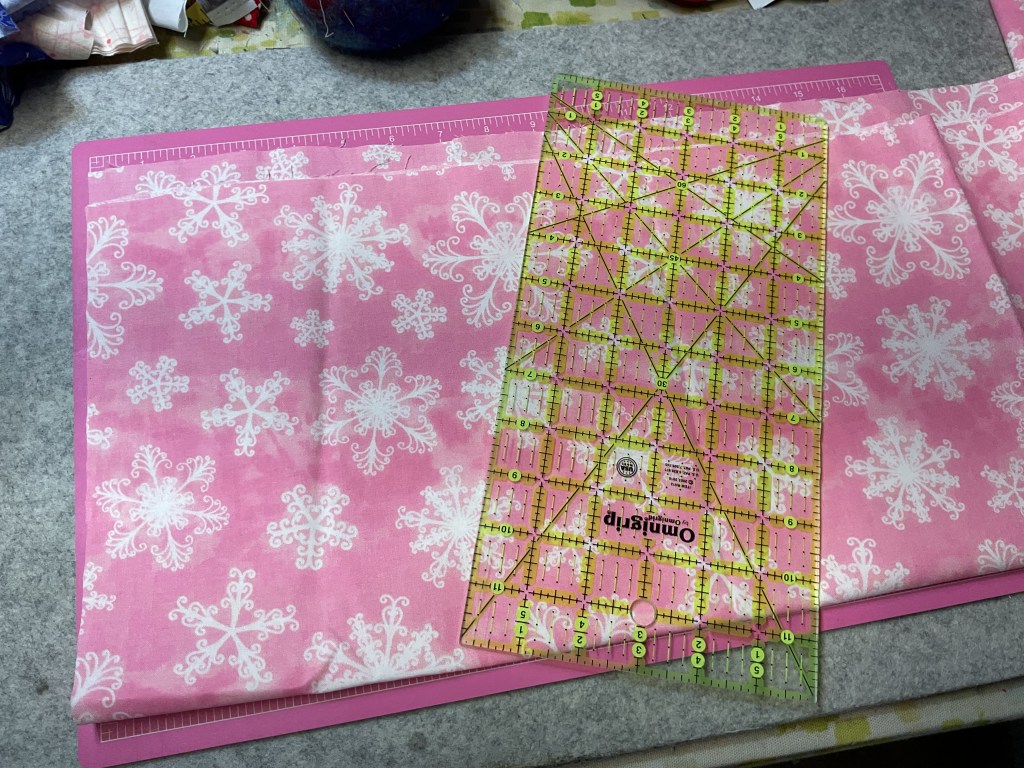
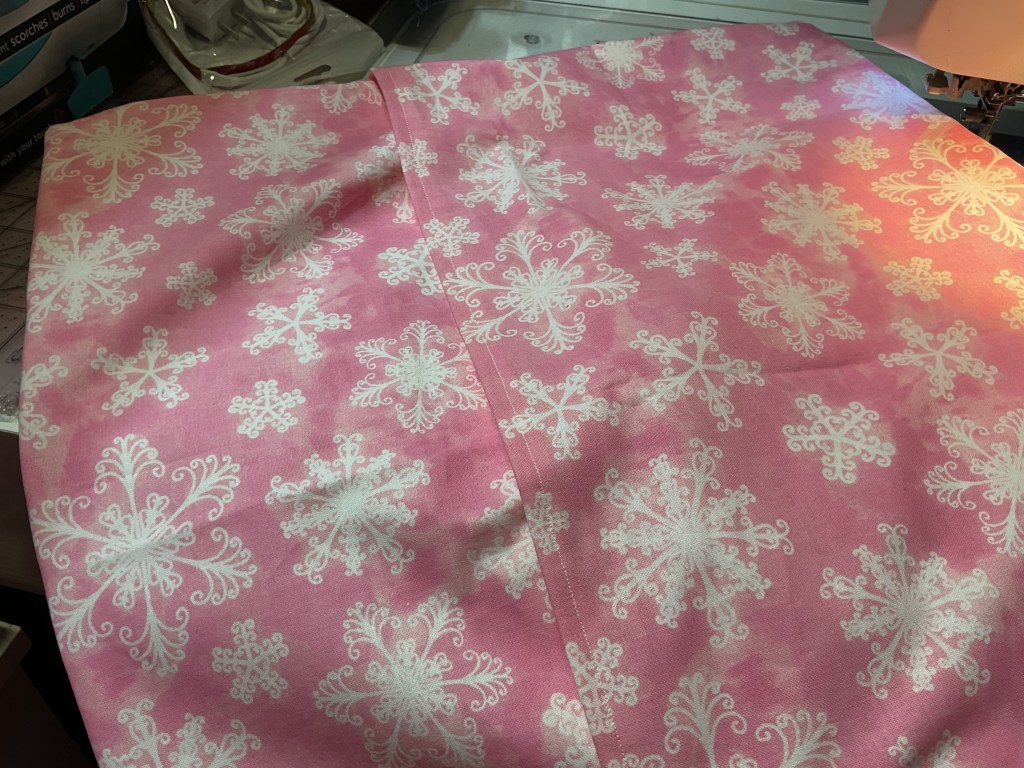
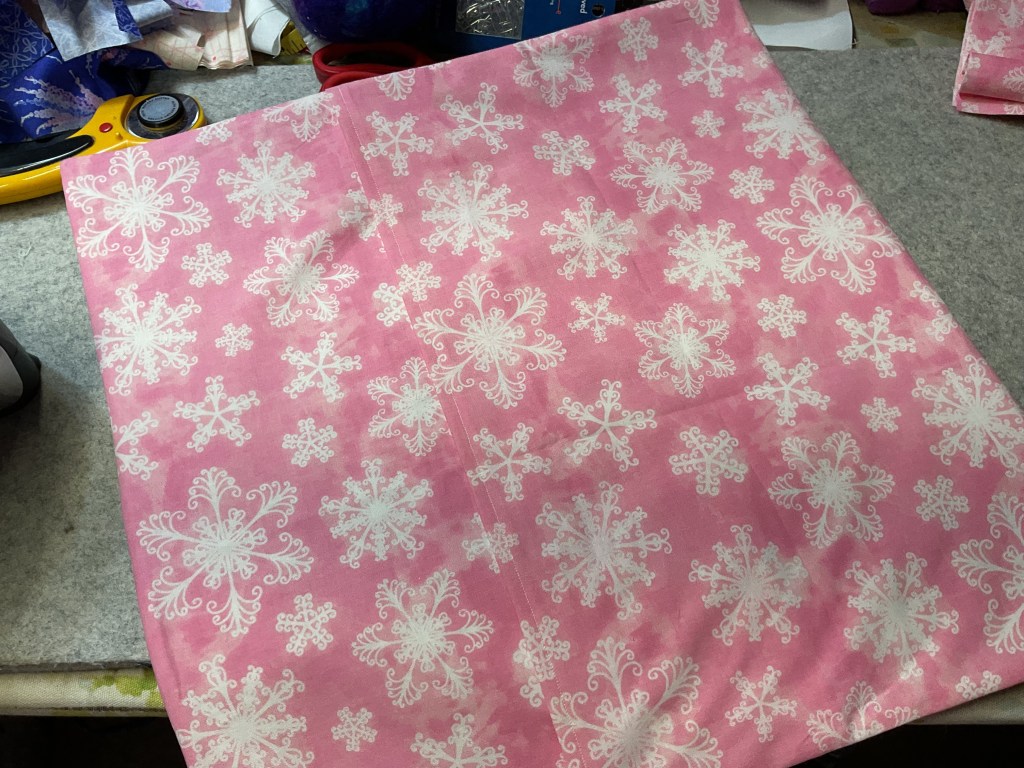
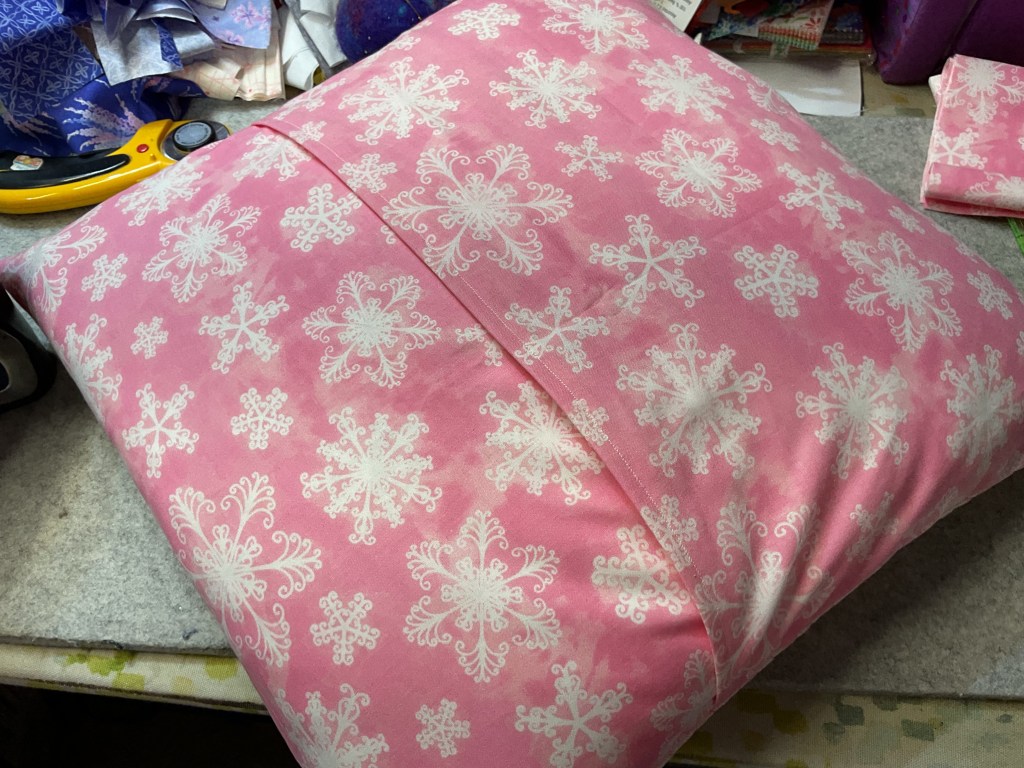
I chose these cheeky pink snowflakes for the back of my Happy Hearts Pillow since we’ll still be having snow for Valentine’s Day around here.
I decided to cut my 2 backing pieces of fabric 12 1/2″ x 18 1/2″ so that I would have a 6″ overlap. There aren’t any real rules for how much overlap to have on an Envelope back, but if you don’t have enough, you’ll know it because the opening on the back will bulge out, exposing the pillow insert. Better to have a generous overlap than not enough.
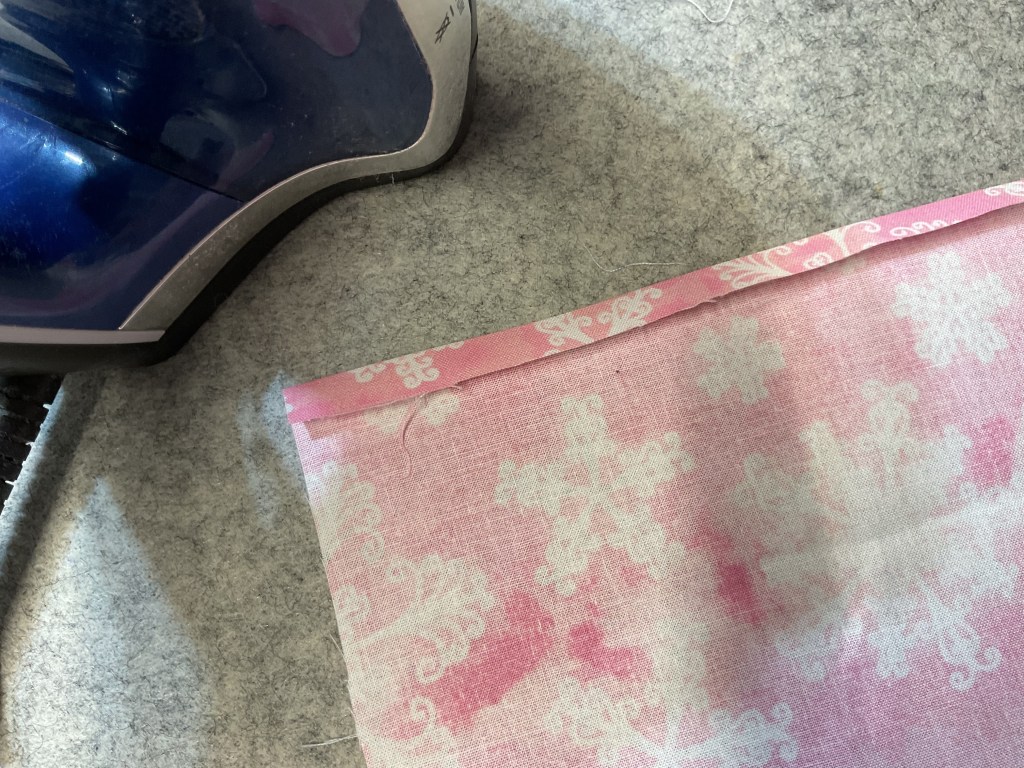
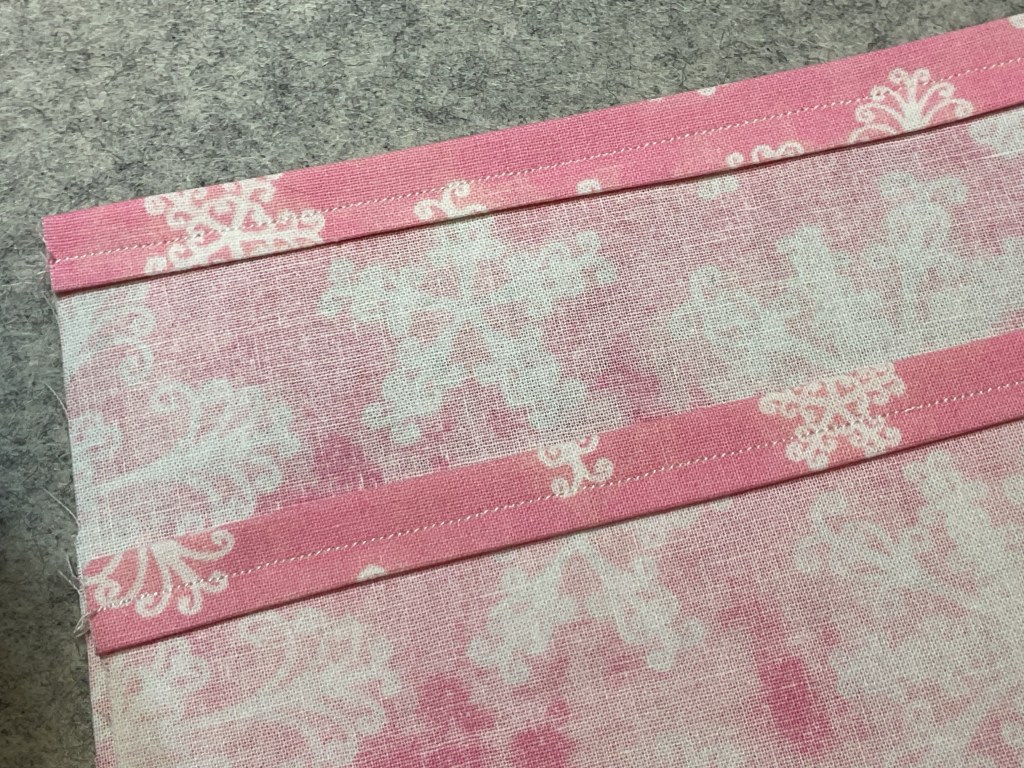
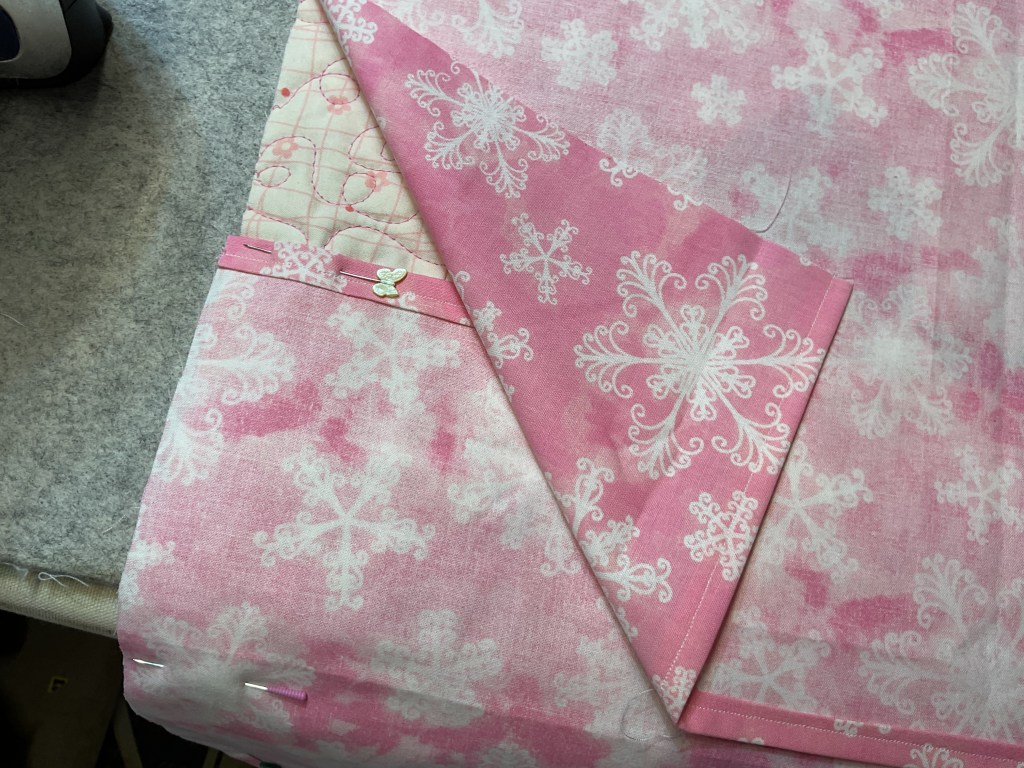
Next, I’m going to press a 1/4″ hem along an 18 1/2″ side on BOTH of the backing pieces.
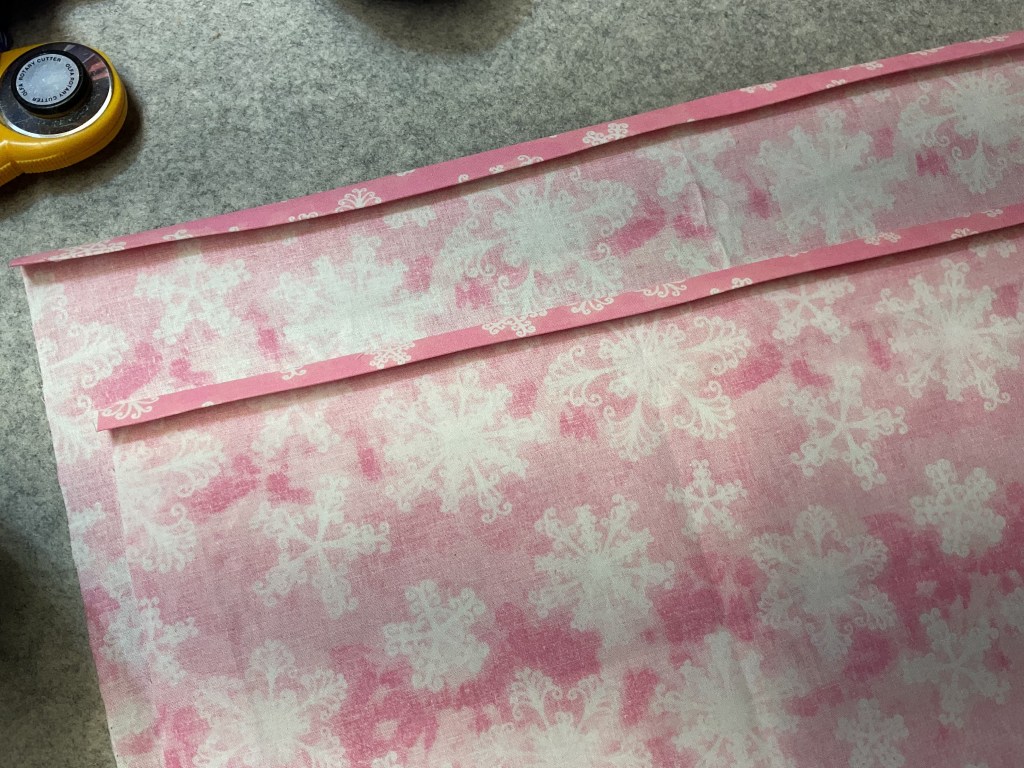
Then we’ll fold it over one more time so that the raw edges will be sandwiched in the hem. You can pin them in place if needed, but since I pressed them, they’ll hold up while I sew.
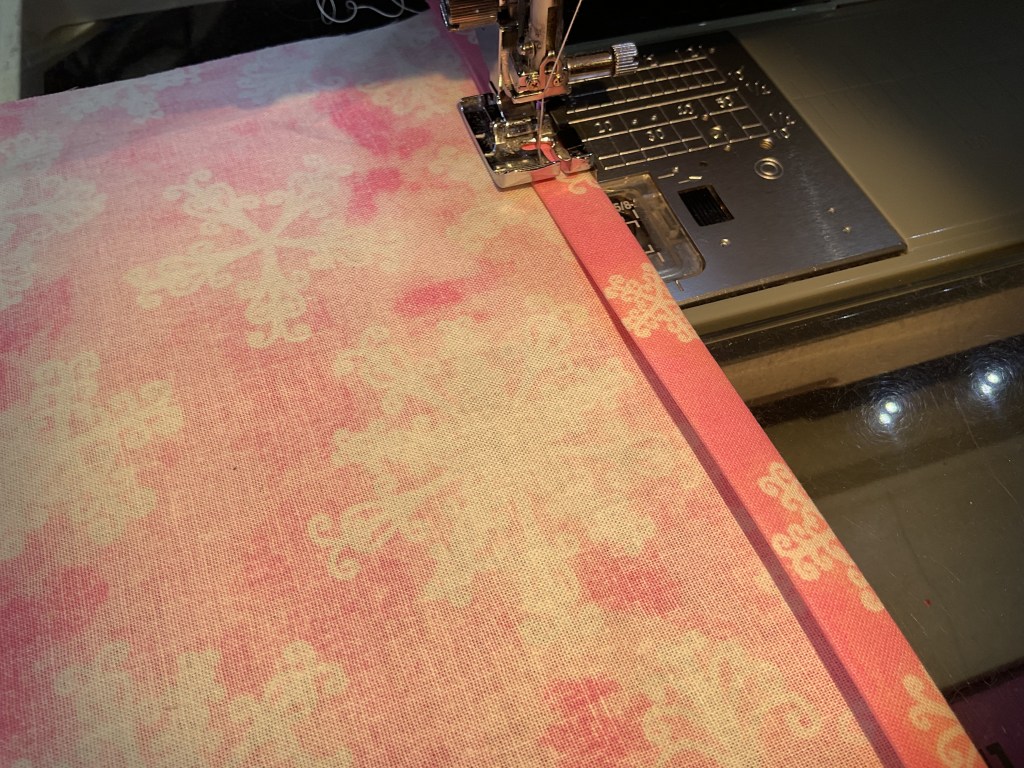
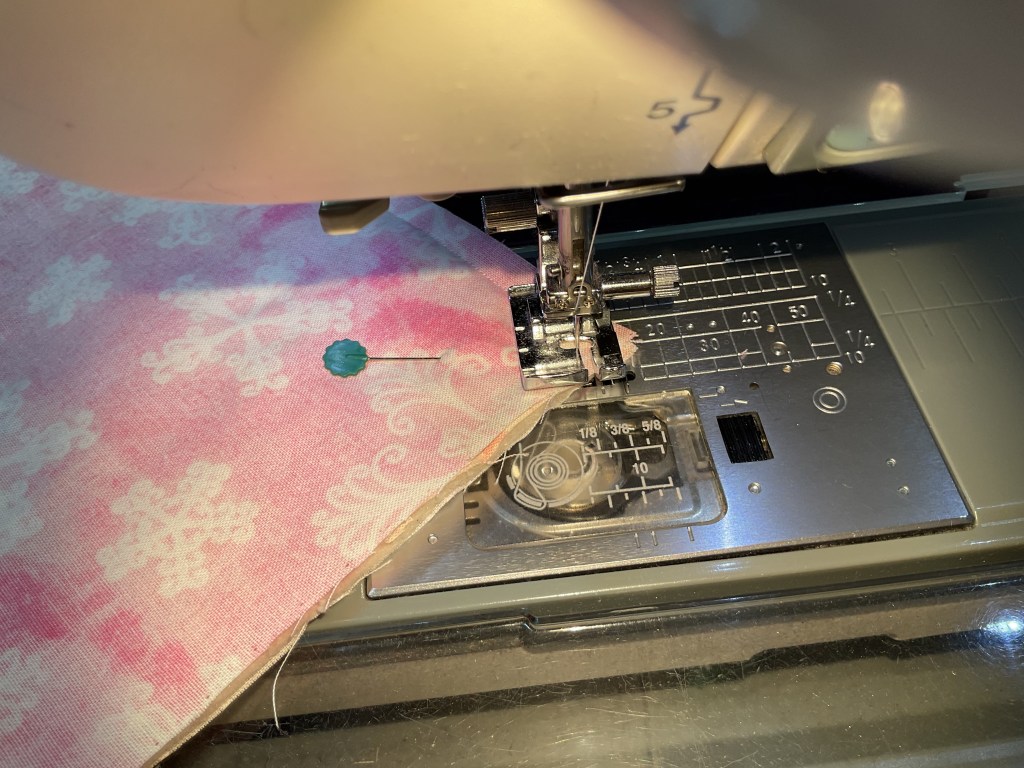
Alrighty, now we’re headed to the sewing machine to sew down the hem on both sections.
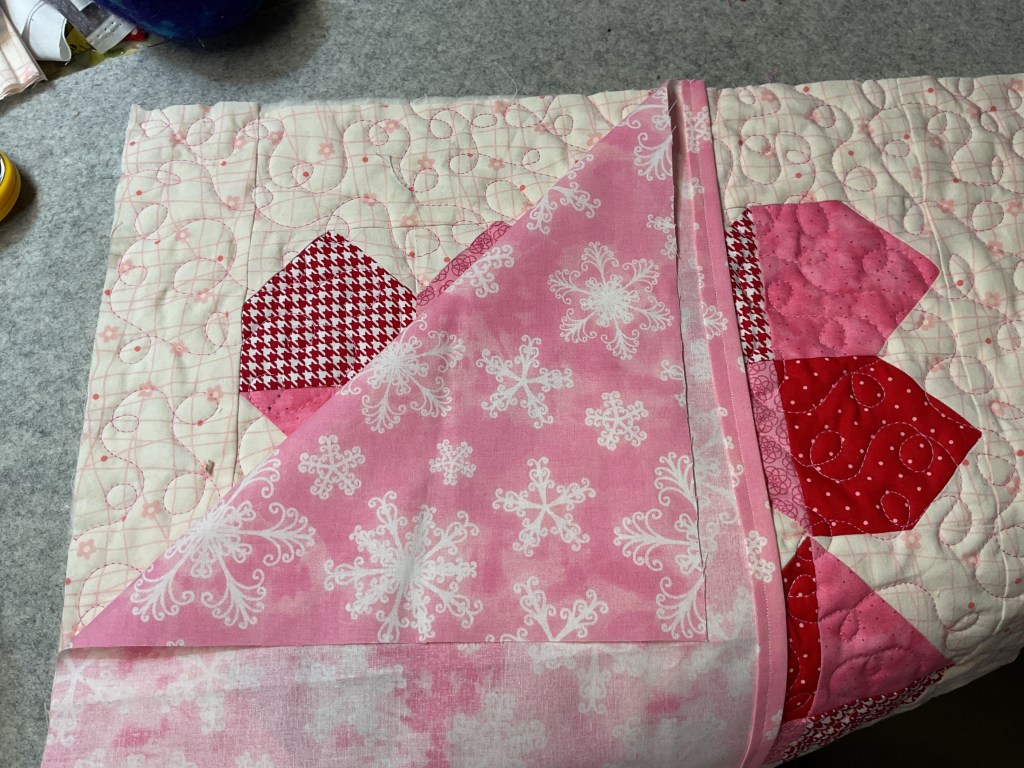
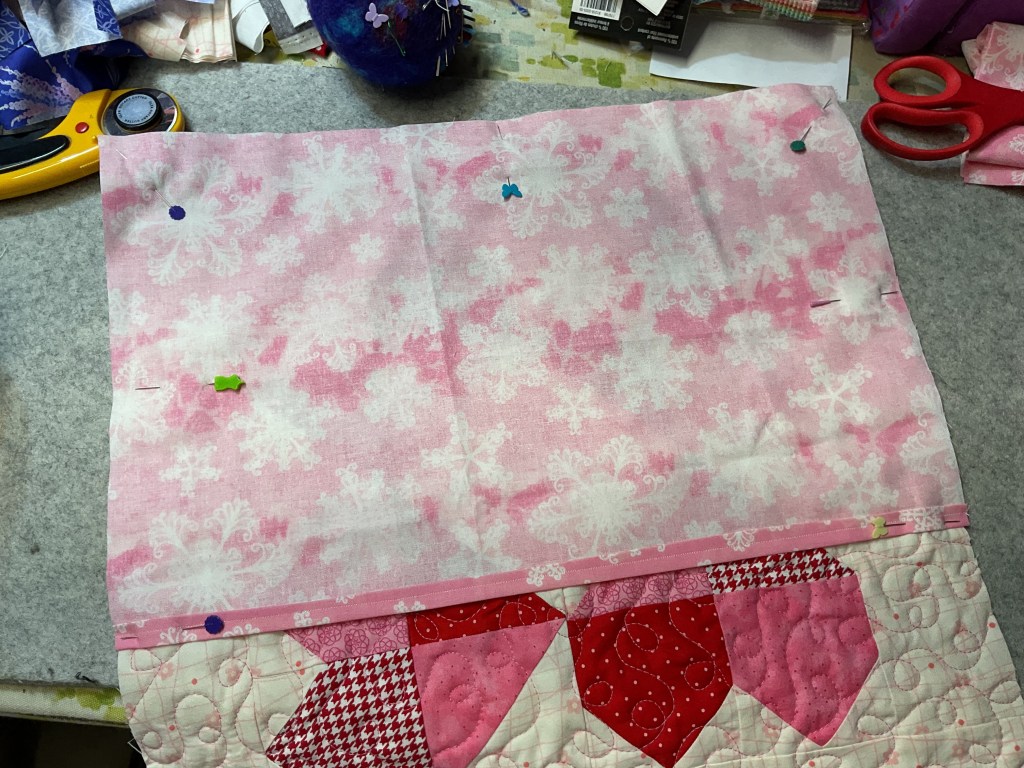
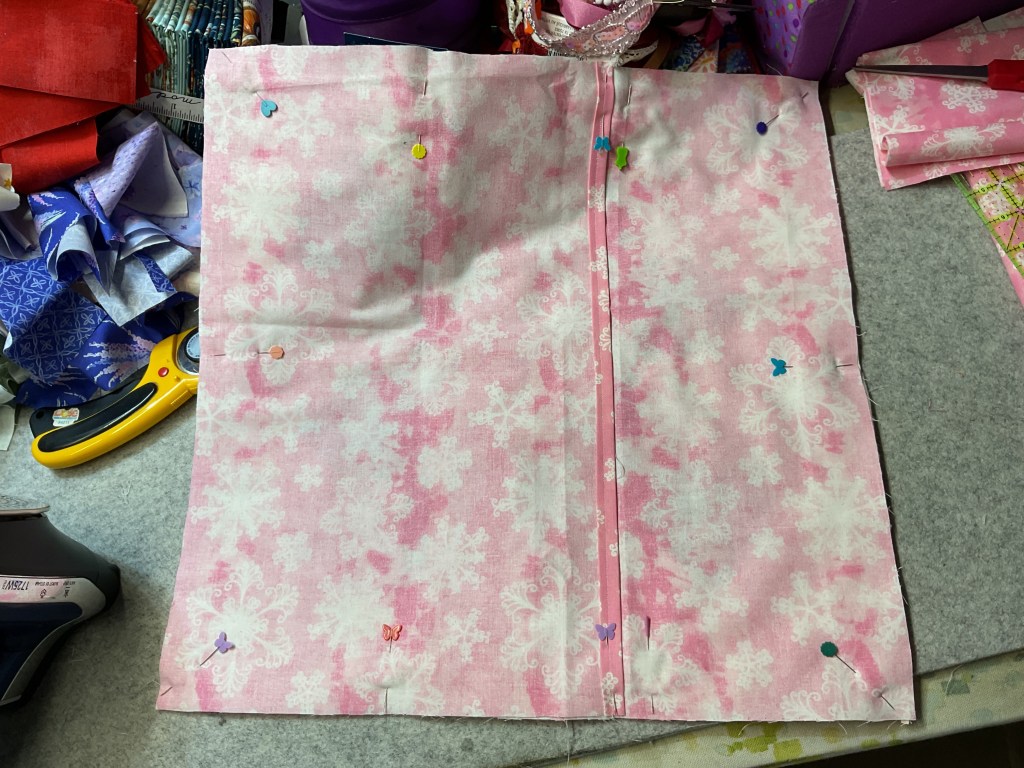
Our next step is to layer one of the back sections right sides together (RST) with the pillow cover, lining up the outer edges with the hemmed edge towards the middle. This time I’m going to pin generously because I really don’t want anything moving out of place.
So far, so good. Let’s layer the second backing section now, again with the hemmed edge towards the center, overlapping the hemmed edge of the first section. I pinned everything into submission.
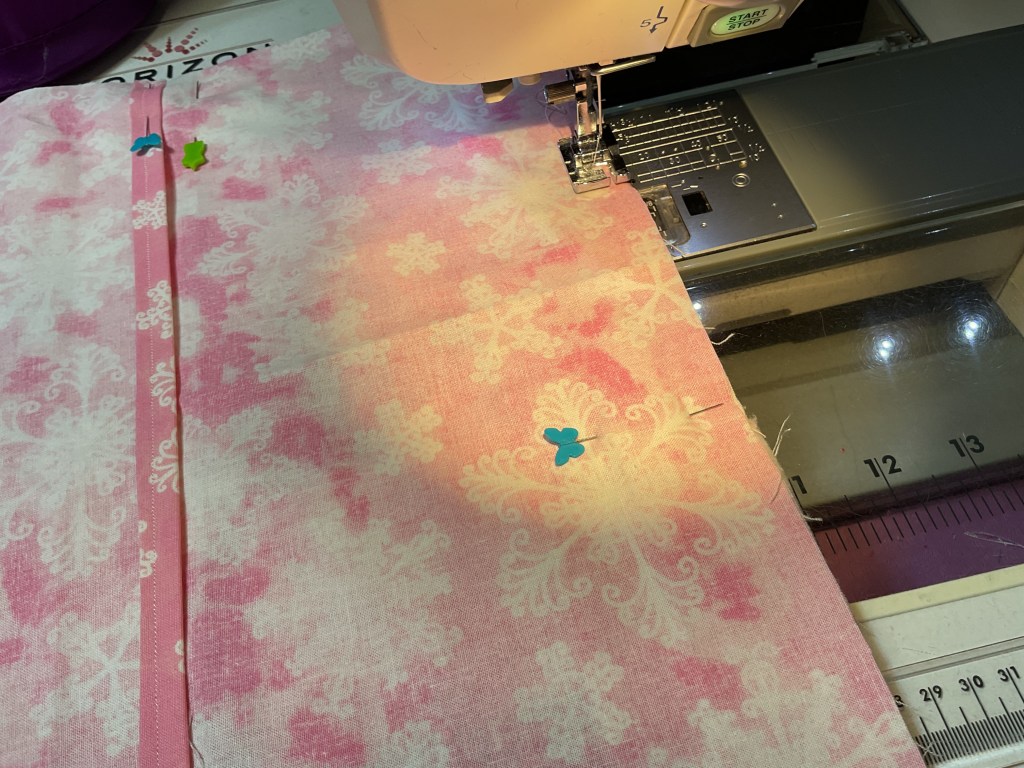
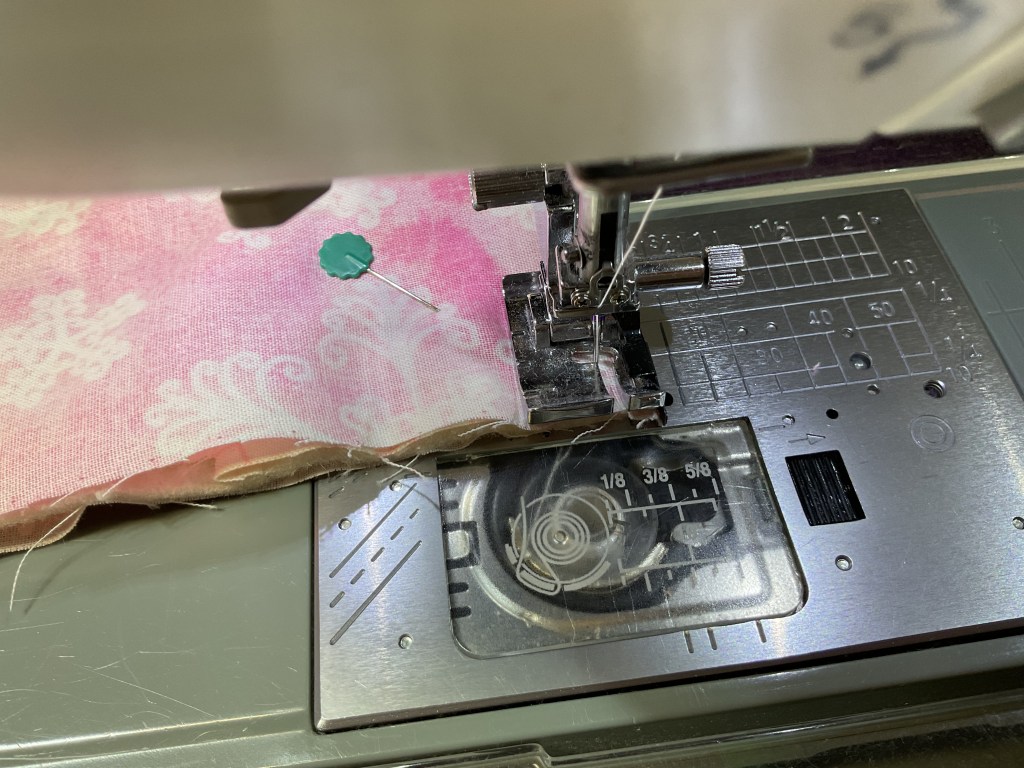
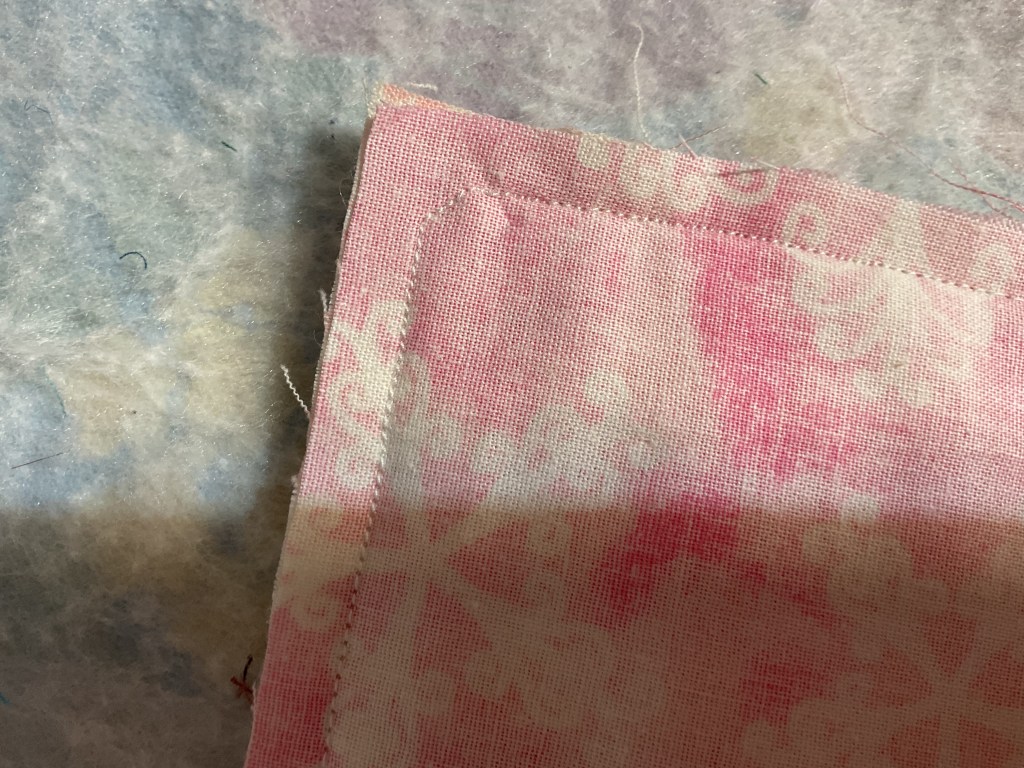
Back to the sewing machine to sew all the way around, using a 1/4″ seam allowance.
I want to take a minute and share a really good tip about sewing corners – I learned this great idea from a fellow quilt guild member years ago.
When you are a few stitches from where you plan to stop and turn the corner, pause and turn your project 45 degrees and stitch a couple stitches, then turn it the rest of the way and continue sewing on the new side. These couple of stitches give your corner a little ease and room for turning. You’ll actually end up with neater corners when you’re turning things right sides out if you do this.
Oops – you caught me – I just sewed over my pin instead of pulling it out. Call the Quilt Police!
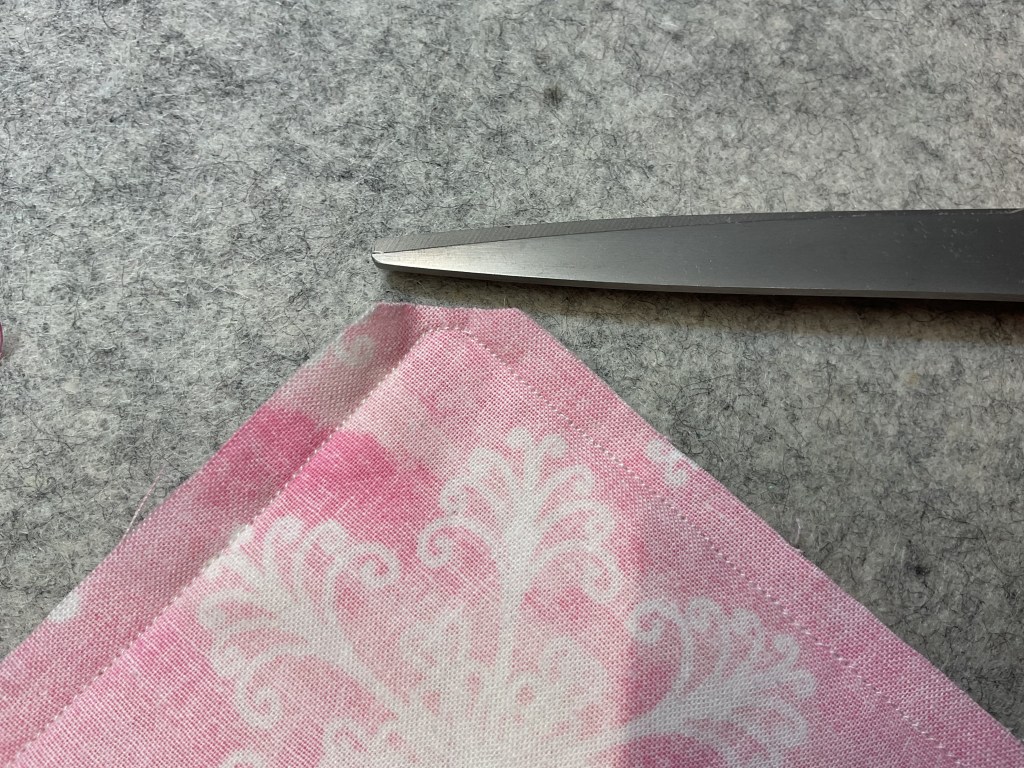
I’m also going to cut across all 4 of my corners to reduce the bulk which will help those corners to turn out neatly. Be careful NOT to cut through your stitching.
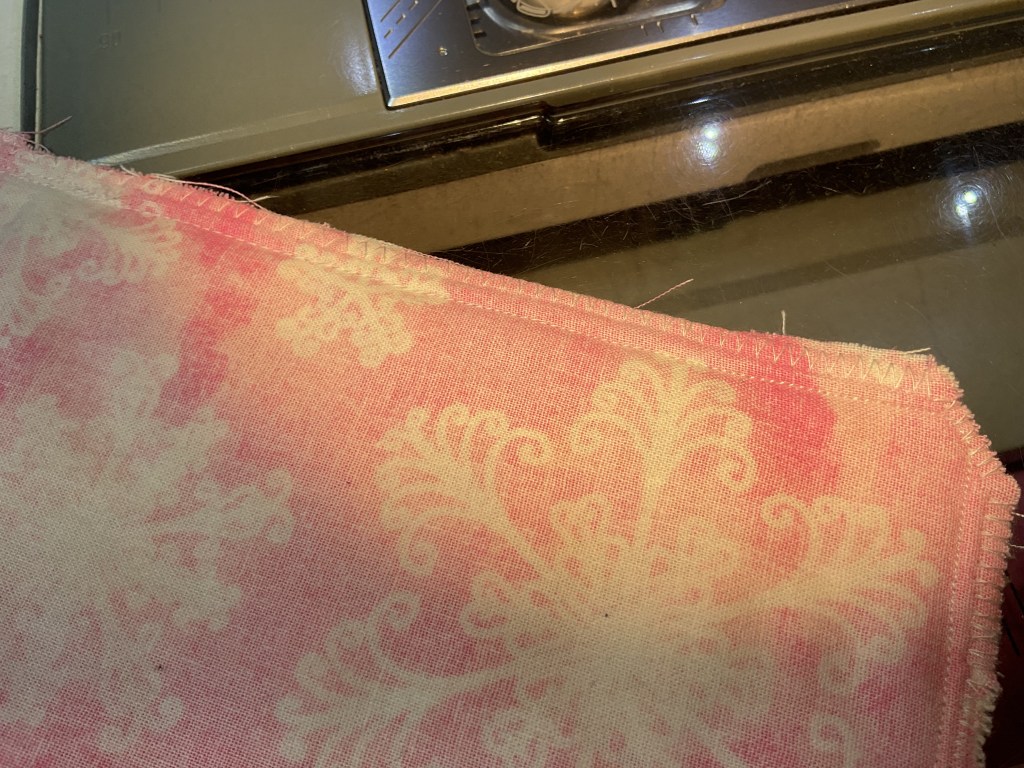
Since my inside edges are going to be unfinished, I think I’ll take a little extra time to zig zag around the outside before turning things right sides out. This will just help to keep things neat and tidy so they don’t fray. If you have a serger, you can easily serge around the outside edges. And if you know how to use your serger, somebody please teach me – mine is still new in the box three years after purchase…….
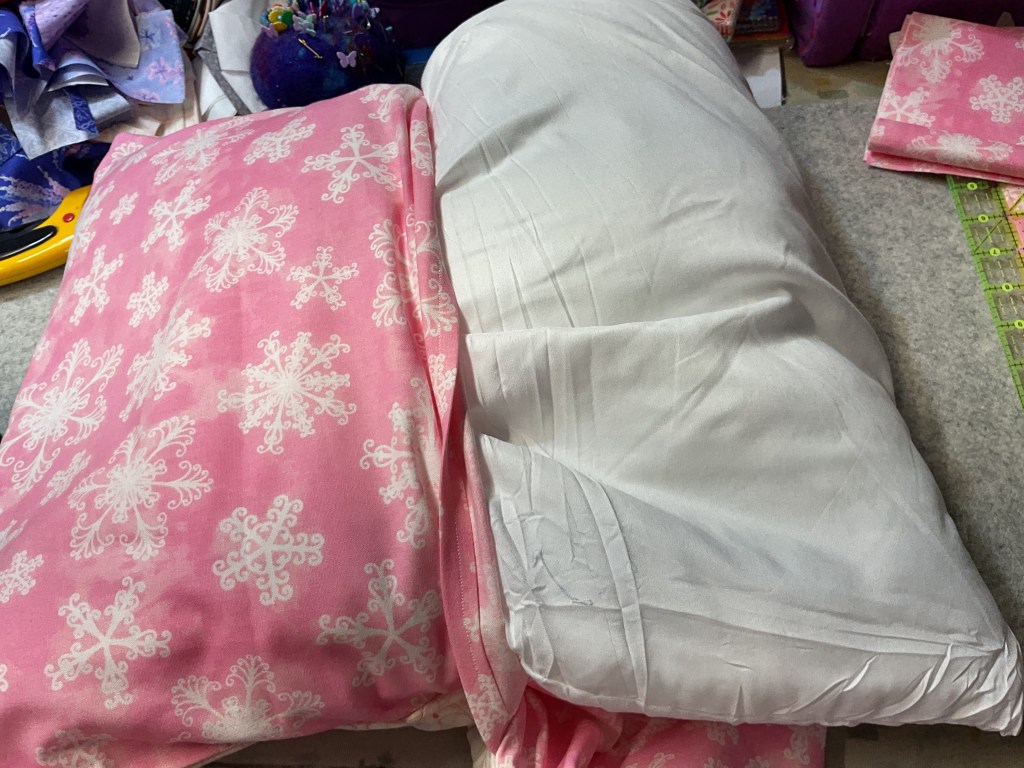
Okay, let’s turn this pillow cover right sides out through the Envelope Back opening. Yippee!
I’m going to take a little time to press things really well and smooth my edges so the pillow back won’t be showing around the front edge of the pillow. Much better.
Time to pop an 18″ pillow insert into my now-completed pillow cover.
And here is the completed Happy Hearts pillow with Envelope Pillow Back. Done and done. I think it turned out pretty well!
Well, that’s it for me this week.
Hope to see you here again next Thursday for more VRD fun! Bring a friend!